Adverbs

Unit 6
          By: C. Lipari
What is an
  adverb?
Hint: the word “adverb” has the prefix
              ad + verb.
  It is a word that adds to the verb.
Adverbs
A word that tells more about
a verb, an adjective or
another adverb.
It can tell how, when or
where an action takes place.
Examples:
 Our family drove slowly to the zoo.

 Highway safety is a very big problem.

 Dad always drives extremely carefully.

 We waited outside for the gates to open.
Adverbs before adjectives and
adverbs:
 Adverbs describe or tell more
 about verbs. Adverbs can also
 tell more about adjectives.
 Sometimes these adverbs tell to
 what degree or what extent.

 The weather seemed terribly cold.
More on adverbs...

 They can also tell more
 about other adverbs.

 The ship moved very slowly.
Comparing adverbs
An adverb can compare two or
more actions.
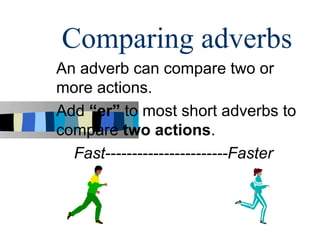
Add “er” to most short adverbs to
compare two actions.
  Fast-----------------------Faster
Comparing adverbs
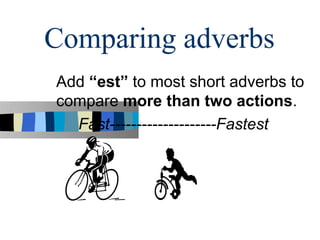
Add “est” to most short adverbs to
compare more than two actions.
  Fast--------------------Fastest
Comparing adverbs
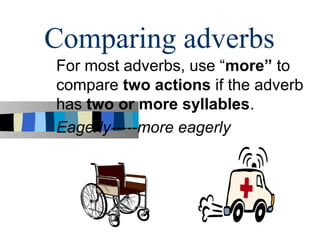
For most adverbs, use “more” to
compare two actions if the adverb
has two or more syllables.
Eagerly-----more eagerly
Comparing adverbs
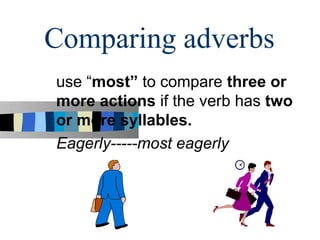
use “most” to compare three or
more actions if the verb has two
or more syllables.
Eagerly-----most eagerly
Negatives
A negative is a word that
means “No.”
Ex. Nobody saw me.
I have nothing to do.
More Negatives...
Do not use two negatives in the
same sentence. This is known
as a double negative.
Correct a sentence with two
negatives by changing one
negative to a positive word by
dropping one negative.
“Have you ever flown in
a helicopter?” Nora
asked.
“No, but I have been in
an airplane,” I said.
“Was it scary?” Nora
asked.
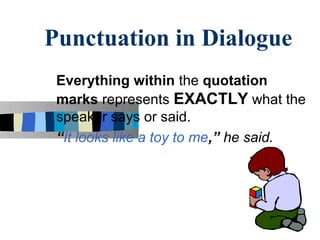
Punctuation in Dialogue
 Everything within the quotation
 marks represents EXACTLY what the
 speaker says or said.
 “It looks like a toy to me,” he said.
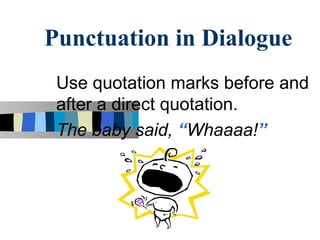
Punctuation in Dialogue
 Use quotation marks before and
 after a direct quotation.
 The baby said, “Whaaaa!”
Punctuation in Dialogue
 Begin a quotation with a capital
 letter.
 The announcer said, “It looks
 like a slam dunk to me.”
Punctuation in Dialogue
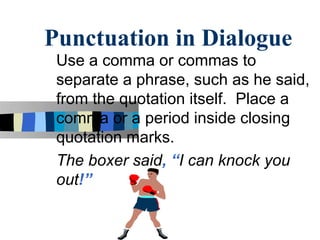
 Use a comma or commas to
 separate a phrase, such as he said,
 from the quotation itself. Place a
 comma or a period inside closing
 quotation marks.
 The boxer said, “I can knock you
 out!”
Punctuation on Quotations

Place the question mark or the
exclamation mark inside the quotation
marks when it is part of the quotation.
Rob exclaimed, “What a strange object!”

Place it outside the quotation marks
when it is part of the entire sentence
but not part of the quotation.
Did Rob say, “It’s a flying machine”?
Prepositions
A word that relates a noun or pronoun
to another word in a sentence.
Ex: about above besides from to of

    at    over up           with up
Ex: This book about bicycles is Ted’s.
Prepositional Phrases
A group of words that begins with
a preposition and ends with a noun
or pronoun.
Ex:
The heart is an organ in the body.
Prepositional Phrases
Object of a preposition is the
noun or pronoun that follows the
preposition.
Ex:
The heart is an organ in the body.
Object Prepositions In
Prepositional Phrases
 Object pronoun is the pronoun that
 follows a preposition in a sentence.
 Object pronoun can take the place of
 a noun in a prepositional phrase.
 My friends planned a surprise party for
 Sally.
 My friends planned a surprise party for
 her.
Combining sentences:
A complex sentence contains two
related ideas joined by a conjunction
other than and, but, or or.
Conjunctions such as after,
although, because, before, since,
until, and while are used to connect
related ideas.
Ex.Whitney has been gardening
since she was five.
Commas with Introductory
Prepositional Phrases and
Interjections
Use a comma after a prepositional
phrase at the beginning of a sentence.
Ex. For sunburn protection, I wear
sunscreen.
Use a comma after a mild
interjection.
Ex. My, this sunburn is uncomfortable.
Good luck on the test!

     Take your time!
Complete the assignment
on the board when you are
          done!

Adverbs

  • 1.
    Adverbs Unit 6 By: C. Lipari
  • 2.
    What is an adverb? Hint: the word “adverb” has the prefix ad + verb. It is a word that adds to the verb.
  • 3.
    Adverbs A word thattells more about a verb, an adjective or another adverb. It can tell how, when or where an action takes place.
  • 4.
    Examples: Our familydrove slowly to the zoo. Highway safety is a very big problem. Dad always drives extremely carefully. We waited outside for the gates to open.
  • 5.
    Adverbs before adjectivesand adverbs: Adverbs describe or tell more about verbs. Adverbs can also tell more about adjectives. Sometimes these adverbs tell to what degree or what extent. The weather seemed terribly cold.
  • 6.
    More on adverbs... They can also tell more about other adverbs. The ship moved very slowly.
  • 7.
    Comparing adverbs An adverbcan compare two or more actions. Add “er” to most short adverbs to compare two actions. Fast-----------------------Faster
  • 8.
    Comparing adverbs Add “est”to most short adverbs to compare more than two actions. Fast--------------------Fastest
  • 9.
    Comparing adverbs For mostadverbs, use “more” to compare two actions if the adverb has two or more syllables. Eagerly-----more eagerly
  • 10.
    Comparing adverbs use “most”to compare three or more actions if the verb has two or more syllables. Eagerly-----most eagerly
  • 11.
    Negatives A negative isa word that means “No.” Ex. Nobody saw me. I have nothing to do.
  • 12.
    More Negatives... Do notuse two negatives in the same sentence. This is known as a double negative. Correct a sentence with two negatives by changing one negative to a positive word by dropping one negative.
  • 13.
    “Have you everflown in a helicopter?” Nora asked. “No, but I have been in an airplane,” I said. “Was it scary?” Nora asked.
  • 14.
    Punctuation in Dialogue Everything within the quotation marks represents EXACTLY what the speaker says or said. “It looks like a toy to me,” he said.
  • 15.
    Punctuation in Dialogue Use quotation marks before and after a direct quotation. The baby said, “Whaaaa!”
  • 16.
    Punctuation in Dialogue Begin a quotation with a capital letter. The announcer said, “It looks like a slam dunk to me.”
  • 17.
    Punctuation in Dialogue Use a comma or commas to separate a phrase, such as he said, from the quotation itself. Place a comma or a period inside closing quotation marks. The boxer said, “I can knock you out!”
  • 18.
    Punctuation on Quotations Placethe question mark or the exclamation mark inside the quotation marks when it is part of the quotation. Rob exclaimed, “What a strange object!” Place it outside the quotation marks when it is part of the entire sentence but not part of the quotation. Did Rob say, “It’s a flying machine”?
  • 19.
    Prepositions A word thatrelates a noun or pronoun to another word in a sentence. Ex: about above besides from to of at over up with up Ex: This book about bicycles is Ted’s.
  • 20.
    Prepositional Phrases A groupof words that begins with a preposition and ends with a noun or pronoun. Ex: The heart is an organ in the body.
  • 21.
    Prepositional Phrases Object ofa preposition is the noun or pronoun that follows the preposition. Ex: The heart is an organ in the body.
  • 22.
    Object Prepositions In PrepositionalPhrases Object pronoun is the pronoun that follows a preposition in a sentence. Object pronoun can take the place of a noun in a prepositional phrase. My friends planned a surprise party for Sally. My friends planned a surprise party for her.
  • 23.
    Combining sentences: A complexsentence contains two related ideas joined by a conjunction other than and, but, or or. Conjunctions such as after, although, because, before, since, until, and while are used to connect related ideas. Ex.Whitney has been gardening since she was five.
  • 24.
    Commas with Introductory PrepositionalPhrases and Interjections Use a comma after a prepositional phrase at the beginning of a sentence. Ex. For sunburn protection, I wear sunscreen. Use a comma after a mild interjection. Ex. My, this sunburn is uncomfortable.
  • 25.
    Good luck onthe test! Take your time! Complete the assignment on the board when you are done!