Adjective Phrases
and
Adjective Clauses
• A phrase is a group of words that works together as a single part of
speech. A prepositional phrase starts with a preposition and ends
with its object.
• A prepositional phrase that modifies or describes a noun is an
adjective phrase
• An adjective phrase will usually follow the noun it describes.
EXAMPLES:
1. The sweet potatoes in the vegetable bin are green with mold.
2. The note from Beverly confessed that she had taken the car keys.
3. The clues within the first few chapters will lead to the criminal.
4. One type of vegetable is cruciferous.
• A clause is a group of words that has a subject and a predicate
• When a clause does not form a sentence, it is a dependent (aka
subordinate) clause.
• A dependent clause that describes a noun is an adjective clause.
• An adjective clause will usually follow the noun it describes.
EXAMPLES:
1. Fruit that is grown organically is expensive.
2. I know someone whose father served in Korea.
3. Erma Bombeck said, “Never go to a doctor whose office plants have
died.”
4. The reason why Charlie is so tired is his lack of sleep.
Like adjectives, adjective phrases and
adjective clauses answer the questions
which one or what kind.
Bah dum, tsss! ;)
• FYI:
- A restrictive adjective clause is necessary to the meaning of the
sentence.
The shoes that I bought today are too tight.
- A nonrestrictive adjective clause is NOT needed for the meaning of
the sentence. Nonrestrictive clauses are usually set off by commas.
Philadelphia, which is a large city, has many historic landmarks.
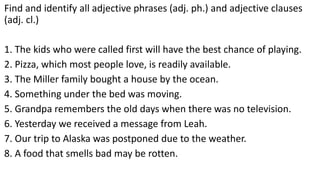
Find and identify all adjective phrases (adj. ph.) and adjective clauses
(adj. cl.)
1. The kids who were called first will have the best chance of playing.
2. Pizza, which most people love, is readily available.
3. The Miller family bought a house by the ocean.
4. Something under the bed was moving.
5. Grandpa remembers the old days when there was no television.
6. Yesterday we received a message from Leah.
7. Our trip to Alaska was postponed due to the weather.
8. A food that smells bad may be rotten.
Adj phrases&adjclausesgrade8

Adj phrases&adjclausesgrade8

  • 1.
  • 2.
    • A phraseis a group of words that works together as a single part of speech. A prepositional phrase starts with a preposition and ends with its object. • A prepositional phrase that modifies or describes a noun is an adjective phrase • An adjective phrase will usually follow the noun it describes. EXAMPLES: 1. The sweet potatoes in the vegetable bin are green with mold. 2. The note from Beverly confessed that she had taken the car keys. 3. The clues within the first few chapters will lead to the criminal. 4. One type of vegetable is cruciferous.
  • 4.
    • A clauseis a group of words that has a subject and a predicate • When a clause does not form a sentence, it is a dependent (aka subordinate) clause. • A dependent clause that describes a noun is an adjective clause. • An adjective clause will usually follow the noun it describes. EXAMPLES: 1. Fruit that is grown organically is expensive. 2. I know someone whose father served in Korea. 3. Erma Bombeck said, “Never go to a doctor whose office plants have died.” 4. The reason why Charlie is so tired is his lack of sleep.
  • 6.
    Like adjectives, adjectivephrases and adjective clauses answer the questions which one or what kind. Bah dum, tsss! ;)
  • 7.
    • FYI: - Arestrictive adjective clause is necessary to the meaning of the sentence. The shoes that I bought today are too tight. - A nonrestrictive adjective clause is NOT needed for the meaning of the sentence. Nonrestrictive clauses are usually set off by commas. Philadelphia, which is a large city, has many historic landmarks.
  • 8.
    Find and identifyall adjective phrases (adj. ph.) and adjective clauses (adj. cl.) 1. The kids who were called first will have the best chance of playing. 2. Pizza, which most people love, is readily available. 3. The Miller family bought a house by the ocean. 4. Something under the bed was moving. 5. Grandpa remembers the old days when there was no television. 6. Yesterday we received a message from Leah. 7. Our trip to Alaska was postponed due to the weather. 8. A food that smells bad may be rotten.