A(An) vs. The 
Countable vs. Uncountable Nouns
 Countable nouns are nouns that can be 
counted. Most nouns in English are countable. 
 Examples: 
 I have two dogs. 
 Sandra has three cars. 
 Jessie has ten dollars.
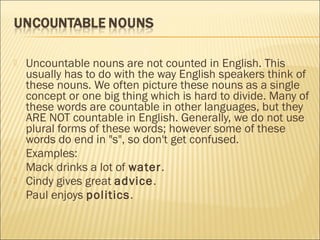
 Uncountable nouns are not counted in English. This 
usually has to do with the way English speakers think of 
these nouns. We often picture these nouns as a single 
concept or one big thing which is hard to divide. Many of 
these words are countable in other languages, but they 
ARE NOT countable in English. Generally, we do not use 
plural forms of these words; however some of these 
words do end in "s", so don't get confused. 
 Examples: 
 Mack drinks a lot of water. 
 Cindy gives great advice. 
 Paul enjoys politics.
 Sometimes in English, we do use uncountable 
nouns in plural forms. This is most commonly 
done with liquids and substances. It usually 
takes on the meaning of "cups of", "bottles of" 
or "types of". 
 Examples: 
 We'll have two cof fees. 
 I bought three waters. 
 The company produces two leathers.
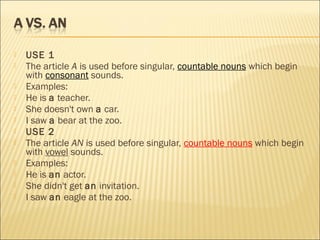
 USE 1 
 The article A is used before singular, countable nouns which begin 
with consonant sounds. 
 Examples: 
 He is a teacher. 
 She doesn't own a car. 
 I saw a bear at the zoo. 
 USE 2 
 The article AN is used before singular, countable nouns which begin 
with vowel sounds. 
 Examples: 
 He is an actor. 
 She didn't get an invitation. 
 I saw an eagle at the zoo.
 USE 3 
 Remember that A(AN) means "one" or "a single". You cannot 
use A(AN) with plural nouns. 
 Examples: 
 I saw a bears in Yellowstone National Park. Not Correct 
 I saw bears in Yellowstone National Park. Correct 
 USE 4 
 If there is an adjective or an adverb-adjective combination 
before the noun, A(AN) should agree with the first sound in 
the adjective or the adverb-adjective combination. 
 Examples: 
 He is an excellent teacher. 
 I saw a really beautiful eagle at the zoo.
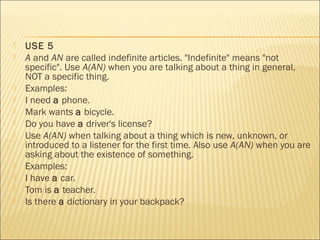
 USE 5 
 A and AN are called indefinite articles. "Indefinite" means "not 
specific". Use A(AN) when you are talking about a thing in general, 
NOT a specific thing. 
 Examples: 
 I need a phone. 
 Mark wants a bicycle. 
 Do you have a driver's license? 
 Use A(AN) when talking about a thing which is new, unknown, or 
introduced to a listener for the first time. Also use A(AN) when you are 
asking about the existence of something. 
 Examples: 
 I have a car. 
 Tom is a teacher. 
 Is there a dictionary in your backpack?
 USE 6 
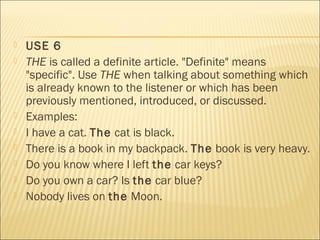
 THE is called a definite article. "Definite" means 
"specific". Use THE when talking about something which 
is already known to the listener or which has been 
previously mentioned, introduced, or discussed. 
 Examples: 
 I have a cat. The cat is black. 
 There is a book in my backpack. The book is very heavy. 
 Do you know where I left the car keys? 
 Do you own a car? Is the car blue? 
 Nobody lives on the Moon.
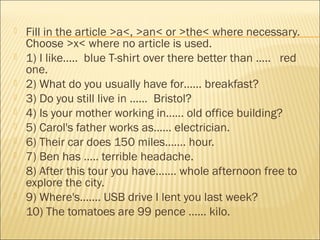
 Fill in the article >a<, >an< or >the< where necessary. 
Choose >x< where no article is used. 
 1) I like….. blue T-shirt over there better than ….. red 
one. 
 2) What do you usually have for…… breakfast? 
 3) Do you still live in …… Bristol? 
 4) Is your mother working in…… old office building? 
 5) Carol's father works as…… electrician. 
 6) Their car does 150 miles……. hour. 
 7) Ben has ….. terrible headache. 
 8) After this tour you have……. whole afternoon free to 
explore the city. 
 9) Where's……. USB drive I lent you last week? 
 10) The tomatoes are 99 pence …… kilo.
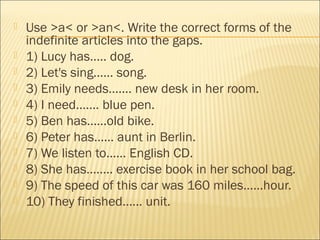
 Use >a< or >an<. Write the correct forms of the 
indefinite articles into the gaps. 
 1) Lucy has….. dog. 
 2) Let's sing…… song. 
 3) Emily needs……. new desk in her room. 
 4) I need……. blue pen. 
 5) Ben has……old bike. 
 6) Peter has…… aunt in Berlin. 
 7) We listen to…… English CD. 
 8) She has…….. exercise book in her school bag. 
 9) The speed of this car was 160 miles……hour. 
 10) They finished…… unit.

The articles in the english language

  • 1.
    A(An) vs. The Countable vs. Uncountable Nouns
  • 2.
     Countable nounsare nouns that can be counted. Most nouns in English are countable.  Examples:  I have two dogs.  Sandra has three cars.  Jessie has ten dollars.
  • 3.
     Uncountable nounsare not counted in English. This usually has to do with the way English speakers think of these nouns. We often picture these nouns as a single concept or one big thing which is hard to divide. Many of these words are countable in other languages, but they ARE NOT countable in English. Generally, we do not use plural forms of these words; however some of these words do end in "s", so don't get confused.  Examples:  Mack drinks a lot of water.  Cindy gives great advice.  Paul enjoys politics.
  • 4.
     Sometimes inEnglish, we do use uncountable nouns in plural forms. This is most commonly done with liquids and substances. It usually takes on the meaning of "cups of", "bottles of" or "types of".  Examples:  We'll have two cof fees.  I bought three waters.  The company produces two leathers.
  • 5.
     USE 1  The article A is used before singular, countable nouns which begin with consonant sounds.  Examples:  He is a teacher.  She doesn't own a car.  I saw a bear at the zoo.  USE 2  The article AN is used before singular, countable nouns which begin with vowel sounds.  Examples:  He is an actor.  She didn't get an invitation.  I saw an eagle at the zoo.
  • 6.
     USE 3  Remember that A(AN) means "one" or "a single". You cannot use A(AN) with plural nouns.  Examples:  I saw a bears in Yellowstone National Park. Not Correct  I saw bears in Yellowstone National Park. Correct  USE 4  If there is an adjective or an adverb-adjective combination before the noun, A(AN) should agree with the first sound in the adjective or the adverb-adjective combination.  Examples:  He is an excellent teacher.  I saw a really beautiful eagle at the zoo.
  • 7.
     USE 5  A and AN are called indefinite articles. "Indefinite" means "not specific". Use A(AN) when you are talking about a thing in general, NOT a specific thing.  Examples:  I need a phone.  Mark wants a bicycle.  Do you have a driver's license?  Use A(AN) when talking about a thing which is new, unknown, or introduced to a listener for the first time. Also use A(AN) when you are asking about the existence of something.  Examples:  I have a car.  Tom is a teacher.  Is there a dictionary in your backpack?
  • 8.
     USE 6  THE is called a definite article. "Definite" means "specific". Use THE when talking about something which is already known to the listener or which has been previously mentioned, introduced, or discussed.  Examples:  I have a cat. The cat is black.  There is a book in my backpack. The book is very heavy.  Do you know where I left the car keys?  Do you own a car? Is the car blue?  Nobody lives on the Moon.
  • 9.
     Fill inthe article >a<, >an< or >the< where necessary. Choose >x< where no article is used.  1) I like….. blue T-shirt over there better than ….. red one.  2) What do you usually have for…… breakfast?  3) Do you still live in …… Bristol?  4) Is your mother working in…… old office building?  5) Carol's father works as…… electrician.  6) Their car does 150 miles……. hour.  7) Ben has ….. terrible headache.  8) After this tour you have……. whole afternoon free to explore the city.  9) Where's……. USB drive I lent you last week?  10) The tomatoes are 99 pence …… kilo.
  • 10.
     Use >a<or >an<. Write the correct forms of the indefinite articles into the gaps.  1) Lucy has….. dog.  2) Let's sing…… song.  3) Emily needs……. new desk in her room.  4) I need……. blue pen.  5) Ben has……old bike.  6) Peter has…… aunt in Berlin.  7) We listen to…… English CD.  8) She has…….. exercise book in her school bag.  9) The speed of this car was 160 miles……hour.  10) They finished…… unit.