Research Project Writing Yuying Chris Chang [email_address] http://www.projectwriting.blogspot.com
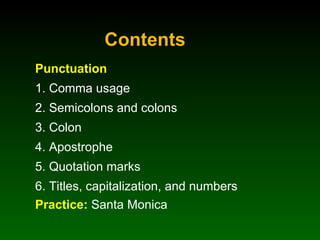
Contents Punctuation  1. Comma usage  2. Semicolons and colons 3. Colon 4. Apostrophe  5. Quotation marks  6. Titles, capitalization, and numbers  Practice:  Santa Monica
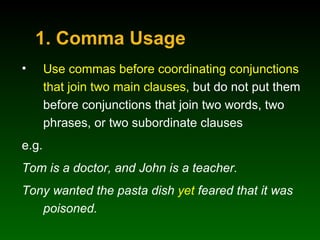
1. Comma Usage Use commas before coordinating conjunctions that join two main clauses,  but do not put them before conjunctions that join two words, two phrases, or two subordinate clauses  e.g. Tom is a doctor, and John is a teacher. Tony wanted the pasta dish   yet  feared that it was poisoned.
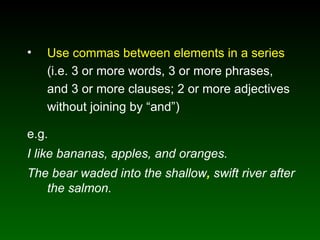
Use commas between elements in a series   (i.e. 3 or more words, 3 or more phrases, and 3 or more clauses; 2 or more adjectives without joining by “and”) e.g.  I like bananas, apples, and oranges. The bear waded into the shallow ,   swift river after the salmon.
Use commas after introductory elements   (including words, preposition phrases of 5 words or more, infinitive and participial phrases, subordinate clause that precedes a main clause) e.g.  On the other hand, Ringo greatly admired  Beethoven. If you do not work hard, you will flunk in the final exam. Making a big mistake, Macebeth listened to his wife.
Use commas before and after interrupting elements e.g. Van Goh, feeling rejected and depressed, cut off most of his ear.
2.  Semicolons a) To join only those independent clauses that are closely related in meaning e.g.  The auditors made six recommendations ;  however, only one has been adopted so far.
b) A series of elements embedded an internal comma e. g. Henry's mother believes three things: that every situation, no matter how grim, will be happily resolved ;  that no one knows more about human nature than she ;   and that Henry, who is thirty-five years old, will never be able to do his own laundry.
3. The Colon A colon follows right after a main clause  It is used to give an example, an illustration, a restatement, a quotation, a series, or a list  The example, illustration, etc. could be clauses, phrases, words It is generally not used after a verb
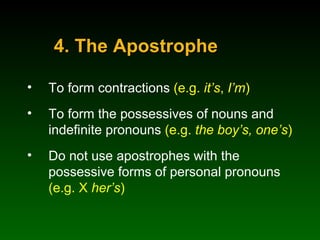
4. The Apostrophe To form contractions  (e.g.  it’s ,  I’m ) To form the possessives of nouns and indefinite pronouns  (e.g.  the boy’s,   one’s ) Do not use apostrophes with the possessive forms of personal pronouns  (e.g. X  her’s )
5. Quotation Marks To enclose direct quotations (not indirect quotations) and dialogue e.g.  direct quotation Hal said,  “ Squid tentacles are my favorite snacks. ” indirect quotation Hal said that squid tentacles are my favorite snacks.
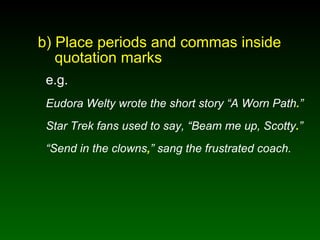
b) Place periods and commas inside    quotation marks e.g. Eudora Welty wrote the short story “A Worn Path . ” Star Trek fans used to say, “Beam me up, Scotty . ” “ Send in the clowns , ” sang the frustrated coach.
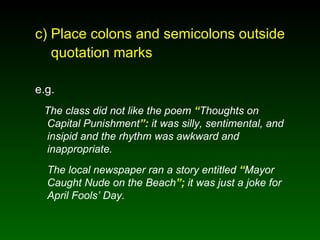
c) Place colons and semicolons outside   quotation marks e.g. The class did not like the poem  “ Thoughts on Capital Punishment ”:  it was silly, sentimental, and insipid and the rhythm was awkward and inappropriate. The local newspaper ran a story entitled  “ Mayor Caught Nude on the Beach ”;  it was just a joke for April Fools’ Day.
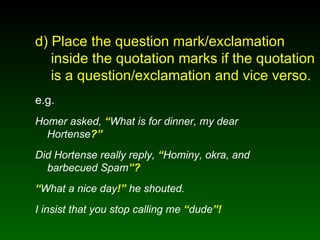
d) Place the question mark/exclamation   inside the quotation marks if the quotation    is a question/exclamation and vice verso. e.g. Homer asked,  “ What is for dinner, my dear Hortense ?” Did Hortense really reply,  “ Hominy, okra, and barbecued Spam ”? “ What a nice day !”  he shouted. I insist that you stop calling me  “ dude ”!
6-1. Titles When talking about the titles of books, periodicals, plays, CDs, and television programs, we usually place italics  or put quotation marks. Longer ones  Italics  Shorter ones   quotation marks
6-2. Capitalization Capitalize the first letter of each word in a title except for a, an,, and the, coordinating conjunctions, and prepositions.  But, the first letter of the word is always capitalized. e.g. “ A  Good Man Is Hard  to  Find.”
Do not capitalize the first letter of words that refer to a direction, but do capitalize such words referring to a specific region. e.g. Alabama and Mississippi are among the states in the  South . Turn  south  on Hill Street and go four blocks to the end of the street.
6.3 Numbers Spell out numbers at the beginning of sentences Be consistent (either spell the number out or use numerals) when numbers are compared, are joined by conjunctions, or occur in a series Spell out numbers that require no more than two words

Punctuation

  • 1.
    Research Project WritingYuying Chris Chang [email_address] http://www.projectwriting.blogspot.com
  • 2.
    Contents Punctuation 1. Comma usage 2. Semicolons and colons 3. Colon 4. Apostrophe 5. Quotation marks 6. Titles, capitalization, and numbers Practice: Santa Monica
  • 3.
    1. Comma UsageUse commas before coordinating conjunctions that join two main clauses, but do not put them before conjunctions that join two words, two phrases, or two subordinate clauses e.g. Tom is a doctor, and John is a teacher. Tony wanted the pasta dish yet feared that it was poisoned.
  • 4.
    Use commas betweenelements in a series (i.e. 3 or more words, 3 or more phrases, and 3 or more clauses; 2 or more adjectives without joining by “and”) e.g. I like bananas, apples, and oranges. The bear waded into the shallow , swift river after the salmon.
  • 5.
    Use commas afterintroductory elements (including words, preposition phrases of 5 words or more, infinitive and participial phrases, subordinate clause that precedes a main clause) e.g. On the other hand, Ringo greatly admired Beethoven. If you do not work hard, you will flunk in the final exam. Making a big mistake, Macebeth listened to his wife.
  • 6.
    Use commas beforeand after interrupting elements e.g. Van Goh, feeling rejected and depressed, cut off most of his ear.
  • 7.
    2. Semicolonsa) To join only those independent clauses that are closely related in meaning e.g. The auditors made six recommendations ; however, only one has been adopted so far.
  • 8.
    b) A seriesof elements embedded an internal comma e. g. Henry's mother believes three things: that every situation, no matter how grim, will be happily resolved ; that no one knows more about human nature than she ; and that Henry, who is thirty-five years old, will never be able to do his own laundry.
  • 9.
    3. The ColonA colon follows right after a main clause It is used to give an example, an illustration, a restatement, a quotation, a series, or a list The example, illustration, etc. could be clauses, phrases, words It is generally not used after a verb
  • 10.
    4. The ApostropheTo form contractions (e.g. it’s , I’m ) To form the possessives of nouns and indefinite pronouns (e.g. the boy’s, one’s ) Do not use apostrophes with the possessive forms of personal pronouns (e.g. X her’s )
  • 11.
    5. Quotation MarksTo enclose direct quotations (not indirect quotations) and dialogue e.g. direct quotation Hal said, “ Squid tentacles are my favorite snacks. ” indirect quotation Hal said that squid tentacles are my favorite snacks.
  • 12.
    b) Place periodsand commas inside quotation marks e.g. Eudora Welty wrote the short story “A Worn Path . ” Star Trek fans used to say, “Beam me up, Scotty . ” “ Send in the clowns , ” sang the frustrated coach.
  • 13.
    c) Place colonsand semicolons outside quotation marks e.g. The class did not like the poem “ Thoughts on Capital Punishment ”: it was silly, sentimental, and insipid and the rhythm was awkward and inappropriate. The local newspaper ran a story entitled “ Mayor Caught Nude on the Beach ”; it was just a joke for April Fools’ Day.
  • 14.
    d) Place thequestion mark/exclamation inside the quotation marks if the quotation is a question/exclamation and vice verso. e.g. Homer asked, “ What is for dinner, my dear Hortense ?” Did Hortense really reply, “ Hominy, okra, and barbecued Spam ”? “ What a nice day !” he shouted. I insist that you stop calling me “ dude ”!
  • 15.
    6-1. Titles Whentalking about the titles of books, periodicals, plays, CDs, and television programs, we usually place italics or put quotation marks. Longer ones  Italics Shorter ones  quotation marks
  • 16.
    6-2. Capitalization Capitalizethe first letter of each word in a title except for a, an,, and the, coordinating conjunctions, and prepositions. But, the first letter of the word is always capitalized. e.g. “ A Good Man Is Hard to Find.”
  • 17.
    Do not capitalizethe first letter of words that refer to a direction, but do capitalize such words referring to a specific region. e.g. Alabama and Mississippi are among the states in the South . Turn south on Hill Street and go four blocks to the end of the street.
  • 18.
    6.3 Numbers Spellout numbers at the beginning of sentences Be consistent (either spell the number out or use numerals) when numbers are compared, are joined by conjunctions, or occur in a series Spell out numbers that require no more than two words