ADHD SOAP Note Example | SOAP Note Writing
Services
By GPAShark.com
At GPAShark.com, we provide expert SOAP Note Writing services to help you
excel in your clinical documentation. Below is an example of a SOAP note for a
patient with ADHD.
ADHD SOAP Note Example
Subjective:
• Chief Complaint (CC): "I have trouble focusing and staying on task."
• History of Present Illness (HPI): John Doe, a 12-year-old male, presents with persistent
symptoms of inattention, hyperactivity, and impulsivity. These symptoms have been present
for over a year and are impacting his academic performance and social interactions. His
parents report that he struggles to complete homework, often forgets instructions, and is
easily distracted. Teachers have noted that he fidgets frequently and has difficulty staying
seated.
• Past Medical History (PMH): No significant past medical history. No history of head trauma
or seizures.
• Family History (FH): Father has a history of ADHD. No other psychiatric conditions in the
family.
• Social History (SH): Lives with both parents and a younger sibling. Active in sports and enjoys
video games. No tobacco, alcohol, or drug use.
Review of Systems (ROS):
o General: No weight loss, fever, or fatigue.
o HEENT: No vision or hearing problems.
o Cardiovascular: No chest pain or palpitations.
o Respiratory: No shortness of breath or wheezing.
o Gastrointestinal: No abdominal pain or changes in bowel habits.
o Neurological: No headaches or seizures.
o Psychiatric: Reports difficulty focusing, hyperactivity, and impulsivity.
Objective:
• Vital Signs: BP 110/70, HR 80, RR 16, T 98.6°F, Weight 100 lbs, Height 5'0".
• General: Well-nourished, well-developed male, appears stated age, no acute distress.
• HEENT: Normocephalic, atraumatic, PERRLA, EOMI, TMs clear, no nasal discharge, throat
non-erythematous.
• Cardiovascular: S1 and S2 normal, no murmurs, rubs, or gallops.
• Respiratory: Clear to auscultation bilaterally, no wheezes, rales, or rhonchi.
• Abdomen: Soft, non-tender, no hepatosplenomegaly, normal bowel sounds.
• Neurological: Alert and oriented x3, normal gait, no focal deficits.
• Psychiatric: Appears restless, fidgety, makes frequent interruptions, has difficulty
maintaining attention during the interview.
Assessment:
• Diagnosis: Attention-Deficit/Hyperactivity Disorder (ADHD), combined presentation.
Plan:
1. Medication: Start on Methylphenidate 10 mg PO daily in the morning. Monitor for efficacy
and side effects. Schedule follow-up in 4 weeks to reassess.
2. Behavioral Therapy: Refer to a child psychologist for cognitive-behavioral therapy (CBT) to
help manage symptoms and improve coping strategies.
3. School Accommodations: Recommend meeting with school counselor to discuss possible
accommodations such as extra time on tests and a quiet environment for exams.
4. Parent Education: Provide educational materials about ADHD and discuss behavioral
management techniques. Encourage parents to establish a structured routine at home.
5. Follow-up: Return visit in 4 weeks for medication review and progress assessment.
For more examples and professional assistance with your SOAP notes, visit GPAShark.com. We are
here to help you achieve excellence in clinical documentation and patient care.

ADHD SOAP Note Example | SOAP Note Writing Services.pdf

  • 1.
    ADHD SOAP NoteExample | SOAP Note Writing Services By GPAShark.com At GPAShark.com, we provide expert SOAP Note Writing services to help you excel in your clinical documentation. Below is an example of a SOAP note for a patient with ADHD.
  • 2.
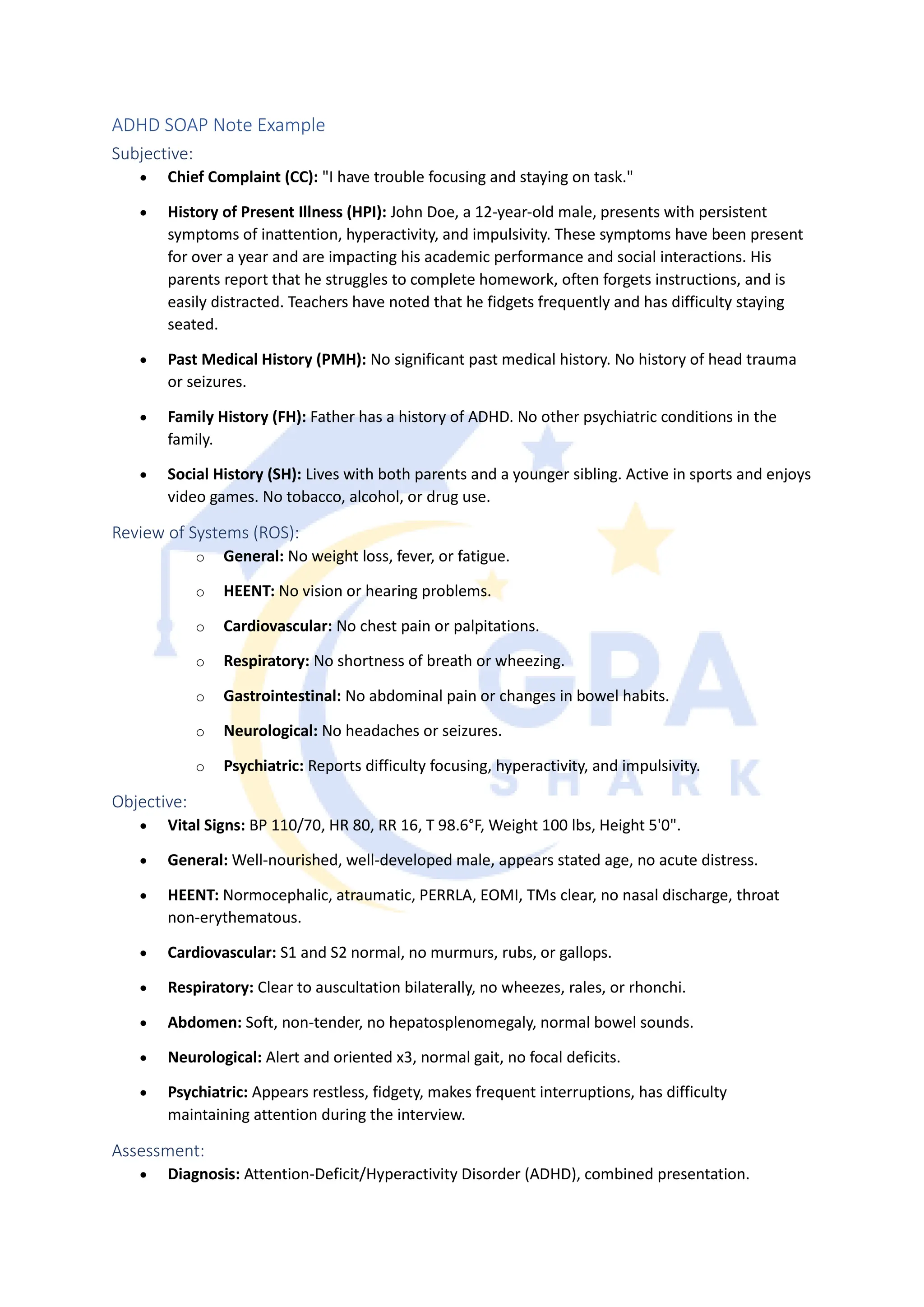
    ADHD SOAP NoteExample Subjective: • Chief Complaint (CC): "I have trouble focusing and staying on task." • History of Present Illness (HPI): John Doe, a 12-year-old male, presents with persistent symptoms of inattention, hyperactivity, and impulsivity. These symptoms have been present for over a year and are impacting his academic performance and social interactions. His parents report that he struggles to complete homework, often forgets instructions, and is easily distracted. Teachers have noted that he fidgets frequently and has difficulty staying seated. • Past Medical History (PMH): No significant past medical history. No history of head trauma or seizures. • Family History (FH): Father has a history of ADHD. No other psychiatric conditions in the family. • Social History (SH): Lives with both parents and a younger sibling. Active in sports and enjoys video games. No tobacco, alcohol, or drug use. Review of Systems (ROS): o General: No weight loss, fever, or fatigue. o HEENT: No vision or hearing problems. o Cardiovascular: No chest pain or palpitations. o Respiratory: No shortness of breath or wheezing. o Gastrointestinal: No abdominal pain or changes in bowel habits. o Neurological: No headaches or seizures. o Psychiatric: Reports difficulty focusing, hyperactivity, and impulsivity. Objective: • Vital Signs: BP 110/70, HR 80, RR 16, T 98.6°F, Weight 100 lbs, Height 5'0". • General: Well-nourished, well-developed male, appears stated age, no acute distress. • HEENT: Normocephalic, atraumatic, PERRLA, EOMI, TMs clear, no nasal discharge, throat non-erythematous. • Cardiovascular: S1 and S2 normal, no murmurs, rubs, or gallops. • Respiratory: Clear to auscultation bilaterally, no wheezes, rales, or rhonchi. • Abdomen: Soft, non-tender, no hepatosplenomegaly, normal bowel sounds. • Neurological: Alert and oriented x3, normal gait, no focal deficits. • Psychiatric: Appears restless, fidgety, makes frequent interruptions, has difficulty maintaining attention during the interview. Assessment: • Diagnosis: Attention-Deficit/Hyperactivity Disorder (ADHD), combined presentation.
  • 3.
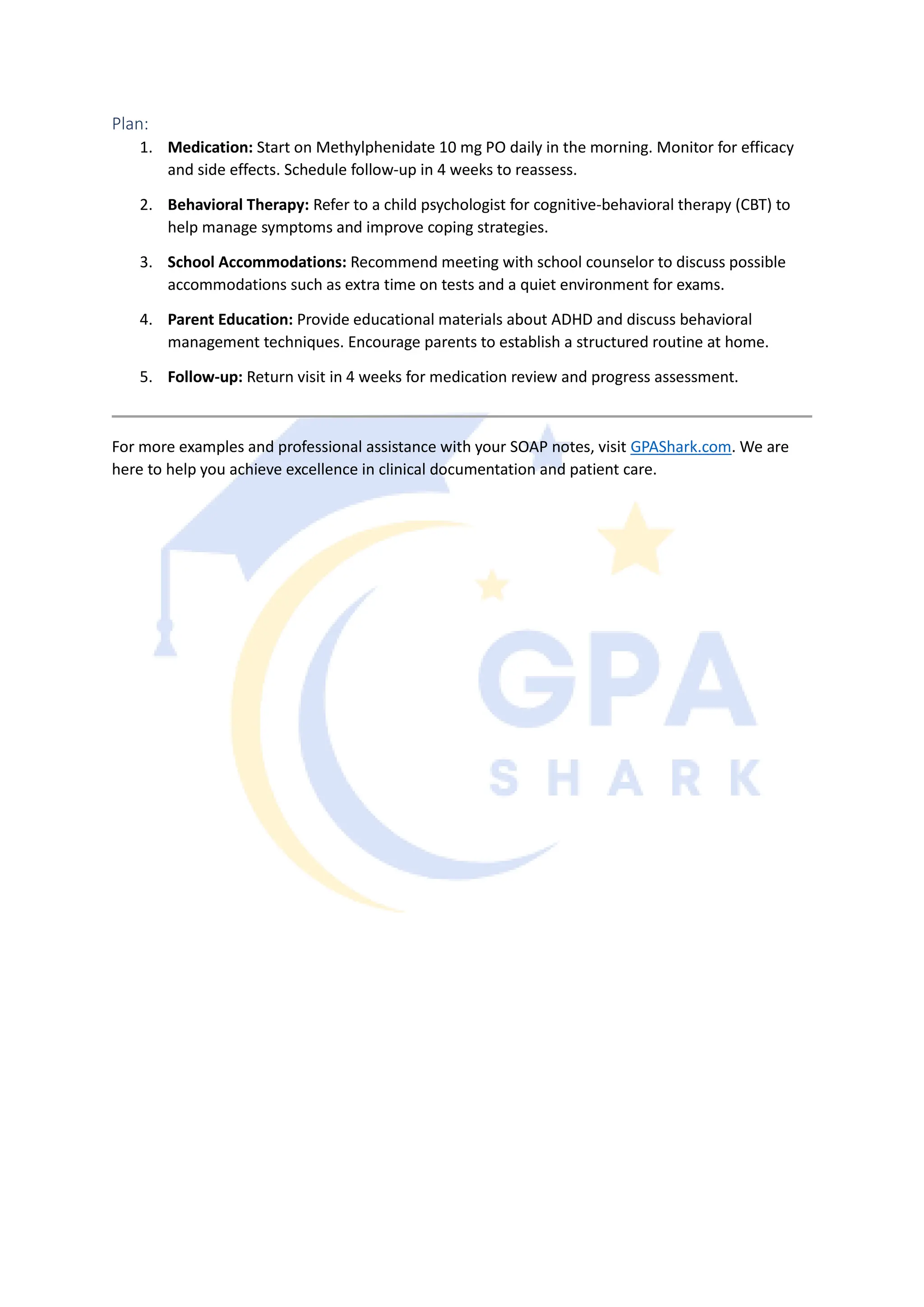
    Plan: 1. Medication: Starton Methylphenidate 10 mg PO daily in the morning. Monitor for efficacy and side effects. Schedule follow-up in 4 weeks to reassess. 2. Behavioral Therapy: Refer to a child psychologist for cognitive-behavioral therapy (CBT) to help manage symptoms and improve coping strategies. 3. School Accommodations: Recommend meeting with school counselor to discuss possible accommodations such as extra time on tests and a quiet environment for exams. 4. Parent Education: Provide educational materials about ADHD and discuss behavioral management techniques. Encourage parents to establish a structured routine at home. 5. Follow-up: Return visit in 4 weeks for medication review and progress assessment. For more examples and professional assistance with your SOAP notes, visit GPAShark.com. We are here to help you achieve excellence in clinical documentation and patient care.