Rhetorical Analysis Thesis Statements ENG
102 | PPT
ENG 102
ReliableAssignmentsHelp.com
Introduction to Rhetorical Analysis
Rhetorical analysis involves examining how an
author uses language to persuade their audience.
Purpose: To understand and critique the
strategies and techniques employed in the text.
What is a Thesis Statement?
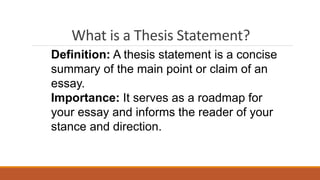
Definition: A thesis statement is a concise
summary of the main point or claim of an
essay.
Importance: It serves as a roadmap for
your essay and informs the reader of your
stance and direction.
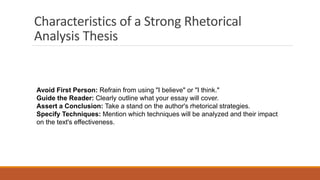
Characteristics of a Strong Rhetorical
Analysis Thesis
Avoid First Person: Refrain from using "I believe" or "I think."
Guide the Reader: Clearly outline what your essay will cover.
Assert a Conclusion: Take a stand on the author's rhetorical strategies.
Specify Techniques: Mention which techniques will be analyzed and their impact
on the text's effectiveness.
Examples of Strong Thesis Statements
Statistics and Emotion:
"Jones effectively convinces his audience through the use of statistics and surveys paired with
emotional stories."
Objectivity Concerns:
"Although Myers includes many convincing logical arguments through the use of historical facts,
her readers may doubt her objectivity due to her sarcastic tone."
Credibility through Ethos:
"Thompson uses personal stories and details his extensive research to establish his credibility.
These appeals to ethos, combined with his friendly tone, create an effective argument for ----."
Pathos and Ethos:
"Roberts effectively employs the rhetorical appeals of pathos and ethos. However, his use of
unsupported logical appeals causes readers to doubt his claim that ---- is supported by
research."
Unsuccessful Persuasion:
"Mitchell’s attempt to convince the audience that ----- is unsuccessful due to his insensitive word
choice and angry tone.
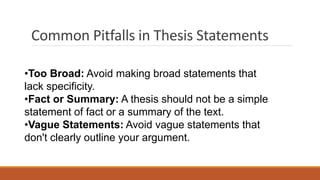
Common Pitfalls in Thesis Statements
•Too Broad: Avoid making broad statements that
lack specificity.
•Fact or Summary: A thesis should not be a simple
statement of fact or a summary of the text.
•Vague Statements: Avoid vague statements that
don't clearly outline your argument.
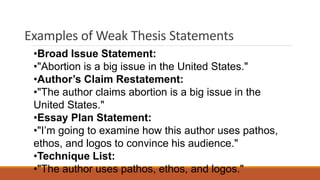
Examples of Weak Thesis Statements
•Broad Issue Statement:
•"Abortion is a big issue in the United States."
•Author’s Claim Restatement:
•"The author claims abortion is a big issue in the
United States."
•Essay Plan Statement:
•"I’m going to examine how this author uses pathos,
ethos, and logos to convince his audience."
•Technique List:
•"The author uses pathos, ethos, and logos."
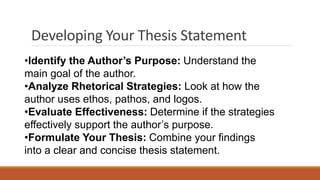
Developing Your Thesis Statement
•Identify the Author’s Purpose: Understand the
main goal of the author.
•Analyze Rhetorical Strategies: Look at how the
author uses ethos, pathos, and logos.
•Evaluate Effectiveness: Determine if the strategies
effectively support the author’s purpose.
•Formulate Your Thesis: Combine your findings
into a clear and concise thesis statement.
Conclusion
•Recap: A strong thesis statement is essential for a
successful rhetorical analysis essay.
•Resources: For further assistance, visit
ReliableAssignmentsHelp.com.
•Contact Us: Reach out for personalized help with
your assignments.

Rhetorical Analysis Thesis Statements ENG 102.pptx

  • 1.
    Rhetorical Analysis ThesisStatements ENG 102 | PPT ENG 102 ReliableAssignmentsHelp.com
  • 2.
    Introduction to RhetoricalAnalysis Rhetorical analysis involves examining how an author uses language to persuade their audience. Purpose: To understand and critique the strategies and techniques employed in the text.
  • 3.
    What is aThesis Statement? Definition: A thesis statement is a concise summary of the main point or claim of an essay. Importance: It serves as a roadmap for your essay and informs the reader of your stance and direction.
  • 4.
    Characteristics of aStrong Rhetorical Analysis Thesis Avoid First Person: Refrain from using "I believe" or "I think." Guide the Reader: Clearly outline what your essay will cover. Assert a Conclusion: Take a stand on the author's rhetorical strategies. Specify Techniques: Mention which techniques will be analyzed and their impact on the text's effectiveness.
  • 5.
    Examples of StrongThesis Statements Statistics and Emotion: "Jones effectively convinces his audience through the use of statistics and surveys paired with emotional stories." Objectivity Concerns: "Although Myers includes many convincing logical arguments through the use of historical facts, her readers may doubt her objectivity due to her sarcastic tone." Credibility through Ethos: "Thompson uses personal stories and details his extensive research to establish his credibility. These appeals to ethos, combined with his friendly tone, create an effective argument for ----." Pathos and Ethos: "Roberts effectively employs the rhetorical appeals of pathos and ethos. However, his use of unsupported logical appeals causes readers to doubt his claim that ---- is supported by research." Unsuccessful Persuasion: "Mitchell’s attempt to convince the audience that ----- is unsuccessful due to his insensitive word choice and angry tone.
  • 6.
    Common Pitfalls inThesis Statements •Too Broad: Avoid making broad statements that lack specificity. •Fact or Summary: A thesis should not be a simple statement of fact or a summary of the text. •Vague Statements: Avoid vague statements that don't clearly outline your argument.
  • 7.
    Examples of WeakThesis Statements •Broad Issue Statement: •"Abortion is a big issue in the United States." •Author’s Claim Restatement: •"The author claims abortion is a big issue in the United States." •Essay Plan Statement: •"I’m going to examine how this author uses pathos, ethos, and logos to convince his audience." •Technique List: •"The author uses pathos, ethos, and logos."
  • 8.
    Developing Your ThesisStatement •Identify the Author’s Purpose: Understand the main goal of the author. •Analyze Rhetorical Strategies: Look at how the author uses ethos, pathos, and logos. •Evaluate Effectiveness: Determine if the strategies effectively support the author’s purpose. •Formulate Your Thesis: Combine your findings into a clear and concise thesis statement.
  • 9.
    Conclusion •Recap: A strongthesis statement is essential for a successful rhetorical analysis essay. •Resources: For further assistance, visit ReliableAssignmentsHelp.com. •Contact Us: Reach out for personalized help with your assignments.