Approaching a childwith ADHD
DR.NIRUPAMA
2N D
YEAR PG
DEPARTMENT OF PSYCHIATRY
2.
What is ADHD?
•Attention Deficit Hyperactive Disorder is one of the most common
neurodevelopmental disorders of childhood.
• It is usually first diagnosed in childhood and often lasts into adulthood.
• Children with ADHD may have trouble paying attention, controlling
impulsive behaviors (may act without thinking about what the result will
be), or be overly active.
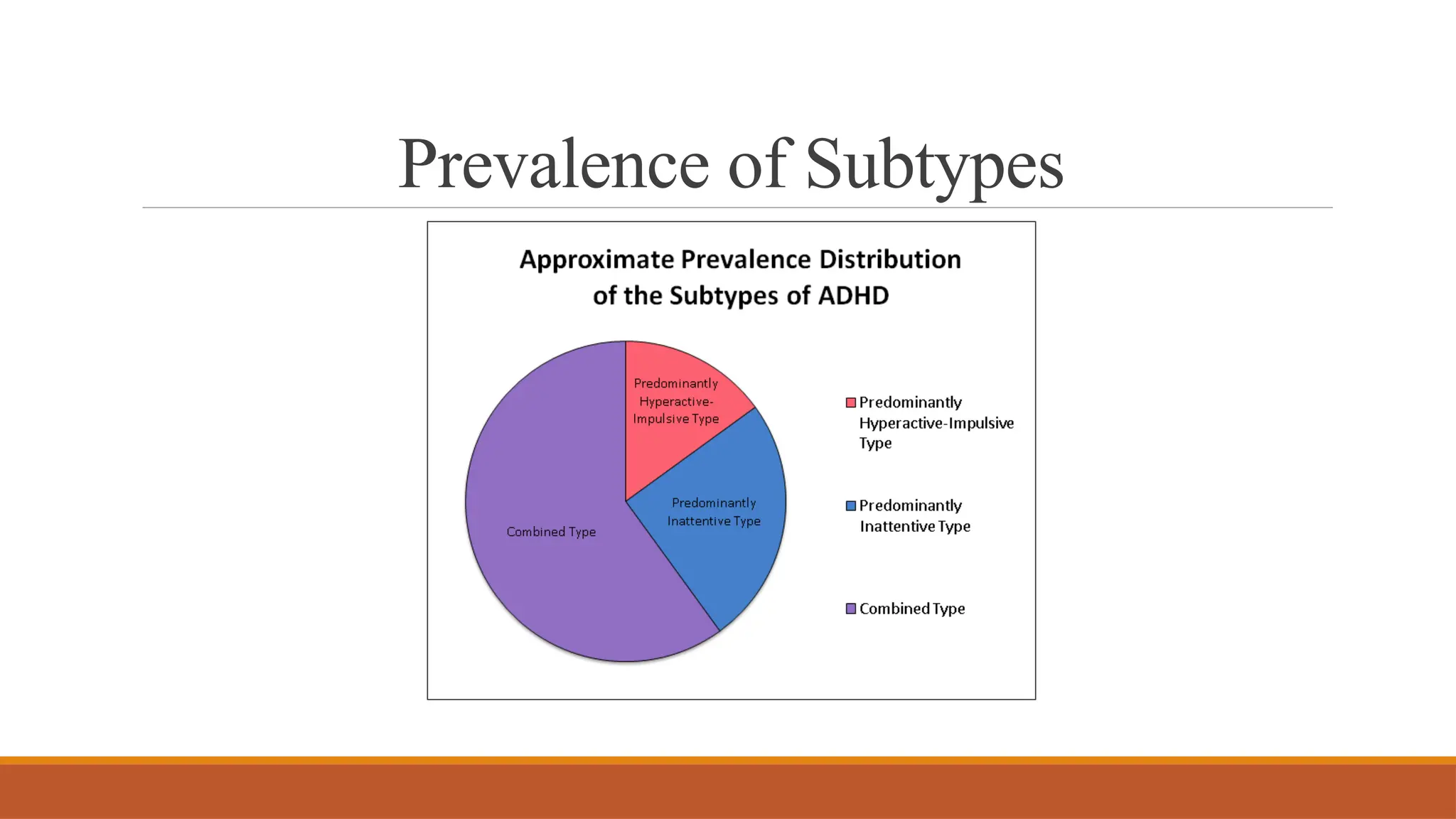
ADHD Subtypes
◦ Hyperactive, Inattentive, Mixed
DSM-5 Criteria-Inattentive Symptoms
Inattention:Six or more symptoms of inattention for children up to age 16,
five or more, for adolescents 17 and older and adults; symptoms of
inattention has to be present for at least 6 months, and they are
inappropriate for developmental level:
◦ Often fails to give close attention to details or makes careless mistakes in
schoolwork, or with other activities.
◦ Often has trouble holding attention on tasks or activities.
◦ Often does not seem to listen when spoken to directly.
◦ Often does not follow through on instructions and fails to finish schoolwork,
chores, or duties in the workplace (e.g., loses focus, side-tracked).
5.
◦ Often hastrouble organizing tasks and activities.
◦ Often avoids, dislikes, or is reluctant to do tasks that require mental
effort over a long period of time (such as schoolwork or
homework).
◦ Often loses things necessary for tasks and activities (e.g. school
materials, pencils, books, tools, wallets, keys, paperwork,
eyeglasses, mobile telephones).
◦ Is often easily distracted
◦ Is often forgetful in daily activities.
6.
DSM-5 Criteria-Hyperactive Symptoms
Hyperactivityand Impulsivity: Six or more symptoms of
hyperactivity-impulsivity for children up to age 16, five or more for
adolescents 17 and older, and adults; symptoms of hyperactivity-
impulsivity has to be present for at least 6 months to an extent that is
disruptive and inappropriate for the person’s developmental level:
◦ Often fidgets with or taps hands or feet, or squirms in seat.
◦ Often leaves seat in situations when remaining seated is expected.
◦ Often runs about or climbs in situations where it is not appropriate
(adolescents or adults may be limited to feeling restless).
◦ Often unable to play or take part in leisure activities quietly.
7.
◦ Is often"on the go" acting as if "driven by a motor".
◦ Often talks excessively.
◦ Often blurts out an answer before a question has been completed.
◦ Often has trouble waiting his/her turn.
◦ Often interrupts or intrudes on others (e.g., butts into conversations
or games)
8.
Why is ADHDa Problem?
Prevalence of 8-10% of all school-age children
◦ 5.2 Million Children, 2.5 :1 -- Male : Female
High incidence of co-morbid disorders
◦ Learning Disability, ODD, Anxiety, Depression
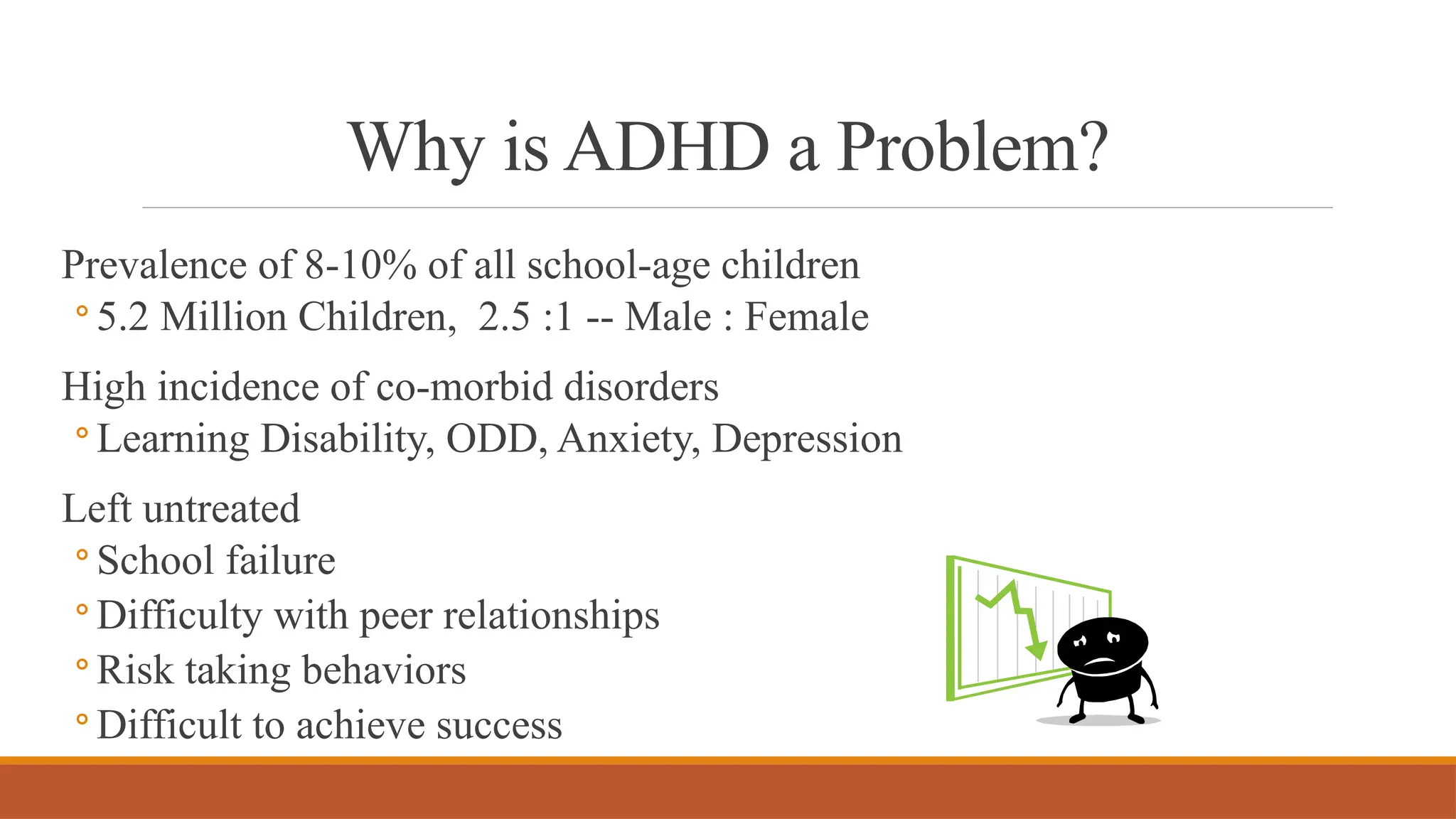
Left untreated
◦ School failure
◦ Difficulty with peer relationships
◦ Risk taking behaviors
◦ Difficult to achieve success
9.
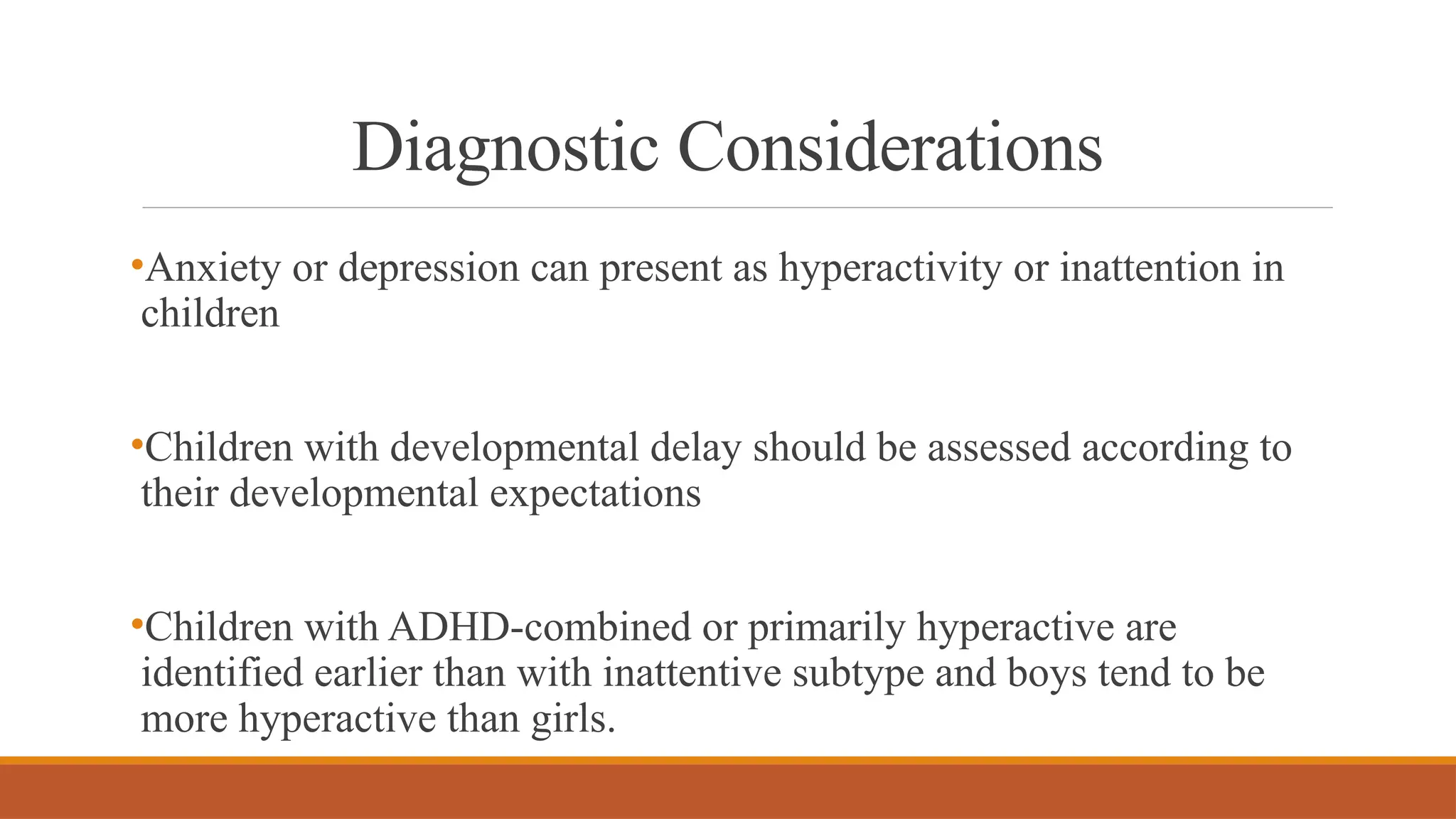
Diagnostic Considerations
•Anxiety ordepression can present as hyperactivity or inattention in
children
•Children with developmental delay should be assessed according to
their developmental expectations
•Children with ADHD-combined or primarily hyperactive are
identified earlier than with inattentive subtype and boys tend to be
more hyperactive than girls.
10.
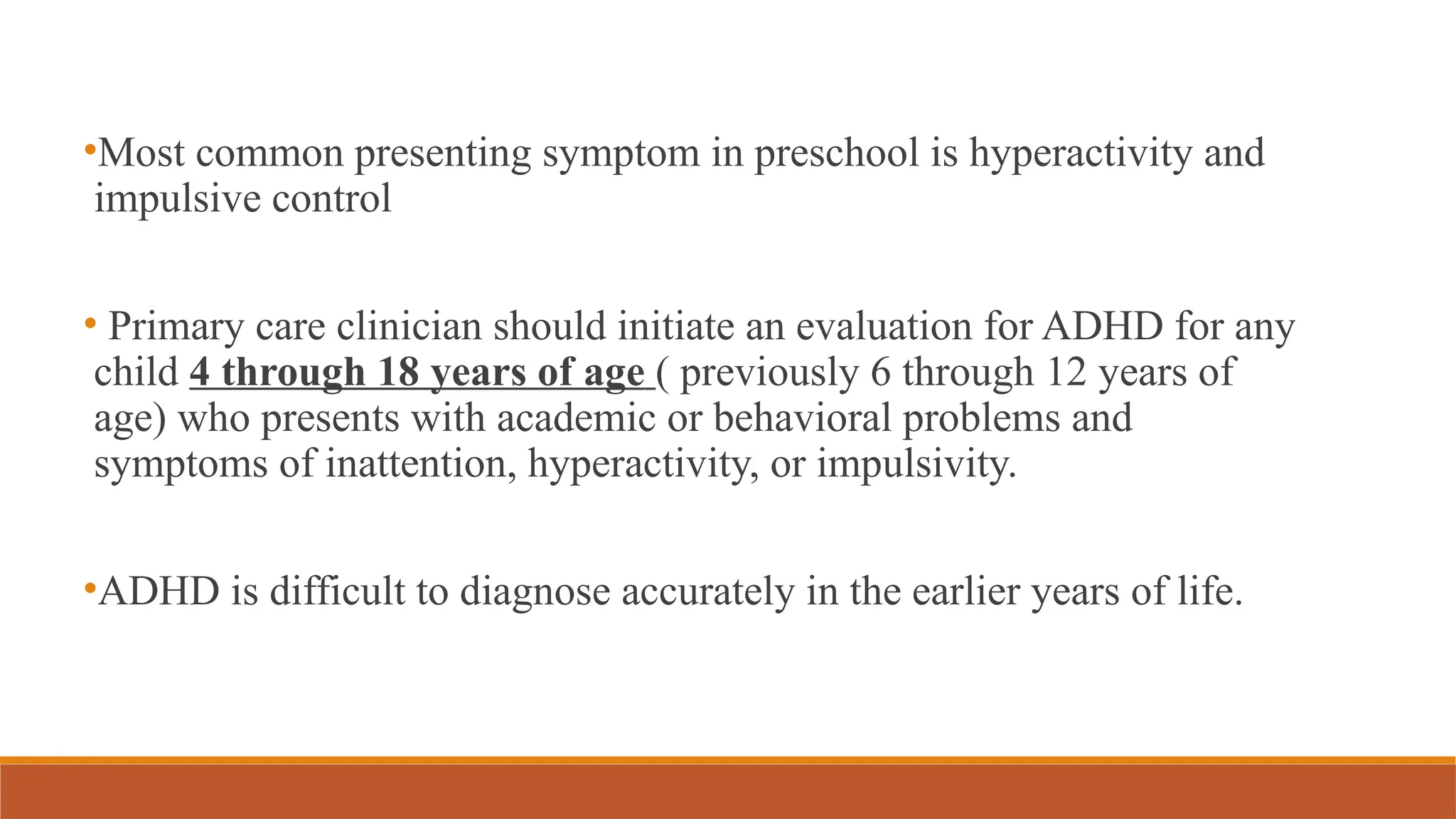
•Most common presentingsymptom in preschool is hyperactivity and
impulsive control
• Primary care clinician should initiate an evaluation for ADHD for any
child 4 through 18 years of age ( previously 6 through 12 years of
age) who presents with academic or behavioral problems and
symptoms of inattention, hyperactivity, or impulsivity.
•ADHD is difficult to diagnose accurately in the earlier years of life.
11.
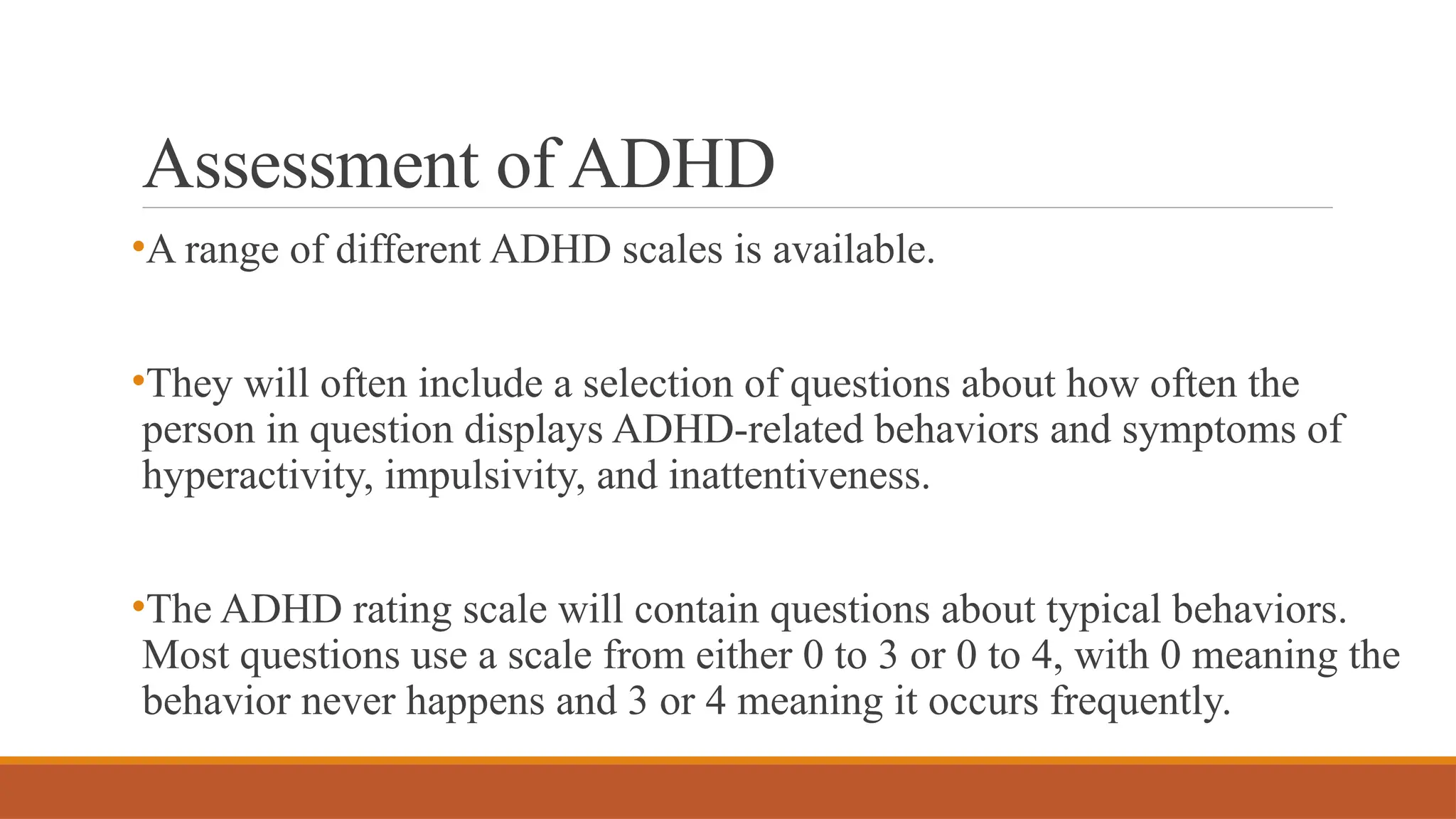
Assessment of ADHD
•Arange of different ADHD scales is available.
•They will often include a selection of questions about how often the
person in question displays ADHD-related behaviors and symptoms of
hyperactivity, impulsivity, and inattentiveness.
•The ADHD rating scale will contain questions about typical behaviors.
Most questions use a scale from either 0 to 3 or 0 to 4, with 0 meaning the
behavior never happens and 3 or 4 meaning it occurs frequently.
12.
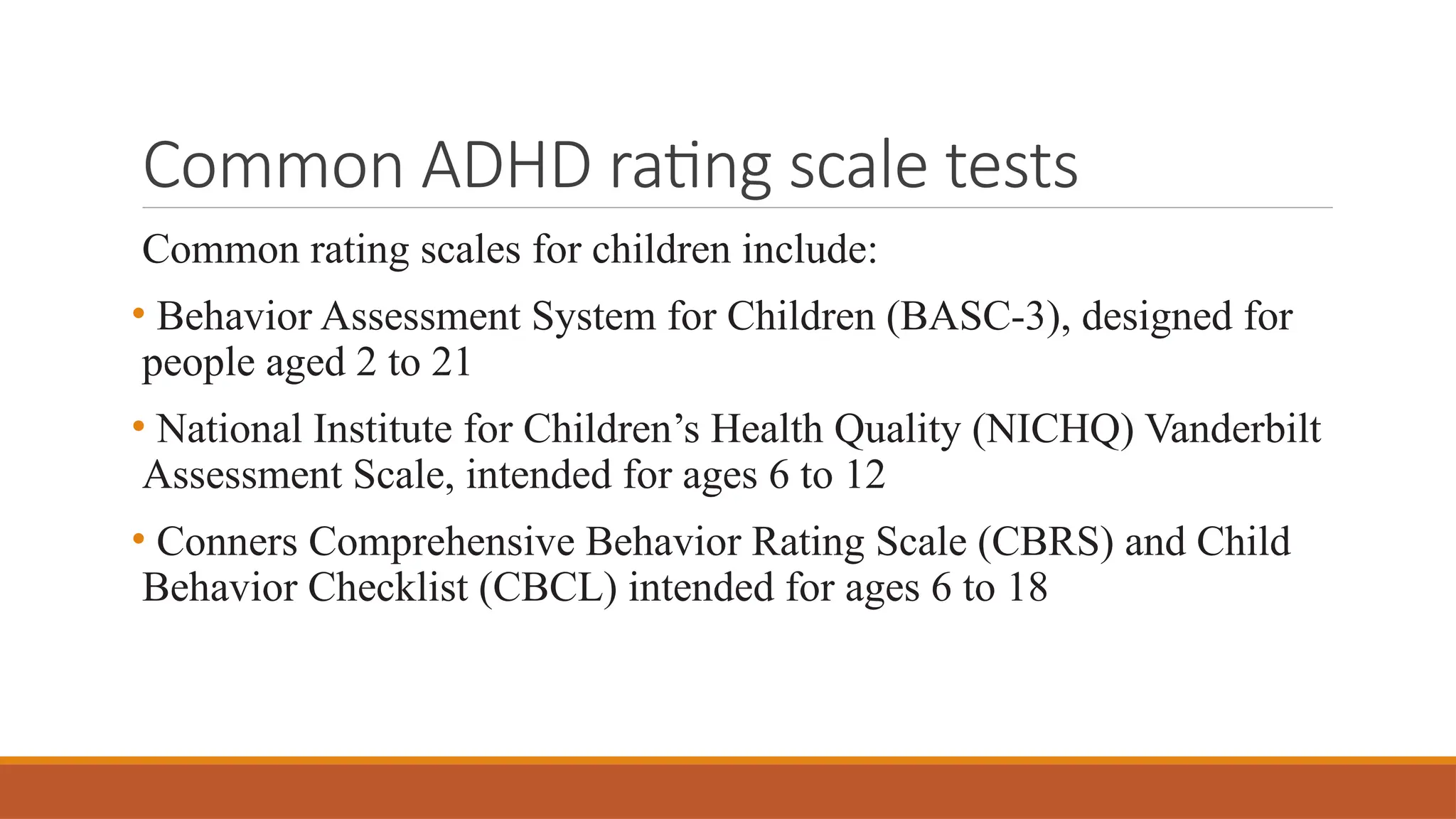
Common ADHD ratingscale tests
Common rating scales for children include:
• Behavior Assessment System for Children (BASC-3), designed for
people aged 2 to 21
• National Institute for Children’s Health Quality (NICHQ) Vanderbilt
Assessment Scale, intended for ages 6 to 12
• Conners Comprehensive Behavior Rating Scale (CBRS) and Child
Behavior Checklist (CBCL) intended for ages 6 to 18
13.
Communicating the resultseffectively
•Address parent fears and anxiety at the start of the feedback session
•Provide honest, straightforward information
•Break the information down
•Confirm accuracy of the findings and report with parents
•Use clear language that is easy to understand and meaningful to parents
•Include practical strategies that are easy and feasible to implement by teachers and
parents
14.
•Identify what thetest results mean for their child and provide specific
examples as to how that manifests at home and in the classroom
•Discuss how conclusions/diagnosis was made based on the tests used
•Educate parents about “normal” developmental expectations and where
their child fits
•Check-in with parents to explain what they understand of the information
•Explain the root difficulties the child is experiencing to promote parent
understanding and shift their understanding of presenting behaviours
15.
Treatment of ADHD
Three-prongedapproach
1. Behavioral modification
2. Educational support
3. Use of medication to supplement
16.
Behavioral modification
Behavior therapyrecognizes the limits that having ADHD puts on a
child. It focuses on how the important people and places in the child's
life can adapt to encourage good behavior and discourage unwanted
behavior. It incudes
◦ Positive reinforcement
◦ Special jobs or leadership duties
◦ Open communication with parents
◦ Keeping the child on a daily schedule.
◦ Cut down on distractions
◦ Use calm discipline.
◦ Develop a good communication system with child's teacher
17.
Educational support-accommodations
Physical
◦ Seating
◦Organization of materials
◦ Removal of distractions including during testing
Instructional accommodations
◦ Repeat and simplify directions
◦ Check in for understanding
◦ Provide examples and written instructions
Medication Considerations
•Finding theright medication
•Starting at a low dose and increase slowly
•Monitor for side effects versus benefit
•Use Vanderbilt questionnaire as a baseline to monitor response
to treatment
Stimulant Pharmacokinetics
•Weight dependentdosing in children is not well established. In
general, start at a low dose and increase slowly.
•Onset of action 45 min to 1 hour
•Duration
• Immediate release 3-5 hours
• Extended release 8-12 hours
22.
Side Effects ofStimulants
•Appetite suppression
•Sleep disturbance
•Weight loss
•Transient symptoms:
• Headache, stomachache
•Uncommon side effects:
• Acute marked changes in behavior or mood
• Symptoms of hallucination, psychosis, or mania
23.
Other Concerns
•Stimulants asgateway to drug abuse?
• NO! Untreated ADHD has increased risk of substance abuse.
Treated ADHD risk of substance abuse is near population levels.
24.
How to TrackEfficacy
• Vanderbilt Rating Scales
• Parent and teacher
• School reports
• Academic progress
• Behavior reports
25.
References
Pelham, W. E.,Fabiano, G. A., & Massetti, G. M. (2005). Evidence-based assessment of Attention
Deficit Hyperactivity Disorder in children and adolescents. Journal of Clinical Child and Adolescent
Psychology, 34(3), 449-476. doi: 10.1207/s15374424jccp3403_5
Sayal, K., Letch, N., & El Abd, S. (2008). Evaluation of screening in children referred for an ADHD
assessment. Child and Adolescent Mental Health, 13, 41–46. doi: 10.1111/j.1475-3588.2007.00463.x
Sowerby, P., & Tripp, G. (2009). Evidence-based assessment of attention-deficit/hyperactivity
disorder (ADHD). In J. L. Matson et al. (Eds). Assessing childhood psychopathology and
developmental disabilities (pp. 209-239). doi: 10.1007/978-0-387-09528-8
Wolraich, M. L., Lambert, E. W., Bickman, L., Simmons, T., Doffind, M. A., & Worley, K. A.
(2004). Assessing the impact of parent and teacher agreement on diagnosing Attention-Deficit
Hyperactivity Disorder. Developmental and Behavioral Pediatrics, 25, 41- 47. doi:
0196-206X/00/2501-0041
Wright, K. D., Waschbusch, D. A., Frankland, B. W. (2007). Combining data from parent ratings
and parent interview when assessing ADHD. Journal of Psychopathology and Behavior Assessment,
29, 141–148. doi: 10.1007/s10862-006-9039-4



![ADHD (best)]](https://cdn.slidesharecdn.com/ss_thumbnails/bykhaihojoshuagabriel1-1234763718979961-1-thumbnail.jpg?width=640&height=640&fit=bounds)


