iHuman History Taking Tips
Website: gpashark.com
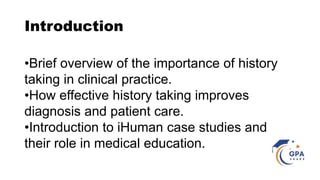
Introduction
•Brief overview of the importance of history
taking in clinical practice.
•How effective history taking improves
diagnosis and patient care.
•Introduction to iHuman case studies and
their role in medical education.
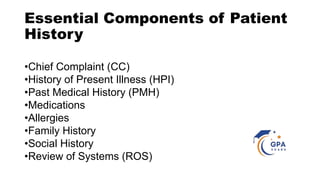
Essential Components of Patient
History
•Chief Complaint (CC)
•History of Present Illness (HPI)
•Past Medical History (PMH)
•Medications
•Allergies
•Family History
•Social History
•Review of Systems (ROS)
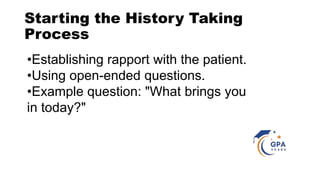
Starting the History Taking
Process
•Establishing rapport with the patient.
•Using open-ended questions.
•Example question: "What brings you
in today?"
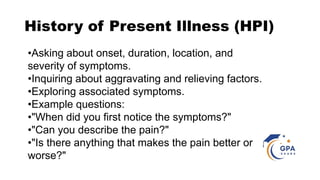
History of Present Illness (HPI)
•Asking about onset, duration, location, and
severity of symptoms.
•Inquiring about aggravating and relieving factors.
•Exploring associated symptoms.
•Example questions:
•"When did you first notice the symptoms?"
•"Can you describe the pain?"
•"Is there anything that makes the pain better or
worse?"
Past Medical History (PMH)
•Documenting past illnesses, surgeries, and
hospitalizations.
•Asking about chronic conditions.
•Example questions:
•"Have you had any significant illnesses or
surgeries?"
•"Do you have any chronic conditions like
diabetes or hypertension?"
Medications and Allergies
•Reviewing current and past medications,
including over-the-counter drugs and
supplements.
•Asking about known allergies to medications,
foods, or environmental factors.
•Example questions:
•"Are you currently taking any medications?"
•"Do you have any known allergies?"
Family and Social History
•Exploring family health history to identify genetic
or hereditary conditions.
•Inquiring about lifestyle factors such as smoking,
alcohol use, occupation, and living situation.
•Example questions:
•"Can you tell me about your family’s health
history?"
•"Do you smoke or use any tobacco products?"
Review of Systems (ROS)
•Following a systematic approach by covering each
body system.
•Asking specific questions related to common
symptoms for each system.
•Example questions:
•"Have you experienced any weight loss, fever, or
fatigue recently?"
•"Any chest pain, palpitations, or shortness of
breath?"

iHuman History Taking Tips-ihuman case study help.pptx

  • 1.
    iHuman History TakingTips Website: gpashark.com
  • 2.
    Introduction •Brief overview ofthe importance of history taking in clinical practice. •How effective history taking improves diagnosis and patient care. •Introduction to iHuman case studies and their role in medical education.
  • 3.
    Essential Components ofPatient History •Chief Complaint (CC) •History of Present Illness (HPI) •Past Medical History (PMH) •Medications •Allergies •Family History •Social History •Review of Systems (ROS)
  • 4.
    Starting the HistoryTaking Process •Establishing rapport with the patient. •Using open-ended questions. •Example question: "What brings you in today?"
  • 5.
    History of PresentIllness (HPI) •Asking about onset, duration, location, and severity of symptoms. •Inquiring about aggravating and relieving factors. •Exploring associated symptoms. •Example questions: •"When did you first notice the symptoms?" •"Can you describe the pain?" •"Is there anything that makes the pain better or worse?"
  • 6.
    Past Medical History(PMH) •Documenting past illnesses, surgeries, and hospitalizations. •Asking about chronic conditions. •Example questions: •"Have you had any significant illnesses or surgeries?" •"Do you have any chronic conditions like diabetes or hypertension?"
  • 7.
    Medications and Allergies •Reviewingcurrent and past medications, including over-the-counter drugs and supplements. •Asking about known allergies to medications, foods, or environmental factors. •Example questions: •"Are you currently taking any medications?" •"Do you have any known allergies?"
  • 8.
    Family and SocialHistory •Exploring family health history to identify genetic or hereditary conditions. •Inquiring about lifestyle factors such as smoking, alcohol use, occupation, and living situation. •Example questions: •"Can you tell me about your family’s health history?" •"Do you smoke or use any tobacco products?"
  • 9.
    Review of Systems(ROS) •Following a systematic approach by covering each body system. •Asking specific questions related to common symptoms for each system. •Example questions: •"Have you experienced any weight loss, fever, or fatigue recently?" •"Any chest pain, palpitations, or shortness of breath?"