International Research Journal of Engineering and Technology (IRJET) e-ISSN: 2395-0056
Volume: 10 Issue: 01 | Jan 2023 www.irjet.net p-ISSN: 2395-0072
© 2022, IRJET | Impact Factor value: 7.529 | ISO 9001:2008 Certified Journal | Page 190
A REVIEW OF CHARACTERIZATION TECHNIQUES OF COMPOSITE
MATERIALS
Pankaj kumar1, Rahul kumar2
1Assistant Professor, Mechanical Department, Subharti University
2Assistant Professor, Mechanical Department, Subharti University
---------------------------------------------------------------------***---------------------------------------------------------------------
Abstract:
A review of characterization methods of composite
materials. The review considers the evaluation of composite
by different methods. This article review about Non
dustractive testing methods and capabilities of most
common methods in composite NDT applications such as
Ultrasonic testing, Infrared testing, Radiography, Rcoustic
testing principals, Ultrasonic phased array detection
technique and Shearography with respect to merit and
demerit of these methods. Composite materials are
increasing in product efficiency, cost-effectiveness and the
development of superior specific properties. There is
increasing importance in their applications to load-carrying
structures. Thus, tough and reliable non-destructive testing
of composites is important here to reduce safety concerns
and maintenance costs. There have been various non-
destructive testing methods built upon different principles
for quality assurance during the whole lifecycle of a
composite product.
Keywords
Non dustractive testing, composite materials,
capabilities, product efficiency, properties.
1. INTRODUCTION:
Composite materials prove themselves to be very
efficient as compared to other conventional materials.
They are budget friendly and offer superior properties.
Thus, demands increase a lot for these materials.
Therefore, to reduce the risk of failure, NDT is very much
essential for this kind of materials. In this article we
covered the basics of various NDT techniques including
introduction, principle, scope in which they can be used,
history, applications, equipment, etc. We also covered
various advantages as well as drawbacks associated with
these tests.In order to achieve such robust properties
efficiently, the manufacturing process associated with
these materials is very sensitive and difficult task so that
they can be strong enough to be sued in aerospace,
turbine, etc. manufacturing areas. Today, carbon fiber
composites are variedly used in many applications dur to
their complementary properties varying from material to
material.
Figure:1 -Steps involved in carbon fiber
manufacture
A ample range of NDT methods plays major roles in
testing of composite materials (Scott & Scala, 1982). The
applications of composite NDT may include manufacturing
(Venkataraman, 2001), pipe and tube manufacturing
(Hufenbach et al. 2011; Schneider, 1984), storage tanks
(Castaings & Hosten, 2008), aerospace (Liew et al. 2011;
Yekani Fard et al. 2014) military and defense (Bennett et
al. 2013), nuclear industry (Vavilov et al. 2015), and
composite defects characterization (Fotsing et al. 2014).
Numerous techniques are used in the composite NDT field,
including ultrasonic testing (Peng et al. 2012),
thermographic testing (Kroeger, 2014), infrared
thermography testing (Vavilov et al. 2015), radiographic
testing (Tan et al. 2011), visual testing (VT) or visual
inspection (VI) (Bossi & Giurgiutiu, 2015), acoustic
emission testing (AE) (Sarasini & Santulli, 2014), acousto-
ultrasonic (Su et al., 2014), shearography testing (Hung et
al. 2013), optical testing (Liu et al. 2014), electromagnetic
testing (Yang et al. 2013), liquid penetrant testing
(Kalinichenko et al. 2013), and magnetic particle testing
(Lu et al. 2013). Due such a wide range of applications,
they can have some deformations and shortcomings in
lattice, which may affect stability and limit the applications
of these fibers in long term.
International Research Journal of Engineering and Technology (IRJET) e-ISSN: 2395-0056
Volume: 10 Issue: 01 | Jan 2023 www.irjet.net p-ISSN: 2395-0072
© 2022, IRJET | Impact Factor value: 7.529 | ISO 9001:2008 Certified Journal | Page 191
2. Non-Destructive testing method
This article depicts various such instabilities in the
lattice of carbon fibers on long terms and some non-
destructive tests. These not destructive tests can prove to
be an important tool because they can test material
without damaging. Though some minute damages occur,
but this saves a lot of time and material required in
manufacturing those specimens. There are many
prerequisites for non-destructive tests which includes the
conforming of materials. This identifies the form of
problem and then comparing it with original pure fiber,
we get to know the problem. Some commonly used types
of non-destructive tests are: CT, X-ray, Ultrasound, IR-
thermography, phased array detection, etc. Coming to
NDT, we have various subcategories of NDT that are
classified as: contact and non-contact testing.
Figure:2-Picture showing various manufacturing
defects and in-service damages on various scales
Table:1- Comparison between Destructive testing
and Non Destructive testing
Table:2- Contact vs. Non-contact NDT testing methods
Contact vs. non-contact NDT methods:
Traditional Ultrasonic
testing
Through transmission
ultrasonic testing
Eddy current testing Radiography Testing
Magnetic Testing Thermography
Electromagnetic Testing IR testing
Penetrant Testing Holography
Liquid Penetrant testing Shearography & Visual
Inspection
2.1 Types of Non- Destructive Testing
Method
One major aspect of these methods is that not all the
methods are suitable for every kind of application. So,
careful choice of testing method is necessary. Like, in
aerospace sector, in aircraft health monitoring and
damage identification, we can use Ultrasonic,
thermographic, Usamentiaga vibrations, IR thermography
and Shearography testing methods. For health monitoring
of structures, we can use ultrasonic testing, for health
monitoring of composite wind-box and damage in GFRP,
we can use ultrasonic testing and thermographic testing,
respectively. For auto detection of impact damage in
carbon fibers, we can use thermographic testing and
Usamentiaga radiography. Likewise, there are many more
fields with different testing techniques. Ultrasonic testing
is one of the commonly use testing method.
IDENTIFICATION OF NEED / REQUIREMENT AS PER
APPLICATION OF COMPOSITE MATERIAL
SELECTION OF MATRIX AND REINFORCEMENT
CHARACTERIZATION OF COMPOSITE MATERIAL
COMBINING OF MATRIX AND REINFORCEMENT
International Research Journal of Engineering and Technology (IRJET) e-ISSN: 2395-0056
Volume: 10 Issue: 01 | Jan 2023 www.irjet.net p-ISSN: 2395-0072
© 2022, IRJET | Impact Factor value: 7.529 | ISO 9001:2008 Certified Journal | Page 192
2.2 Ultrasonic Testing
Out of these testing, visual testing is one of the basic
and quick technique that can save lot of time and money.
Though it doesn’t need scientific equipment, it has its own
disadvantages in accuracy and other parameters. In this,
the analyst can simply observe the surface of material by
looking for cracks or failures. LPT (Liquid Penetrant
Testing) is one of the major techniques in this field. This is
mainly applied for non-porous materials. So that, cracks or
failures can easily absorb the liquid and we can find
damages. One major success in this field is the use of
transmitters, receivers, transducers and other display
devices in so called ultrasonic testing. The information is
defined by a unique crack location, flaw size and
orientation. Ultrasonic testing can either be based on pulse
echo or based on transmission of radiations, using a high
frequency sound wave having frequency range of 1-
50MHz to detect internal features. Ultrasonic testing has
high accuracy due to the fact that it uses different probes
for different materials. Thus, frequent replacement is
required, which in turn reduces efficiency. So, another
technique called SWF is developed.
Figure 3: -Principle of ultrasonic testing
2.3 Principle of Infrared Testing
Another major type of testing technique is
thermography, which uses the principle of thermal
imaging. This is based on the phenomena that when there
is a crack in the body of the fiber, the heat fluctuation
occurs there due to sudden change in conductivity. One
thing to note is that cracks on deeper side of the fiber
cause less effect on heat as compared to the cracks on
outer side. Hence, this technique is used for thinner fibers.
Using this technique offers some advantages one of which
is that we can inspect a relatively larger area of the fiber.
But this technique requires large investment on
instrumentation and highly skilled person. Further, if the
crack goes deeper, the clarity decreases.
Figure 4: -Principle of Infrared Testing
3. Radiography
Next most commonly used testing technique is
radiography. Delamination (generation of air voids)
is the most common type of problem solved by this
method. However, we can notice it in the output
only when it is not perpendicular to path of X-rays.
For thinner parts, we use 1-5V source as light
radiography while in thick parts we use γ-rays. It
can also detect inclusions, non-uniform fiber
distribution and fiber mislocation.
Figure 5:-Radiographic techniques
Some of the most common types of radiography
technique:
1) Compton Scatter Imaging technique
2) Neutron Photographic Method
3) Computed Tomography
Though radiography is more accurate as compared
to X-ray testing, it requires a very costly neutron beam and
also used only for high testing requirements.
Radiographic
techniques
Film
Radiography
Computed
Radiography
Computed
tomography
Digital
Radiography
γ Ray
Radiography
X-ray
computed
Tomography
International Research Journal of Engineering and Technology (IRJET) e-ISSN: 2395-0056
Volume: 10 Issue: 01 | Jan 2023 www.irjet.net p-ISSN: 2395-0072
© 2022, IRJET | Impact Factor value: 7.529 | ISO 9001:2008 Certified Journal | Page 193
Principles of electromagnetism and electricity are
applied in electromagnetic testing. This mainly reveals
defects like, fracture, fault, corrosion or any other
condition of materials. Electric and magnetic fields are
created in the test object for this. Some most commonly
used techniques of this kind are:
Figure 6: -Techniques of electromagnetism
2.4 Acoustic testing principle
One of the most effective technique for analysis of failure
is acoustic emission analysis. This method was
developed in early 1950s by Kaiser. The defects tested
by this method are matrix micro cracking, fibbers-matrix
debonding, localized delimitation or fibre pullout and
breakage. The mechanical stress waves generated by
these cracks or defects are in concentric form and are
sensed by piezoelectric sensors. The main difference
between this and other types of analysis is that it uses
energy generated by object in the form of vibrations
while other techniques impart energy to the object. The
major advantages include its global scope of sensors,
fast, accurate and no need for disassembling. However, it
makes difficult to correlate between type of damage and
the intensity and type of vibrations coming out. Since,
this can only determine the type of failure, we can use a
combination of acoustic and ultrasonic testing called
acousto-ultrasonic testing. This makes the test more
sensitive and efficient.
Figure 7: -Acoustic testing principle
2.5 Principle of ultrasonic phased array
detection technique
Use of lasers in this field can prove itself to be more
efficient and is used in Shearography testing. It offers
the advantage that we require less skilled users to
operate the process. Also, it produces less noise as
compared to other tests. During testing, stress
concentrations vary around defects, which deduct the
concentration and criticality of failure. This is a major
advantage in this test.
Based on Huygens’ principles and Helmholtz’s
integral sound pressure theorem, another method
was developed called Ultrasonic phased array
detection method. This method uses multiple beams
for scanning and imaging purposes. The apparatus
uses some phased array controllers, chips of probe
and some electrical and detection systems to detect
sound waves coming from the object, after emitting
form chips. Basically, time lag between various waves
determines the crack or failure. Ultrasonic phased
array controlling mechanism distributes the sound
pressure accordingly so as to speed up the task and
increase the accuracy.
Figure 8: -Principle of ultrasonic phased array
detection technique
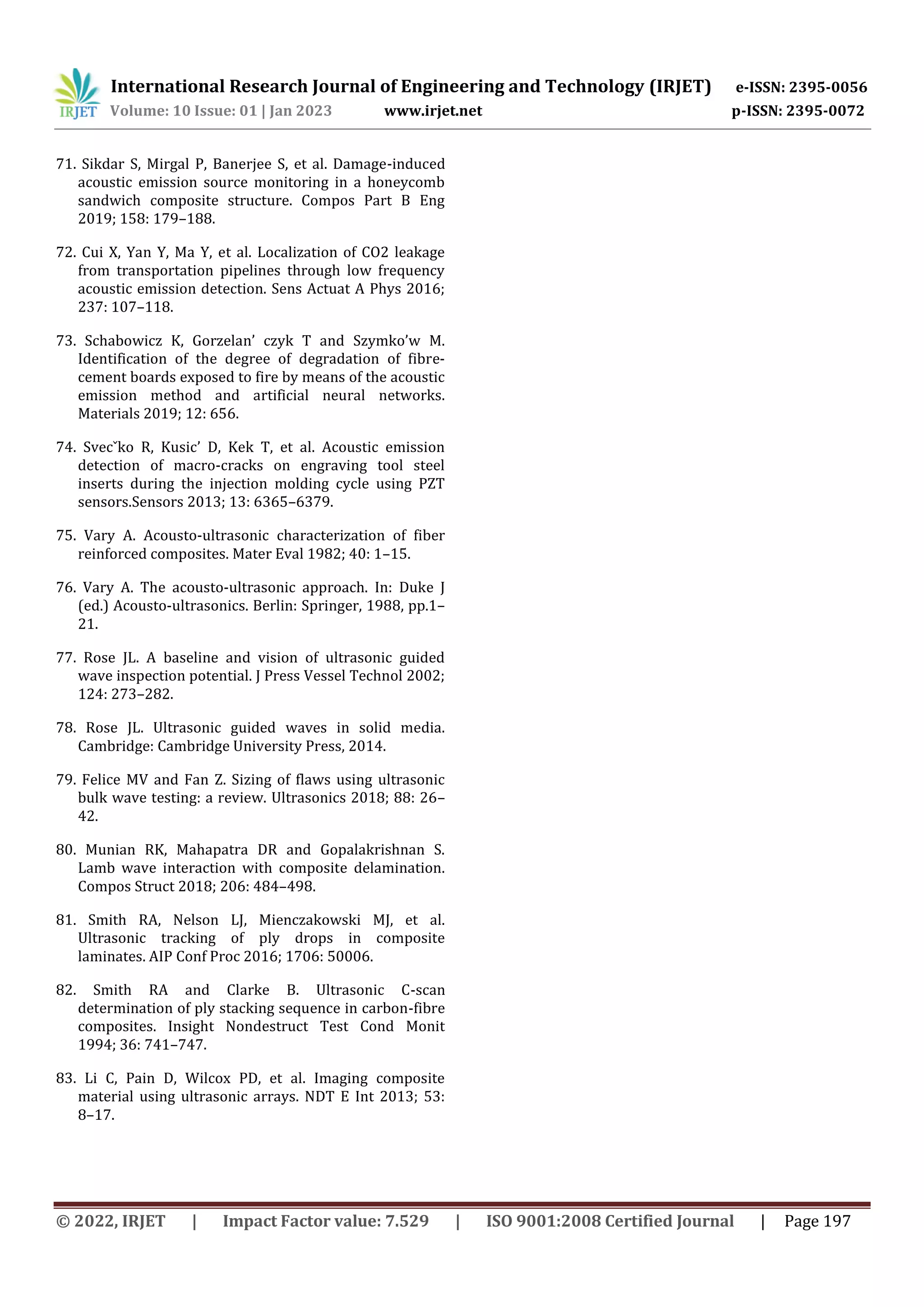
2.6 Shearography
Shearography testing (ST) is one of the important
types of NDT technique that comes under non-contact
type. It was developed by Leendertz and Butters in around
1970s. It can be used as a powerful way to detect, flaws
and defects, leakage, delimitation, displacement, strain,
curvature and residual stress. Along with these, it can also
do mechanical analysis, surface profiling test, etc. In this, a
laser beam is made to fall on the surface of material to be
tested. The reflected part of this beam is then imagined in
ET
ECT
RFT
MFLT
ACFMT
International Research Journal of Engineering and Technology (IRJET) e-ISSN: 2395-0056
Volume: 10 Issue: 01 | Jan 2023 www.irjet.net p-ISSN: 2395-0072
© 2022, IRJET | Impact Factor value: 7.529 | ISO 9001:2008 Certified Journal | Page 194
a shearing device, dividing into two coherent images, one
of which is monitored for damages in material. Pattern is
recorded in a CCD(Charge Coupled Device) camera and
displayed and analysis for further ting digitally. This
technique can be used in analysis of structures like pipes,
sandwich, wind turbine blades, aerospace structures as
well as racing types.
Figure 9: -Principle of Shearography
3 CONCLUSION
NDT techniques are impressive methods for testing and
evaluation, as it is required during different phases within
the lifetime of a composite product, it is significant that
each method has its strength but some techniques show
capabilities for a full diagnosis of possible defects and
damage evaluation in a composite system. In this
technique we use different-different tests on composite
materials, in this review, we present the benefits and
limitations of NDT methods. The selection of suitable
methods can be challenging but essential to providing the
right information for balanced composite materials and
structures.
REFRENCES
1. Fosting, E. R., Ross, A., & Ruiz, E. (2014).
Characterization of surface defects on composites
sandwich materials based on deflectrometry. NDT
& E international, 62, 29-39.
2. Arumugam, V., Kumar, C.S., Santulli, C., Sarasini, F.,
& Stanley, A. J. (2011). A Global method for
identification of failure modes in Fiberglass using
Acoustic Emission. Journal of testing and
evaluation, 39(5).
3. Aidi, B., Philen, M.k., & Case, S.W. (2015).
Progressive damages assessment of centrally
notched composite specimens in fatigues.
Composites part A: Applied Science and
manufacturing, 74(0), 47-59.
4. Oguma, I., Goto, R., & Sugiura, T. (2012).
Ultrasonic inspection of an internal flaw in a
ferromagnetic specimen using angle beam EMATs.
Przeglad Elektrotechinczny.
5. Ashby MF and Cebon D. Materials selection in
mechanical design. Le J Phys IV 1993; 3: C7-1–C7-
9.
6. Amenabar I, Lopez F and Mendikute A. In
introductory review to THz non-destructive
testing of composite mater. J Infrared Millim
Terahertz Waves 2013; 34:152–169.
7. Hamstad MA. A review: acoustic emission, a tool
for composite-materials studies. Exp Mech 1986;
26: 7–13.
8. Duchene P, Chaki S, Ayadi A, et al. A review of
non-destructive techniques used for mechanical
damage assessment in polymer composites. J
Mater Sci 2018; 53: 7915–7938.
9. ASTM E2533:2017. Standard guide for non-
destructive testing of polymer matrix composites
used in aerospace applications.
10. Summerscales J. Non-destructive testing of fibrere
inforced plastics composites. Berlin: Springer,
1990.
11. Birt EA and Smith RA. A review of NDE methods
for porosity measurement in fibre-reinforced
polymer composites.
12. Insight Nondestruct Test Cond Monit 2004;
46:681–686.
13. Cheng L and Tian GY. Comparison of non-
destructive testing methods on detection of
delaminations in composites.J Sensors 2012;
2012: 408437.
14. Heuer H, Schulze M, Pooch M, et al. Review on
quality assurance along the CFRP value chain–
non-destructive testing of fabrics, preforms and
CFRP by HF radio wave techniques. Compos Part
B Eng 2015; 77: 494–501.
15. Li Z and Meng Z. A review of the radio frequency
non-destructive testing for carbon-fibre
composites. Meas Sci Rev 2016; 16: 68–76.
International Research Journal of Engineering and Technology (IRJET) e-ISSN: 2395-0056
Volume: 10 Issue: 01 | Jan 2023 www.irjet.net p-ISSN: 2395-0072
© 2022, IRJET | Impact Factor value: 7.529 | ISO 9001:2008 Certified Journal | Page 195
16. Ibrahim ME. Nondestructive evaluation of thick
section composites and sandwich structures: a
review.Compos Part A Appl Sci Manuf 2014; 64:
36–48.
17. Cawley P. The rapid non-destructive inspection of
large composite structures. Composites 1994; 25:
351–357.
18. Mook G, Pohl J and Michel F. Non-destructive
characterization of smart CFRP structures. Smart
Mater Struct 2003; 12: 997–1004.
19. Zou Y, Tong L and Steven GP. Vibration-based
model dependent damage (delamination)
identification and health monitoring for
composite structures – a review. J Sound Vib
2000; 230: 357–378.
20. Tuloup C, Harizi W, Aboura Z, et al. On the use of
insitupiezoelectric sensors for the manufacturing
and structural health monitoring of polymer-
matrix composites:a literature review. Compos
Struct 2019; 215:127–149.
21. Greene E. Marine composites non-destructive
evaluation. Sh Struct 2014; 1: 416–427.
22. Drewry MA and Georgiou GA. A review of NDT
techniques for wind turbines. Insight Nondestruct
Test Cond Monit 2007; 49: 137–141.
23. Ciang CC, Lee JR and Bang HJ. Structural health
monitoring for a wind turbine system: a review of
damage detection methods. Meas Sci Technol
2008; 19: 122001.
24. Raisˇutis R, Jasi_unien_e E, Sˇ literis R, et al. The
review of non-destructive testing techniques
suitable for inspection of the wind turbine blades.
Ultragarsas 2008; 63: 26–30.
25. Galappaththi UIK, De Silva AKM, Macdonald M, et
al. Review of inspection and quality control
techniques for composite wind turbine blades.
Insight Non destruct Test Cond Monit 2012; 54:
82–85.
26. Garnier C, Pastor ML, Eyma F, et al. The detection
of aeronautical defects in situ on composite
structures using Non Destructive Testing. Compos
Struct 2011; 93:1328–1336.
27. Katnam KB, Da Silva LFM and Young TM. Bonded
repair of composite aircraft structures: a review
of scientific challenges and opportunities. Prog
Aerosp Sci 2013; 61: 26–42.
29. Fahr A. Aeronautical applications of non-
destructive testing. Lancaster, PA: DEStech
Publications, Inc., 2013.
30. Joyce PJ, Kugler D and Moon TJ. A technique for
characterizing process-induced fiber waviness in
unidirectional composite laminates-using optical
microscopy.J Compos Mater 1997; 31: 1694–1727.
31. Pain D and Drinkwater BW. Detection of fibre
waviness using ultrasonic array scattering data. J
Non destruct Eval 2013; 32: 215–227.
32. Hull D and Clyne TW. An introduction to composite
materials. Cambridge: Cambridge University Press,
1996.
33. Wang B and Fancey KS. Viscoelastically prestressed
polymeric matrix composites: an investigation into
fibre deformation and prestress mechanisms.
Compos Part Appl Sci Manuf 2018; 111: 106–114.
34. Wang J, Potter KD, Hazra K, et al. Experimental
fabrication and characterization of out-of-plane
fiber waviness in continuous fiber- reinforced
composites. J Compos Mater 2012; 46: 2041–2053.
35. Hyer MW. Some observations on the cured shape of
thin unsymmetric laminates. J Compos Mater 1981;
15: 175–194.
36. Hyer MW. The room-temperature shapes of four-
layer unsymmetric cross-ply laminates. J Compos
Mater 1982; 16: 318–340.
37. Wang B and Fancey KS. A bistable morphing
composite using viscoelastically generated
prestress. Mater Lett 2015; 158: 108–110.
38. Wang B, Ge C and Fancey KS. Snap-through
behaviour of a bistable structure based on
viscoelastically generated prestress. Compos Part
B Eng 2017; 114:23–33.
39. Lubin G. Handbook of composites. Berlin:
Springer,2013.
40. Berthelot JM and Rhazi J. Acoustic emission in
carbon fibre composites. Compos Sci Technol 1990;
37:411–428.
41. Haque A and Hossain MK. Effects of moisture and
temperature on high strain rate behavior of S2-
glassvinylester woven composites. J Compos
Mater 2003;37: 627–647.
42. Huang S and Wang S. New technologies in
electromagnetic non-destructive testing. Berlin:
Springer, 2016.
International Research Journal of Engineering and Technology (IRJET) e-ISSN: 2395-0056
Volume: 10 Issue: 01 | Jan 2023 www.irjet.net p-ISSN: 2395-0072
© 2022, IRJET | Impact Factor value: 7.529 | ISO 9001:2008 Certified Journal | Page 196
43. Ghoni R, Dollah M, Sulaiman A, et al. Defect
characterization based on eddy current technique:
technical review. Adv Mech Eng 2014; 6: 182496.
44. Koyama K, Hoshikawa H and Kojima G. Eddy current
non destructive testing for carbon fiber- reinforced
composites. J Press Vessel Technol 2013; 135: 41501.
45. Ferguson B and Zhang XC. Materials for terahertz
science and technology. Nat Mater 2002; 1: 26–33.
46. Dhillon SS, Vitiello MS, Linfield EH, et al. The 2017
terahertz science and technology roadmap. J Phys D
Appl Phys 2017; 50: 43001.
47. Zhong S. Progress in terahertz nondestructive testing:
a review. Front Mech Eng 2019; 14: 273–281.
48. Ambrosini D and Ferraro P. Here, there and
everywhere: the art and science of optics at work. Opt
Laser Eng 2018; 104: 1–8.
49. Hung YY and Ho HP. Shearography: an optical
measurement technique and applications. Mater Sci
Eng R Reports 2005; 49: 61–87.
50. Yang L and Xie X. Digital shearography: new
developments and applications. Bellingham, WA: SPIE
Press, 2016.
51. Arai M and Crawford K. Neutron sources and facilities.
In: Anderson IS, McGreevy RL and Bilheux H. (eds)
Neutron imaging and applications. Berlin:
Springer,2009, pp.13–30.
52. Meola C and Carlomagno GM. Application of infrared
thermography to adhesion science. J Adhes Sci Technol
2006; 20: 589–632.
53. Schoonahd JW, Gould JD and Miller LA. Studies of
visual inspection. Ergonomics 1973; 16: 365–379.
54. Scruby CB. An introduction to acoustic emission. J Phys
E 1987; 20: 946–953.
55. Kaiser J. An investigation into the occurrence of noises
in tensile tests or a study of acoustic phenomena in
tensile tests. PhD Dissertation, Technische Hochschule
Munchen, Munich, 1950.
56. Tensi HM. The Kaiser-effect and its scientific
background. J Acoust Emiss 2004; 22: s1–s16.
57. Dahmene F, Yaacoubi S and Mountassir MEL. Acoustic
emission of composites structures: story, success, and
challenges. Phys Procedia 2015; 70: 599–603.
58. Huguet S, Godin N, Gaertner R, et al. Use of acoustic
emission to identify damage modes in glass fibre
reinforced polyester. Compos Sci Technol 2002; 62:
1433–1444.
59. Godin N, Huguet S, Gaertner R, et al. Clustering of
acoustic emission signals collected during tensile tests
on unidirectional glass/polyester composite using
supervised and unsupervised classifiers. NDT E Int
2004; 37: 253–264.
60. Kordatos EZ, Dassios KG, Aggelis DG, et al. Rapid
evaluation of the fatigue limit in composites using
infrared lock-in thermography and acoustic emission.
Mech Res Commun 2013; 54: 14–20.
61. Nechad H, Helmstetter A, El Guerjouma R, et al. Creep
ruptures in heterogeneous materials. Phys Rev Lett
2005; 94: 45501.
62. Chou HY, Mouritz AP, Bannister MK, et al. Acoustic
emission analysis of composite pressure vessels under
constant and cyclic pressure. Compos Part A Appl Sci
Manuf 2015; 70: 111–120.
63. Barre’ S and Benzeggagh ML. On the use of acoustic
emission to investigate damage mechanisms in glass
fibre- reinforced polypropylene. Compos Sci Technol
1994; 52: 369–376.
64. ASTM E1067:2018. Standard practice for acoustic
emission examination of fiber glass reinforced plastic
resin (FRP) tanks/vessels.
65. ASTM E1118:2016. Standard practice for acoustic
emission examination of reinforced thermosetting
tesin pipe (RTRP).
66. ASTM E2191:2016. Standard practice for examination
of gas-filled filament-wound composite pressure
vessels using acoustic emission.
67. ASTM E2076:2015. Standard practice for examination
of fiberglass reinforced plastic fan blades using
acoustic emission.
68. ASTM E2661:2015. Standard practice for acoustic
emission examination of plate-like and flat panel
composite structures used in aerospace applications.
69. Ramirez-Jimenez CR, Papadakis N, Reynolds N, et al.
Identification of failure modes in glass/polypropylene
composites by means of the primary frequency
content of the acoustic emission event. Compos Sci
Technol 2004; 64: 1819–1827.
70. Marec A, Thomas JH and El Guerjouma R. Damage
characterization of polymer-based composite
materials: multivariable analysis and wavelet
transform for clustering acoustic emission data. Mech
Syst Signal Process 2008; 22: 1441–1464.
International Research Journal of Engineering and Technology (IRJET) e-ISSN: 2395-0056
Volume: 10 Issue: 01 | Jan 2023 www.irjet.net p-ISSN: 2395-0072
© 2022, IRJET | Impact Factor value: 7.529 | ISO 9001:2008 Certified Journal | Page 197
71. Sikdar S, Mirgal P, Banerjee S, et al. Damage-induced
acoustic emission source monitoring in a honeycomb
sandwich composite structure. Compos Part B Eng
2019; 158: 179–188.
72. Cui X, Yan Y, Ma Y, et al. Localization of CO2 leakage
from transportation pipelines through low frequency
acoustic emission detection. Sens Actuat A Phys 2016;
237: 107–118.
73. Schabowicz K, Gorzelan’ czyk T and Szymko’w M.
Identification of the degree of degradation of fibre-
cement boards exposed to fire by means of the acoustic
emission method and artificial neural networks.
Materials 2019; 12: 656.
74. Svecˇko R, Kusic’ D, Kek T, et al. Acoustic emission
detection of macro-cracks on engraving tool steel
inserts during the injection molding cycle using PZT
sensors.Sensors 2013; 13: 6365–6379.
75. Vary A. Acousto-ultrasonic characterization of fiber
reinforced composites. Mater Eval 1982; 40: 1–15.
76. Vary A. The acousto-ultrasonic approach. In: Duke J
(ed.) Acousto-ultrasonics. Berlin: Springer, 1988, pp.1–
21.
77. Rose JL. A baseline and vision of ultrasonic guided
wave inspection potential. J Press Vessel Technol 2002;
124: 273–282.
78. Rose JL. Ultrasonic guided waves in solid media.
Cambridge: Cambridge University Press, 2014.
79. Felice MV and Fan Z. Sizing of flaws using ultrasonic
bulk wave testing: a review. Ultrasonics 2018; 88: 26–
42.
80. Munian RK, Mahapatra DR and Gopalakrishnan S.
Lamb wave interaction with composite delamination.
Compos Struct 2018; 206: 484–498.
81. Smith RA, Nelson LJ, Mienczakowski MJ, et al.
Ultrasonic tracking of ply drops in composite
laminates. AIP Conf Proc 2016; 1706: 50006.
82. Smith RA and Clarke B. Ultrasonic C-scan
determination of ply stacking sequence in carbon-fibre
composites. Insight Nondestruct Test Cond Monit
1994; 36: 741–747.
83. Li C, Pain D, Wilcox PD, et al. Imaging composite
material using ultrasonic arrays. NDT E Int 2013; 53:
8–17.

A REVIEW OF CHARACTERIZATION TECHNIQUES OF COMPOSITE MATERIALS

  • 1.
    International Research Journalof Engineering and Technology (IRJET) e-ISSN: 2395-0056 Volume: 10 Issue: 01 | Jan 2023 www.irjet.net p-ISSN: 2395-0072 © 2022, IRJET | Impact Factor value: 7.529 | ISO 9001:2008 Certified Journal | Page 190 A REVIEW OF CHARACTERIZATION TECHNIQUES OF COMPOSITE MATERIALS Pankaj kumar1, Rahul kumar2 1Assistant Professor, Mechanical Department, Subharti University 2Assistant Professor, Mechanical Department, Subharti University ---------------------------------------------------------------------***--------------------------------------------------------------------- Abstract: A review of characterization methods of composite materials. The review considers the evaluation of composite by different methods. This article review about Non dustractive testing methods and capabilities of most common methods in composite NDT applications such as Ultrasonic testing, Infrared testing, Radiography, Rcoustic testing principals, Ultrasonic phased array detection technique and Shearography with respect to merit and demerit of these methods. Composite materials are increasing in product efficiency, cost-effectiveness and the development of superior specific properties. There is increasing importance in their applications to load-carrying structures. Thus, tough and reliable non-destructive testing of composites is important here to reduce safety concerns and maintenance costs. There have been various non- destructive testing methods built upon different principles for quality assurance during the whole lifecycle of a composite product. Keywords Non dustractive testing, composite materials, capabilities, product efficiency, properties. 1. INTRODUCTION: Composite materials prove themselves to be very efficient as compared to other conventional materials. They are budget friendly and offer superior properties. Thus, demands increase a lot for these materials. Therefore, to reduce the risk of failure, NDT is very much essential for this kind of materials. In this article we covered the basics of various NDT techniques including introduction, principle, scope in which they can be used, history, applications, equipment, etc. We also covered various advantages as well as drawbacks associated with these tests.In order to achieve such robust properties efficiently, the manufacturing process associated with these materials is very sensitive and difficult task so that they can be strong enough to be sued in aerospace, turbine, etc. manufacturing areas. Today, carbon fiber composites are variedly used in many applications dur to their complementary properties varying from material to material. Figure:1 -Steps involved in carbon fiber manufacture A ample range of NDT methods plays major roles in testing of composite materials (Scott & Scala, 1982). The applications of composite NDT may include manufacturing (Venkataraman, 2001), pipe and tube manufacturing (Hufenbach et al. 2011; Schneider, 1984), storage tanks (Castaings & Hosten, 2008), aerospace (Liew et al. 2011; Yekani Fard et al. 2014) military and defense (Bennett et al. 2013), nuclear industry (Vavilov et al. 2015), and composite defects characterization (Fotsing et al. 2014). Numerous techniques are used in the composite NDT field, including ultrasonic testing (Peng et al. 2012), thermographic testing (Kroeger, 2014), infrared thermography testing (Vavilov et al. 2015), radiographic testing (Tan et al. 2011), visual testing (VT) or visual inspection (VI) (Bossi & Giurgiutiu, 2015), acoustic emission testing (AE) (Sarasini & Santulli, 2014), acousto- ultrasonic (Su et al., 2014), shearography testing (Hung et al. 2013), optical testing (Liu et al. 2014), electromagnetic testing (Yang et al. 2013), liquid penetrant testing (Kalinichenko et al. 2013), and magnetic particle testing (Lu et al. 2013). Due such a wide range of applications, they can have some deformations and shortcomings in lattice, which may affect stability and limit the applications of these fibers in long term.
  • 2.
    International Research Journalof Engineering and Technology (IRJET) e-ISSN: 2395-0056 Volume: 10 Issue: 01 | Jan 2023 www.irjet.net p-ISSN: 2395-0072 © 2022, IRJET | Impact Factor value: 7.529 | ISO 9001:2008 Certified Journal | Page 191 2. Non-Destructive testing method This article depicts various such instabilities in the lattice of carbon fibers on long terms and some non- destructive tests. These not destructive tests can prove to be an important tool because they can test material without damaging. Though some minute damages occur, but this saves a lot of time and material required in manufacturing those specimens. There are many prerequisites for non-destructive tests which includes the conforming of materials. This identifies the form of problem and then comparing it with original pure fiber, we get to know the problem. Some commonly used types of non-destructive tests are: CT, X-ray, Ultrasound, IR- thermography, phased array detection, etc. Coming to NDT, we have various subcategories of NDT that are classified as: contact and non-contact testing. Figure:2-Picture showing various manufacturing defects and in-service damages on various scales Table:1- Comparison between Destructive testing and Non Destructive testing Table:2- Contact vs. Non-contact NDT testing methods Contact vs. non-contact NDT methods: Traditional Ultrasonic testing Through transmission ultrasonic testing Eddy current testing Radiography Testing Magnetic Testing Thermography Electromagnetic Testing IR testing Penetrant Testing Holography Liquid Penetrant testing Shearography & Visual Inspection 2.1 Types of Non- Destructive Testing Method One major aspect of these methods is that not all the methods are suitable for every kind of application. So, careful choice of testing method is necessary. Like, in aerospace sector, in aircraft health monitoring and damage identification, we can use Ultrasonic, thermographic, Usamentiaga vibrations, IR thermography and Shearography testing methods. For health monitoring of structures, we can use ultrasonic testing, for health monitoring of composite wind-box and damage in GFRP, we can use ultrasonic testing and thermographic testing, respectively. For auto detection of impact damage in carbon fibers, we can use thermographic testing and Usamentiaga radiography. Likewise, there are many more fields with different testing techniques. Ultrasonic testing is one of the commonly use testing method. IDENTIFICATION OF NEED / REQUIREMENT AS PER APPLICATION OF COMPOSITE MATERIAL SELECTION OF MATRIX AND REINFORCEMENT CHARACTERIZATION OF COMPOSITE MATERIAL COMBINING OF MATRIX AND REINFORCEMENT
  • 3.
    International Research Journalof Engineering and Technology (IRJET) e-ISSN: 2395-0056 Volume: 10 Issue: 01 | Jan 2023 www.irjet.net p-ISSN: 2395-0072 © 2022, IRJET | Impact Factor value: 7.529 | ISO 9001:2008 Certified Journal | Page 192 2.2 Ultrasonic Testing Out of these testing, visual testing is one of the basic and quick technique that can save lot of time and money. Though it doesn’t need scientific equipment, it has its own disadvantages in accuracy and other parameters. In this, the analyst can simply observe the surface of material by looking for cracks or failures. LPT (Liquid Penetrant Testing) is one of the major techniques in this field. This is mainly applied for non-porous materials. So that, cracks or failures can easily absorb the liquid and we can find damages. One major success in this field is the use of transmitters, receivers, transducers and other display devices in so called ultrasonic testing. The information is defined by a unique crack location, flaw size and orientation. Ultrasonic testing can either be based on pulse echo or based on transmission of radiations, using a high frequency sound wave having frequency range of 1- 50MHz to detect internal features. Ultrasonic testing has high accuracy due to the fact that it uses different probes for different materials. Thus, frequent replacement is required, which in turn reduces efficiency. So, another technique called SWF is developed. Figure 3: -Principle of ultrasonic testing 2.3 Principle of Infrared Testing Another major type of testing technique is thermography, which uses the principle of thermal imaging. This is based on the phenomena that when there is a crack in the body of the fiber, the heat fluctuation occurs there due to sudden change in conductivity. One thing to note is that cracks on deeper side of the fiber cause less effect on heat as compared to the cracks on outer side. Hence, this technique is used for thinner fibers. Using this technique offers some advantages one of which is that we can inspect a relatively larger area of the fiber. But this technique requires large investment on instrumentation and highly skilled person. Further, if the crack goes deeper, the clarity decreases. Figure 4: -Principle of Infrared Testing 3. Radiography Next most commonly used testing technique is radiography. Delamination (generation of air voids) is the most common type of problem solved by this method. However, we can notice it in the output only when it is not perpendicular to path of X-rays. For thinner parts, we use 1-5V source as light radiography while in thick parts we use γ-rays. It can also detect inclusions, non-uniform fiber distribution and fiber mislocation. Figure 5:-Radiographic techniques Some of the most common types of radiography technique: 1) Compton Scatter Imaging technique 2) Neutron Photographic Method 3) Computed Tomography Though radiography is more accurate as compared to X-ray testing, it requires a very costly neutron beam and also used only for high testing requirements. Radiographic techniques Film Radiography Computed Radiography Computed tomography Digital Radiography γ Ray Radiography X-ray computed Tomography
  • 4.
    International Research Journalof Engineering and Technology (IRJET) e-ISSN: 2395-0056 Volume: 10 Issue: 01 | Jan 2023 www.irjet.net p-ISSN: 2395-0072 © 2022, IRJET | Impact Factor value: 7.529 | ISO 9001:2008 Certified Journal | Page 193 Principles of electromagnetism and electricity are applied in electromagnetic testing. This mainly reveals defects like, fracture, fault, corrosion or any other condition of materials. Electric and magnetic fields are created in the test object for this. Some most commonly used techniques of this kind are: Figure 6: -Techniques of electromagnetism 2.4 Acoustic testing principle One of the most effective technique for analysis of failure is acoustic emission analysis. This method was developed in early 1950s by Kaiser. The defects tested by this method are matrix micro cracking, fibbers-matrix debonding, localized delimitation or fibre pullout and breakage. The mechanical stress waves generated by these cracks or defects are in concentric form and are sensed by piezoelectric sensors. The main difference between this and other types of analysis is that it uses energy generated by object in the form of vibrations while other techniques impart energy to the object. The major advantages include its global scope of sensors, fast, accurate and no need for disassembling. However, it makes difficult to correlate between type of damage and the intensity and type of vibrations coming out. Since, this can only determine the type of failure, we can use a combination of acoustic and ultrasonic testing called acousto-ultrasonic testing. This makes the test more sensitive and efficient. Figure 7: -Acoustic testing principle 2.5 Principle of ultrasonic phased array detection technique Use of lasers in this field can prove itself to be more efficient and is used in Shearography testing. It offers the advantage that we require less skilled users to operate the process. Also, it produces less noise as compared to other tests. During testing, stress concentrations vary around defects, which deduct the concentration and criticality of failure. This is a major advantage in this test. Based on Huygens’ principles and Helmholtz’s integral sound pressure theorem, another method was developed called Ultrasonic phased array detection method. This method uses multiple beams for scanning and imaging purposes. The apparatus uses some phased array controllers, chips of probe and some electrical and detection systems to detect sound waves coming from the object, after emitting form chips. Basically, time lag between various waves determines the crack or failure. Ultrasonic phased array controlling mechanism distributes the sound pressure accordingly so as to speed up the task and increase the accuracy. Figure 8: -Principle of ultrasonic phased array detection technique 2.6 Shearography Shearography testing (ST) is one of the important types of NDT technique that comes under non-contact type. It was developed by Leendertz and Butters in around 1970s. It can be used as a powerful way to detect, flaws and defects, leakage, delimitation, displacement, strain, curvature and residual stress. Along with these, it can also do mechanical analysis, surface profiling test, etc. In this, a laser beam is made to fall on the surface of material to be tested. The reflected part of this beam is then imagined in ET ECT RFT MFLT ACFMT
  • 5.
    International Research Journalof Engineering and Technology (IRJET) e-ISSN: 2395-0056 Volume: 10 Issue: 01 | Jan 2023 www.irjet.net p-ISSN: 2395-0072 © 2022, IRJET | Impact Factor value: 7.529 | ISO 9001:2008 Certified Journal | Page 194 a shearing device, dividing into two coherent images, one of which is monitored for damages in material. Pattern is recorded in a CCD(Charge Coupled Device) camera and displayed and analysis for further ting digitally. This technique can be used in analysis of structures like pipes, sandwich, wind turbine blades, aerospace structures as well as racing types. Figure 9: -Principle of Shearography 3 CONCLUSION NDT techniques are impressive methods for testing and evaluation, as it is required during different phases within the lifetime of a composite product, it is significant that each method has its strength but some techniques show capabilities for a full diagnosis of possible defects and damage evaluation in a composite system. In this technique we use different-different tests on composite materials, in this review, we present the benefits and limitations of NDT methods. The selection of suitable methods can be challenging but essential to providing the right information for balanced composite materials and structures. REFRENCES 1. Fosting, E. R., Ross, A., & Ruiz, E. (2014). Characterization of surface defects on composites sandwich materials based on deflectrometry. NDT & E international, 62, 29-39. 2. Arumugam, V., Kumar, C.S., Santulli, C., Sarasini, F., & Stanley, A. J. (2011). A Global method for identification of failure modes in Fiberglass using Acoustic Emission. Journal of testing and evaluation, 39(5). 3. Aidi, B., Philen, M.k., & Case, S.W. (2015). Progressive damages assessment of centrally notched composite specimens in fatigues. Composites part A: Applied Science and manufacturing, 74(0), 47-59. 4. Oguma, I., Goto, R., & Sugiura, T. (2012). Ultrasonic inspection of an internal flaw in a ferromagnetic specimen using angle beam EMATs. Przeglad Elektrotechinczny. 5. Ashby MF and Cebon D. Materials selection in mechanical design. Le J Phys IV 1993; 3: C7-1–C7- 9. 6. Amenabar I, Lopez F and Mendikute A. In introductory review to THz non-destructive testing of composite mater. J Infrared Millim Terahertz Waves 2013; 34:152–169. 7. Hamstad MA. A review: acoustic emission, a tool for composite-materials studies. Exp Mech 1986; 26: 7–13. 8. Duchene P, Chaki S, Ayadi A, et al. A review of non-destructive techniques used for mechanical damage assessment in polymer composites. J Mater Sci 2018; 53: 7915–7938. 9. ASTM E2533:2017. Standard guide for non- destructive testing of polymer matrix composites used in aerospace applications. 10. Summerscales J. Non-destructive testing of fibrere inforced plastics composites. Berlin: Springer, 1990. 11. Birt EA and Smith RA. A review of NDE methods for porosity measurement in fibre-reinforced polymer composites. 12. Insight Nondestruct Test Cond Monit 2004; 46:681–686. 13. Cheng L and Tian GY. Comparison of non- destructive testing methods on detection of delaminations in composites.J Sensors 2012; 2012: 408437. 14. Heuer H, Schulze M, Pooch M, et al. Review on quality assurance along the CFRP value chain– non-destructive testing of fabrics, preforms and CFRP by HF radio wave techniques. Compos Part B Eng 2015; 77: 494–501. 15. Li Z and Meng Z. A review of the radio frequency non-destructive testing for carbon-fibre composites. Meas Sci Rev 2016; 16: 68–76.
  • 6.
    International Research Journalof Engineering and Technology (IRJET) e-ISSN: 2395-0056 Volume: 10 Issue: 01 | Jan 2023 www.irjet.net p-ISSN: 2395-0072 © 2022, IRJET | Impact Factor value: 7.529 | ISO 9001:2008 Certified Journal | Page 195 16. Ibrahim ME. Nondestructive evaluation of thick section composites and sandwich structures: a review.Compos Part A Appl Sci Manuf 2014; 64: 36–48. 17. Cawley P. The rapid non-destructive inspection of large composite structures. Composites 1994; 25: 351–357. 18. Mook G, Pohl J and Michel F. Non-destructive characterization of smart CFRP structures. Smart Mater Struct 2003; 12: 997–1004. 19. Zou Y, Tong L and Steven GP. Vibration-based model dependent damage (delamination) identification and health monitoring for composite structures – a review. J Sound Vib 2000; 230: 357–378. 20. Tuloup C, Harizi W, Aboura Z, et al. On the use of insitupiezoelectric sensors for the manufacturing and structural health monitoring of polymer- matrix composites:a literature review. Compos Struct 2019; 215:127–149. 21. Greene E. Marine composites non-destructive evaluation. Sh Struct 2014; 1: 416–427. 22. Drewry MA and Georgiou GA. A review of NDT techniques for wind turbines. Insight Nondestruct Test Cond Monit 2007; 49: 137–141. 23. Ciang CC, Lee JR and Bang HJ. Structural health monitoring for a wind turbine system: a review of damage detection methods. Meas Sci Technol 2008; 19: 122001. 24. Raisˇutis R, Jasi_unien_e E, Sˇ literis R, et al. The review of non-destructive testing techniques suitable for inspection of the wind turbine blades. Ultragarsas 2008; 63: 26–30. 25. Galappaththi UIK, De Silva AKM, Macdonald M, et al. Review of inspection and quality control techniques for composite wind turbine blades. Insight Non destruct Test Cond Monit 2012; 54: 82–85. 26. Garnier C, Pastor ML, Eyma F, et al. The detection of aeronautical defects in situ on composite structures using Non Destructive Testing. Compos Struct 2011; 93:1328–1336. 27. Katnam KB, Da Silva LFM and Young TM. Bonded repair of composite aircraft structures: a review of scientific challenges and opportunities. Prog Aerosp Sci 2013; 61: 26–42. 29. Fahr A. Aeronautical applications of non- destructive testing. Lancaster, PA: DEStech Publications, Inc., 2013. 30. Joyce PJ, Kugler D and Moon TJ. A technique for characterizing process-induced fiber waviness in unidirectional composite laminates-using optical microscopy.J Compos Mater 1997; 31: 1694–1727. 31. Pain D and Drinkwater BW. Detection of fibre waviness using ultrasonic array scattering data. J Non destruct Eval 2013; 32: 215–227. 32. Hull D and Clyne TW. An introduction to composite materials. Cambridge: Cambridge University Press, 1996. 33. Wang B and Fancey KS. Viscoelastically prestressed polymeric matrix composites: an investigation into fibre deformation and prestress mechanisms. Compos Part Appl Sci Manuf 2018; 111: 106–114. 34. Wang J, Potter KD, Hazra K, et al. Experimental fabrication and characterization of out-of-plane fiber waviness in continuous fiber- reinforced composites. J Compos Mater 2012; 46: 2041–2053. 35. Hyer MW. Some observations on the cured shape of thin unsymmetric laminates. J Compos Mater 1981; 15: 175–194. 36. Hyer MW. The room-temperature shapes of four- layer unsymmetric cross-ply laminates. J Compos Mater 1982; 16: 318–340. 37. Wang B and Fancey KS. A bistable morphing composite using viscoelastically generated prestress. Mater Lett 2015; 158: 108–110. 38. Wang B, Ge C and Fancey KS. Snap-through behaviour of a bistable structure based on viscoelastically generated prestress. Compos Part B Eng 2017; 114:23–33. 39. Lubin G. Handbook of composites. Berlin: Springer,2013. 40. Berthelot JM and Rhazi J. Acoustic emission in carbon fibre composites. Compos Sci Technol 1990; 37:411–428. 41. Haque A and Hossain MK. Effects of moisture and temperature on high strain rate behavior of S2- glassvinylester woven composites. J Compos Mater 2003;37: 627–647. 42. Huang S and Wang S. New technologies in electromagnetic non-destructive testing. Berlin: Springer, 2016.
  • 7.
    International Research Journalof Engineering and Technology (IRJET) e-ISSN: 2395-0056 Volume: 10 Issue: 01 | Jan 2023 www.irjet.net p-ISSN: 2395-0072 © 2022, IRJET | Impact Factor value: 7.529 | ISO 9001:2008 Certified Journal | Page 196 43. Ghoni R, Dollah M, Sulaiman A, et al. Defect characterization based on eddy current technique: technical review. Adv Mech Eng 2014; 6: 182496. 44. Koyama K, Hoshikawa H and Kojima G. Eddy current non destructive testing for carbon fiber- reinforced composites. J Press Vessel Technol 2013; 135: 41501. 45. Ferguson B and Zhang XC. Materials for terahertz science and technology. Nat Mater 2002; 1: 26–33. 46. Dhillon SS, Vitiello MS, Linfield EH, et al. The 2017 terahertz science and technology roadmap. J Phys D Appl Phys 2017; 50: 43001. 47. Zhong S. Progress in terahertz nondestructive testing: a review. Front Mech Eng 2019; 14: 273–281. 48. Ambrosini D and Ferraro P. Here, there and everywhere: the art and science of optics at work. Opt Laser Eng 2018; 104: 1–8. 49. Hung YY and Ho HP. Shearography: an optical measurement technique and applications. Mater Sci Eng R Reports 2005; 49: 61–87. 50. Yang L and Xie X. Digital shearography: new developments and applications. Bellingham, WA: SPIE Press, 2016. 51. Arai M and Crawford K. Neutron sources and facilities. In: Anderson IS, McGreevy RL and Bilheux H. (eds) Neutron imaging and applications. Berlin: Springer,2009, pp.13–30. 52. Meola C and Carlomagno GM. Application of infrared thermography to adhesion science. J Adhes Sci Technol 2006; 20: 589–632. 53. Schoonahd JW, Gould JD and Miller LA. Studies of visual inspection. Ergonomics 1973; 16: 365–379. 54. Scruby CB. An introduction to acoustic emission. J Phys E 1987; 20: 946–953. 55. Kaiser J. An investigation into the occurrence of noises in tensile tests or a study of acoustic phenomena in tensile tests. PhD Dissertation, Technische Hochschule Munchen, Munich, 1950. 56. Tensi HM. The Kaiser-effect and its scientific background. J Acoust Emiss 2004; 22: s1–s16. 57. Dahmene F, Yaacoubi S and Mountassir MEL. Acoustic emission of composites structures: story, success, and challenges. Phys Procedia 2015; 70: 599–603. 58. Huguet S, Godin N, Gaertner R, et al. Use of acoustic emission to identify damage modes in glass fibre reinforced polyester. Compos Sci Technol 2002; 62: 1433–1444. 59. Godin N, Huguet S, Gaertner R, et al. Clustering of acoustic emission signals collected during tensile tests on unidirectional glass/polyester composite using supervised and unsupervised classifiers. NDT E Int 2004; 37: 253–264. 60. Kordatos EZ, Dassios KG, Aggelis DG, et al. Rapid evaluation of the fatigue limit in composites using infrared lock-in thermography and acoustic emission. Mech Res Commun 2013; 54: 14–20. 61. Nechad H, Helmstetter A, El Guerjouma R, et al. Creep ruptures in heterogeneous materials. Phys Rev Lett 2005; 94: 45501. 62. Chou HY, Mouritz AP, Bannister MK, et al. Acoustic emission analysis of composite pressure vessels under constant and cyclic pressure. Compos Part A Appl Sci Manuf 2015; 70: 111–120. 63. Barre’ S and Benzeggagh ML. On the use of acoustic emission to investigate damage mechanisms in glass fibre- reinforced polypropylene. Compos Sci Technol 1994; 52: 369–376. 64. ASTM E1067:2018. Standard practice for acoustic emission examination of fiber glass reinforced plastic resin (FRP) tanks/vessels. 65. ASTM E1118:2016. Standard practice for acoustic emission examination of reinforced thermosetting tesin pipe (RTRP). 66. ASTM E2191:2016. Standard practice for examination of gas-filled filament-wound composite pressure vessels using acoustic emission. 67. ASTM E2076:2015. Standard practice for examination of fiberglass reinforced plastic fan blades using acoustic emission. 68. ASTM E2661:2015. Standard practice for acoustic emission examination of plate-like and flat panel composite structures used in aerospace applications. 69. Ramirez-Jimenez CR, Papadakis N, Reynolds N, et al. Identification of failure modes in glass/polypropylene composites by means of the primary frequency content of the acoustic emission event. Compos Sci Technol 2004; 64: 1819–1827. 70. Marec A, Thomas JH and El Guerjouma R. Damage characterization of polymer-based composite materials: multivariable analysis and wavelet transform for clustering acoustic emission data. Mech Syst Signal Process 2008; 22: 1441–1464.
  • 8.
    International Research Journalof Engineering and Technology (IRJET) e-ISSN: 2395-0056 Volume: 10 Issue: 01 | Jan 2023 www.irjet.net p-ISSN: 2395-0072 © 2022, IRJET | Impact Factor value: 7.529 | ISO 9001:2008 Certified Journal | Page 197 71. Sikdar S, Mirgal P, Banerjee S, et al. Damage-induced acoustic emission source monitoring in a honeycomb sandwich composite structure. Compos Part B Eng 2019; 158: 179–188. 72. Cui X, Yan Y, Ma Y, et al. Localization of CO2 leakage from transportation pipelines through low frequency acoustic emission detection. Sens Actuat A Phys 2016; 237: 107–118. 73. Schabowicz K, Gorzelan’ czyk T and Szymko’w M. Identification of the degree of degradation of fibre- cement boards exposed to fire by means of the acoustic emission method and artificial neural networks. Materials 2019; 12: 656. 74. Svecˇko R, Kusic’ D, Kek T, et al. Acoustic emission detection of macro-cracks on engraving tool steel inserts during the injection molding cycle using PZT sensors.Sensors 2013; 13: 6365–6379. 75. Vary A. Acousto-ultrasonic characterization of fiber reinforced composites. Mater Eval 1982; 40: 1–15. 76. Vary A. The acousto-ultrasonic approach. In: Duke J (ed.) Acousto-ultrasonics. Berlin: Springer, 1988, pp.1– 21. 77. Rose JL. A baseline and vision of ultrasonic guided wave inspection potential. J Press Vessel Technol 2002; 124: 273–282. 78. Rose JL. Ultrasonic guided waves in solid media. Cambridge: Cambridge University Press, 2014. 79. Felice MV and Fan Z. Sizing of flaws using ultrasonic bulk wave testing: a review. Ultrasonics 2018; 88: 26– 42. 80. Munian RK, Mahapatra DR and Gopalakrishnan S. Lamb wave interaction with composite delamination. Compos Struct 2018; 206: 484–498. 81. Smith RA, Nelson LJ, Mienczakowski MJ, et al. Ultrasonic tracking of ply drops in composite laminates. AIP Conf Proc 2016; 1706: 50006. 82. Smith RA and Clarke B. Ultrasonic C-scan determination of ply stacking sequence in carbon-fibre composites. Insight Nondestruct Test Cond Monit 1994; 36: 741–747. 83. Li C, Pain D, Wilcox PD, et al. Imaging composite material using ultrasonic arrays. NDT E Int 2013; 53: 8–17.