
3D PRINTING AND
TOOLING
Presented by
Prof.S.Sathishkumar
Assistant Professor
Department of Mechanical Engineering
Vel Tech Rangarajan Dr.Sagunthala R&D Institute of Science and Technology
Avadi- Chennai-600062
Course Educational Objective
undergoing this course we are expected to
• Know the principles, methods, areas of usage, possibilities and limitations as well as environmental effects of the additive
manufacturing technologies
• Be familiar with the characteristics of various materials that are used in additive manufacturing.
Course Outcomes
 Describe the differences and of the application of a range of additive manufacturing processes
 Select and use correct CAD formats in the manufacture of a 3D printed part.
 Understand the operating principles, capabilities, and limitations of liquid and solid based additive manufacturing system, including
fused deposition modelling and stereolithography.
 Appreciate the operating principles, capabilities and limitations of powder based additive manufacturing system, including 3D printing
and laser sintering.
 Describe the important process parameters for bio-manufacturing and determine the suitable additive technique for bio-manufacturing.
UNIT I-INTRODUCTION
Overview – History – Need-Classification –Additive manufacturing
Technology in product development–Additive manufacturing -
Materials for Additive Manufacturing.
INTRODUCTION
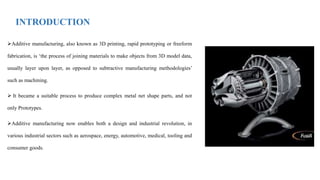
Additive manufacturing, also known as 3D printing, rapid prototyping or freeform
fabrication, is ‘the process of joining materials to make objects from 3D model data,
usually layer upon layer, as opposed to subtractive manufacturing methodologies’
such as machining.
 It became a suitable process to produce complex metal net shape parts, and not
only Prototypes.
Additive manufacturing now enables both a design and industrial revolution, in
various industrial sectors such as aerospace, energy, automotive, medical, tooling and
consumer goods.
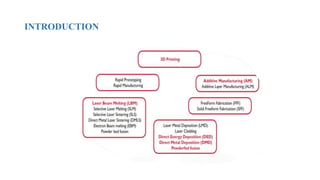
INTRODUCTION
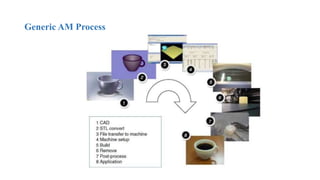
Generic AM Process
NEED (OR) BENEFITS OF AM
• Increased design freedom versus conventional casting and machining
• Light weight structures, made possible either by the use of lattice design or by designing parts where material
is only where it needs to be, without other constraints
• New functions such as complex internal channels or several parts built in one Net shape process meaning less
raw material consumption, up to 25 times less versus machining , important in the case of expensive or
difficult to machine alloys. The net shape capability helps creating complex parts in one step only thus
reducing the number of assembly operations such as welding, brazing.
• No tools needed, unlike other conventional metallurgy processes which require molds and metal forming or
removal tools
• Short production cycle time: complex parts can be produced layer by layer in a few hours in additive
machines. The total cycle time including post processing usually amounts to a few days or weeks and it is
usually much shorter than conventional metallurgy processes which often require production cycles of several
months. The process is recommended for the production of parts in small series
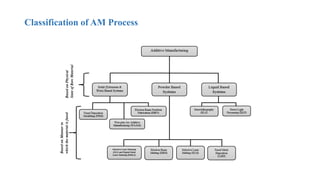
Classification of AM Process
Materials used for Additive Manufacturing
AM technology was originally developed around polymeric materials, waxes, and paper laminates.
Subsequently, there has been introduction of composites, metals, and ceramics.
CNC machining can be used for soft materials, like medium-density fiberboard (MDF), machinable foams,
machinable waxes, and even some polymers. However, use of CNC to shape softer materials is focused on
preparing these parts for use in a multistage process like casting. When using CNC machining to make final
products, it works particularly well for hard, relatively brittle materials like steels and other metal alloys to
produce high accuracy parts with well-defined properties.
THANK YOU

3D PRINTING AND TOOLING

  • 1.
    3D PRINTING AND TOOLING Presentedby Prof.S.Sathishkumar Assistant Professor Department of Mechanical Engineering Vel Tech Rangarajan Dr.Sagunthala R&D Institute of Science and Technology Avadi- Chennai-600062
  • 2.
    Course Educational Objective undergoingthis course we are expected to • Know the principles, methods, areas of usage, possibilities and limitations as well as environmental effects of the additive manufacturing technologies • Be familiar with the characteristics of various materials that are used in additive manufacturing.
  • 3.
    Course Outcomes  Describethe differences and of the application of a range of additive manufacturing processes  Select and use correct CAD formats in the manufacture of a 3D printed part.  Understand the operating principles, capabilities, and limitations of liquid and solid based additive manufacturing system, including fused deposition modelling and stereolithography.  Appreciate the operating principles, capabilities and limitations of powder based additive manufacturing system, including 3D printing and laser sintering.  Describe the important process parameters for bio-manufacturing and determine the suitable additive technique for bio-manufacturing.
  • 4.
    UNIT I-INTRODUCTION Overview –History – Need-Classification –Additive manufacturing Technology in product development–Additive manufacturing - Materials for Additive Manufacturing.
  • 5.
    INTRODUCTION Additive manufacturing, alsoknown as 3D printing, rapid prototyping or freeform fabrication, is ‘the process of joining materials to make objects from 3D model data, usually layer upon layer, as opposed to subtractive manufacturing methodologies’ such as machining.  It became a suitable process to produce complex metal net shape parts, and not only Prototypes. Additive manufacturing now enables both a design and industrial revolution, in various industrial sectors such as aerospace, energy, automotive, medical, tooling and consumer goods.
  • 6.
  • 7.
  • 8.
    NEED (OR) BENEFITSOF AM • Increased design freedom versus conventional casting and machining • Light weight structures, made possible either by the use of lattice design or by designing parts where material is only where it needs to be, without other constraints • New functions such as complex internal channels or several parts built in one Net shape process meaning less raw material consumption, up to 25 times less versus machining , important in the case of expensive or difficult to machine alloys. The net shape capability helps creating complex parts in one step only thus reducing the number of assembly operations such as welding, brazing.
  • 9.
    • No toolsneeded, unlike other conventional metallurgy processes which require molds and metal forming or removal tools • Short production cycle time: complex parts can be produced layer by layer in a few hours in additive machines. The total cycle time including post processing usually amounts to a few days or weeks and it is usually much shorter than conventional metallurgy processes which often require production cycles of several months. The process is recommended for the production of parts in small series
  • 10.
  • 11.
    Materials used forAdditive Manufacturing AM technology was originally developed around polymeric materials, waxes, and paper laminates. Subsequently, there has been introduction of composites, metals, and ceramics. CNC machining can be used for soft materials, like medium-density fiberboard (MDF), machinable foams, machinable waxes, and even some polymers. However, use of CNC to shape softer materials is focused on preparing these parts for use in a multistage process like casting. When using CNC machining to make final products, it works particularly well for hard, relatively brittle materials like steels and other metal alloys to produce high accuracy parts with well-defined properties.
  • 12.