ADDITIVE
MANUFACTURING
What Is Additive Manufacturing
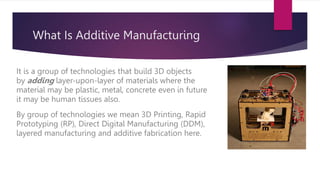
It is a group of technologies that build 3D objects
by adding layer-upon-layer of materials where the
material may be plastic, metal, concrete even in future
it may be human tissues also.
By group of technologies we mean 3D Printing, Rapid
Prototyping (RP), Direct Digital Manufacturing (DDM),
layered manufacturing and additive fabrication here.
History
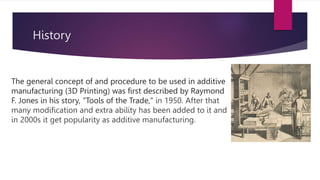
The general concept of and procedure to be used in additive
manufacturing (3D Printing) was first described by Raymond
F. Jones in his story, "Tools of the Trade," in 1950. After that
many modification and extra ability has been added to it and
in 2000s it get popularity as additive manufacturing.
General Principals
 Modelling:
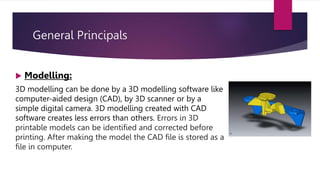
3D modelling can be done by a 3D modelling software like
computer-aided design (CAD), by 3D scanner or by a
simple digital camera. 3D modelling created with CAD
software creates less errors than others. Errors in 3D
printable models can be identified and corrected before
printing. After making the model the CAD file is stored as a
file in computer.
General Principals
Printing:
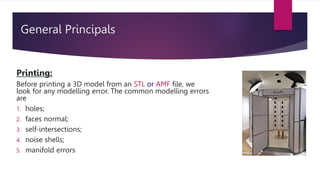
Before printing a 3D model from an STL or AMF file, we
look for any modelling error. The common modelling errors
are
1. holes;
2. faces normal;
3. self-intersections;
4. noise shells;
5. manifold errors
General Principals
 Printing:
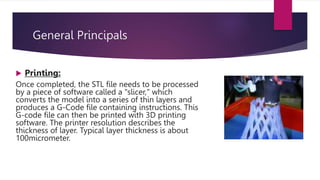
Once completed, the STL file needs to be processed
by a piece of software called a "slicer," which
converts the model into a series of thin layers and
produces a G-Code file containing instructions. This
G-code file can then be printed with 3D printing
software. The printer resolution describes the
thickness of layer. Typical layer thickness is about
100micrometer.
General Principals
 Finishing:
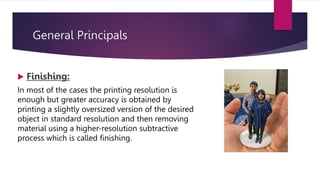
In most of the cases the printing resolution is
enough but greater accuracy is obtained by
printing a slightly oversized version of the desired
object in standard resolution and then removing
material using a higher-resolution subtractive
process which is called finishing.
Materials Being Used
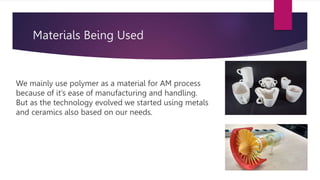
We mainly use polymer as a material for AM process
because of it’s ease of manufacturing and handling.
But as the technology evolved we started using metals
and ceramics also based on our needs.
Multi-Material Printing
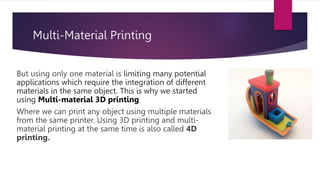
But using only one material is limiting many potential
applications which require the integration of different
materials in the same object. This is why we started
using Multi-material 3D printing
Where we can print any object using multiple materials
from the same printer. Using 3D printing and multi-
material printing at the same time is also called 4D
printing.
Processes And Printers
Although this technology looks like simple adding of layers upon layers but there are many difficult
processes also for producing a visualization tool in design, a means to create highly customized products
for consumers and professionals, as industrial tooling, to produce small lots of production parts. We can
group them in seven category as
• Vat photopolymerization
• Material jetting
• Binder jetting
• Powder bed fusion
• Material extrusion
• Directed energy deposition
• Sheet lamination
Processes And Printers
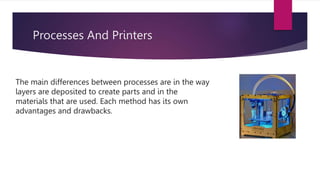
The main differences between processes are in the way
layers are deposited to create parts and in the
materials that are used. Each method has its own
advantages and drawbacks.
Applications
Typical applications for metal Additive Manufacturing are
 1) Production of models and prototypes during a product’s
development phase
 2) Parts for pilot series production in medical, automotive and
aerospace industry
 3) Short series production where tooling costs for casting or
injection moulding would be too high.
 4) Parts of high geometrical complexity which can not be
produced by means of conventional manufacturing (moulding,
grinding, milling, casting, etc.)
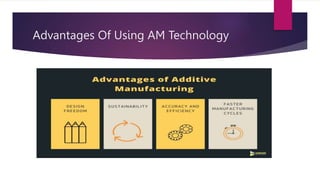
Advantages Of Using AM Technology
Future Of Additive manufacturing
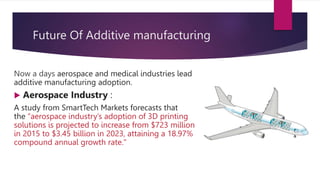
Now a days aerospace and medical industries lead
additive manufacturing adoption.
 Aerospace Industry :
A study from SmartTech Markets forecasts that
the “aerospace industry’s adoption of 3D printing
solutions is projected to increase from $723 million
in 2015 to $3.45 billion in 2023, attaining a 18.97%
compound annual growth rate."
Future In Medical Industry
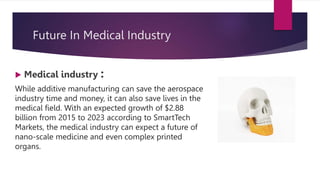
 Medical industry :
While additive manufacturing can save the aerospace
industry time and money, it can also save lives in the
medical field. With an expected growth of $2.88
billion from 2015 to 2023 according to SmartTech
Markets, the medical industry can expect a future of
nano-scale medicine and even complex printed
organs.
Thank You Page
Source : additivemanufacturing.com
medium.com
Wikipedia.com
Images : Wikipedia.com
images.google.com

Additive_Manufacturing

  • 1.
  • 2.
    What Is AdditiveManufacturing It is a group of technologies that build 3D objects by adding layer-upon-layer of materials where the material may be plastic, metal, concrete even in future it may be human tissues also. By group of technologies we mean 3D Printing, Rapid Prototyping (RP), Direct Digital Manufacturing (DDM), layered manufacturing and additive fabrication here.
  • 3.
    History The general conceptof and procedure to be used in additive manufacturing (3D Printing) was first described by Raymond F. Jones in his story, "Tools of the Trade," in 1950. After that many modification and extra ability has been added to it and in 2000s it get popularity as additive manufacturing.
  • 4.
    General Principals  Modelling: 3Dmodelling can be done by a 3D modelling software like computer-aided design (CAD), by 3D scanner or by a simple digital camera. 3D modelling created with CAD software creates less errors than others. Errors in 3D printable models can be identified and corrected before printing. After making the model the CAD file is stored as a file in computer.
  • 5.
    General Principals Printing: Before printinga 3D model from an STL or AMF file, we look for any modelling error. The common modelling errors are 1. holes; 2. faces normal; 3. self-intersections; 4. noise shells; 5. manifold errors
  • 6.
    General Principals  Printing: Oncecompleted, the STL file needs to be processed by a piece of software called a "slicer," which converts the model into a series of thin layers and produces a G-Code file containing instructions. This G-code file can then be printed with 3D printing software. The printer resolution describes the thickness of layer. Typical layer thickness is about 100micrometer.
  • 7.
    General Principals  Finishing: Inmost of the cases the printing resolution is enough but greater accuracy is obtained by printing a slightly oversized version of the desired object in standard resolution and then removing material using a higher-resolution subtractive process which is called finishing.
  • 8.
    Materials Being Used Wemainly use polymer as a material for AM process because of it’s ease of manufacturing and handling. But as the technology evolved we started using metals and ceramics also based on our needs.
  • 9.
    Multi-Material Printing But usingonly one material is limiting many potential applications which require the integration of different materials in the same object. This is why we started using Multi-material 3D printing Where we can print any object using multiple materials from the same printer. Using 3D printing and multi- material printing at the same time is also called 4D printing.
  • 10.
    Processes And Printers Althoughthis technology looks like simple adding of layers upon layers but there are many difficult processes also for producing a visualization tool in design, a means to create highly customized products for consumers and professionals, as industrial tooling, to produce small lots of production parts. We can group them in seven category as • Vat photopolymerization • Material jetting • Binder jetting • Powder bed fusion • Material extrusion • Directed energy deposition • Sheet lamination
  • 11.
    Processes And Printers Themain differences between processes are in the way layers are deposited to create parts and in the materials that are used. Each method has its own advantages and drawbacks.
  • 12.
    Applications Typical applications formetal Additive Manufacturing are  1) Production of models and prototypes during a product’s development phase  2) Parts for pilot series production in medical, automotive and aerospace industry  3) Short series production where tooling costs for casting or injection moulding would be too high.  4) Parts of high geometrical complexity which can not be produced by means of conventional manufacturing (moulding, grinding, milling, casting, etc.)
  • 13.
    Advantages Of UsingAM Technology
  • 14.
    Future Of Additivemanufacturing Now a days aerospace and medical industries lead additive manufacturing adoption.  Aerospace Industry : A study from SmartTech Markets forecasts that the “aerospace industry’s adoption of 3D printing solutions is projected to increase from $723 million in 2015 to $3.45 billion in 2023, attaining a 18.97% compound annual growth rate."
  • 15.
    Future In MedicalIndustry  Medical industry : While additive manufacturing can save the aerospace industry time and money, it can also save lives in the medical field. With an expected growth of $2.88 billion from 2015 to 2023 according to SmartTech Markets, the medical industry can expect a future of nano-scale medicine and even complex printed organs.
  • 16.
    Thank You Page Source: additivemanufacturing.com medium.com Wikipedia.com Images : Wikipedia.com images.google.com