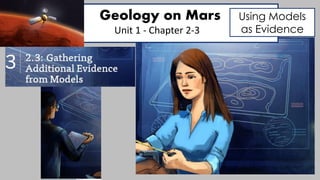
Geology on Mars
Unit 1 - Chapter 2-3
Using Models
as Evidence
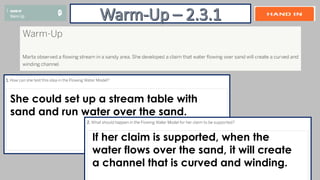
She could set up a stream table with
sand and run water over the sand.
If her claim is supported, when the
water flows over the sand, it will create
a channel that is curved and winding.
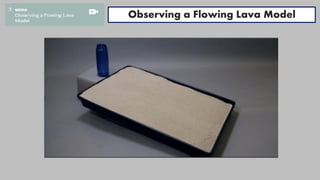
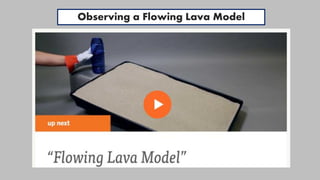
Observing a Flowing Lava Model
You will watch a video of a new model
to get evidence about whether flowing
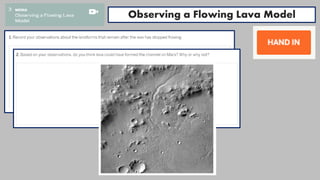
lava could have formed the channel on
Mars.
The Flowing Water Model used flowing
water and sand to represent flowing
water in the natural world, actual lava
cannot be used to represent flowing
lava. This Flowing Lava Model uses
wax to represent flowing lava.
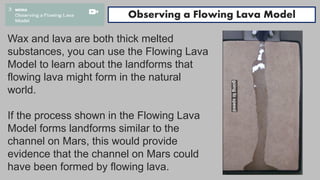
Wax and lava are both thick melted
substances, you can use the Flowing Lava
Model to learn about the landforms that
flowing lava might form in the natural
world.
If the process shown in the Flowing Lava
Model forms landforms similar to the
channel on Mars, this would provide
evidence that the channel on Mars could
have been formed by flowing lava.
Observing a Flowing Lava Model
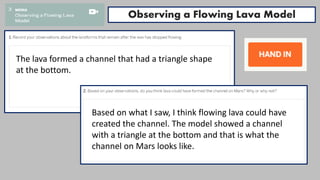
The lava formed a channel that had a triangle shape
at the bottom.
Based on what I saw, I think flowing lava could have
created the channel. The model showed a channel
with a triangle at the bottom and that is what the
channel on Mars looks like.
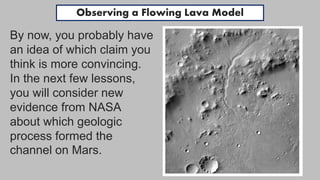
By now, you probably have
an idea of which claim you
think is more convincing.
In the next few lessons,
you will consider new
evidence from NASA
about which geologic
process formed the
channel on Mars.
Observing a Flowing Lava Model
Review the Chapter 2 Question. Remind students that they are
investigating the question: How can we gather more evidence about
whether lava or water formed the channel on Mars?
• In the previous lesson, we used a Flowing Water Model to get more evidence
about what formed the channel on Mars. We gathered evidence about the claim
that landforms formed by flowing water remain after the water stops flowing. We
observed that landforms do remain.
• That means that the channel on Mars could have been formed by flowing water
even though there is no water flowing water there now.
Testing an Idea with the Flowing Water Model
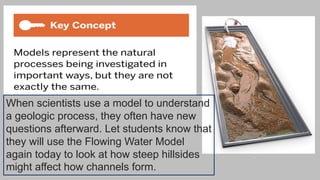
When scientists use a model to understand
a geologic process, they often have new
questions afterward. Let students know that
they will use the Flowing Water Model
again today to look at how steep hillsides
might affect how channels form.
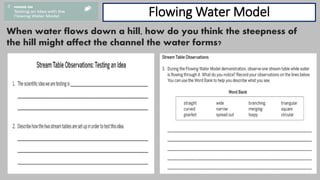
Flowing Water Model
When water flows down a hill, how do you think the steepness of
the hill might affect the channel the water forms?
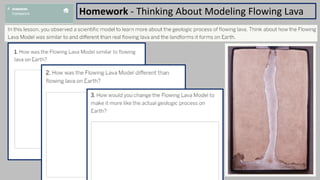
Homework - Thinking About Modeling Flowing Lava

Gathering Additional Evidence from Models

  • 1.
    Geology on Mars Unit1 - Chapter 2-3 Using Models as Evidence
  • 3.
    She could setup a stream table with sand and run water over the sand. If her claim is supported, when the water flows over the sand, it will create a channel that is curved and winding.
  • 4.
    Observing a FlowingLava Model You will watch a video of a new model to get evidence about whether flowing lava could have formed the channel on Mars. The Flowing Water Model used flowing water and sand to represent flowing water in the natural world, actual lava cannot be used to represent flowing lava. This Flowing Lava Model uses wax to represent flowing lava.
  • 5.
    Wax and lavaare both thick melted substances, you can use the Flowing Lava Model to learn about the landforms that flowing lava might form in the natural world. If the process shown in the Flowing Lava Model forms landforms similar to the channel on Mars, this would provide evidence that the channel on Mars could have been formed by flowing lava. Observing a Flowing Lava Model
  • 6.
  • 7.
  • 8.
    Observing a FlowingLava Model The lava formed a channel that had a triangle shape at the bottom. Based on what I saw, I think flowing lava could have created the channel. The model showed a channel with a triangle at the bottom and that is what the channel on Mars looks like.
  • 9.
    By now, youprobably have an idea of which claim you think is more convincing. In the next few lessons, you will consider new evidence from NASA about which geologic process formed the channel on Mars. Observing a Flowing Lava Model
  • 10.
  • 11.
    Review the Chapter2 Question. Remind students that they are investigating the question: How can we gather more evidence about whether lava or water formed the channel on Mars? • In the previous lesson, we used a Flowing Water Model to get more evidence about what formed the channel on Mars. We gathered evidence about the claim that landforms formed by flowing water remain after the water stops flowing. We observed that landforms do remain. • That means that the channel on Mars could have been formed by flowing water even though there is no water flowing water there now. Testing an Idea with the Flowing Water Model
  • 12.
    When scientists usea model to understand a geologic process, they often have new questions afterward. Let students know that they will use the Flowing Water Model again today to look at how steep hillsides might affect how channels form.
  • 13.
    Flowing Water Model Whenwater flows down a hill, how do you think the steepness of the hill might affect the channel the water forms?
  • 14.
    Homework - ThinkingAbout Modeling Flowing Lava