DEVELOPMENT OF
EVOLUTIONARY
THOUGHT
GENERAL BIOLOGY 2
LEARNING COMPETENCY
Trace the development of
evolutionary thought
STEM_BIO11/12-IIIc-g-11
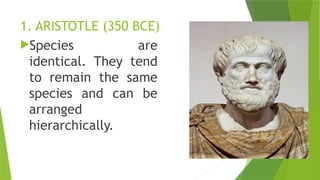
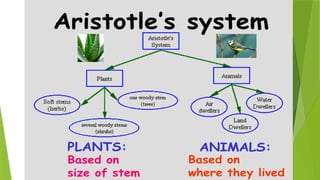
1. ARISTOTLE (350 BCE)
Species are
identical. They tend
to remain the same
species and can be
arranged
hierarchically.
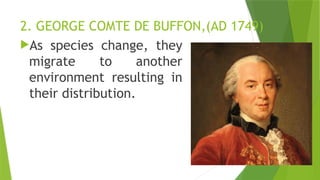
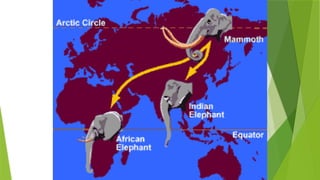
2. GEORGE COMTE DE BUFFON,(AD 1749)
As species change, they
migrate to another
environment resulting in
their distribution.
3. JAMES HUTTON (1795)
He developed the theory on
“Gradualism”
According to this theory, the
population of a species is
transformed slowly and
progressively into a new species
by the accumulation of micro-
evolutionary changes in the
genetic heritage
4. JEAN BAPTISTE de LAMARCK
Proposed that modern species
descended from other species.
Theory of Need
-Organisms change because they
need to.
- For an organism to evolve a
structure, it must need the
structure.
4. JEAN BAPTISTE de LAMARCK
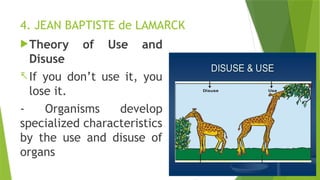
Theory of Use and
Disuse
-If you don’t use it, you
lose it.
- Organisms develop
specialized characteristics
by the use and disuse of
organs
4. JEAN BAPTISTE de LAMARCK
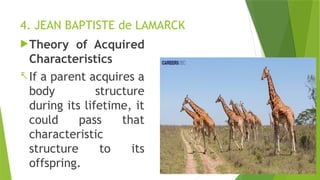
Theory of Acquired
Characteristics
-If a parent acquires a
body structure
during its lifetime, it
could pass that
characteristic
structure to its
offspring.
5. CHARLES LYELL (1830)
Geologist, followed
footsteps of Hutton
All changes in the
environment are
uniform and gradual.
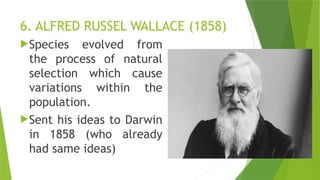
6. ALFRED RUSSEL WALLACE (1858)
Species evolved from
the process of natural
selection which cause
variations within the
population.
Sent his ideas to Darwin
in 1858 (who already
had same ideas)
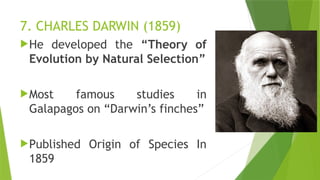
7. CHARLES DARWIN (1859)
He developed the “Theory of
Evolution by Natural Selection”
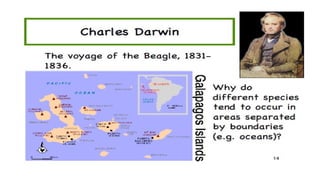
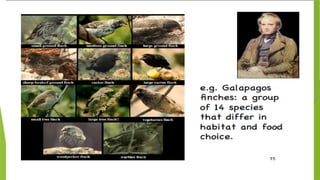
Most famous studies in
Galapagos on “Darwin’s finches”
Published Origin of Species In
1859
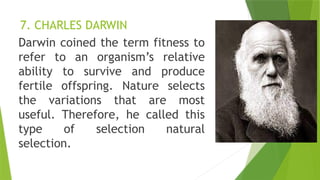
7. CHARLES DARWIN
Darwin coined the term fitness to
refer to an organism’s relative
ability to survive and produce
fertile offspring. Nature selects
the variations that are most
useful. Therefore, he called this
type of selection natural
selection.
Thank you and
God bless you!

DEVELOPMENT OF EVOLUTIONARY THOUGHT.pptx

  • 1.
  • 2.
    LEARNING COMPETENCY Trace thedevelopment of evolutionary thought STEM_BIO11/12-IIIc-g-11
  • 3.
    1. ARISTOTLE (350BCE) Species are identical. They tend to remain the same species and can be arranged hierarchically.
  • 5.
    2. GEORGE COMTEDE BUFFON,(AD 1749) As species change, they migrate to another environment resulting in their distribution.
  • 7.
    3. JAMES HUTTON(1795) He developed the theory on “Gradualism” According to this theory, the population of a species is transformed slowly and progressively into a new species by the accumulation of micro- evolutionary changes in the genetic heritage
  • 8.
    4. JEAN BAPTISTEde LAMARCK Proposed that modern species descended from other species. Theory of Need -Organisms change because they need to. - For an organism to evolve a structure, it must need the structure.
  • 9.
    4. JEAN BAPTISTEde LAMARCK Theory of Use and Disuse -If you don’t use it, you lose it. - Organisms develop specialized characteristics by the use and disuse of organs
  • 10.
    4. JEAN BAPTISTEde LAMARCK Theory of Acquired Characteristics -If a parent acquires a body structure during its lifetime, it could pass that characteristic structure to its offspring.
  • 12.
    5. CHARLES LYELL(1830) Geologist, followed footsteps of Hutton All changes in the environment are uniform and gradual.
  • 13.
    6. ALFRED RUSSELWALLACE (1858) Species evolved from the process of natural selection which cause variations within the population. Sent his ideas to Darwin in 1858 (who already had same ideas)
  • 14.
    7. CHARLES DARWIN(1859) He developed the “Theory of Evolution by Natural Selection” Most famous studies in Galapagos on “Darwin’s finches” Published Origin of Species In 1859
  • 17.
    7. CHARLES DARWIN Darwincoined the term fitness to refer to an organism’s relative ability to survive and produce fertile offspring. Nature selects the variations that are most useful. Therefore, he called this type of selection natural selection.
  • 18.

Editor's Notes

  • #5 Naturalist. His theories influenced Lamarck and Darwin.
  • #7 Prevailing Idea: Catastrophism: sudden changes were due to large or quick events. Father of Geology. First geologist. Earth’s geological features and history of life as a result of slow process with small/gradual changes over long period of time.
  • #8 Speciation
  • #12 Earth was over 300 million years old.