



3 Things You Should Know About the
Changing Refrigeration Climate
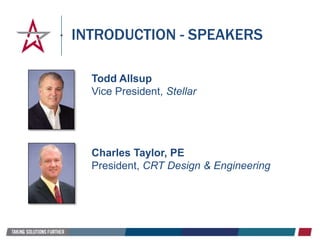
INTRODUCTION - SPEAKERS
Todd Allsup
Vice President, Stellar
Charles Taylor, PE
President, CRT Design & Engineering
• What you need to know about the revised compliance
schedules and impacts of non-compliance
• Innovative technologies to address changing landscape
including:
• Distributed refrigeration – low-charge rooftop packaged systems
• CO2/NH3 cascade systems
• Low-charge packaged chillers
• Pros/cons in evaluating options and choosing best
solutions
AGENDA FOR WEBINAR
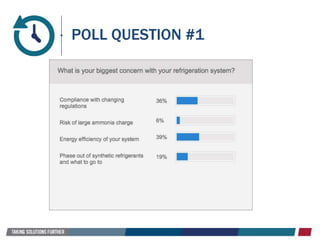
What is your biggest concern with your refrigeration
system?
• Compliance with changing regulations
• Risk of large ammonia charge
• Energy efficiency of your system
• Phase out of synthetic refrigerants and what to go to
POLL QUESTION #1
POLL QUESTION #1
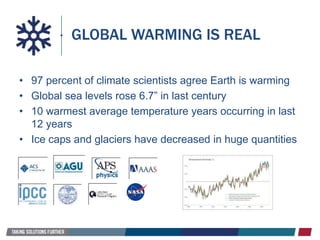
• 97 percent of climate scientists agree Earth is warming
• Global sea levels rose 6.7” in last century
• 10 warmest average temperature years occurring in last
12 years
• Ice caps and glaciers have decreased in huge quantities
GLOBAL WARMING IS REAL
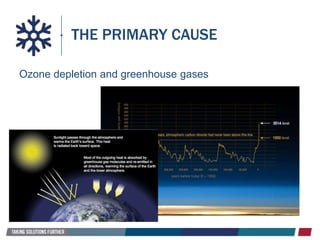
Ozone depletion and greenhouse gases
THE PRIMARY CAUSE
1987 Montreal Protocol: First globally supported legislation to
reduce ozone depleting substances – Bans CFCs
1992 Kyoto Protocol: Expanded the agreements to reduce
greenhouse gas emissions – ban HCFCs
2013 President Obama outlined the Climate Action Plan
2014 EPA proposed new regulations under the SNAP
(Significant New Alternative Policy) program to significantly
move up the phase out date for many of the industries
workhorse refrigerants.
REGULATORY AGENCIES
Regulations are pushing the industry toward natural refrigerants.
2013 President Obama issues executive order 13650
Actions to improve Chemical Facility Safety
• Issued proposed revisions for Process Safety Management
• Adding new management systems
• Expanding mechanical integrity
• Expanding management of change requirements
• Updated RAGAGEP
• Issued proposed revisions for Risk Management Program
• Similar modifications as PSM but more detailed and broader
• Requiring “inherently safer technology”
• 2014 CFATS - Chemical Facility Anti-Terrorism Standards
REGULATION UPDATE
Presently 3,415 regulations in pipeline with focus to get as much
done in this administration as possible.
REVISED COMPLIANCE SCHEDULES AND
IMPACTS OF NON-COMPLIANCE
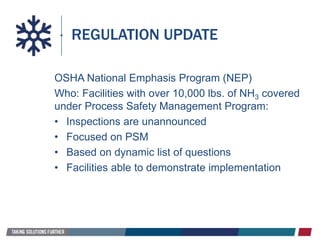
REGULATION UPDATE
OSHA National Emphasis Program (NEP)
Who: Facilities with over 10,000 lbs. of NH3 covered
under Process Safety Management Program:
• Inspections are unannounced
• Focused on PSM
• Based on dynamic list of questions
• Facilities able to demonstrate implementation
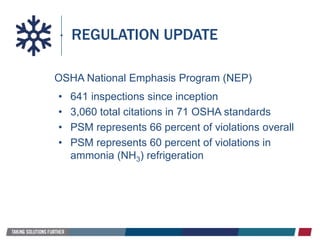
REGULATION UPDATE
OSHA National Emphasis Program (NEP)
• 641 inspections since inception
• 3,060 total citations in 71 OSHA standards
• PSM represents 66 percent of violations overall
• PSM represents 60 percent of violations in
ammonia (NH3) refrigeration
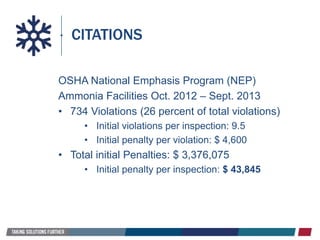
CITATIONS
OSHA National Emphasis Program (NEP)
Ammonia Facilities Oct. 2012 – Sept. 2013
• 734 Violations (26 percent of total violations)
• Initial violations per inspection: 9.5
• Initial penalty per violation: $ 4,600
• Total initial Penalties: $ 3,376,075
• Initial penalty per inspection: $ 43,845
REGULATION UPDATE
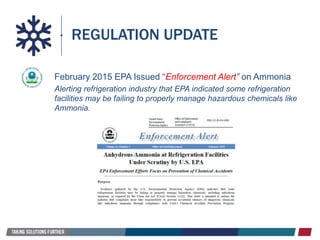
February 2015 EPA Issued “Enforcement Alert” on Ammonia
Alerting refrigeration industry that EPA indicated some refrigeration
facilities may be failing to properly manage hazardous chemicals like
Ammonia.
• Refrigeration industry is being
pushed toward natural
refrigerants
• Regulations on large-charge
ammonia systems are
increasing
WHAT’S THE SOLUTION?
How do you get the advantages of natural
refrigerant and minimize the risk?
INNOVATIVE TECHNOLOGIES TO ADDRESS
CHANGING LANDSCAPE
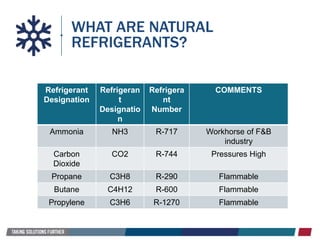
WHAT ARE NATURAL
REFRIGERANTS?
Refrigerant
Designation
Refrigeran
t
Designatio
n
Refrigera
nt
Number
COMMENTS
Ammonia NH3 R-717 Workhorse of F&B
industry
Carbon
Dioxide
CO2 R-744 Pressures High
Propane C3H8 R-290 Flammable
Butane C4H12 R-600 Flammable
Propylene C3H6 R-1270 Flammable
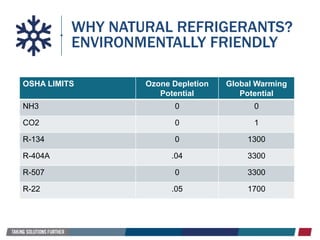
WHY NATURAL REFRIGERANTS?
ENVIRONMENTALLY FRIENDLY
OSHA LIMITS Ozone Depletion
Potential
Global Warming
Potential
NH3 0 0
CO2 0 1
R-134 0 1300
R-404A .04 3300
R-507 0 3300
R-22 .05 1700
WHY NATURAL REFRIGERANTS?
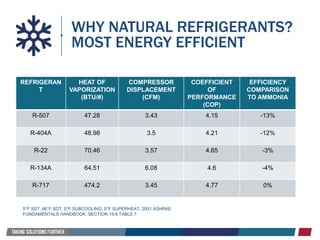
MOST ENERGY EFFICIENT
REFRIGERAN
T
HEAT OF
VAPORIZATION
(BTU/#)
COMPRESSOR
DISPLACEMENT
(CFM)
COEFFICIENT
OF
PERFORMANCE
(COP)
EFFICIENCY
COMPARISON
TO AMMONIA
R-507 47.28 3.43 4.15 -13%
R-404A 48.98 3.5 4.21 -12%
R-22 70.46 3.57 4.65 -3%
R-134A 64.51 6.08 4.6 -4%
R-717 474.2 3.45 4.77 0%
5°F SST, 86°F SDT, 0°F SUBCOOLING, 0°F SUPERHEAT, 2001 ASHRAE
FUNDAMENTALS HANDBOOK, SECTION 19.8 TABLE 7
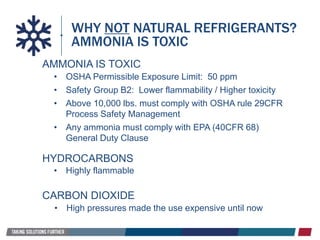
WHY NOT NATURAL REFRIGERANTS?
AMMONIA IS TOXIC
AMMONIA IS TOXIC
• OSHA Permissible Exposure Limit: 50 ppm
• Safety Group B2: Lower flammability / Higher toxicity
• Above 10,000 lbs. must comply with OSHA rule 29CFR
Process Safety Management
• Any ammonia must comply with EPA (40CFR 68)
General Duty Clause
HYDROCARBONS
• Highly flammable
CARBON DIOXIDE
• High pressures made the use expensive until now
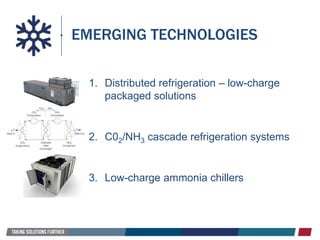
1. Distributed refrigeration – low-charge
packaged solutions
2. C02/NH3 cascade refrigeration systems
3. Low-charge ammonia chillers
EMERGING TECHNOLOGIES
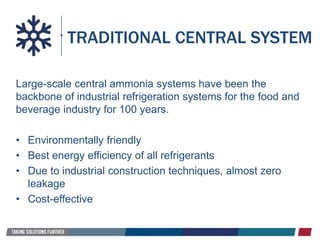
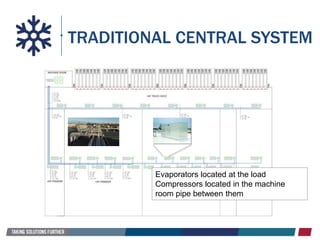
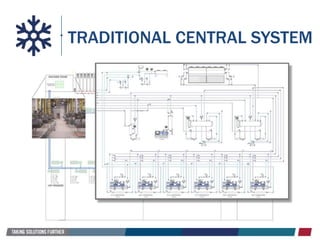
Large-scale central ammonia systems have been the
backbone of industrial refrigeration systems for the food and
beverage industry for 100 years.
• Environmentally friendly
• Best energy efficiency of all refrigerants
• Due to industrial construction techniques, almost zero
leakage
• Cost-effective
TRADITIONAL CENTRAL SYSTEM
Evaporators located at the load
Compressors located in the machine
room pipe between them
TRADITIONAL CENTRAL SYSTEM
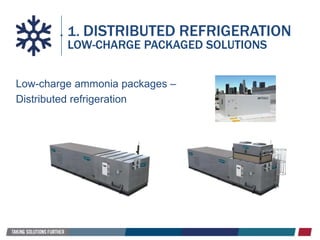
Low-charge ammonia packages –
Distributed refrigeration
1. DISTRIBUTED REFRIGERATION
LOW-CHARGE PACKAGED SOLUTIONS
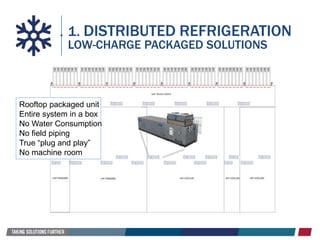
1. DISTRIBUTED REFRIGERATION
LOW-CHARGE PACKAGED SOLUTIONS
Rooftop packaged unit
Entire system in a box
No Water Consumption
No field piping
True “plug and play”
No machine room
1. DISTRIBUTED REFRIGERATION
LOW-CHARGE PACKAGED SOLUTIONS
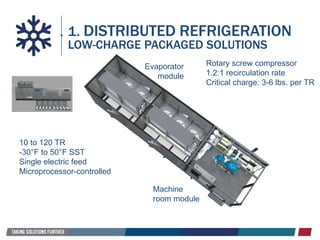
Evaporator
module
Machine
room module
Rotary screw compressor
1.2:1 recirculation rate
Critical charge: 3-6 lbs. per TR
10 to 120 TR
-30°F to 50°F SST
Single electric feed
Microprocessor-controlled
1. DISTRIBUTED REFRIGERATION
LOW-CHARGE PACKAGED SOLUTIONS
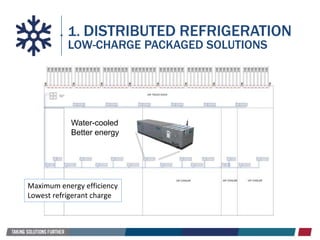
Water-cooled
Better energy
Maximum energy efficiency
Lowest refrigerant charge
1. DISTRIBUTED REFRIGERATION
LOW-CHARGE PACKAGED SOLUTIONS
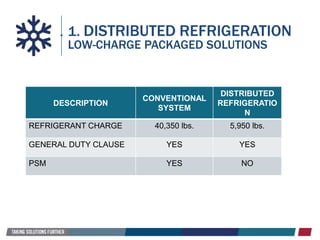
DESCRIPTION
CONVENTIONAL
SYSTEM
DISTRIBUTED
REFRIGERATIO
N
REFRIGERANT CHARGE 40,350 lbs. 5,950 lbs.
GENERAL DUTY CLAUSE YES YES
PSM YES NO
2. CO2/NH3 CASCADE SYSTEM
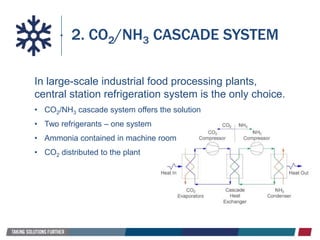
In large-scale industrial food processing plants,
central station refrigeration system is the only choice.
• CO2/NH3 cascade system offers the solution
• Two refrigerants – one system
• Ammonia contained in machine room
• CO2 distributed to the plant
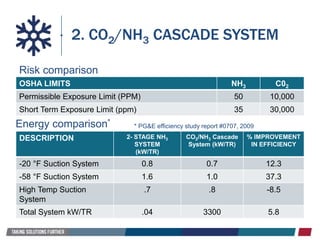
Risk comparison
2. CO2/NH3 CASCADE SYSTEM
OSHA LIMITS NH3 C02
Permissible Exposure Limit (PPM) 50 10,000
Short Term Exposure Limit (ppm) 35 30,000
DESCRIPTION 2- STAGE NH3
SYSTEM
(kW/TR)
CO2/NH3 Cascade
System (kW/TR)
% IMPROVEMENT
IN EFFICIENCY
-20 °F Suction System 0.8 0.7 12.3
-58 °F Suction System 1.6 1.0 37.3
High Temp Suction
System
.7 .8 -8.5
Total System kW/TR .04 3300 5.8
Energy comparison*
* PG&E efficiency study report #0707, 2009
2. CO2/NH3 CASCADE SYSTEM
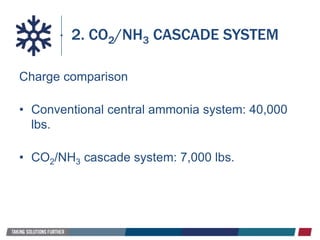
Charge comparison
• Conventional central ammonia system: 40,000
lbs.
• CO2/NH3 cascade system: 7,000 lbs.
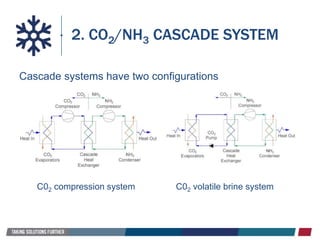
Cascade systems have two configurations
2. CO2/NH3 CASCADE SYSTEM
C02 compression system C02 volatile brine system
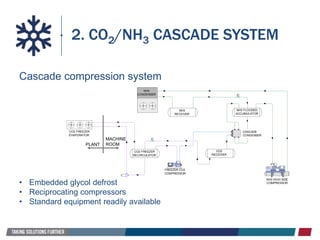
Cascade compression system
2. CO2/NH3 CASCADE SYSTEM
NH3 HIGH SIDE
COMPRESSOR
CO2 FREEZER
EVAPORATOR
M
M
NH3
RECEIVER
NH3 FLOODED
ACCUMULATOR
CO2 FREEZER
RECIRCULATOR
NH3
CONDENSER
CASCADE
CONDENSER
CO2
RECEIVER
FREEZER CO2
COMPRESSOR
MACHINE
ROOMPLANT
• Embedded glycol defrost
• Reciprocating compressors
• Standard equipment readily available
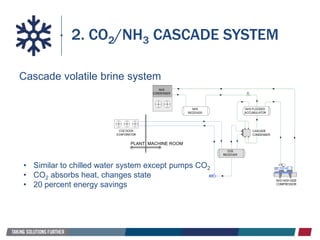
Cascade volatile brine system
2. CO2/NH3 CASCADE SYSTEM
CO2 DOCK
EVAPORATOR
CASCADE
CONDENSER
CO2
RECEIVER
NH3 HIGH SIDE
COMPRESSOR
M
NH3
RECEIVER
NH3 FLOODED
ACCUMULATOR
NH3
CONDENSER
• Similar to chilled water system except pumps CO2
• CO2 absorbs heat, changes state
• 20 percent energy savings
MACHINE ROOMPLANT
In accordance with the Montreal Protocol, the phase out of
CFC and HCFC refrigerant continues
• R-22 will be completely banned by 2020
• Numerous synthetic refrigerants are options but each
has challenges:
• High global warming potential (potential to be replaced in future)
• Reduction in efficiency
• Increase in leakage rate
• Temperature glide
3. LOW-CHARGE AMMONIA
CHILLERS
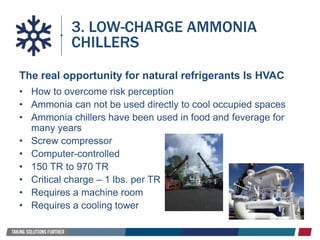
The real opportunity for natural refrigerants Is HVAC
• How to overcome risk perception
• Ammonia can not be used directly to cool occupied spaces
• Ammonia chillers have been used in food and feverage for
many years
• Screw compressor
• Computer-controlled
• 150 TR to 970 TR
• Critical charge – 1 lbs. per TR
• Requires a machine room
• Requires a cooling tower
3. LOW-CHARGE AMMONIA
CHILLERS
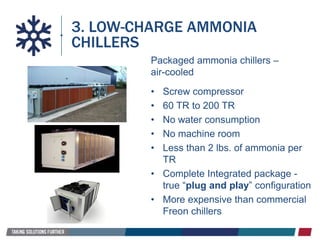
Packaged ammonia chillers –
air-cooled
• Screw compressor
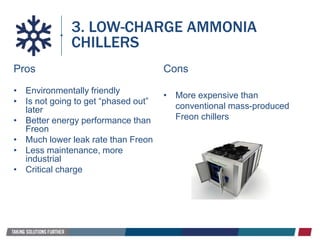
• 60 TR to 200 TR
• No water consumption
• No machine room
• Less than 2 lbs. of ammonia per
TR
• Complete Integrated package -
true “plug and play” configuration
• More expensive than commercial
Freon chillers
3. LOW-CHARGE AMMONIA
CHILLERS
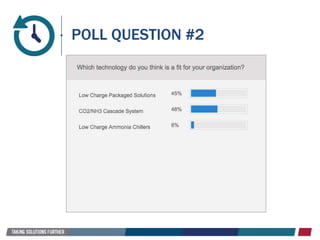
Which technology do you think is a fit for your
organization?
• Low-charge packaged solutions
• CO2/NH3 cascade system
• Low-charge ammonia chillers
POLL QUESTION #2
POLL QUESTION #2
PROS/CONS IN EVALUATING OPTIONS AND
CHOOSING BEST SOLUTIONS
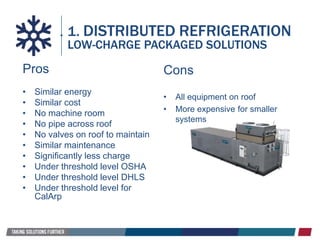
Pros
• Similar energy
• Similar cost
• No machine room
• No pipe across roof
• No valves on roof to maintain
• Similar maintenance
• Significantly less charge
• Under threshold level OSHA
• Under threshold level DHLS
• Under threshold level for
CalArp
1. DISTRIBUTED REFRIGERATION
LOW-CHARGE PACKAGED SOLUTIONS
Cons
• All equipment on roof
• More expensive for smaller
systems
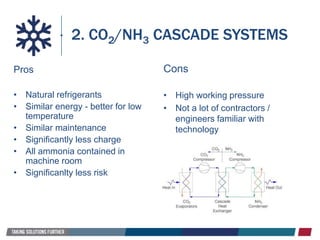
2. CO2/NH3 CASCADE SYSTEMS
Pros
• Natural refrigerants
• Similar energy - better for low
temperature
• Similar maintenance
• Significantly less charge
• All ammonia contained in
machine room
• Significanlty less risk
Cons
• High working pressure
• Not a lot of contractors /
engineers familiar with
technology
3. LOW-CHARGE AMMONIA
CHILLERS
Pros
• Environmentally friendly
• Is not going to get “phased out”
later
• Better energy performance than
Freon
• Much lower leak rate than Freon
• Less maintenance, more
industrial
• Critical charge
Cons
• More expensive than
conventional mass-produced
Freon chillers
1. Synthetic refrigerants are being phased out. As environmentally
friendly alternatives become commercially viable, the synthetic
refrigerants that are presently being used may be phased out in the
future
2. The government is increasing oversight and regulations for large-
charge ammonia systems
3. Distributed refrigeration with packaged rooftop units is a viable solution
to take advantage of natural refrigerants while minimizing the risk
4. For plants that require a central system, CO2/NH3 cascade systems
provide an alternative that minimizes large ammonia charges
5. Low-charge ammonia chillers are a viable option to replace Freon
chillers, using natural refrigerants while minimizing the risk
5 KEY TAKEAWAYS
CONTACT INFO - SPEAKERS
Todd Allsup
Vice President, Stellar
tallsup@stellar.net
904-899-9339
Charles Taylor, PE
President, CRT Design & Engineering
chuck.taylor@crt-design.com
904-923-0084
3 Things You Should Know About the Changing Refrigeration Climate

3 Things You Should Know About the Changing Refrigeration Climate

  • 1.
    3 Things YouShould Know About the Changing Refrigeration Climate
  • 2.
    INTRODUCTION - SPEAKERS ToddAllsup Vice President, Stellar Charles Taylor, PE President, CRT Design & Engineering
  • 3.
    • What youneed to know about the revised compliance schedules and impacts of non-compliance • Innovative technologies to address changing landscape including: • Distributed refrigeration – low-charge rooftop packaged systems • CO2/NH3 cascade systems • Low-charge packaged chillers • Pros/cons in evaluating options and choosing best solutions AGENDA FOR WEBINAR
  • 4.
    What is yourbiggest concern with your refrigeration system? • Compliance with changing regulations • Risk of large ammonia charge • Energy efficiency of your system • Phase out of synthetic refrigerants and what to go to POLL QUESTION #1
  • 5.
  • 6.
    • 97 percentof climate scientists agree Earth is warming • Global sea levels rose 6.7” in last century • 10 warmest average temperature years occurring in last 12 years • Ice caps and glaciers have decreased in huge quantities GLOBAL WARMING IS REAL
  • 7.
    Ozone depletion andgreenhouse gases THE PRIMARY CAUSE
  • 8.
    1987 Montreal Protocol:First globally supported legislation to reduce ozone depleting substances – Bans CFCs 1992 Kyoto Protocol: Expanded the agreements to reduce greenhouse gas emissions – ban HCFCs 2013 President Obama outlined the Climate Action Plan 2014 EPA proposed new regulations under the SNAP (Significant New Alternative Policy) program to significantly move up the phase out date for many of the industries workhorse refrigerants. REGULATORY AGENCIES Regulations are pushing the industry toward natural refrigerants.
  • 9.
    2013 President Obamaissues executive order 13650 Actions to improve Chemical Facility Safety • Issued proposed revisions for Process Safety Management • Adding new management systems • Expanding mechanical integrity • Expanding management of change requirements • Updated RAGAGEP • Issued proposed revisions for Risk Management Program • Similar modifications as PSM but more detailed and broader • Requiring “inherently safer technology” • 2014 CFATS - Chemical Facility Anti-Terrorism Standards REGULATION UPDATE Presently 3,415 regulations in pipeline with focus to get as much done in this administration as possible.
  • 10.
    REVISED COMPLIANCE SCHEDULESAND IMPACTS OF NON-COMPLIANCE
  • 11.
    REGULATION UPDATE OSHA NationalEmphasis Program (NEP) Who: Facilities with over 10,000 lbs. of NH3 covered under Process Safety Management Program: • Inspections are unannounced • Focused on PSM • Based on dynamic list of questions • Facilities able to demonstrate implementation
  • 12.
    REGULATION UPDATE OSHA NationalEmphasis Program (NEP) • 641 inspections since inception • 3,060 total citations in 71 OSHA standards • PSM represents 66 percent of violations overall • PSM represents 60 percent of violations in ammonia (NH3) refrigeration
  • 13.
    CITATIONS OSHA National EmphasisProgram (NEP) Ammonia Facilities Oct. 2012 – Sept. 2013 • 734 Violations (26 percent of total violations) • Initial violations per inspection: 9.5 • Initial penalty per violation: $ 4,600 • Total initial Penalties: $ 3,376,075 • Initial penalty per inspection: $ 43,845
  • 14.
    REGULATION UPDATE February 2015EPA Issued “Enforcement Alert” on Ammonia Alerting refrigeration industry that EPA indicated some refrigeration facilities may be failing to properly manage hazardous chemicals like Ammonia.
  • 15.
    • Refrigeration industryis being pushed toward natural refrigerants • Regulations on large-charge ammonia systems are increasing WHAT’S THE SOLUTION? How do you get the advantages of natural refrigerant and minimize the risk?
  • 16.
    INNOVATIVE TECHNOLOGIES TOADDRESS CHANGING LANDSCAPE
  • 17.
    WHAT ARE NATURAL REFRIGERANTS? Refrigerant Designation Refrigeran t Designatio n Refrigera nt Number COMMENTS AmmoniaNH3 R-717 Workhorse of F&B industry Carbon Dioxide CO2 R-744 Pressures High Propane C3H8 R-290 Flammable Butane C4H12 R-600 Flammable Propylene C3H6 R-1270 Flammable
  • 18.
    WHY NATURAL REFRIGERANTS? ENVIRONMENTALLYFRIENDLY OSHA LIMITS Ozone Depletion Potential Global Warming Potential NH3 0 0 CO2 0 1 R-134 0 1300 R-404A .04 3300 R-507 0 3300 R-22 .05 1700
  • 19.
    WHY NATURAL REFRIGERANTS? MOSTENERGY EFFICIENT REFRIGERAN T HEAT OF VAPORIZATION (BTU/#) COMPRESSOR DISPLACEMENT (CFM) COEFFICIENT OF PERFORMANCE (COP) EFFICIENCY COMPARISON TO AMMONIA R-507 47.28 3.43 4.15 -13% R-404A 48.98 3.5 4.21 -12% R-22 70.46 3.57 4.65 -3% R-134A 64.51 6.08 4.6 -4% R-717 474.2 3.45 4.77 0% 5°F SST, 86°F SDT, 0°F SUBCOOLING, 0°F SUPERHEAT, 2001 ASHRAE FUNDAMENTALS HANDBOOK, SECTION 19.8 TABLE 7
  • 20.
    WHY NOT NATURALREFRIGERANTS? AMMONIA IS TOXIC AMMONIA IS TOXIC • OSHA Permissible Exposure Limit: 50 ppm • Safety Group B2: Lower flammability / Higher toxicity • Above 10,000 lbs. must comply with OSHA rule 29CFR Process Safety Management • Any ammonia must comply with EPA (40CFR 68) General Duty Clause HYDROCARBONS • Highly flammable CARBON DIOXIDE • High pressures made the use expensive until now
  • 21.
    1. Distributed refrigeration– low-charge packaged solutions 2. C02/NH3 cascade refrigeration systems 3. Low-charge ammonia chillers EMERGING TECHNOLOGIES
  • 22.
    Large-scale central ammoniasystems have been the backbone of industrial refrigeration systems for the food and beverage industry for 100 years. • Environmentally friendly • Best energy efficiency of all refrigerants • Due to industrial construction techniques, almost zero leakage • Cost-effective TRADITIONAL CENTRAL SYSTEM
  • 23.
    TRADITIONAL CENTRAL SYSTEM Evaporatorslocated at the load Compressors located in the machine room pipe between them
  • 24.
  • 25.
    Low-charge ammonia packages– Distributed refrigeration 1. DISTRIBUTED REFRIGERATION LOW-CHARGE PACKAGED SOLUTIONS
  • 26.
    1. DISTRIBUTED REFRIGERATION LOW-CHARGEPACKAGED SOLUTIONS Rooftop packaged unit Entire system in a box No Water Consumption No field piping True “plug and play” No machine room
  • 27.
    1. DISTRIBUTED REFRIGERATION LOW-CHARGEPACKAGED SOLUTIONS Evaporator module Machine room module Rotary screw compressor 1.2:1 recirculation rate Critical charge: 3-6 lbs. per TR 10 to 120 TR -30°F to 50°F SST Single electric feed Microprocessor-controlled
  • 28.
    1. DISTRIBUTED REFRIGERATION LOW-CHARGEPACKAGED SOLUTIONS Water-cooled Better energy Maximum energy efficiency Lowest refrigerant charge
  • 29.
    1. DISTRIBUTED REFRIGERATION LOW-CHARGEPACKAGED SOLUTIONS DESCRIPTION CONVENTIONAL SYSTEM DISTRIBUTED REFRIGERATIO N REFRIGERANT CHARGE 40,350 lbs. 5,950 lbs. GENERAL DUTY CLAUSE YES YES PSM YES NO
  • 30.
    2. CO2/NH3 CASCADESYSTEM In large-scale industrial food processing plants, central station refrigeration system is the only choice. • CO2/NH3 cascade system offers the solution • Two refrigerants – one system • Ammonia contained in machine room • CO2 distributed to the plant
  • 31.
    Risk comparison 2. CO2/NH3CASCADE SYSTEM OSHA LIMITS NH3 C02 Permissible Exposure Limit (PPM) 50 10,000 Short Term Exposure Limit (ppm) 35 30,000 DESCRIPTION 2- STAGE NH3 SYSTEM (kW/TR) CO2/NH3 Cascade System (kW/TR) % IMPROVEMENT IN EFFICIENCY -20 °F Suction System 0.8 0.7 12.3 -58 °F Suction System 1.6 1.0 37.3 High Temp Suction System .7 .8 -8.5 Total System kW/TR .04 3300 5.8 Energy comparison* * PG&E efficiency study report #0707, 2009
  • 32.
    2. CO2/NH3 CASCADESYSTEM Charge comparison • Conventional central ammonia system: 40,000 lbs. • CO2/NH3 cascade system: 7,000 lbs.
  • 33.
    Cascade systems havetwo configurations 2. CO2/NH3 CASCADE SYSTEM C02 compression system C02 volatile brine system
  • 34.
    Cascade compression system 2.CO2/NH3 CASCADE SYSTEM NH3 HIGH SIDE COMPRESSOR CO2 FREEZER EVAPORATOR M M NH3 RECEIVER NH3 FLOODED ACCUMULATOR CO2 FREEZER RECIRCULATOR NH3 CONDENSER CASCADE CONDENSER CO2 RECEIVER FREEZER CO2 COMPRESSOR MACHINE ROOMPLANT • Embedded glycol defrost • Reciprocating compressors • Standard equipment readily available
  • 35.
    Cascade volatile brinesystem 2. CO2/NH3 CASCADE SYSTEM CO2 DOCK EVAPORATOR CASCADE CONDENSER CO2 RECEIVER NH3 HIGH SIDE COMPRESSOR M NH3 RECEIVER NH3 FLOODED ACCUMULATOR NH3 CONDENSER • Similar to chilled water system except pumps CO2 • CO2 absorbs heat, changes state • 20 percent energy savings MACHINE ROOMPLANT
  • 36.
    In accordance withthe Montreal Protocol, the phase out of CFC and HCFC refrigerant continues • R-22 will be completely banned by 2020 • Numerous synthetic refrigerants are options but each has challenges: • High global warming potential (potential to be replaced in future) • Reduction in efficiency • Increase in leakage rate • Temperature glide 3. LOW-CHARGE AMMONIA CHILLERS
  • 37.
    The real opportunityfor natural refrigerants Is HVAC • How to overcome risk perception • Ammonia can not be used directly to cool occupied spaces • Ammonia chillers have been used in food and feverage for many years • Screw compressor • Computer-controlled • 150 TR to 970 TR • Critical charge – 1 lbs. per TR • Requires a machine room • Requires a cooling tower 3. LOW-CHARGE AMMONIA CHILLERS
  • 38.
    Packaged ammonia chillers– air-cooled • Screw compressor • 60 TR to 200 TR • No water consumption • No machine room • Less than 2 lbs. of ammonia per TR • Complete Integrated package - true “plug and play” configuration • More expensive than commercial Freon chillers 3. LOW-CHARGE AMMONIA CHILLERS
  • 39.
    Which technology doyou think is a fit for your organization? • Low-charge packaged solutions • CO2/NH3 cascade system • Low-charge ammonia chillers POLL QUESTION #2
  • 40.
  • 41.
    PROS/CONS IN EVALUATINGOPTIONS AND CHOOSING BEST SOLUTIONS
  • 42.
    Pros • Similar energy •Similar cost • No machine room • No pipe across roof • No valves on roof to maintain • Similar maintenance • Significantly less charge • Under threshold level OSHA • Under threshold level DHLS • Under threshold level for CalArp 1. DISTRIBUTED REFRIGERATION LOW-CHARGE PACKAGED SOLUTIONS Cons • All equipment on roof • More expensive for smaller systems
  • 43.
    2. CO2/NH3 CASCADESYSTEMS Pros • Natural refrigerants • Similar energy - better for low temperature • Similar maintenance • Significantly less charge • All ammonia contained in machine room • Significanlty less risk Cons • High working pressure • Not a lot of contractors / engineers familiar with technology
  • 44.
    3. LOW-CHARGE AMMONIA CHILLERS Pros •Environmentally friendly • Is not going to get “phased out” later • Better energy performance than Freon • Much lower leak rate than Freon • Less maintenance, more industrial • Critical charge Cons • More expensive than conventional mass-produced Freon chillers
  • 45.
    1. Synthetic refrigerantsare being phased out. As environmentally friendly alternatives become commercially viable, the synthetic refrigerants that are presently being used may be phased out in the future 2. The government is increasing oversight and regulations for large- charge ammonia systems 3. Distributed refrigeration with packaged rooftop units is a viable solution to take advantage of natural refrigerants while minimizing the risk 4. For plants that require a central system, CO2/NH3 cascade systems provide an alternative that minimizes large ammonia charges 5. Low-charge ammonia chillers are a viable option to replace Freon chillers, using natural refrigerants while minimizing the risk 5 KEY TAKEAWAYS
  • 46.
    CONTACT INFO -SPEAKERS Todd Allsup Vice President, Stellar tallsup@stellar.net 904-899-9339 Charles Taylor, PE President, CRT Design & Engineering chuck.taylor@crt-design.com 904-923-0084

Editor's Notes

  • #10 Changed proposed
  • #37 Thousands of R-22 Chillers in the market that will have to be retrofitted or replaced.