Kaizen:  Achieving Operational Excellence through Continuous Improvement AUGUST | 2008 Mark Verone Director, Partner Marketing Operations
Operational Excellence Through Continuous Improvement… Ad Operations Goal… Provide the highest levels of quality to our customers. Eliminate redundant and wasteful activities How do we achieve this? Operations teams achieve high quality through continuous improvement, learning, modifying process, and adapting to change.   The Japanese refer to this as Kaizen,  which means, "change for the better" or "improvement,” the English translation is "continuous or continual improvement." Kaizen is widely used in manufacturing operations but the concepts apply to all businesses that strive to  eliminate waste  and  provide higher quality  for their customers.
Kaizen (pron. Ky-zen)
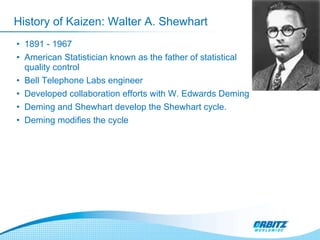
History of Kaizen: Walter A. Shewhart 1891 - 1967 American Statistician known as the father of statistical quality control Bell Telephone Labs engineer Developed collaboration efforts with W. Edwards Deming Deming and Shewhart develop the Shewhart cycle. Deming modifies the cycle
History of Kaizen: W. Edwards Deming 1900-1993 American Statistics professor, specializing in acceptance sampling Sent to Japan after WW II Helped Japanese focus on and improve quality System (not employees) is cause of poor quality Fourteen Points American manufacturing turned their nose at him until they started to lose market share in the late 1980’s and early 90’s Deming is considered a hero in Japanese manufacturing but only started to get recognition in the US around the time of his death. Toyota is now the #1 Auto Manufacturer in the world.  Not GM While American Auto Manufacturers are closing plants, Toyota is expanding production. The reason...W. Edwards Deming and Kaizen
History of Kaizen: Brian Joiner, Ph.D. Retired Professor of Statistics and Director of Statistical Consulting, University of Wisconsin-Madison Co-founder, co-owner and CEO of Joiner Associates Incorporated, an internationally known management consulting firm (now called Oriel Inc.). (Consultant to senior management at Bell Canada, Dupont, GE, General Motors, Lubrizol, McDonnell Douglas, MCI, Rohm & Haas, and other firms.) Joiner Associates is considered by many to be at the forefront of the nation's quality movement.  Author of numerous publications Honors: W. Edwards Deming Medal, Walter Shewhart Medal, William G. Hunter Award, Ellis R. Ott Award, Frank Wilcoxon Prize (twice), Fellow of American Statistical Association. One of Original nine Judges for the Malcolm Baldrige National Quality Award, awarded annually since 1988.  Source: University of Wisconsin
3 Principles of Kaizen : Operational Excellence through: Process  &  Results  (not results-only) Systemic Thinking  (i.e. big picture, not solely the narrow view) Non-judgmental ,  Non-blaming  (because blaming is wasteful).
Continuous Improvement (Kaizen)
Methods (Deming/ Shewhart Cycle) PDCA: P lan D o C heck A ct FOCUS: F ind O rganize C larify U ncover S tart
PDCA PLAN:  establish the objectives and processes necessary to deliver results in accordance with the specifications.  DO:  implement the processes.  CHECK:  monitor and evaluate the processes and results against objectives and Specifications and report the outcome.  ACT:  apply actions to the outcome for necessary improvement. This means reviewing all steps (Plan, Do, Check, Act) and modifying the process to improve it before its next implementation.
FOCUS – PDCA Methodology F ind  a process that needs improvement. O rganize  a team that knows the process. C larify  knowledge of the process through data collection.  U ncover  the underlying causes of variation or poor quality.  S tart  the P-D-C-A cycle by choosing a single modification to the process. P lan  a pilot to test the improvement.  D o  the improvement.  C heck  that the process actually improved.  A ct  to adopt, adjust or abandon the change.
“ Brian Joiner 7 Step Model" STEP 1: Define Project Purpose and Scope Focus on strategically important problems  Choose an appropriate project team and team leader(s)  Clarify the project mission Determine how much progress can be expected Formulate a framework and execution plan for the project  STEP 2: Current Situation Understand the present process Determine customer needs and expectations Flow chart the process Collect data to identify the real problem Standardize the process, if necessary  STEP 3: Cause Analysis Dig down for the root causes of the problem  Identify the major potential causes  Verify them with data, if possible  STEP 4: Solutions Choose between alternative solutions  Keep solutions simple Identify barriers to implementing solutions Plan and make necessary changes (use PDCA)  STEP 5: Results Evaluate the solutions Collect data, to compare before and after improvement Compare results with what we expected  STEP 6: Standardization Standardize the new process Document the changes made Error proof the process  STEP 7: Future Plans Review what has been learned from this project Decide whether to continue with this project, or Close project, and move on to a more pressing project
Advertising Operations? Account Management Sales Support Ad Operations Pre-sales At-Risk Optimization Forecasting Billing Revenue Recognition
These are the Operations Customers: Our  consumer customers  who come to our site(s) for a purpose Our  advertising partners  and clients who seek to influence our consumer customers. Our  advertising sales team  - the front line to our clients Our  internal partners  (Supplier, Product, Merchandising, / Marketing) who rely on Partner Marketing to bring value to all of the above
Cross Training To maintain the flow, workers have to be able to help out as needed Rotate workers through jobs: Keep skills sharp (managers too - prove they know what they’re doing) Reduce boredom & fatigue Expand understanding of overall picture Increase potential for new ideas
Team Expectations: Line Up with Sales Process Let nothing slip through the cracks (prioritize) Minimize distractions (helping disease)  Stick to core competency Ask questions? – don’t assume Solve Problems – don’t extend them Make suggestions to improve campaign delivery Think about overall campaign (big picture) FOCUS on QUALITY!
FOCUS on Quality F ind  a process to improve O rganize  a team that knows the process C larify  the knowledge of the process U ncover  the cause of the poor quality S tart  the cycle to modify the process
Focus on Quality Exercise: Many companies are trying to keep their reject rates down to 1/10 th  of 1 percent (99.9% quality) Do you think 99.9% quality is adequate? If you were in charge of a new product line or service, what level of Quality is acceptable to you as a percentage of total items produced? 85%, 90%, 95%, 99.9%? What level of Quality is acceptable to your customers? What level of Quality is acceptable to your team?
SOMETHING TO PONDER  ABOUT 99.9% QUALITY … If 99.9% is good enough, then…  12 newborns  will be given to the wrong parents daily 114,500 mismatched pairs of shoes  will be shipped each year 18,322 pieces of mail  will be mishandled every hour 2,000,000 documents  will be lost by the IRS this year 2.5 million books  will be shipped with the wrong covers 2 planes  landing at Chicago’s O’Hare airport will be unsafe every day 315 entries  in Webster’s Dictionary will be misspelled 20,000 incorrect drug prescriptions  will be written this year 880,000 credit cards  in circulation will turn out to have incorrect cardholder information on their magnetic strips 103,260 income tax returns  will be processed incorrectly 5.5 million cases of soft drinks  will be produced flat 291 pacemaker  operations will be performed incorrectly 3,056 copies  of tomorrow’s Wall Street Journal will be missing one of three sections
99.9% Quality: Now would you still be satisfied with 99.9% quality? Should our customers be satisfied with 99.9% Quality?
How can your organization help operations? Include Account Managers EARLY in the process… Include Account Managers on CMS and SFDC entries 3 rd  Party Tags or Billing at time of proposal Frequency Caps? Set Realistic Expectations Understand our products & pricing rules No delivery History Revisions allowed after campaign has started (no time machine) Let us know when there is problem so we can be proactive
How do we use this? We work as a team to support our customers. We think about making every process better. We think about simplifying or reducing redundant activities or tasks. We FOCUS on increasing productivity and quality. We find ways to provide better service to ALL of our customers. We reward success and learn from our mistakes.
Kaizen works… Since debuting this concept 2yrs ago our organization has eliminated waste, cross-trained our teams and balanced the workload Used to be 1 or 2 people covered the bulk of the work and other people had less – balance the distribution Ad server lived under Orbitz…cleaned up to handle volume Eliminated redundant activities and automated many processes Kaizen is all about your team and people.  We do not have an operations staff…that is an infection…we are a team.
Kaizen works…feedback from a member of our team “A quality shared by the management in general, is a solution oriented approach.  If a problem or a challenging issue arises, there isn’t any time or effort wasted laying blame.  Rather, efforts are focused on fixing the problem or efficiently addressing the issue.  I think this approach keeps morale high, emphasizes performance, and encourages accountability because people are not hesitant to come forward when there is a problem or ask for assistance when needed.” Ad Trafficker
How can we help you? Q&A / Open Discussion… THOUGHT PROVOKER FOR YOUR ORGANIZATION: What can Sales Support / Planning do to better serve you and our clients? What can Client Services do to better serve you and your clients? What Can Ad Operations do to better serve you and your clients? How do we work better as a team?
Kaizen:  Achieving Operational Excellence through Continuous Improvement AUGUST | 2008 Mark Verone Director, Partner Marketing Operations

Ad Monsters Kaizen - Mark Verone

  • 1.
    Kaizen: AchievingOperational Excellence through Continuous Improvement AUGUST | 2008 Mark Verone Director, Partner Marketing Operations
  • 2.
    Operational Excellence ThroughContinuous Improvement… Ad Operations Goal… Provide the highest levels of quality to our customers. Eliminate redundant and wasteful activities How do we achieve this? Operations teams achieve high quality through continuous improvement, learning, modifying process, and adapting to change.  The Japanese refer to this as Kaizen, which means, "change for the better" or "improvement,” the English translation is "continuous or continual improvement." Kaizen is widely used in manufacturing operations but the concepts apply to all businesses that strive to eliminate waste and provide higher quality for their customers.
  • 3.
  • 4.
    History of Kaizen:Walter A. Shewhart 1891 - 1967 American Statistician known as the father of statistical quality control Bell Telephone Labs engineer Developed collaboration efforts with W. Edwards Deming Deming and Shewhart develop the Shewhart cycle. Deming modifies the cycle
  • 5.
    History of Kaizen:W. Edwards Deming 1900-1993 American Statistics professor, specializing in acceptance sampling Sent to Japan after WW II Helped Japanese focus on and improve quality System (not employees) is cause of poor quality Fourteen Points American manufacturing turned their nose at him until they started to lose market share in the late 1980’s and early 90’s Deming is considered a hero in Japanese manufacturing but only started to get recognition in the US around the time of his death. Toyota is now the #1 Auto Manufacturer in the world. Not GM While American Auto Manufacturers are closing plants, Toyota is expanding production. The reason...W. Edwards Deming and Kaizen
  • 6.
    History of Kaizen:Brian Joiner, Ph.D. Retired Professor of Statistics and Director of Statistical Consulting, University of Wisconsin-Madison Co-founder, co-owner and CEO of Joiner Associates Incorporated, an internationally known management consulting firm (now called Oriel Inc.). (Consultant to senior management at Bell Canada, Dupont, GE, General Motors, Lubrizol, McDonnell Douglas, MCI, Rohm & Haas, and other firms.) Joiner Associates is considered by many to be at the forefront of the nation's quality movement. Author of numerous publications Honors: W. Edwards Deming Medal, Walter Shewhart Medal, William G. Hunter Award, Ellis R. Ott Award, Frank Wilcoxon Prize (twice), Fellow of American Statistical Association. One of Original nine Judges for the Malcolm Baldrige National Quality Award, awarded annually since 1988. Source: University of Wisconsin
  • 7.
    3 Principles ofKaizen : Operational Excellence through: Process & Results (not results-only) Systemic Thinking (i.e. big picture, not solely the narrow view) Non-judgmental , Non-blaming (because blaming is wasteful).
  • 8.
  • 9.
    Methods (Deming/ ShewhartCycle) PDCA: P lan D o C heck A ct FOCUS: F ind O rganize C larify U ncover S tart
  • 10.
    PDCA PLAN: establish the objectives and processes necessary to deliver results in accordance with the specifications. DO: implement the processes. CHECK: monitor and evaluate the processes and results against objectives and Specifications and report the outcome. ACT: apply actions to the outcome for necessary improvement. This means reviewing all steps (Plan, Do, Check, Act) and modifying the process to improve it before its next implementation.
  • 11.
    FOCUS – PDCAMethodology F ind a process that needs improvement. O rganize a team that knows the process. C larify knowledge of the process through data collection. U ncover the underlying causes of variation or poor quality. S tart the P-D-C-A cycle by choosing a single modification to the process. P lan a pilot to test the improvement. D o the improvement. C heck that the process actually improved. A ct to adopt, adjust or abandon the change.
  • 12.
    “ Brian Joiner7 Step Model" STEP 1: Define Project Purpose and Scope Focus on strategically important problems Choose an appropriate project team and team leader(s) Clarify the project mission Determine how much progress can be expected Formulate a framework and execution plan for the project STEP 2: Current Situation Understand the present process Determine customer needs and expectations Flow chart the process Collect data to identify the real problem Standardize the process, if necessary STEP 3: Cause Analysis Dig down for the root causes of the problem Identify the major potential causes Verify them with data, if possible STEP 4: Solutions Choose between alternative solutions Keep solutions simple Identify barriers to implementing solutions Plan and make necessary changes (use PDCA) STEP 5: Results Evaluate the solutions Collect data, to compare before and after improvement Compare results with what we expected STEP 6: Standardization Standardize the new process Document the changes made Error proof the process STEP 7: Future Plans Review what has been learned from this project Decide whether to continue with this project, or Close project, and move on to a more pressing project
  • 13.
    Advertising Operations? AccountManagement Sales Support Ad Operations Pre-sales At-Risk Optimization Forecasting Billing Revenue Recognition
  • 14.
    These are theOperations Customers: Our consumer customers who come to our site(s) for a purpose Our advertising partners and clients who seek to influence our consumer customers. Our advertising sales team - the front line to our clients Our internal partners (Supplier, Product, Merchandising, / Marketing) who rely on Partner Marketing to bring value to all of the above
  • 15.
    Cross Training Tomaintain the flow, workers have to be able to help out as needed Rotate workers through jobs: Keep skills sharp (managers too - prove they know what they’re doing) Reduce boredom & fatigue Expand understanding of overall picture Increase potential for new ideas
  • 16.
    Team Expectations: LineUp with Sales Process Let nothing slip through the cracks (prioritize) Minimize distractions (helping disease) Stick to core competency Ask questions? – don’t assume Solve Problems – don’t extend them Make suggestions to improve campaign delivery Think about overall campaign (big picture) FOCUS on QUALITY!
  • 17.
    FOCUS on QualityF ind a process to improve O rganize a team that knows the process C larify the knowledge of the process U ncover the cause of the poor quality S tart the cycle to modify the process
  • 18.
    Focus on QualityExercise: Many companies are trying to keep their reject rates down to 1/10 th of 1 percent (99.9% quality) Do you think 99.9% quality is adequate? If you were in charge of a new product line or service, what level of Quality is acceptable to you as a percentage of total items produced? 85%, 90%, 95%, 99.9%? What level of Quality is acceptable to your customers? What level of Quality is acceptable to your team?
  • 19.
    SOMETHING TO PONDER ABOUT 99.9% QUALITY … If 99.9% is good enough, then… 12 newborns will be given to the wrong parents daily 114,500 mismatched pairs of shoes will be shipped each year 18,322 pieces of mail will be mishandled every hour 2,000,000 documents will be lost by the IRS this year 2.5 million books will be shipped with the wrong covers 2 planes landing at Chicago’s O’Hare airport will be unsafe every day 315 entries in Webster’s Dictionary will be misspelled 20,000 incorrect drug prescriptions will be written this year 880,000 credit cards in circulation will turn out to have incorrect cardholder information on their magnetic strips 103,260 income tax returns will be processed incorrectly 5.5 million cases of soft drinks will be produced flat 291 pacemaker operations will be performed incorrectly 3,056 copies of tomorrow’s Wall Street Journal will be missing one of three sections
  • 20.
    99.9% Quality: Nowwould you still be satisfied with 99.9% quality? Should our customers be satisfied with 99.9% Quality?
  • 21.
    How can yourorganization help operations? Include Account Managers EARLY in the process… Include Account Managers on CMS and SFDC entries 3 rd Party Tags or Billing at time of proposal Frequency Caps? Set Realistic Expectations Understand our products & pricing rules No delivery History Revisions allowed after campaign has started (no time machine) Let us know when there is problem so we can be proactive
  • 22.
    How do weuse this? We work as a team to support our customers. We think about making every process better. We think about simplifying or reducing redundant activities or tasks. We FOCUS on increasing productivity and quality. We find ways to provide better service to ALL of our customers. We reward success and learn from our mistakes.
  • 23.
    Kaizen works… Sincedebuting this concept 2yrs ago our organization has eliminated waste, cross-trained our teams and balanced the workload Used to be 1 or 2 people covered the bulk of the work and other people had less – balance the distribution Ad server lived under Orbitz…cleaned up to handle volume Eliminated redundant activities and automated many processes Kaizen is all about your team and people. We do not have an operations staff…that is an infection…we are a team.
  • 24.
    Kaizen works…feedback froma member of our team “A quality shared by the management in general, is a solution oriented approach. If a problem or a challenging issue arises, there isn’t any time or effort wasted laying blame. Rather, efforts are focused on fixing the problem or efficiently addressing the issue. I think this approach keeps morale high, emphasizes performance, and encourages accountability because people are not hesitant to come forward when there is a problem or ask for assistance when needed.” Ad Trafficker
  • 25.
    How can wehelp you? Q&A / Open Discussion… THOUGHT PROVOKER FOR YOUR ORGANIZATION: What can Sales Support / Planning do to better serve you and our clients? What can Client Services do to better serve you and your clients? What Can Ad Operations do to better serve you and your clients? How do we work better as a team?
  • 26.
    Kaizen: AchievingOperational Excellence through Continuous Improvement AUGUST | 2008 Mark Verone Director, Partner Marketing Operations

Editor's Notes

  • #2 INTRODUCTION: Why Kaizen? My favorite MBA class was Operations Management. The professor was very hands-on when it came to explaining things and he was responsible for building Grainger’s distribution systems. The pivotal moment of the class was when he took us on a field trip to the $200MM Grainger Distribution Center he built in Chicago. All these concepts came together and jumped out of the text book. While the concepts I am discussing today are rooted in manufacturing, I believe they can apply to Ad Operations…and we are now seeing the results of our efforts
  • #4 Masaaki Imai made the term famous in his book, Kaizen: The Key to Japan's Competitive Success . Kaizen is a Japanese term for continuous improvement that has its roots in America’s brain trust.
  • #8 Kaizen is a daily activity whose purpose goes beyond improvement. It is also a process that, when done correctly, humanizes the workplace, eliminates hard work (both mental and physical), and teaches people how to do rapid experiments using the scientific method and how to learn to see and eliminate waste in business processes. Importantly, kaizen must operate with three principles in place: process and results (not results-only); systemic thinking (i.e. big picture, not solely the narrow view); and non-judgmental, non-blaming (because blaming is wasteful). Everyone participates in kaizen; people of all levels in an organization, from the CEO on down, as well as external stakeholders if needed. The format for kaizen can be individual, suggestion system, small group, or large group. Kaizen is a long term culture shift
  • #9 Kaizen often takes place one small step at a time, hence the English translation: "continuous improvement", or "continual improvement." Yet radical changes for the sake of goals, such as just in time and moving lines, also gain the full support of upper level management. Goals for kaizen workshops are intentionally set very high because there are countless examples of drastic reductions in process lead time to serve as proof of their practicality. The cycle of kaizen activity can be defined as: standardize an operation -> measure the standardized operation (find cycle time and amount of in-process inventory) -> gauge measurements against requirements -> innovate to meet requirements and increase productivity -> standardize the new, improved operations -> continue cycle ad infinitum . This is also known as the Shewhart cycle , Deming cycle, or PDCA. The "zen" in Kaizen emphasizes the learn-by-doing aspect of improving production. This philosophy is focused in a different direction from the "command-and-control" improvement programs of the mid-20th century. Kaizen methodology includes making changes and looking at the results, then adjusting. Large-scale preplanning and extensive project scheduling are replaced by smaller experiments in improvement, which can be rapidly adapted as new improvements are suggested.
  • #10 PDCA was made popular by Dr. W. Edwards Deming, who is considered by many to be the father of modern quality control; however it was always referred to by him as the "Shewhart cycle." Later in Deming's career, he modified PDCA to "Plan, Do, Study, Act" (PDSA) so as to better describe his recommendations. In Six Sigma programs, this cycle is called "Define, Measure, Analyze, Improve, Control" (DMAIC). PDCA should be repeatedly implemented, as quickly as possible, in upward spirals that converge on the ultimate goal, each cycle closer than the previous. This approach is based on the understanding that our knowledge and skills are always limited, but improving as we go. Often, key information is unknown, or unknowable. Rather than enter "analysis paralysis" to get it perfect the first time, it is better to be approximately right than exactly wrong. Over time and with better knowledge and skills, PDCA will help define the ideal goal, as well as help get us there. Velocity of change is a key competitive factor in today's world. PDCA allows for quantum breakthroughs (typical Western approach), as well as Kaizen (typical Eastern Lean approach with continuous improvement); thereby providing the best of both worlds. In this way, PDCA helps ensure the fastest rate of improvement; often a critical success factor. The power of Deming's concept is in its simplicity. While easy to understand, it is often difficult to accomplish on a on-going basis due to complacency, distractions, loss of focus, lack of commitment, re-assigned priorities, lack of resources, etc. While most claim full knowledge and on-going application, few have in-depth understanding, and even fewer practice PDCA on a consistent basis.
  • #11 PDCA (aka the Deming Cycle , Shewhart cycle , or Deming Wheel ) is an iterative four-step quality control strategyThe Shewhart Cycle PLAN  establish the objectives and processes necessary to deliver results in accordance with the specifications . DO  implement the processes. CHECK  monitor and evaluate the processes and results against objectives and Specifications and report the outcome. ACT  apply actions to the outcome for necessary improvement. This means reviewing all steps (Plan, Do, Check, Act) and modifying the process to improve it before its next implementation.
  • #13 The Joiner Seven Step Method – Brian Joiner – Deming Protégé - Retired Professor of Statistics and Director of Statistical Consulting, University of Wisconsin The Plan-Do-Check-Act cycle can (and should) be applied at all levels of improvement. However, it is useful to have a fuller, more detailed macro P-D-C-A that applies to the project as a whole. This provides us with: a framework with which we can visualize progress through a project, check-steps that allow us to see that we are not trying to proceed too quickly through part of the improvement process without having gained sufficient understanding, a means of documenting a project. One useful framework to do this is the "7 Step Model", developed by Joiner Associates ( Brian L. Joiner ). As well as providing a disciplined framework for progressing through a project, the 7 Step model provides a good framework for documenting a project.
  • #20 Possible hand out…print at business center