A R D S
Adult Respiratory distress Syndrome (ARDS) Variety of unrelated massive insults injure gas exchanging surface of Lungs First described as clinical syndrome in 1967 by Ashbaugh & Petty  Clinical terms synonymous with ARDS  Acute respiratory failure  Capillary leak syndrome  Da Nang Lung  Shock Lung  Traumatic wet Lung  Adult hyaline membrane disease
欧美 ARDS 联席会议 Report of European-American Consensus Conference on ARDS: Definitions, Mechanism, Relevant Outcomes and Clinical Trial Coordination (1992) From Am J Respir Crit Care Med, 1994,149:818
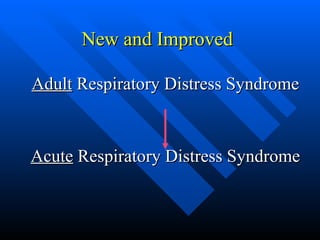
New and Improved Adult  Respiratory Distress Syndrome Acute  Respiratory Distress Syndrome
Introduction  Acute respiratory distress syndrome (ARDS) is a clinical syndrome of severe dyspnea of rapid onset, hypoxemia, and diffuse pulmonary infiltrates leading to respiratory failure. ARDS is caused by diffuse lung injury from many underlying medical and surgical disorders
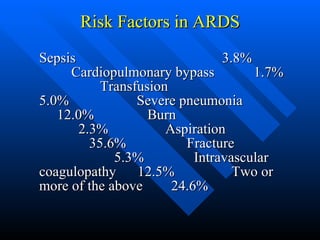
Risk Factors in ARDS Sepsis  3.8%  Cardiopulmonary bypass  1.7%  Transfusion  5.0%  Severe pneumonia  12.0%  Burn  2.3%  Aspiration  35.6%  Fracture  5.3%  Intravascular coagulopathy  12.5%  Two or more of the above  24.6%
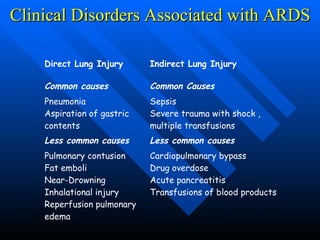
Clinical Disorders Associated with ARDS
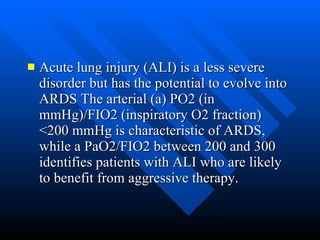
Acute lung injury (ALI) is a less severe disorder but has the potential to evolve into ARDS The arterial (a) PO2 (in mmHg)/FIO2 (inspiratory O2 fraction) <200 mmHg is characteristic of ARDS, while a PaO2/FIO2 between 200 and 300 identifies patients with ALI who are likely to benefit from aggressive therapy.
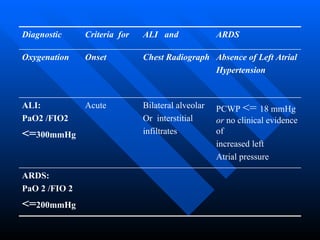
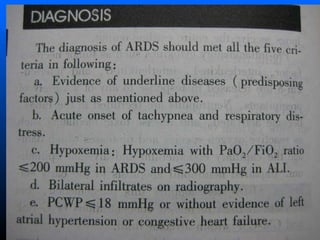
ARDS: PaO 2 /FIO 2 <= 200mmHg PCWP  <=  18 mmHg  or  no clinical evidence of increased left  Atrial pressure Bilateral alveolar Or  interstitial infiltrates Acute ALI: PaO2 /FIO2 <= 300mmHg Absence of Left Atrial Hypertension Chest Radiograph Onset Oxygenation ARDS ALI  and Criteria  for Diagnostic
The annual incidences of ALI and ARDS are estimated to be up to 80/100,000 and 60/100,000, respectively. Approximately 10% of all intensive care unit (ICU) admissions suffer from acute respiratory failure, with ~20% of these patients meeting criteria for ALI or ARDS.
Etiology most cases (>80%) are caused by a relatively small number of clinical disorders, namely, severe sepsis syndrome and/or bacterial pneumonia (~40–50%), trauma, multiple transfusions, aspiration of gastric contents, and drug overdose  The risks of developing ARDS are increased in patients suffering from more than one predisposing medical or surgical condition;
Several other clinical variables have been associated with the development of ARDS  older age,  chronic alcohol abuse,  metabolic acidosis,  severity of critical illness.
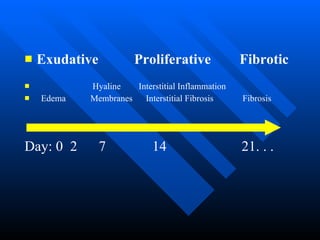
Clinical Course and Pathophysiology  The natural history of ARDS is marked by three phases — exudative, proliferative, and fibrotic — each with characteristic clinical and pathologic features
Exudative  Proliferative  Fibrotic Hyaline  Interstitial Inflammation Edema  Membranes  Interstitial Fibrosis  Fibrosis Day: 0  2  7  14  21. . .
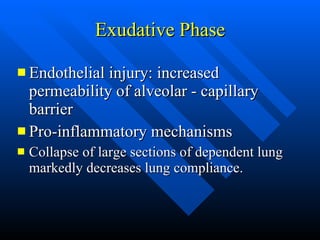
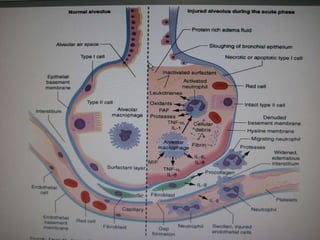
Exudative Phase Endothelial injury: increased permeability of alveolar - capillary barrier Pro-inflammatory mechanisms Collapse of large sections of dependent lung markedly decreases lung compliance.
 
 
Consequently, intrapulmonary shunting and hypoxemia develop and the work of breathing rises, leading to dyspnea. The pathophysiologic alterations in alveolar spaces are exacerbated by microvascular occlusion, which leads to reductions in pulmonary arterial blood flow to ventilated portions of the lung, increasing the dead space, and pulmonary hypertension. Thus, in addition to severe hypoxemia, hypercapnia secondary to an increase in pulmonary dead space is also prominent in early ARDS.
The exudative phase encompasses the first 7 days of illness after exposure to a precipitating ARDS risk factor  Dyspnea develops with a sensation of rapid shallow breathing and an inability to get enough air.  Tachypnea and increased work of breathing frequently result in respiratory fatigue and ultimately in respiratory failure.
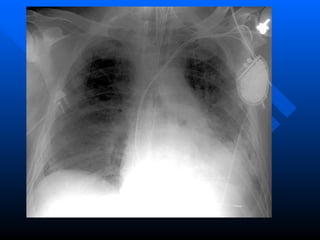
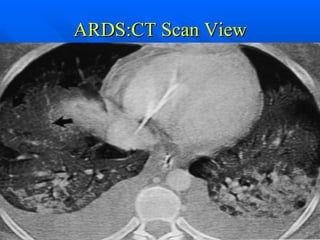
Laboratory values are generally nonspecific and primarily indicative of underlying clinical disorders. The chest radiograph usually reveals alveolar and interstitial opacities involving at least three-quarters of the lung fields  Chest computed tomography (CT) scanning in ARDS reveals extensive heterogeneity of lung involvement
ARDS:CT Scan View
Proliferative Phase  Most patients recover rapidly and are liberated from mechanical ventilation during this phase  Some patients develop progressive lung injury and early changes of pulmonary fibrosis during the proliferative phase  the initiation of lung repair, organization of alveolar exudates, and a shift from a neutrophil to a lymphocyte-predominant pulmonary infiltrate
type II pneumocytes synthesize new pulmonary surfactant and differentiate into type I pneumocytes  The presence of alveolar type III procollagen peptide, a marker of pulmonary fibrosis, is associated with a protracted clinical course and increased mortality from ARDS
Fibrotic Phase  many patients with ARDS recover lung function 3–4 weeks after the initial pulmonary injury, some will enter a fibrotic phase that may require long-term support on mechanical ventilators and/or supplemental oxygen.  the alveolar edema and inflammatory exudates of earlier phases are now converted to extensive alveolar duct and interstitial fibrosis
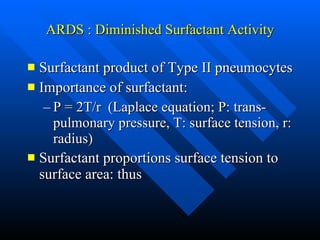
ARDS : Diminished Surfactant Activity Surfactant product of Type II pneumocytes Importance of surfactant: P = 2T/r  (Laplace equation; P: trans-pulmonary pressure, T: surface tension, r: radius) Surfactant proportions surface tension to surface area: thus
 
 
Acinar architecture is markedly disrupted, leading to emphysema-like changes with large bullae.  Intimal fibroproliferation in the pulmonary microcirculation leads to progressive vascular occlusion and pulmonary hypertension.
The physiologic consequences include an increased risk of  pneumothorax,  reductions in lung compliance,  increased pulmonary dead space.
 
Acute Respiratory Distress: Treatment   General Principles : (1) the recognition and treatment of the underlying medical and surgical disorders (e.g., sepsis, aspiration, trauma);  (2) minimizing procedures and their complications (3) prophylaxis against venous thromboembolism, gastrointestinal bleeding, and central venous catheter infections;  (4) the prompt recognition of nosocomial infections; and  (5) provision of adequate nutrition
MANAGEMENT OF ARDS Mechanical ventilation  corrects hypoxemia/respiratory acidosis Fluid management  correction of anemia and hypovolemia Pharmacological intervention  Dopamine to augment C.O.  Diuretics  Antibiotics  Corticosteroids - no demonstrated benefit  early disease, helpful 1 week later Mortality continues to be 50 to 60%
Management of Mechanical Ventilation  Patients meeting clinical criteria for ARDS frequently fatigue from increased work of breathing and progressive hypoxemia, requiring mechanical ventilation for support
Ventilator-Induced Lung Injury  Ventilator-induced injury can be demonstrated in experimental models of ALI, with high tidal volume ventilation resulting in additional, synergistic alveolar damage. These findings led to the hypothesis that ventilating patients suffering from ALI or ARDS with lower tidal volumes would protect against ventilator-induced lung injury and improve clinical outcomes.
compared low tidal volume (6 mL/kg predicted body weight) ventilation to conventional tidal volume (12 mL/kg predicted body weight) ventilation.  Mortality was significantly lower in the low tidal volume patients (31%) compared to the conventional tidal volume patients (40%).  This improvement in survival represents the most substantial benefit in ARDS mortality demonstrated for  any  therapeutic intervention in ARDS to date.
Prevention of Alveolar Collapse In ARDS, the presence of alveolar and interstitial fluid and the loss of surfactant can lead to a marked reduction of lung compliance.  Without an increase in end-expiratory pressure, significant alveolar collapse can occur at end-expiration, impairing oxygenation
In most clinical settings, positive end-expiratory pressure (PEEP) is empirically set to minimize FIO2 and maximize PaO2. On most modern mechanical ventilators, it is possible to construct a static pressure–volume curve for the respiratory system.  Oxygenation can also be improved by increasing mean airway pressure with &quot;inverse ratio ventilation.&quot;
In several randomized trials, mechanical ventilation in the prone position improved arterial oxygenation, but its effect on survival and other important clinical outcomes remains uncertain.
Other Strategies in Mechanical Ventilation   These include high-frequency ventilation (HFV), i.e., ventilating at extremely high respiratory rates (5–20 cycles per second) and low tidal volumes (1–2 mL/kg). Also, lung-replacement therapy with extracorporeal membrane oxygenation (ECMO  Data in support of the efficacy of &quot;adjunctive&quot; ventilator therapies (e.g., high PEEP, inverse ratio ventilation, prone positioning, HFV, ECMO, and PLV) remain incomplete, so these modalities are not routinely used.
Fluid Management  Increased pulmonary vascular permeability leading to interstitial and alveolar edema rich in protein is a central feature of ARDS.  impaired vascular integrity augments the normal increase in extravascular lung water that occurs with increasing left atrial pressure
aggressive attempts to reduce left atrial filling pressures with fluid restriction and diuretics should be an important aspect of ARDS management, limited only by hypotension and hypoperfusion of critical organs, such as the kidneys.
Glucocorticoids Inflammatory mediators and leukocytes are abundant in the lungs of patients with ARDS.  Many attempts have been made to treat both early and late ARDS with glucocorticoids to reduce this potentially deleterious pulmonary inflammation. Few studies have shown any benefit.
Current evidence does  not  support the use of glucocorticoids in the care of ARDS patients.  However, the ARDS Network is currently conducting a large-scale study of glucocorticoids in the late phase of ARDS
Other Therapies  Clinical trials of surfactant replacement therapy have proved disappointing. Similarly, although several randomized clinical trials of inhaled nitric oxide (NO) in ARDS have demonstrated improved oxygenation, no significant improvement in survival or decrements in time on mechanical ventilation has been observed. Therefore, the use of NO is  not  currently recommended in ARDS.
Recommendations  Many clinical trials have been undertaken to improve the outcome of patients with ARDS; most have been unsuccessful in modifying the natural history. The large number and uncertain clinical efficacy of ARDS therapies can make it difficult for clinicians to select a rational treatment plan, and these patients' critical illness can tempt physicians to try unproven and potentially harmful therapies
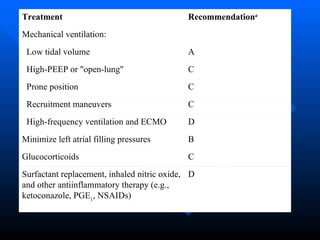
D Surfactant replacement, inhaled nitric oxide, and other antiinflammatory therapy (e.g., ketoconazole, PGE 1 , NSAIDs)   C Glucocorticoids B Minimize left atrial filling pressures D    High-frequency ventilation and ECMO C    Recruitment maneuvers C    Prone position C    High-PEEP or &quot;open-lung&quot; A    Low tidal volume   Mechanical ventilation: Recommendation a   Treatment
Prognosis Mortality  Functional Recovery in ARDS Survivors
Mortality Recent mortality estimates for ARDS range from 41 to 65%. There is substantial variability, but a trend toward improved ARDS outcomes appears evident.  improvement in survival is likely secondary to advances in the care of septic/infected patients and those with multiple organ failure
Several risk factors for mortality to help estimate prognosis have been identified.  Advanced age is an important risk factor  Preexisting organ dysfunction from chronic medical illness is an important additional risk factor for increased mortality.  Several factors related to the presenting clinical disorders also increase risk for ARDS mortality.
Surprisingly, there is little value in predicting ARDS mortality from the extent of hypoxemia and any of the following measures of the severity of lung injury: the level of PEEP used in mechanical ventilation, the respiratory compliance, the extent of alveolar infiltrates on chest radiography, and the lung injury score (a composite of all these variables). However, recent data indicate that an early (within 24 h of presentation) elevation in dead space may predict increased mortality from ARDS
Functional Recovery in ARDS Survivors  it is a testament to the resolving powers of the lung that the majority of patients recover nearly normal lung function.  Patients usually recover their maximum lung function within 6 months. One year after endotracheal extubation, over a third of ARDS survivors have normal spirometry values and diffusion capacity. Most of the remaining patients have only mild abnormalities in their pulmonary function
recovery of lung function is strongly associated with the extent of lung injury in early ARDS. Low static respiratory compliance, high levels of required PEEP, longer durations of mechanical ventilation, and high lung injury scores are all associated with worse recovery of pulmonary function.
------END------

Ards2

  • 1.
  • 2.
    Adult Respiratory distressSyndrome (ARDS) Variety of unrelated massive insults injure gas exchanging surface of Lungs First described as clinical syndrome in 1967 by Ashbaugh & Petty Clinical terms synonymous with ARDS Acute respiratory failure Capillary leak syndrome Da Nang Lung Shock Lung Traumatic wet Lung Adult hyaline membrane disease
  • 3.
    欧美 ARDS 联席会议Report of European-American Consensus Conference on ARDS: Definitions, Mechanism, Relevant Outcomes and Clinical Trial Coordination (1992) From Am J Respir Crit Care Med, 1994,149:818
  • 4.
    New and ImprovedAdult Respiratory Distress Syndrome Acute Respiratory Distress Syndrome
  • 5.
    Introduction Acuterespiratory distress syndrome (ARDS) is a clinical syndrome of severe dyspnea of rapid onset, hypoxemia, and diffuse pulmonary infiltrates leading to respiratory failure. ARDS is caused by diffuse lung injury from many underlying medical and surgical disorders
  • 6.
    Risk Factors inARDS Sepsis 3.8% Cardiopulmonary bypass 1.7% Transfusion 5.0% Severe pneumonia 12.0% Burn 2.3% Aspiration 35.6% Fracture 5.3% Intravascular coagulopathy 12.5% Two or more of the above 24.6%
  • 7.
  • 8.
    Acute lung injury(ALI) is a less severe disorder but has the potential to evolve into ARDS The arterial (a) PO2 (in mmHg)/FIO2 (inspiratory O2 fraction) <200 mmHg is characteristic of ARDS, while a PaO2/FIO2 between 200 and 300 identifies patients with ALI who are likely to benefit from aggressive therapy.
  • 9.
    ARDS: PaO 2/FIO 2 <= 200mmHg PCWP <= 18 mmHg or no clinical evidence of increased left Atrial pressure Bilateral alveolar Or interstitial infiltrates Acute ALI: PaO2 /FIO2 <= 300mmHg Absence of Left Atrial Hypertension Chest Radiograph Onset Oxygenation ARDS ALI and Criteria for Diagnostic
  • 10.
    The annual incidencesof ALI and ARDS are estimated to be up to 80/100,000 and 60/100,000, respectively. Approximately 10% of all intensive care unit (ICU) admissions suffer from acute respiratory failure, with ~20% of these patients meeting criteria for ALI or ARDS.
  • 11.
    Etiology most cases(>80%) are caused by a relatively small number of clinical disorders, namely, severe sepsis syndrome and/or bacterial pneumonia (~40–50%), trauma, multiple transfusions, aspiration of gastric contents, and drug overdose The risks of developing ARDS are increased in patients suffering from more than one predisposing medical or surgical condition;
  • 12.
    Several other clinicalvariables have been associated with the development of ARDS older age, chronic alcohol abuse, metabolic acidosis, severity of critical illness.
  • 13.
    Clinical Course andPathophysiology The natural history of ARDS is marked by three phases — exudative, proliferative, and fibrotic — each with characteristic clinical and pathologic features
  • 14.
    Exudative Proliferative Fibrotic Hyaline Interstitial Inflammation Edema Membranes Interstitial Fibrosis Fibrosis Day: 0 2 7 14 21. . .
  • 15.
    Exudative Phase Endothelialinjury: increased permeability of alveolar - capillary barrier Pro-inflammatory mechanisms Collapse of large sections of dependent lung markedly decreases lung compliance.
  • 16.
  • 17.
  • 18.
    Consequently, intrapulmonary shuntingand hypoxemia develop and the work of breathing rises, leading to dyspnea. The pathophysiologic alterations in alveolar spaces are exacerbated by microvascular occlusion, which leads to reductions in pulmonary arterial blood flow to ventilated portions of the lung, increasing the dead space, and pulmonary hypertension. Thus, in addition to severe hypoxemia, hypercapnia secondary to an increase in pulmonary dead space is also prominent in early ARDS.
  • 19.
    The exudative phaseencompasses the first 7 days of illness after exposure to a precipitating ARDS risk factor Dyspnea develops with a sensation of rapid shallow breathing and an inability to get enough air. Tachypnea and increased work of breathing frequently result in respiratory fatigue and ultimately in respiratory failure.
  • 20.
    Laboratory values aregenerally nonspecific and primarily indicative of underlying clinical disorders. The chest radiograph usually reveals alveolar and interstitial opacities involving at least three-quarters of the lung fields Chest computed tomography (CT) scanning in ARDS reveals extensive heterogeneity of lung involvement
  • 21.
  • 22.
    Proliferative Phase Most patients recover rapidly and are liberated from mechanical ventilation during this phase Some patients develop progressive lung injury and early changes of pulmonary fibrosis during the proliferative phase the initiation of lung repair, organization of alveolar exudates, and a shift from a neutrophil to a lymphocyte-predominant pulmonary infiltrate
  • 23.
    type II pneumocytessynthesize new pulmonary surfactant and differentiate into type I pneumocytes The presence of alveolar type III procollagen peptide, a marker of pulmonary fibrosis, is associated with a protracted clinical course and increased mortality from ARDS
  • 24.
    Fibrotic Phase many patients with ARDS recover lung function 3–4 weeks after the initial pulmonary injury, some will enter a fibrotic phase that may require long-term support on mechanical ventilators and/or supplemental oxygen. the alveolar edema and inflammatory exudates of earlier phases are now converted to extensive alveolar duct and interstitial fibrosis
  • 25.
    ARDS : DiminishedSurfactant Activity Surfactant product of Type II pneumocytes Importance of surfactant: P = 2T/r (Laplace equation; P: trans-pulmonary pressure, T: surface tension, r: radius) Surfactant proportions surface tension to surface area: thus
  • 26.
  • 27.
  • 28.
    Acinar architecture ismarkedly disrupted, leading to emphysema-like changes with large bullae. Intimal fibroproliferation in the pulmonary microcirculation leads to progressive vascular occlusion and pulmonary hypertension.
  • 29.
    The physiologic consequencesinclude an increased risk of pneumothorax, reductions in lung compliance, increased pulmonary dead space.
  • 30.
  • 31.
    Acute Respiratory Distress:Treatment General Principles : (1) the recognition and treatment of the underlying medical and surgical disorders (e.g., sepsis, aspiration, trauma); (2) minimizing procedures and their complications (3) prophylaxis against venous thromboembolism, gastrointestinal bleeding, and central venous catheter infections; (4) the prompt recognition of nosocomial infections; and (5) provision of adequate nutrition
  • 32.
    MANAGEMENT OF ARDSMechanical ventilation corrects hypoxemia/respiratory acidosis Fluid management correction of anemia and hypovolemia Pharmacological intervention Dopamine to augment C.O. Diuretics Antibiotics Corticosteroids - no demonstrated benefit early disease, helpful 1 week later Mortality continues to be 50 to 60%
  • 33.
    Management of MechanicalVentilation Patients meeting clinical criteria for ARDS frequently fatigue from increased work of breathing and progressive hypoxemia, requiring mechanical ventilation for support
  • 34.
    Ventilator-Induced Lung Injury Ventilator-induced injury can be demonstrated in experimental models of ALI, with high tidal volume ventilation resulting in additional, synergistic alveolar damage. These findings led to the hypothesis that ventilating patients suffering from ALI or ARDS with lower tidal volumes would protect against ventilator-induced lung injury and improve clinical outcomes.
  • 35.
    compared low tidalvolume (6 mL/kg predicted body weight) ventilation to conventional tidal volume (12 mL/kg predicted body weight) ventilation. Mortality was significantly lower in the low tidal volume patients (31%) compared to the conventional tidal volume patients (40%). This improvement in survival represents the most substantial benefit in ARDS mortality demonstrated for any therapeutic intervention in ARDS to date.
  • 36.
    Prevention of AlveolarCollapse In ARDS, the presence of alveolar and interstitial fluid and the loss of surfactant can lead to a marked reduction of lung compliance. Without an increase in end-expiratory pressure, significant alveolar collapse can occur at end-expiration, impairing oxygenation
  • 37.
    In most clinicalsettings, positive end-expiratory pressure (PEEP) is empirically set to minimize FIO2 and maximize PaO2. On most modern mechanical ventilators, it is possible to construct a static pressure–volume curve for the respiratory system. Oxygenation can also be improved by increasing mean airway pressure with &quot;inverse ratio ventilation.&quot;
  • 38.
    In several randomizedtrials, mechanical ventilation in the prone position improved arterial oxygenation, but its effect on survival and other important clinical outcomes remains uncertain.
  • 39.
    Other Strategies inMechanical Ventilation These include high-frequency ventilation (HFV), i.e., ventilating at extremely high respiratory rates (5–20 cycles per second) and low tidal volumes (1–2 mL/kg). Also, lung-replacement therapy with extracorporeal membrane oxygenation (ECMO Data in support of the efficacy of &quot;adjunctive&quot; ventilator therapies (e.g., high PEEP, inverse ratio ventilation, prone positioning, HFV, ECMO, and PLV) remain incomplete, so these modalities are not routinely used.
  • 40.
    Fluid Management Increased pulmonary vascular permeability leading to interstitial and alveolar edema rich in protein is a central feature of ARDS. impaired vascular integrity augments the normal increase in extravascular lung water that occurs with increasing left atrial pressure
  • 41.
    aggressive attempts toreduce left atrial filling pressures with fluid restriction and diuretics should be an important aspect of ARDS management, limited only by hypotension and hypoperfusion of critical organs, such as the kidneys.
  • 42.
    Glucocorticoids Inflammatory mediatorsand leukocytes are abundant in the lungs of patients with ARDS. Many attempts have been made to treat both early and late ARDS with glucocorticoids to reduce this potentially deleterious pulmonary inflammation. Few studies have shown any benefit.
  • 43.
    Current evidence does not support the use of glucocorticoids in the care of ARDS patients. However, the ARDS Network is currently conducting a large-scale study of glucocorticoids in the late phase of ARDS
  • 44.
    Other Therapies Clinical trials of surfactant replacement therapy have proved disappointing. Similarly, although several randomized clinical trials of inhaled nitric oxide (NO) in ARDS have demonstrated improved oxygenation, no significant improvement in survival or decrements in time on mechanical ventilation has been observed. Therefore, the use of NO is not currently recommended in ARDS.
  • 45.
    Recommendations Manyclinical trials have been undertaken to improve the outcome of patients with ARDS; most have been unsuccessful in modifying the natural history. The large number and uncertain clinical efficacy of ARDS therapies can make it difficult for clinicians to select a rational treatment plan, and these patients' critical illness can tempt physicians to try unproven and potentially harmful therapies
  • 46.
    D Surfactant replacement,inhaled nitric oxide, and other antiinflammatory therapy (e.g., ketoconazole, PGE 1 , NSAIDs)   C Glucocorticoids B Minimize left atrial filling pressures D    High-frequency ventilation and ECMO C    Recruitment maneuvers C    Prone position C    High-PEEP or &quot;open-lung&quot; A    Low tidal volume   Mechanical ventilation: Recommendation a   Treatment
  • 47.
    Prognosis Mortality Functional Recovery in ARDS Survivors
  • 48.
    Mortality Recent mortalityestimates for ARDS range from 41 to 65%. There is substantial variability, but a trend toward improved ARDS outcomes appears evident. improvement in survival is likely secondary to advances in the care of septic/infected patients and those with multiple organ failure
  • 49.
    Several risk factorsfor mortality to help estimate prognosis have been identified. Advanced age is an important risk factor Preexisting organ dysfunction from chronic medical illness is an important additional risk factor for increased mortality. Several factors related to the presenting clinical disorders also increase risk for ARDS mortality.
  • 50.
    Surprisingly, there islittle value in predicting ARDS mortality from the extent of hypoxemia and any of the following measures of the severity of lung injury: the level of PEEP used in mechanical ventilation, the respiratory compliance, the extent of alveolar infiltrates on chest radiography, and the lung injury score (a composite of all these variables). However, recent data indicate that an early (within 24 h of presentation) elevation in dead space may predict increased mortality from ARDS
  • 51.
    Functional Recovery inARDS Survivors it is a testament to the resolving powers of the lung that the majority of patients recover nearly normal lung function. Patients usually recover their maximum lung function within 6 months. One year after endotracheal extubation, over a third of ARDS survivors have normal spirometry values and diffusion capacity. Most of the remaining patients have only mild abnormalities in their pulmonary function
  • 52.
    recovery of lungfunction is strongly associated with the extent of lung injury in early ARDS. Low static respiratory compliance, high levels of required PEEP, longer durations of mechanical ventilation, and high lung injury scores are all associated with worse recovery of pulmonary function.
  • 53.