Dr.Asif Mian Ansari
DNB resident
Dept. of General Surgery
Max hospital, Mohali
 Sudden interruption of blood supply to segment of intestine
 Rare (0.09-0.2%) but life threatening (50-80% mortality)
Bowel ischemia
Cellular
damage
Bowel
necrosis
AMI
Occlusive
Embolism
(AMAE-50%)
Thrombosis
(AMAT-15-25%)
Venous thrombosis
(MVT-5-15%)
Non-occlusive
ACUTE MESENTRIC ARTERIAL EMBOLISM
Sources of embolism:
Left atrium-cardiac arrythmia
Left ventricle-global myocardial dysfunction
with poor EF
Endocarditis
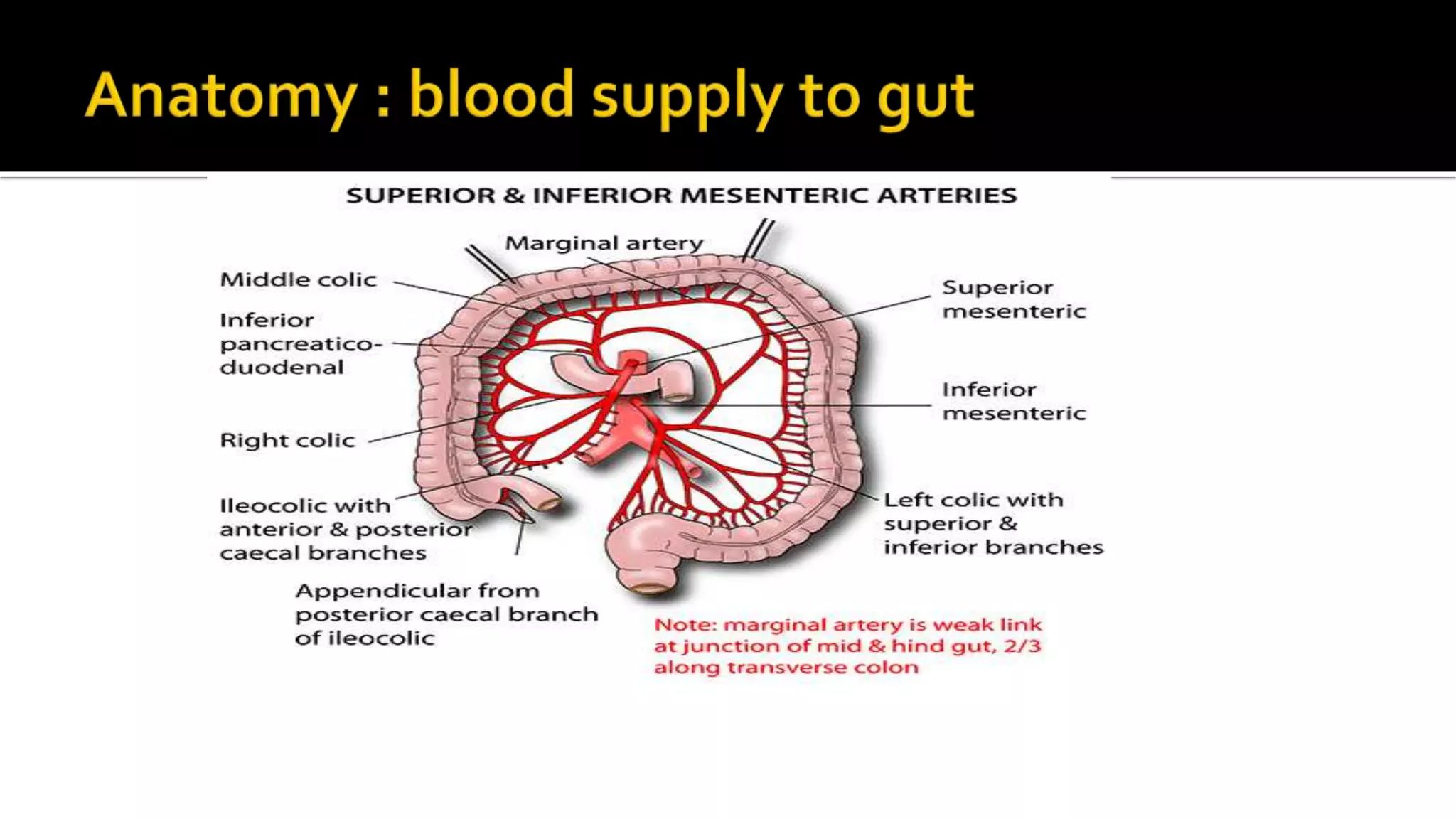
Rarely-atherosclerotic aorta
3-10 cm distal to origin of SMA-sparing proximal jejunum
& colon
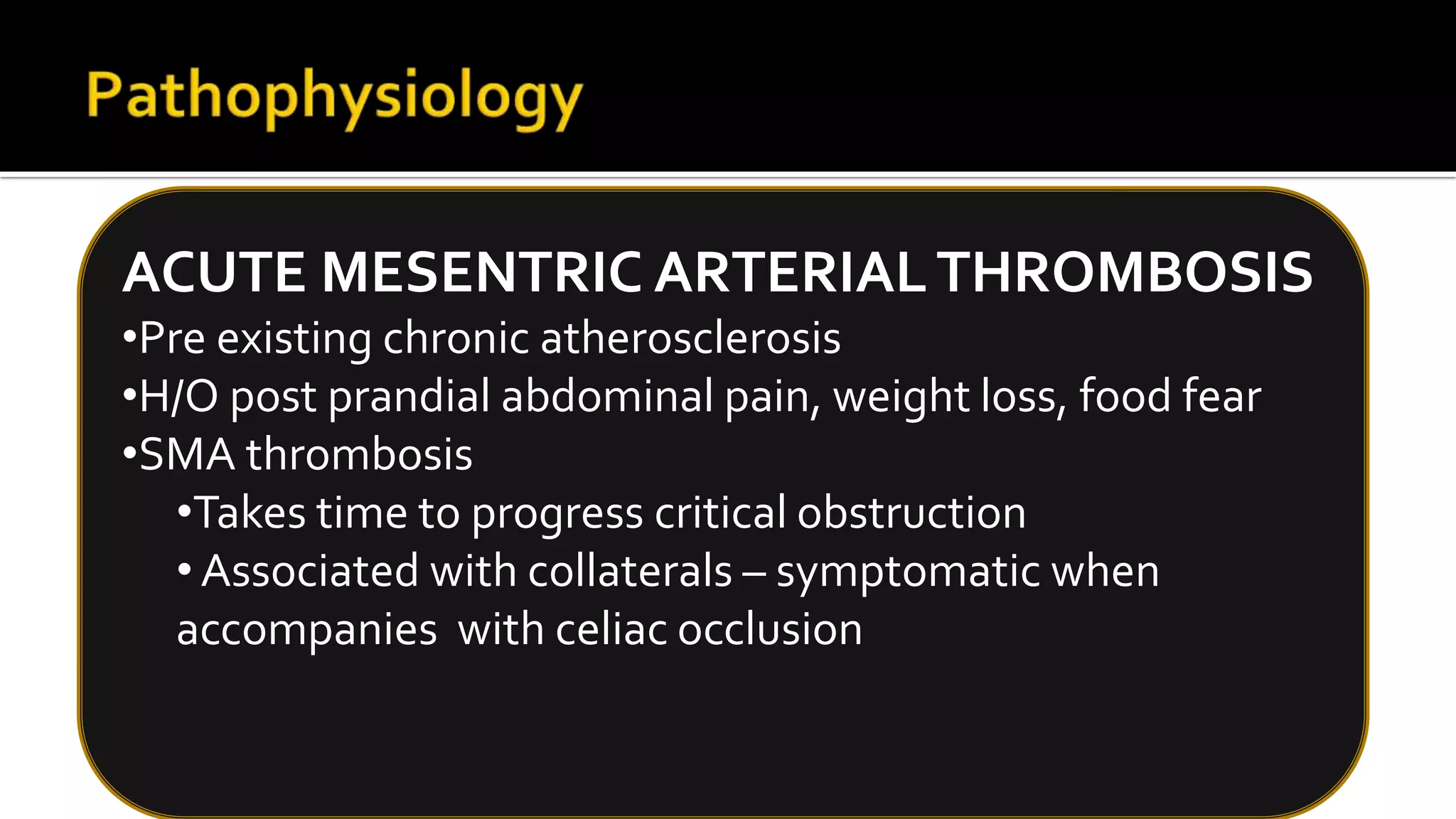
ACUTE MESENTRIC ARTERIALTHROMBOSIS
•Pre existing chronic atherosclerosis
•H/O post prandial abdominal pain, weight loss, food fear
•SMA thrombosis
•Takes time to progress critical obstruction
• Associated with collaterals – symptomatic when
accompanies with celiac occlusion
MESENTRIC VENOUSTHROMBOSIS
< 1% cases of MI
FollowsVirchow’sTriad 80%
20% ideopathic
portal HTN, Pancreatitis, IBD, sepsis & trauma
 Severe pain abdomen – 95%
 Nausea –44%
 Vomiting – 35%
 Diarrhoea – 35%
 Bleeding per rectum – 16%
 Triad of pain + fever + blood in stools – 1/3rd patients
 Signs of peritonitis – irreversible bowel ischemia with necrosis
 Delayed presentation – septic shock
 Risk factors may be found on evaluation
 High index of suspicion in cases with clinical features with
 Abnormally highTLC
 Metabolic acidosis
 Elevated lactates >2 mmol/L
 These cases should undergo early CT angiography
 D-Dimer: >0.9 mg/L, reflecting ongoing clot formation &
fibrinolysis
 Should be done in any suspected case as soon as possible
 Irreversible bowel ischemia:
 Dilated bowel
 Pneumatosis intestinalis
 Portal venous gas
 Free intraperitoneal gas
 At the time of diagnosis:
 Fluid and electrolyte resuscitation
 Naso-gastric suction
 Broad spectrum antibiotics
 Heparin therapy
 Vasopressors: used with caution, dobutamine, low dose dopamine
and milrinone cause less impact on mesenteric blood flow
 Continued monitoring of lactates
 Prompt laparotomy in unstable, perforation peritonitis cases
 Goal of surgery:
 Re-establishment blood supply to the ischemic bowel.
 Resection of all non-viable regions.
 Preservation of all viable bowel.
 Damage control surgery:
 choice in case of critical ill with AMI
 Planned 2nd look laparotomy after resuscitation in ICU
 Examination of stapled bowel
 AMAE – Embolectomy & primary/patch angioplasty
 AMAT– Bipass procedure
 NOMI – treatment of underlying condition
 MVT – continued heparin therapy
 Jatinder Kumar Gosain 67/male
 Admitted on 21st sept 2017
 Acute mesenteric venous thrombosis with ischemia
 Post operatively, patient developed septic shock and MODS
 Died on oct 2nd, 11:05 AM
 Darshan singh 65/male
 15 days history
 Admitted on 20th oct, 2017 and discharged on 2nd Nov 2017
 Severe abdominal pain out of proportion to physical findings
is assumed to be AMI
 Early CT angiography
 Prompt resuscitation, antibiotics & anticoagulation
 Inotropes must be used with caution
 MVT – anticoagulation is mainstay of treatment
Acute mesenteric ischemia

Acute mesenteric ischemia

  • 1.
    Dr.Asif Mian Ansari DNBresident Dept. of General Surgery Max hospital, Mohali
  • 2.
     Sudden interruptionof blood supply to segment of intestine  Rare (0.09-0.2%) but life threatening (50-80% mortality) Bowel ischemia Cellular damage Bowel necrosis
  • 3.
  • 7.
    ACUTE MESENTRIC ARTERIALEMBOLISM Sources of embolism: Left atrium-cardiac arrythmia Left ventricle-global myocardial dysfunction with poor EF Endocarditis Rarely-atherosclerotic aorta 3-10 cm distal to origin of SMA-sparing proximal jejunum & colon
  • 8.
    ACUTE MESENTRIC ARTERIALTHROMBOSIS •Preexisting chronic atherosclerosis •H/O post prandial abdominal pain, weight loss, food fear •SMA thrombosis •Takes time to progress critical obstruction • Associated with collaterals – symptomatic when accompanies with celiac occlusion
  • 9.
    MESENTRIC VENOUSTHROMBOSIS < 1%cases of MI FollowsVirchow’sTriad 80% 20% ideopathic portal HTN, Pancreatitis, IBD, sepsis & trauma
  • 11.
     Severe painabdomen – 95%  Nausea –44%  Vomiting – 35%  Diarrhoea – 35%  Bleeding per rectum – 16%  Triad of pain + fever + blood in stools – 1/3rd patients  Signs of peritonitis – irreversible bowel ischemia with necrosis  Delayed presentation – septic shock
  • 12.
     Risk factorsmay be found on evaluation
  • 13.
     High indexof suspicion in cases with clinical features with  Abnormally highTLC  Metabolic acidosis  Elevated lactates >2 mmol/L  These cases should undergo early CT angiography  D-Dimer: >0.9 mg/L, reflecting ongoing clot formation & fibrinolysis
  • 14.
     Should bedone in any suspected case as soon as possible
  • 16.
     Irreversible bowelischemia:  Dilated bowel  Pneumatosis intestinalis  Portal venous gas  Free intraperitoneal gas
  • 17.
     At thetime of diagnosis:  Fluid and electrolyte resuscitation  Naso-gastric suction  Broad spectrum antibiotics  Heparin therapy  Vasopressors: used with caution, dobutamine, low dose dopamine and milrinone cause less impact on mesenteric blood flow  Continued monitoring of lactates  Prompt laparotomy in unstable, perforation peritonitis cases
  • 18.
     Goal ofsurgery:  Re-establishment blood supply to the ischemic bowel.  Resection of all non-viable regions.  Preservation of all viable bowel.  Damage control surgery:  choice in case of critical ill with AMI  Planned 2nd look laparotomy after resuscitation in ICU  Examination of stapled bowel
  • 19.
     AMAE –Embolectomy & primary/patch angioplasty  AMAT– Bipass procedure  NOMI – treatment of underlying condition  MVT – continued heparin therapy
  • 20.
     Jatinder KumarGosain 67/male  Admitted on 21st sept 2017  Acute mesenteric venous thrombosis with ischemia
  • 21.
     Post operatively,patient developed septic shock and MODS  Died on oct 2nd, 11:05 AM
  • 22.
     Darshan singh65/male  15 days history  Admitted on 20th oct, 2017 and discharged on 2nd Nov 2017
  • 24.
     Severe abdominalpain out of proportion to physical findings is assumed to be AMI  Early CT angiography  Prompt resuscitation, antibiotics & anticoagulation  Inotropes must be used with caution  MVT – anticoagulation is mainstay of treatment