Mesenteric Ischemia
Supervisors :
Professor Dr Abduh Shamsan
Professor Dr Raydan AlEriani
prepared by Resident : Dr Ezzaddin Obaid
Introduction
• Ischemia affecting the small intestine is generally referred to as mesenteric ischemia, while
ischemia affecting the large intestine is referred to as colonic ischemia.
• A broader term, splanchnic (visceral) ischemia, encompasses ischemia affecting the
intestine, as well as other abdominal organs such as the liver, spleen, or kidneys.
• It can be caused by any process that reduces intestinal blood flow, such as arterial
occlusion, venous occlusion, or arterial vasospasm.
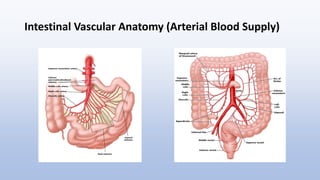
Intestinal Vascular Anatomy (Arterial Blood Supply)
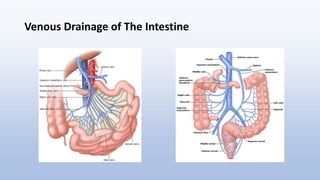
Venous Drainage of The Intestine
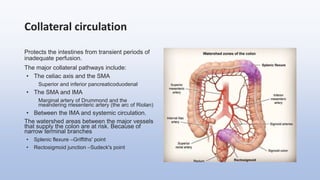
Collateral circulation
Protects the intestines from transient periods of
inadequate perfusion.
The major collateral pathways include:
• The celiac axis and the SMA
Superior and inferior pancreaticoduodenal
• The SMA and IMA
Marginal artery of Drummond and the
meandering mesenteric artery (the arc of Riolan)
• Between the IMA and systemic circulation.
The watershed areas between the major vessels
that supply the colon are at risk. Because of
narrow terminal branches
• Splenic flexure –Griffiths' point
• Rectosigmoid junction –Sudeck's point
Physiology And Mechanisms Of Ischemia
• The splanchnic circulation receives between 10 to 35 percent of cardiac output, depending upon
whether it is in the fed or fasted state.
• Although the capillary density within the intestinal vasculature is high, intestinal oxygen extraction
is relatively low, thereby permitting sufficient oxygen to be delivered to the liver via the portal vein.
• As a result, intestinal blood flow must be reduced by at least 50 percent from the normal fasting
level before oxygen delivery to the intestine becomes compromised
Classification
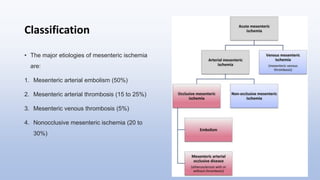
• The major etiologies of mesenteric ischemia
are:
1. Mesenteric arterial embolism (50%)
2. Mesenteric arterial thrombosis (15 to 25%)
3. Mesenteric venous thrombosis (5%)
4. Nonocclusive mesenteric ischemia (20 to
30%)
Acute Mesenteric Arterial Occlusion
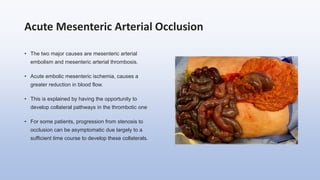
• The two major causes are mesenteric arterial
embolism and mesenteric arterial thrombosis.
• Acute embolic mesenteric ischemia, causes a
greater reduction in blood flow.
• This is explained by having the opportunity to
develop collateral pathways in the thrombotic one
• For some patients, progression from stenosis to
occlusion can be asymptomatic due largely to a
sufficient time course to develop these collaterals.
Risk Factors
Any process that increases the potential for embolism from the heart or proximal arterial vasculature
or for arterial thrombosis
General risks (smoking, hypertension, hyperlipidemia, diabetes)
Risks for Embolism
• Cardiac Arrhythmias
• Cardiac Valvular Disease
• Infective Endocarditis
• Recent Myocardial Infarction
• Ventricular Aneurysm
• Aortic Atherosclerosis
• Aortic Aneurysm
Risks for Thrombotic Occlusion
• Peripheral Artery Disease
• Advanced Age
• Low Cardiac Output States
• Traumatic Injury
• Less Frequently, Vasculitis, Most Commonly
Polyarteritis Nodosa
Nonocclusive Mesenteric Ischemia
• Due to primary mesenteric arterial vasoconstriction and hypoperfusion
• The majority of cases involve spasm of branches of the superior mesenteric artery (SMA)
• Risk factors for NOMI include:
o Heart failure/cardiogenic shock
o Aortic insufficiency
o Septic shock
o Cocaine abuse/methamphetamine abuse
o Recent cardiopulmonary bypass
o Chronic renal insufficiency/dialysis
o Severe burns (associated hypovolemia/shock)
o Vasoconstrictive medications
Venous Mesenteric Ischemia
• Mesenteric venous thrombosis can present acutely or in a subacute or chronic manner.
• Idiopathic (eg, hypercoagulable states) or from secondary causes (eg, malignancy or prior
abdominal surgery).
• Local factors (eg, splenectomy, pancreatitis) appear to be associated with initial thrombus formation
in the large veins, whereas systemic hypercoagulable states (eg, protein C deficiency) lead to
thrombosis initiated in the small veins
• Mesenteric venous thrombosis rarely involves the colon (inferior mesenteric venous drainage)
• Chronic mesenteric venous thrombosis is suggested by the presence of thrombus with well-
developed collateralization, often in association with cavernous transformation of the portal vein and
in the absence of signs of intestinal ischemia or infarction.
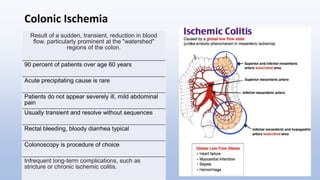
Colonic Ischemia
Result of a sudden, transient, reduction in blood
flow, particularly prominent at the "watershed"
regions of the colon.
90 percent of patients over age 60 years
Acute precipitating cause is rare
Patients do not appear severely ill, mild abdominal
pain
Usually transient and resolve without sequences
Rectal bleeding, bloody diarrhea typical
Colonoscopy is procedure of choice
Infrequent long-term complications, such as
stricture or chronic ischemic colitis.
Chronic Mesenteric Ischemia
• Patients with mesenteric atherosclerosis
• Typically over the age of 60 and are three times more likely to be female rather than male
• History of smoking, coronary heart disease, cerebrovascular disease, or lower extremity peripheral
artery disease
Symptoms
• “Intestinal angina." dull, crampy, postprandial epigastric pain.
• abdominal pain with eating leads patients to avoid eating (food fear), and they typically lose weight
• Rare causes include median arcuate ligament syndrome (compression of the celiac artery from the
median arcuate ligament of the diaphragm), fibromuscular dysplasia, aortic or mesenteric artery
dissection, vasculitis, and retroperitoneal fibrosis
Clinical Features
• The diagnosis of acute mesenteric ischemia depends upon a high level of clinical suspicion
Abdominal pain
• The classic clinical description is "abdominal pain out of proportion to the physical examination."
• Arterial embolism is typically sudden, severe, periumbilical, and often accompanied by nausea and
vomiting.
• Thrombotic mesenteric arterial occlusion may report worsened postprandial pain
• Mesenteric venous thrombosis are more likely to present with a more insidious onset of abdominal
pain
• Nonocclusive mesenteric ischemia (NOMI) is usually more variable
Past medical history
• Previous embolic event, history or family history of DVT or PE
• symptoms of chronic mesenteric ischemia (Intestinal Angina)
Physical examination
• May be normal initially or show only mild abdominal distension with no signs of peritoneal
inflammation.
• As bowel ischemia progresses, the abdomen becomes grossly distended, bowel sounds become
absent, and peritoneal signs develop.
• Signs consistent with dehydration and shock indicate a deteriorating clinical course.
Laboratory studies
• Nonspecific, EVEN normal laboratory values do not exclude acute mesenteric ischemia.
• Findings may include, marked leukocytosis, an elevated hematocrit, and a metabolic acidosis.
• Elevated lactate and serum amylase levels
A useful clinical guideline is that any patient with acute abdominal pain and metabolic
acidosis has intestinal ischemia until proven otherwise
Initial Management
• Gastrointestinal decompression
• Fluid resuscitation
• Hemodynamic monitoring and support
• Correction of electrolyte abnormalities
• Pain control
• Anticoagulation under most circumstances
• Initiation of broad-spectrum antibiotics
• Avoidance of vasopressors
• Supplemental oxygen
For those without indications for immediate abdominal exploration, a definitive diagnosis requires
advanced abdominal imaging.
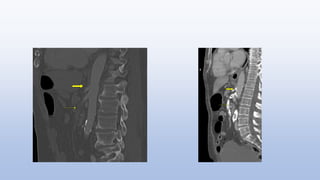
Radiological Evaluation
Distended featureless loops of small bowel with wall
thickening (arrow) and separation of the bowel loops
Air within the wall of the ascending colon (arrow)
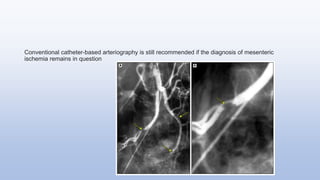
Conventional catheter-based arteriography is still recommended if the diagnosis of mesenteric
ischemia remains in question
Management Of Acute Arterial Mesenteric Occlusion
Optimal treatment may include open, endovascular, or a combined approach.
• The traditional treatment of acute mesenteric arterial embolism is early surgical laparotomy with
embolectomy
• An alternative approach for acute embolus, particularly in those with severe comorbidities, is local
infusion of a thrombolytic agent
• For mesenteric arterial thrombosis, choices include surgical revascularization (mesenteric bypass),
or thrombolysis with endovascular angioplasty and stenting
• The choice depends on the time course, severity of ischemia, and medical comorbidities of the
patient.
• Patients who are good-risk surgical candidates with indications for immediate laparotomy such as
peritonitis should be taken directly to the operating room for exploration.
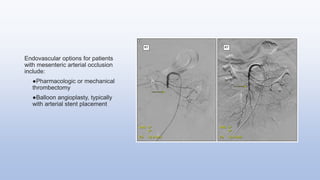
Endovascular options for patients
with mesenteric arterial occlusion
include:
●Pharmacologic or mechanical
thrombectomy
●Balloon angioplasty, typically
with arterial stent placement
Questional Bowel Viability Intra Op
• Bowel of questionable viability should
reassessed after perfusion is restored
• Color, distention, peristalsis, arterial pulsations
in the mesenteric arcades, and bleeding from
cut surfaces, should be assessed.
• The presence of Doppler signals over the
serosal surface may be helpful in identifying
potentially salvageable ischemic segments to
be left in place for reevaluation at second-look
operation
• Intravenous injection of fluorescein dye with
inspection of the intestine illuminated via a
Wood's lamp can assist in determining
remaining bowel viability.
Long-term Medical Management
• Aimed at the prevention of future embolic events, typically with the use of vitamin K antagonists or
novel oral anticoagulants
• Following revascularization of thrombotic arterial occlusion due to atherosclerosis, medical
management of peripheral artery disease includes antiplatelet therapy and statin therapy as part of
a cardiovascular risk reduction strategy.
Treatment Of Specific Etiologies
Mesenteric venous thrombosis
• Predominantly conservative, consisting of systemic anticoagulation to minimize extension of
thrombus, bowel rest, and careful, serial observation for any signs of clinical deterioration
• Venous thrombolysis has been reported in small case series.
• Surgical exploration is limited to those patients with definite signs of bowel infarction.
• Hypercoagulability testing should include protein S, protein C, and antithrombin III, factor V Leiden
mutation, activated protein C resistance, anticardiolipin antibodies, antiphospholipid antibodies, or
lupus anticoagulant.
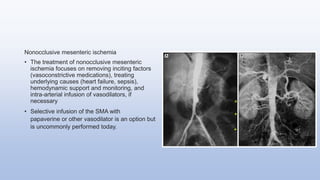
Nonocclusive mesenteric ischemia
• The treatment of nonocclusive mesenteric
ischemia focuses on removing inciting factors
(vasoconstrictive medications), treating
underlying causes (heart failure, sepsis),
hemodynamic support and monitoring, and
intra-arterial infusion of vasodilators, if
necessary
• Selective infusion of the SMA with
papaverine or other vasodilator is an option but
is uncommonly performed today.
Morbidity And Mortality
In general mortality rates exceed 60 percent
• Patients who survive an acute event are likely to die of complications related to the underlying
condition.
• Time to diagnosis and treatment is paramount to survival for acute mesenteric ischemia patients.
• Advanced mesenteric ischemia requiring bowel resection is associated with a 15-fold increase in
mortality.
• Acute mesenteric venous thrombosis has a better prognosis than other forms of acute mesenteric
ischemia
• Nonocclusive intestinal ischemia has the poorest survival rate among the various etiologies of
mesenteric ischemia. Mortality rate of 70-90%
• For those who survive massive bowel resection, short bowel syndrome and life long TPN.
THANK YOU

Mesentric-ischemia MAT -SMA-lectures.pptx

  • 1.
    Mesenteric Ischemia Supervisors : ProfessorDr Abduh Shamsan Professor Dr Raydan AlEriani prepared by Resident : Dr Ezzaddin Obaid
  • 2.
    Introduction • Ischemia affectingthe small intestine is generally referred to as mesenteric ischemia, while ischemia affecting the large intestine is referred to as colonic ischemia. • A broader term, splanchnic (visceral) ischemia, encompasses ischemia affecting the intestine, as well as other abdominal organs such as the liver, spleen, or kidneys. • It can be caused by any process that reduces intestinal blood flow, such as arterial occlusion, venous occlusion, or arterial vasospasm.
  • 3.
    Intestinal Vascular Anatomy(Arterial Blood Supply)
  • 4.
    Venous Drainage ofThe Intestine
  • 5.
    Collateral circulation Protects theintestines from transient periods of inadequate perfusion. The major collateral pathways include: • The celiac axis and the SMA Superior and inferior pancreaticoduodenal • The SMA and IMA Marginal artery of Drummond and the meandering mesenteric artery (the arc of Riolan) • Between the IMA and systemic circulation. The watershed areas between the major vessels that supply the colon are at risk. Because of narrow terminal branches • Splenic flexure –Griffiths' point • Rectosigmoid junction –Sudeck's point
  • 6.
    Physiology And MechanismsOf Ischemia • The splanchnic circulation receives between 10 to 35 percent of cardiac output, depending upon whether it is in the fed or fasted state. • Although the capillary density within the intestinal vasculature is high, intestinal oxygen extraction is relatively low, thereby permitting sufficient oxygen to be delivered to the liver via the portal vein. • As a result, intestinal blood flow must be reduced by at least 50 percent from the normal fasting level before oxygen delivery to the intestine becomes compromised
  • 7.
    Classification • The majoretiologies of mesenteric ischemia are: 1. Mesenteric arterial embolism (50%) 2. Mesenteric arterial thrombosis (15 to 25%) 3. Mesenteric venous thrombosis (5%) 4. Nonocclusive mesenteric ischemia (20 to 30%)
  • 8.
    Acute Mesenteric ArterialOcclusion • The two major causes are mesenteric arterial embolism and mesenteric arterial thrombosis. • Acute embolic mesenteric ischemia, causes a greater reduction in blood flow. • This is explained by having the opportunity to develop collateral pathways in the thrombotic one • For some patients, progression from stenosis to occlusion can be asymptomatic due largely to a sufficient time course to develop these collaterals.
  • 9.
    Risk Factors Any processthat increases the potential for embolism from the heart or proximal arterial vasculature or for arterial thrombosis General risks (smoking, hypertension, hyperlipidemia, diabetes) Risks for Embolism • Cardiac Arrhythmias • Cardiac Valvular Disease • Infective Endocarditis • Recent Myocardial Infarction • Ventricular Aneurysm • Aortic Atherosclerosis • Aortic Aneurysm Risks for Thrombotic Occlusion • Peripheral Artery Disease • Advanced Age • Low Cardiac Output States • Traumatic Injury • Less Frequently, Vasculitis, Most Commonly Polyarteritis Nodosa
  • 10.
    Nonocclusive Mesenteric Ischemia •Due to primary mesenteric arterial vasoconstriction and hypoperfusion • The majority of cases involve spasm of branches of the superior mesenteric artery (SMA) • Risk factors for NOMI include: o Heart failure/cardiogenic shock o Aortic insufficiency o Septic shock o Cocaine abuse/methamphetamine abuse o Recent cardiopulmonary bypass o Chronic renal insufficiency/dialysis o Severe burns (associated hypovolemia/shock) o Vasoconstrictive medications
  • 11.
    Venous Mesenteric Ischemia •Mesenteric venous thrombosis can present acutely or in a subacute or chronic manner. • Idiopathic (eg, hypercoagulable states) or from secondary causes (eg, malignancy or prior abdominal surgery). • Local factors (eg, splenectomy, pancreatitis) appear to be associated with initial thrombus formation in the large veins, whereas systemic hypercoagulable states (eg, protein C deficiency) lead to thrombosis initiated in the small veins • Mesenteric venous thrombosis rarely involves the colon (inferior mesenteric venous drainage) • Chronic mesenteric venous thrombosis is suggested by the presence of thrombus with well- developed collateralization, often in association with cavernous transformation of the portal vein and in the absence of signs of intestinal ischemia or infarction.
  • 12.
    Colonic Ischemia Result ofa sudden, transient, reduction in blood flow, particularly prominent at the "watershed" regions of the colon. 90 percent of patients over age 60 years Acute precipitating cause is rare Patients do not appear severely ill, mild abdominal pain Usually transient and resolve without sequences Rectal bleeding, bloody diarrhea typical Colonoscopy is procedure of choice Infrequent long-term complications, such as stricture or chronic ischemic colitis.
  • 13.
    Chronic Mesenteric Ischemia •Patients with mesenteric atherosclerosis • Typically over the age of 60 and are three times more likely to be female rather than male • History of smoking, coronary heart disease, cerebrovascular disease, or lower extremity peripheral artery disease Symptoms • “Intestinal angina." dull, crampy, postprandial epigastric pain. • abdominal pain with eating leads patients to avoid eating (food fear), and they typically lose weight • Rare causes include median arcuate ligament syndrome (compression of the celiac artery from the median arcuate ligament of the diaphragm), fibromuscular dysplasia, aortic or mesenteric artery dissection, vasculitis, and retroperitoneal fibrosis
  • 14.
    Clinical Features • Thediagnosis of acute mesenteric ischemia depends upon a high level of clinical suspicion Abdominal pain • The classic clinical description is "abdominal pain out of proportion to the physical examination." • Arterial embolism is typically sudden, severe, periumbilical, and often accompanied by nausea and vomiting. • Thrombotic mesenteric arterial occlusion may report worsened postprandial pain • Mesenteric venous thrombosis are more likely to present with a more insidious onset of abdominal pain • Nonocclusive mesenteric ischemia (NOMI) is usually more variable Past medical history • Previous embolic event, history or family history of DVT or PE • symptoms of chronic mesenteric ischemia (Intestinal Angina)
  • 15.
    Physical examination • Maybe normal initially or show only mild abdominal distension with no signs of peritoneal inflammation. • As bowel ischemia progresses, the abdomen becomes grossly distended, bowel sounds become absent, and peritoneal signs develop. • Signs consistent with dehydration and shock indicate a deteriorating clinical course. Laboratory studies • Nonspecific, EVEN normal laboratory values do not exclude acute mesenteric ischemia. • Findings may include, marked leukocytosis, an elevated hematocrit, and a metabolic acidosis. • Elevated lactate and serum amylase levels A useful clinical guideline is that any patient with acute abdominal pain and metabolic acidosis has intestinal ischemia until proven otherwise
  • 16.
    Initial Management • Gastrointestinaldecompression • Fluid resuscitation • Hemodynamic monitoring and support • Correction of electrolyte abnormalities • Pain control • Anticoagulation under most circumstances • Initiation of broad-spectrum antibiotics • Avoidance of vasopressors • Supplemental oxygen For those without indications for immediate abdominal exploration, a definitive diagnosis requires advanced abdominal imaging.
  • 17.
    Radiological Evaluation Distended featurelessloops of small bowel with wall thickening (arrow) and separation of the bowel loops Air within the wall of the ascending colon (arrow)
  • 19.
    Conventional catheter-based arteriographyis still recommended if the diagnosis of mesenteric ischemia remains in question
  • 20.
    Management Of AcuteArterial Mesenteric Occlusion Optimal treatment may include open, endovascular, or a combined approach. • The traditional treatment of acute mesenteric arterial embolism is early surgical laparotomy with embolectomy • An alternative approach for acute embolus, particularly in those with severe comorbidities, is local infusion of a thrombolytic agent • For mesenteric arterial thrombosis, choices include surgical revascularization (mesenteric bypass), or thrombolysis with endovascular angioplasty and stenting • The choice depends on the time course, severity of ischemia, and medical comorbidities of the patient. • Patients who are good-risk surgical candidates with indications for immediate laparotomy such as peritonitis should be taken directly to the operating room for exploration.
  • 21.
    Endovascular options forpatients with mesenteric arterial occlusion include: ●Pharmacologic or mechanical thrombectomy ●Balloon angioplasty, typically with arterial stent placement
  • 22.
    Questional Bowel ViabilityIntra Op • Bowel of questionable viability should reassessed after perfusion is restored • Color, distention, peristalsis, arterial pulsations in the mesenteric arcades, and bleeding from cut surfaces, should be assessed. • The presence of Doppler signals over the serosal surface may be helpful in identifying potentially salvageable ischemic segments to be left in place for reevaluation at second-look operation • Intravenous injection of fluorescein dye with inspection of the intestine illuminated via a Wood's lamp can assist in determining remaining bowel viability.
  • 23.
    Long-term Medical Management •Aimed at the prevention of future embolic events, typically with the use of vitamin K antagonists or novel oral anticoagulants • Following revascularization of thrombotic arterial occlusion due to atherosclerosis, medical management of peripheral artery disease includes antiplatelet therapy and statin therapy as part of a cardiovascular risk reduction strategy.
  • 24.
    Treatment Of SpecificEtiologies Mesenteric venous thrombosis • Predominantly conservative, consisting of systemic anticoagulation to minimize extension of thrombus, bowel rest, and careful, serial observation for any signs of clinical deterioration • Venous thrombolysis has been reported in small case series. • Surgical exploration is limited to those patients with definite signs of bowel infarction. • Hypercoagulability testing should include protein S, protein C, and antithrombin III, factor V Leiden mutation, activated protein C resistance, anticardiolipin antibodies, antiphospholipid antibodies, or lupus anticoagulant.
  • 25.
    Nonocclusive mesenteric ischemia •The treatment of nonocclusive mesenteric ischemia focuses on removing inciting factors (vasoconstrictive medications), treating underlying causes (heart failure, sepsis), hemodynamic support and monitoring, and intra-arterial infusion of vasodilators, if necessary • Selective infusion of the SMA with papaverine or other vasodilator is an option but is uncommonly performed today.
  • 26.
    Morbidity And Mortality Ingeneral mortality rates exceed 60 percent • Patients who survive an acute event are likely to die of complications related to the underlying condition. • Time to diagnosis and treatment is paramount to survival for acute mesenteric ischemia patients. • Advanced mesenteric ischemia requiring bowel resection is associated with a 15-fold increase in mortality. • Acute mesenteric venous thrombosis has a better prognosis than other forms of acute mesenteric ischemia • Nonocclusive intestinal ischemia has the poorest survival rate among the various etiologies of mesenteric ischemia. Mortality rate of 70-90% • For those who survive massive bowel resection, short bowel syndrome and life long TPN.
  • 27.