
ISCHAEMIC
COLITIS
Dr Dhaval Mangukiya
SIDS Hospital
ISCHAEMIC COLITIS
 Relatively common in the elderly
 Commonest form of ischaemic injury to the GI tract
 Spectrum of disease from transient mucosal inflammation to
gangrene
 Real incidence is uncertain:
(1.7 cases per 1000 autopsies in Sweden)
Scand J Gastro 2006
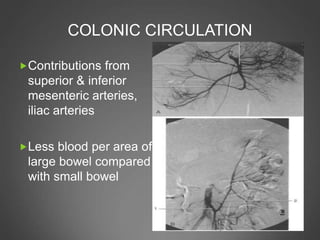
COLONIC CIRCULATION
Contributions from
superior & inferior
mesenteric arteries,
iliac arteries
Less blood per area of
large bowel compared
with small bowel
COLONIC CIRCULATION
Marginal artery of
Drummond
Arc of Riolan
Griffith’s & Sudeck’s
points
PATHOPHYSIOLOGY OF COLONIC
ISCHAEMIA
 Occlusion of main vessels is rare
 Transient low flow state with degenerative narrowing of small
vessels in the elderly
 Vasoconstriction & increased metabolic requirements in some
cases
SPECIFIC CAUSES OF COLONIC
ISCHAEMIA
 After AAA repair
 AMI & shock, cardiopulmonary bypass (high mortality)
 Hypercoagulable states
 Vasculitis
 Marathon running
 Cocaine
COLONIC ISCHAEMIA AFTER
AORTIC ANEURYSM REPAIR
 Occurs in 5% of cases
 High index of suspicion & early colonoscopy
 Trial of implantation of IMA after repair: 128 patients with patent
IMA randomised - ischaemia in 6 patients after implantation & 10
patients without implantation (NS)
 Austria, J Vasc Surg, 2006
HYPERCOAGULABLE STATES
 Coagulation abnormalities in 28% of patients with colonic
ischaemia compared with 8.4% of general population
 Coagulation abnormalities included factor V & activated protein C
resistance, protein S deficiency, anticardiolipin antibody
 Canton Ohio, Southern Medical Journal 2004
ISCHAEMIA DUE TO COCAINE
DISTRIBUTION OF ISCHAEMIC
CHANGES
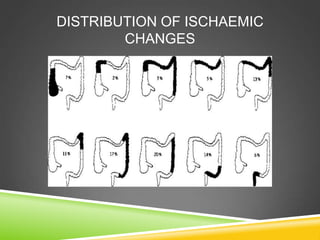
 Most commonly splenic flexure & descending colon
 After AAA repair & IMA ligation usually involves sigmoid colon
 Embolic disease causes right colon ischaemia
DISTRIBUTION OF ISCHAEMIC
CHANGES
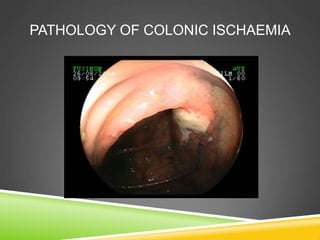
PATHOLOGY OF COLONIC ISCHAEMIA
Oedema, submucosal haemorrhage &
haemosiderin laden macrophages
Mucosal sloughing & ulceration
Full thickness infarction, ghost cells
Chronic colitis with ulceration
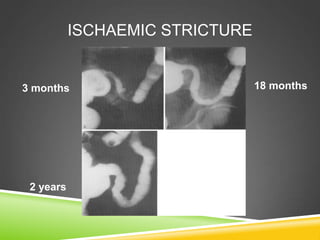
Ischaemic stricture
PATHOLOGY OF COLONIC ISCHAEMIA
ISCHAEMIC STRICTURE
3 months 18 months
2 years
SYMPTOMS & SIGNS OF COLONIC
ISCHAEMIA
 Left sided cramping pain with or without faecal urgency
 Rectal bleeding
 Diarrhoea
 Signs of peritonitis
 Clinical context – post AAA repair
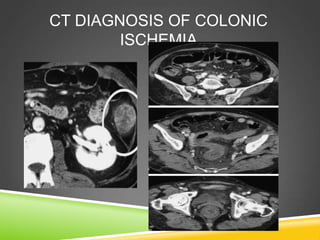
DIAGNOSIS OF COLONIC
ISCHAEMIA
 CT scan
 Colonoscopy
 Angiography is rarely helpful
CT DIAGNOSIS OF COLONIC
ISCHEMIA
MANAGEMENT OF COLONIC
ISCHAEMIA
 Suspect & confirm diagnosis
 Supportive treatment – IV fluids, IV antibiotics, bowel rest
 Regular clinical & colonoscopic assessment
COLOURS OF ISCHAEMIA
Red Yellow
Green Grey
COLOURS OF ISCHAEMIA
Black
COLONOSCOPIC MANAGEMENT BASED
ON COLOUR
(CLEVELAND CLINIC GUIDELINES):
 Red mucosa – repeat 4-5 days
 Yellow mucosa – repeat 2-3 days
 Green mucosa – repeat next day
 Grey mucosa – repeat in 12 hours
 Black mucosa - laparotomy
INDICATIONS FOR SURGERY IN
COLONIC ISCHAEMIA
Peritonitis – at presentation or after
observation
Free gas, intramural gas,
intraportal gas on X-ray
Infarction at colonoscopy – lack of bleeding
Colonic stricture
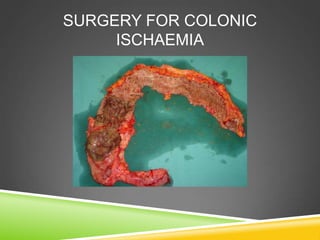
SURGERY FOR COLONIC
ISCHAEMIA
 Resect ischaemic bowel – normal mucosa at resection margins
 Hartmann’s procedure or anterior resection/left hemicolectomy &
loop ileostomy for left sided ischaemia
 Right hemi-colectomy for right sided ischaemia
 Low Hartmann’s for rectal ischaemia
SURGERY FOR COLONIC
ISCHAEMIA
OUTCOME OF ISCHAEMIC COLITIS
 129 patients studied 1992-2002, mean age 66 (29-98), 47% male
 54 in hospital at presentation
 43 patients (33 percent) had peritonitis & required immediate
surgery (51% mortality)
 70 patients treated non operatively – 17 required subsequent
surgery (24%)
 Longo et al, St. Louis, Surgery 2003
Ischemic colitis

Ischemic colitis

  • 1.
  • 2.
    ISCHAEMIC COLITIS  Relativelycommon in the elderly  Commonest form of ischaemic injury to the GI tract  Spectrum of disease from transient mucosal inflammation to gangrene  Real incidence is uncertain: (1.7 cases per 1000 autopsies in Sweden) Scand J Gastro 2006
  • 3.
    COLONIC CIRCULATION Contributions from superior& inferior mesenteric arteries, iliac arteries Less blood per area of large bowel compared with small bowel
  • 4.
    COLONIC CIRCULATION Marginal arteryof Drummond Arc of Riolan Griffith’s & Sudeck’s points
  • 5.
    PATHOPHYSIOLOGY OF COLONIC ISCHAEMIA Occlusion of main vessels is rare  Transient low flow state with degenerative narrowing of small vessels in the elderly  Vasoconstriction & increased metabolic requirements in some cases
  • 6.
    SPECIFIC CAUSES OFCOLONIC ISCHAEMIA  After AAA repair  AMI & shock, cardiopulmonary bypass (high mortality)  Hypercoagulable states  Vasculitis  Marathon running  Cocaine
  • 7.
    COLONIC ISCHAEMIA AFTER AORTICANEURYSM REPAIR  Occurs in 5% of cases  High index of suspicion & early colonoscopy  Trial of implantation of IMA after repair: 128 patients with patent IMA randomised - ischaemia in 6 patients after implantation & 10 patients without implantation (NS)  Austria, J Vasc Surg, 2006
  • 8.
    HYPERCOAGULABLE STATES  Coagulationabnormalities in 28% of patients with colonic ischaemia compared with 8.4% of general population  Coagulation abnormalities included factor V & activated protein C resistance, protein S deficiency, anticardiolipin antibody  Canton Ohio, Southern Medical Journal 2004
  • 9.
  • 10.
    DISTRIBUTION OF ISCHAEMIC CHANGES Most commonly splenic flexure & descending colon  After AAA repair & IMA ligation usually involves sigmoid colon  Embolic disease causes right colon ischaemia
  • 11.
  • 12.
    PATHOLOGY OF COLONICISCHAEMIA Oedema, submucosal haemorrhage & haemosiderin laden macrophages Mucosal sloughing & ulceration Full thickness infarction, ghost cells Chronic colitis with ulceration Ischaemic stricture
  • 13.
  • 14.
  • 15.
    SYMPTOMS & SIGNSOF COLONIC ISCHAEMIA  Left sided cramping pain with or without faecal urgency  Rectal bleeding  Diarrhoea  Signs of peritonitis  Clinical context – post AAA repair
  • 16.
    DIAGNOSIS OF COLONIC ISCHAEMIA CT scan  Colonoscopy  Angiography is rarely helpful
  • 17.
    CT DIAGNOSIS OFCOLONIC ISCHEMIA
  • 18.
    MANAGEMENT OF COLONIC ISCHAEMIA Suspect & confirm diagnosis  Supportive treatment – IV fluids, IV antibiotics, bowel rest  Regular clinical & colonoscopic assessment
  • 19.
    COLOURS OF ISCHAEMIA RedYellow Green Grey
  • 20.
  • 21.
    COLONOSCOPIC MANAGEMENT BASED ONCOLOUR (CLEVELAND CLINIC GUIDELINES):  Red mucosa – repeat 4-5 days  Yellow mucosa – repeat 2-3 days  Green mucosa – repeat next day  Grey mucosa – repeat in 12 hours  Black mucosa - laparotomy
  • 22.
    INDICATIONS FOR SURGERYIN COLONIC ISCHAEMIA Peritonitis – at presentation or after observation Free gas, intramural gas, intraportal gas on X-ray Infarction at colonoscopy – lack of bleeding Colonic stricture
  • 23.
    SURGERY FOR COLONIC ISCHAEMIA Resect ischaemic bowel – normal mucosa at resection margins  Hartmann’s procedure or anterior resection/left hemicolectomy & loop ileostomy for left sided ischaemia  Right hemi-colectomy for right sided ischaemia  Low Hartmann’s for rectal ischaemia
  • 24.
  • 25.
    OUTCOME OF ISCHAEMICCOLITIS  129 patients studied 1992-2002, mean age 66 (29-98), 47% male  54 in hospital at presentation  43 patients (33 percent) had peritonitis & required immediate surgery (51% mortality)  70 patients treated non operatively – 17 required subsequent surgery (24%)  Longo et al, St. Louis, Surgery 2003