


ED Stroke Update
DAVID BLACKER
Neurologist & stroke
physician,
Sir Charles Gairdner
Hospital
Clinical Professor of
Neurology
University of WA
Medical Director
WA Neuroscience Research
Institute
No disclosures
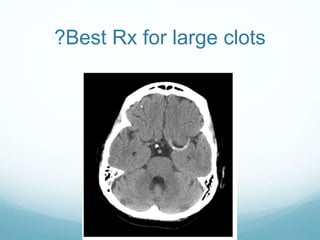
?Best Rx for large clots
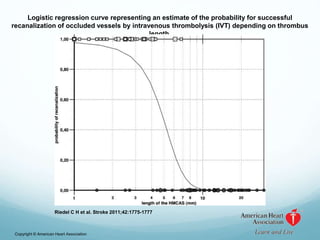
Logistic regression curve representing an estimate of the probability for successful
recanalization of occluded vessels by intravenous thrombolysis (IVT) depending on thrombus
length.
Riedel C H et al. Stroke 2011;42:1775-1777
Copyright © American Heart Association
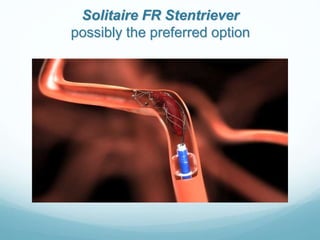
Solitaire FR Stentriever
possibly the preferred option
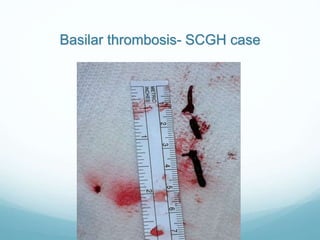
Basilar thrombosis- SCGH case
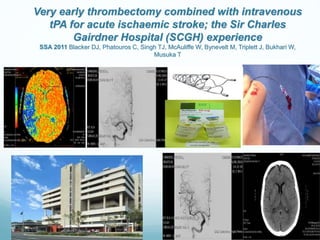
Very early thrombectomy combined with intravenous
tPA for acute ischaemic stroke; the Sir Charles
Gairdner Hospital (SCGH) experience
SSA 2011 Blacker DJ, Phatouros C, Singh TJ, McAuliffe W, Bynevelt M, Triplett J, Bukhari W,
Musuka T
Recent transfer to SCGH
 Initially registrar to registrar contact
 Wrong hospital
 NOT a stroke
 Distress to patient
 Delays on return
 $$$$$$
 How do we do better?
Is transfer required
 For stroke?
 For neurological evaluation
Who is to benefit from the transfer?
 Patient?
 Family?
 Doctors?
Stroke Units
 In Utopia
 All patients should be managed in a stroke unit, since
the evidence suggests better outcomes.
Stroke Units
Stroke Unit benefits
 Benefit 5.6/100
 reduced mortality (22% v 26%)
 reduced dependency (56% v 62%)
 reduced cost of care ($10-16 000 savings)
 LOS reduced 2-11 days
Stroke Units
Stroke unit features
 geographically distinct
 comprehensive assessment
 co-ordinated MDT
 early mobilisation (avoid bed rest)
 staff with interest; ongoing training and education
 team meetings (DC planning)
 encourage patient participation in rehab
Stroke Units
Reasons for benefit
 application of proven treatments
 ?more intense monitoring of physiology
 anticipation, early recognition, and treatment of
complications
 volume of practice
 audit, review, QA, research
 enthusiastic, expert staff
Stroke Unit- Physician role
 Knowledge of stroke and TIA
 Accurate determination of mechanism
 Institution of appropriate Rx;
eg anti-coagulation for AF
CEA -symptomatic high grade stenosis
Correct Dx of mimics
Patients to transfer to teritary or
“quaternary” centres
1. Acute therapy for ischaemic stroke; depends on system
of care
2. Most cases of ICH (if active treatment planned)
3. Young massive MCA, candidates for decompression.
4. Cerebellar infarct > 3cm, candidate for decompression.
5. Carotid revascularization.
6. Dx unclear, advanced workup required (neuro opinion,
MRI, TOE, LP)
Consultant to consultant
discussion
 Early advice on Dx
 Early advice on interventions
 In the future; IV tPA
 “Big picture” discussion on goals of transfer
 Chance for education
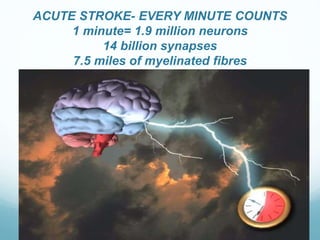
ACUTE STROKE- EVERY MINUTE COUNTS
1 minute= 1.9 million neurons
14 billion synapses
7.5 miles of myelinated fibres
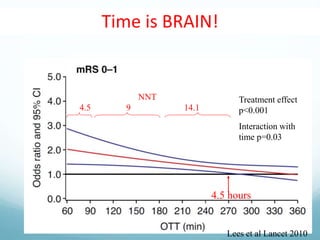
IV tPA meta-analysis – level 1 evidence
Lees et al Lancet 2010
NNT
4.5 9 14.1
Time is BRAIN!
Treatment effect
p<0.001
Interaction with
time p=0.03
4.5 hours
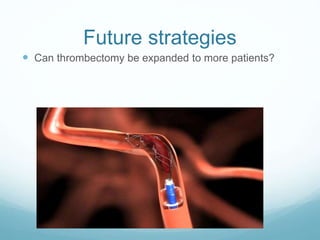
Future strategies
 Can thrombectomy be expanded to more patients?
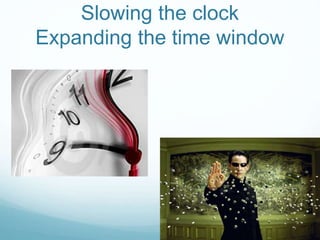
Slowing the clock
Expanding the time window
Neuroprotective agents in the field
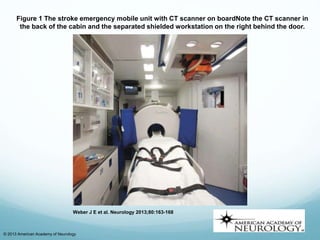
Figure 1 The stroke emergency mobile unit with CT scanner on boardNote the CT scanner in
the back of the cabin and the separated shielded workstation on the right behind the door.
Weber J E et al. Neurology 2013;80:163-168
© 2013 American Academy of Neurology
Pre-hospital therapies
 Jeff Saver California
 Unique pre-hospital stroke trial
 Ethics considerations
 Magnesium IV
 1700 patients
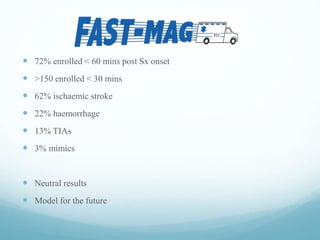
 72% enrolled < 60 mins post Sx onset
 >150 enrolled < 30 mins
 62% ischaemic stroke
 22% haemorrhage
 13% TIAs
 3% mimics
 Neutral results
 Model for the future
Neuroprotective agents in the
field
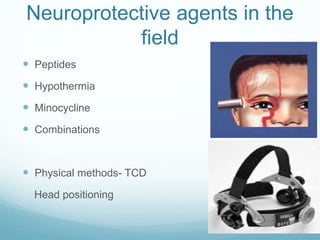
 Peptides
 Hypothermia
 Minocycline
 Combinations
 Physical methods- TCD
Head positioning
Neuroprotection
Poly-arginine and arginine rich peptides are
neuroprotective in stroke models
Bruno Meloni et al
J Cerebral Blood Flow and Metabolism 2015 Feb 11th
The Perth Intravenous Minocyline
Stroke Study PIMSS
David Blacker
David Prentice
Edith Kohler
Tim Bates
Graeme Hankey
RPH, SCGH,
Swan Districts Hospital, UWA
van Heerden and David Blacker
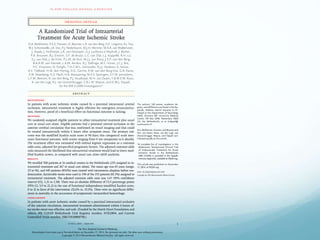
Edith Kohler, David A. Prentice, Timothy R. Bates, Graeme J. Hankey, Anne Claxton, Jolandi
Meta-Analysis
Intravenous Minocycline in Acute Stroke : A Randomized, Controlled Pilot Study and
Print ISSN: 0039-2499. Online ISSN: 1524-4628
Copyright © 2013 American Heart Association, Inc. All rights reserved.
is published by the American Heart Association, 7272 Greenville Avenue, Dallas, TX 75231Stroke
published online July 18, 2013;Stroke.
http://stroke.ahajournals.org/content/early/2013/07/18/STROKEAHA.113.000780
World Wide Web at:
The online version of this article, along with updated information and services, is located on the
http://stroke.ahajournals.org//subscriptions/
is online at:StrokeInformation about subscribing toSubscriptions:
http://www.lww.com/reprints
Information about reprints can be found online at:Reprints:
document.Permissions and Rights Question and Answerprocess is available in the
Request Permissions in the middle column of the Web page under Services. Further information about this
Once the online version of the published article for which permission is being requested is located, click
can be obtained via RightsLink, a service of the Copyright Clearance Center, not the Editorial Office.Strokein
Requests for permissions to reproduce figures, tables, or portions of articles originally publishedPermissions:
by GRAEME HANKEY on July 23, 2013http://stroke.ahajournals.org/Downloaded from
The West Australian Intravenous
Minocycline and tPA Stroke Study
(WAIMATSS)
A pilot study of a strategy to reduce
haemorrhagic transformation
David Blacker
Mike Bynevelt
David Prentice
Graeme Hankey
Tim Bates
Andrew Kelly
Tony Alvaro
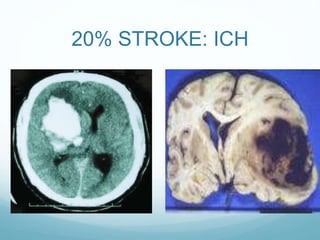
20% STROKE: ICH
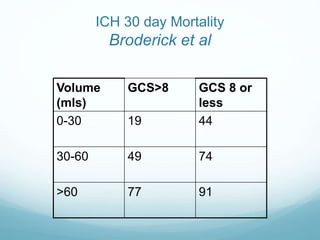
ICH 30 day Mortality
Broderick et al
9177>60
744930-60
44190-30
GCS 8 or
less
GCS>8Volume
(mls)
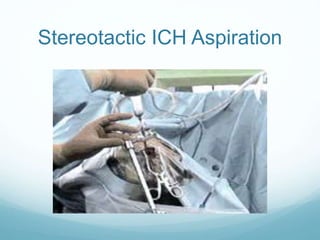
Stereotactic ICH Aspiration
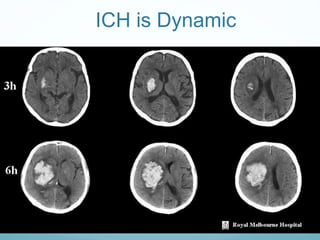
ICH is Dynamic
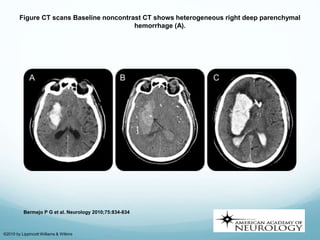
Figure CT scans Baseline noncontrast CT shows heterogeneous right deep parenchymal
hemorrhage (A).
Bermejo P G et al. Neurology 2010;75:834-834
©2010 by Lippincott Williams & Wilkins
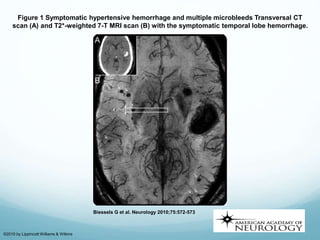
Figure 1 Symptomatic hypertensive hemorrhage and multiple microbleeds Transversal CT
scan (A) and T2*-weighted 7-T MRI scan (B) with the symptomatic temporal lobe hemorrhage.
Biessels G et al. Neurology 2010;75:572-573
©2010 by Lippincott Williams & Wilkins
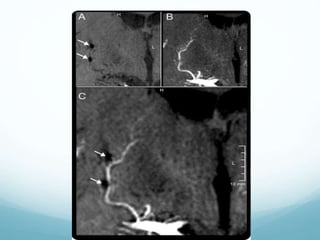
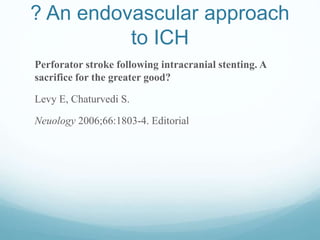
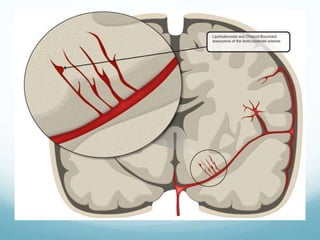
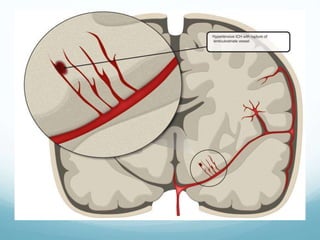
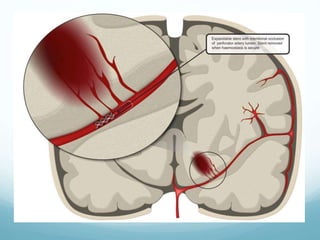
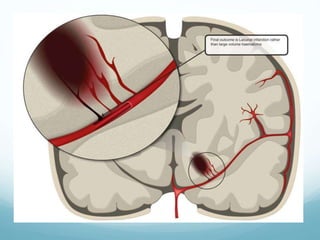
? An endovascular approach
to ICH
Perforator stroke following intracranial stenting. A
sacrifice for the greater good?
Levy E, Chaturvedi S.
Neuology 2006;66:1803-4. Editorial
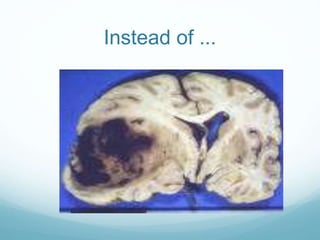
Instead of ...
“Star Trek” approach
 Stereotactic DXRT, or US to “cauterise” the
bleeder; activated microbubbles+ haemostatic
drug?
Other issues
 Secondary prevention strategies
 Novel rehabilitation techniques
 Organisation of services
 Basic sciences
 Psychology
Acute Ischaemic Stroke Mx SCGH - ED Update

Acute Ischaemic Stroke Mx SCGH - ED Update

  • 1.
    ED Stroke Update DAVIDBLACKER Neurologist & stroke physician, Sir Charles Gairdner Hospital Clinical Professor of Neurology University of WA Medical Director WA Neuroscience Research Institute No disclosures
  • 2.
    ?Best Rx forlarge clots
  • 4.
    Logistic regression curverepresenting an estimate of the probability for successful recanalization of occluded vessels by intravenous thrombolysis (IVT) depending on thrombus length. Riedel C H et al. Stroke 2011;42:1775-1777 Copyright © American Heart Association
  • 5.
  • 6.
  • 7.
    Very early thrombectomycombined with intravenous tPA for acute ischaemic stroke; the Sir Charles Gairdner Hospital (SCGH) experience SSA 2011 Blacker DJ, Phatouros C, Singh TJ, McAuliffe W, Bynevelt M, Triplett J, Bukhari W, Musuka T
  • 14.
    Recent transfer toSCGH  Initially registrar to registrar contact  Wrong hospital  NOT a stroke  Distress to patient  Delays on return  $$$$$$  How do we do better?
  • 15.
    Is transfer required For stroke?  For neurological evaluation Who is to benefit from the transfer?  Patient?  Family?  Doctors?
  • 16.
    Stroke Units  InUtopia  All patients should be managed in a stroke unit, since the evidence suggests better outcomes.
  • 17.
    Stroke Units Stroke Unitbenefits  Benefit 5.6/100  reduced mortality (22% v 26%)  reduced dependency (56% v 62%)  reduced cost of care ($10-16 000 savings)  LOS reduced 2-11 days
  • 18.
    Stroke Units Stroke unitfeatures  geographically distinct  comprehensive assessment  co-ordinated MDT  early mobilisation (avoid bed rest)  staff with interest; ongoing training and education  team meetings (DC planning)  encourage patient participation in rehab
  • 19.
    Stroke Units Reasons forbenefit  application of proven treatments  ?more intense monitoring of physiology  anticipation, early recognition, and treatment of complications  volume of practice  audit, review, QA, research  enthusiastic, expert staff
  • 20.
    Stroke Unit- Physicianrole  Knowledge of stroke and TIA  Accurate determination of mechanism  Institution of appropriate Rx; eg anti-coagulation for AF CEA -symptomatic high grade stenosis Correct Dx of mimics
  • 21.
    Patients to transferto teritary or “quaternary” centres 1. Acute therapy for ischaemic stroke; depends on system of care 2. Most cases of ICH (if active treatment planned) 3. Young massive MCA, candidates for decompression. 4. Cerebellar infarct > 3cm, candidate for decompression. 5. Carotid revascularization. 6. Dx unclear, advanced workup required (neuro opinion, MRI, TOE, LP)
  • 22.
    Consultant to consultant discussion Early advice on Dx  Early advice on interventions  In the future; IV tPA  “Big picture” discussion on goals of transfer  Chance for education
  • 23.
    ACUTE STROKE- EVERYMINUTE COUNTS 1 minute= 1.9 million neurons 14 billion synapses 7.5 miles of myelinated fibres
  • 25.
    IV tPA meta-analysis– level 1 evidence Lees et al Lancet 2010 NNT 4.5 9 14.1 Time is BRAIN! Treatment effect p<0.001 Interaction with time p=0.03 4.5 hours
  • 26.
    Future strategies  Canthrombectomy be expanded to more patients?
  • 27.
  • 28.
  • 29.
    Figure 1 Thestroke emergency mobile unit with CT scanner on boardNote the CT scanner in the back of the cabin and the separated shielded workstation on the right behind the door. Weber J E et al. Neurology 2013;80:163-168 © 2013 American Academy of Neurology
  • 30.
    Pre-hospital therapies  JeffSaver California  Unique pre-hospital stroke trial  Ethics considerations  Magnesium IV  1700 patients
  • 31.
     72% enrolled< 60 mins post Sx onset  >150 enrolled < 30 mins  62% ischaemic stroke  22% haemorrhage  13% TIAs  3% mimics  Neutral results  Model for the future
  • 32.
    Neuroprotective agents inthe field  Peptides  Hypothermia  Minocycline  Combinations  Physical methods- TCD Head positioning
  • 33.
    Neuroprotection Poly-arginine and argininerich peptides are neuroprotective in stroke models Bruno Meloni et al J Cerebral Blood Flow and Metabolism 2015 Feb 11th
  • 34.
    The Perth IntravenousMinocyline Stroke Study PIMSS David Blacker David Prentice Edith Kohler Tim Bates Graeme Hankey RPH, SCGH, Swan Districts Hospital, UWA
  • 35.
    van Heerden andDavid Blacker Edith Kohler, David A. Prentice, Timothy R. Bates, Graeme J. Hankey, Anne Claxton, Jolandi Meta-Analysis Intravenous Minocycline in Acute Stroke : A Randomized, Controlled Pilot Study and Print ISSN: 0039-2499. Online ISSN: 1524-4628 Copyright © 2013 American Heart Association, Inc. All rights reserved. is published by the American Heart Association, 7272 Greenville Avenue, Dallas, TX 75231Stroke published online July 18, 2013;Stroke. http://stroke.ahajournals.org/content/early/2013/07/18/STROKEAHA.113.000780 World Wide Web at: The online version of this article, along with updated information and services, is located on the http://stroke.ahajournals.org//subscriptions/ is online at:StrokeInformation about subscribing toSubscriptions: http://www.lww.com/reprints Information about reprints can be found online at:Reprints: document.Permissions and Rights Question and Answerprocess is available in the Request Permissions in the middle column of the Web page under Services. Further information about this Once the online version of the published article for which permission is being requested is located, click can be obtained via RightsLink, a service of the Copyright Clearance Center, not the Editorial Office.Strokein Requests for permissions to reproduce figures, tables, or portions of articles originally publishedPermissions: by GRAEME HANKEY on July 23, 2013http://stroke.ahajournals.org/Downloaded from
  • 36.
    The West AustralianIntravenous Minocycline and tPA Stroke Study (WAIMATSS) A pilot study of a strategy to reduce haemorrhagic transformation David Blacker Mike Bynevelt David Prentice Graeme Hankey Tim Bates Andrew Kelly Tony Alvaro
  • 37.
  • 38.
    ICH 30 dayMortality Broderick et al 9177>60 744930-60 44190-30 GCS 8 or less GCS>8Volume (mls)
  • 39.
  • 40.
  • 41.
    Figure CT scansBaseline noncontrast CT shows heterogeneous right deep parenchymal hemorrhage (A). Bermejo P G et al. Neurology 2010;75:834-834 ©2010 by Lippincott Williams & Wilkins
  • 42.
    Figure 1 Symptomatichypertensive hemorrhage and multiple microbleeds Transversal CT scan (A) and T2*-weighted 7-T MRI scan (B) with the symptomatic temporal lobe hemorrhage. Biessels G et al. Neurology 2010;75:572-573 ©2010 by Lippincott Williams & Wilkins
  • 44.
    ? An endovascularapproach to ICH Perforator stroke following intracranial stenting. A sacrifice for the greater good? Levy E, Chaturvedi S. Neuology 2006;66:1803-4. Editorial
  • 49.
  • 50.
    “Star Trek” approach Stereotactic DXRT, or US to “cauterise” the bleeder; activated microbubbles+ haemostatic drug?
  • 51.
    Other issues  Secondaryprevention strategies  Novel rehabilitation techniques  Organisation of services  Basic sciences  Psychology

Editor's Notes