Approaches to the management
  of statin intolerant patients
                          By
                Ashraf Reda, MD,FESC
   Prof and head of Card. Dep., Menofiya University
                 President of WGLVR
                Chairman of EGYBAC
The problem
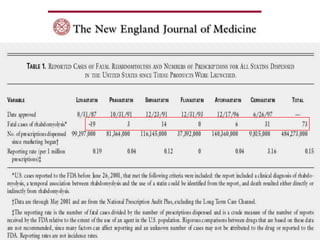
•   5% -10% side effects with statin
•   More patients become statin eligible
•   The use of high dosage
•   Combination therapy
•   Special situations: Pregnancy-Elderly-Children
•   Run in phases may underestimate the
    problem
Higher doses= More adverse effects
                 “TNT”
Non CV mortality with the high doses need further evaluation

Elevated liver enzymes:1.2% vs 0.2% p<0.001

Rhabdomyolysis 2 cases(80mg) vs 3 cases(10mg)

5461 pts. were excluded in the run in phase
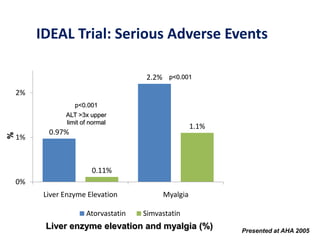
IDEAL Trial: Serious Adverse Events

                                      2.2%    p<0.001

    2%
                   p<0.001
                ALT >3x upper
                limit of normal
                                                       1.1%
           0.97%
%


    1%


                         0.11%
    0%
          Liver Enzyme Elevation             Myalgia

                       Atorvastatin   Simvastatin
          Liver enzyme elevation and myalgia (%)              Presented at AHA 2005
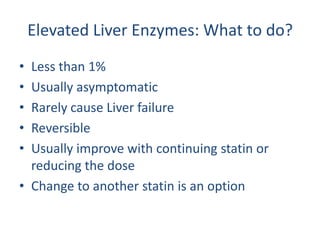
Elevated Liver Enzymes: What to do?
• Less than 1%
• Usually asymptomatic
• Rarely cause Liver failure
• Reversible
• Usually improve with continuing statin or
  reducing the dose
• Change to another statin is an option
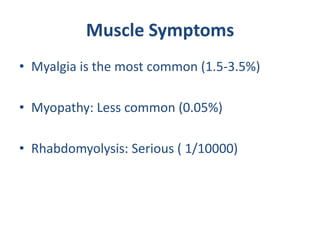
Muscle Symptoms
• Myalgia is the most common (1.5-3.5%)

• Myopathy: Less common (0.05%)

• Rhabdomyolysis: Serious ( 1/10000)
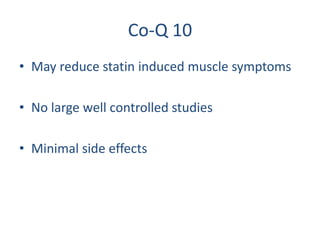
Co-Q 10
• May reduce statin induced muscle symptoms

• No large well controlled studies

• Minimal side effects
-
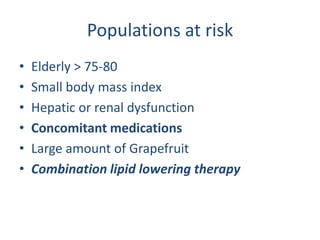
Populations at risk
•   Elderly > 75-80
•   Small body mass index
•   Hepatic or renal dysfunction
•   Concomitant medications
•   Large amount of Grapefruit
•   Combination lipid lowering therapy
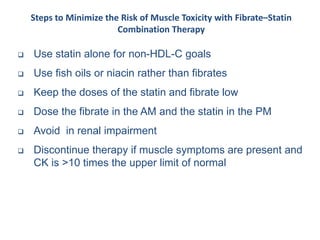
Steps to Minimize the Risk of Muscle Toxicity with Fibrate–Statin
                         Combination Therapy

   Use statin alone for non-HDL-C goals
   Use fish oils or niacin rather than fibrates
   Keep the doses of the statin and fibrate low
   Dose the fibrate in the AM and the statin in the PM
   Avoid in renal impairment
   Discontinue therapy if muscle symptoms are present and
    CK is >10 times the upper limit of normal
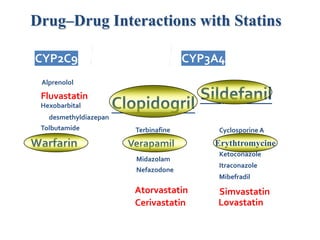
Drug–Drug Interactions with Statins

          CYP2C9                                                 CYP3A4
                                                  Amlodipine               Quinidine
             Alprenolol
                                                  Diltiazem
            Fluvastatin                                                 Sildefanil
            Hexobarbital                Clopidogril                        Warfarin

            N- desmethyldiazepan                  Protease inhibitors     Clarithromycin
            Tolbutamide                           Terbinafine             Cyclosporine A

        Warfarin                               Verapamil                   Erythromycin
                                                                          Erythtromycine
                                                                          Ketoconazole
                                                  Midazolam
                                                                          Itraconazole
                                                  Nefazodone
                                                  Nifedipine              Mibefradil
                                                  Atorvastatin            Simvastatin
                                                  Cerivastatin            Lovastatin


Adapted form Corsini A et al. Atherosclerosis, 2002; 35–40.
If not tolerated what to do?
• DC Statin temporarily to be sure that the Side
  effects are statin related
• Re-challenge with a lower dose or change to
  other statin
• If multiple statins are not tolerated we can use
  less effective
  drugs(Resin, Ezetimibe, Niacin, Fibrate)
• More intense Life style change program
SOMETIMES STATIN COULDN’T BE
AN APTION
Referred because of abnormal lipid profile

• 32 yrs female
•  30 weeks twin pregnancy
• IUF
• +ve FH (CABG for the Father @ 45yrs)
• Father T Cholesterol known to be more than
  300 mg/dl
• Border line Bl. G.
• No Ho DM or hypertension
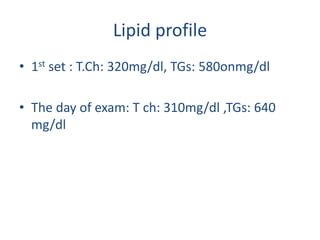
Lipid profile
• 1st set : T.Ch: 320mg/dl, TGs: 580onmg/dl

• The day of exam: T ch: 310mg/dl ,TGs: 640
  mg/dl
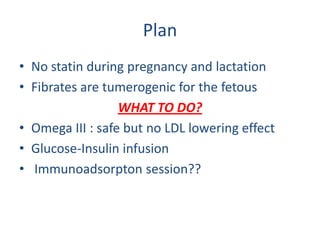
Plan
• No statin during pregnancy and lactation
• Fibrates are tumerogenic for the fetous
                  WHAT TO DO?
• Omega III : safe but no LDL lowering effect
• Glucose-Insulin infusion
• Immunoadsorpton session??
New Statin Intolerance Clinic:
               Work up
• Validated questionnaire including FH of statin
  intolerance
• Level of CK and Vit. D
• Renal and thyroid function tests
• Genetic testing for statin efficacy and
  potential toxicity
• Proximal muscle strength evaluation
• Percutaneous muscle biopsy
Cardiology@Menofiya

  Facebook group

www.cardiolipid.com
Conclusions
• Statin intolerance is not common however the
  numbers are increasing as Millions are
  receiving statin
• Side effects with a statin do not mean that
  other statin couldn’t be used
• Elderly, Low BMI, hepatic or renal
  dysfunction, high dosage and combinations
  are important predictors
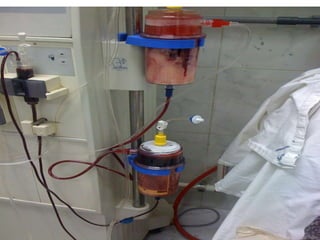
Immunoadsorption- LDL aphaeresis (to take away
[Greek])
Indications:
*failure medical (>LDL>200 mg/dl with CAD)
and > 300 mg/dl without CAD


*Coast s 3000 / tt every 2 weeks for life
Statin in childhood for familial dyslipidemia

• The earlier to start the better (CIMT)

• As early as 8 years is effective and probably
  safe
Apo A-1 Milano
• Five weekly infusions of an ApoA-I Milano/ phospholipid
  complex produced significant regression of coronary
  atheroma burden by IVUS.

• Adverse events were similar to placebo.

• Coronary disease is more dynamic than previously
  realized and can be rapidly affected by agents that
  augment reverse cholesterol transport.


                                                            24
Another non statin way to do it
APO-A1
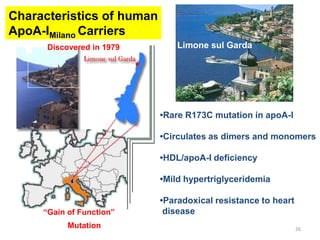
Characteristics of human
ApoA-IMilano Carriers
      Discovered in 1979       Limone sul Garda


                           •Rare R173C mutation in apoA-I

                           •Circulates as dimers and monomers

                           •HDL/apoA-I deficiency

                           •Mild hypertriglyceridemia

                           •Paradoxical resistance to heart
     “Gain of Function”     disease
           Mutation                                           26
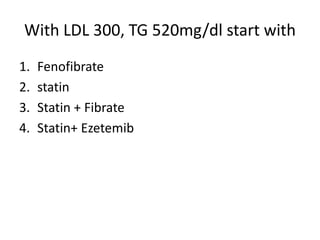
With LDL 300, TG 520mg/dl start with
1.   Fenofibrate
2.   statin
3.   Statin + Fibrate
4.   Statin+ Ezetemib
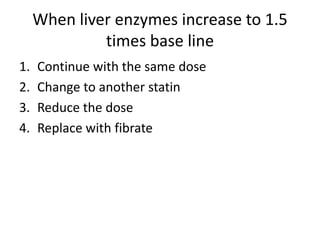
When liver enzymes increase to 1.5
              times base line
1.   Continue with the same dose
2.   Change to another statin
3.   Reduce the dose
4.   Replace with fibrate
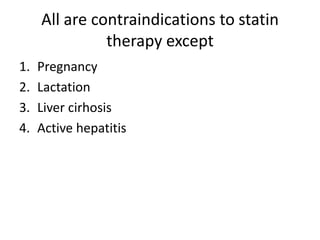
All are contraindications to statin
               therapy except
1.   Pregnancy
2.   Lactation
3.   Liver cirhosis
4.   Active hepatitis
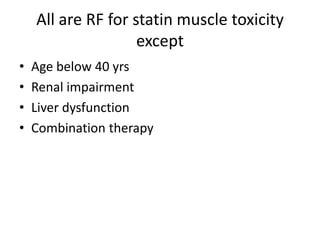
All are RF for statin muscle toxicity
                    except
•   Age below 40 yrs
•   Renal impairment
•   Liver dysfunction
•   Combination therapy
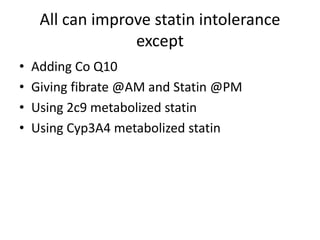
All can improve statin intolerance
                  except
•   Adding Co Q10
•   Giving fibrate @AM and Statin @PM
•   Using 2c9 metabolized statin
•   Using Cyp3A4 metabolized statin
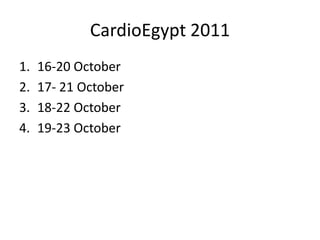
CardioEgypt 2011
1.   16-20 October
2.   17- 21 October
3.   18-22 October
4.   19-23 October

Statin intolerant patients

  • 1.
    Approaches to themanagement of statin intolerant patients By Ashraf Reda, MD,FESC Prof and head of Card. Dep., Menofiya University President of WGLVR Chairman of EGYBAC
  • 2.
    The problem • 5% -10% side effects with statin • More patients become statin eligible • The use of high dosage • Combination therapy • Special situations: Pregnancy-Elderly-Children • Run in phases may underestimate the problem
  • 3.
    Higher doses= Moreadverse effects “TNT” Non CV mortality with the high doses need further evaluation Elevated liver enzymes:1.2% vs 0.2% p<0.001 Rhabdomyolysis 2 cases(80mg) vs 3 cases(10mg) 5461 pts. were excluded in the run in phase
  • 4.
    IDEAL Trial: SeriousAdverse Events 2.2% p<0.001 2% p<0.001 ALT >3x upper limit of normal 1.1% 0.97% % 1% 0.11% 0% Liver Enzyme Elevation Myalgia Atorvastatin Simvastatin Liver enzyme elevation and myalgia (%) Presented at AHA 2005
  • 5.
    Elevated Liver Enzymes:What to do? • Less than 1% • Usually asymptomatic • Rarely cause Liver failure • Reversible • Usually improve with continuing statin or reducing the dose • Change to another statin is an option
  • 6.
    Muscle Symptoms • Myalgiais the most common (1.5-3.5%) • Myopathy: Less common (0.05%) • Rhabdomyolysis: Serious ( 1/10000)
  • 7.
    Co-Q 10 • Mayreduce statin induced muscle symptoms • No large well controlled studies • Minimal side effects
  • 8.
  • 9.
    Populations at risk • Elderly > 75-80 • Small body mass index • Hepatic or renal dysfunction • Concomitant medications • Large amount of Grapefruit • Combination lipid lowering therapy
  • 10.
    Steps to Minimizethe Risk of Muscle Toxicity with Fibrate–Statin Combination Therapy  Use statin alone for non-HDL-C goals  Use fish oils or niacin rather than fibrates  Keep the doses of the statin and fibrate low  Dose the fibrate in the AM and the statin in the PM  Avoid in renal impairment  Discontinue therapy if muscle symptoms are present and CK is >10 times the upper limit of normal
  • 11.
    Drug–Drug Interactions withStatins CYP2C9 CYP3A4 Amlodipine Quinidine Alprenolol Diltiazem Fluvastatin Sildefanil Hexobarbital Clopidogril Warfarin N- desmethyldiazepan Protease inhibitors Clarithromycin Tolbutamide Terbinafine Cyclosporine A Warfarin Verapamil Erythromycin Erythtromycine Ketoconazole Midazolam Itraconazole Nefazodone Nifedipine Mibefradil Atorvastatin Simvastatin Cerivastatin Lovastatin Adapted form Corsini A et al. Atherosclerosis, 2002; 35–40.
  • 12.
    If not toleratedwhat to do? • DC Statin temporarily to be sure that the Side effects are statin related • Re-challenge with a lower dose or change to other statin • If multiple statins are not tolerated we can use less effective drugs(Resin, Ezetimibe, Niacin, Fibrate) • More intense Life style change program
  • 13.
  • 14.
    Referred because ofabnormal lipid profile • 32 yrs female • 30 weeks twin pregnancy • IUF • +ve FH (CABG for the Father @ 45yrs) • Father T Cholesterol known to be more than 300 mg/dl • Border line Bl. G. • No Ho DM or hypertension
  • 15.
    Lipid profile • 1stset : T.Ch: 320mg/dl, TGs: 580onmg/dl • The day of exam: T ch: 310mg/dl ,TGs: 640 mg/dl
  • 16.
    Plan • No statinduring pregnancy and lactation • Fibrates are tumerogenic for the fetous WHAT TO DO? • Omega III : safe but no LDL lowering effect • Glucose-Insulin infusion • Immunoadsorpton session??
  • 18.
    New Statin IntoleranceClinic: Work up • Validated questionnaire including FH of statin intolerance • Level of CK and Vit. D • Renal and thyroid function tests • Genetic testing for statin efficacy and potential toxicity • Proximal muscle strength evaluation • Percutaneous muscle biopsy
  • 20.
    Cardiology@Menofiya Facebookgroup www.cardiolipid.com
  • 21.
    Conclusions • Statin intoleranceis not common however the numbers are increasing as Millions are receiving statin • Side effects with a statin do not mean that other statin couldn’t be used • Elderly, Low BMI, hepatic or renal dysfunction, high dosage and combinations are important predictors
  • 22.
    Immunoadsorption- LDL aphaeresis(to take away [Greek]) Indications: *failure medical (>LDL>200 mg/dl with CAD) and > 300 mg/dl without CAD *Coast s 3000 / tt every 2 weeks for life
  • 23.
    Statin in childhoodfor familial dyslipidemia • The earlier to start the better (CIMT) • As early as 8 years is effective and probably safe
  • 24.
    Apo A-1 Milano •Five weekly infusions of an ApoA-I Milano/ phospholipid complex produced significant regression of coronary atheroma burden by IVUS. • Adverse events were similar to placebo. • Coronary disease is more dynamic than previously realized and can be rapidly affected by agents that augment reverse cholesterol transport. 24
  • 25.
    Another non statinway to do it APO-A1
  • 26.
    Characteristics of human ApoA-IMilanoCarriers Discovered in 1979 Limone sul Garda •Rare R173C mutation in apoA-I •Circulates as dimers and monomers •HDL/apoA-I deficiency •Mild hypertriglyceridemia •Paradoxical resistance to heart “Gain of Function” disease Mutation 26
  • 28.
    With LDL 300,TG 520mg/dl start with 1. Fenofibrate 2. statin 3. Statin + Fibrate 4. Statin+ Ezetemib
  • 29.
    When liver enzymesincrease to 1.5 times base line 1. Continue with the same dose 2. Change to another statin 3. Reduce the dose 4. Replace with fibrate
  • 30.
    All are contraindicationsto statin therapy except 1. Pregnancy 2. Lactation 3. Liver cirhosis 4. Active hepatitis
  • 31.
    All are RFfor statin muscle toxicity except • Age below 40 yrs • Renal impairment • Liver dysfunction • Combination therapy
  • 32.
    All can improvestatin intolerance except • Adding Co Q10 • Giving fibrate @AM and Statin @PM • Using 2c9 metabolized statin • Using Cyp3A4 metabolized statin
  • 33.
    CardioEgypt 2011 1. 16-20 October 2. 17- 21 October 3. 18-22 October 4. 19-23 October