Acute flaccid paralysis
P a g e | 1
Neurology 2018
Kareem Alnakeeb
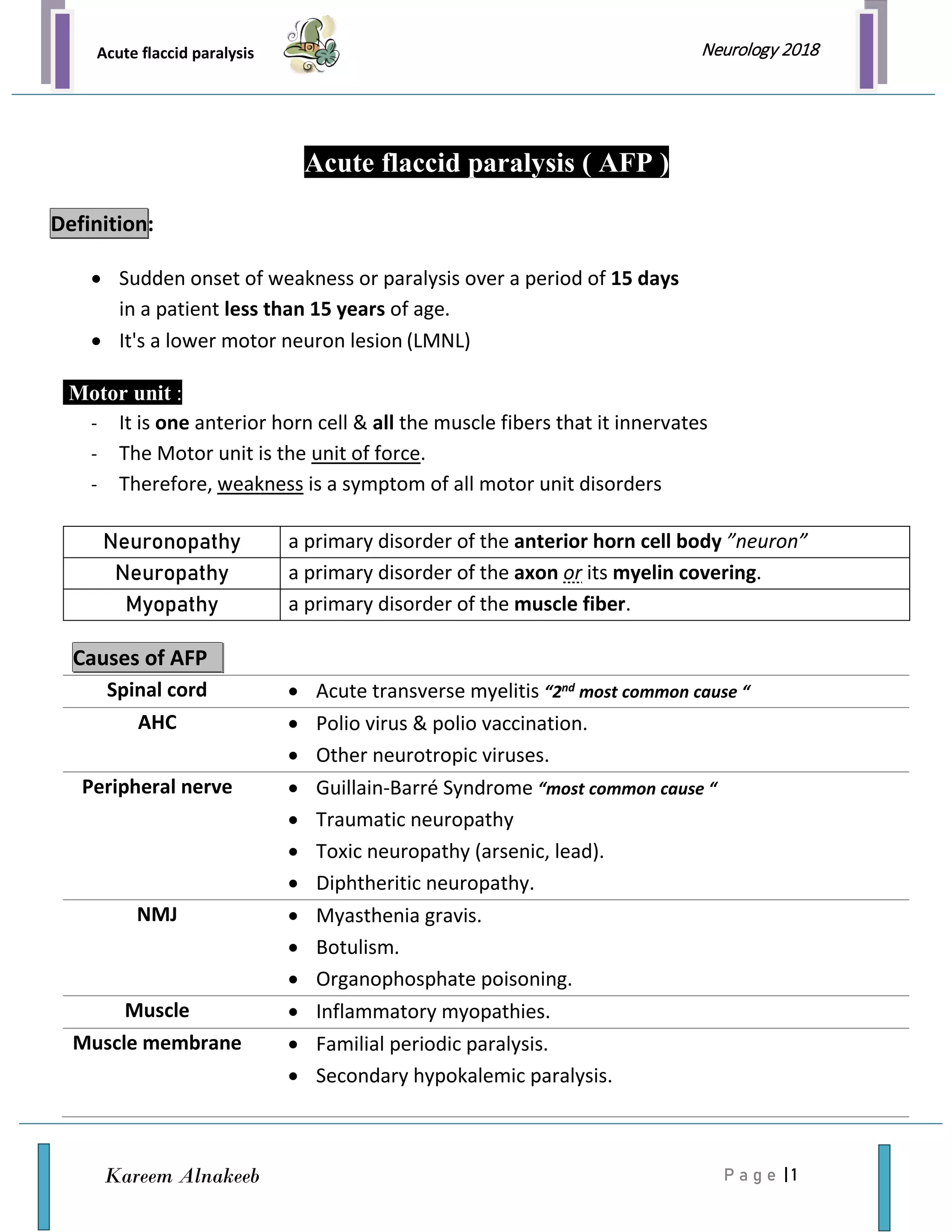
Acute flaccid paralysis ( AFP )
• Sudden onset of weakness or paralysis over a period of 15 days
in a patient less than 15 years of age.
• It's a lower motor neuron lesion (LMNL)
Motor unit :
- It is one anterior horn cell & all the muscle fibers that it innervates
- The Motor unit is the unit of force.
- Therefore, weakness is a symptom of all motor unit disorders
Spinal cord • Acute transverse myelitis “2nd most common cause “
AHC • Polio virus & polio vaccination.
• Other neurotropic viruses.
Peripheral nerve • Guillain-Barré Syndrome “most common cause “
• Traumatic neuropathy
• Toxic neuropathy (arsenic, lead).
• Diphtheritic neuropathy.
NMJ • Myasthenia gravis.
• Botulism.
• Organophosphate poisoning.
Muscle • Inflammatory myopathies.
Muscle membrane • Familial periodic paralysis.
• Secondary hypokalemic paralysis.
Neuronopathy a primary disorder of the anterior horn cell body ”neuron”
Neuropathy a primary disorder of the axon or its myelin covering.
Myopathy a primary disorder of the muscle fiber.
Definition:
Causes of AFP
Acute flaccid paralysis
P a g e | 2
Neurology 2018
Kareem Alnakeeb
● Demonstrate motor weakness.
● Clinical localization: ( spinal cord, peripheral nerve, NMJ, muscle ) ;
○ Deep tendon reflex ( DTR ) : ( absent/ reduced/ normal )
○ Sphincters: ( preserved or affected )
○ Sensory loss: ( no loss, glove and stocking, or dermatomal )
1. Accurate clinical history is essential.
2. Spinal cord lesions:
○ Urgent MRI spinal cord
○ CSF: cells/ protein/ glucose/ culture/ TB isolation.
○ PCR for cryptococcal antigen/ oligoclonal bands.
3. Peripheral nerve:
If unilateral: MRI lumbosacral plexus
Nerve conduction velocity (NCV).
If bilateral: CSF proteins and cells
Nerve conduction studies (NCS) / forced vital capacity (FVC)
4. Muscle: Creatine kinase/ urine myoglobin.
● Abnormal gait is the initial complaint with proximal or distal leg weakness.
● Inquire about :
o diplopia, drooping eyelids
o difficulty chewing and swallowing,
o facial expressions and voice changes.
1. Transverse myelitis
2. Poliomyelitis
3. Guillain-Barré syndrome (GBS)
4. Traumatic neuritis
5. Acute myasthenic crisis
6. Botulinum Toxicity
7. Familial hypokalemic periodic
paralysis
8. Secondary hypokalemic periodic
paralysis
Work up:
Clinical presentation:
Common clinical types of AFP
Clinical Approach
Acute flaccid paralysis
P a g e | 3
Neurology 2018
Kareem Alnakeeb
1. Transverse myelitis (TM)
- Acute demyelinating disorder of the spinal cord (other parts of the CNS can be affected).
- Occurs in children aged 4 years & above.
 After viral infection  Post-vaccination
- Inflammation across one segment of spinal cord & damage to myelin sheath of peripheral
nerves.
- Damage at one segment of spinal cord affects function at that segment & segments below it.
- The segment of spinal cord at which damage occurs determine which parts of body are affected
 Motorsymptoms: ● Symmetrical leg weakness
● Paraplegia with areflexia ( but later: hyperreflexia )
 Sensorysymptoms: ● Back pain is commonly at the onset.
● Sensory level (loss of sensation below level of lesion )
 Autonomicsymptoms: ● Early bladder involvement.
- Exclusion of acute cord compression is essential (usually by MRI)
“ Despite the absence of evidence “
1. High dose IV methylprednisolone (1 g daily for 3 to 7 days) is first-line treatment
(to hasten recovery - reduce disease activity - restore neurologic function)
2. Plasmapheresis is possibly effective for acute fulminant CNS demyelinating diseases
(including TM) that fail to respond to high-dose corticosteroids treatment.
3. Symptomatic management of bowel & bladder dysfunction.
4. Physical & occupational therapy to prevent contracture.
- Recovery is related to the onset.
Definition:
Etiology:
Pathogenesis:
C/P:
Diagnosis:
Treatment:
Prognosis:
N.B. Demyelination usually occurs at thoracic level causing problems with leg movement & bowel and bladder
l
Acute flaccid paralysis
P a g e | 4
Neurology 2018
Kareem Alnakeeb
2. Poliomyelitis
( Polio ; gray matter - Myelitis ; inflammation of the spinal cord )
● 1,486 cases in 2005, 1,593 cases in 2006.
● Endemic countries: (Afghanistan, India, Nigeria, and Pakistan)
Now rare; present in:
a) Endemic settings.
b) Small outbreaks where polio eradication has occurred.
c) Rarely as vaccine associated paralytic polio (VAPP).
Etiology:
- Poliovirus: RNA virus that is a type of enterovirus & has 3 serotypes;
 Type 1: most frequently associated with epidemics.
 Types 2 and 3: usually associated with vaccine-associated paralytic polio (VAPP).
● Poliovirus is transmitted via the fecal-oral route, particularly in low-hygiene settings.
● The virus replicates in the nasopharynx and GI tract, and may spread via the bloodstream
to the lymph nodes and, rarely, to the CNS, where it affects the motor neurons in the
AHCs and brainstem, leading to: difficulty in swallowing, speaking and breathing.
● NOT All infections result in severe injuries and paralysis.
- Asymptomatic: the majority of patients.
- Minor GI illness (~10%), including: fever, malaise, nausea, and vomiting.
- Paralytic form (0.1%).
- Symptoms of poliomyelitis always CNS specific.
Prevalence:
Incidence:
C/P:
Pathogenesis:
Acute flaccid paralysis
P a g e | 5
Neurology 2018
Kareem Alnakeeb
3- Guillain-Barré Syndrome (GBS)
- Acute post-infectious polyneuropathy—mostly motor; all ages; most with demyelinating
neuropathy
- After Infection:
o GIT infection “Campylobacter jejuni“  Most common
o Respiratory infection “Mycoplasma Pneumoniae”
o Viral infection e.g. CMV, EBV, HIV.
- Post-vaccination e.g. swine flu vaccine → no longer used
- Autoimmune basis
- Immune responses to Non-self antigen (infectious agents, vaccines) that cross-react with
host nerve tissue through a resemblance of epitope (molecular mimicry).
- Both the cellular and humoral immune responses participate in the process
- This immune response can be directed towards myelin or axon of peripheral nerve.
- Neural targets are: gangliosides GM1 in myelin
- Infection with C. jejuni can generate antibodies to specific gangliosides e.g.
Anti ganglioside ab-GM1 (in 20-50% of cases).
 Motorsymptoms: ● Ascending Symmetrical weakness/ flaccid paralysis
(L.L. → Trunk → U.L. → Bulbar ms. → Facial ms. → Diaphragm)
● Weakness is associated with Hypotonia & Areflexia
● Bulbar involvement in half: dysphagia.
● Bilateral facial weakness, Respiratory insufficiency
 Sensorysymptoms: ● Low back pain is prominent (79%) at onset of paralysis
● Numbness and paresthesia” variable sensory complaints “
 Autonomicsymptoms: ● Cardiac dysrhythmias
● Orthostatic hypotension, hypertension
● Paralytic ileus
● Bladder dysfunction
Definition:
Etiology:
Pathogenesis:
C/P:
Acute flaccid paralysis
P a g e | 6
Neurology 2018
Kareem Alnakeeb
1) CSF →
 Less than one week (Early in the course):
- protein level may NOT yet be elevated, but rarely they remain normal.
 After the first week of symptoms: “Albuminocytologic dissociation”
- normal pressure, normal cell count, and elevated proteins (> 50 mg/dl).
2) Electrophysiological studies:
- Most specific & sensitive tests for diagnosis
a) Nerve conduction studies (NCS):  nerve conduction velocities
b) Electromyography (EMG): Acute denervation of the muscle
1)IVIG : at a dose of 0.4 gm/kg/day ( for 5 days )
2)Plasmapheresis :
May decrease the severity and shorten the duration of GBS.
it's most beneficial within 7 days, but still beneficial up to 30 days after onset.
 N.B Glucocorticoids are Not effective in GBS.
- 3 to 4% Mortality 2ry
to autonomic dysfunction and respiratory failure.
- At long-term follow up;
93% were free of symptoms, & the reminder were able to walk unaided
- 50% are ambulatory by 6 months, 70% walk within a year of onset of the disease
- Recurrence, chronic progressive course, or relapses.
Investigations:
Treatment:
Prognosis:
Children with the following should be admitted to PICU:
1. Rapidly progressive weakness.
2.Flaccid quadriparesis.
3.Bulbar palsy.
4.Reduced vital capacity (≤20 ml/kg).
5.Autonomic cardiovascular instability.
Acute flaccid paralysis
P a g e | 7
Neurology 2018
Kareem Alnakeeb
4. Traumatic neuritis
Traumatic neuritis is caused by injections.
● AFP is usually accompanied by pain in the gluteal region or along the affected leg.
● Onset of AFP in the affected lower limb occurs from 1 hour to 5 days after injection in
the gluteal region.
● Atrophy may appear 40 to 60 days later.
● Knee jerk is present.
● Ankle jerk is absent or diminished.
● Child walks with a foot drop.
● Gradual recovery with physiotherapy usually occurs within 3 to 9 months.
5. Acute myasthenic crisis
● Autoimmune disease causing weakness and fatigability of muscles
(>50% ocular weakness, 15% bulbar weakness, <5% limb weakness alone).
● Involvement of respiratory muscles is a serious life threatening condition
termed myasthenia crisis.
● The majority of patients with antibodies have thymus abnormalities: (hyperplasia or
thymoma)
● Repetitive nerve stimulation are abnormal with characteristic findings in 60%.
● Acetylcholine receptors antibody assays; positive in 85% of cases.
● Steroids, IVIG, or plasmapheresis.
Etiology:
C/P:
prognosis:
Definition:
Investigations:
Treatment:
N.B. Atrophy caused by a traumatic injection Never reaches the degree seen in polio.
Differences in calf circumference usually don't exceed 0.5 to 1.5 cm.
Acute flaccid paralysis
P a g e | 8
Neurology 2018
Kareem Alnakeeb
6. Botulinum Toxicity
- Clostridium botulinum: gram-positive, spore-forming, obligate anaerobic bacteria
- The organism or its heat resistant spores proliferates in anaerobic conditions
(in the colon / in wounds / in food).
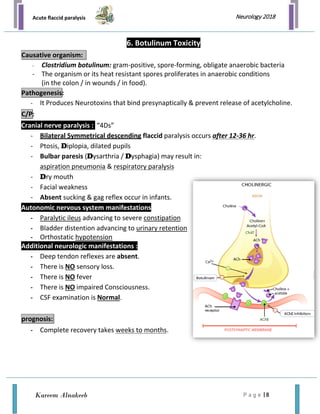
- It Produces Neurotoxins that bind presynaptically & prevent release of acetylcholine.
Cranial nerve paralysis : “4Ds”
- Bilateral Symmetrical descending flaccid paralysis occurs after 12-36 hr.
- Ptosis, Diplopia, dilated pupils
- Bulbar paresis (Dysarthria / Dysphagia) may result in:
aspiration pneumonia & respiratory paralysis
- Dry mouth
- Facial weakness
- Absent sucking & gag reflex occur in infants.
Autonomic nervous system manifestations
- Paralytic ileus advancing to severe constipation
- Bladder distention advancing to urinary retention
- Orthostatic hypotension
Additional neurologic manifestations :
- Deep tendon reflexes are absent.
- There is NO sensory loss.
- There is NO fever
- There is NO impaired Consciousness.
- CSF examination is Normal.
- Complete recovery takes weeks to months.
Causative organism:
Pathogenesis:
C/P:
prognosis:
Acute flaccid paralysis
P a g e | 9
Neurology 2018
Kareem Alnakeeb
7. Familial hypokalemic periodic paralysis
● Autosomal dominant acute systemic weakness.
● During an attack, the serum K+
falls to < 3.5 mg.
● Sudden onset, Attacks last 6-12 hours
● pure motor weakness in one or more limb, Areflexia with NO respiratory distress.
● Severe hypokalemia causes respiratory & bulbar weakness.
● Repeated oral potassium : Treatment of attacks
● Daily acetazolamide : may decrease frequency of attacks.
8. Secondary hypokalemic periodic paralysis
● Caused by urinary or GIT loss of K+
Definition:
C/P:
Treatment:

Acute Flaccid Paralysis: Pediatric Neurology Notes 2018

  • 1.
    Acute flaccid paralysis Pa g e | 1 Neurology 2018 Kareem Alnakeeb Acute flaccid paralysis ( AFP ) • Sudden onset of weakness or paralysis over a period of 15 days in a patient less than 15 years of age. • It's a lower motor neuron lesion (LMNL) Motor unit : - It is one anterior horn cell & all the muscle fibers that it innervates - The Motor unit is the unit of force. - Therefore, weakness is a symptom of all motor unit disorders Spinal cord • Acute transverse myelitis “2nd most common cause “ AHC • Polio virus & polio vaccination. • Other neurotropic viruses. Peripheral nerve • Guillain-Barré Syndrome “most common cause “ • Traumatic neuropathy • Toxic neuropathy (arsenic, lead). • Diphtheritic neuropathy. NMJ • Myasthenia gravis. • Botulism. • Organophosphate poisoning. Muscle • Inflammatory myopathies. Muscle membrane • Familial periodic paralysis. • Secondary hypokalemic paralysis. Neuronopathy a primary disorder of the anterior horn cell body ”neuron” Neuropathy a primary disorder of the axon or its myelin covering. Myopathy a primary disorder of the muscle fiber. Definition: Causes of AFP
  • 2.
    Acute flaccid paralysis Pa g e | 2 Neurology 2018 Kareem Alnakeeb ● Demonstrate motor weakness. ● Clinical localization: ( spinal cord, peripheral nerve, NMJ, muscle ) ; ○ Deep tendon reflex ( DTR ) : ( absent/ reduced/ normal ) ○ Sphincters: ( preserved or affected ) ○ Sensory loss: ( no loss, glove and stocking, or dermatomal ) 1. Accurate clinical history is essential. 2. Spinal cord lesions: ○ Urgent MRI spinal cord ○ CSF: cells/ protein/ glucose/ culture/ TB isolation. ○ PCR for cryptococcal antigen/ oligoclonal bands. 3. Peripheral nerve: If unilateral: MRI lumbosacral plexus Nerve conduction velocity (NCV). If bilateral: CSF proteins and cells Nerve conduction studies (NCS) / forced vital capacity (FVC) 4. Muscle: Creatine kinase/ urine myoglobin. ● Abnormal gait is the initial complaint with proximal or distal leg weakness. ● Inquire about : o diplopia, drooping eyelids o difficulty chewing and swallowing, o facial expressions and voice changes. 1. Transverse myelitis 2. Poliomyelitis 3. Guillain-Barré syndrome (GBS) 4. Traumatic neuritis 5. Acute myasthenic crisis 6. Botulinum Toxicity 7. Familial hypokalemic periodic paralysis 8. Secondary hypokalemic periodic paralysis Work up: Clinical presentation: Common clinical types of AFP Clinical Approach
  • 3.
    Acute flaccid paralysis Pa g e | 3 Neurology 2018 Kareem Alnakeeb 1. Transverse myelitis (TM) - Acute demyelinating disorder of the spinal cord (other parts of the CNS can be affected). - Occurs in children aged 4 years & above.  After viral infection  Post-vaccination - Inflammation across one segment of spinal cord & damage to myelin sheath of peripheral nerves. - Damage at one segment of spinal cord affects function at that segment & segments below it. - The segment of spinal cord at which damage occurs determine which parts of body are affected  Motorsymptoms: ● Symmetrical leg weakness ● Paraplegia with areflexia ( but later: hyperreflexia )  Sensorysymptoms: ● Back pain is commonly at the onset. ● Sensory level (loss of sensation below level of lesion )  Autonomicsymptoms: ● Early bladder involvement. - Exclusion of acute cord compression is essential (usually by MRI) “ Despite the absence of evidence “ 1. High dose IV methylprednisolone (1 g daily for 3 to 7 days) is first-line treatment (to hasten recovery - reduce disease activity - restore neurologic function) 2. Plasmapheresis is possibly effective for acute fulminant CNS demyelinating diseases (including TM) that fail to respond to high-dose corticosteroids treatment. 3. Symptomatic management of bowel & bladder dysfunction. 4. Physical & occupational therapy to prevent contracture. - Recovery is related to the onset. Definition: Etiology: Pathogenesis: C/P: Diagnosis: Treatment: Prognosis: N.B. Demyelination usually occurs at thoracic level causing problems with leg movement & bowel and bladder l
  • 4.
    Acute flaccid paralysis Pa g e | 4 Neurology 2018 Kareem Alnakeeb 2. Poliomyelitis ( Polio ; gray matter - Myelitis ; inflammation of the spinal cord ) ● 1,486 cases in 2005, 1,593 cases in 2006. ● Endemic countries: (Afghanistan, India, Nigeria, and Pakistan) Now rare; present in: a) Endemic settings. b) Small outbreaks where polio eradication has occurred. c) Rarely as vaccine associated paralytic polio (VAPP). Etiology: - Poliovirus: RNA virus that is a type of enterovirus & has 3 serotypes;  Type 1: most frequently associated with epidemics.  Types 2 and 3: usually associated with vaccine-associated paralytic polio (VAPP). ● Poliovirus is transmitted via the fecal-oral route, particularly in low-hygiene settings. ● The virus replicates in the nasopharynx and GI tract, and may spread via the bloodstream to the lymph nodes and, rarely, to the CNS, where it affects the motor neurons in the AHCs and brainstem, leading to: difficulty in swallowing, speaking and breathing. ● NOT All infections result in severe injuries and paralysis. - Asymptomatic: the majority of patients. - Minor GI illness (~10%), including: fever, malaise, nausea, and vomiting. - Paralytic form (0.1%). - Symptoms of poliomyelitis always CNS specific. Prevalence: Incidence: C/P: Pathogenesis:
  • 5.
    Acute flaccid paralysis Pa g e | 5 Neurology 2018 Kareem Alnakeeb 3- Guillain-Barré Syndrome (GBS) - Acute post-infectious polyneuropathy—mostly motor; all ages; most with demyelinating neuropathy - After Infection: o GIT infection “Campylobacter jejuni“  Most common o Respiratory infection “Mycoplasma Pneumoniae” o Viral infection e.g. CMV, EBV, HIV. - Post-vaccination e.g. swine flu vaccine → no longer used - Autoimmune basis - Immune responses to Non-self antigen (infectious agents, vaccines) that cross-react with host nerve tissue through a resemblance of epitope (molecular mimicry). - Both the cellular and humoral immune responses participate in the process - This immune response can be directed towards myelin or axon of peripheral nerve. - Neural targets are: gangliosides GM1 in myelin - Infection with C. jejuni can generate antibodies to specific gangliosides e.g. Anti ganglioside ab-GM1 (in 20-50% of cases).  Motorsymptoms: ● Ascending Symmetrical weakness/ flaccid paralysis (L.L. → Trunk → U.L. → Bulbar ms. → Facial ms. → Diaphragm) ● Weakness is associated with Hypotonia & Areflexia ● Bulbar involvement in half: dysphagia. ● Bilateral facial weakness, Respiratory insufficiency  Sensorysymptoms: ● Low back pain is prominent (79%) at onset of paralysis ● Numbness and paresthesia” variable sensory complaints “  Autonomicsymptoms: ● Cardiac dysrhythmias ● Orthostatic hypotension, hypertension ● Paralytic ileus ● Bladder dysfunction Definition: Etiology: Pathogenesis: C/P:
  • 6.
    Acute flaccid paralysis Pa g e | 6 Neurology 2018 Kareem Alnakeeb 1) CSF →  Less than one week (Early in the course): - protein level may NOT yet be elevated, but rarely they remain normal.  After the first week of symptoms: “Albuminocytologic dissociation” - normal pressure, normal cell count, and elevated proteins (> 50 mg/dl). 2) Electrophysiological studies: - Most specific & sensitive tests for diagnosis a) Nerve conduction studies (NCS):  nerve conduction velocities b) Electromyography (EMG): Acute denervation of the muscle 1)IVIG : at a dose of 0.4 gm/kg/day ( for 5 days ) 2)Plasmapheresis : May decrease the severity and shorten the duration of GBS. it's most beneficial within 7 days, but still beneficial up to 30 days after onset.  N.B Glucocorticoids are Not effective in GBS. - 3 to 4% Mortality 2ry to autonomic dysfunction and respiratory failure. - At long-term follow up; 93% were free of symptoms, & the reminder were able to walk unaided - 50% are ambulatory by 6 months, 70% walk within a year of onset of the disease - Recurrence, chronic progressive course, or relapses. Investigations: Treatment: Prognosis: Children with the following should be admitted to PICU: 1. Rapidly progressive weakness. 2.Flaccid quadriparesis. 3.Bulbar palsy. 4.Reduced vital capacity (≤20 ml/kg). 5.Autonomic cardiovascular instability.
  • 7.
    Acute flaccid paralysis Pa g e | 7 Neurology 2018 Kareem Alnakeeb 4. Traumatic neuritis Traumatic neuritis is caused by injections. ● AFP is usually accompanied by pain in the gluteal region or along the affected leg. ● Onset of AFP in the affected lower limb occurs from 1 hour to 5 days after injection in the gluteal region. ● Atrophy may appear 40 to 60 days later. ● Knee jerk is present. ● Ankle jerk is absent or diminished. ● Child walks with a foot drop. ● Gradual recovery with physiotherapy usually occurs within 3 to 9 months. 5. Acute myasthenic crisis ● Autoimmune disease causing weakness and fatigability of muscles (>50% ocular weakness, 15% bulbar weakness, <5% limb weakness alone). ● Involvement of respiratory muscles is a serious life threatening condition termed myasthenia crisis. ● The majority of patients with antibodies have thymus abnormalities: (hyperplasia or thymoma) ● Repetitive nerve stimulation are abnormal with characteristic findings in 60%. ● Acetylcholine receptors antibody assays; positive in 85% of cases. ● Steroids, IVIG, or plasmapheresis. Etiology: C/P: prognosis: Definition: Investigations: Treatment: N.B. Atrophy caused by a traumatic injection Never reaches the degree seen in polio. Differences in calf circumference usually don't exceed 0.5 to 1.5 cm.
  • 8.
    Acute flaccid paralysis Pa g e | 8 Neurology 2018 Kareem Alnakeeb 6. Botulinum Toxicity - Clostridium botulinum: gram-positive, spore-forming, obligate anaerobic bacteria - The organism or its heat resistant spores proliferates in anaerobic conditions (in the colon / in wounds / in food). - It Produces Neurotoxins that bind presynaptically & prevent release of acetylcholine. Cranial nerve paralysis : “4Ds” - Bilateral Symmetrical descending flaccid paralysis occurs after 12-36 hr. - Ptosis, Diplopia, dilated pupils - Bulbar paresis (Dysarthria / Dysphagia) may result in: aspiration pneumonia & respiratory paralysis - Dry mouth - Facial weakness - Absent sucking & gag reflex occur in infants. Autonomic nervous system manifestations - Paralytic ileus advancing to severe constipation - Bladder distention advancing to urinary retention - Orthostatic hypotension Additional neurologic manifestations : - Deep tendon reflexes are absent. - There is NO sensory loss. - There is NO fever - There is NO impaired Consciousness. - CSF examination is Normal. - Complete recovery takes weeks to months. Causative organism: Pathogenesis: C/P: prognosis:
  • 9.
    Acute flaccid paralysis Pa g e | 9 Neurology 2018 Kareem Alnakeeb 7. Familial hypokalemic periodic paralysis ● Autosomal dominant acute systemic weakness. ● During an attack, the serum K+ falls to < 3.5 mg. ● Sudden onset, Attacks last 6-12 hours ● pure motor weakness in one or more limb, Areflexia with NO respiratory distress. ● Severe hypokalemia causes respiratory & bulbar weakness. ● Repeated oral potassium : Treatment of attacks ● Daily acetazolamide : may decrease frequency of attacks. 8. Secondary hypokalemic periodic paralysis ● Caused by urinary or GIT loss of K+ Definition: C/P: Treatment: