INFLAMMATION
• Acute inflammation
Immediate response after cell injury and it is short duration
Cardinal signs
i. Redness
ii. Heat
iii. Swelling
iv. Pain
v. Loss of function
• Inflammation starts with hemodynamic changes
a. Immediate vasoconstriction
b. Massive vasodilation
c. Increased vascular permeability of chemical mediators.
These are Vasoactive amines, histamines and serotonins.
Bradykinin and end product of kinin cascade
Leukotrienes
Increased vascular permeability may be due to:
Endothelial cell pericyte contraction
Direct endothelial cell injury
Leukocyte injury of endothelial cells
NEUTROPHILS plays a major role in the immune system. They have the ff characteristics:
• Granulocytes with segmented nucleus
• Produce hydrolytic enzymes
• Chemotactic
• Active in hypoxic conditions
• First to move to the site of injury
Neutrophils migrate from the circulatory system to the site of injury.
Migration and adhesion of Neutrophils
Adhesion is mediated by complimentary molecules on the surface of the
neutrophil and the endothelium
a. At the site of the inflammation endothelial cells have increased expression
of E-selectin and P-selectin
b. Neutrophils weakly binds to endothelial selectin and roll along the surface.
c. Neutrophils are stimulated by chemokines to express their integrins
d. Binding of the integrins adheres the neutrophils to the endothelia wall
• Modulation of adhesion molecules in inflammation
i. Redistribution to the surface
ii. Additional synthesis ; cytokine IL-1 and TNF induce the production of E-selectin
iii. Increase binding affinity: chemotactic agents cause a conformational change in the
leukocyte integrin LFA-1 which is converted into highly affinity binding state
Defect in Adhesion
i. Diabetes mellitus
ii. Corticosteroid use
iii. Acute alcohol intoxication
iv. Leukocyte adhesion deficiency
Autosomal recessive
Recurrent bacterial infections
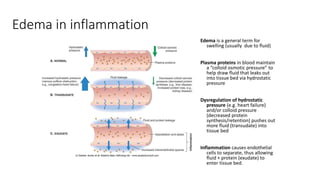
Edema in inflammation
Edema is a general term for
swelling (usually due to fluid)
Plasma proteins in blood maintain
a “colloid osmotic pressure” to
help draw fluid that leaks out
into tissue bed via hydrostatic
pressure
Dysregulation of hydrostatic
pressure (e.g. heart failure)
and/or colloid pressure
(decreased protein
synthesis/retention) pushes out
more fluid (transudate) into
tissue bed
Inflammation causes endothelial
cells to separate, thus allowing
fluid + protein (exudate) to
enter tissue bed.
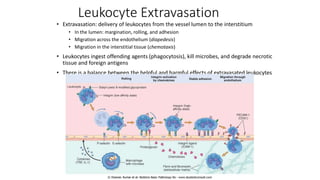
Leukocyte Extravasation
• Extravasation: delivery of leukocytes from the vessel lumen to the interstitium
• In the lumen: margination, rolling, and adhesion
• Migration across the endothelium (diapedesis)
• Migration in the interstitial tissue (chemotaxis)
• Leukocytes ingest offending agents (phagocytosis), kill microbes, and degrade necrotic
tissue and foreign antigens
• There is a balance between the helpful and harmful effects of extravasated leukocytes
Leukocyte Margination
Photomicrograph courtesy of Dr. James G. Lewis
Sequence of Events - Injury
Sequence of Events - Infection
• Emigration of Leukocytes
Leukocytes emigrate from the vasculature by extending pseudopods between the
endothelial cells
They then move between the endothelial cells migrating between the basement
membrane to the inflammatory site.
Chemotaxis
Chemotaxis is the attraction of cells toward a chemical mediator that is released in
the area of inflammation
Important chemotactic factors for neutrophils
i. Bacterial products
ii. Leukotriene B4
iii. Complement system products C3b
iv. Alpha-chemokine (IL8)
• Phagocytosis and degranulation
a. Opsonin enhance recognition and phagocytosis of bacteria
b. Important opsonin
i. FC portion of IgG
ii. Compliment system products C3b
iii. Plasma proteins
• Engulfment
i. Neutrophils sends out cytoplasmic processes that surround the bacteria
ii. The bacteria is internalized within a phagosome
iii. The phagosomes fuses with lysosomes ((degranulation)
• Defects of phagocytosis
Chediak Higashi syndrome
Autosomal recessive
Neutropenia
Neutrophils has giant granules
Defect in chemotaxis and granulation
Intracellular killing
a. Oxygen dependent killing
i. Respiratory burst
Require oxygen and NADPH
Produces superoxide hydroxyl radicals and hydrogen peroxide
ii. Myeloperoxidase
requires hydrogen peroxide and halides
b. oxygen independent killing
i. Lysozymes
ii. Lactoferrin
iii. Acid hydrolysis
iv. Bactericidal permeability increasing protein defensing
c. Deficiency of oxygen dependent killing
Chronic granulomatous disease of childhood
Deficiency of NADPH oxidase
Lack superoxide and hydrogen peroxide
FOUR OUTCOMES OF INFLAMMATION
• Complete resolution with regeneration
• Complete resolution with scaring
• Abscess formation
• Transition to chronic inflammation
CHRONIC INFLAMMATION
• Causes of chronic inflammation
a. Following a bout of acute inflammation
b. Persistent infection
c. Infection with certain organisms
i. Viral infection
ii. Mycobacteria
iii. Parasitic infections
iv. Fungal infection
d. Autoimmune diseases
e. Response to foreign materials
Response to malignant tumors
• IMPORTANT CELLS IN CHRONIC INFLAMMATION
a. Macrophages
i. Macrophages are derived from blood monocytes
ii. Tissue based macrophages of Connective tissue of:
Lung
Liver
Bone
Brain (microglia)
NB: During chronic inflammation macrophages are recruited mainly from the
blood.
Macrophages
• Chemotactic factors (C5a, MCP-alpha, PDGF TGF-beta)
• Secretes a wide range of active products (monokines)
• May be modified into epithelioid cells in granulation
• b. lymphocytes
i. B-cells and plasma cells.
ii. T cells
iii. Lymphocytes chemokines: lymphotoxin
c. Eosinophils
i. Play an important role in parasitic infections
ii. Eosinophilic chemokine
iii. Granules contain major basic protein which is toxic to parasites.
d. Basophil
Tissue based basophils are called mast cells
Mast cells are present in large quantities in the lung and skin
Play an important role in IgE mediated allergic reaction (allergies and anaphylaxis)
• Chronic granulomatous inflammation
a. Specialized form of chronic inflammation characterized by small aggregates of modified macrophages (epithelioid
cells and multi nucleated giant cells) surrounded by a rim of lymphocytes.
b. Composition of a granuloma
i. Epithelioid cell
IFN gamma transforms macrophages – epithelioid cells
Enlarge cells with abundant pink cytoplasm.
ii. Multinucleated giant cells
Formed from fusion of epithelioid cells
Langhans –type giant cells ( peripheral arrangement of nucleus)
Foreign body type giant cells (haphazard arranged nuclei )
iii. Lymphocytes and plasma cells
iv. Central caseous necrosis
• Granulomatous diseases
Tuberculosis
Cat-scratch fever
Syphilis
Leprosy
Fungal infection
Parasitic infection
Foreign body
Beryllium
Sarcoidosis
Types of Inflammation: acute vs. chronic
Types of repair: resolution vs. organization (fibrosis)

Advanced Pathophysiology 3.pptx

  • 1.
    INFLAMMATION • Acute inflammation Immediateresponse after cell injury and it is short duration Cardinal signs i. Redness ii. Heat iii. Swelling iv. Pain v. Loss of function
  • 2.
    • Inflammation startswith hemodynamic changes a. Immediate vasoconstriction b. Massive vasodilation c. Increased vascular permeability of chemical mediators. These are Vasoactive amines, histamines and serotonins. Bradykinin and end product of kinin cascade Leukotrienes Increased vascular permeability may be due to: Endothelial cell pericyte contraction Direct endothelial cell injury Leukocyte injury of endothelial cells
  • 3.
    NEUTROPHILS plays amajor role in the immune system. They have the ff characteristics: • Granulocytes with segmented nucleus • Produce hydrolytic enzymes • Chemotactic • Active in hypoxic conditions • First to move to the site of injury
  • 4.
    Neutrophils migrate fromthe circulatory system to the site of injury. Migration and adhesion of Neutrophils Adhesion is mediated by complimentary molecules on the surface of the neutrophil and the endothelium a. At the site of the inflammation endothelial cells have increased expression of E-selectin and P-selectin b. Neutrophils weakly binds to endothelial selectin and roll along the surface. c. Neutrophils are stimulated by chemokines to express their integrins d. Binding of the integrins adheres the neutrophils to the endothelia wall
  • 5.
    • Modulation ofadhesion molecules in inflammation i. Redistribution to the surface ii. Additional synthesis ; cytokine IL-1 and TNF induce the production of E-selectin iii. Increase binding affinity: chemotactic agents cause a conformational change in the leukocyte integrin LFA-1 which is converted into highly affinity binding state Defect in Adhesion i. Diabetes mellitus ii. Corticosteroid use iii. Acute alcohol intoxication iv. Leukocyte adhesion deficiency Autosomal recessive Recurrent bacterial infections
  • 6.
    Edema in inflammation Edemais a general term for swelling (usually due to fluid) Plasma proteins in blood maintain a “colloid osmotic pressure” to help draw fluid that leaks out into tissue bed via hydrostatic pressure Dysregulation of hydrostatic pressure (e.g. heart failure) and/or colloid pressure (decreased protein synthesis/retention) pushes out more fluid (transudate) into tissue bed Inflammation causes endothelial cells to separate, thus allowing fluid + protein (exudate) to enter tissue bed.
  • 7.
    Leukocyte Extravasation • Extravasation:delivery of leukocytes from the vessel lumen to the interstitium • In the lumen: margination, rolling, and adhesion • Migration across the endothelium (diapedesis) • Migration in the interstitial tissue (chemotaxis) • Leukocytes ingest offending agents (phagocytosis), kill microbes, and degrade necrotic tissue and foreign antigens • There is a balance between the helpful and harmful effects of extravasated leukocytes
  • 8.
  • 9.
  • 10.
    Sequence of Events- Infection
  • 11.
    • Emigration ofLeukocytes Leukocytes emigrate from the vasculature by extending pseudopods between the endothelial cells They then move between the endothelial cells migrating between the basement membrane to the inflammatory site. Chemotaxis Chemotaxis is the attraction of cells toward a chemical mediator that is released in the area of inflammation Important chemotactic factors for neutrophils i. Bacterial products ii. Leukotriene B4 iii. Complement system products C3b iv. Alpha-chemokine (IL8)
  • 12.
    • Phagocytosis anddegranulation a. Opsonin enhance recognition and phagocytosis of bacteria b. Important opsonin i. FC portion of IgG ii. Compliment system products C3b iii. Plasma proteins • Engulfment i. Neutrophils sends out cytoplasmic processes that surround the bacteria ii. The bacteria is internalized within a phagosome iii. The phagosomes fuses with lysosomes ((degranulation)
  • 13.
    • Defects ofphagocytosis Chediak Higashi syndrome Autosomal recessive Neutropenia Neutrophils has giant granules Defect in chemotaxis and granulation Intracellular killing a. Oxygen dependent killing i. Respiratory burst Require oxygen and NADPH Produces superoxide hydroxyl radicals and hydrogen peroxide
  • 14.
    ii. Myeloperoxidase requires hydrogenperoxide and halides b. oxygen independent killing i. Lysozymes ii. Lactoferrin iii. Acid hydrolysis iv. Bactericidal permeability increasing protein defensing c. Deficiency of oxygen dependent killing Chronic granulomatous disease of childhood Deficiency of NADPH oxidase Lack superoxide and hydrogen peroxide
  • 15.
    FOUR OUTCOMES OFINFLAMMATION • Complete resolution with regeneration • Complete resolution with scaring • Abscess formation • Transition to chronic inflammation
  • 16.
    CHRONIC INFLAMMATION • Causesof chronic inflammation a. Following a bout of acute inflammation b. Persistent infection c. Infection with certain organisms i. Viral infection ii. Mycobacteria iii. Parasitic infections iv. Fungal infection d. Autoimmune diseases e. Response to foreign materials Response to malignant tumors
  • 17.
    • IMPORTANT CELLSIN CHRONIC INFLAMMATION a. Macrophages i. Macrophages are derived from blood monocytes ii. Tissue based macrophages of Connective tissue of: Lung Liver Bone Brain (microglia) NB: During chronic inflammation macrophages are recruited mainly from the blood.
  • 18.
    Macrophages • Chemotactic factors(C5a, MCP-alpha, PDGF TGF-beta) • Secretes a wide range of active products (monokines) • May be modified into epithelioid cells in granulation • b. lymphocytes i. B-cells and plasma cells. ii. T cells iii. Lymphocytes chemokines: lymphotoxin
  • 19.
    c. Eosinophils i. Playan important role in parasitic infections ii. Eosinophilic chemokine iii. Granules contain major basic protein which is toxic to parasites. d. Basophil Tissue based basophils are called mast cells Mast cells are present in large quantities in the lung and skin Play an important role in IgE mediated allergic reaction (allergies and anaphylaxis)
  • 20.
    • Chronic granulomatousinflammation a. Specialized form of chronic inflammation characterized by small aggregates of modified macrophages (epithelioid cells and multi nucleated giant cells) surrounded by a rim of lymphocytes. b. Composition of a granuloma i. Epithelioid cell IFN gamma transforms macrophages – epithelioid cells Enlarge cells with abundant pink cytoplasm. ii. Multinucleated giant cells Formed from fusion of epithelioid cells Langhans –type giant cells ( peripheral arrangement of nucleus) Foreign body type giant cells (haphazard arranged nuclei ) iii. Lymphocytes and plasma cells iv. Central caseous necrosis
  • 21.
    • Granulomatous diseases Tuberculosis Cat-scratchfever Syphilis Leprosy Fungal infection Parasitic infection Foreign body Beryllium Sarcoidosis
  • 22.
    Types of Inflammation:acute vs. chronic Types of repair: resolution vs. organization (fibrosis)