Objectives of cryptography:
There are four main objectives of cryptography:-
a). Confidentiality: It guarantees that the sensitive
information can only be accessed by those users/entities
authorized to unveil it.
b). Data integrity: It is a service which addresses the
unauthorized alteration of data. This property refers to data
that has not been changed, destroyed, or lost in a malicious or
accidental manner.
c). Authentication: It is a service related to identification.
This function applies to both entities and information itself.
Two parties entering into a communication should identify
each other.
d). Non-repudiation: It is a service which prevents an entity
from denying previous commitments or actions.
TYPES
 Cryptography involves two main approaches:
 Symmetric-key cryptography.
 Asymmetric-key cryptography.
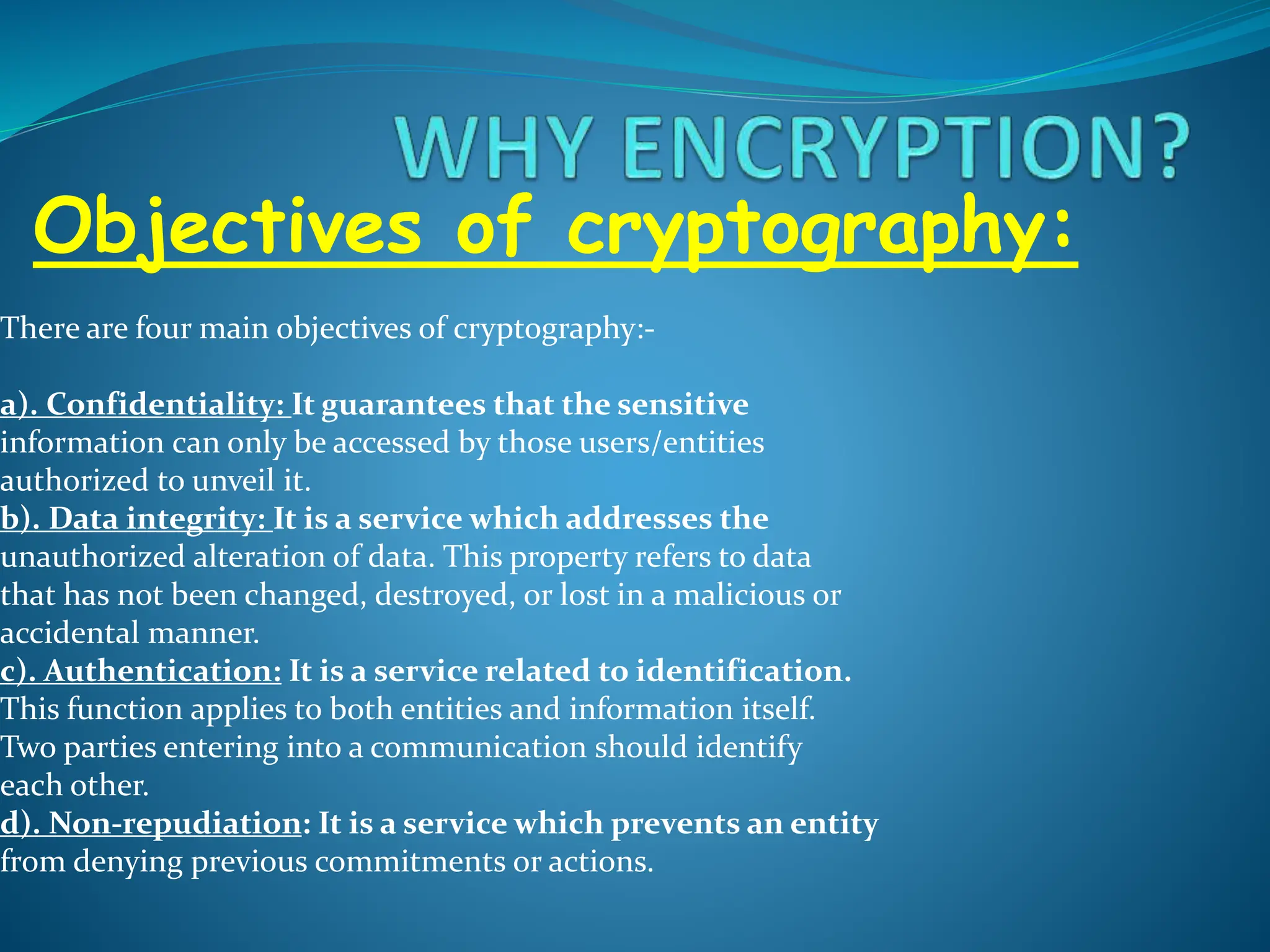
 Symmetric-key cryptography: Same secret key is
used for
 both encryption and decryption.
 Asymmetric-key cryptography: Two different keys
are used
 i.e. one for encryption and other for decryption.
SIMPLIFIED MODEL OF
ASYMMETRIC CRYPTO SYSTEM
COMPARISON OF SECRET KEY AND PUBLIC
KEY
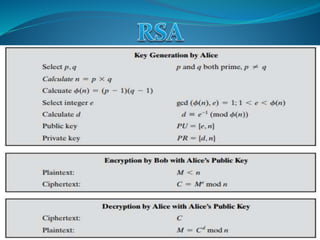
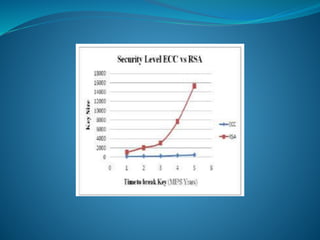
The main interest of the elliptic curve cryptosystems is to decrease the
required key-size to achieve appropriate security. Thus, we have an
equivalent security level among RSA algorithm using 1024-bit key and
an elliptic curve cryptosystem using more or less a 160-bit key. The
following comparison table given by NIST in [SP800-57] perfectly
illustrates the key size benefits of using elliptic curves based
cryptography:
ECC
RSA
 Elliptic curves are not ellipses. Elliptic curves are described by
cubic equations similar to those used for calculating the
circumference of an ellipse
 Elliptic curve cryptography makes use of elliptic curves, in
which the variables and coefficients are all restricted to
elements of a finite field
 An elliptic curve is defined by an equation in two variables
with coefficients.
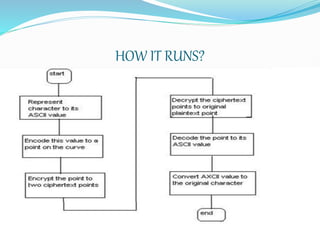
HOW IT RUNS?
𝑦2
mod p = (𝑥3
+ ax + b) mod p
Lists of points (other than O) that are part of 𝐸23 (1, 1). plots the points of 𝐸23(1, 1); note that the
points, with one exception, are symmetric about y = 11.5.
Koblitz’s Method for
Encoding Plaintext
Step1: Pick an elliptic curve Ep(a,b).
Step 2: Let us say that E has N points on it.
Step 3: Let us say that our alphabet consists of the digits 0,1,2,3,4,5,6,7,8,9
and the letters A,B,C,. . . , X,Y,Z coded as 10,11,. . . , 35.
Step 4: This converts our message into a series of numbers between 0 & 35.
Step 5: Now choose an auxiliary base parameter, for example k = 20. ( both
parties should agree upon this)
Step 6: For each number mk (say), take x=mk + 1 and try to solve for y.
Step 7: If you can't do it, then try x = mk +2 and then x = mk +3 until you
can solve for y.
Step 8: In practice, you will find such a ‘y’ before you hit x = mk + k - 1.
Then take the point (x,y). This now converts the number m into a point
on the elliptic curve. In this way, the entire message becomes a sequence
of points.
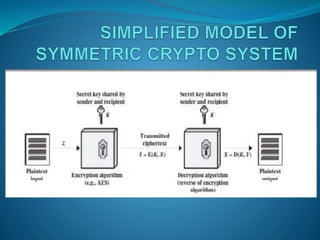
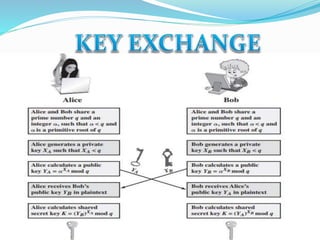
 Both the entities in the cryptosystem agree upon a,b,p,G,n which are
called ‘
Domain Parameters’of G is called generator point and n is the order
of G.
Now A generates a random number nA< n as his private Key and
calculates his public key
 Set 𝑃𝐴= G+G+G+…..nA times.
B generates a random number nB< n as his private Key and calculates his
public key.
 set 𝑃𝑩= G+G+G+….nB times.
A sends C = 2 ciphertext points those are { kG, 𝑃𝑚 + k𝑃𝑏) }.
Where G - generator Point
𝑃𝑚 - plaintext point on the curve
k - a random number chosen by A
𝑃𝑏 - public key of B
DECRYPTION
𝑃𝑚+ k𝑃𝐵- 𝑛𝐵(kG) = 𝑃𝑚+ k(𝑛𝐵)G - 𝑛𝐵 (kG) = 𝑃𝑚
Where G - generator Point
𝑃𝑚 - plaintext point on the curve
k - a random number chosen by A
𝑃𝐵 - public key of B
AN EXAMPLE
Example: Say the parameters of curve are: p(751),a(-1),b(188),n(727).
1. Say we have to send character ‘b’.
2. ‘B’ is first encoded as number 11.
3. x=mk+1 i.e, 11*20+1=221cannot solve it for a y such that y^2 = x^3 + ax+ b
mod p
4. So go for x=mk+2 , x=222 , no y exists. x=mk+3, x=223, no y exists.
5. x=mk+4 so x=224 can solve it for y and y=248.
6. Now the point (224,248) is point is encrypted and decrypted as a message.
7. To decode just compute (x-1)/k i.e, (224-1)/20=223/20 i.e, 11.15.
8. Return 11 as original plaintext(greatest integer less than (x-1)/k ,that is 11.
9. The number 11 is now decoded to character ‘B’.
10. The probability that we fail to find a square (and hence fail to associate m to
a point) is about (½)^k .
OUR PROGRESS
 function [X,Y,n] = PC(A,B,p)
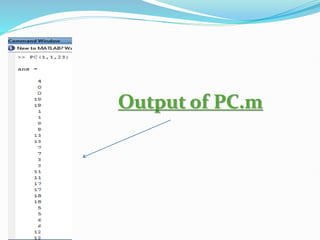
This function m-file finds and plots all the points that lie in E_p(A,B)
These points are on the curve y^2 = x^3 + AX + B (mod p)
 function [x3,y3,m] = ECADP(x1,y1,x2,y2,A,p)
This function m-file performs Elliptic Curve addition over prime curves.
Suppose we are working on the elliptic curve y^2 = x^3 + Ax + B
Define P1 = (x1,y1)
P2 = (x2,y2)
Then P1 + P2 = P3 = (x3,y3) is defined by as below
If one if the variables in infinity then we define P + infinity = P
and the user should type in ’infinity’ for both the x and y values.
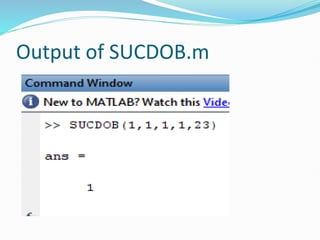
 function [X2,Y2] = SUCDOB(X1,Y1,k,A,p)
This is a function m-file to perform the successive doubling algorithm
on prime curves. If P = (X1,Y1) and k is an integer, then this algorithm
will find kP = (X2,Y2) where we are operating over the elliptic curve
y^2 = x^3 + Ax + B (mod p), p prime
OUR PROGRESS
 function [flag] = check(x,y,A,B,p)
An m-file to check if the point (x,y) lies on the prime curve
y^2 = x^3 + Ax + B (mod p)
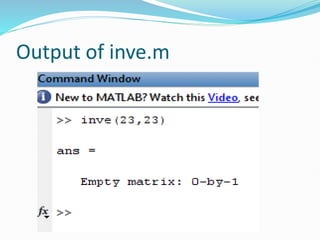
 function [I] = inve(N,p)
This m-file finds the inverse of an element, N, in the group Z_p
for use with prime curves.
 function [x10,y,c] = ECC(x,y,a,b,M,x9,n)
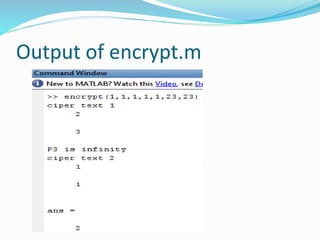
 function [c1,c2,X6,Y6]=encrypt(X2,Y2,X,Y,a,p,n)
 function [X14,Y14,c,str_back_to_char]=decrypt(x1,y1,X,Y,n,a,b,p,z,c)
 Main function
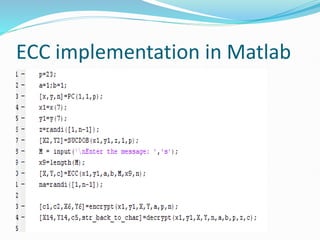
 M = input('nEnter the message: ','s'); % ASCII TO MESSAGE CONVERSION
Let us look more closely
Output of PC.m
The set of points for a=b=1
and p=23
Output of PC.m
Output of ECADP.m
Output of SUCDOB.m
Output of check.m
Output of inve.m
Output of encrypt.m
Output of decrypt.m
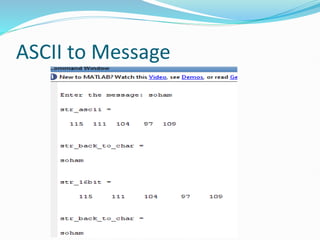
ASCII to Message
ECC implementation in Matlab
Final Output
Novel encryption algorithm and software development ecc and rsa

Novel encryption algorithm and software development ecc and rsa

  • 1.
    Objectives of cryptography: Thereare four main objectives of cryptography:- a). Confidentiality: It guarantees that the sensitive information can only be accessed by those users/entities authorized to unveil it. b). Data integrity: It is a service which addresses the unauthorized alteration of data. This property refers to data that has not been changed, destroyed, or lost in a malicious or accidental manner. c). Authentication: It is a service related to identification. This function applies to both entities and information itself. Two parties entering into a communication should identify each other. d). Non-repudiation: It is a service which prevents an entity from denying previous commitments or actions.
  • 2.
    TYPES  Cryptography involvestwo main approaches:  Symmetric-key cryptography.  Asymmetric-key cryptography.  Symmetric-key cryptography: Same secret key is used for  both encryption and decryption.  Asymmetric-key cryptography: Two different keys are used  i.e. one for encryption and other for decryption.
  • 4.
  • 5.
    COMPARISON OF SECRETKEY AND PUBLIC KEY
  • 7.
    The main interestof the elliptic curve cryptosystems is to decrease the required key-size to achieve appropriate security. Thus, we have an equivalent security level among RSA algorithm using 1024-bit key and an elliptic curve cryptosystem using more or less a 160-bit key. The following comparison table given by NIST in [SP800-57] perfectly illustrates the key size benefits of using elliptic curves based cryptography:
  • 9.
  • 10.
     Elliptic curvesare not ellipses. Elliptic curves are described by cubic equations similar to those used for calculating the circumference of an ellipse  Elliptic curve cryptography makes use of elliptic curves, in which the variables and coefficients are all restricted to elements of a finite field  An elliptic curve is defined by an equation in two variables with coefficients.
  • 11.
  • 12.
    𝑦2 mod p =(𝑥3 + ax + b) mod p Lists of points (other than O) that are part of 𝐸23 (1, 1). plots the points of 𝐸23(1, 1); note that the points, with one exception, are symmetric about y = 11.5.
  • 13.
    Koblitz’s Method for EncodingPlaintext Step1: Pick an elliptic curve Ep(a,b). Step 2: Let us say that E has N points on it. Step 3: Let us say that our alphabet consists of the digits 0,1,2,3,4,5,6,7,8,9 and the letters A,B,C,. . . , X,Y,Z coded as 10,11,. . . , 35. Step 4: This converts our message into a series of numbers between 0 & 35. Step 5: Now choose an auxiliary base parameter, for example k = 20. ( both parties should agree upon this) Step 6: For each number mk (say), take x=mk + 1 and try to solve for y. Step 7: If you can't do it, then try x = mk +2 and then x = mk +3 until you can solve for y. Step 8: In practice, you will find such a ‘y’ before you hit x = mk + k - 1. Then take the point (x,y). This now converts the number m into a point on the elliptic curve. In this way, the entire message becomes a sequence of points.
  • 14.
     Both theentities in the cryptosystem agree upon a,b,p,G,n which are called ‘ Domain Parameters’of G is called generator point and n is the order of G. Now A generates a random number nA< n as his private Key and calculates his public key  Set 𝑃𝐴= G+G+G+…..nA times. B generates a random number nB< n as his private Key and calculates his public key.  set 𝑃𝑩= G+G+G+….nB times.
  • 16.
    A sends C= 2 ciphertext points those are { kG, 𝑃𝑚 + k𝑃𝑏) }. Where G - generator Point 𝑃𝑚 - plaintext point on the curve k - a random number chosen by A 𝑃𝑏 - public key of B
  • 17.
    DECRYPTION 𝑃𝑚+ k𝑃𝐵- 𝑛𝐵(kG)= 𝑃𝑚+ k(𝑛𝐵)G - 𝑛𝐵 (kG) = 𝑃𝑚 Where G - generator Point 𝑃𝑚 - plaintext point on the curve k - a random number chosen by A 𝑃𝐵 - public key of B
  • 18.
    AN EXAMPLE Example: Saythe parameters of curve are: p(751),a(-1),b(188),n(727). 1. Say we have to send character ‘b’. 2. ‘B’ is first encoded as number 11. 3. x=mk+1 i.e, 11*20+1=221cannot solve it for a y such that y^2 = x^3 + ax+ b mod p 4. So go for x=mk+2 , x=222 , no y exists. x=mk+3, x=223, no y exists. 5. x=mk+4 so x=224 can solve it for y and y=248. 6. Now the point (224,248) is point is encrypted and decrypted as a message. 7. To decode just compute (x-1)/k i.e, (224-1)/20=223/20 i.e, 11.15. 8. Return 11 as original plaintext(greatest integer less than (x-1)/k ,that is 11. 9. The number 11 is now decoded to character ‘B’. 10. The probability that we fail to find a square (and hence fail to associate m to a point) is about (½)^k .
  • 19.
    OUR PROGRESS  function[X,Y,n] = PC(A,B,p) This function m-file finds and plots all the points that lie in E_p(A,B) These points are on the curve y^2 = x^3 + AX + B (mod p)  function [x3,y3,m] = ECADP(x1,y1,x2,y2,A,p) This function m-file performs Elliptic Curve addition over prime curves. Suppose we are working on the elliptic curve y^2 = x^3 + Ax + B Define P1 = (x1,y1) P2 = (x2,y2) Then P1 + P2 = P3 = (x3,y3) is defined by as below If one if the variables in infinity then we define P + infinity = P and the user should type in ’infinity’ for both the x and y values.  function [X2,Y2] = SUCDOB(X1,Y1,k,A,p) This is a function m-file to perform the successive doubling algorithm on prime curves. If P = (X1,Y1) and k is an integer, then this algorithm will find kP = (X2,Y2) where we are operating over the elliptic curve y^2 = x^3 + Ax + B (mod p), p prime
  • 20.
    OUR PROGRESS  function[flag] = check(x,y,A,B,p) An m-file to check if the point (x,y) lies on the prime curve y^2 = x^3 + Ax + B (mod p)  function [I] = inve(N,p) This m-file finds the inverse of an element, N, in the group Z_p for use with prime curves.  function [x10,y,c] = ECC(x,y,a,b,M,x9,n)  function [c1,c2,X6,Y6]=encrypt(X2,Y2,X,Y,a,p,n)  function [X14,Y14,c,str_back_to_char]=decrypt(x1,y1,X,Y,n,a,b,p,z,c)  Main function  M = input('nEnter the message: ','s'); % ASCII TO MESSAGE CONVERSION
  • 21.
    Let us lookmore closely Output of PC.m The set of points for a=b=1 and p=23
  • 22.
  • 23.
  • 24.
  • 25.
  • 26.
  • 27.
  • 28.
  • 29.
  • 30.
  • 31.