JOB ORDER COSTINGvs. PROCESS COSTING
Job order costing is a costing
method which is used to determine
the cost of manufacturing each
product. This costing method is
usually adopted when the
manufacturer produces a variety of
products which are different from
one another and needs to calculate
the cost for doing an individual job.
Job costing includes the direct labor,
direct materials, and manufacturing
overhead for that particular job.
Process costing is a way to
track production costs at each stage
of manufacturing. It’s ideal for
businesses that produce goods in
large volumes, like food, chemicals,
or electronics, where processes are
consistent and continuous. This
method allocates expenses for
materials, labor, and overhead
across production stages.
DEFINITION
3.
JOB ORDER COSTINGvs. PROCESS COSTING
Job order costing is a
system for determining the cost
of individual products, perhaps
within a larger manufacturing
job. It is an efficient way to
forecast actual expenses for
materials, labor, and overhead
before production. Armed with a
job cost, you can determine the
advisability of producing that
particular item.
Process costing ensures
clear tracking of costs, making it
easier for businesses to manage
production expenses. Analyzing
materials, labor, and overhead
provides essential insights for
controlling costs and maintaining
profitability.
IMPORTANCE
4.
JOB ORDER COSTING& PROCESS COSTING
• Both job and process cost systems have the same
goal: to determine the cost of products.
• Both job and process cost systems have the same
cost flows. Accountants record production in separate
accounts for materials inventory, labor, and overhead.
Then, they transfer the costs to a Work in Process
Inventory account.
• Both job and process cost systems use
predetermined overhead rates to apply overhead.
SIMILARITIES
5.
JOB ORDER COSTING& PROCESS COSTING
• Types of products produced.
• Cost accumulation procedures.
• Work in Process Inventory accounts.
DIFFERENCES
6.
JOB ORDER COSTING
1.Identifying the Job
2. Calculating the Costs
3. Choosing the Allocation Base
4. Receiving the Order
5. Maintaining Job Cost Sheets
6. Revising the Costs
HOW TO CALCULATE JOC?
7.
PROCESS COSTING
1. AnalyzingInventory
2. Calculating Equivalent Units
3. Determining Total Costs
4. Calculating Cost Per Unit
5. Allocating Costs for Completed and
Incomplete Products
STEPS IN PROCESS COSTING
8.
JOB ORDER COSTINGvs. PROCESS COSTING
ILLUSTRATION
HETOGENEOUS PRODUCT HOMOGENEOUS PRODUCT
ORDERS
(ONLY ONE WIP ACCOUNT)
PROCESS
(WIP ACCOUNTS FOR
EVERY SINGLE
DEPARTMENTS)
JOB COST SHEET PRODUCTION COST REPORT
Activity-based costing
(ABC) isa costing method that
assigns overhead and
indirect costs to related
products and services.
WHAT IS ACTIVITY-BASED
COSTING?
11.
Activity-based costing (ABC)is mostly used in the
manufacturing industry. It enhances the reliability of cost data,
hence producing nearly true costs and better classifying the
costs incurred by the company during its production process.
This costing system is used in target costing, product
costing, product line profitability analysis, customer profitability
analysis, and service pricing. Activity-based costing is used to get
a better grasp on costs, allowing companies to form a more
appropriate pricing strategy.
The formula for activity-based costing is the cost pool total
divided by the cost driver, which yields the cost driver rate. The
cost driver rate is used in activity-based costing to calculate the
amount of overhead and indirect costs related to a particular
activity.
How Activity-Based
Costing (ABC) Works?
12.
1. Identify allthe activities required to create the product.
2. Divide the activities into cost pools, which include all the
individual costs related to an activity. Calculate the total
overhead of each cost pool.
3. Assign each cost pool activity cost drivers, such as
hours or units.
4. Calculate the cost driver rate by dividing the total
overhead in each cost pool by the total cost drivers.
5. Multiply the cost driver rate by the number of cost
drivers.
The ABC calculation is
as follows:
13.
As an activity-basedcosting example, consider
Company ABC, which has a P50,000 per year electricity
bill. The number of labor hours has a direct impact on
the electric bill. For the year, there were 2,500 labor
hours worked; in this example, this is the cost driver.
Calculating the cost driver rate is done by dividing the
P50,000 a year electric bill by the 2,500 hours, yielding
a cost driver rate of P20. For Product XYZ, the company
uses electricity for 10 hours. The overhead costs for the
product are P200, or P20 times 10.
EXAMPLE
14.
The ABC systemof cost accounting is based on activities, which are any events, units
of work, or tasks with a specific goal—such as setting up machines for production,
designing products, distributing finished goods, or operating machines. Activities
consume overhead resources and are considered cost objects.
Under the ABC system, an activity can also be considered as any transaction or event
that is a cost driver. A cost driver, also known as an activity driver, is used to refer to an
allocation base. Examples of cost drivers include machine setups, maintenance
requests, consumed power, purchase orders, quality inspections, or production orders.
There are two categories of activity measures: transaction drivers, which involve
counting how many times an activity occurs, and duration drivers, which measure how
long an activity takes to complete.
Unlike traditional cost measurement systems that depend on volume count, such as
machine hours and/or direct labor hours, to allocate indirect or overhead costs to
products, the ABC system classifies five broad levels of activity that are, to a certain
extent, unrelated to how many units are produced. These levels include batch-level
activity, unit-level activity, customer-level activity, organization-sustaining activity, and
product-level activity.
Requirements for
Activity-Based Costing
(ABC)
15.
Activity-based costing (ABC)enhances the costing process in
three ways. First, it expands the number of cost pools that can be
used to assemble overhead costs. Instead of accumulating all costs
in one company-wide pool, it pools costs by activity.
Second, it creates new bases for assigning overhead costs to
items, so costs are allocated based on the activities that generate
costs, instead of on volume measures—such as machine hours or
direct labor costs.
Finally, ABC alters the nature of several indirect costs, making
costs previously considered indirect—such as depreciation,
utilities, or salaries—traceable to certain activities. Alternatively,
ABC transfers overhead costs from high-volume products to low-
volume products, raising the unit cost of low-volume products.
Benefits of Activity-
Based Costing (ABC)
16.
There are fivelevels of activity in ABC costing: unit-level activities, batch-
level activities, product-level activities, customer-level activities, and
organization-sustaining activities. Unit-level activities are performed each
time a unit is produced. (For example, providing power for a piece of equipment
is a unit-level cost.) Batch-level activities are performed each time a batch is
processed, regardless of the number of units in the batch. Coordinating
shipments to customers is an example of a batch-level activity.
Product-level activities are related to specific products; product-level
activities must be carried out regardless of how many units of product are
made and sold. (For example, designing a product is a product-level activity.)
Customer-level activities relate to specific customers. An example of a
customer-level activity is general technical product support. The final level of
activity, organization-sustaining activity, refers to activities that must be
completed regardless of the products being produced, how many batches are
run, or how many units are made.
What Are the Five Levels
of Activity in ABC
Costing?
17.
The goal ofABC costing is to
optimize business activities and
processes to enhance efficiency
and reduce costs. It seeks to
identify the highest cost drivers: the
activities and processes that
consume the most of a company's
resources.
What Does Activity-
Based Costing Seek to
Identify?
18.
ABC costing iscalculated by finding
the total cost pool and dividing it by the
cost driver. The cost pool is an aggregate
of all the costs associated with
performing a particular business task,
such as making a particular product.
Cost drivers are labor hours, machine
hours, and customer contacts.
How Do You Calculate
ABC Costing?
A variable costis an expense that
changes in proportion to how much a
company produces or sells. Variable
costs increase or decrease depending
on a company's production or sales
volume—they rise as production
increases and fall as production
decreases.
What Is a Variable Cost?
21.
Examples of variablecosts include a
manufacturing company's costs of raw
materials and packaging—or a retail
company's credit card transaction fees or
shipping expenses, which rise or fall with
sales. A variable cost can be contrasted with
a fixed cost. Aside from that, some other
variable costs are sales commissions, direct
labor costs, cost of raw materials used in
production, and utility costs.
ILLUSTRATION
23.
The total expensesincurred by any
business consist of variable and fixed costs.
Variable costs are dependent on production
output or sales. The variable cost of
production is a constant amount per unit
produced. As the volume of production and
output increases, variable costs will also
increase. Conversely, when fewer products
are produced, the variable costs associated
with production will consequently decrease.
Understanding Variable
Costs
24.
The total variablecost is simply the quantity of
output multiplied by the variable cost per unit of output:
Total Variable Cost = Total Quantity of Output x Variable
Cost Per Unit of Output
The variable cost per unit will vary across profits.
In general, it can often be specifically calculated as the
sum of the types of variable costs discussed below.
Variable costs may need to be allocated across goods if
they are incurred in batches (i.e. 100 pounds of raw
materials are purchased to manufacture 10,000
finished goods).
Formula and Calculation
of Variable Costs
25.
Along the manufacturingprocess,
there are specific items that are usually
variable costs. For the examples of these
variable costs below, consider the
manufacturing and distribution
processes for a major athletic apparel
producer.
Types of Variable Costs
26.
Raw materials arethe direct goods
purchased that are eventually turned into a
final product. If the athletic brand doesn't
make the shoes, it won't incur the cost of
leather, synthetic mesh, canvas, or other raw
materials. In general, a company should
spend roughly the same amount on raw
materials for every unit produced assuming
no major differences in manufacturing one
unit versus another.
Raw Materials
27.
Direct labor willalso vary depending on the units
produced. For example, if no units are produced, there will
be no direct labor cost. The more units produced, the more
need for direct labor costs. Some labor costs, however, will
still be required even if no units are produced. Certain
positions may be salaried whether output is 100,000 units
or 0 units, such as an accountant or lawyer of the firm.
These employees will receive the same amount of
compensation regardless of the number of units produced.
For others who are tied to an hourly job, putting in more
direct labor hours results in a higher paycheck.
Direct Labor
28.
Commissions are oftena percentage of a
sale's proceeds that are awarded to a company
as additional compensation. If no sales are
executed, there is no commission expense.
Because commissions rise and fall in line with
whatever underlying qualification the
salesperson must hit, the expense varies (i.e. is
variable) with different activity levels.
Commissions
29.
When the manufacturingline turns on
equipment and ramps up production, it begins to
consume energy. When it's time to wrap up
production and shut everything down, utilities
are often no longer consumed. In this example,
utilities usually vary with production. As a
company strives to produce more output, it is
likely this additional effort will require
additional power or energy, resulting in
increased variable utility costs.
Utilities
30.
The cost topackage or ship a product will
only occur if a certain activity is performed.
Therefore, the cost of shipping a finished good
varies (i.e. is variable) depending on the
quantity of units shipped. Though there may be
fixed cost components to shipping (i.e. an in-
house mail distribution network with a
personalized weighing and packaging product
line), many of the ancillary costs are variable.
Shipping/Freight
31.
• Variable costingdata can be used in a variety of ways to
analyze expenses, pricing, and profitability. Variable cost analysis is
important for the following reasons:
• Variable costs help determine pricing. A company usually
strives to competitively price its goods to recover the cost of
manufacturing the goods. By performing variable cost analysis, a
company will better grasp the inputs for its products and what it
needs to collect in revenue per unit to make sure it is earning money.
• Variable costs are an integral part of budgeting and planning. A
company may plan to double its output next year in an attempt to
scale revenue. To do so, it must be aware that variable costs will also
proportionally increase. Any strategic plans relating to growth,
contraction, or expansion to new products will likely incur changes to
variable costs.
Importance of
Variable Cost
Analysis
32.
• Variable costsdetermine the break-even point. A company's break-even
point is calculated as fixed costs divided by contribution margin, and
contribution margin is calculated as revenue - variable costs. A company can
leverage variable cost analysis to calculate exactly how many items it needs
to see to break even as well as how many units it needs to sell to make a
specific amount of money.
• Variable costs determine margins and net income. Gross margin, profit
margin, and net income calculations are often calculated with a combination
of fixed and variable costs. By performing variable cost analysis, a company
can easily identify how scaling or decreasing output can impact profit
calculations.
• Variable costs impact a company's expense structure. Imagine a
company that wants to rent a piece of equipment. It can choose between
paying $1,000 (fixed cost) or $0.05 for every item manufactured. This decision
will have a direct impact on the profitability and earning potential of a
company since a company's expense structure determines its leverage.
33.
Variable cost andaverage variable cost
may sound similar, but each describes an
entirely different value of expenses. While
variable cost is usually used to describe the
variable cost for a single product, average
variable cost often analyzes production over
time and compares variable costs to what
has been produced.
Variable Cost vs.
Average Variable Cost
34.
1. Average VariableCost =
Total Variable Costs / Total
Output
2. Variable Costs vs. Fixed
Costs
The average variable
can be calculated as:
35.
In general, companieswith a
high proportion of variable costs
relative to fixed costs are
considered to be less volatile, as
their profits are more dependent
on the success of their sales.
Note
Variable costs area direct input in the
calculation of contribution margin, the amount of
proceeds a company collects after using sale
proceeds to cover variable costs. Every dollar of
contribution margin goes directly to paying for fixed
costs; once all fixed costs have been paid for, every
dollar of contribution margin contributes to profit.
For this reason, variable costs are a required
item for companies trying to determine their break-
even point. In addition, variable costs are necessary
to determine sale targets for a specific profit target.
Contribution Margin
38.
EXAMPLE OF VARIABLE
COST
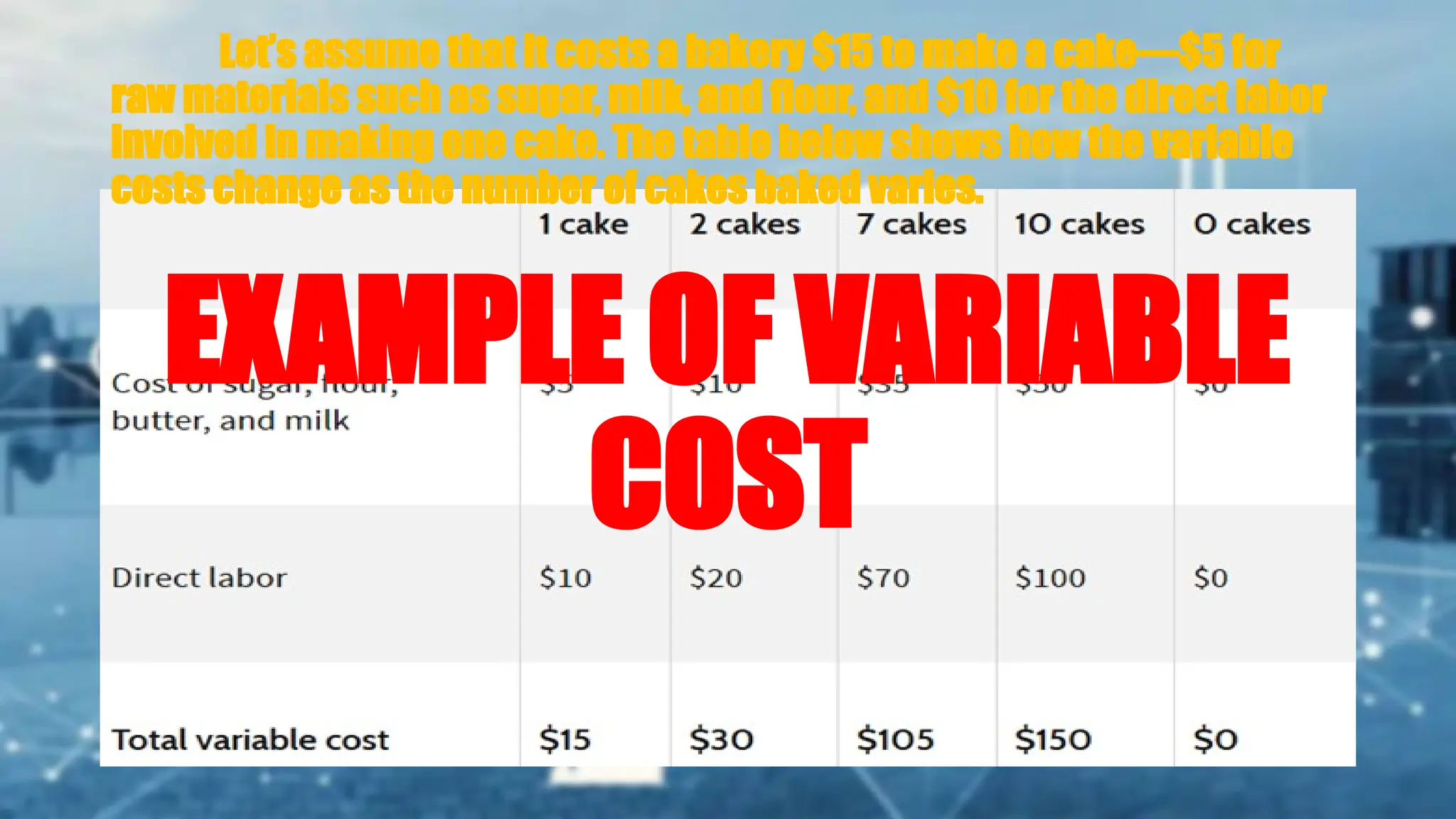
Let’sassume that it costs a bakery $15 to make a cake—$5 for
raw materials such as sugar, milk, and flour, and $10 for the direct labor
involved in making one cake. The table below shows how the variable
costs change as the number of cakes baked varies.
39.
As the productionoutput of cakes increases, the bakery’s
variable costs also increase. When the bakery does not make
any cake, its variable costs drop to zero.
Fixed costs and variable costs comprise the total cost.
Total cost is a determinant of a company’s profits, which is
calculated as:
Profits=Sales−Total Costs Profits=Sales−Total Costs
A company can increase its profits by decreasing its total
costs. Since fixed costs are more challenging to bring down
(for example, reducing rent may entail the company moving to
a cheaper location), most businesses seek to reduce their
variable costs. Decreasing costs usually means decreasing
variable costs.
40.
If the bakerysells each cake for $35, its gross profit per cake will be $35 -
$15 = $20. To calculate the net profit, the fixed costs have to be subtracted from
the gross profit. Assuming the bakery incurs monthly fixed costs of $900, which
includes utilities, rent, and insurance, its monthly profit will look like this:
41.
A business incursa loss when fixed costs are higher than
gross profits. In the bakery’s case, it has gross profits of $700 -
$300 = $400 when it sells only 20 cakes a month. Since its fixed
cost of $900 is higher than $400, it would lose $500 in sales. The
break-even point occurs when fixed costs equal the gross margin,
resulting in no profits or losses. In this case, when the bakery sells
45 cakes for a total variable cost of $675, it breaks even.
A company that seeks to increase its profit by decreasing
variable costs may need to cut down on fluctuating costs for raw
materials, direct labor, and advertising. However, the cost cut
should not affect product or service quality as this would have an
adverse effect on sales. By reducing its variable costs, a business
increases its gross profit margin or contribution margin.
42.
The contribution marginallows management to
determine how much revenue and profit can be earned from
each unit of product sold. The contribution margin is
calculated as:
The contribution margin for the bakery is ($35 - $15) / $35 =
0.5714, or 57.14%. If the bakery reduces its variable costs to $10, its
contribution margin will increase to ($35 - $10) / $35 = 71.43%.
Profits increase when the contribution margin increases. If the
bakery reduces its variable cost by $5, it would earn $0.71 for every
dollar in sales.
43.
Common examples ofvariable costs
include costs of goods sold (COGS; Cost of
Goods Sold; include raw materials, direct
labor, and manufacturing overhead costs,
and certain utilities (for example, electricity
or gas costs that increase with production
capacity).
What Are Some Examples of
Variable Costs?
44.
Variable costs aredirectly related to the cost of
production of goods or services, while fixed costs do
not vary with the level of production. Variable costs
are commonly designated as COGS, whereas fixed
costs are not usually included in COGS. Fluctuations
in sales and production levels can affect variable
costs if factors such as sales commissions are
included in per-unit production costs. Meanwhile,
fixed costs must still be paid even if production slows
down significantly.
How Do Fixed Costs Differ
from Variable Costs?
45.
If companies rampup production to meet
demand, their variable costs will increase as well. If
these costs increase at a rate that exceeds the
profits generated from new units produced, it may
not make sense to expand. A company in such a case
will need to evaluate why it cannot achieve
economies of scale. In economies of scale, variable
costs as a percentage of overall cost per unit
decrease as the scale of production ramps up.
How Can Variable Costs
Impact Growth and
Profitability?