Life cycle costing and
customer life cycle costing.
Prepared by
Ro’ya Abd ELhafez
Main Headlines:
Life cycle costing and whole life costing
Value engineering
product life cycle
Life cycle cost categories
Life-cycle costing and value chain
Life cycle cost (LCC)
Target costing and Target pricing:
Life cycle cost benefits
Life Cycle Costing limitation
Customer life Cycle Costing
Why use life Cycle Costing
Introduction -
• At the start of any project, it is important to understand the costs involved
• Traditional methods simply look at start up costs, cash flow and profit or loss
• Focused primarily on the manufacturing stage of product life cycle .
• Pre & post -manufacturing are treated as expenses costs.
• Traditional costing methods are used for external reporting and comply
with applicable rules( IFRS/ GAAP)
• Life-cycle costing is another type of costing that is useful only
for internal decision-making.
• Pre & post -manufacturing are treated as product costs.
• Does not comply with applicable rules (IFRS/GAAP)
Life cycle costing
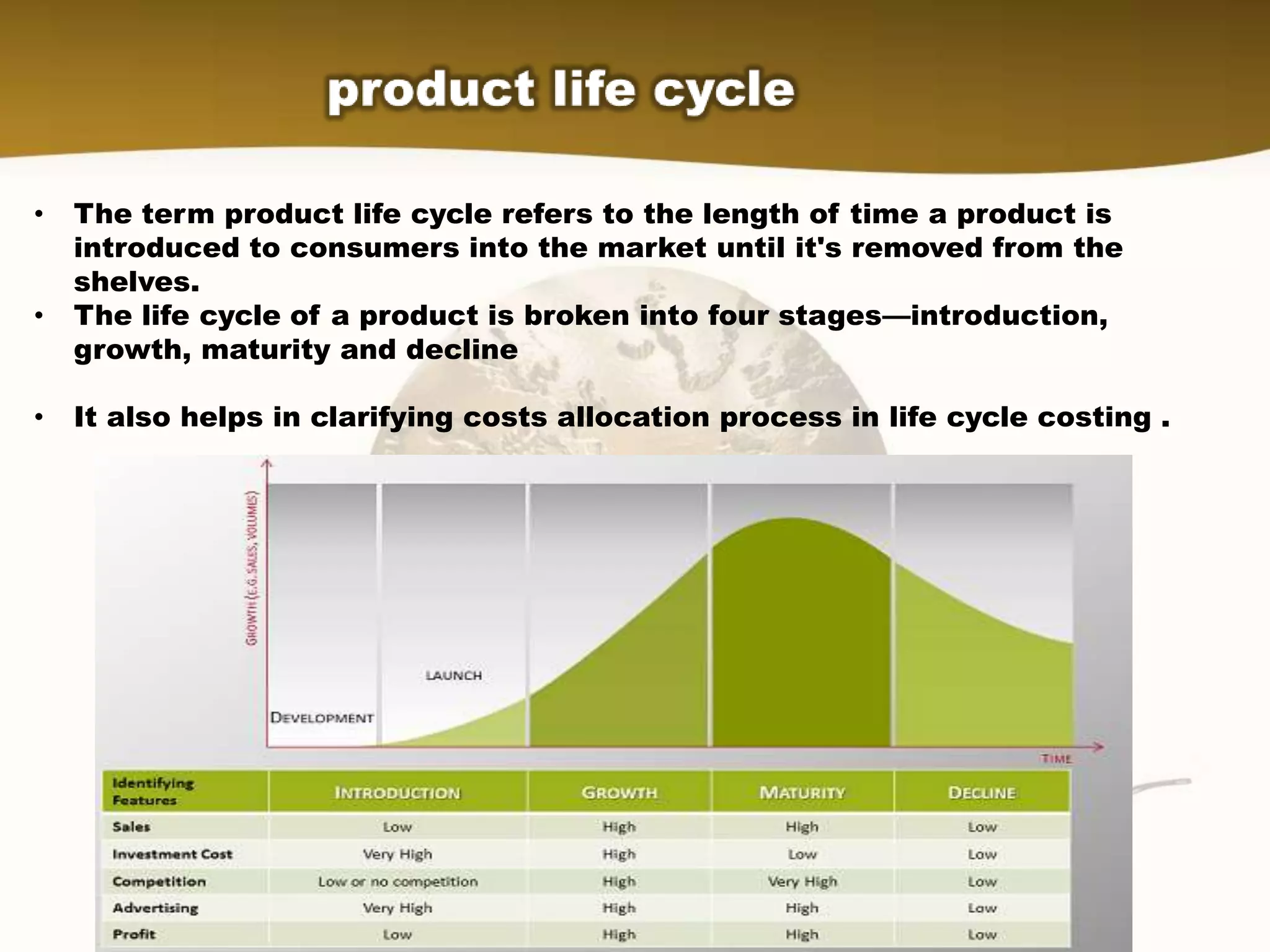
• The term product life cycle refers to the length of time a product is
introduced to consumers into the market until it's removed from the
shelves.
• The life cycle of a product is broken into four stages—introduction,
growth, maturity and decline
• It also helps in clarifying costs allocation process in life cycle costing .
Life cycle cost (LCC): is an approach that assesses the total cost of
an asset over its life cycle including initial capital costs,
maintenance costs, operating costs and the asset's residual value at
the end of its life.
• In life-cycle costing a company takes a much longer view to the cost of
production and attempts to allocate all of cost that is associated with the
product during its life cycle.
• cost that is associated with the product during its life cycle include
research and development, manufacturing, and after sale service costs.
• The process of a company looking at all of the costs hopefully enables it to
determine the ultimate value of developing a better product.
• Life-cycle costing plays a role in strategic planning and decision-making
about products.
Life cycle cost (LCC)
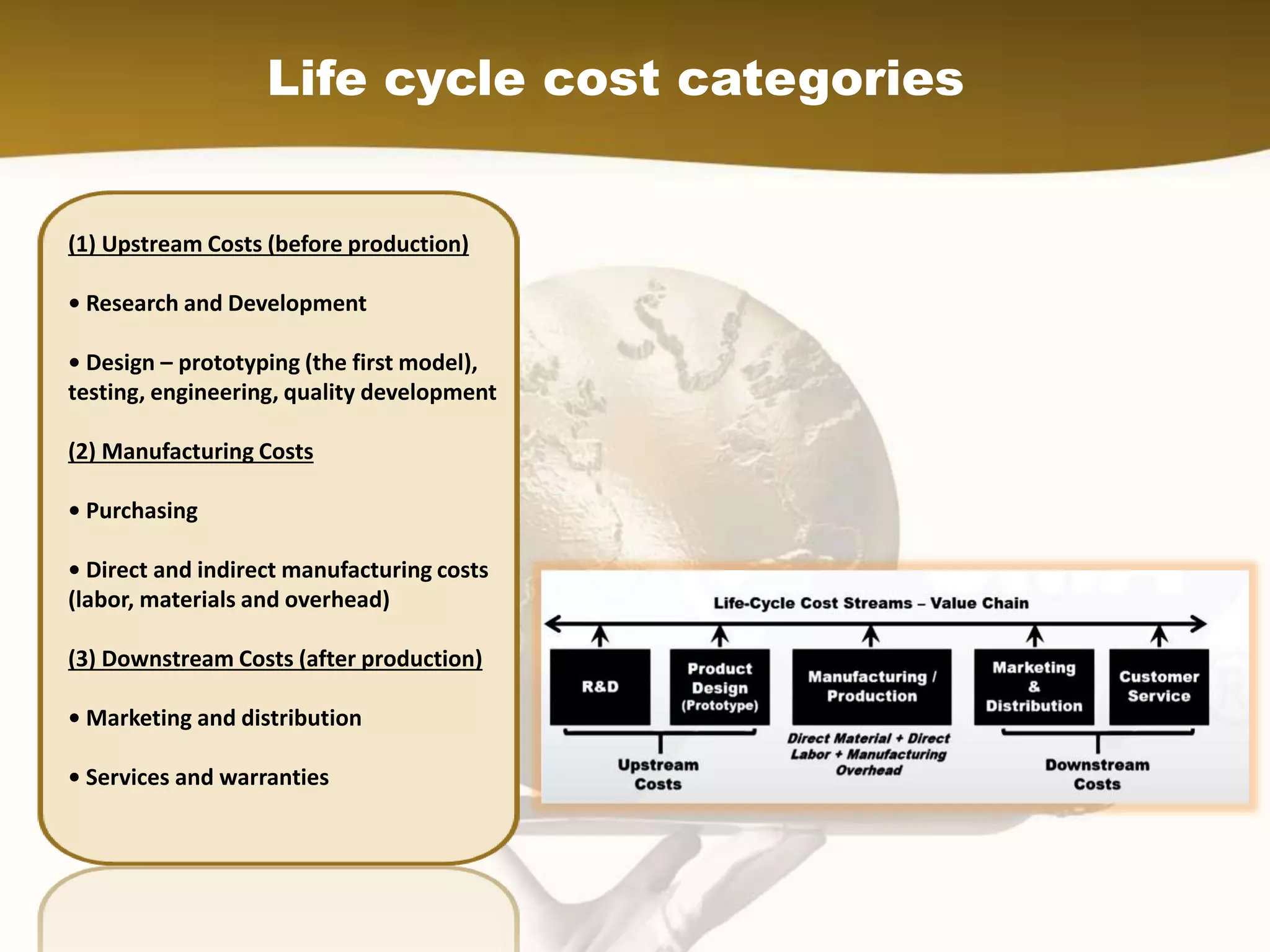
Life cycle cost categories
(1) Upstream Costs (before production)
• Research and Development
• Design – prototyping (the first model),
testing, engineering, quality development
(2) Manufacturing Costs
• Purchasing
• Direct and indirect manufacturing costs
(labor, materials and overhead)
(3) Downstream Costs (after production)
• Marketing and distribution
• Services and warranties
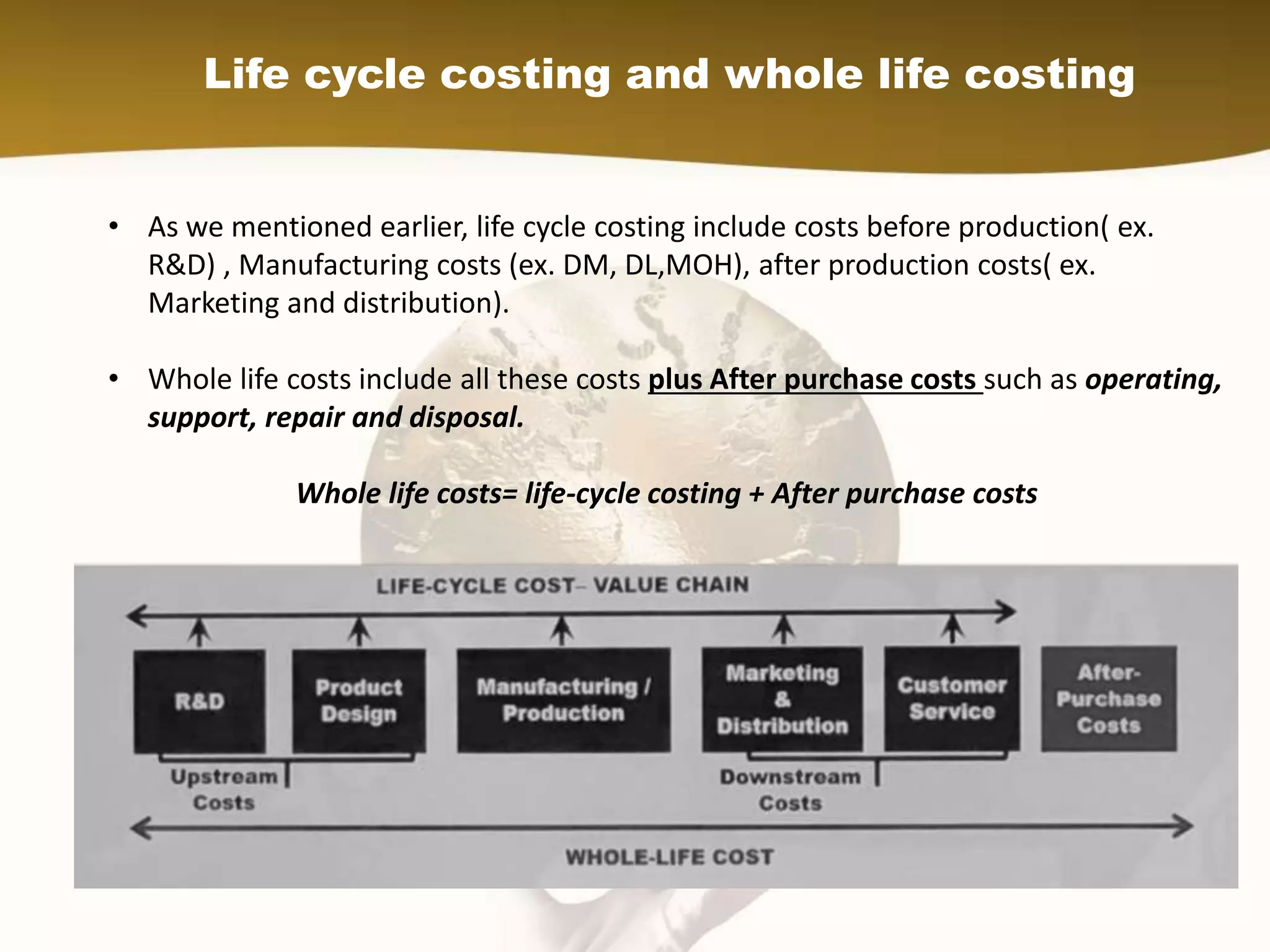
Life cycle costing and whole life costing
• As we mentioned earlier, life cycle costing include costs before production( ex.
R&D) , Manufacturing costs (ex. DM, DL,MOH), after production costs( ex.
Marketing and distribution).
• Whole life costs include all these costs plus After purchase costs such as operating,
support, repair and disposal.
Whole life costs= life-cycle costing + After purchase costs
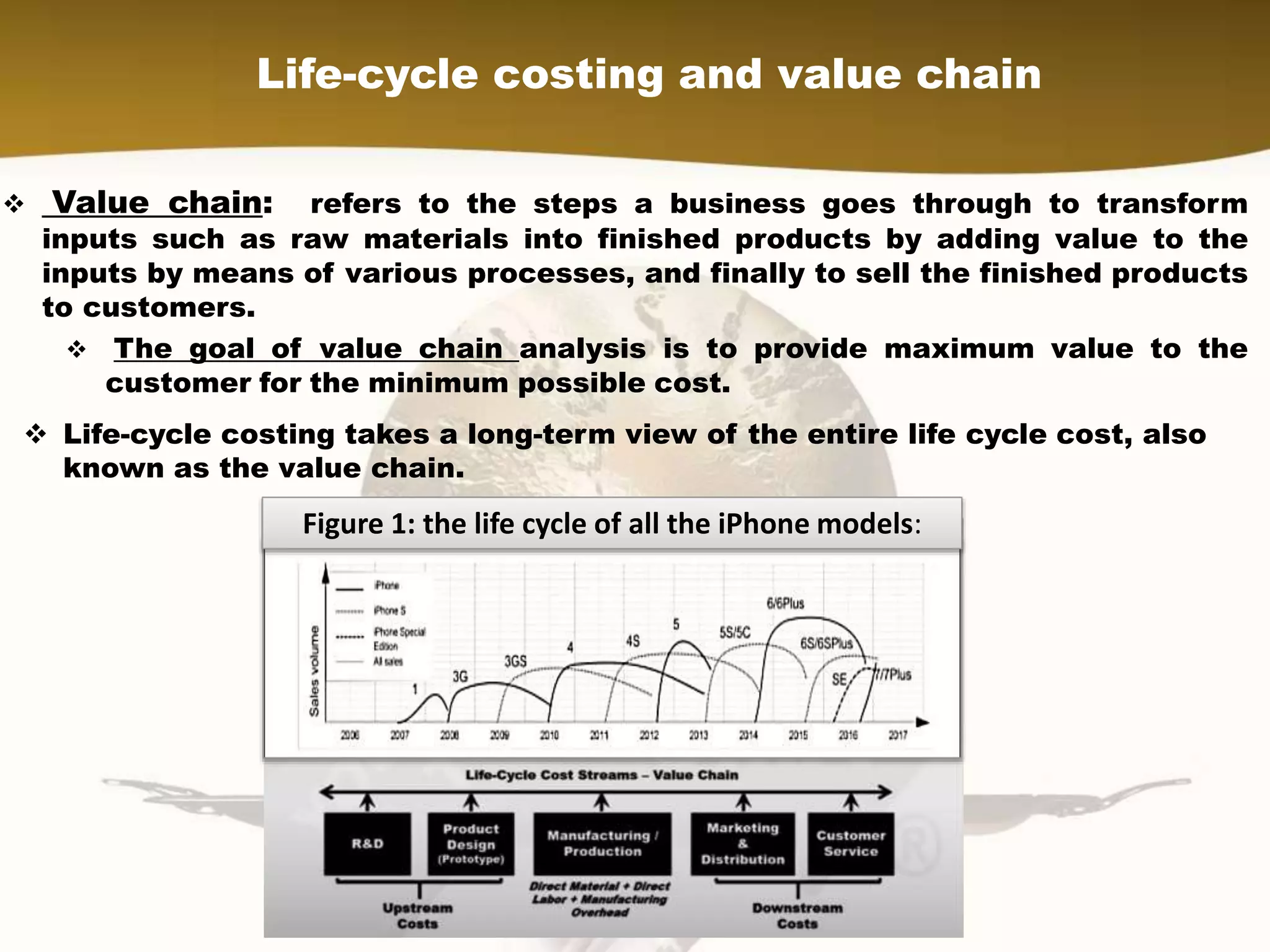
 Life-cycle costing takes a long-term view of the entire life cycle cost, also
known as the value chain.
Life-cycle costing and value chain
 Value chain: refers to the steps a business goes through to transform
inputs such as raw materials into finished products by adding value to the
inputs by means of various processes, and finally to sell the finished products
to customers.
 The goal of value chain analysis is to provide maximum value to the
customer for the minimum possible cost.
Figure 1: the life cycle of all the iPhone models:
Target costing and Target pricing:
• Target costing: is an approach to determine a product's life-cycle
cost which should be sufficient to develop specified functionality
and quality, while ensuring its desired profit.
• It involves setting a target cost by subtracting a desired profit
margin from a competitive market price.
• Target pricing: is a method that businesses use to calculate the
selling price for a product based on market prices. First, a
company decides on a competitive price for its product based on
market research and what similar products are selling for.
• Once the business determines its product's price, the business
sets how much of a profit it wants to make from it, which is also
known as its profit margin.
Target costing and Target pricing:
Example of successful companies: Toyota's, Appel, Tesla
Example of a failed company: Nokia
Example:
Electronic company wants to produce a new product. 1,000,000 is the
number of units will be produced. After studying the market
conditions it found that the suitable selling price is 10$ per unit. The
profit margin of each unit should be 2.5$ which mean that the target
costing for each unit is 7.5$.
Target pricing : 1,000,000* $10 = $10,000,000
Profit Margin= 1,000,000* $2.5= $2,500,000
Target costing: 1,000,000* $7.5= $7,500,000
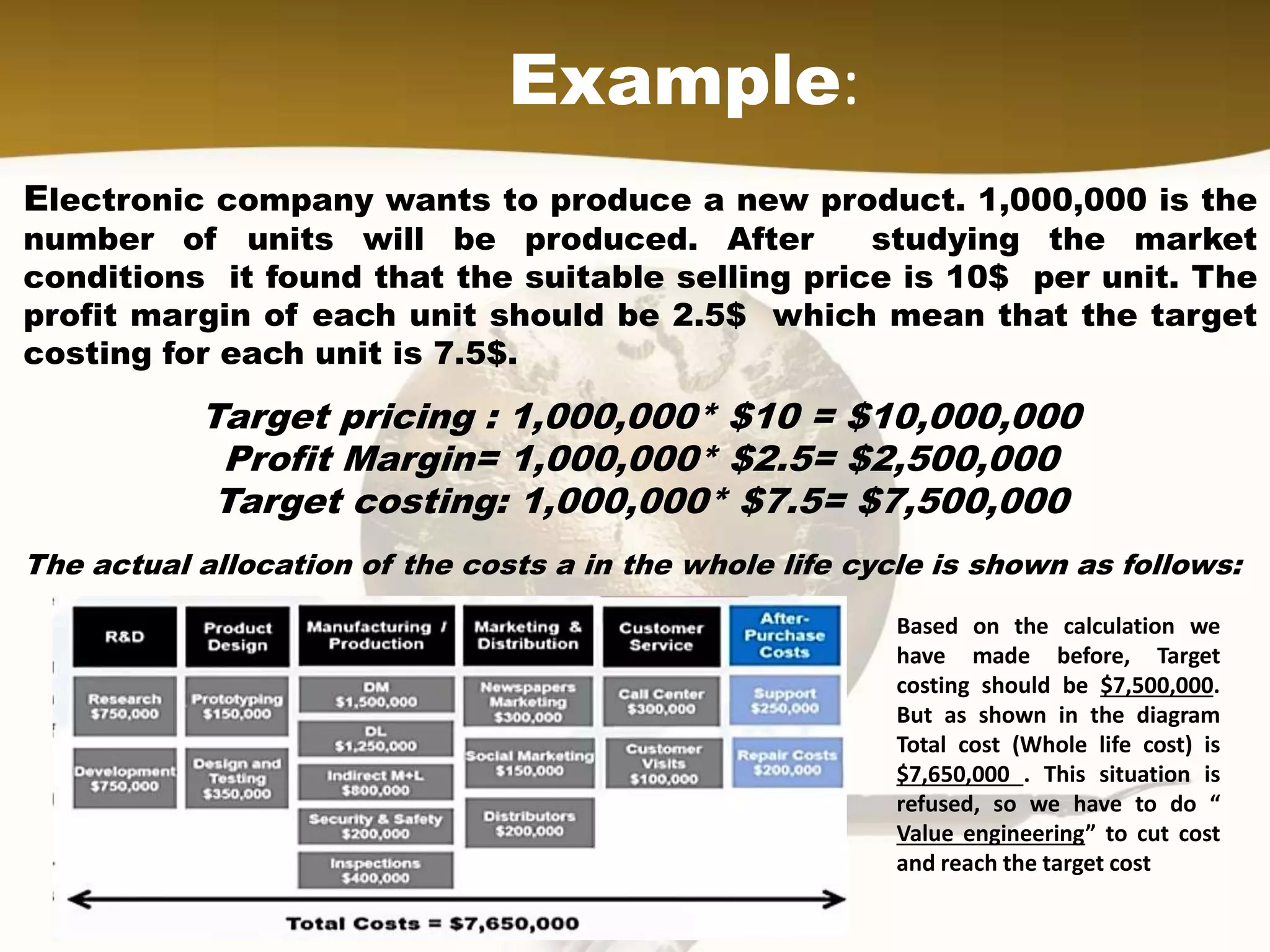
The actual allocation of the costs a in the whole life cycle is shown as follows:
Based on the calculation we
have made before, Target
costing should be $7,500,000.
But as shown in the diagram
Total cost (Whole life cost) is
$7,650,000 . This situation is
refused, so we have to do “
Value engineering” to cut cost
and reach the target cost
Value engineering
• Value engineering: Is a means of reaching Target cost levels. This
is happened through a systemic approach to assessing all aspects
of the value chain cost buildup for a product.
• The purpose of value engineering is to minimize costs without
reducing customer satisfaction.
• For this purpose, distinguish between value – adding and non
value adding activities is useful.
• The company can identify any non-value-adding costs, which
can then be reduced or eliminated without reducing the value
of the product to the customer.
 Continuing to the precious example, we can cut cost from non value
activities such as newspaper marketing, security and safety and
customer visits to reach target cost ($7,500,000)
 Do you have any other suggestion to reduce the cost without
affecting the value?
Value engineering
Benefits
(1)
life-cycle costing
provides a long-
term, more complete
perspective on the
costs
(2)
life-cycle costing
can be used to
lower those long-
term costs
(4)
life-cycle costing
Can be used to assess
future resource
requirements such as
needed operational
support for the product
during its life.
(5)
life-cycle costing
can help in
determining
when a product
will reach the
end of its
economic life.
(3)
life-cycle costing
enabling better
pricing for
profitability over
a product’s
lifetime.
Life cycle cost benefits
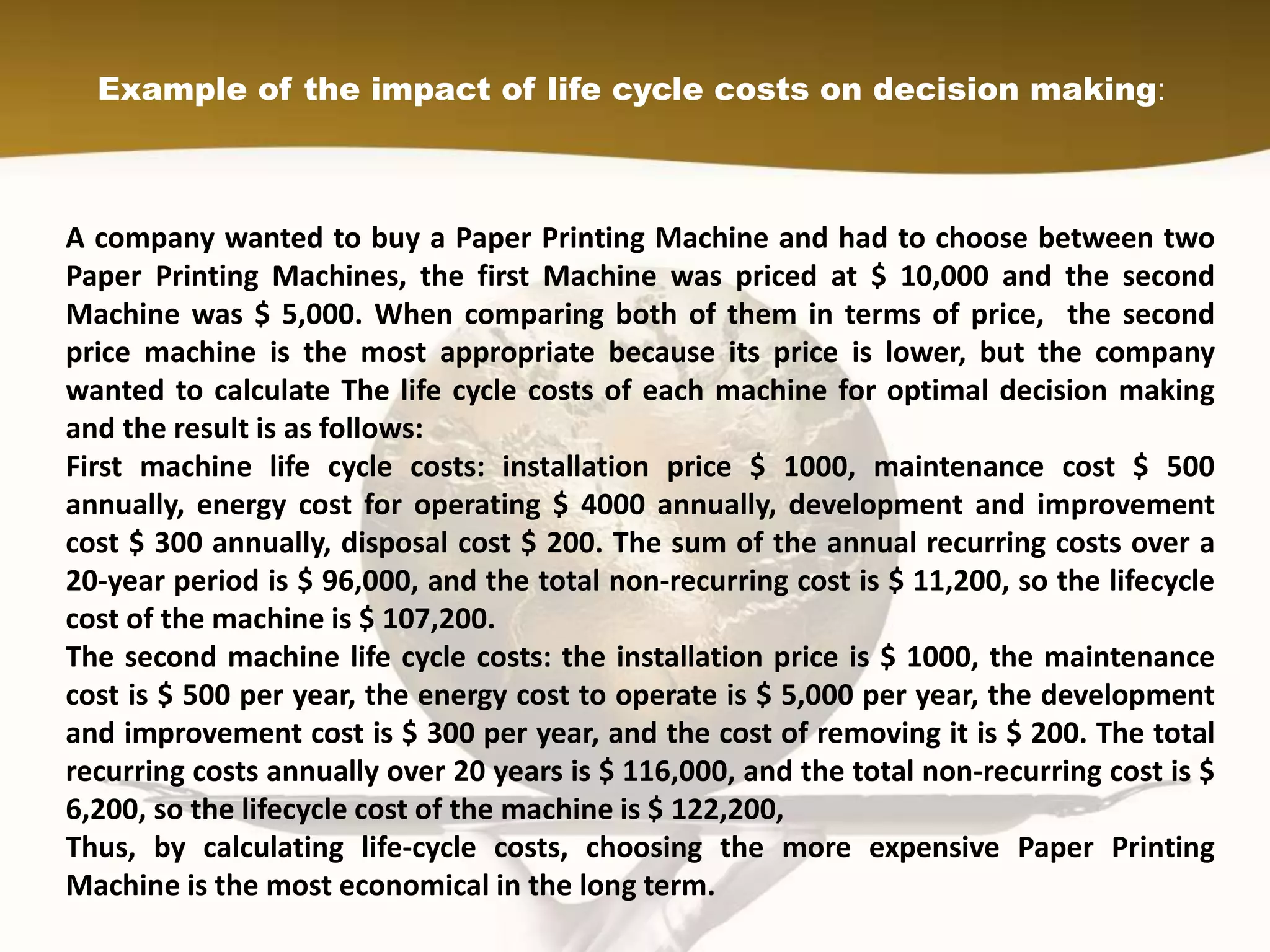
A company wanted to buy a Paper Printing Machine and had to choose between two
Paper Printing Machines, the first Machine was priced at $ 10,000 and the second
Machine was $ 5,000. When comparing both of them in terms of price, the second
price machine is the most appropriate because its price is lower, but the company
wanted to calculate The life cycle costs of each machine for optimal decision making
and the result is as follows:
First machine life cycle costs: installation price $ 1000, maintenance cost $ 500
annually, energy cost for operating $ 4000 annually, development and improvement
cost $ 300 annually, disposal cost $ 200. The sum of the annual recurring costs over a
20-year period is $ 96,000, and the total non-recurring cost is $ 11,200, so the lifecycle
cost of the machine is $ 107,200.
The second machine life cycle costs: the installation price is $ 1000, the maintenance
cost is $ 500 per year, the energy cost to operate is $ 5,000 per year, the development
and improvement cost is $ 300 per year, and the cost of removing it is $ 200. The total
recurring costs annually over 20 years is $ 116,000, and the total non-recurring cost is $
6,200, so the lifecycle cost of the machine is $ 122,200,
Thus, by calculating life-cycle costs, choosing the more expensive Paper Printing
Machine is the most economical in the long term.
Example of the impact of life cycle costs on decision making:
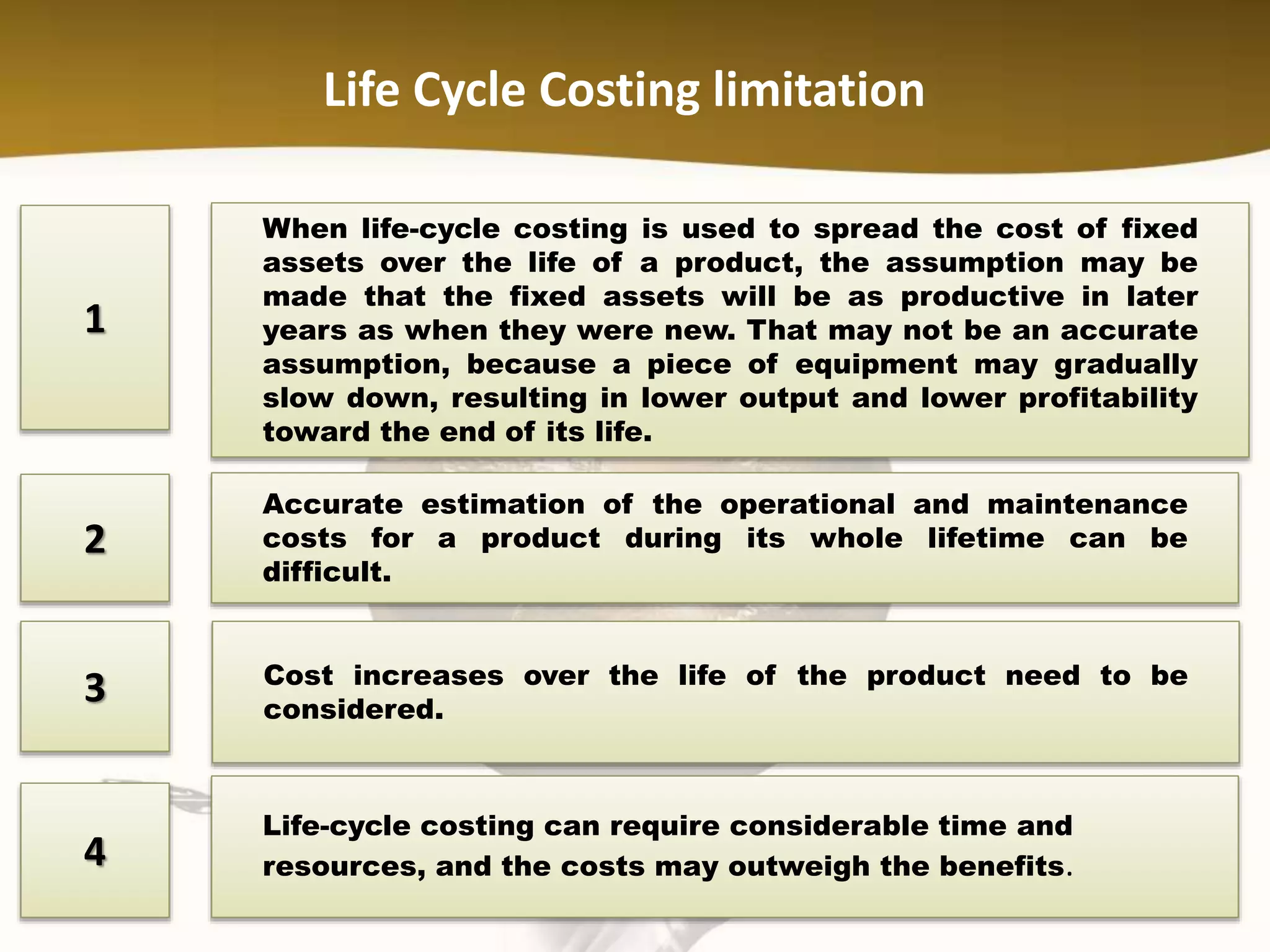
Life Cycle Costing limitation
When life-cycle costing is used to spread the cost of fixed
assets over the life of a product, the assumption may be
made that the fixed assets will be as productive in later
years as when they were new. That may not be an accurate
assumption, because a piece of equipment may gradually
slow down, resulting in lower output and lower profitability
toward the end of its life.
1
Accurate estimation of the operational and maintenance
costs for a product during its whole lifetime can be
difficult.
2
Cost increases over the life of the product need to be
considered.
3
4
Life-cycle costing can require considerable time and
resources, and the costs may outweigh the benefits.
Customer life Cycle Costing
• Customer life-cycle costing looks at the cost of the product from the
customer’s (the buyer’s) standpoint.
• It focuses on the total costs that will be paid by the customer during
the whole time the customer owns the product: the customer’s
purchase costs plus costs to use, maintain, and dispose of the
product or service.
Customer life cycle costing = Purchase cost + after purchase cost
• Customer life-cycle costing is important to a company because it is
part of the pricing decision.
Example:
Customer life Cycle Costing
BusinessSoft Co. is about to launch a new product. The company expects a 6-year life
cycle from the moment it starts developing this product through its last sale and
installation of the product. However, it also expects to provide after-sale services as part
of the contract within and beyond this period.
-R&D ($750,000)
-Design ($500,000)
-Manufacturing ($300,000)
-Marketing($200,000)
-Distribution($100,000)
-Customer services ($250,000)
-After sale support($60,000)
The company plans to produce and sell 1,500 installations of the product and would like
to earn a 40% mark-up over its life-cycle costs relating to this product. Also, the
company envisions that an average client would incur around $500 of installation,
training, operating, maintaining and disposal costs relating to usage of this product per
installation. What is the expected total life-cycle cost per installation for BusinessSoft?
And how much do they need to charge per installation?
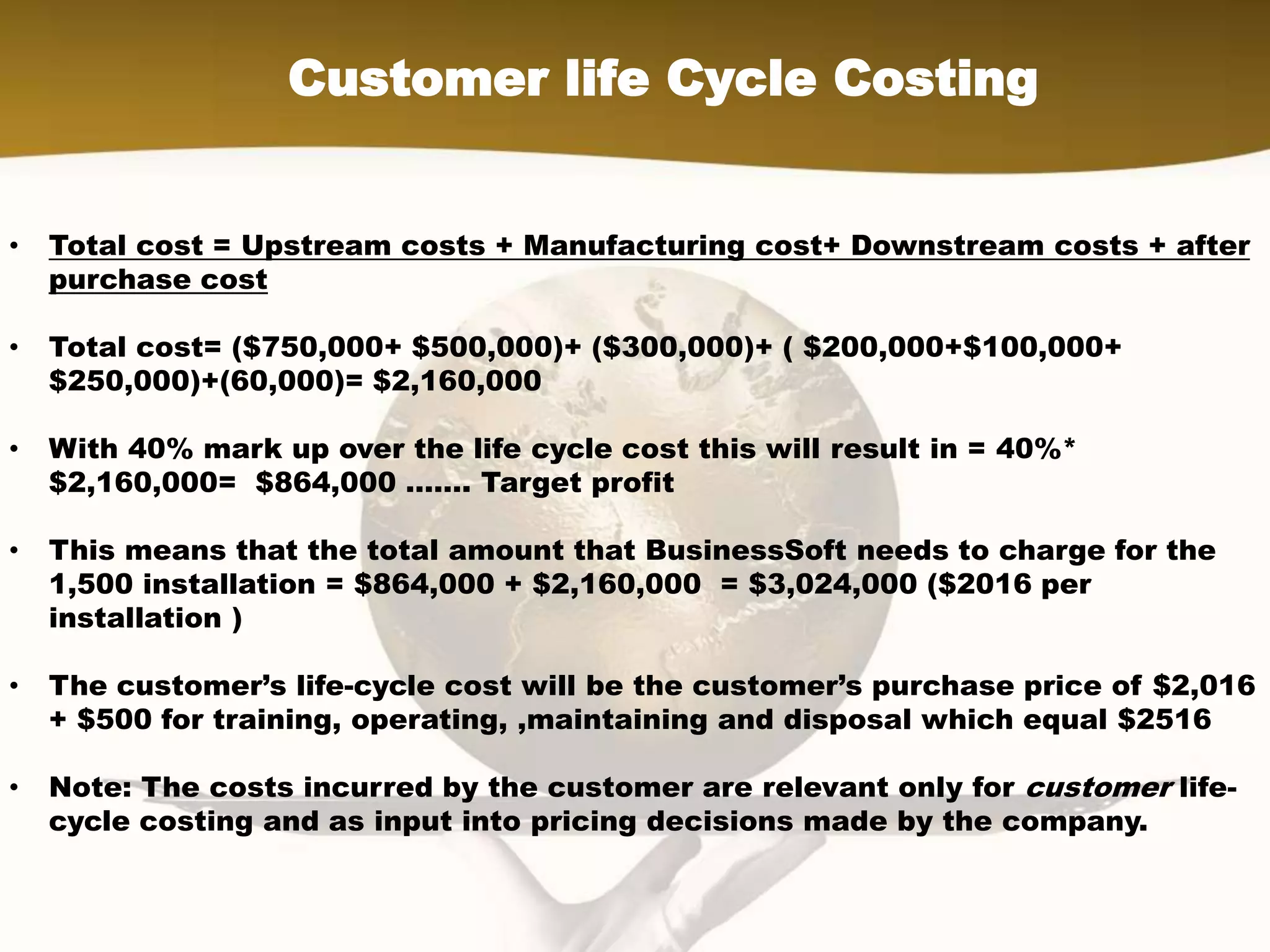
Customer life Cycle Costing
• Total cost = Upstream costs + Manufacturing cost+ Downstream costs + after
purchase cost
• Total cost= ($750,000+ $500,000)+ ($300,000)+ ( $200,000+$100,000+
$250,000)+(60,000)= $2,160,000
• With 40% mark up over the life cycle cost this will result in = 40%*
$2,160,000= $864,000 ……. Target profit
• This means that the total amount that BusinessSoft needs to charge for the
1,500 installation = $864,000 + $2,160,000 = $3,024,000 ($2016 per
installation )
• The customer’s life-cycle cost will be the customer’s purchase price of $2,016
+ $500 for training, operating, ,maintaining and disposal which equal $2516
• Note: The costs incurred by the customer are relevant only for customer life-
cycle costing and as input into pricing decisions made by the company.
Why use life Cycle Costing
• Project Engineering wants to minimize capital costs as the
only criteria
• Maintenance Engineering wants to minimize repair hours
• Production wants to maximize uptime hours
• Reliability Engineering wants to avoid failures
• Accounting wants to maximize project net present value
• Shareholders want to increase stockholder wealth
Do you have
any questions?
?
?

Life cycle costing and customer life cycle costing (cost accounting)

  • 1.
    Life cycle costingand customer life cycle costing. Prepared by Ro’ya Abd ELhafez
  • 2.
    Main Headlines: Life cyclecosting and whole life costing Value engineering product life cycle Life cycle cost categories Life-cycle costing and value chain Life cycle cost (LCC) Target costing and Target pricing: Life cycle cost benefits Life Cycle Costing limitation Customer life Cycle Costing Why use life Cycle Costing
  • 3.
    Introduction - • Atthe start of any project, it is important to understand the costs involved • Traditional methods simply look at start up costs, cash flow and profit or loss • Focused primarily on the manufacturing stage of product life cycle . • Pre & post -manufacturing are treated as expenses costs. • Traditional costing methods are used for external reporting and comply with applicable rules( IFRS/ GAAP) • Life-cycle costing is another type of costing that is useful only for internal decision-making. • Pre & post -manufacturing are treated as product costs. • Does not comply with applicable rules (IFRS/GAAP) Life cycle costing
  • 4.
    • The termproduct life cycle refers to the length of time a product is introduced to consumers into the market until it's removed from the shelves. • The life cycle of a product is broken into four stages—introduction, growth, maturity and decline • It also helps in clarifying costs allocation process in life cycle costing .
  • 5.
    Life cycle cost(LCC): is an approach that assesses the total cost of an asset over its life cycle including initial capital costs, maintenance costs, operating costs and the asset's residual value at the end of its life. • In life-cycle costing a company takes a much longer view to the cost of production and attempts to allocate all of cost that is associated with the product during its life cycle. • cost that is associated with the product during its life cycle include research and development, manufacturing, and after sale service costs. • The process of a company looking at all of the costs hopefully enables it to determine the ultimate value of developing a better product. • Life-cycle costing plays a role in strategic planning and decision-making about products. Life cycle cost (LCC)
  • 6.
    Life cycle costcategories (1) Upstream Costs (before production) • Research and Development • Design – prototyping (the first model), testing, engineering, quality development (2) Manufacturing Costs • Purchasing • Direct and indirect manufacturing costs (labor, materials and overhead) (3) Downstream Costs (after production) • Marketing and distribution • Services and warranties
  • 7.
    Life cycle costingand whole life costing • As we mentioned earlier, life cycle costing include costs before production( ex. R&D) , Manufacturing costs (ex. DM, DL,MOH), after production costs( ex. Marketing and distribution). • Whole life costs include all these costs plus After purchase costs such as operating, support, repair and disposal. Whole life costs= life-cycle costing + After purchase costs
  • 8.
     Life-cycle costingtakes a long-term view of the entire life cycle cost, also known as the value chain. Life-cycle costing and value chain  Value chain: refers to the steps a business goes through to transform inputs such as raw materials into finished products by adding value to the inputs by means of various processes, and finally to sell the finished products to customers.  The goal of value chain analysis is to provide maximum value to the customer for the minimum possible cost. Figure 1: the life cycle of all the iPhone models:
  • 9.
    Target costing andTarget pricing: • Target costing: is an approach to determine a product's life-cycle cost which should be sufficient to develop specified functionality and quality, while ensuring its desired profit. • It involves setting a target cost by subtracting a desired profit margin from a competitive market price. • Target pricing: is a method that businesses use to calculate the selling price for a product based on market prices. First, a company decides on a competitive price for its product based on market research and what similar products are selling for. • Once the business determines its product's price, the business sets how much of a profit it wants to make from it, which is also known as its profit margin.
  • 10.
    Target costing andTarget pricing: Example of successful companies: Toyota's, Appel, Tesla Example of a failed company: Nokia
  • 11.
    Example: Electronic company wantsto produce a new product. 1,000,000 is the number of units will be produced. After studying the market conditions it found that the suitable selling price is 10$ per unit. The profit margin of each unit should be 2.5$ which mean that the target costing for each unit is 7.5$. Target pricing : 1,000,000* $10 = $10,000,000 Profit Margin= 1,000,000* $2.5= $2,500,000 Target costing: 1,000,000* $7.5= $7,500,000 The actual allocation of the costs a in the whole life cycle is shown as follows: Based on the calculation we have made before, Target costing should be $7,500,000. But as shown in the diagram Total cost (Whole life cost) is $7,650,000 . This situation is refused, so we have to do “ Value engineering” to cut cost and reach the target cost
  • 12.
    Value engineering • Valueengineering: Is a means of reaching Target cost levels. This is happened through a systemic approach to assessing all aspects of the value chain cost buildup for a product. • The purpose of value engineering is to minimize costs without reducing customer satisfaction. • For this purpose, distinguish between value – adding and non value adding activities is useful. • The company can identify any non-value-adding costs, which can then be reduced or eliminated without reducing the value of the product to the customer.
  • 13.
     Continuing tothe precious example, we can cut cost from non value activities such as newspaper marketing, security and safety and customer visits to reach target cost ($7,500,000)  Do you have any other suggestion to reduce the cost without affecting the value? Value engineering
  • 14.
    Benefits (1) life-cycle costing provides along- term, more complete perspective on the costs (2) life-cycle costing can be used to lower those long- term costs (4) life-cycle costing Can be used to assess future resource requirements such as needed operational support for the product during its life. (5) life-cycle costing can help in determining when a product will reach the end of its economic life. (3) life-cycle costing enabling better pricing for profitability over a product’s lifetime. Life cycle cost benefits
  • 15.
    A company wantedto buy a Paper Printing Machine and had to choose between two Paper Printing Machines, the first Machine was priced at $ 10,000 and the second Machine was $ 5,000. When comparing both of them in terms of price, the second price machine is the most appropriate because its price is lower, but the company wanted to calculate The life cycle costs of each machine for optimal decision making and the result is as follows: First machine life cycle costs: installation price $ 1000, maintenance cost $ 500 annually, energy cost for operating $ 4000 annually, development and improvement cost $ 300 annually, disposal cost $ 200. The sum of the annual recurring costs over a 20-year period is $ 96,000, and the total non-recurring cost is $ 11,200, so the lifecycle cost of the machine is $ 107,200. The second machine life cycle costs: the installation price is $ 1000, the maintenance cost is $ 500 per year, the energy cost to operate is $ 5,000 per year, the development and improvement cost is $ 300 per year, and the cost of removing it is $ 200. The total recurring costs annually over 20 years is $ 116,000, and the total non-recurring cost is $ 6,200, so the lifecycle cost of the machine is $ 122,200, Thus, by calculating life-cycle costs, choosing the more expensive Paper Printing Machine is the most economical in the long term. Example of the impact of life cycle costs on decision making:
  • 16.
    Life Cycle Costinglimitation When life-cycle costing is used to spread the cost of fixed assets over the life of a product, the assumption may be made that the fixed assets will be as productive in later years as when they were new. That may not be an accurate assumption, because a piece of equipment may gradually slow down, resulting in lower output and lower profitability toward the end of its life. 1 Accurate estimation of the operational and maintenance costs for a product during its whole lifetime can be difficult. 2 Cost increases over the life of the product need to be considered. 3 4 Life-cycle costing can require considerable time and resources, and the costs may outweigh the benefits.
  • 17.
    Customer life CycleCosting • Customer life-cycle costing looks at the cost of the product from the customer’s (the buyer’s) standpoint. • It focuses on the total costs that will be paid by the customer during the whole time the customer owns the product: the customer’s purchase costs plus costs to use, maintain, and dispose of the product or service. Customer life cycle costing = Purchase cost + after purchase cost • Customer life-cycle costing is important to a company because it is part of the pricing decision.
  • 18.
    Example: Customer life CycleCosting BusinessSoft Co. is about to launch a new product. The company expects a 6-year life cycle from the moment it starts developing this product through its last sale and installation of the product. However, it also expects to provide after-sale services as part of the contract within and beyond this period. -R&D ($750,000) -Design ($500,000) -Manufacturing ($300,000) -Marketing($200,000) -Distribution($100,000) -Customer services ($250,000) -After sale support($60,000) The company plans to produce and sell 1,500 installations of the product and would like to earn a 40% mark-up over its life-cycle costs relating to this product. Also, the company envisions that an average client would incur around $500 of installation, training, operating, maintaining and disposal costs relating to usage of this product per installation. What is the expected total life-cycle cost per installation for BusinessSoft? And how much do they need to charge per installation?
  • 19.
    Customer life CycleCosting • Total cost = Upstream costs + Manufacturing cost+ Downstream costs + after purchase cost • Total cost= ($750,000+ $500,000)+ ($300,000)+ ( $200,000+$100,000+ $250,000)+(60,000)= $2,160,000 • With 40% mark up over the life cycle cost this will result in = 40%* $2,160,000= $864,000 ……. Target profit • This means that the total amount that BusinessSoft needs to charge for the 1,500 installation = $864,000 + $2,160,000 = $3,024,000 ($2016 per installation ) • The customer’s life-cycle cost will be the customer’s purchase price of $2,016 + $500 for training, operating, ,maintaining and disposal which equal $2516 • Note: The costs incurred by the customer are relevant only for customer life- cycle costing and as input into pricing decisions made by the company.
  • 20.
    Why use lifeCycle Costing
  • 21.
    • Project Engineeringwants to minimize capital costs as the only criteria • Maintenance Engineering wants to minimize repair hours • Production wants to maximize uptime hours • Reliability Engineering wants to avoid failures • Accounting wants to maximize project net present value • Shareholders want to increase stockholder wealth
  • 22.
    Do you have anyquestions? ? ?