Dr. Anu Gupta
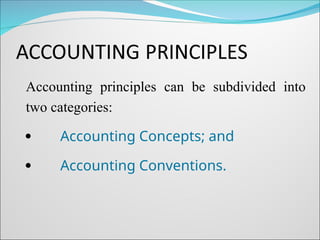
Accounting principles can be subdivided into
two categories:
 Accounting Concepts; and
 Accounting Conventions.
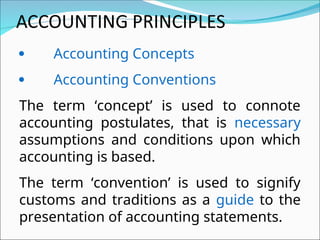
 Accounting Concepts
 Accounting Conventions
The term ‘concept’ is used to connote
accounting postulates, that is necessary
assumptions and conditions upon which
accounting is based.
The term ‘convention’ is used to signify
customs and traditions as a guide to the
presentation of accounting statements.
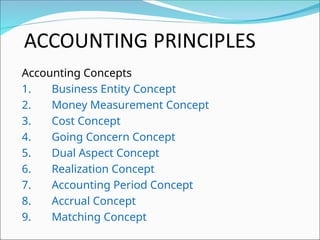
Accounting Concepts
1. Business Entity Concept
2. Money Measurement Concept
3. Cost Concept
4. Going Concern Concept
5. Dual Aspect Concept
6. Realization Concept
7. Accounting Period Concept
8. Accrual Concept
9. Matching Concept
Accounting Conventions
1. Convention of Consistency
2. Convention of Full Disclosure
3. Convention of Materiality
4. Convention of Conservatism or Prudence
Accounting Concepts
The term ‘concept’ is used to connote
accounting postulates, that is necessary
assumptions and conditions upon which
accounting is based.
Business is treated as a separate entity or
unit apart from its owner and others. All
the transactions of the business are
recorded in the books of business from
the point of view of the business as an
entity and even the owner is treated as a
creditor to the extent of his/her capital.
In accounting, we record only those
transactions which are expressed in
terms of money. In other words, a fact
which can not be expressed in monetary
terms, is not recorded in the books of
accounts.
In accounting, life of the business is perpetual
but still it has to report the results of activity
undertaken in one year. So final accounts are
prepared for the accounting period which is 12
months period and normally it is the Financial
Year ( 1st
April to 31st
March).
Transactions are entered in the books of
accounts at the amount actually involved.
E.g.- A company purchases a car for
Rs.1,50,000/- the real value of which is
Rs.2,00,000/-, the purchase will be recorded as
Rs.1,50,000/- and not any more. This is one of
the most important concept and it prevents
arbitrary values being put on transactions.
It is persuaded that the business will
exists for a long time and transactions
are recorded from this point of view. The
entity is assumed to remain in operation
sufficiently long to carry out its objects
and plans.
Each transaction has two aspects, that is,
the receiving benefit by one party and the
giving benefit by the other. This principle
is the core of accountancy.
For example, the proprietor of a business
starts his business with Cash
Rs.1,00,000/-, Machinery of Rs.50,000/-
and Building of Rs.30,000/-, then this fact
is recorded at two places. That is Assets
account (Cash, Machinery & Building) and
Capital accounts. The capital of the
business is equal to the assets of the
business.
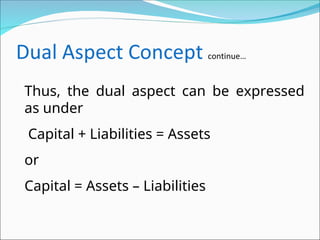
Thus, the dual aspect can be expressed
as under
Capital + Liabilities = Assets
or
Capital = Assets – Liabilities
This concept emphasizes that profits
should be considered only when
realized . Accounting should take into
consideration profits only when the same
have been realized.
Matching concept requires that expenses
should be matched to the revenues of the
appropriate accounting period. So we
must determine the revenue earned
during a particular accounting period and
the expenses incurred to earn those
revenues.
Accrual is concerned with expected future
cash receipts and payments : Accounting
attempts to recognize non-cash events
and circumstances as they occur.
Examples are – purchase and sales of
goods on credit ,wages and salaries
outstanding.
Accounting Conventions
The term ‘convention’ is used to signify
customs and traditions as a guide to the
presentation of accounting statements.
In order to enable the management to
draw important conclusions regarding
the working of the company over a few
years, it is essential that accounting
practices and methods remain
unchanged from one accounting period
to another. The comparison of one
accounting period with that of another is
possible only when the convention of
This principle implies that accounts must
be honestly prepared and all material
information must be disclosed therein.
The contents of Balance Sheet and Profit
and Loss Account are prescribed by law.
These are designed to make disclosure of
all material facts compulsory.
Financial statements are always drawn up
on rather a conservative basis. That is,
showing a position better than what it is,
not permitted. It is also not proper to
show a position worse than what it is. In
other words, secret reserves are not
permitted.
Accounting Concepts and Conventionss.ppt

Accounting Concepts and Conventionss.ppt

  • 1.
  • 2.
    Accounting principles canbe subdivided into two categories:  Accounting Concepts; and  Accounting Conventions.
  • 3.
     Accounting Concepts Accounting Conventions The term ‘concept’ is used to connote accounting postulates, that is necessary assumptions and conditions upon which accounting is based. The term ‘convention’ is used to signify customs and traditions as a guide to the presentation of accounting statements.
  • 4.
    Accounting Concepts 1. BusinessEntity Concept 2. Money Measurement Concept 3. Cost Concept 4. Going Concern Concept 5. Dual Aspect Concept 6. Realization Concept 7. Accounting Period Concept 8. Accrual Concept 9. Matching Concept
  • 5.
    Accounting Conventions 1. Conventionof Consistency 2. Convention of Full Disclosure 3. Convention of Materiality 4. Convention of Conservatism or Prudence
  • 6.
    Accounting Concepts The term‘concept’ is used to connote accounting postulates, that is necessary assumptions and conditions upon which accounting is based.
  • 7.
    Business is treatedas a separate entity or unit apart from its owner and others. All the transactions of the business are recorded in the books of business from the point of view of the business as an entity and even the owner is treated as a creditor to the extent of his/her capital.
  • 8.
    In accounting, werecord only those transactions which are expressed in terms of money. In other words, a fact which can not be expressed in monetary terms, is not recorded in the books of accounts.
  • 9.
    In accounting, lifeof the business is perpetual but still it has to report the results of activity undertaken in one year. So final accounts are prepared for the accounting period which is 12 months period and normally it is the Financial Year ( 1st April to 31st March).
  • 10.
    Transactions are enteredin the books of accounts at the amount actually involved. E.g.- A company purchases a car for Rs.1,50,000/- the real value of which is Rs.2,00,000/-, the purchase will be recorded as Rs.1,50,000/- and not any more. This is one of the most important concept and it prevents arbitrary values being put on transactions.
  • 11.
    It is persuadedthat the business will exists for a long time and transactions are recorded from this point of view. The entity is assumed to remain in operation sufficiently long to carry out its objects and plans.
  • 12.
    Each transaction hastwo aspects, that is, the receiving benefit by one party and the giving benefit by the other. This principle is the core of accountancy.
  • 13.
    For example, theproprietor of a business starts his business with Cash Rs.1,00,000/-, Machinery of Rs.50,000/- and Building of Rs.30,000/-, then this fact is recorded at two places. That is Assets account (Cash, Machinery & Building) and Capital accounts. The capital of the business is equal to the assets of the business.
  • 14.
    Thus, the dualaspect can be expressed as under Capital + Liabilities = Assets or Capital = Assets – Liabilities
  • 15.
    This concept emphasizesthat profits should be considered only when realized . Accounting should take into consideration profits only when the same have been realized.
  • 16.
    Matching concept requiresthat expenses should be matched to the revenues of the appropriate accounting period. So we must determine the revenue earned during a particular accounting period and the expenses incurred to earn those revenues.
  • 17.
    Accrual is concernedwith expected future cash receipts and payments : Accounting attempts to recognize non-cash events and circumstances as they occur. Examples are – purchase and sales of goods on credit ,wages and salaries outstanding.
  • 18.
    Accounting Conventions The term‘convention’ is used to signify customs and traditions as a guide to the presentation of accounting statements.
  • 19.
    In order toenable the management to draw important conclusions regarding the working of the company over a few years, it is essential that accounting practices and methods remain unchanged from one accounting period to another. The comparison of one accounting period with that of another is possible only when the convention of
  • 20.
    This principle impliesthat accounts must be honestly prepared and all material information must be disclosed therein. The contents of Balance Sheet and Profit and Loss Account are prescribed by law. These are designed to make disclosure of all material facts compulsory.
  • 21.
    Financial statements arealways drawn up on rather a conservative basis. That is, showing a position better than what it is, not permitted. It is also not proper to show a position worse than what it is. In other words, secret reserves are not permitted.