Discussion Outline
• Cone of Experience
• Pie Graph on Senses and Perception
• Reasons for Using Instructional Media in
the Classroom
• Guidelines in the Selection of Instructional
Media
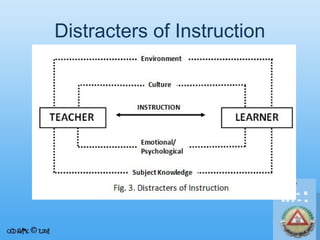
• Distracters of Instruction
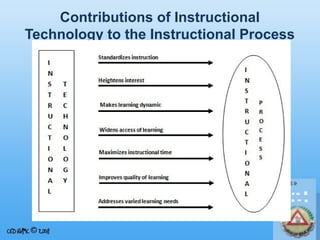
• Contributions of Instructional Technology
to the Learning Process
The “Cone of Experience”
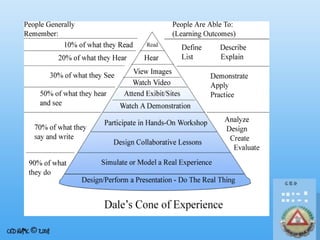
What is Dale’s cone of experience?
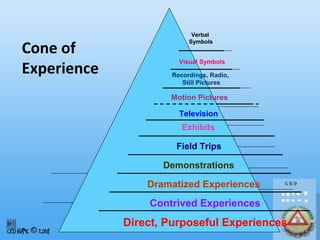
•The cone of experience is a pictorial device used to
explain the interrelationships of the various types of
audio-visual media, as well as their individual
“positions” in the learning process.
•The cone's utility in selecting instructional
resources and activities is as practical today as when
Dale created it.
Cone of
Experience

Verbal
Symbols

Visual Symbols
Recordings, Radio,
Still Pictures

Motion Pictures

Television

Exhibits

Field Trips

Demonstrations

Dramatized Experiences

Contrived Experiences

Direct, Purposeful Experiences
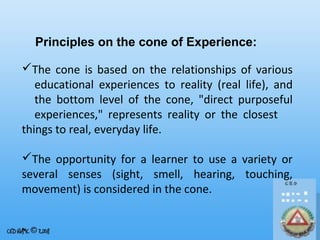
Principles on the cone of Experience:
The cone is based on the relationships of various
educational experiences to reality (real life), and
the bottom level of the cone, "direct purposeful
experiences," represents reality or the closest
things to real, everyday life.
The opportunity for a learner to use a variety or
several senses (sight, smell, hearing, touching,
movement) is considered in the cone.
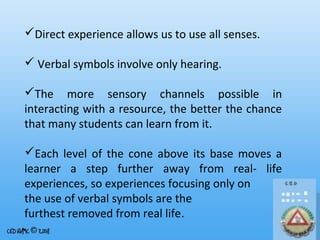
Direct experience allows us to use all senses.
 Verbal symbols involve only hearing.
The more sensory channels possible in
interacting with a resource, the better the chance
that many students can learn from it.
Each level of the cone above its base moves a
learner a step further away from real- life
experiences, so experiences focusing only on
the use of verbal symbols are the
furthest removed from real life.
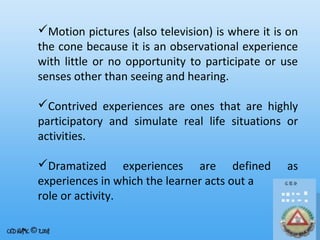
Motion pictures (also television) is where it is on
the cone because it is an observational experience
with little or no opportunity to participate or use
senses other than seeing and hearing.
Contrived experiences are ones that are highly
participatory and simulate real life situations or
activities.
Dramatized experiences are defined
experiences in which the learner acts out a
role or activity.

as
Verbal Symbols
• principal medium of communication
• bear no physical resemblance to the objects or ideas for
which they stand
• may be a word for concretion, idea, scientific principle,
formula or philosophic aphorism
• Disadvantage: highly abstract
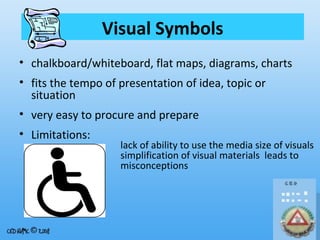
Visual Symbols
• chalkboard/whiteboard, flat maps, diagrams, charts
• fits the tempo of presentation of idea, topic or
situation
• very easy to procure and prepare
• Limitations:

lack of ability to use the media size of visuals
simplification of visual materials leads to
misconceptions
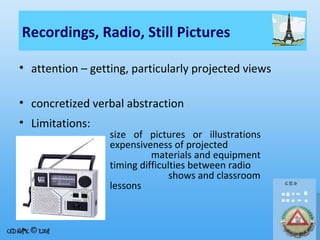
Recordings, Radio, Still Pictures
• attention – getting, particularly projected views
• concretized verbal abstraction
• Limitations:

size of pictures or illustrations
expensiveness of projected
materials and equipment
timing difficulties between radio
shows and classroom
lessons
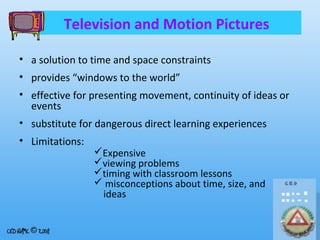
Television and Motion Pictures
• a solution to time and space constraints
• provides “windows to the world”
• effective for presenting movement, continuity of ideas or
events
• substitute for dangerous direct learning experiences
• Limitations:

Expensive
viewing problems
timing with classroom lessons
 misconceptions about time, size, and
ideas
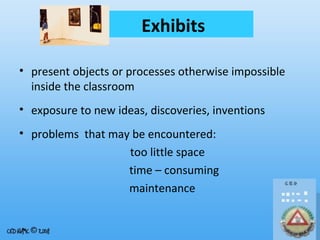
Exhibits
• present objects or processes otherwise impossible
inside the classroom
• exposure to new ideas, discoveries, inventions
• problems that may be encountered:
too little space
time – consuming
maintenance
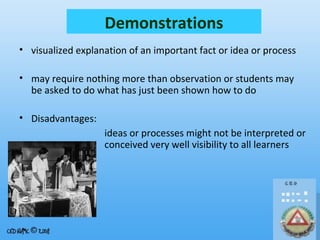
Demonstrations
• visualized explanation of an important fact or idea or process
• may require nothing more than observation or students may
be asked to do what has just been shown how to do
• Disadvantages:
ideas or processes might not be interpreted or
conceived very well visibility to all learners
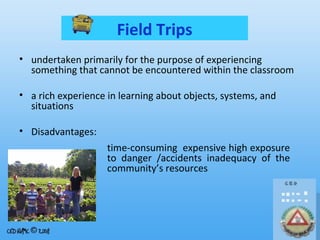
Field Trips
• undertaken primarily for the purpose of experiencing
something that cannot be encountered within the classroom
• a rich experience in learning about objects, systems, and
situations
• Disadvantages:
time-consuming expensive high exposure
to danger /accidents inadequacy of the
community’s resources
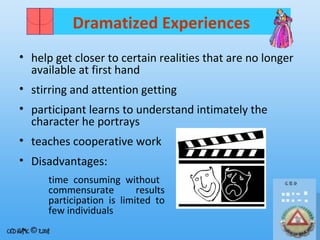
Dramatized Experiences
• help get closer to certain realities that are no longer
available at first hand
• stirring and attention getting
• participant learns to understand intimately the
character he portrays
• teaches cooperative work
• Disadvantages:
time consuming without
commensurate
results
participation is limited to
few individuals
Contrived Experiences
• an “editing” of reality
• substitutes for confusing or unmanageable first – hand
experiences
• easier to handle, manipulate or operate
• Disadvantages:
simplification leads to misconceptions, distorted views,
and incomplete pictures of reality no freedom to handle
expensive or fragile models, mock – ups, specimens, etc.
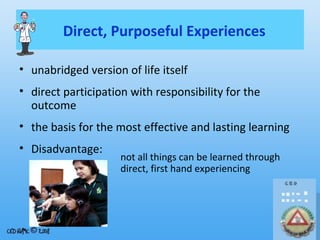
Direct, Purposeful Experiences
• unabridged version of life itself
• direct participation with responsibility for the
outcome
• the basis for the most effective and lasting learning
• Disadvantage:

not all things can be learned through
direct, first hand experiencing
Reference:
Dale, E. (1954). Audio-Visual Methods in
Teaching. NY: Dryden Press.
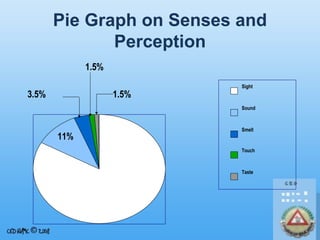
Pie Graph on Senses and Perception
Pie Graph on Senses and
Perception
1.5%
3.5%

1.5%

Sight

Sound

Smell

11%

Touch

Taste

83%
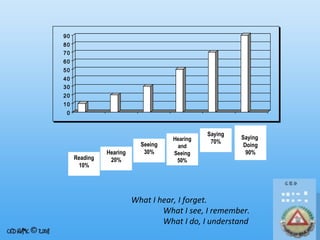
Retention Rate Levels
• Learning is an active process. Retention level
practically increases as students are actively
involve in various learning activities.
• Researchers found out that the most effective
approaches – resulting in 75% and 90%
retention rates, respectively – are learning by
doing and learning by teaching others
90
80
70
60
50
40
30
20
10
0

Reading
10%

Hearing
20%

Seeing
30%

Hearing
and
Seeing
50%

Saying
70%

Hearing

Saying
Doing
90%

What I hear, I forget.
What I see, I remember.
What I do, I understand
• References:
•
•
•
•
•
•
•

Corpus, Brenda B. and Salandanan, Gloria G. (2007) Principles of Teaching
1. Quezon City: Lorimar Publishing, Inc.
Garo, Candelaria D. (2004) Educational Technology . Mandaluyong City
National Book Store.
Lucido, Paz I. and Borabo (1997) Educational Technology. Quezon City:
Katha Publishing Co., Inc.
Newby, Timothy J, Stepich, Donald A., Lehman, James D. and Russell
James D. (2000) Instructional Technology for Teaching and Learning.
New Jersey: Prentice-Hall, Inc.
Reasons for Using Instructional
Media in the Classroom

Source: Kemp, J. & Smellie, D. (1994). Planning, producing, and using instructional technologies. 7th
edition. NY: Harper Collins
Happening too quickly

• Media used: films, charts, movies,
specimens
Too complex to be appreciated
• Media used:
– Mock-ups, models, diagrams, charts, pictures
Too small to be observed
• Media used:
– Telescope, microscope, lens, drawings, films,
slides, models, pictures
Too large to be easily
comprehended
• Media used:
– models, mock-ups, films, slides, diagrams
Too dangerous to permit live
observation
• Media used:
– simulators, films, slides, diagrams
Taking some place some
distance away in time and
space
• Media used:
– simulators, films, field trips, dramas,
slides, pictures
Guidelines in the Selection of
Instructional Materials

Source: Garo, C. (2007). Teaching educational technology. Manila: Rex Publishing.
Determine the needs.
• What are you trying to accomplish?
• What needs might specific instructional
media address.
Check a variety of sources

• Library resource
• Commercial producers
• distributors
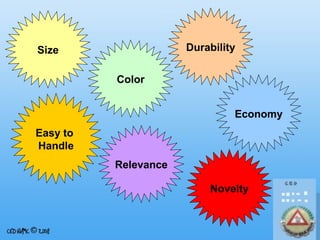
Obtain and preview the
materials
Durability

Size
Color

Economy
Easy to
Handle
Relevance
Novelty
Try the materials out with
students
• How well do they like the materials?
• How effectively do the materials help them
learn?
Compare any competing
materials
• Its effectiveness and appeal to students
Make your selection

• Select the material that works best for
your students/learning situation
Distracters of Instruction
Contributions of Instructional
Technology to the Instructional Process

Cone of experience1

  • 1.
    Discussion Outline • Coneof Experience • Pie Graph on Senses and Perception • Reasons for Using Instructional Media in the Classroom • Guidelines in the Selection of Instructional Media • Distracters of Instruction • Contributions of Instructional Technology to the Learning Process
  • 2.
    The “Cone ofExperience”
  • 3.
    What is Dale’scone of experience? •The cone of experience is a pictorial device used to explain the interrelationships of the various types of audio-visual media, as well as their individual “positions” in the learning process. •The cone's utility in selecting instructional resources and activities is as practical today as when Dale created it.
  • 4.
    Cone of Experience Verbal Symbols Visual Symbols Recordings,Radio, Still Pictures Motion Pictures Television Exhibits Field Trips Demonstrations Dramatized Experiences Contrived Experiences Direct, Purposeful Experiences
  • 5.
    Principles on thecone of Experience: The cone is based on the relationships of various educational experiences to reality (real life), and the bottom level of the cone, "direct purposeful experiences," represents reality or the closest things to real, everyday life. The opportunity for a learner to use a variety or several senses (sight, smell, hearing, touching, movement) is considered in the cone.
  • 6.
    Direct experience allowsus to use all senses.  Verbal symbols involve only hearing. The more sensory channels possible in interacting with a resource, the better the chance that many students can learn from it. Each level of the cone above its base moves a learner a step further away from real- life experiences, so experiences focusing only on the use of verbal symbols are the furthest removed from real life.
  • 7.
    Motion pictures (alsotelevision) is where it is on the cone because it is an observational experience with little or no opportunity to participate or use senses other than seeing and hearing. Contrived experiences are ones that are highly participatory and simulate real life situations or activities. Dramatized experiences are defined experiences in which the learner acts out a role or activity. as
  • 9.
    Verbal Symbols • principalmedium of communication • bear no physical resemblance to the objects or ideas for which they stand • may be a word for concretion, idea, scientific principle, formula or philosophic aphorism • Disadvantage: highly abstract
  • 10.
    Visual Symbols • chalkboard/whiteboard,flat maps, diagrams, charts • fits the tempo of presentation of idea, topic or situation • very easy to procure and prepare • Limitations: lack of ability to use the media size of visuals simplification of visual materials leads to misconceptions
  • 11.
    Recordings, Radio, StillPictures • attention – getting, particularly projected views • concretized verbal abstraction • Limitations: size of pictures or illustrations expensiveness of projected materials and equipment timing difficulties between radio shows and classroom lessons
  • 12.
    Television and MotionPictures • a solution to time and space constraints • provides “windows to the world” • effective for presenting movement, continuity of ideas or events • substitute for dangerous direct learning experiences • Limitations: Expensive viewing problems timing with classroom lessons  misconceptions about time, size, and ideas
  • 13.
    Exhibits • present objectsor processes otherwise impossible inside the classroom • exposure to new ideas, discoveries, inventions • problems that may be encountered: too little space time – consuming maintenance
  • 14.
    Demonstrations • visualized explanationof an important fact or idea or process • may require nothing more than observation or students may be asked to do what has just been shown how to do • Disadvantages: ideas or processes might not be interpreted or conceived very well visibility to all learners
  • 15.
    Field Trips • undertakenprimarily for the purpose of experiencing something that cannot be encountered within the classroom • a rich experience in learning about objects, systems, and situations • Disadvantages: time-consuming expensive high exposure to danger /accidents inadequacy of the community’s resources
  • 16.
    Dramatized Experiences • helpget closer to certain realities that are no longer available at first hand • stirring and attention getting • participant learns to understand intimately the character he portrays • teaches cooperative work • Disadvantages: time consuming without commensurate results participation is limited to few individuals
  • 17.
    Contrived Experiences • an“editing” of reality • substitutes for confusing or unmanageable first – hand experiences • easier to handle, manipulate or operate • Disadvantages: simplification leads to misconceptions, distorted views, and incomplete pictures of reality no freedom to handle expensive or fragile models, mock – ups, specimens, etc.
  • 18.
    Direct, Purposeful Experiences •unabridged version of life itself • direct participation with responsibility for the outcome • the basis for the most effective and lasting learning • Disadvantage: not all things can be learned through direct, first hand experiencing
  • 19.
    Reference: Dale, E. (1954).Audio-Visual Methods in Teaching. NY: Dryden Press.
  • 20.
    Pie Graph onSenses and Perception
  • 21.
    Pie Graph onSenses and Perception 1.5% 3.5% 1.5% Sight Sound Smell 11% Touch Taste 83%
  • 22.
    Retention Rate Levels •Learning is an active process. Retention level practically increases as students are actively involve in various learning activities. • Researchers found out that the most effective approaches – resulting in 75% and 90% retention rates, respectively – are learning by doing and learning by teaching others
  • 23.
  • 24.
    • References: • • • • • • • Corpus, BrendaB. and Salandanan, Gloria G. (2007) Principles of Teaching 1. Quezon City: Lorimar Publishing, Inc. Garo, Candelaria D. (2004) Educational Technology . Mandaluyong City National Book Store. Lucido, Paz I. and Borabo (1997) Educational Technology. Quezon City: Katha Publishing Co., Inc. Newby, Timothy J, Stepich, Donald A., Lehman, James D. and Russell James D. (2000) Instructional Technology for Teaching and Learning. New Jersey: Prentice-Hall, Inc.
  • 25.
    Reasons for UsingInstructional Media in the Classroom Source: Kemp, J. & Smellie, D. (1994). Planning, producing, and using instructional technologies. 7th edition. NY: Harper Collins
  • 26.
    Happening too quickly •Media used: films, charts, movies, specimens
  • 27.
    Too complex tobe appreciated • Media used: – Mock-ups, models, diagrams, charts, pictures
  • 28.
    Too small tobe observed • Media used: – Telescope, microscope, lens, drawings, films, slides, models, pictures
  • 29.
    Too large tobe easily comprehended • Media used: – models, mock-ups, films, slides, diagrams
  • 30.
    Too dangerous topermit live observation • Media used: – simulators, films, slides, diagrams
  • 31.
    Taking some placesome distance away in time and space • Media used: – simulators, films, field trips, dramas, slides, pictures
  • 32.
    Guidelines in theSelection of Instructional Materials Source: Garo, C. (2007). Teaching educational technology. Manila: Rex Publishing.
  • 33.
    Determine the needs. •What are you trying to accomplish? • What needs might specific instructional media address.
  • 34.
    Check a varietyof sources • Library resource • Commercial producers • distributors
  • 35.
    Obtain and previewthe materials
  • 36.
  • 37.
    Try the materialsout with students • How well do they like the materials? • How effectively do the materials help them learn?
  • 38.
    Compare any competing materials •Its effectiveness and appeal to students
  • 39.
    Make your selection •Select the material that works best for your students/learning situation
  • 40.
  • 41.
    Contributions of Instructional Technologyto the Instructional Process