New Literacy Set
Erasmus+ Project, 2015-2017
Communication literacy
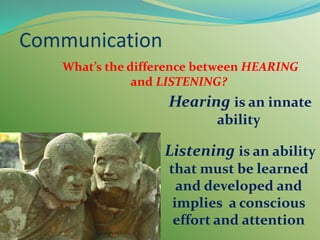
What’s the difference between HEARING
and LISTENING?
Hearing is an innate
ability
Listening is an ability
that must be learned
and developed and
implies a conscious
effort and attention
Communication
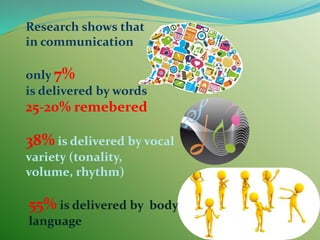
Research shows that
in communication
only 7%
is delivered by words
25-20% remebered
38% is delivered by vocal
variety (tonality,
volume, rhythm)
55% is delivered by body
language
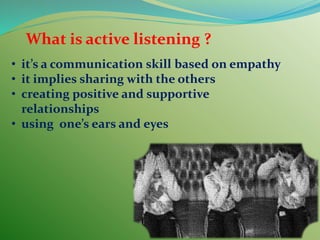
What is active listening ?
• it’s a communication skill based on empathy
• it implies sharing with the others
• creating positive and supportive
relationships
• using one’s ears and eyes
Becoming an Active Listener
1. Pay attention
2. Show that you’re listening
3. Provide feedback
4. Defer judgment
5. Respond appropriately
1. Pay attention
 Look at the speaker directly.
 Put aside distracting thoughts.
 Don't mentally prepare a rebuttal!
 Avoid being distracted by environmental factors. For
example, side conversations.
 "Listen" to the speaker's body language.
2. Show that you’re listening
• Nod occasionally.
• Smile and use other facial expressions.
• Note your posture and make sure it is open and
inviting.
• Encourage the speaker to continue with small verbal
comments like yes, and uh huh.
3. Provide feedback
• Reflect what has been said by paraphrasing. "What I'm
hearing is," and "Sounds like you are saying," are great
ways to reflect back.
• Ask questions to clarify certain points. "What do you
mean when you say." "Is this what you mean?"
• Summarize the speaker's comments periodically.
4. Defer judgment
 Interrupting is a waste of time. It frustrates the speaker
and limits full understanding of the message.
• Allow the speaker to finish each point before asking
questions.
• Don't interrupt with counter arguments.
5. Respond appropriately
 Active listening is a model for respect and
understanding. You are gaining information and
perspective. You add nothing by attacking the speaker
or otherwise putting him or her down.
• Be candid, open, and honest in your response.
• Assert your opinions respectfully.
• Treat the other person in a way that you think he or she
would want to be treated.
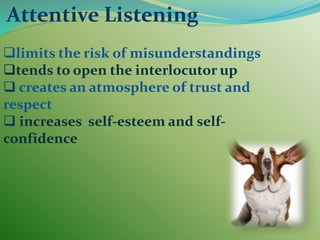
Attentive Listening
limits the risk of misunderstandings
tends to open the interlocutor up
 creates an atmosphere of trust and
respect
 increases self-esteem and self-
confidence
Active listening is a physical and
psychological process that involves
• Listening to what is being said (words)
• listening to what is not being said (what is behind
words, pauses included)
• staying focused on how the message is
conveyed (any body language cues)
Empathic listening
Empathic listening is about
understanding the views and feelings of the
speaking person
trying to ‘put yourself in the speaker’s shoes’
However
it is not about agreeing, making judgements,
offering advice
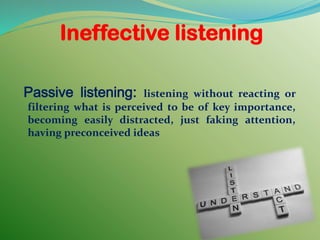
Ineffective listening
Passive listening: listening without reacting or
filtering what is perceived to be of key importance,
becoming easily distracted, just faking attention,
having preconceived ideas
Barriers to listening
Verbal factors: content too difficult/boring,
poorly delivered, interruptions
Environmental factors such as the light or
the temperature of the room, noises,
distracting movements, smells
Personal factors: feeling physically unwell,
stress, thinking about personal problems,
preconceived opinions, biases,
defensiveness
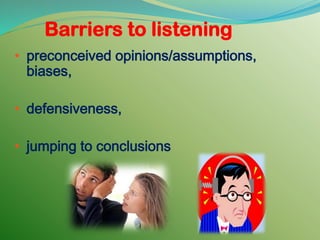
• preconceived opinions/assumptions,
biases,
• defensiveness,
• jumping to conclusions
Barriers to listening
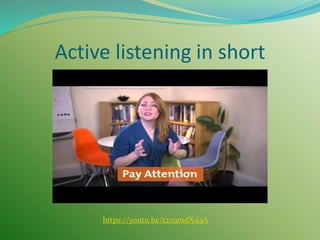
Active listening in short
https://youtu.be/t2z9mdX1j4A
Active listening

Active listening

  • 1.
    New Literacy Set Erasmus+Project, 2015-2017 Communication literacy
  • 3.
    What’s the differencebetween HEARING and LISTENING? Hearing is an innate ability Listening is an ability that must be learned and developed and implies a conscious effort and attention Communication
  • 5.
    Research shows that incommunication only 7% is delivered by words 25-20% remebered 38% is delivered by vocal variety (tonality, volume, rhythm) 55% is delivered by body language
  • 7.
    What is activelistening ? • it’s a communication skill based on empathy • it implies sharing with the others • creating positive and supportive relationships • using one’s ears and eyes
  • 8.
    Becoming an ActiveListener 1. Pay attention 2. Show that you’re listening 3. Provide feedback 4. Defer judgment 5. Respond appropriately
  • 9.
    1. Pay attention Look at the speaker directly.  Put aside distracting thoughts.  Don't mentally prepare a rebuttal!  Avoid being distracted by environmental factors. For example, side conversations.  "Listen" to the speaker's body language.
  • 10.
    2. Show thatyou’re listening • Nod occasionally. • Smile and use other facial expressions. • Note your posture and make sure it is open and inviting. • Encourage the speaker to continue with small verbal comments like yes, and uh huh.
  • 11.
    3. Provide feedback •Reflect what has been said by paraphrasing. "What I'm hearing is," and "Sounds like you are saying," are great ways to reflect back. • Ask questions to clarify certain points. "What do you mean when you say." "Is this what you mean?" • Summarize the speaker's comments periodically.
  • 12.
    4. Defer judgment Interrupting is a waste of time. It frustrates the speaker and limits full understanding of the message. • Allow the speaker to finish each point before asking questions. • Don't interrupt with counter arguments.
  • 13.
    5. Respond appropriately Active listening is a model for respect and understanding. You are gaining information and perspective. You add nothing by attacking the speaker or otherwise putting him or her down. • Be candid, open, and honest in your response. • Assert your opinions respectfully. • Treat the other person in a way that you think he or she would want to be treated.
  • 14.
    Attentive Listening limits therisk of misunderstandings tends to open the interlocutor up  creates an atmosphere of trust and respect  increases self-esteem and self- confidence
  • 15.
    Active listening isa physical and psychological process that involves • Listening to what is being said (words) • listening to what is not being said (what is behind words, pauses included) • staying focused on how the message is conveyed (any body language cues)
  • 16.
    Empathic listening Empathic listeningis about understanding the views and feelings of the speaking person trying to ‘put yourself in the speaker’s shoes’ However it is not about agreeing, making judgements, offering advice
  • 17.
    Ineffective listening Passive listening:listening without reacting or filtering what is perceived to be of key importance, becoming easily distracted, just faking attention, having preconceived ideas
  • 18.
    Barriers to listening Verbalfactors: content too difficult/boring, poorly delivered, interruptions Environmental factors such as the light or the temperature of the room, noises, distracting movements, smells Personal factors: feeling physically unwell, stress, thinking about personal problems, preconceived opinions, biases, defensiveness
  • 19.
    • preconceived opinions/assumptions, biases, •defensiveness, • jumping to conclusions Barriers to listening
  • 20.
    Active listening inshort https://youtu.be/t2z9mdX1j4A