ASSESSMENT, RECORDING, REPORTING POLICY
( This is an interim policy – awaiting findings from authority working group on assessment)

Rationale
Assessment is the means of obtaining information, which allows teachers, pupils
and parents to make judgements about pupil progress. The starting point for this
is the curriculum and the processes of learning and teaching. Assessment is
integral to the planning process and is a tool for reflection on programme
construction and teaching. Assessment measures the success of learning,
teaching and achievement and guides the next steps to be achieved.
General
This policy on assessment, recording and reporting is based on the existing
Guidelines on Assessment 5-14 and on current good practice. This policy is
based on the learning and teaching of pupils in the school and gives advice to
each teacher and to parents on the ways in which information will be gathered
about the success and progress of the pupil in relation to the curriculum and
personal and social development.
Assessment can be:
•

Formative – to indicate the effectiveness of teaching and learning

•

Diagnostic – to indicate strengths and weaknesses

•

Summative – for recording and reporting purposes

•

Informal – on-going for teacher and pupil information

•

Self and peer assessment

Aims:
To use assessment:
•

to recognise achievement and progression

1
•

to support learning and assist pupils to reach learning targets

•

to provide feedback to pupils, parents and other teachers

•

to promote high and realistic expectations for pupils

•

to provide information as a basis for monitoring and evaluating provision and
attainment/achievement at school

•

to produce good evidence to inform decisions about next steps in learning

Formative Assessment
Formative assessment is probably the most important type of assessment for a
class teacher as it should be fully integrated into the planning process.
Formative assessment and the use to which it is put, is crucial to effective
learning and teaching. It can help point the way to a reconsideration of the work
pupil’s are being asked to do, the teaching approach or the pupils learning. It
can identify areas of learning forgotten or misunderstood by the pupil, reveal
unsuspected knowledge of skills, identify possible barriers and provide
information on relevance, pace and interest of teaching for a learning group.
Teachers should report on pupil’s progress and attainment across the curriculum
using their professional judgement and the evidence available to them, and from
their own continuous assessment.

Assessment will improve the quality of

learning and teaching if information gathered has a clear purpose, is collected
systematically and is used appropriately. Assessment is an integral part of what
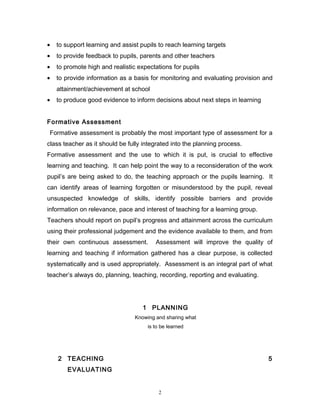
teacher’s always do, planning, teaching, recording, reporting and evaluating.

1 PLANNING
Knowing and sharing what
is to be learned

2 TEACHING

5

EVALUATING

2
Assessment as part of

Using assessment to

effective learning and teaching

evaluate learning and
teaching

3 RECORDING

4

REPORTING
Summarising success and

Providing useful

Progress

feedback

Planning
We need to take account of attainment outcomes, strands, targets in 5-14
Guidelines and our own school guidelines. In planning we need to consider the
time allocation of areas to be taught as recommended in 5-14. We need to have
a limited number of aims. Assessment should be incorporated and evident in our
Forward Plans.
We need to identify recent activities or developments important for new learning
and we need to match tasks to pupil’s abilities and experience – we need to plan
for groups and where appropriate individuals. We need to plan effective tasks
and flexible teaching methods that maintain the correct balance across the
curriculum. We should strive to design tasks that aid progress and are
challenging, yet attainable.
Teaching
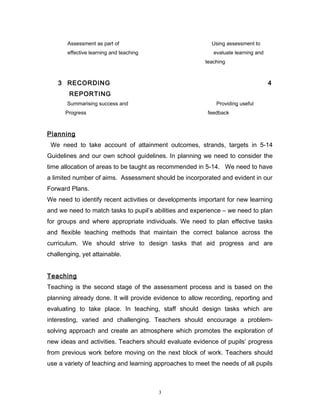
Teaching is the second stage of the assessment process and is based on the
planning already done. It will provide evidence to allow recording, reporting and
evaluating to take place. In teaching, staff should design tasks which are
interesting, varied and challenging. Teachers should encourage a problemsolving approach and create an atmosphere which promotes the exploration of
new ideas and activities. Teachers should evaluate evidence of pupils’ progress
from previous work before moving on the next block of work. Teachers should
use a variety of teaching and learning approaches to meet the needs of all pupils

3
and match tasks to pupils’ abilities and experience. (See whole School Teaching
for Learning Policy for advice).
At the end of a teaching block, we need to identify strengths and weaknesses of
a pupil’s/groups progress and record areas needing further development through
our evaluations/next steps comment. This should include an assessment of our
teaching and the impact this may have on the pupils future learning - e.g.
Did we get our points across effectively?
Was our lesson challenging and stimulating?
Did we use the most appropriate teaching approach?
Did we cater for the needs of all pupils?
Recording
Recording provides the platform from which teachers can base their reporting to
others and is a mechanism for evaluating learning and teaching. Our teachers’
forward plans/programmes of study can serve a dual purpose as plans and
records.
Recording will enable teachers to share with pupils successful learning and
identify development needs and next steps. It will monitor the effectiveness of
teaching and pupils’ progress in relation to attainment outcomes and targets.
It will enable teachers to report to parents, other teachers and other appropriate
agencies. It will also inform the Head Teacher/School Board about attainment
levels in classwork and in National Tests.
Types of Record:
Teaching records (as part of the forward plans)


A succinct account of teaching and learning aims



A brief indication of teaching methods used



An evaluative comment of how the class/groups have coped



A note of next steps

Individual Records
4


Folios/collections of work



National test results



Records of self-peer assessment



Indications of levels of achievement

Summaries of overall class performance


An on-going record of the number of pupils working at each level in each
main curricular area



Submission of national test results to the Head Teacher 3 times a year

General
Records of day-to-day progress will be kept by staff on a group/individual basis.
At the senior end the pupils themselves can complete most of these sheets.
Records of 5-14 attainment and individual National Test records should be kept
by the teachers.
Recording of evidence is also available in teacher’s weekly plans. Project folders
should be kept and examples of work from this and other areas of the curriculum
should be retained in the individual pupil’s folio of work. Guidelines on work to be
included in folios form part of this document.
Teachers should only note significant strengths and weaknesses in formal record
sheet and indicate the need for longer-term action such as extension and
reinforcement. Their strengths and weaknesses and areas for development will
be reported to parents through school reports.
Ways of recording
Evidence can be:


recorded on tape,
5


in folios of pupil’s work;



brief notes in teachers’ jotters,



in teachers’ forward plans,



checklists, worksheets,



National Tests,



video recording (with parents permission) record sheets,



self/peer assessment sheets,



pupils’ reports.

Folio folders should be reviewed regularly so they do not become too bulky and
key items can be passed on from stage to stage with the pupil. Work for folios
should contain work selected by the teacher/pupil. Teachers should ensure the
work is dated and marked by the teacher in some way.
What to record
Teachers should record for each pupil only what is useful and relevant for
planning next steps in learning and for reporting progress. This should include
brief comments on progress in relation to specific teaching aims, particular
strengths and development needs. It may include pupil’s approach to learning,
their interests and information about personal and social development. Often
informal anecdotal comments are useful also.
When to record
We should record at the end of a planned block of learning and teaching for
example, in our forward planning evaluation section or as is required within the
day-to-day running of the class. Teachers should update their individual/group
pupils records termly. Recording should also take place prior to planned parental
consultation or reports to parents. When pupils have covered work at an
appropriate 5-14 level in reading, writing and maths and there is evidence of this,
National tests should be carried out and results recorded.
(See appendix 2 for Assessment schedule)

6
Kinds of evidence we can use:


Conversation with pupils/parents/teachers



Written evidence (pupil’s work)



Comments written on pupil’s work



Observation



Discussing targets/tasks with pupils



Oral questioning



Tasks set by teachers



Assessment/progress work built into schemes



Extension work – pupils able to apply knowledge/skills to new situations



Attainment in 5-14 targets (use of checklists)



Standardised test results



Cognitive Abilities Tests (C.A.T.) results



Co-operation in a project



Self/peer assessment (pupils should be encouraged to reflect on own work
and compare performance against agreed criteria, eg self correction and
conferencing after writing, self assessment sheet at end of ES topic, peer
assessment in talking task)



Senior pupils can use same headings as Class Teacher in reports, and list
what they consider their strengths and weaknesses to be



Ability to carry our practical activities

An example of evidence through practical activities could be:
(a)

Can pupil make a start?

(b)

Can pupil apply their knowledge to task?

(c)

Can pupil choose appropriate materials

(d)

Can pupil report findings

An example of evidence from writing could be (a) short responses – write a
word/few words, answer to a question, filling in a table, chart, labeling a picture,
diagram, completing statements.
7
Extended writing – gives information on knowledge and attitudes – what they
know, think, feel. Also gives information on use of language, e.g. vocabulary,
sentence structure, organisation of ideas, etc.
(See appendix 1 for examples of evidence to keep)

Self/peer assessment
The role of self/peer assessment has been identified as an important aspect of
assessment. Pupils can self assess aspects of their work using agreed criteria,
using a known code that indicates how they have performed or through meeting
of individual targets. Pupils can also peer assess using criteria, codes and
targets. Peer assessment is carried out in conferencing during North Lanark
writing lessons. Peer assessment can be very valid as most pupils will value the
judgement passed onto them by their classmates.
The Role of National Testing
National Testing will provide an additional and important source of evidence of
pupil attainment in reading, writing and maths, in relation to nationally agreed and
understood standards. Pupils will take a test in reading, writing or maths when
teacher’s own assessment indicates that pupil has achieved the attainment
targets at one level and is ready to move from that level. The tests will confirm or
not, the teacher’s view that a pupil is ready for the next level of work.
In most cases it is recommended that pupils be tested in groups, but in some
cases this may be individuals. The teacher will review the evidence of attainment
collected or recorded to identify if pupils/pupil are/is ready to be tested. The
teacher will be required to be able to provide this evidence of attainment to the
Head Teacher or to the parents to support the decision that a pupil is ready to be
tested. Participation of pupils with a record of needs will be left to discretion of
8
the Head Teacher in consultation with the class teacher and parents. Some
pupils with specific needs may necessitate a scribe or addition time to complete
tests.
The class teacher will be responsible for the administering of and marking of the
tests.

(Learning Support team may also be involved).

Learning Support

members may also assist some pupils with tests, e.g. if reading is the problem in
for example a maths test.
Test results will be reported to parents with report sheets issued twice a year.
The sitting of National Tests should be incorporated in forward planning by the
teacher. We have an individual record sheet for each pupil which shows tests
and levels sat and the date the level was achieved. These should be filled in and
passed onto the next teacher. A separate record sheet of names, levels and
results should be submitted to the Head Teacher for monitoring in December,
March and June.
It may be more suitable to establish a ‘testing time’ in a week which can be used
for formal testing, eg during written mental test time, silent reading period where
the atmosphere is conductive for concentration and the teacher is free to
administer test to a group. The pupils could be set tasks that require little direct
supervision.
National Tests Papers
Ordering and Storage of Tests: The class teachers will order the tests they
require for their class for the year after October, on the contexts they would like.
The Head Teacher, after collating the order, will order the tests and they will be
stored in a unit in the Staff Room. Additional tests can be re-ordered throughout
the year.
Time Allocation for Tests
9
The time limit for most reading/maths tests is around 20-25 minutes but this is
flexible to allow for the individual pupil’s needs. The time for writing is longer.
(See guidelines on how to administer tests).
Assessment and Support for Learning
Where pupils are noticed to be having difficulty or failing, the Support for
Learning teacher will initially observe in the classroom and if necessary follow up
with more detailed or diagnostic assessment, to try and identify specific problems
and recommend strategies, methods, resources to help.

A differentiated

curriculum may be all that is required. Formative and diagnostic assessment is
carried out on a regular basis by the Support for Learning teacher. A Learning
Support record is kept of pupils requiring specific needs and Individual Education
Programmes are implemented.

Learning Support can also be consulted on

suitability of assessment tasks and on particular problems of assessing the work
of pupils with Learning difficulties. Learning Support can also advise and provide
differentiated assessment materials for all pupils, including the able.
Reporting
Reporting following assessment will contribute to communication and cooperation amongst teachers and parents.
Reporting and compilation of pupil reports serves a number of purposes. They
provide feedback to pupils, they inform parents of their child’s progress and
provide and agenda for parents’ meetings, and they pass information from one
teacher to another for from one school to another.
Reporting to Pupils
This can take the form of discussion, written comments on work, identifying areas
of strengths and setting targets for areas needing to be worked on, encouraging
any improvement or task well done (a simple sticker is very effective!), at the end

10
of a topic/task, on the spot as part of the day-to-day teaching or when a target
has been met.
Reporting to Parents
It is school policy to issue 2 written reports per year, one in November and one in
May/June. The November report indicates progress made, 5-14 level achieved,
comments on homework and behaviour and consideration for others.

The

May/June report includes aforementioned plus teachers comment, next steps
and comments on how parents can help their child at home.
Reporting to parents has 2 main elements: talking with parents and written
reports.
Reporting to Teachers
This will take the form of passed on record sheets, pupil reports and informal
discussions.
Reporting to School Board
The Head Teacher will provide information to the School Board about overall
attainment in the school.
Evaluating Assessment
The teachers will evaluate the assessment in practice as part of a whole school
activity but also as an individual teacher.
They will evaluate termly, and organise assessment practices to be consistent
with the curricular programme of a class, and on a day-to-day basis to relate to
the needs of the class, groups or individuals.
Evaluation by groups of staff at team/staff meeting will take place regularly in
discussion with the Head Teacher.

11
We will consider assessment within each curricular areas as we review policy in
that area. In Collective Activity Time or In Service Days ,the teachers will share
work and ideas on assessment and practice will be reviewed. Standards and
assessment criteria, methods and materials will also be discussed to ensure
consistency of approach throughout the school. This will be an on-going process.
Assessment in Environmental Studies/Science
Methods of assessment and skills/knowledge and understanding to be assessed
are included in our termly forward plans. Suggestions for assessment in
Environmental Studies:
Pre-topic


Pre-topic assessment brainstorming - what do we know about the topic?



Questionnaires



Testing children on specific skills needed for project work

End of topic assessment


Diary jottings of unstructured assessment



Structured assessment tasks



Project folders and pupil’s work



Pupil’s self assessment tasks



End of topic activity, e.g. oral/tape representation, practical activity where
solving the problem depends on putting to use knowledge and skills
developed in the topic, repetition of pre-topic tasks.



Quiz



Sequencing exercises

Comments on project/personal project folders
Positive comments on folders should take the form of:
(a)

general overall assessment, including comment on effort and enthusiasm

(b)

assessment of content including special mention of tasks well done
12
(c)

assessment of presentation, including organisation, illustrations, etc

(d)

some advice, if necessary, for the next project

Pupil self assessment task
Questions to be asked of pupils near end of the topic might be:
(a)

Write down 3 most important things you have learned about.

(b)

Which parts of the topic did you like best? Why?

(c)

Did you learn a lot, a little, not much?

(d)

Was there any part of the topic you found difficult?

(e)

Which assignments did you do best? (Provide list for ticking).

(f)

Which do you think you can improve?

(g)

Is there a part of a topic you would like to know more about?

For assessment purposes particularly in Science and Technology, the teacher
may look at the pupil’s ability to prepare for tasks, carry out tasks and review and
report on tasks (see revised 5-14 documents for enquiry at different 5-14 levels).
No teacher will be expected to assess every pupil individually on each aspect of
every topic. We need to limit outcomes, differentiate the tasks and adjust criteria
to suit the varying abilities of the pupils.
Monitoring and review
Assessment will be monitored and reviewed according to mechanisms set down
in our school Quality Assurance, Monitoring and Review policy and as part of the
cycle of School Development Planning.
There are presently working groups both at local authority and National levels
looking at assessment and this policy will be amended to take account of
recommendations and advice.

13
GUIDELINES ON EVIDENCE TO KEEP FOR RECORD
KEEPING AND ASSESSMENT
Child’s Individual Folio – Samples of work to include:
1

Two pieces of Functional, Imaginative and Personal writing per term from P4P7 (drafts and re-drafts).
P1-P3 to include handwriting examples (where appropriate) and 3 pieces of
Functional, Imaginative and Personal per year.
(This should include at least one piece of writing chosen by the pupil not just
the teacher).

2

Maths/Number – assessment sheets (e.g. Graded Assessment Tests,
Heinemann), teacher produced/published assessment activities/tests

3

Environmental Studies/Expressive Arts – can include artwork, scientific
reports and examples of work showing involvement and understanding of
topics and associated skills.

4

Any other significant pieces of work, e.g. self/peer assessment sheets,
examples of Health, Religious Education or Personal, Social Development
activities.
This should be filed and dated and appropriate 5-14 levels should be written
on it, where it is necessary. These files should be passed on from stage to
stage with the pupil.

5

Any National Test sat.

14
The following should be kept in a separate record keeping/assessment folder
held by the teacher and passed onto the next teacher at the end of the year
or when moving school when these can be included in P.P.R.s:
1 Phonic Sheets (record)
2 Reading Record Sheets and Assessment Sheets
3 Nelson Spelling Check List (group)
4 Individual 5-14 Record Sheet in Maths and Language and Environmental
Studies
5 Oracy Record Sheet
6 Environmental Studies Record Sheet (topics/areas covered)
7 National Testing results
8 Standardised/Cognitive Abilities tests results
9 Other teacher produced assessment sheets
10 Any tape recordings/video relevant to individuals/groups should be kept
as forms of assessment where appropriate
11 Copy of pupil report
(Master of all record sheets is kept in the main office.)

15
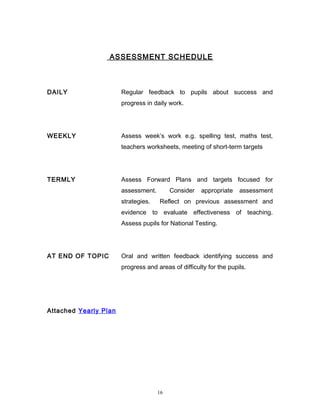
ASSESSMENT SCHEDULE

DAILY

Regular feedback to pupils about success and
progress in daily work.

WEEKLY

Assess week’s work e.g. spelling test, maths test,
teachers worksheets, meeting of short-term targets

TERMLY

Assess Forward Plans and targets focused for
assessment.
strategies.

Consider

appropriate

assessment

Reflect on previous assessment and

evidence to evaluate effectiveness of teaching.
Assess pupils for National Testing.

AT END OF TOPIC

Oral and written feedback identifying success and
progress and areas of difficulty for the pupils.

Attached Yearly Plan

16
17

Assessment, recording, reporting policy

  • 1.
    ASSESSMENT, RECORDING, REPORTINGPOLICY ( This is an interim policy – awaiting findings from authority working group on assessment) Rationale Assessment is the means of obtaining information, which allows teachers, pupils and parents to make judgements about pupil progress. The starting point for this is the curriculum and the processes of learning and teaching. Assessment is integral to the planning process and is a tool for reflection on programme construction and teaching. Assessment measures the success of learning, teaching and achievement and guides the next steps to be achieved. General This policy on assessment, recording and reporting is based on the existing Guidelines on Assessment 5-14 and on current good practice. This policy is based on the learning and teaching of pupils in the school and gives advice to each teacher and to parents on the ways in which information will be gathered about the success and progress of the pupil in relation to the curriculum and personal and social development. Assessment can be: • Formative – to indicate the effectiveness of teaching and learning • Diagnostic – to indicate strengths and weaknesses • Summative – for recording and reporting purposes • Informal – on-going for teacher and pupil information • Self and peer assessment Aims: To use assessment: • to recognise achievement and progression 1
  • 2.
    • to support learningand assist pupils to reach learning targets • to provide feedback to pupils, parents and other teachers • to promote high and realistic expectations for pupils • to provide information as a basis for monitoring and evaluating provision and attainment/achievement at school • to produce good evidence to inform decisions about next steps in learning Formative Assessment Formative assessment is probably the most important type of assessment for a class teacher as it should be fully integrated into the planning process. Formative assessment and the use to which it is put, is crucial to effective learning and teaching. It can help point the way to a reconsideration of the work pupil’s are being asked to do, the teaching approach or the pupils learning. It can identify areas of learning forgotten or misunderstood by the pupil, reveal unsuspected knowledge of skills, identify possible barriers and provide information on relevance, pace and interest of teaching for a learning group. Teachers should report on pupil’s progress and attainment across the curriculum using their professional judgement and the evidence available to them, and from their own continuous assessment. Assessment will improve the quality of learning and teaching if information gathered has a clear purpose, is collected systematically and is used appropriately. Assessment is an integral part of what teacher’s always do, planning, teaching, recording, reporting and evaluating. 1 PLANNING Knowing and sharing what is to be learned 2 TEACHING 5 EVALUATING 2
  • 3.
    Assessment as partof Using assessment to effective learning and teaching evaluate learning and teaching 3 RECORDING 4 REPORTING Summarising success and Providing useful Progress feedback Planning We need to take account of attainment outcomes, strands, targets in 5-14 Guidelines and our own school guidelines. In planning we need to consider the time allocation of areas to be taught as recommended in 5-14. We need to have a limited number of aims. Assessment should be incorporated and evident in our Forward Plans. We need to identify recent activities or developments important for new learning and we need to match tasks to pupil’s abilities and experience – we need to plan for groups and where appropriate individuals. We need to plan effective tasks and flexible teaching methods that maintain the correct balance across the curriculum. We should strive to design tasks that aid progress and are challenging, yet attainable. Teaching Teaching is the second stage of the assessment process and is based on the planning already done. It will provide evidence to allow recording, reporting and evaluating to take place. In teaching, staff should design tasks which are interesting, varied and challenging. Teachers should encourage a problemsolving approach and create an atmosphere which promotes the exploration of new ideas and activities. Teachers should evaluate evidence of pupils’ progress from previous work before moving on the next block of work. Teachers should use a variety of teaching and learning approaches to meet the needs of all pupils 3
  • 4.
    and match tasksto pupils’ abilities and experience. (See whole School Teaching for Learning Policy for advice). At the end of a teaching block, we need to identify strengths and weaknesses of a pupil’s/groups progress and record areas needing further development through our evaluations/next steps comment. This should include an assessment of our teaching and the impact this may have on the pupils future learning - e.g. Did we get our points across effectively? Was our lesson challenging and stimulating? Did we use the most appropriate teaching approach? Did we cater for the needs of all pupils? Recording Recording provides the platform from which teachers can base their reporting to others and is a mechanism for evaluating learning and teaching. Our teachers’ forward plans/programmes of study can serve a dual purpose as plans and records. Recording will enable teachers to share with pupils successful learning and identify development needs and next steps. It will monitor the effectiveness of teaching and pupils’ progress in relation to attainment outcomes and targets. It will enable teachers to report to parents, other teachers and other appropriate agencies. It will also inform the Head Teacher/School Board about attainment levels in classwork and in National Tests. Types of Record: Teaching records (as part of the forward plans)  A succinct account of teaching and learning aims  A brief indication of teaching methods used  An evaluative comment of how the class/groups have coped  A note of next steps Individual Records 4
  • 5.
     Folios/collections of work  Nationaltest results  Records of self-peer assessment  Indications of levels of achievement Summaries of overall class performance  An on-going record of the number of pupils working at each level in each main curricular area  Submission of national test results to the Head Teacher 3 times a year General Records of day-to-day progress will be kept by staff on a group/individual basis. At the senior end the pupils themselves can complete most of these sheets. Records of 5-14 attainment and individual National Test records should be kept by the teachers. Recording of evidence is also available in teacher’s weekly plans. Project folders should be kept and examples of work from this and other areas of the curriculum should be retained in the individual pupil’s folio of work. Guidelines on work to be included in folios form part of this document. Teachers should only note significant strengths and weaknesses in formal record sheet and indicate the need for longer-term action such as extension and reinforcement. Their strengths and weaknesses and areas for development will be reported to parents through school reports. Ways of recording Evidence can be:  recorded on tape, 5
  • 6.
     in folios ofpupil’s work;  brief notes in teachers’ jotters,  in teachers’ forward plans,  checklists, worksheets,  National Tests,  video recording (with parents permission) record sheets,  self/peer assessment sheets,  pupils’ reports. Folio folders should be reviewed regularly so they do not become too bulky and key items can be passed on from stage to stage with the pupil. Work for folios should contain work selected by the teacher/pupil. Teachers should ensure the work is dated and marked by the teacher in some way. What to record Teachers should record for each pupil only what is useful and relevant for planning next steps in learning and for reporting progress. This should include brief comments on progress in relation to specific teaching aims, particular strengths and development needs. It may include pupil’s approach to learning, their interests and information about personal and social development. Often informal anecdotal comments are useful also. When to record We should record at the end of a planned block of learning and teaching for example, in our forward planning evaluation section or as is required within the day-to-day running of the class. Teachers should update their individual/group pupils records termly. Recording should also take place prior to planned parental consultation or reports to parents. When pupils have covered work at an appropriate 5-14 level in reading, writing and maths and there is evidence of this, National tests should be carried out and results recorded. (See appendix 2 for Assessment schedule) 6
  • 7.
    Kinds of evidencewe can use:  Conversation with pupils/parents/teachers  Written evidence (pupil’s work)  Comments written on pupil’s work  Observation  Discussing targets/tasks with pupils  Oral questioning  Tasks set by teachers  Assessment/progress work built into schemes  Extension work – pupils able to apply knowledge/skills to new situations  Attainment in 5-14 targets (use of checklists)  Standardised test results  Cognitive Abilities Tests (C.A.T.) results  Co-operation in a project  Self/peer assessment (pupils should be encouraged to reflect on own work and compare performance against agreed criteria, eg self correction and conferencing after writing, self assessment sheet at end of ES topic, peer assessment in talking task)  Senior pupils can use same headings as Class Teacher in reports, and list what they consider their strengths and weaknesses to be  Ability to carry our practical activities An example of evidence through practical activities could be: (a) Can pupil make a start? (b) Can pupil apply their knowledge to task? (c) Can pupil choose appropriate materials (d) Can pupil report findings An example of evidence from writing could be (a) short responses – write a word/few words, answer to a question, filling in a table, chart, labeling a picture, diagram, completing statements. 7
  • 8.
    Extended writing –gives information on knowledge and attitudes – what they know, think, feel. Also gives information on use of language, e.g. vocabulary, sentence structure, organisation of ideas, etc. (See appendix 1 for examples of evidence to keep) Self/peer assessment The role of self/peer assessment has been identified as an important aspect of assessment. Pupils can self assess aspects of their work using agreed criteria, using a known code that indicates how they have performed or through meeting of individual targets. Pupils can also peer assess using criteria, codes and targets. Peer assessment is carried out in conferencing during North Lanark writing lessons. Peer assessment can be very valid as most pupils will value the judgement passed onto them by their classmates. The Role of National Testing National Testing will provide an additional and important source of evidence of pupil attainment in reading, writing and maths, in relation to nationally agreed and understood standards. Pupils will take a test in reading, writing or maths when teacher’s own assessment indicates that pupil has achieved the attainment targets at one level and is ready to move from that level. The tests will confirm or not, the teacher’s view that a pupil is ready for the next level of work. In most cases it is recommended that pupils be tested in groups, but in some cases this may be individuals. The teacher will review the evidence of attainment collected or recorded to identify if pupils/pupil are/is ready to be tested. The teacher will be required to be able to provide this evidence of attainment to the Head Teacher or to the parents to support the decision that a pupil is ready to be tested. Participation of pupils with a record of needs will be left to discretion of 8
  • 9.
    the Head Teacherin consultation with the class teacher and parents. Some pupils with specific needs may necessitate a scribe or addition time to complete tests. The class teacher will be responsible for the administering of and marking of the tests. (Learning Support team may also be involved). Learning Support members may also assist some pupils with tests, e.g. if reading is the problem in for example a maths test. Test results will be reported to parents with report sheets issued twice a year. The sitting of National Tests should be incorporated in forward planning by the teacher. We have an individual record sheet for each pupil which shows tests and levels sat and the date the level was achieved. These should be filled in and passed onto the next teacher. A separate record sheet of names, levels and results should be submitted to the Head Teacher for monitoring in December, March and June. It may be more suitable to establish a ‘testing time’ in a week which can be used for formal testing, eg during written mental test time, silent reading period where the atmosphere is conductive for concentration and the teacher is free to administer test to a group. The pupils could be set tasks that require little direct supervision. National Tests Papers Ordering and Storage of Tests: The class teachers will order the tests they require for their class for the year after October, on the contexts they would like. The Head Teacher, after collating the order, will order the tests and they will be stored in a unit in the Staff Room. Additional tests can be re-ordered throughout the year. Time Allocation for Tests 9
  • 10.
    The time limitfor most reading/maths tests is around 20-25 minutes but this is flexible to allow for the individual pupil’s needs. The time for writing is longer. (See guidelines on how to administer tests). Assessment and Support for Learning Where pupils are noticed to be having difficulty or failing, the Support for Learning teacher will initially observe in the classroom and if necessary follow up with more detailed or diagnostic assessment, to try and identify specific problems and recommend strategies, methods, resources to help. A differentiated curriculum may be all that is required. Formative and diagnostic assessment is carried out on a regular basis by the Support for Learning teacher. A Learning Support record is kept of pupils requiring specific needs and Individual Education Programmes are implemented. Learning Support can also be consulted on suitability of assessment tasks and on particular problems of assessing the work of pupils with Learning difficulties. Learning Support can also advise and provide differentiated assessment materials for all pupils, including the able. Reporting Reporting following assessment will contribute to communication and cooperation amongst teachers and parents. Reporting and compilation of pupil reports serves a number of purposes. They provide feedback to pupils, they inform parents of their child’s progress and provide and agenda for parents’ meetings, and they pass information from one teacher to another for from one school to another. Reporting to Pupils This can take the form of discussion, written comments on work, identifying areas of strengths and setting targets for areas needing to be worked on, encouraging any improvement or task well done (a simple sticker is very effective!), at the end 10
  • 11.
    of a topic/task,on the spot as part of the day-to-day teaching or when a target has been met. Reporting to Parents It is school policy to issue 2 written reports per year, one in November and one in May/June. The November report indicates progress made, 5-14 level achieved, comments on homework and behaviour and consideration for others. The May/June report includes aforementioned plus teachers comment, next steps and comments on how parents can help their child at home. Reporting to parents has 2 main elements: talking with parents and written reports. Reporting to Teachers This will take the form of passed on record sheets, pupil reports and informal discussions. Reporting to School Board The Head Teacher will provide information to the School Board about overall attainment in the school. Evaluating Assessment The teachers will evaluate the assessment in practice as part of a whole school activity but also as an individual teacher. They will evaluate termly, and organise assessment practices to be consistent with the curricular programme of a class, and on a day-to-day basis to relate to the needs of the class, groups or individuals. Evaluation by groups of staff at team/staff meeting will take place regularly in discussion with the Head Teacher. 11
  • 12.
    We will considerassessment within each curricular areas as we review policy in that area. In Collective Activity Time or In Service Days ,the teachers will share work and ideas on assessment and practice will be reviewed. Standards and assessment criteria, methods and materials will also be discussed to ensure consistency of approach throughout the school. This will be an on-going process. Assessment in Environmental Studies/Science Methods of assessment and skills/knowledge and understanding to be assessed are included in our termly forward plans. Suggestions for assessment in Environmental Studies: Pre-topic  Pre-topic assessment brainstorming - what do we know about the topic?  Questionnaires  Testing children on specific skills needed for project work End of topic assessment  Diary jottings of unstructured assessment  Structured assessment tasks  Project folders and pupil’s work  Pupil’s self assessment tasks  End of topic activity, e.g. oral/tape representation, practical activity where solving the problem depends on putting to use knowledge and skills developed in the topic, repetition of pre-topic tasks.  Quiz  Sequencing exercises Comments on project/personal project folders Positive comments on folders should take the form of: (a) general overall assessment, including comment on effort and enthusiasm (b) assessment of content including special mention of tasks well done 12
  • 13.
    (c) assessment of presentation,including organisation, illustrations, etc (d) some advice, if necessary, for the next project Pupil self assessment task Questions to be asked of pupils near end of the topic might be: (a) Write down 3 most important things you have learned about. (b) Which parts of the topic did you like best? Why? (c) Did you learn a lot, a little, not much? (d) Was there any part of the topic you found difficult? (e) Which assignments did you do best? (Provide list for ticking). (f) Which do you think you can improve? (g) Is there a part of a topic you would like to know more about? For assessment purposes particularly in Science and Technology, the teacher may look at the pupil’s ability to prepare for tasks, carry out tasks and review and report on tasks (see revised 5-14 documents for enquiry at different 5-14 levels). No teacher will be expected to assess every pupil individually on each aspect of every topic. We need to limit outcomes, differentiate the tasks and adjust criteria to suit the varying abilities of the pupils. Monitoring and review Assessment will be monitored and reviewed according to mechanisms set down in our school Quality Assurance, Monitoring and Review policy and as part of the cycle of School Development Planning. There are presently working groups both at local authority and National levels looking at assessment and this policy will be amended to take account of recommendations and advice. 13
  • 14.
    GUIDELINES ON EVIDENCETO KEEP FOR RECORD KEEPING AND ASSESSMENT Child’s Individual Folio – Samples of work to include: 1 Two pieces of Functional, Imaginative and Personal writing per term from P4P7 (drafts and re-drafts). P1-P3 to include handwriting examples (where appropriate) and 3 pieces of Functional, Imaginative and Personal per year. (This should include at least one piece of writing chosen by the pupil not just the teacher). 2 Maths/Number – assessment sheets (e.g. Graded Assessment Tests, Heinemann), teacher produced/published assessment activities/tests 3 Environmental Studies/Expressive Arts – can include artwork, scientific reports and examples of work showing involvement and understanding of topics and associated skills. 4 Any other significant pieces of work, e.g. self/peer assessment sheets, examples of Health, Religious Education or Personal, Social Development activities. This should be filed and dated and appropriate 5-14 levels should be written on it, where it is necessary. These files should be passed on from stage to stage with the pupil. 5 Any National Test sat. 14
  • 15.
    The following shouldbe kept in a separate record keeping/assessment folder held by the teacher and passed onto the next teacher at the end of the year or when moving school when these can be included in P.P.R.s: 1 Phonic Sheets (record) 2 Reading Record Sheets and Assessment Sheets 3 Nelson Spelling Check List (group) 4 Individual 5-14 Record Sheet in Maths and Language and Environmental Studies 5 Oracy Record Sheet 6 Environmental Studies Record Sheet (topics/areas covered) 7 National Testing results 8 Standardised/Cognitive Abilities tests results 9 Other teacher produced assessment sheets 10 Any tape recordings/video relevant to individuals/groups should be kept as forms of assessment where appropriate 11 Copy of pupil report (Master of all record sheets is kept in the main office.) 15
  • 16.
    ASSESSMENT SCHEDULE DAILY Regular feedbackto pupils about success and progress in daily work. WEEKLY Assess week’s work e.g. spelling test, maths test, teachers worksheets, meeting of short-term targets TERMLY Assess Forward Plans and targets focused for assessment. strategies. Consider appropriate assessment Reflect on previous assessment and evidence to evaluate effectiveness of teaching. Assess pupils for National Testing. AT END OF TOPIC Oral and written feedback identifying success and progress and areas of difficulty for the pupils. Attached Yearly Plan 16
  • 17.