 Instruction refers to the implementation
of the objectives. It is concerned with the
methodologies of the strategies of
teaching.
 1.) Supplantive Approach
 This is referred to as “direct” instruction. The
teacher attempts to promote learning by
providing explicit directions and explanations
regarding how to do a tank.
 With this approach, information is presented in
an ordered sequence in which component
subskills are taught directly or a foundation for
later task.
 Generative Approach
 This is referred to as “constructivist” or
“developmental”. The teacher functions as a
facilitator who takes a less central role in
learning process that is student-directed. The
teacher provide opportunities for the students
to make their own linkages to prior knowledge
and to device her mown strategies for work.
 With this approach, information is presented
on a schedule determined by students interest
and goals.
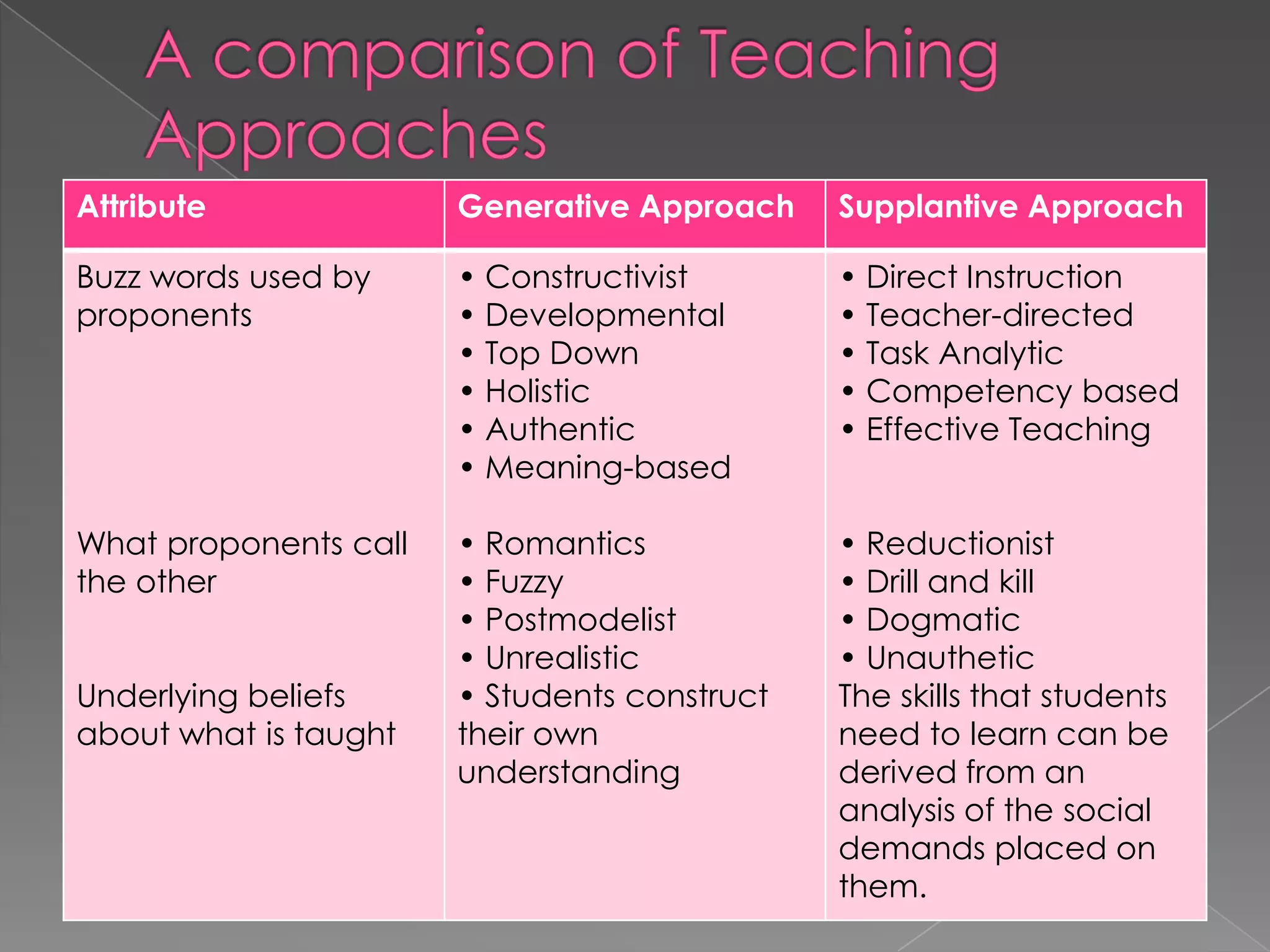
Attribute Generative Approach Supplantive Approach
Buzz words used by
proponents
What proponents call
the other
Underlying beliefs
about what is taught
• Constructivist
• Developmental
• Top Down
• Holistic
• Authentic
• Meaning-based
• Romantics
• Fuzzy
• Postmodelist
• Unrealistic
• Students construct
their own
understanding
• Direct Instruction
• Teacher-directed
• Task Analytic
• Competency based
• Effective Teaching
• Reductionist
• Drill and kill
• Dogmatic
• Unauthetic
The skills that students
need to learn can be
derived from an
analysis of the social
demands placed on
them.
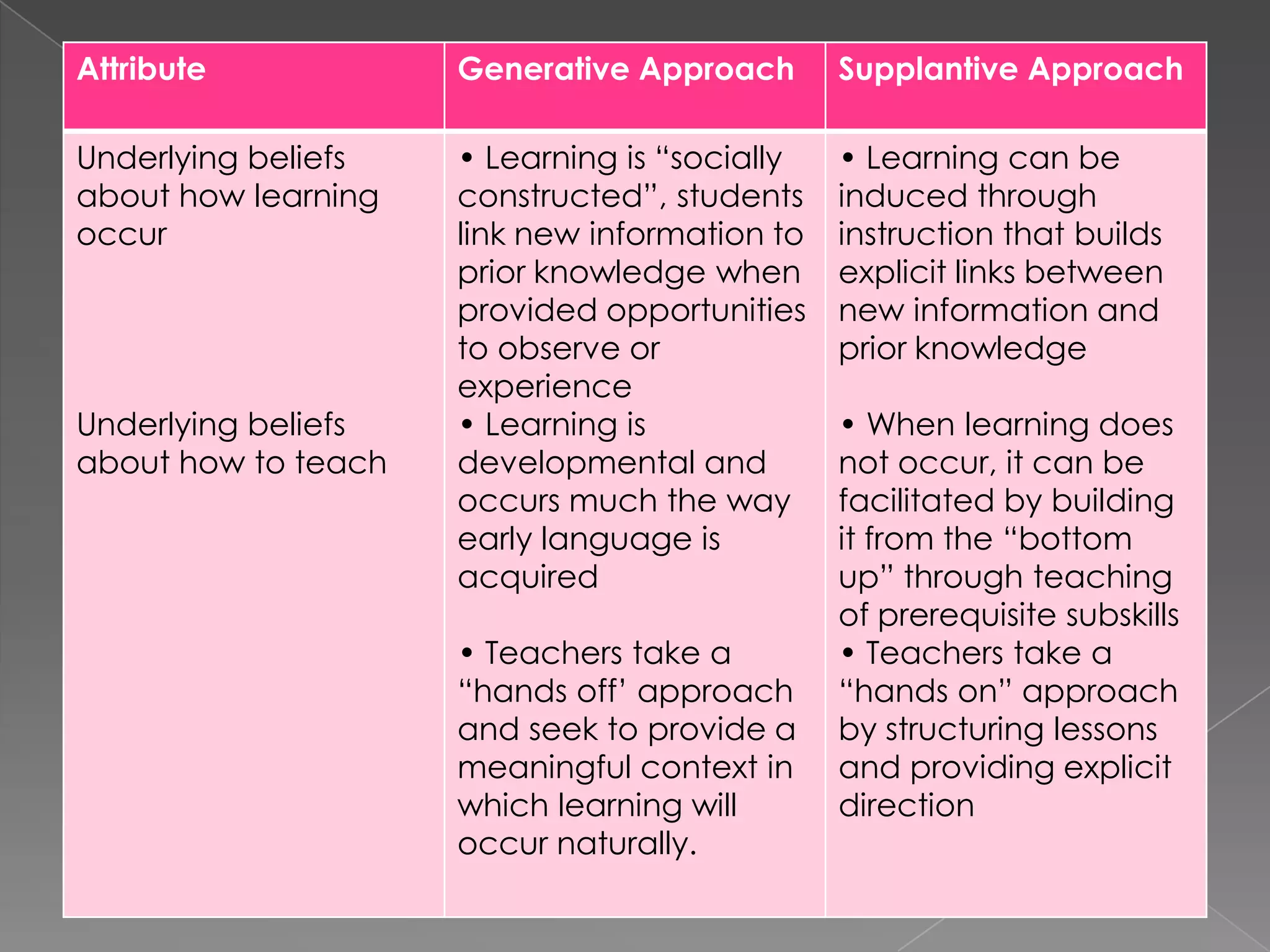
Attribute Generative Approach Supplantive Approach
Underlying beliefs
about how learning
occur
Underlying beliefs
about how to teach
• Learning is “socially
constructed”, students
link new information to
prior knowledge when
provided opportunities
to observe or
experience
• Learning is
developmental and
occurs much the way
early language is
acquired
• Teachers take a
“hands off’ approach
and seek to provide a
meaningful context in
which learning will
occur naturally.
• Learning can be
induced through
instruction that builds
explicit links between
new information and
prior knowledge
• When learning does
not occur, it can be
facilitated by building
it from the “bottom
up” through teaching
of prerequisite subskills
• Teachers take a
“hands on” approach
by structuring lessons
and providing explicit
direction
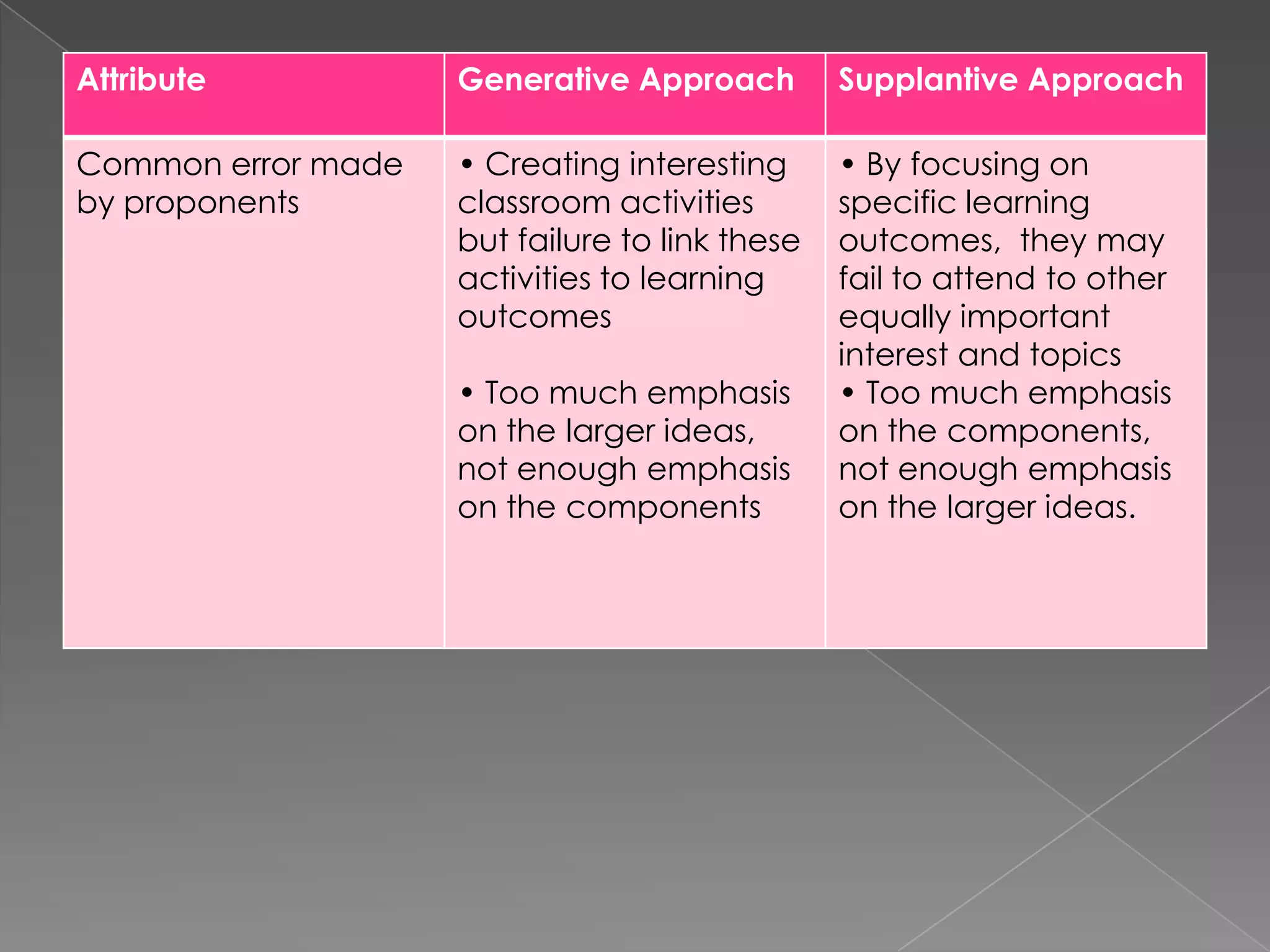
Attribute Generative Approach Supplantive Approach
Common error made
by proponents
• Creating interesting
classroom activities
but failure to link these
activities to learning
outcomes
• Too much emphasis
on the larger ideas,
not enough emphasis
on the components
• By focusing on
specific learning
outcomes, they may
fail to attend to other
equally important
interest and topics
• Too much emphasis
on the components,
not enough emphasis
on the larger ideas.
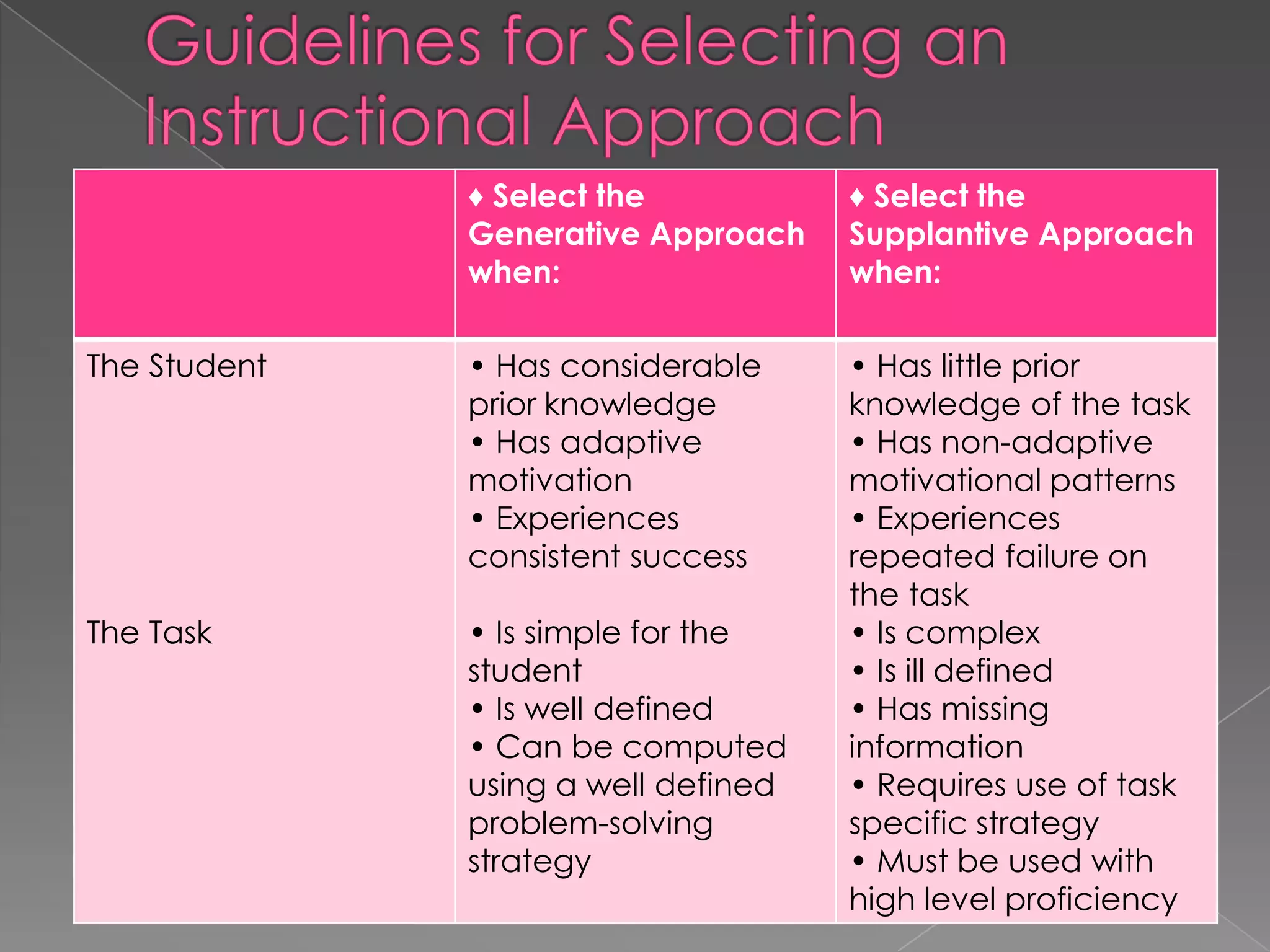
♦ Select the
Generative Approach
when:
♦ Select the
Supplantive Approach
when:
The Student
The Task
• Has considerable
prior knowledge
• Has adaptive
motivation
• Experiences
consistent success
• Is simple for the
student
• Is well defined
• Can be computed
using a well defined
problem-solving
strategy
• Has little prior
knowledge of the task
• Has non-adaptive
motivational patterns
• Experiences
repeated failure on
the task
• Is complex
• Is ill defined
• Has missing
information
• Requires use of task
specific strategy
• Must be used with
high level proficiency
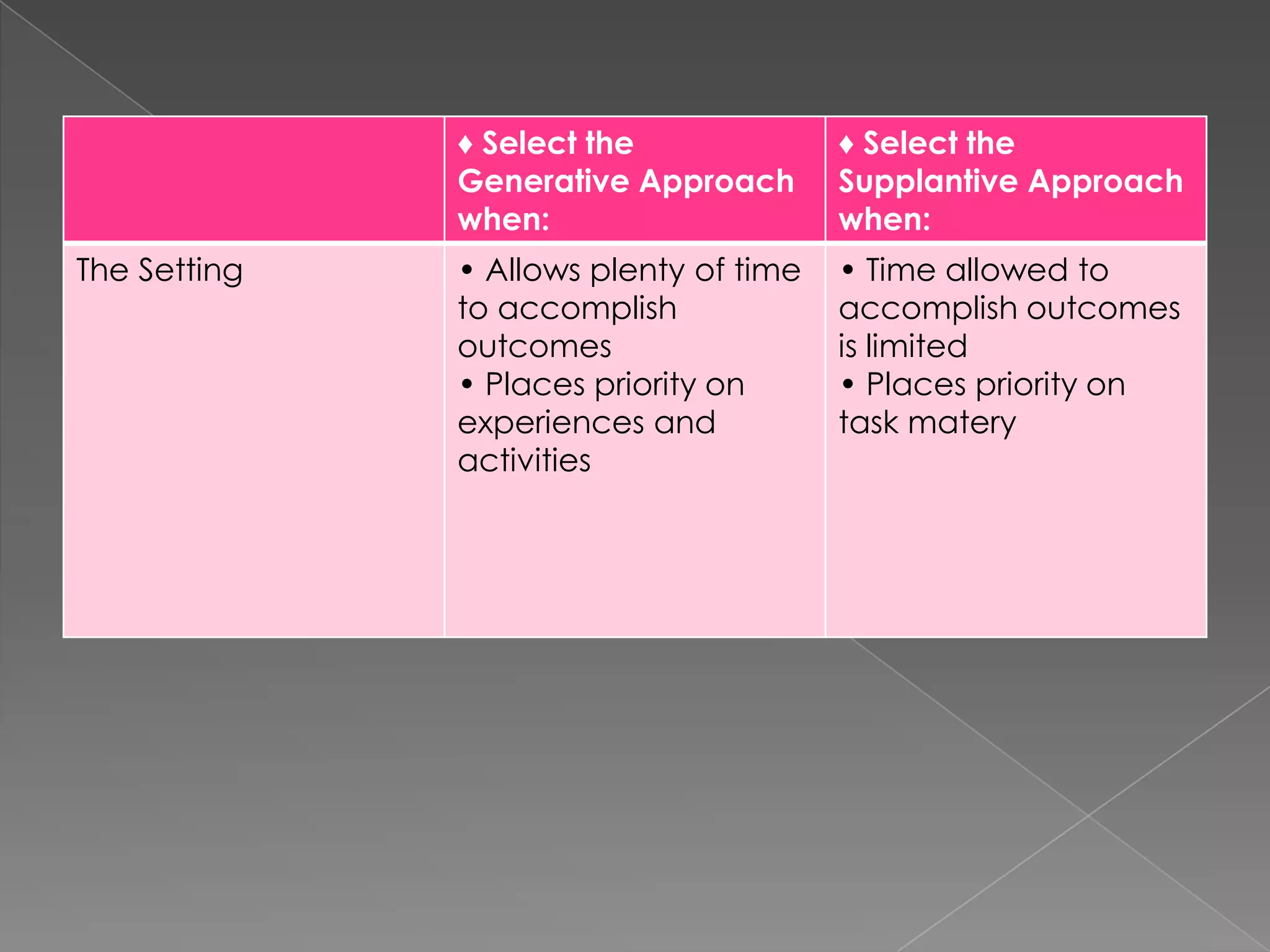
♦ Select the
Generative Approach
when:
♦ Select the
Supplantive Approach
when:
The Setting • Allows plenty of time
to accomplish
outcomes
• Places priority on
experiences and
activities
• Time allowed to
accomplish outcomes
is limited
• Places priority on
task matery

Criteria for assessment instruction

  • 1.
     Instruction refersto the implementation of the objectives. It is concerned with the methodologies of the strategies of teaching.
  • 2.
     1.) SupplantiveApproach  This is referred to as “direct” instruction. The teacher attempts to promote learning by providing explicit directions and explanations regarding how to do a tank.  With this approach, information is presented in an ordered sequence in which component subskills are taught directly or a foundation for later task.
  • 3.
     Generative Approach This is referred to as “constructivist” or “developmental”. The teacher functions as a facilitator who takes a less central role in learning process that is student-directed. The teacher provide opportunities for the students to make their own linkages to prior knowledge and to device her mown strategies for work.  With this approach, information is presented on a schedule determined by students interest and goals.
  • 4.
    Attribute Generative ApproachSupplantive Approach Buzz words used by proponents What proponents call the other Underlying beliefs about what is taught • Constructivist • Developmental • Top Down • Holistic • Authentic • Meaning-based • Romantics • Fuzzy • Postmodelist • Unrealistic • Students construct their own understanding • Direct Instruction • Teacher-directed • Task Analytic • Competency based • Effective Teaching • Reductionist • Drill and kill • Dogmatic • Unauthetic The skills that students need to learn can be derived from an analysis of the social demands placed on them.
  • 5.
    Attribute Generative ApproachSupplantive Approach Underlying beliefs about how learning occur Underlying beliefs about how to teach • Learning is “socially constructed”, students link new information to prior knowledge when provided opportunities to observe or experience • Learning is developmental and occurs much the way early language is acquired • Teachers take a “hands off’ approach and seek to provide a meaningful context in which learning will occur naturally. • Learning can be induced through instruction that builds explicit links between new information and prior knowledge • When learning does not occur, it can be facilitated by building it from the “bottom up” through teaching of prerequisite subskills • Teachers take a “hands on” approach by structuring lessons and providing explicit direction
  • 6.
    Attribute Generative ApproachSupplantive Approach Common error made by proponents • Creating interesting classroom activities but failure to link these activities to learning outcomes • Too much emphasis on the larger ideas, not enough emphasis on the components • By focusing on specific learning outcomes, they may fail to attend to other equally important interest and topics • Too much emphasis on the components, not enough emphasis on the larger ideas.
  • 7.
    ♦ Select the GenerativeApproach when: ♦ Select the Supplantive Approach when: The Student The Task • Has considerable prior knowledge • Has adaptive motivation • Experiences consistent success • Is simple for the student • Is well defined • Can be computed using a well defined problem-solving strategy • Has little prior knowledge of the task • Has non-adaptive motivational patterns • Experiences repeated failure on the task • Is complex • Is ill defined • Has missing information • Requires use of task specific strategy • Must be used with high level proficiency
  • 8.
    ♦ Select the GenerativeApproach when: ♦ Select the Supplantive Approach when: The Setting • Allows plenty of time to accomplish outcomes • Places priority on experiences and activities • Time allowed to accomplish outcomes is limited • Places priority on task matery