OTL:NGP:EA:1217
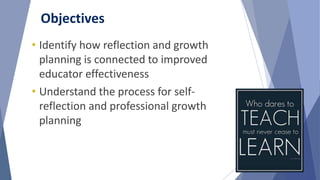
• Identify how reflection and growth
planning is connected to improved
educator effectiveness
• Understand the process for self-
reflection and professional growth
planning
Objectives
 A process by which certified personnel assess the
effectiveness and adequacy of their professional
knowledge and performance for the purpose of
identifying areas for professional learning and growth
Self-Reflection
An individualized plan that is:
 focused on improving professional practice
and leadership skills
 aligned with educator and student
performance standards
 built using a variety of sources such as
student data, educator data, and
school/district data
 produced in consultation with the evaluator
Professional Growth Plan
“Advocates of professional
development for teachers are not
arguing that teaching is of poor quality
and must be fixed. Their advocacy for
professional development for teachers
reflects the recognition that teaching
is so hard that it is never perfect; no
matter how good a lesson is, it could
always be improved.”
Danielson, Talk About Teaching (2009).
Effective teachers may reflect on their work
formally or informally; for example they may
review a day’s work mentally, keep a journal,
meet regularly with a mentor or with
colleagues, or assess a videotaped recording
of their teaching.
Good & Brophy, 1997; NBPTS, n.d.
Connecting Self-Reflection to
Effective Teaching
When teachers use data to reflect on
what worked, what did not work, and
what types of changes they might make
to be more successful, the likelihood of
knowing how to improve increases
dramatically.
Airason & Gullickson, 2006; Tucker, Stronge,
& Gareis, 2002.
Connecting Self-Reflection to
Effective Teaching (continued)
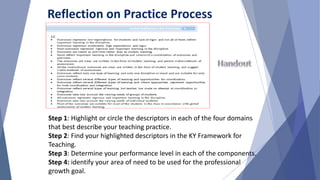
Step 1: Highlight or circle the descriptors in each of the four domains
that best describe your teaching practice.
Step 2: Find your highlighted descriptors in the KY Framework for
Teaching.
Step 3: Determine your performance level in each of the components.
Step 4: identify your area of need to be used for the professional
growth goal.
Reflection on Practice Process
Initial
Reflection
on
Practice
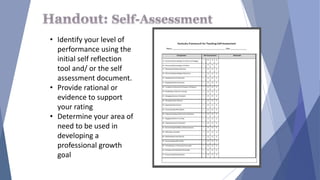
• Identify your level of
performance using the
initial self reflection
tool and/ or the self
assessment document.
• Provide rational or
evidence to support
your rating
• Determine your area of
need to be used in
developing a
professional growth
goal
 Content standards and skills
 Student Voice results
 Professional Learning experiences
 Recent developments in pedagogical research
 An unfamiliar instructional approach
 Demographic changes
 Student Work
 Student engagement during a recent lesson
Places for Self-Reflection
Answer the following to develop a PG goal:
1. What do I want to change about my practice that
will effectively impact student learning?
2. How can I develop a plan of action to address my
professional learning?
3. How will I know if I accomplished my objective?
*You should be able to articulate what sources of
evidence are informing your decisions when writing
your goal.*
Goal setting for Professional Growth
 Reflection on Kentucky Framework for
Teaching (KyFfT)
 Student growth goal
 Content standards and content-specific skills
 Student Voice results
 Reflection on instructional practice and
student outcomes
 Other sources identified in the district CEP
Considerations for professional
growth planning
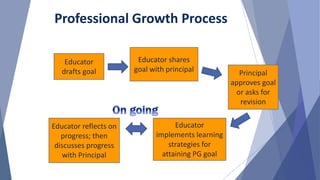
Educator reflects on
progress; then
discusses progress
with Principal
Educator
implements learning
strategies for
attaining PG goal
Principal
approves goal
or asks for
revision
Educator shares
goal with principal
Educator
drafts goal
Professional Growth Process
Any content area –
Area of focus/ growth need: formative assessment
During this school year, I want to embed formative
assessment practices in my daily instruction. I will study
Classroom Assessment for Student Learning, by Rick
Stiggins, with my PLC team and begin to implement
Keys to Quality Assessments. Indicators of success will
include: lesson/unit plans with CASL elements
(formative assessment cycle, learning targets, students
monitoring their own learning); observational data;
reflections after implementation; student data review
and future instruction plans devised during PLC
meetings.
Sample Professional Growth Goal
Any content area –
Focus area/ growth need: questioning &
discussion techniques
During the school year, I will improve my
questioning and discussion techniques. I will
incorporate the Q-Chart for daily classroom
discussions so that students can take ownership of
classroom conversations. I will read and implement
strategies from Classroom Discussions. Growth will
be evidenced through lesson/unit plans that
include strategies from the text, observational data,
self-reflection after implementation, and student
reflections after Socratic Seminars.
Sample Professional Growth Goal
(continued)
Writing a Professional Growth Goal
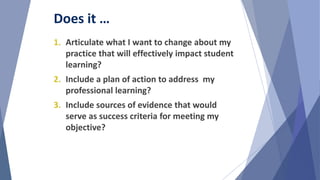
1. Articulate what I want to change about my
practice that will effectively impact student
learning?
2. Include a plan of action to address my
professional learning?
3. Include sources of evidence that would
serve as success criteria for meeting my
objective?
Does it …
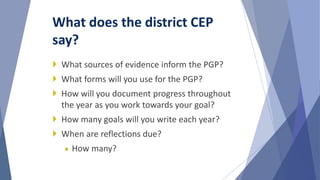
 What sources of evidence inform the PGP?
 What forms will you use for the PGP?
 How will you document progress throughout
the year as you work towards your goal?
 How many goals will you write each year?
 When are reflections due?
● How many?
What does the district CEP
say?
 Are you consistently
implementing the action plan as
agreed in collaboration with your
principal?
Implement PGP and Action Plan
 Are you consistently using
multiple data sources to
reflect on your professional
growth goal(s) status?
Regularly Reflect on PGP Progress
Questions? Contact:
Christine Meisberger
Manager, Teacher and Leader Effectiveness Branch
502-564-1479 ext. 4510
Christine.Meisberger@education.ky.gov

Self Reflection and Professional Growth Planning.pptx

  • 1.
  • 2.
    • Identify howreflection and growth planning is connected to improved educator effectiveness • Understand the process for self- reflection and professional growth planning Objectives
  • 3.
     A processby which certified personnel assess the effectiveness and adequacy of their professional knowledge and performance for the purpose of identifying areas for professional learning and growth Self-Reflection
  • 4.
    An individualized planthat is:  focused on improving professional practice and leadership skills  aligned with educator and student performance standards  built using a variety of sources such as student data, educator data, and school/district data  produced in consultation with the evaluator Professional Growth Plan
  • 5.
    “Advocates of professional developmentfor teachers are not arguing that teaching is of poor quality and must be fixed. Their advocacy for professional development for teachers reflects the recognition that teaching is so hard that it is never perfect; no matter how good a lesson is, it could always be improved.” Danielson, Talk About Teaching (2009).
  • 6.
    Effective teachers mayreflect on their work formally or informally; for example they may review a day’s work mentally, keep a journal, meet regularly with a mentor or with colleagues, or assess a videotaped recording of their teaching. Good & Brophy, 1997; NBPTS, n.d. Connecting Self-Reflection to Effective Teaching
  • 7.
    When teachers usedata to reflect on what worked, what did not work, and what types of changes they might make to be more successful, the likelihood of knowing how to improve increases dramatically. Airason & Gullickson, 2006; Tucker, Stronge, & Gareis, 2002. Connecting Self-Reflection to Effective Teaching (continued)
  • 10.
    Step 1: Highlightor circle the descriptors in each of the four domains that best describe your teaching practice. Step 2: Find your highlighted descriptors in the KY Framework for Teaching. Step 3: Determine your performance level in each of the components. Step 4: identify your area of need to be used for the professional growth goal. Reflection on Practice Process
  • 11.
  • 12.
    • Identify yourlevel of performance using the initial self reflection tool and/ or the self assessment document. • Provide rational or evidence to support your rating • Determine your area of need to be used in developing a professional growth goal
  • 13.
     Content standardsand skills  Student Voice results  Professional Learning experiences  Recent developments in pedagogical research  An unfamiliar instructional approach  Demographic changes  Student Work  Student engagement during a recent lesson Places for Self-Reflection
  • 14.
    Answer the followingto develop a PG goal: 1. What do I want to change about my practice that will effectively impact student learning? 2. How can I develop a plan of action to address my professional learning? 3. How will I know if I accomplished my objective? *You should be able to articulate what sources of evidence are informing your decisions when writing your goal.* Goal setting for Professional Growth
  • 15.
     Reflection onKentucky Framework for Teaching (KyFfT)  Student growth goal  Content standards and content-specific skills  Student Voice results  Reflection on instructional practice and student outcomes  Other sources identified in the district CEP Considerations for professional growth planning
  • 16.
    Educator reflects on progress;then discusses progress with Principal Educator implements learning strategies for attaining PG goal Principal approves goal or asks for revision Educator shares goal with principal Educator drafts goal Professional Growth Process
  • 17.
    Any content area– Area of focus/ growth need: formative assessment During this school year, I want to embed formative assessment practices in my daily instruction. I will study Classroom Assessment for Student Learning, by Rick Stiggins, with my PLC team and begin to implement Keys to Quality Assessments. Indicators of success will include: lesson/unit plans with CASL elements (formative assessment cycle, learning targets, students monitoring their own learning); observational data; reflections after implementation; student data review and future instruction plans devised during PLC meetings. Sample Professional Growth Goal
  • 18.
    Any content area– Focus area/ growth need: questioning & discussion techniques During the school year, I will improve my questioning and discussion techniques. I will incorporate the Q-Chart for daily classroom discussions so that students can take ownership of classroom conversations. I will read and implement strategies from Classroom Discussions. Growth will be evidenced through lesson/unit plans that include strategies from the text, observational data, self-reflection after implementation, and student reflections after Socratic Seminars. Sample Professional Growth Goal (continued)
  • 19.
  • 20.
    1. Articulate whatI want to change about my practice that will effectively impact student learning? 2. Include a plan of action to address my professional learning? 3. Include sources of evidence that would serve as success criteria for meeting my objective? Does it …
  • 21.
     What sourcesof evidence inform the PGP?  What forms will you use for the PGP?  How will you document progress throughout the year as you work towards your goal?  How many goals will you write each year?  When are reflections due? ● How many? What does the district CEP say?
  • 22.
     Are youconsistently implementing the action plan as agreed in collaboration with your principal? Implement PGP and Action Plan
  • 23.
     Are youconsistently using multiple data sources to reflect on your professional growth goal(s) status? Regularly Reflect on PGP Progress
  • 24.
    Questions? Contact: Christine Meisberger Manager,Teacher and Leader Effectiveness Branch 502-564-1479 ext. 4510 Christine.Meisberger@education.ky.gov

Editor's Notes

  • #4 Discuss informal ways educators reflect on their professional practice.
  • #6 Advocates of professional development for teachers are not arguing that teaching is of poor quality and must be fixed. Their advocacy for professional development for teachers reflects the recognition that teaching is so hard that it is never perfect; no matter how good a lesson is, it could always be improved. ( Danielson, Talk About Teaching (2009).
  • #7 Reflection may be formal or informal as it is integrated into every aspect of a teacher’s professional life.
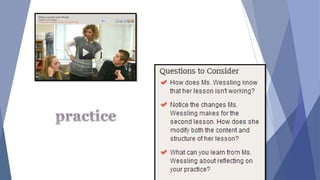
  • #9 What can you learn from this teacher about reflecting on your practice? https://www.teachingchannel.org/videos/when-lesson-plans-fail Video is 16 minutes
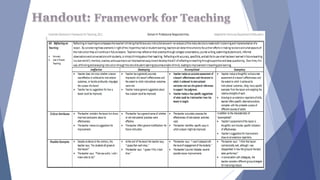
  • #10 Handout needed: framework for teaching. Ask participants to turn to domain 4 of the FfT. Point out components 4A and 4E specifically address reflection and professional growth. (Note: Charlotte Danielson uses the term “reflective practice” instead of self-reflection. ). Have participants read through these two components and the performance levels associated with each. 4.A explicitly addresses reflection on a lesson 4.E explicitly addresses growing and developing professionally Review this sample of component 4A: Reflecting on Teaching: this component encompasses the teacher’s thinking that follows any instructional event-an analysis of the many decisions made both in planning and implementation of a lesson. By considering these three elements (accuracy, use in future, and teaching), in light of the impact they had on student learning, teachers can determine where to focus their efforts in making revisions. Over time, this way of thinking and analyzing instruction through the lens of student learning becomes a habit of mind, leading to improvements in teaching and learning.
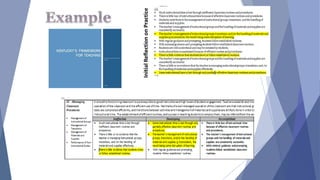
  • #11 Using the Initial Reflection on Practice document, an educator reflects on their teaching choosing the descriptors that best describe their teaching practices.
  • #12 After a teacher has chosen the descriptors that best describe their teaching practice, they then refer to the KY Framework for Teaching and find the descriptors within the performance levels. Using this process, a teacher determines their performance level in each of the components in the framework. It is this data that helps determine the professional growth need. Educators record their self reflection ratings on the self assessment document.
  • #13 As a group or individually, complete the self assessment and determine the main area of need for the professional growth goal
  • #14 As content standards are evolving, teachers may want to self-assess their knowledge of content and content-specific skills. Additionally, instructional strategies that support Kentucky’s Academic Standards (KAS) such as LDC and MDC may be new to some teachers; however, self-reflection of practice might focus on instructional approaches.
  • #15 After reflection, teachers consider these three questions to help write their professional growth goal (PGG). The PGG is produced by a teacher in consultation with a principal or PLC.
  • #16 Before an educator writes their professional growth goal, they would certainly reflect on their teaching performance using the Kentucky Framework for Teaching. However, teachers can consider other information as they make decisions about their professional growth. Using sources such as student voice, or observation notes, or student growth progress or goals can help inform the professional growth need. All or any of these can be considered as a teacher decides his or her professional growth goal.
  • #18 Notice how the goal addresses all three questions even if briefly. A teacher will decide the learning that will help him or her attain the goal.
  • #19 Notice how the goal addresses all three questions even if briefly. A teacher will decide the learning that will help him or her attain the goal.
  • #23 Our past experiences with Professional Growth Planning has taught us that the action plan must be consistently implemented as agreed upon during the collaboration between principal and teacher. Teacher reflects on each phase of implementation making adjustments and revisions as needed.
  • #24 As the teacher reviews, analyzes and reflects upon student work samples, test data and naturally occurring data generated in teaching and learning, she/he monitors his/her progress towards goal(s) and determining their goal status.