ACRYLIC FIBER
Md Joynul Abedin
Textile 28th batch
Daffodil International University
joynula98@gmail.com
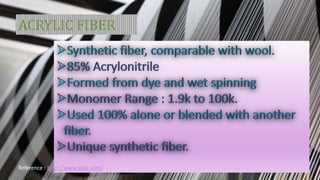
ACRYLIC FIBER
Reference : http://www.aksa.com/
HISTORY
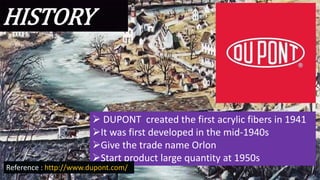
 DUPONT created the first acrylic fibers in 1941
It was first developed in the mid-1940s
Give the trade name Orlon
Start product large quantity at 1950s
Reference : http://www.dupont.com/
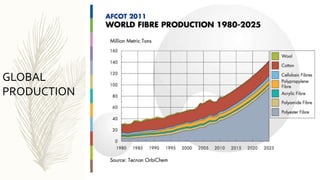
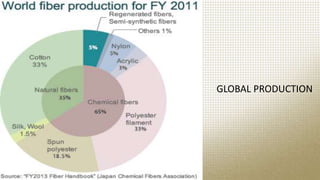
GLOBAL
PRODUCTION
GLOBAL PRODUCTION
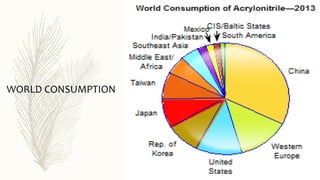
WORLD CONSUMPTION
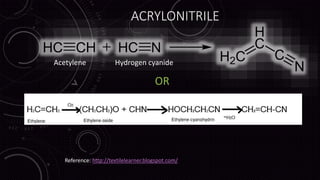
ACRYLONITRILE
Acetylene Hydrogen cyanide
OR
Reference: http://textilelearner.blogspot.com/
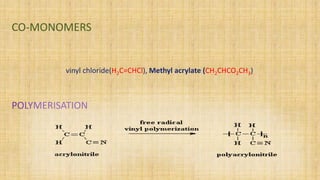
CO-MONOMERS
POLYMERISATION
vinyl chloride(H2C=CHCl), Methyl acrylate (CH2CHCO2CH3)
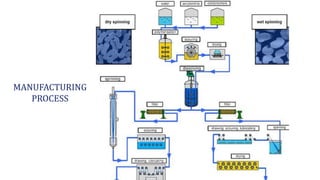
MANUFACTURING
PROCESS
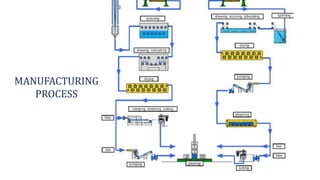
MANUFACTURING
PROCESS
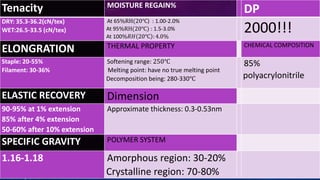
Tenacity MOISTURE REGAIN%
DP
DRY: 35.3-36.2(cN/tex)
WET:26.5-33.5 (cN/tex)
At 65%RH(20℃) : 1.00-2.0%
At 95%RH(20℃) : 1.5-3.0%
At 100%𝑅𝐻 20℃ : 4.0%
2000!!!
ELONGRATION THERMAL PROPERTY CHEMICAL COMPOSITION
Staple: 20-55%
Filament: 30-36%
Softening range: 250℃
Melting point: have no true melting point
Decomposition being: 280-330℃
85%
polyacrylonitrile
ELASTIC RECOVERY Dimension
90-95% at 1% extension
85% after 4% extension
50-60% after 10% extension
Approximate thickness: 0.3-0.53nm
SPECIFIC GRAVITY POLYMER SYSTEM
1.16-1.18 Amorphous region: 30-20%
Crystalline region: 70-80%
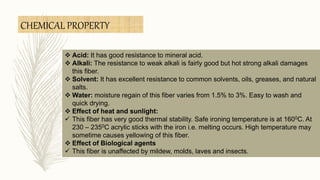
 Acid: It has good resistance to mineral acid.
 Alkali: The resistance to weak alkali is fairly good but hot strong alkali damages
this fiber.
 Solvent: It has excellent resistance to common solvents, oils, greases, and natural
salts.
 Water: moisture regain of this fiber varies from 1.5% to 3%. Easy to wash and
quick drying.
 Effect of heat and sunlight:
 This fiber has very good thermal stability. Safe ironing temperature is at 1600C. At
230 – 2350C acrylic sticks with the iron i.e. melting occurs. High temperature may
sometime causes yellowing of this fiber.
 Effect of Biological agents
 This fiber is unaffected by mildew, molds, laves and insects.
CHEMICAL PROPERTY
Acrylic Fiber Characteristics
1. Lighter than wool fibers, and fabric hand with
bulkiness.
2. Superior in warm retention, light and warm.
3. Superior in elastic recovery, and resistant to
crease.
4. Excellent in color development and can be dyed
in desired color.
5. Little affected by sunlight.
6. Resistant to chemicals and cannot be attacked
by molds and insects.
7. Thermoplastic
End use
• [FOR CLOTHING]
Sweaters,Women's and Children'sWear, Sports Wear, Socks,
Knitted Underwear, Pajamas, Gloves, etc
• [FOR HOME FURNISHINGS AND BEDDING]
Carpets, AVariety of Rugs, Upholstery, Cushions, Blankets,
Pile Sheets, etc.
• [FOR INDUSTRIAL USES]
Felts for Paper Making, Filter Cloth, AlternativeAsbestos,
Tents, Sheet, etc.
• [FOR OTHER USES]
Rag Doll,Toys, AuxiliaryTapes for Bags, Braids, Cloth for Bags,
Acrylic Fiber

Acrylic Fiber

  • 1.
    ACRYLIC FIBER Md JoynulAbedin Textile 28th batch Daffodil International University joynula98@gmail.com
  • 3.
    ACRYLIC FIBER Reference :http://www.aksa.com/
  • 4.
    HISTORY  DUPONT createdthe first acrylic fibers in 1941 It was first developed in the mid-1940s Give the trade name Orlon Start product large quantity at 1950s Reference : http://www.dupont.com/
  • 5.
  • 6.
  • 7.
  • 8.
    ACRYLONITRILE Acetylene Hydrogen cyanide OR Reference:http://textilelearner.blogspot.com/
  • 9.
  • 10.
  • 11.
  • 12.
    Tenacity MOISTURE REGAIN% DP DRY:35.3-36.2(cN/tex) WET:26.5-33.5 (cN/tex) At 65%RH(20℃) : 1.00-2.0% At 95%RH(20℃) : 1.5-3.0% At 100%𝑅𝐻 20℃ : 4.0% 2000!!! ELONGRATION THERMAL PROPERTY CHEMICAL COMPOSITION Staple: 20-55% Filament: 30-36% Softening range: 250℃ Melting point: have no true melting point Decomposition being: 280-330℃ 85% polyacrylonitrile ELASTIC RECOVERY Dimension 90-95% at 1% extension 85% after 4% extension 50-60% after 10% extension Approximate thickness: 0.3-0.53nm SPECIFIC GRAVITY POLYMER SYSTEM 1.16-1.18 Amorphous region: 30-20% Crystalline region: 70-80%
  • 13.
     Acid: Ithas good resistance to mineral acid.  Alkali: The resistance to weak alkali is fairly good but hot strong alkali damages this fiber.  Solvent: It has excellent resistance to common solvents, oils, greases, and natural salts.  Water: moisture regain of this fiber varies from 1.5% to 3%. Easy to wash and quick drying.  Effect of heat and sunlight:  This fiber has very good thermal stability. Safe ironing temperature is at 1600C. At 230 – 2350C acrylic sticks with the iron i.e. melting occurs. High temperature may sometime causes yellowing of this fiber.  Effect of Biological agents  This fiber is unaffected by mildew, molds, laves and insects. CHEMICAL PROPERTY
  • 14.
    Acrylic Fiber Characteristics 1.Lighter than wool fibers, and fabric hand with bulkiness. 2. Superior in warm retention, light and warm. 3. Superior in elastic recovery, and resistant to crease. 4. Excellent in color development and can be dyed in desired color. 5. Little affected by sunlight. 6. Resistant to chemicals and cannot be attacked by molds and insects. 7. Thermoplastic
  • 15.
    End use • [FORCLOTHING] Sweaters,Women's and Children'sWear, Sports Wear, Socks, Knitted Underwear, Pajamas, Gloves, etc • [FOR HOME FURNISHINGS AND BEDDING] Carpets, AVariety of Rugs, Upholstery, Cushions, Blankets, Pile Sheets, etc. • [FOR INDUSTRIAL USES] Felts for Paper Making, Filter Cloth, AlternativeAsbestos, Tents, Sheet, etc. • [FOR OTHER USES] Rag Doll,Toys, AuxiliaryTapes for Bags, Braids, Cloth for Bags,