Gel Spinning
1
Presentation by:
Manish Kumar(15MT20)
Dept. of Metallurgical and Materials Engineering
2INDEX:
 Spinning
 Basic terms
 Types of spinning
 What is Gel ?
 Gel Spinning
 Concept of Gel Spinning
 Gel Spinning process
 Difference between Gel Spinning, Wet Spinning and Dry Spinning
 Factors affecting Gel Spinning
 Gel Spinning Process for Polyethylene
 Spinning of UHMWPE fibre
 Structure and properties of Gel Fibre
 Applications of Gel spun fibres
 Spinning:
“Spinning is the process of converting fibres into yarn”.
Or
“The process of extrusion & solidification of endless filament”.
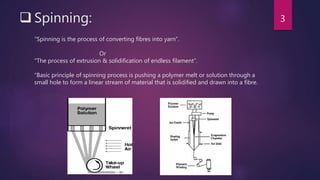
“Basic principle of spinning process is pushing a polymer melt or solution through a
small hole to form a linear stream of material that is solidified and drawn into a fibre.
3
 Basic terms……
a) Spinneret:- A nozzle or plate provided with fine holes through which a fibre
forming solution or melt is extruded in fibre manufacture is called spinneret. It work
as a principle, to a bathroom shower head.
4
b). Extrusion:- Extrusion is a forcing or pumping the spinning solution through the tiny
holes of a spinneret.
5
c) Method of spinning:- General steps……..
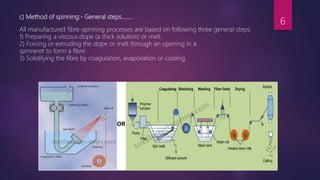
All manufactured fibre-spinning processes are based on following three general steps:
1) Preparing a viscous dope (a thick solution) or melt.
2) Forcing or extruding the dope or melt through an opening in a
spinneret to form a fibre.
3) Solidifying the fibre by coagulation, evaporation or cooling.
6
d) Types of Spinning methods:-
There are generally four spinning methods of producing synthetic filaments that are,
1) Melt spinning
2) Dry spinning
3) Wet spinning
4) Gel spinning
7
What is Gel ? 8
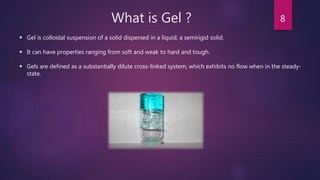
 Gel is colloidal suspension of a solid dispersed in a liquid; a semirigid solid.
 It can have properties ranging from soft and weak to hard and tough.
 Gels are defined as a substantially dilute cross-linked system, which exhibits no flow when in the steady-
state.
Gel Spinning 9
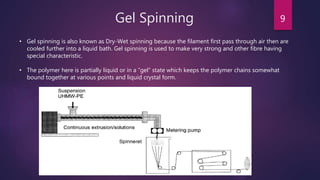
• Gel spinning is also known as Dry-Wet spinning because the filament first pass through air then are
cooled further into a liquid bath. Gel spinning is used to make very strong and other fibre having
special characteristic.
• The polymer here is partially liquid or in a “gel” state which keeps the polymer chains somewhat
bound together at various points and liquid crystal form.
Gel Spinning 10
In gel spinning process, the polymer solution is prepared at temperature and conditions where it is flowable and
is extruded to conditions where it forms a gel structure.
This allows the individual molecular chains to connect optimally with each other, and on coagulation, form a
network structure which is able to undergo very high draw ratios to give fibre with high tensile strength and
modulus.
In case of polyethylene the ultra-drawing can be applied as the crystallization during drawing does not prevent
drawability due to weak interactions between polymer chains.
Concept of Gel Spinning
11
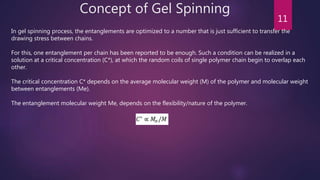
In gel spinning process, the entanglements are optimized to a number that is just sufficient to transfer the
drawing stress between chains.
For this, one entanglement per chain has been reported to be enough. Such a condition can be realized in a
solution at a critical concentration (C*), at which the random coils of single polymer chain begin to overlap each
other.
The critical concentration C* depends on the average molecular weight (M) of the polymer and molecular weight
between entanglements (Me).
The entanglement molecular weight Me, depends on the flexibility/nature of the polymer.
Concept of Gel Spinning
12
the maximum attainable draw ratio can be predicted from the following relation:
where c is a material constant
the maximum attainable draw ratio increases with the molecular weight (M) of the
polymer(Ideal Condition)
if we consider the drawing of a single molecule from its random coiled state
Concept of Gel Spinning
13
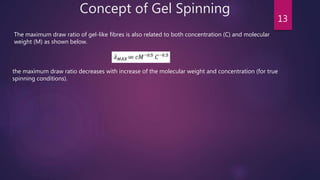
The maximum draw ratio of gel-like fibres is also related to both concentration (C) and molecular
weight (M) as shown below.
the maximum draw ratio decreases with increase of the molecular weight and concentration (for true
spinning conditions).
Gel Spinning Process 14
 General gel spinning process can be divided into the four following steps:
1. Dissolution: The dissolution of polymer chain in solvent.
The molecular chains of the solid polymers may be entangled, and the entanglements
will affect the molecular chain stretching.
The dissolution of polymers in solvent can disentangle these entanglements to aid the
gel fibre stretching.
2. Spinning and formation:
extruding the solvent from the spinnerets by gear pump, and cooling it rapidly by air or
water.
The rapid cooling process can lead to the formation of crystals and retain the
disentangled state of polymers to aid the formation of high-strength and high-elastic
modulus fibre.
Gel Spinning Process 15
3. Remove solvent:
the most commonly used methods to remove solvent in gel spinning include the
natural drying method and the use of extractant, which mainly aims to remove the
solvent residuals in gel fibre.
The extractant can displace the gel fibre solvent based on diffusion and
penetration principles.
In gel spinning, the selection of solvent and extractant directly affect the stretching
stability, and is key to the gel spinning method.
4. Stretching:
the high magnification stretching of the gel fibre. High magnification stretching
can change the folded polymer molecular chains to straight chains, and improve
polymer crystallinity and orientation.
This is a unique feature of gel spinning, and is the key to enhancing gel fibre
performance.
Gel Spinning 16
 How Gel spinning is different as compared to Wet and Dry spinning ?
1. Raw materials of high molecular weight: Polymers of high molecular weight can withstand high
magnification stretching, and help improve fibre strength and other mechanical properties.
The rising molecular weight can reduce defects in fibre structure caused by the chain polymer
end group to enhance fibre strength.
2. Dilute solution: the diluted solution can reduce gel viscosity, improve gel fibre spinning
capability, and be conducive to the disentanglement of high polymer chains to enhance fibre
strength and mechanical properties.
3. High magnification stretching: The high magnification stretching can change the folded
polymer molecular chains to straight chains, and improve polymer crystallinity and orientation,
which is an incomparable advantage over other spinning methods.
Gel Spinning 17
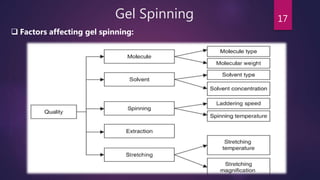
 Factors affecting gel spinning:
Gel Spinning 18
 Factor affecting gel spinning:
1. Molecule type: Molecule type determines the use of the product.
2. Molecular weight: Molecular weight determine the strength and modulus of the fibre after gel spinning.
The molecular weight directly affects the length of the molecular chain. Usually, longer molecular
chains will have higher fibre strength and modulus.
3. Solvent type: selection of solvent is highly important to gel spinning. The dissolution rate of polymers
directly affects the spinning property and stability of the gel fibre.
4. Solution concentration: Solution concentration can directly affects the maximum stretching magnification of
the gel fiber. The lower concentration can lead to higher maximum stretching magnification of the gel fibre and
higher fibre modulus
Contd… 19
5. Ladder speed: higher ladder speed can result in better fibre extensibility.
excessively high ladder speed often leads to excessive shearing rate between the fluid and the
wall of the flow channel. As a result, the molecular chain alleviating speed cannot keep up with
the spinning speed to increase surface stress and internal defects of fibre.
6. Spinning temperature: a higher spinning temperature will make the dissolution of the spinning solution
more even.
However, relatively high temperature can easily lead to the thermal cracking of the fibre and
reduce the viscosity of the spinning solution.
Hence, the entanglements of the molecular chains will be reduced, and the arrangements will be
loosened to increase the fibre defects.
7. Extraction: Appropriate extractant can reduce the impact of the solvent residuals on the stretching of
the gel.
Contd… 20
8. Stretching temperature: the gel spinning stretching temperature directly affects the maximum gel
stretching magnification, and indirectly affects the modulus of the gel fibre.
The rising temperature of gel spinning stretching can promote the mobility in between single
molecular chains to improve the extensibility of the gel fibre until reaching the melting point of the
polymer.
Hence, the setting of the stretching temperature is usually slightly below the melting point.
9. Stretching magnification: When the stretching magnification gradually increases, the growth of
orientation tends to slow down while the strength and growth rate of the crystals also reduces.
When it reaches half of the maximum stretching magnification, spot defects occur on the surface
of the gel fibre.
When the stretching magnification gradually increases, the molecular chains become gradually
intense and the fibre internal crystallisation starts to change to make the arrangement of
microfibrillar denser.
21
Gel Spinning Process for Polyethylene
 The main reasons for selecting Polyethylene are:
 the highest values of theoretical tenacity and modulus among flexible polymers
 simple planar zigzag chain structure without any bulky side group
 lack of high inter-molecular interactions
 high crystallinity
 possibility of producing ultra high molecular weight polymer
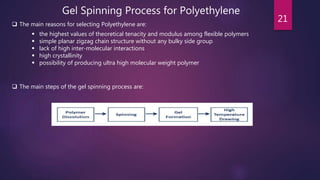
 The main steps of the gel spinning process are:
22
Process flow diagram for UHMPE fibres
 Process flow diagram
Various solvents, such as tetralin, decalin,
naphthalene, mineral oil, paraffin oil and paraffin
wax, have been reported for gel spinning of
UHMWPE.
23
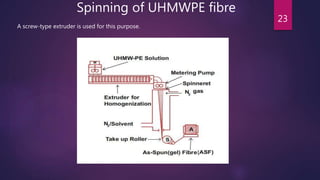
Spinning of UHMWPE fibre
A screw-type extruder is used for this purpose.
24
Spinning of UHMWPE fibre
 Spinning Process
From the viewpoint of the spinning process, it is important to understand the rheological properties of
UHMWPE solution.
The polymer solution has unique non-Newtonian behavior.
Large die-Swell - related to the highly elastic property of UHMWPE solution.
Pull-out - due to the combination of higher elongational strength of the solution and its highly elastic property.
When the solution is pressed through the spinneret and the strain is applied, the molecules are forced into a
highly elongated form. This forms the first step in the orientation process.
25
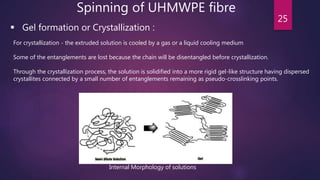
Spinning of UHMWPE fibre
 Gel formation or Crystallization :
For crystallization - the extruded solution is cooled by a gas or a liquid cooling medium
Some of the entanglements are lost because the chain will be disentangled before crystallization.
Through the crystallization process, the solution is solidified into a more rigid gel-like structure having dispersed
crystallites connected by a small number of entanglements remaining as pseudo-crosslinking points.
Internal Morphology of solutions
26
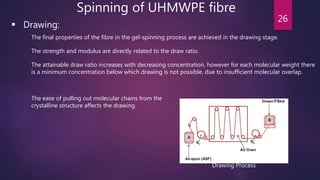
Spinning of UHMWPE fibre
 Drawing:
The final properties of the fibre in the gel-spinning process are achieved in the drawing stage.
The strength and modulus are directly related to the draw ratio.
The attainable draw ratio increases with decreasing concentration, however for each molecular weight there
is a minimum concentration below which drawing is not possible, due to insufficient molecular overlap.
The ease of pulling out molecular chains from the
crystalline structure affects the drawing.
Drawing Process
27
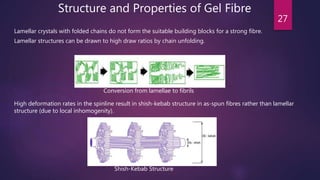
Structure and Properties of Gel Fibre
Lamellar crystals with folded chains do not form the suitable building blocks for a strong fibre.
Lamellar structures can be drawn to high draw ratios by chain unfolding.
High deformation rates in the spinline result in shish-kebab structure in as-spun fibres rather than lamellar
structure (due to local inhomogenity).
Conversion from lamellae to fibrils
Shish-Kebab Structure
28
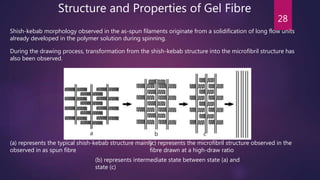
Structure and Properties of Gel Fibre
Shish-kebab morphology observed in the as-spun filaments originate from a solidification of long flow units
already developed in the polymer solution during spinning.
During the drawing process, transformation from the shish-kebab structure into the microfibril structure has
also been observed.
(a) represents the typical shish-kebab structure mainly
observed in as spun fibre
(c) represents the microfibril structure observed in the
fibre drawn at a high-draw ratio
(b) represents intermediate state between state (a) and
state (c)
a b c
29
Structure and Properties of Gel Fibre
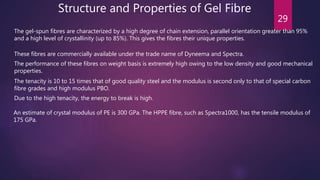
The gel-spun fibres are characterized by a high degree of chain extension, parallel orientation greater than 95%
and a high level of crystallinity (up to 85%). This gives the fibres their unique properties.
These fibres are commercially available under the trade name of Dyneema and Spectra.
The performance of these fibres on weight basis is extremely high owing to the low density and good mechanical
properties.
The tenacity is 10 to 15 times that of good quality steel and the modulus is second only to that of special carbon
fibre grades and high modulus PBO.
Due to the high tenacity, the energy to break is high.
An estimate of crystal modulus of PE is 300 GPa. The HPPE fibre, such as Spectra1000, has the tensile modulus of
175 GPa.
30
Structure and Properties of Gel Fibre
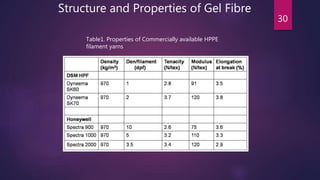
Table1. Properties of Commercially available HPPE
filament yarns
31
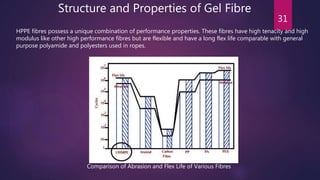
HPPE fibres possess a unique combination of performance properties. These fibres have high tenacity and high
modulus like other high performance fibres but are flexible and have a long flex life comparable with general
purpose polyamide and polyesters used in ropes.
Structure and Properties of Gel Fibre
Comparison of Abrasion and Flex Life of Various Fibres
32
• High performance ropes
• High performance fabrics
• Reinforcements for composites
• Sports and leisure goods
• Fishing nets
Applications
In these applications, excellent properties such as light weight, super-high strength and modulus, good impact
properties, environmental and chemical stability of UHSPE fibres is utilized.
Table 2. Properties and Applications of Aramids Fibres
33
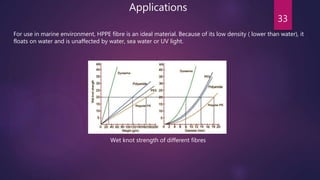
For use in marine environment, HPPE fibre is an ideal material. Because of its low density ( lower than water), it
floats on water and is unaffected by water, sea water or UV light.
Applications
Wet knot strength of different fibres
34
The low weight and high strength of HPPE fibres make it possible to produce heavy-duty ropes with very
special characteristics.
HPPE ropes float on water, are flexible and have a low elongation. Thus, they are very easy to handle.
Abrasion resistance and fatigue are good to any standard, which is why HPPE ropes last much longer than other
ropes.
Applications
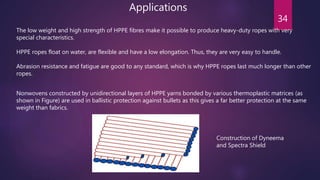
Nonwovens constructed by unidirectional layers of HPPE yarns bonded by various thermoplastic matrices (as
shown in Figure) are used in ballistic protection against bullets as this gives a far better protection at the same
weight than fabrics.
Construction of Dyneema
and Spectra Shield
35
References
36

Gel spinning

  • 1.
    Gel Spinning 1 Presentation by: ManishKumar(15MT20) Dept. of Metallurgical and Materials Engineering
  • 2.
    2INDEX:  Spinning  Basicterms  Types of spinning  What is Gel ?  Gel Spinning  Concept of Gel Spinning  Gel Spinning process  Difference between Gel Spinning, Wet Spinning and Dry Spinning  Factors affecting Gel Spinning  Gel Spinning Process for Polyethylene  Spinning of UHMWPE fibre  Structure and properties of Gel Fibre  Applications of Gel spun fibres
  • 3.
     Spinning: “Spinning isthe process of converting fibres into yarn”. Or “The process of extrusion & solidification of endless filament”. “Basic principle of spinning process is pushing a polymer melt or solution through a small hole to form a linear stream of material that is solidified and drawn into a fibre. 3
  • 4.
     Basic terms…… a)Spinneret:- A nozzle or plate provided with fine holes through which a fibre forming solution or melt is extruded in fibre manufacture is called spinneret. It work as a principle, to a bathroom shower head. 4
  • 5.
    b). Extrusion:- Extrusionis a forcing or pumping the spinning solution through the tiny holes of a spinneret. 5
  • 6.
    c) Method ofspinning:- General steps…….. All manufactured fibre-spinning processes are based on following three general steps: 1) Preparing a viscous dope (a thick solution) or melt. 2) Forcing or extruding the dope or melt through an opening in a spinneret to form a fibre. 3) Solidifying the fibre by coagulation, evaporation or cooling. 6
  • 7.
    d) Types ofSpinning methods:- There are generally four spinning methods of producing synthetic filaments that are, 1) Melt spinning 2) Dry spinning 3) Wet spinning 4) Gel spinning 7
  • 8.
    What is Gel? 8  Gel is colloidal suspension of a solid dispersed in a liquid; a semirigid solid.  It can have properties ranging from soft and weak to hard and tough.  Gels are defined as a substantially dilute cross-linked system, which exhibits no flow when in the steady- state.
  • 9.
    Gel Spinning 9 •Gel spinning is also known as Dry-Wet spinning because the filament first pass through air then are cooled further into a liquid bath. Gel spinning is used to make very strong and other fibre having special characteristic. • The polymer here is partially liquid or in a “gel” state which keeps the polymer chains somewhat bound together at various points and liquid crystal form.
  • 10.
    Gel Spinning 10 Ingel spinning process, the polymer solution is prepared at temperature and conditions where it is flowable and is extruded to conditions where it forms a gel structure. This allows the individual molecular chains to connect optimally with each other, and on coagulation, form a network structure which is able to undergo very high draw ratios to give fibre with high tensile strength and modulus. In case of polyethylene the ultra-drawing can be applied as the crystallization during drawing does not prevent drawability due to weak interactions between polymer chains.
  • 11.
    Concept of GelSpinning 11 In gel spinning process, the entanglements are optimized to a number that is just sufficient to transfer the drawing stress between chains. For this, one entanglement per chain has been reported to be enough. Such a condition can be realized in a solution at a critical concentration (C*), at which the random coils of single polymer chain begin to overlap each other. The critical concentration C* depends on the average molecular weight (M) of the polymer and molecular weight between entanglements (Me). The entanglement molecular weight Me, depends on the flexibility/nature of the polymer.
  • 12.
    Concept of GelSpinning 12 the maximum attainable draw ratio can be predicted from the following relation: where c is a material constant the maximum attainable draw ratio increases with the molecular weight (M) of the polymer(Ideal Condition) if we consider the drawing of a single molecule from its random coiled state
  • 13.
    Concept of GelSpinning 13 The maximum draw ratio of gel-like fibres is also related to both concentration (C) and molecular weight (M) as shown below. the maximum draw ratio decreases with increase of the molecular weight and concentration (for true spinning conditions).
  • 14.
    Gel Spinning Process14  General gel spinning process can be divided into the four following steps: 1. Dissolution: The dissolution of polymer chain in solvent. The molecular chains of the solid polymers may be entangled, and the entanglements will affect the molecular chain stretching. The dissolution of polymers in solvent can disentangle these entanglements to aid the gel fibre stretching. 2. Spinning and formation: extruding the solvent from the spinnerets by gear pump, and cooling it rapidly by air or water. The rapid cooling process can lead to the formation of crystals and retain the disentangled state of polymers to aid the formation of high-strength and high-elastic modulus fibre.
  • 15.
    Gel Spinning Process15 3. Remove solvent: the most commonly used methods to remove solvent in gel spinning include the natural drying method and the use of extractant, which mainly aims to remove the solvent residuals in gel fibre. The extractant can displace the gel fibre solvent based on diffusion and penetration principles. In gel spinning, the selection of solvent and extractant directly affect the stretching stability, and is key to the gel spinning method. 4. Stretching: the high magnification stretching of the gel fibre. High magnification stretching can change the folded polymer molecular chains to straight chains, and improve polymer crystallinity and orientation. This is a unique feature of gel spinning, and is the key to enhancing gel fibre performance.
  • 16.
    Gel Spinning 16 How Gel spinning is different as compared to Wet and Dry spinning ? 1. Raw materials of high molecular weight: Polymers of high molecular weight can withstand high magnification stretching, and help improve fibre strength and other mechanical properties. The rising molecular weight can reduce defects in fibre structure caused by the chain polymer end group to enhance fibre strength. 2. Dilute solution: the diluted solution can reduce gel viscosity, improve gel fibre spinning capability, and be conducive to the disentanglement of high polymer chains to enhance fibre strength and mechanical properties. 3. High magnification stretching: The high magnification stretching can change the folded polymer molecular chains to straight chains, and improve polymer crystallinity and orientation, which is an incomparable advantage over other spinning methods.
  • 17.
    Gel Spinning 17 Factors affecting gel spinning:
  • 18.
    Gel Spinning 18 Factor affecting gel spinning: 1. Molecule type: Molecule type determines the use of the product. 2. Molecular weight: Molecular weight determine the strength and modulus of the fibre after gel spinning. The molecular weight directly affects the length of the molecular chain. Usually, longer molecular chains will have higher fibre strength and modulus. 3. Solvent type: selection of solvent is highly important to gel spinning. The dissolution rate of polymers directly affects the spinning property and stability of the gel fibre. 4. Solution concentration: Solution concentration can directly affects the maximum stretching magnification of the gel fiber. The lower concentration can lead to higher maximum stretching magnification of the gel fibre and higher fibre modulus
  • 19.
    Contd… 19 5. Ladderspeed: higher ladder speed can result in better fibre extensibility. excessively high ladder speed often leads to excessive shearing rate between the fluid and the wall of the flow channel. As a result, the molecular chain alleviating speed cannot keep up with the spinning speed to increase surface stress and internal defects of fibre. 6. Spinning temperature: a higher spinning temperature will make the dissolution of the spinning solution more even. However, relatively high temperature can easily lead to the thermal cracking of the fibre and reduce the viscosity of the spinning solution. Hence, the entanglements of the molecular chains will be reduced, and the arrangements will be loosened to increase the fibre defects. 7. Extraction: Appropriate extractant can reduce the impact of the solvent residuals on the stretching of the gel.
  • 20.
    Contd… 20 8. Stretchingtemperature: the gel spinning stretching temperature directly affects the maximum gel stretching magnification, and indirectly affects the modulus of the gel fibre. The rising temperature of gel spinning stretching can promote the mobility in between single molecular chains to improve the extensibility of the gel fibre until reaching the melting point of the polymer. Hence, the setting of the stretching temperature is usually slightly below the melting point. 9. Stretching magnification: When the stretching magnification gradually increases, the growth of orientation tends to slow down while the strength and growth rate of the crystals also reduces. When it reaches half of the maximum stretching magnification, spot defects occur on the surface of the gel fibre. When the stretching magnification gradually increases, the molecular chains become gradually intense and the fibre internal crystallisation starts to change to make the arrangement of microfibrillar denser.
  • 21.
    21 Gel Spinning Processfor Polyethylene  The main reasons for selecting Polyethylene are:  the highest values of theoretical tenacity and modulus among flexible polymers  simple planar zigzag chain structure without any bulky side group  lack of high inter-molecular interactions  high crystallinity  possibility of producing ultra high molecular weight polymer  The main steps of the gel spinning process are:
  • 22.
    22 Process flow diagramfor UHMPE fibres  Process flow diagram Various solvents, such as tetralin, decalin, naphthalene, mineral oil, paraffin oil and paraffin wax, have been reported for gel spinning of UHMWPE.
  • 23.
    23 Spinning of UHMWPEfibre A screw-type extruder is used for this purpose.
  • 24.
    24 Spinning of UHMWPEfibre  Spinning Process From the viewpoint of the spinning process, it is important to understand the rheological properties of UHMWPE solution. The polymer solution has unique non-Newtonian behavior. Large die-Swell - related to the highly elastic property of UHMWPE solution. Pull-out - due to the combination of higher elongational strength of the solution and its highly elastic property. When the solution is pressed through the spinneret and the strain is applied, the molecules are forced into a highly elongated form. This forms the first step in the orientation process.
  • 25.
    25 Spinning of UHMWPEfibre  Gel formation or Crystallization : For crystallization - the extruded solution is cooled by a gas or a liquid cooling medium Some of the entanglements are lost because the chain will be disentangled before crystallization. Through the crystallization process, the solution is solidified into a more rigid gel-like structure having dispersed crystallites connected by a small number of entanglements remaining as pseudo-crosslinking points. Internal Morphology of solutions
  • 26.
    26 Spinning of UHMWPEfibre  Drawing: The final properties of the fibre in the gel-spinning process are achieved in the drawing stage. The strength and modulus are directly related to the draw ratio. The attainable draw ratio increases with decreasing concentration, however for each molecular weight there is a minimum concentration below which drawing is not possible, due to insufficient molecular overlap. The ease of pulling out molecular chains from the crystalline structure affects the drawing. Drawing Process
  • 27.
    27 Structure and Propertiesof Gel Fibre Lamellar crystals with folded chains do not form the suitable building blocks for a strong fibre. Lamellar structures can be drawn to high draw ratios by chain unfolding. High deformation rates in the spinline result in shish-kebab structure in as-spun fibres rather than lamellar structure (due to local inhomogenity). Conversion from lamellae to fibrils Shish-Kebab Structure
  • 28.
    28 Structure and Propertiesof Gel Fibre Shish-kebab morphology observed in the as-spun filaments originate from a solidification of long flow units already developed in the polymer solution during spinning. During the drawing process, transformation from the shish-kebab structure into the microfibril structure has also been observed. (a) represents the typical shish-kebab structure mainly observed in as spun fibre (c) represents the microfibril structure observed in the fibre drawn at a high-draw ratio (b) represents intermediate state between state (a) and state (c) a b c
  • 29.
    29 Structure and Propertiesof Gel Fibre The gel-spun fibres are characterized by a high degree of chain extension, parallel orientation greater than 95% and a high level of crystallinity (up to 85%). This gives the fibres their unique properties. These fibres are commercially available under the trade name of Dyneema and Spectra. The performance of these fibres on weight basis is extremely high owing to the low density and good mechanical properties. The tenacity is 10 to 15 times that of good quality steel and the modulus is second only to that of special carbon fibre grades and high modulus PBO. Due to the high tenacity, the energy to break is high. An estimate of crystal modulus of PE is 300 GPa. The HPPE fibre, such as Spectra1000, has the tensile modulus of 175 GPa.
  • 30.
    30 Structure and Propertiesof Gel Fibre Table1. Properties of Commercially available HPPE filament yarns
  • 31.
    31 HPPE fibres possessa unique combination of performance properties. These fibres have high tenacity and high modulus like other high performance fibres but are flexible and have a long flex life comparable with general purpose polyamide and polyesters used in ropes. Structure and Properties of Gel Fibre Comparison of Abrasion and Flex Life of Various Fibres
  • 32.
    32 • High performanceropes • High performance fabrics • Reinforcements for composites • Sports and leisure goods • Fishing nets Applications In these applications, excellent properties such as light weight, super-high strength and modulus, good impact properties, environmental and chemical stability of UHSPE fibres is utilized. Table 2. Properties and Applications of Aramids Fibres
  • 33.
    33 For use inmarine environment, HPPE fibre is an ideal material. Because of its low density ( lower than water), it floats on water and is unaffected by water, sea water or UV light. Applications Wet knot strength of different fibres
  • 34.
    34 The low weightand high strength of HPPE fibres make it possible to produce heavy-duty ropes with very special characteristics. HPPE ropes float on water, are flexible and have a low elongation. Thus, they are very easy to handle. Abrasion resistance and fatigue are good to any standard, which is why HPPE ropes last much longer than other ropes. Applications Nonwovens constructed by unidirectional layers of HPPE yarns bonded by various thermoplastic matrices (as shown in Figure) are used in ballistic protection against bullets as this gives a far better protection at the same weight than fabrics. Construction of Dyneema and Spectra Shield
  • 35.
  • 36.