ASSIGNMENT
Natural And Man Made Fibers
Topic: Fiber Report
Submitted To: Imran Raza
Malik
Submitted By: Iftikharwali
Discipline:Textile Science
Date:26/03/2015
Identification of Fibers
1. BURN TESTS
Procedure: Cut a small sample of textile fiber and holding it in a tweezers or forceps cautiously ignite
with a matchstick or lighter. Observe the sample carefully, because each fiber type will burn in a specific
way, producing different colored smoke, a particular smell and leaving its own kind of residue. To match
your findings with the correct fiber compare with the chart below.
FIBER Performance at flame Odor Residue
Approach
to flame
In the
flame
Withdrawn
from flame
SILK
Shrinks
away
Burns
slowly
Self
extinguishing
Burning
hair
Brittle, swollen,
black ash
WOOL
Shrinks
away
Burns
slowly
Self
extinguishing
Burning
hair
Brittle, swollen,
black ash
COTTON
No
effect
Burns
readily
Continues
to burn
Burning
paper
Gray
skeletal ash
NYLON
Shrinks
away
Burns slowly
and melts
Often self
extinguishing
Celery
Sometimes
perceptible
Hard light
colored bead
ACRYLIC
Shrinks
away
Burns slowly
and melts
Continues to
burn
and melt
Acrid
Brittle black
bead
POLYPROPYLENE
(OLEFIN)
LINEN
Shrinks
quickly
Not Defined
Burns
and melts
Not Defined
Burns
and melt
Burns
Not defined
Not Defined
Hard, round
bead, maybe
light brown
Brittle Ashes
Polyester Melts Melts Melts Sweetish
Hard Ashes
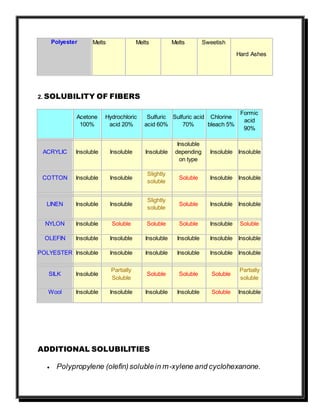
2. SOLUBILITY OF FIBERS
Acetone
100%
Hydrochloric
acid 20%
Sulfuric
acid 60%
Sulfuric acid
70%
Chlorine
bleach 5%
Formic
acid
90%
ACRYLIC Insoluble Insoluble Insoluble
Insoluble
depending
on type
Insoluble Insoluble
COTTON Insoluble Insoluble
Slightly
soluble
Soluble Insoluble Insoluble
LINEN Insoluble Insoluble
Slightly
soluble
Soluble Insoluble Insoluble
NYLON Insoluble Soluble Soluble Soluble Insoluble Soluble
OLEFIN Insoluble Insoluble Insoluble Insoluble Insoluble Insoluble
POLYESTER Insoluble Insoluble Insoluble Insoluble Insoluble Insoluble
SILK Insoluble
Partially
Soluble
Soluble Soluble Soluble
Partially
soluble
Wool Insoluble Insoluble Insoluble Insoluble Soluble Insoluble
ADDITIONAL SOLUBILITIES
 Polypropylene (olefin)solublein m-xylene and cyclohexanone.
 Acrylicsoluble indimethylform amide.
 Polyestersolublein m-cresol.
Nylon 6 is soluble indimethylform amide and nylon 66 is not
MICROSCOPIC ANALYSIS OF FIBERS
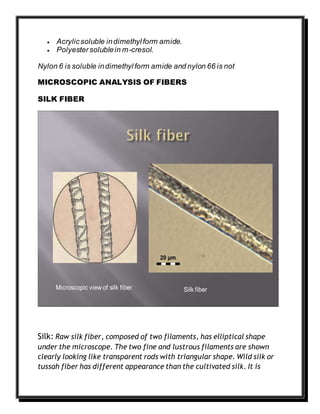
SILK FIBER
Microscopic view of silk fiber Silk fiber
Silk: Raw silk fiber, composed of two filaments, has elliptical shape
under the microscope. The two fine and lustrous filaments are shown
clearly looking like transparent rods with triangular shape. Wild silk or
tussah fiber has different appearance than the cultivated silk. It is
flattened, coarse, thick and broader fiber having fine, wavy lines all
across its surface whereas cultivated silk is narrower fiber with no marks
on it.
MICROSCOPIC ANALYSIS OF FIBERS
WOOL FIBER
Microscopic
viewof wool
Raw wool
Wool: Wool fiber has irregular, roughly cylindrical, multi cellular
structure with tapered ends. Under a microscope, three basic layers are
shown- epidermis (outer layer), cortex (middle layer) and medulla (inner
layer). Medulla is seen only in coarse and medium wool fibers and that
too under a highly powerful microscope.
MICROSCOPIC ANALYSIS OF FIBERS
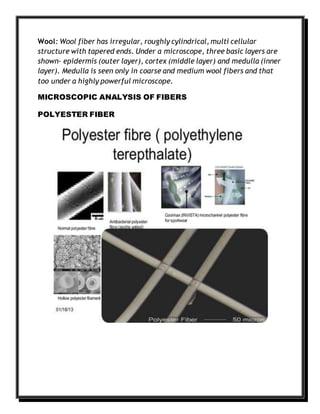
POLYESTER FIBER
POLYESTER
Polyester: Generally, polyester fiber is smooth, straight. It looks round
cross sectionally. However, with various finishing processes, its
appearance changes in context of texture and luster.
MICROSCOPIC ANALYSIS OF FIBERS
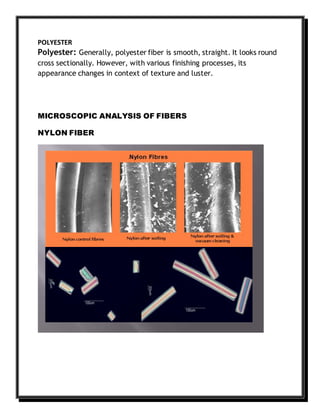
NYLON FIBER
Nylon: There are many variants of nylon fiber. However, generally
it appears fine, round, smooth and translucent. Sometimes it has
shiny appearance. If it looks dull, it will also be dotted under the
microscope.
MICROSCOPIC ANALYSIS OF FIBERS
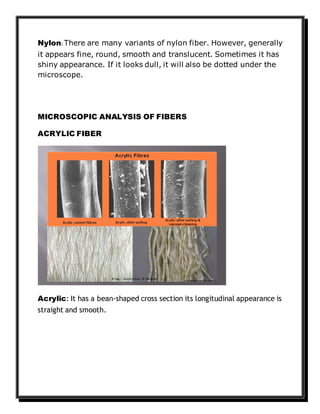
ACRYLIC FIBER
Acrylic: It has a bean-shaped cross section its longitudinal appearance is
straight and smooth.
MICROSCOPIC ANALYSIS OF FIBERS
POLY PROPYLENE FIBER
Polypropylene: When viewed cross sectionals polypropylene fiber looks
somewhat round but it looks straight and smooth when viewed
longitudinally.
MICROSCOPIC ANALYSIS OF FIBERS
COTTON FIBER
Microscopic view of cotton
fiber
Differentlayers in cotton fiber
Cotton:The cotton fiber is a single elongated cell. Under a microscope,
it looks like flat, spirally twisted ribbon like tube with rough granular
surface. However, mercerized cotton doesn't have natural twist. The
finishing process makes them swollen, straight, smooth and round with a
shining surface.
MICROSCOPIC ANALYSIS OF FIBERS
LINEN FIBER
Linen:Linen fiber, under a microscope, looks like having multiple sided
cylindrical filaments with fine pointed edges. The filaments show nodes
at intervals. It, in fact, looks like a bamboo stick having joints that result
into a little unevenness.
DISTINGUISHING OF FIBERS FROM ONEANOTHER
DISTINGUISHING POLYESTER FROM OTHER FIBRES:
Polyester is soluble in hot Meta cresol; however unlike acetate it is not
soluble in acetone, and unlike nylon it is not soluble in concentrated
formic acid.
DISTINGUISHING ACRYLICS FROM OTHER FIBRES:
Acrylic fibers will dissolve in 70 percent solution of ammonium
thiocyanate at 130 degree Celsius but the other fibers will not.
DISTINGUISHING SILK FROM WOOL:
The use of concentrated cold hydrochloric acid will dissolve the silk and
the wool fiber swells.
DISTINGUISHING NYLON FROM OTHER FIBRES:
If the fabric is thought to contain nylon, the fabric may be immersed in a
boiling solution of sodium hydroxide. The nylon is insoluble in such a
solution
DISTINGUISHING LINEN FROM COTTON:
Cotton and linen are immersed in a 1% solution of fuchsine in alcohol to
give red rose color. Later they are washed and immersed into ammonia,
linen retains the red coloration but cotton does not
Identification Fibers report

Identification Fibers report

  • 1.
    ASSIGNMENT Natural And ManMade Fibers Topic: Fiber Report Submitted To: Imran Raza Malik Submitted By: Iftikharwali Discipline:Textile Science Date:26/03/2015
  • 2.
    Identification of Fibers 1.BURN TESTS Procedure: Cut a small sample of textile fiber and holding it in a tweezers or forceps cautiously ignite with a matchstick or lighter. Observe the sample carefully, because each fiber type will burn in a specific way, producing different colored smoke, a particular smell and leaving its own kind of residue. To match your findings with the correct fiber compare with the chart below. FIBER Performance at flame Odor Residue Approach to flame In the flame Withdrawn from flame SILK Shrinks away Burns slowly Self extinguishing Burning hair Brittle, swollen, black ash WOOL Shrinks away Burns slowly Self extinguishing Burning hair Brittle, swollen, black ash COTTON No effect Burns readily Continues to burn Burning paper Gray skeletal ash NYLON Shrinks away Burns slowly and melts Often self extinguishing Celery Sometimes perceptible Hard light colored bead ACRYLIC Shrinks away Burns slowly and melts Continues to burn and melt Acrid Brittle black bead POLYPROPYLENE (OLEFIN) LINEN Shrinks quickly Not Defined Burns and melts Not Defined Burns and melt Burns Not defined Not Defined Hard, round bead, maybe light brown Brittle Ashes
  • 3.
    Polyester Melts MeltsMelts Sweetish Hard Ashes 2. SOLUBILITY OF FIBERS Acetone 100% Hydrochloric acid 20% Sulfuric acid 60% Sulfuric acid 70% Chlorine bleach 5% Formic acid 90% ACRYLIC Insoluble Insoluble Insoluble Insoluble depending on type Insoluble Insoluble COTTON Insoluble Insoluble Slightly soluble Soluble Insoluble Insoluble LINEN Insoluble Insoluble Slightly soluble Soluble Insoluble Insoluble NYLON Insoluble Soluble Soluble Soluble Insoluble Soluble OLEFIN Insoluble Insoluble Insoluble Insoluble Insoluble Insoluble POLYESTER Insoluble Insoluble Insoluble Insoluble Insoluble Insoluble SILK Insoluble Partially Soluble Soluble Soluble Soluble Partially soluble Wool Insoluble Insoluble Insoluble Insoluble Soluble Insoluble ADDITIONAL SOLUBILITIES  Polypropylene (olefin)solublein m-xylene and cyclohexanone.
  • 4.
     Acrylicsoluble indimethylformamide.  Polyestersolublein m-cresol. Nylon 6 is soluble indimethylform amide and nylon 66 is not MICROSCOPIC ANALYSIS OF FIBERS SILK FIBER Microscopic view of silk fiber Silk fiber Silk: Raw silk fiber, composed of two filaments, has elliptical shape under the microscope. The two fine and lustrous filaments are shown clearly looking like transparent rods with triangular shape. Wild silk or tussah fiber has different appearance than the cultivated silk. It is
  • 5.
    flattened, coarse, thickand broader fiber having fine, wavy lines all across its surface whereas cultivated silk is narrower fiber with no marks on it. MICROSCOPIC ANALYSIS OF FIBERS WOOL FIBER Microscopic viewof wool Raw wool
  • 6.
    Wool: Wool fiberhas irregular, roughly cylindrical, multi cellular structure with tapered ends. Under a microscope, three basic layers are shown- epidermis (outer layer), cortex (middle layer) and medulla (inner layer). Medulla is seen only in coarse and medium wool fibers and that too under a highly powerful microscope. MICROSCOPIC ANALYSIS OF FIBERS POLYESTER FIBER
  • 7.
    POLYESTER Polyester: Generally, polyesterfiber is smooth, straight. It looks round cross sectionally. However, with various finishing processes, its appearance changes in context of texture and luster. MICROSCOPIC ANALYSIS OF FIBERS NYLON FIBER
  • 8.
    Nylon: There aremany variants of nylon fiber. However, generally it appears fine, round, smooth and translucent. Sometimes it has shiny appearance. If it looks dull, it will also be dotted under the microscope. MICROSCOPIC ANALYSIS OF FIBERS ACRYLIC FIBER Acrylic: It has a bean-shaped cross section its longitudinal appearance is straight and smooth.
  • 9.
    MICROSCOPIC ANALYSIS OFFIBERS POLY PROPYLENE FIBER
  • 10.
    Polypropylene: When viewedcross sectionals polypropylene fiber looks somewhat round but it looks straight and smooth when viewed longitudinally. MICROSCOPIC ANALYSIS OF FIBERS COTTON FIBER Microscopic view of cotton fiber Differentlayers in cotton fiber
  • 11.
    Cotton:The cotton fiberis a single elongated cell. Under a microscope, it looks like flat, spirally twisted ribbon like tube with rough granular surface. However, mercerized cotton doesn't have natural twist. The finishing process makes them swollen, straight, smooth and round with a shining surface. MICROSCOPIC ANALYSIS OF FIBERS LINEN FIBER
  • 12.
    Linen:Linen fiber, undera microscope, looks like having multiple sided cylindrical filaments with fine pointed edges. The filaments show nodes at intervals. It, in fact, looks like a bamboo stick having joints that result into a little unevenness. DISTINGUISHING OF FIBERS FROM ONEANOTHER DISTINGUISHING POLYESTER FROM OTHER FIBRES: Polyester is soluble in hot Meta cresol; however unlike acetate it is not soluble in acetone, and unlike nylon it is not soluble in concentrated formic acid. DISTINGUISHING ACRYLICS FROM OTHER FIBRES: Acrylic fibers will dissolve in 70 percent solution of ammonium thiocyanate at 130 degree Celsius but the other fibers will not. DISTINGUISHING SILK FROM WOOL: The use of concentrated cold hydrochloric acid will dissolve the silk and the wool fiber swells. DISTINGUISHING NYLON FROM OTHER FIBRES: If the fabric is thought to contain nylon, the fabric may be immersed in a boiling solution of sodium hydroxide. The nylon is insoluble in such a solution DISTINGUISHING LINEN FROM COTTON:
  • 13.
    Cotton and linenare immersed in a 1% solution of fuchsine in alcohol to give red rose color. Later they are washed and immersed into ammonia, linen retains the red coloration but cotton does not