CHEMICAL
PEELS
DR. ANAM MEHMOOD
POST GRADUATE RESIDENT
DERMATOLOGY UNIT I
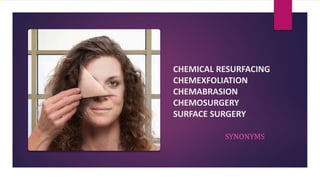
CHEMICAL RESURFACING
CHEMEXFOLIATION
CHEMABRASION
CHEMOSURGERY
SURFACE SURGERY
SYNONYMS
What is skin
peeling?
METHOD OF SKIN
RESURFACING
• ACCELERATED EXFOLIATION BY
USING IRRITANT CHEMICALS
HISTORY
Since ancient times,
women have been using different methods to exfoliate their skin
EGYPTIANS
 Ancient Egyptians used animal oils
 Cleopatra was reported to bathe in sour milk to
rejuvenate skin
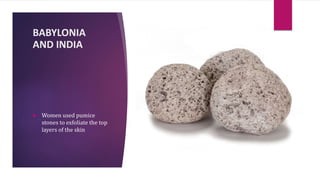
BABYLONIA
AND INDIA
 Women used pumice
stones to exfoliate the top
layers of the skin
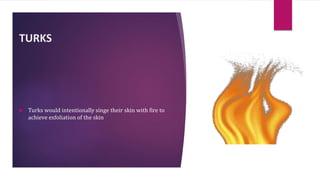
TURKS
 Turks would intentionally singe their skin with fire to
achieve exfoliation of the skin
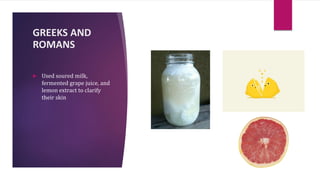
GREEKS AND
ROMANS
 Used soured milk,
fermented grape juice, and
lemon extract to clarify
their skin
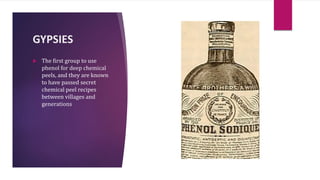
GYPSIES
 The first group to use
phenol for deep chemical
peels, and they are known
to have passed secret
chemical peel recipes
between villages and
generations
Today!!!
Chemical Peels are the THIRD most commonly performed
noninvasive cosmetic procedure in United States with over
1,300,000 procedures performed in 2016 alone
American Society of Plastic Surgeons
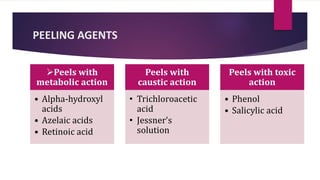
PEELING AGENTS
Peels with
metabolic action
• Alpha-hydroxyl
acids
• Azelaic acids
• Retinoic acid
Peels with
caustic action
• Trichloroacetic
acid
• Jessner’s
solution
Peels with toxic
action
• Phenol
• Salicylic acid
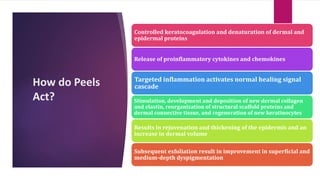
How do Peels
Act?
Controlled keratocoagulation and denaturation of dermal and
epidermal proteins
Release of proinflammatory cytokines and chemokines
Targeted inflammation activates normal healing signal
cascade
Stimulation, development and deposition of new dermal collagen
and elastin, reorganization of structural scaffold proteins and
dermal connective tissue, and regeneration of new keratinocytes
Results in rejuvenation and thickening of the epidermis and an
increase in dermal volume
Subsequent exfoliation result in improvement in superficial and
medium-depth dyspigmentation
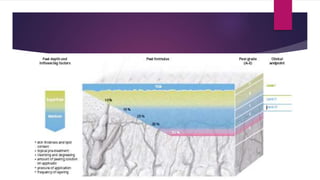
CLASSIFICATION OF PEELS
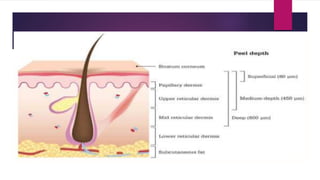
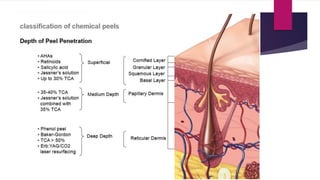
DEPENDING UPON DEPTH
Factors
 Chemicals applied
 Mode of application
 Skin type
 Skin condition
 Mhj
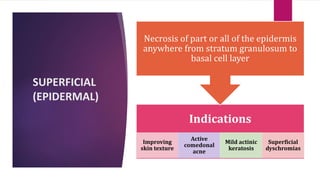
SUPERFICIAL
(EPIDERMAL)
Indications
Improving
skin texture
Active
comedonal
acne
Mild actinic
keratosis
Superficial
dyschromias
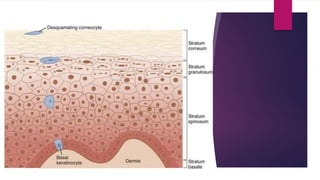
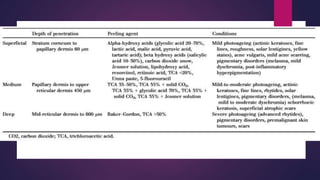
Necrosis of part or all of the epidermis
anywhere from stratum granulosum to
basal cell layer
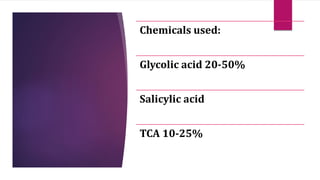
Chemicals used:
Glycolic acid 20-50%
Salicylic acid
TCA 10-25%
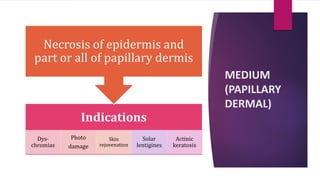
MEDIUM
(PAPILLARY
DERMAL)
Indications
Dys-
chromias
Photo
damage
Skin
rejuvenation
Solar
lentigines
Actinic
keratosis
Necrosis of epidermis and
part or all of papillary dermis
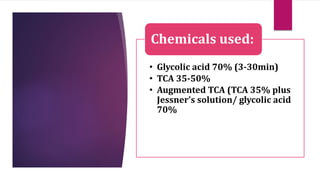
• Glycolic acid 70% (3-30min)
• TCA 35-50%
• Augmented TCA (TCA 35% plus
Jessner’s solution/ glycolic acid
70%
Chemicals used:
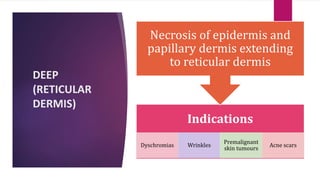
DEEP
(RETICULAR
DERMIS)
Indications
Dyschromias Wrinkles
Premalignant
skin tumours
Acne scars
Necrosis of epidermis and
papillary dermis extending
to reticular dermis
Chemicals used:
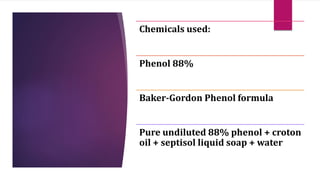
Phenol 88%
Baker-Gordon Phenol formula
Pure undiluted 88% phenol + croton
oil + septisol liquid soap + water
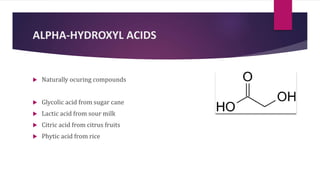
ALPHA-HYDROXYL ACIDS
 Naturally ocuring compounds
 Glycolic acid from sugar cane
 Lactic acid from sour milk
 Citric acid from citrus fruits
 Phytic acid from rice
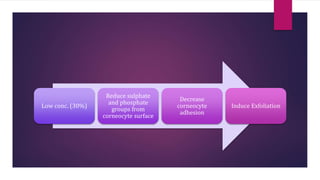
Low conc. (30%)
Reduce sulphate
and phosphate
groups from
corneocyte surface
Decrease
corneocyte
adhesion
Induce Exfoliation
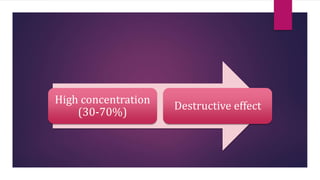
High concentration
(30-70%)
Destructive effect
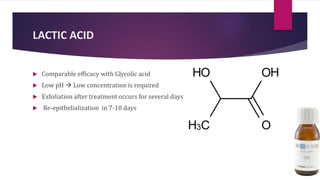
LACTIC ACID
 Comparable efficacy with Glycolic acid
 Low pH  Low concentration is required
 Exfoliation after treatment occurs for several days
 Re-epithelialization in 7-10 days
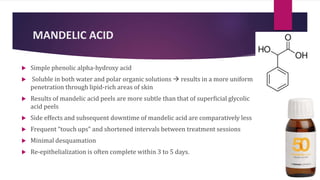
MANDELIC ACID
 Simple phenolic alpha-hydroxy acid
 Soluble in both water and polar organic solutions  results in a more uniform
penetration through lipid-rich areas of skin
 Results of mandelic acid peels are more subtle than that of superficial glycolic
acid peels
 Side effects and subsequent downtime of mandelic acid are comparatively less
 Frequent “touch ups” and shortened intervals between treatment sessions
 Minimal desquamation
 Re-epithelialization is often complete within 3 to 5 days.
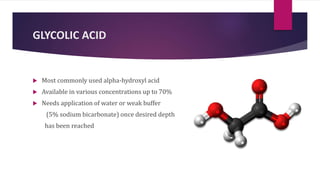
GLYCOLIC ACID
 Most commonly used alpha-hydroxyl acid
 Available in various concentrations up to 70%
 Needs application of water or weak buffer
(5% sodium bicarbonate) once desired depth
has been reached
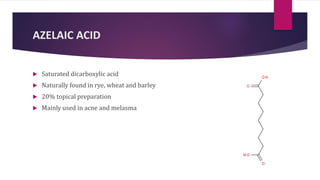
AZELAIC ACID
 Saturated dicarboxylic acid
 Naturally found in rye, wheat and barley
 20% topical preparation
 Mainly used in acne and melasma
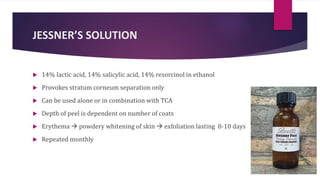
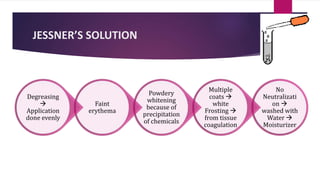
JESSNER’S SOLUTION
 14% lactic acid, 14% salicylic acid, 14% resorcinol in ethanol
 Provokes stratum corneum separation only
 Can be used alone or in combination with TCA
 Depth of peel is dependent on number of coats
 Erythema  powdery whitening of skin  exfoliation lasting 8-10 days
 Repeated monthly
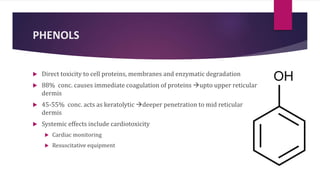
PHENOLS
 Direct toxicity to cell proteins, membranes and enzymatic degradation
 88% conc. causes immediate coagulation of proteins upto upper reticular
dermis
 45-55% conc. acts as keratolytic deeper penetration to mid reticular
dermis
 Systemic effects include cardiotoxicity
 Cardiac monitoring
 Resuscitative equipment
Indications
 Anti ageing
 Deep rhytidosis
 Dyschromia
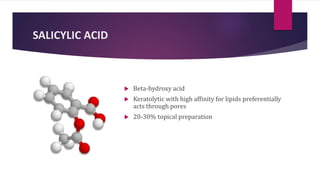
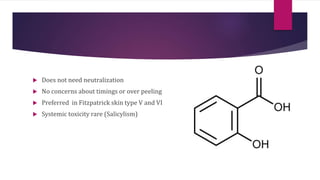
SALICYLIC ACID
 Beta-hydroxy acid
 Keratolytic with high affinity for lipids preferentially
acts through pores
 20-30% topical preparation
Indications
 Comedonal and inflammatory acne
 Early to moderate photo damage
 Oily skin with enlarged pores
 Rosacea
 Post inflammatory hyperpigmentation
 Melasma
 Does not need neutralization
 No concerns about timings or over peeling
 Preferred in Fitzpatrick skin type V and VI
 Systemic toxicity rare (Salicylism)
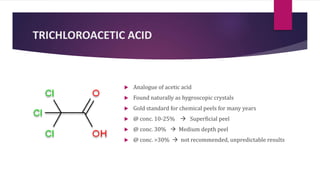
TRICHLOROACETIC ACID
 Analogue of acetic acid
 Found naturally as hygroscopic crystals
 Gold standard for chemical peels for many years
 @ conc. 10-25%  Superficial peel
 @ conc. 30%  Medium depth peel
 @ conc. >30%  not recommended, unpredictable results
 Destructive due to low pH
 Rapidly neutralized
 Coagulation of skin proteins
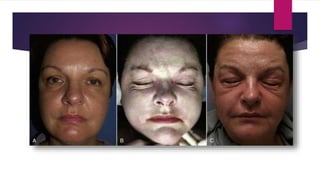
 Clinical end point of treatment is frosting
 Frosting is due to denaturation of proteins
 Replaced by erythema
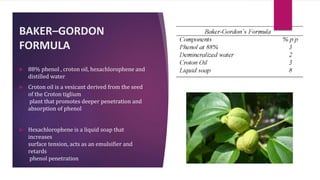
BAKER–GORDON
FORMULA
 88% phenol , croton oil, hexachlorophene and
distilled water
 Croton oil is a vesicant derived from the seed
of the Croton tiglium
plant that promotes deeper penetration and
absorption of phenol
 Hexachlorophene is a liquid soap that
increases
surface tension, acts as an emulsifier and
retards
phenol penetration
COMBINATION PEELS
 70% Glycolic acid un buffered peel followed by 35% TCA
 Combined Jessner’s solution (1-4 coats) and 35%TCA
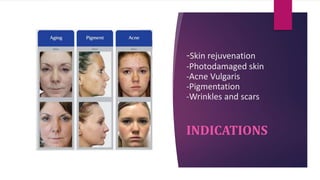
-Skin rejuvenation
-Photodamaged skin
-Acne Vulgaris
-Pigmentation
-Wrinkles and scars
INDICATIONS
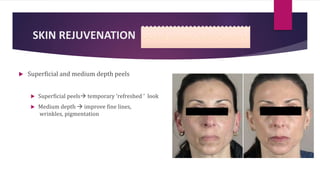
SKIN REJUVENATION
 Superficial and medium depth peels
 Superficial peels temporary ‘refreshed ’ look
 Medium depth  improve fine lines,
wrinkles, pigmentation
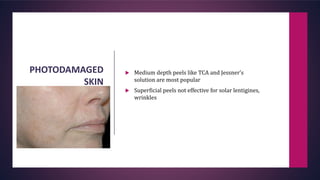
PHOTODAMAGED
SKIN
 Medium depth peels like TCA and Jessner’s
solution are most popular
 Superficial peels not effective for solar lentigines,
wrinkles
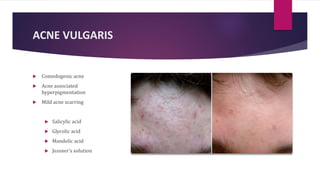
ACNE VULGARIS
 Comedogenic acne
 Acne associated
hyperpigmentation
 Mild acne scarring
 Salicylic acid
 Glycolic acid
 Mandelic acid
 Jessner’s solution
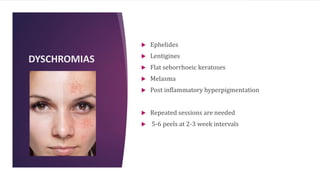
DYSCHROMIAS
 Ephelides
 Lentigines
 Flat seborrhoeic keratoses
 Melasma
 Post inflammatory hyperpigmentation
 Repeated sessions are needed
 5-6 peels at 2-3 week intervals
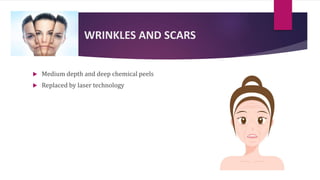
WRINKLES AND SCARS
 Medium depth and deep chemical peels
 Replaced by laser technology
CONTRAINDICATIONS
Absolute
Allergy to peeling solution/ neutralizing
agent
Patients with unrealistic expectations
Immunosuppression
Relative
Use of oral isotretinoin, OCPs, Tetracyclines
Pregnancy or lactation
Herpes labialis
Plain Warts or dermatitis
Radiotherapy irradiated skin/ Photosensitivity
History of scar or keloid formation
PROCEDURE
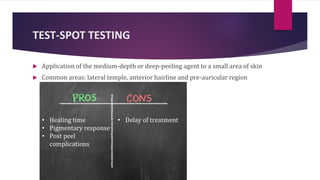
TEST-SPOT TESTING
 Application of the medium-depth or deep-peeling agent to a small area of skin
 Common areas: lateral temple, anterior hairline and pre-auricular region
• Healing time
• Pigmentary response
• Post peel
complications
• Delay of treatment
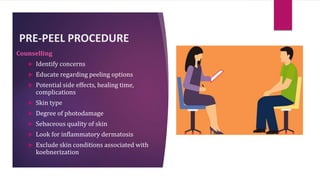
PRE-PEEL PROCEDURE
Counselling
 Identify concerns
 Educate regarding peeling options
 Potential side effects, healing time,
complications
 Skin type
 Degree of photodamage
 Sebaceous quality of skin
 Look for inflammatory dermatosis
 Exclude skin conditions associated with
koebnerization
SKIN PRIMING
Target skin is primed for 2-4 weeks
MORE UNIFORM PENETRATION OF PEELING
AGENT
TO SHORTEN HEALING PHASE
TO REDUCE RISK OF POST INFLAMMATORY
HYPERPIGMENTATION
SKIN PRIMMING
SKIN PRIMING
• Topical Retinoids
For pigmentary disorders:
Stopped 1 week before
peeling procedure
• Topical hydroquinone
• Kojic acid
• Azelaic acid
• Arbutin
• Liquorice
CONSENT & PHOTO DOCUMENTATION
 Whole procedure
 After care
 Informed consent
 Before and after peel photos
 Sun avoidance for 14 days after peel
PEELING PROCEDURE
PEELING PROCEDURE
Careful examination of Skin
Thin skin
requires lower
concentration
Thick skin
requires higher
concentration
Greasy skin gives
better results
than dry skin
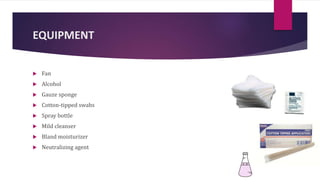
EQUIPMENT
 Fan
 Alcohol
 Gauze sponge
 Cotton-tipped swabs
 Spray bottle
 Mild cleanser
 Bland moisturizer
 Neutralizing agent
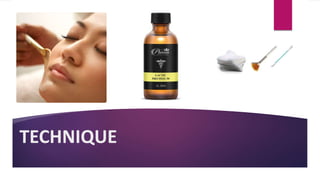
TECHNIQUE
TECHNIQUE
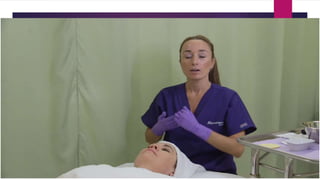
 Remove make up; wash face
 Supine at 45 degrees
 Topical anesthesia can be used medium depth
peels
 Sedation and analgesia for deep peels
 Degreasing for uniform penetration
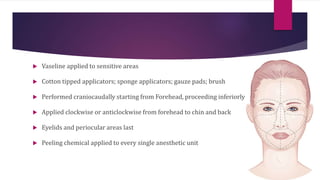
 Vaseline applied to sensitive areas
 Cotton tipped applicators; sponge applicators; gauze pads; brush
 Performed craniocaudally starting from Forehead, proceeding inferiorly
 Applied clockwise or anticlockwise from forehead to chin and back
 Eyelids and periocular areas last
 Peeling chemical applied to every single anesthetic unit
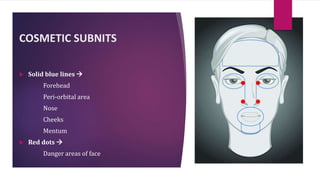
COSMETIC SUBNITS
 Solid blue lines 
Forehead
Peri-orbital area
Nose
Cheeks
Mentum
 Red dots 
Danger areas of face
SAFETY PRECAUTIONS
 Always check label by yourself
 Write down the date of prepared formula on the bottle
 Always shake or tilt the bottle before use
 Always ask patient to close eyes before the procedure
 Watch for tears, dry immediately, tears running down can
create streak of peeling
 Never pass open container over patient’s face
TIPS
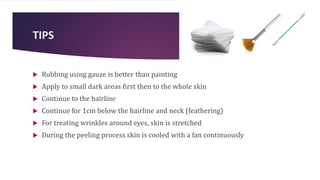
 Rubbing using gauze is better than painting
 Apply to small dark areas first then to the whole skin
 Continue to the hairline
 Continue for 1cm below the hairline and neck (feathering)
 For treating wrinkles around eyes, skin is stretched
 During the peeling process skin is cooled with a fan continuously
GLYCOLIC ACID
 Conc. Range from 15% to 70%
 Concentration of solution and contact time
determines results
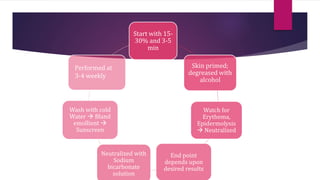
Start with 15-
30% and 3-5
min
Skin primed;
degreased with
alcohol
Watch for
Erythema,
Epidermolysis
 Neutralized
End point
depends upon
desired results
Neutralized with
Sodium
bicarbonate
solution
Wash with cold
Water  Bland
emollient 
Sunscreen
Performed at
3-4 weekly
JESSNER’S SOLUTION
No
Neutralizati
on 
washed with
Water 
Moisturizer
Multiple
coats 
white
Frosting 
from tissue
coagulation
Powdery
whitening
because of
precipitation
of chemicals
Faint
erythema
Degreasing

Application
done evenly
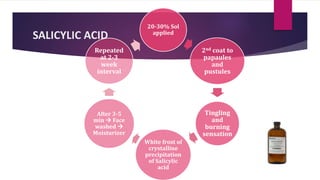
SALICYLIC ACID
20-30% Sol
applied
2nd coat to
papaules
and
pustules
Tingling
and
burning
sensation
White frost of
crystalline
precipitation
of Salicylic
acid
After 3-5
min  Face
washed 
Moisturizer
Repeated
at 2-3
week
interval
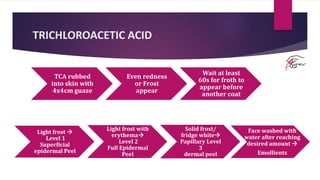
TRICHLOROACETIC ACID
TCA rubbed
into skin with
4x4cm guaze
Even redness
or Frost
appear
Wait at least
60s for froth to
appear before
another coat
Light frost 
Level 1
Superficial
epidermal Peel
Light frost with
erythema
Level 2
Full Epidermal
Peel
Solid frost/
fridge white
Papillary Level
3
dermal peel
Face washed with
water after reaching
desired amount 
Emollients
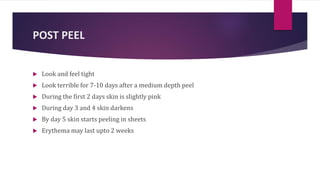
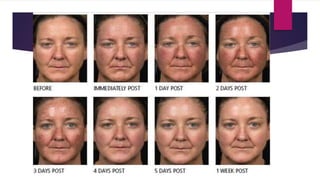
POST PEEL
 Look and feel tight
 Look terrible for 7-10 days after a medium depth peel
 During the first 2 days skin is slightly pink
 During day 3 and 4 skin darkens
 By day 5 skin starts peeling in sheets
 Erythema may last upto 2 weeks
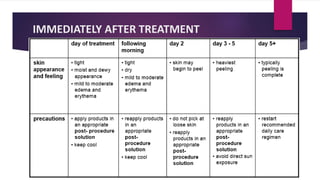
IMMEDIATELY AFTER TREATMENT
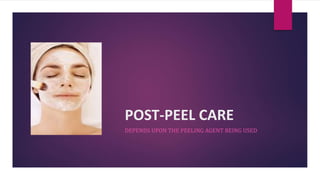
POST-PEEL CARE
DEPENDS UPON THE PEELING AGENT BEING USED
POST-PEEL CARE
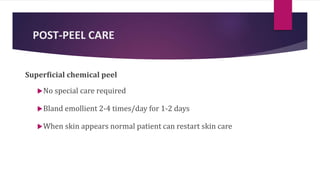
Superficial chemical peel
No special care required
Bland emollient 2-4 times/day for 1-2 days
When skin appears normal patient can restart skin care
POST-PEEL CARE
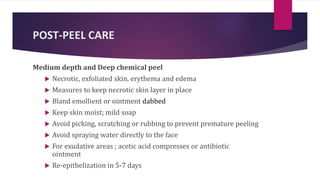
Medium depth and Deep chemical peel
 Necrotic, exfoliated skin, erythema and edema
 Measures to keep necrotic skin layer in place
 Bland emollient or ointment dabbed
 Keep skin moist; mild soap
 Avoid picking, scratching or rubbing to prevent premature peeling
 Avoid spraying water directly to the face
 For exudative areas ; acetic acid compresses or antibiotic
ointment
 Re-epithelization in 5-7 days
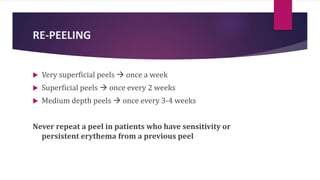
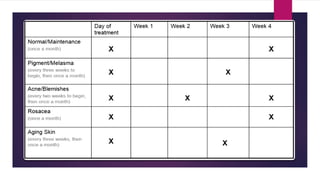
RE-PEELING
 Very superficial peels  once a week
 Superficial peels  once every 2 weeks
 Medium depth peels  once every 3-4 weeks
Never repeat a peel in patients who have sensitivity or
persistent erythema from a previous peel
COMPLICATIONS
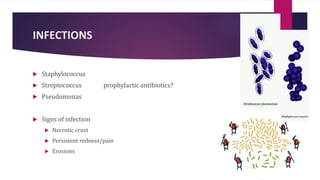
INFECTIONS
 Staphylococcus
 Streptococcus prophylactic antibiotics?
 Pseudomonas
 Signs of infection
 Necrotic crust
 Persistent redness/pain
 Erosions
Reactivation of herpes simplex
 Pain and erosions (no blisters)
 Prophylactic antiviral 24 hours before to
5 days after peel in medium depth peels
 Active lesions need treatment
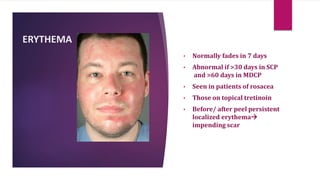
ERYTHEMA
• Normally fades in 7 days
• Abnormal if >30 days in SCP
and >60 days in MDCP
• Seen in patients of rosacea
• Those on topical tretinoin
• Before/ after peel persistent
localized erythema
impending scar
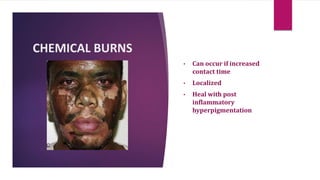
CHEMICAL BURNS
• Can occur if increased
contact time
• Localized
• Heal with post
inflammatory
hyperpigmentation
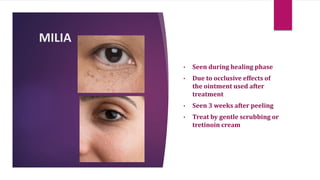
MILIA
• Seen during healing phase
• Due to occlusive effects of
the ointment used after
treatment
• Seen 3 weeks after peeling
• Treat by gentle scrubbing or
tretinoin cream
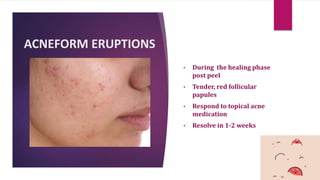
ACNEFORM ERUPTIONS
• During the healing phase
post peel
• Tender, red follicular
papules
• Respond to topical acne
medication
• Resolve in 1-2 weeks
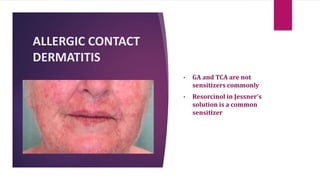
ALLERGIC CONTACT
DERMATITIS
• GA and TCA are not
sensitizers commonly
• Resorcinol in Jessner’s
solution is a common
sensitizer
PREMATURE
PEELING
• Medium depth and deep chemical
peels
• Early removal of necrotic layer
• Fragile healing skin may not re-
epithialize
• Persistent erythema post peel
pigmentation/ scarring
• Treat with topical antibiotic
ointment
• Apply vaseline until re-
epithelialization
• Avoid picking crusts
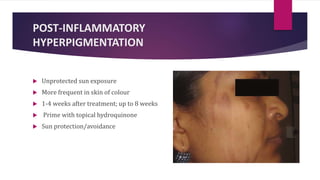
POST-INFLAMMATORY
HYPERPIGMENTATION
 Unprotected sun exposure
 More frequent in skin of colour
 1-4 weeks after treatment; up to 8 weeks
 Prime with topical hydroquinone
 Sun protection/avoidance
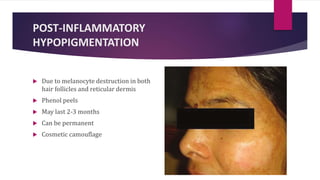
POST-INFLAMMATORY
HYPOPIGMENTATION
 Due to melanocyte destruction in both
hair follicles and reticular dermis
 Phenol peels
 May last 2-3 months
 Can be permanent
 Cosmetic camouflage
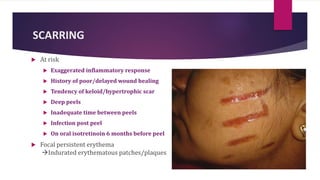
SCARRING
 At risk
 Exaggerated inflammatory response
 History of poor/delayed wound healing
 Tendency of keloid/hypertrophic scar
 Deep peels
 Inadequate time between peels
 Infection post peel
 On oral isotretinoin 6 months before peel
 Focal persistent erythema
Indurated erythematous patches/plaques
SYSTEMIC TOXICITY
 Resorcinol, salicylic acid, phenol applied on skin can be absorbed systemically
 Phenol
 Tachycardia followed by arrhythmias
 Laryngeal edema
 Toxic shock syndrome
 Resorcinol
 Pallor, cold sweating, tremors, collapse
 Anti thyroid activity
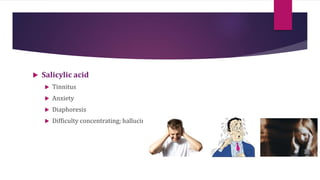
 Salicylic acid
 Tinnitus
 Anxiety
 Diaphoresis
 Difficulty concentrating; hallucinations
CHEMICAL PEELS IN SKIN OF COLOUR
(ASIANS)
 Skin dyschromias
 Acne vulgaris
 Superficial acne marks/scars
 Textural changes superficial peels
 Oily skin
 Fine wrinkles
 Pseudofolliculitis barbae
PEELS IN PATIENTS WITH SKIN OF COLOUR
 Pre-peel priming
 Hydroquinone (2-4 weeks pre-peel)
 Stop topical retinoids 1 week pre-peel
 Superficial peeling agents
 Post peel
 Sun avoidance
 Sunscreens
 Apply topical retinoids for 1 week after peel
 Continue with topical skin whiteners until skin is healed
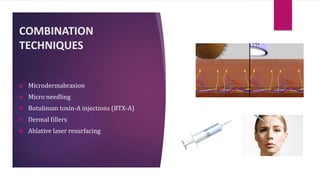
COMBINATION
TECHNIQUES
 Microdermabrasion
 Micro needling
 Botulinum toxin-A injections (BTX-A)
 Dermal fillers
 Ablative laser resurfacing
 According to Illustrated guide to Chemical peels
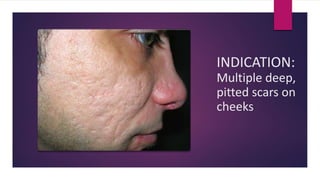
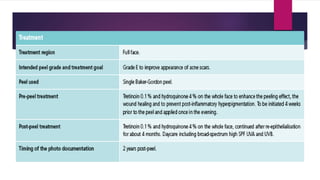
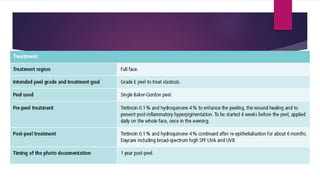
INDICATION:
Multiple deep,
pitted scars on
cheeks
POST-PEEL
PRE-PEEL
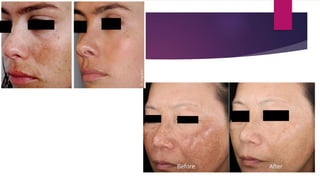
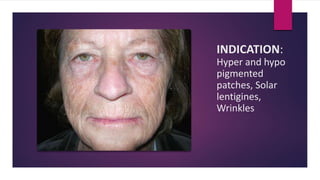
INDICATION:
Hyper and hypo
pigmented
patches, Solar
lentigines,
Wrinkles
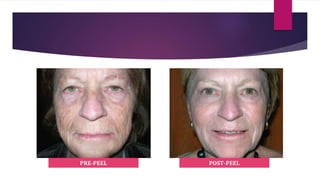
PRE-PEEL POST-PEEL
Mild
properties
Non-
invasive
Minimal
side effects
Outdoor
procedure
Cost
effective
REFRENCES
 Rook's Textbook of Dermatology, 9th Edition
Christopher Griffiths (Editor), Jonathan Barker (Editor), Tanya Bleiker (Editor),
Robert Chalmers (Editor), Daniel Creamer (Editor)
 Connor A, Lowe P, Shumack S. Chemical peels: A review of current practice.
Australasian Journal of Dermatology (2018) 59, 171–181
 Illustrated Guide to Chemical Peels: Basics - Indications - Uses (Aesthetic Methods for
Skin Rejuvenation) by Mark G. Rubin (2014)
 Soleymani T, Lanoue J, Rahman Z. A Practical Approach to Chemical Peels: A Review
of Fundamentals and Step-by-step Algorithmic Protocol for Treatment. J Clin Aesthet
Dermatol. 2018;11(8):21–28.
THANK
YOU

Chemical peels.pptx

  • 1.
    CHEMICAL PEELS DR. ANAM MEHMOOD POSTGRADUATE RESIDENT DERMATOLOGY UNIT I
  • 2.
  • 4.
    What is skin peeling? METHODOF SKIN RESURFACING • ACCELERATED EXFOLIATION BY USING IRRITANT CHEMICALS
  • 5.
    HISTORY Since ancient times, womenhave been using different methods to exfoliate their skin
  • 6.
    EGYPTIANS  Ancient Egyptiansused animal oils  Cleopatra was reported to bathe in sour milk to rejuvenate skin
  • 7.
    BABYLONIA AND INDIA  Womenused pumice stones to exfoliate the top layers of the skin
  • 8.
    TURKS  Turks wouldintentionally singe their skin with fire to achieve exfoliation of the skin
  • 9.
    GREEKS AND ROMANS  Usedsoured milk, fermented grape juice, and lemon extract to clarify their skin
  • 10.
    GYPSIES  The firstgroup to use phenol for deep chemical peels, and they are known to have passed secret chemical peel recipes between villages and generations
  • 11.
    Today!!! Chemical Peels arethe THIRD most commonly performed noninvasive cosmetic procedure in United States with over 1,300,000 procedures performed in 2016 alone American Society of Plastic Surgeons
  • 12.
    PEELING AGENTS Peels with metabolicaction • Alpha-hydroxyl acids • Azelaic acids • Retinoic acid Peels with caustic action • Trichloroacetic acid • Jessner’s solution Peels with toxic action • Phenol • Salicylic acid
  • 13.
    How do Peels Act? Controlledkeratocoagulation and denaturation of dermal and epidermal proteins Release of proinflammatory cytokines and chemokines Targeted inflammation activates normal healing signal cascade Stimulation, development and deposition of new dermal collagen and elastin, reorganization of structural scaffold proteins and dermal connective tissue, and regeneration of new keratinocytes Results in rejuvenation and thickening of the epidermis and an increase in dermal volume Subsequent exfoliation result in improvement in superficial and medium-depth dyspigmentation
  • 14.
  • 15.
    Factors  Chemicals applied Mode of application  Skin type  Skin condition
  • 16.
  • 19.
  • 20.
    Chemicals used: Glycolic acid20-50% Salicylic acid TCA 10-25%
  • 21.
  • 22.
    • Glycolic acid70% (3-30min) • TCA 35-50% • Augmented TCA (TCA 35% plus Jessner’s solution/ glycolic acid 70% Chemicals used:
  • 23.
    DEEP (RETICULAR DERMIS) Indications Dyschromias Wrinkles Premalignant skin tumours Acnescars Necrosis of epidermis and papillary dermis extending to reticular dermis
  • 24.
    Chemicals used: Phenol 88% Baker-GordonPhenol formula Pure undiluted 88% phenol + croton oil + septisol liquid soap + water
  • 25.
    ALPHA-HYDROXYL ACIDS  Naturallyocuring compounds  Glycolic acid from sugar cane  Lactic acid from sour milk  Citric acid from citrus fruits  Phytic acid from rice
  • 26.
    Low conc. (30%) Reducesulphate and phosphate groups from corneocyte surface Decrease corneocyte adhesion Induce Exfoliation
  • 27.
  • 28.
    LACTIC ACID  Comparableefficacy with Glycolic acid  Low pH  Low concentration is required  Exfoliation after treatment occurs for several days  Re-epithelialization in 7-10 days
  • 29.
    MANDELIC ACID  Simplephenolic alpha-hydroxy acid  Soluble in both water and polar organic solutions  results in a more uniform penetration through lipid-rich areas of skin  Results of mandelic acid peels are more subtle than that of superficial glycolic acid peels  Side effects and subsequent downtime of mandelic acid are comparatively less  Frequent “touch ups” and shortened intervals between treatment sessions  Minimal desquamation  Re-epithelialization is often complete within 3 to 5 days.
  • 30.
    GLYCOLIC ACID  Mostcommonly used alpha-hydroxyl acid  Available in various concentrations up to 70%  Needs application of water or weak buffer (5% sodium bicarbonate) once desired depth has been reached
  • 31.
    AZELAIC ACID  Saturateddicarboxylic acid  Naturally found in rye, wheat and barley  20% topical preparation  Mainly used in acne and melasma
  • 32.
    JESSNER’S SOLUTION  14%lactic acid, 14% salicylic acid, 14% resorcinol in ethanol  Provokes stratum corneum separation only  Can be used alone or in combination with TCA  Depth of peel is dependent on number of coats  Erythema  powdery whitening of skin  exfoliation lasting 8-10 days  Repeated monthly
  • 33.
    PHENOLS  Direct toxicityto cell proteins, membranes and enzymatic degradation  88% conc. causes immediate coagulation of proteins upto upper reticular dermis  45-55% conc. acts as keratolytic deeper penetration to mid reticular dermis  Systemic effects include cardiotoxicity  Cardiac monitoring  Resuscitative equipment
  • 34.
    Indications  Anti ageing Deep rhytidosis  Dyschromia
  • 35.
    SALICYLIC ACID  Beta-hydroxyacid  Keratolytic with high affinity for lipids preferentially acts through pores  20-30% topical preparation
  • 36.
    Indications  Comedonal andinflammatory acne  Early to moderate photo damage  Oily skin with enlarged pores  Rosacea  Post inflammatory hyperpigmentation  Melasma
  • 37.
     Does notneed neutralization  No concerns about timings or over peeling  Preferred in Fitzpatrick skin type V and VI  Systemic toxicity rare (Salicylism)
  • 38.
    TRICHLOROACETIC ACID  Analogueof acetic acid  Found naturally as hygroscopic crystals  Gold standard for chemical peels for many years  @ conc. 10-25%  Superficial peel  @ conc. 30%  Medium depth peel  @ conc. >30%  not recommended, unpredictable results
  • 39.
     Destructive dueto low pH  Rapidly neutralized  Coagulation of skin proteins  Clinical end point of treatment is frosting  Frosting is due to denaturation of proteins  Replaced by erythema
  • 41.
    BAKER–GORDON FORMULA  88% phenol, croton oil, hexachlorophene and distilled water  Croton oil is a vesicant derived from the seed of the Croton tiglium plant that promotes deeper penetration and absorption of phenol  Hexachlorophene is a liquid soap that increases surface tension, acts as an emulsifier and retards phenol penetration
  • 42.
    COMBINATION PEELS  70%Glycolic acid un buffered peel followed by 35% TCA  Combined Jessner’s solution (1-4 coats) and 35%TCA
  • 43.
    -Skin rejuvenation -Photodamaged skin -AcneVulgaris -Pigmentation -Wrinkles and scars INDICATIONS
  • 44.
    SKIN REJUVENATION  Superficialand medium depth peels  Superficial peels temporary ‘refreshed ’ look  Medium depth  improve fine lines, wrinkles, pigmentation
  • 45.
    PHOTODAMAGED SKIN  Medium depthpeels like TCA and Jessner’s solution are most popular  Superficial peels not effective for solar lentigines, wrinkles
  • 46.
    ACNE VULGARIS  Comedogenicacne  Acne associated hyperpigmentation  Mild acne scarring  Salicylic acid  Glycolic acid  Mandelic acid  Jessner’s solution
  • 47.
    DYSCHROMIAS  Ephelides  Lentigines Flat seborrhoeic keratoses  Melasma  Post inflammatory hyperpigmentation  Repeated sessions are needed  5-6 peels at 2-3 week intervals
  • 49.
    WRINKLES AND SCARS Medium depth and deep chemical peels  Replaced by laser technology
  • 50.
    CONTRAINDICATIONS Absolute Allergy to peelingsolution/ neutralizing agent Patients with unrealistic expectations Immunosuppression Relative Use of oral isotretinoin, OCPs, Tetracyclines Pregnancy or lactation Herpes labialis Plain Warts or dermatitis Radiotherapy irradiated skin/ Photosensitivity History of scar or keloid formation
  • 51.
  • 52.
    TEST-SPOT TESTING  Applicationof the medium-depth or deep-peeling agent to a small area of skin  Common areas: lateral temple, anterior hairline and pre-auricular region • Healing time • Pigmentary response • Post peel complications • Delay of treatment
  • 53.
    PRE-PEEL PROCEDURE Counselling  Identifyconcerns  Educate regarding peeling options  Potential side effects, healing time, complications  Skin type  Degree of photodamage  Sebaceous quality of skin  Look for inflammatory dermatosis  Exclude skin conditions associated with koebnerization
  • 54.
    SKIN PRIMING Target skinis primed for 2-4 weeks
  • 55.
    MORE UNIFORM PENETRATIONOF PEELING AGENT TO SHORTEN HEALING PHASE TO REDUCE RISK OF POST INFLAMMATORY HYPERPIGMENTATION SKIN PRIMMING
  • 56.
    SKIN PRIMING • TopicalRetinoids For pigmentary disorders: Stopped 1 week before peeling procedure • Topical hydroquinone • Kojic acid • Azelaic acid • Arbutin • Liquorice
  • 57.
    CONSENT & PHOTODOCUMENTATION  Whole procedure  After care  Informed consent  Before and after peel photos  Sun avoidance for 14 days after peel
  • 58.
  • 59.
    PEELING PROCEDURE Careful examinationof Skin Thin skin requires lower concentration Thick skin requires higher concentration Greasy skin gives better results than dry skin
  • 60.
    EQUIPMENT  Fan  Alcohol Gauze sponge  Cotton-tipped swabs  Spray bottle  Mild cleanser  Bland moisturizer  Neutralizing agent
  • 61.
  • 62.
    TECHNIQUE  Remove makeup; wash face  Supine at 45 degrees  Topical anesthesia can be used medium depth peels  Sedation and analgesia for deep peels  Degreasing for uniform penetration
  • 63.
     Vaseline appliedto sensitive areas  Cotton tipped applicators; sponge applicators; gauze pads; brush  Performed craniocaudally starting from Forehead, proceeding inferiorly  Applied clockwise or anticlockwise from forehead to chin and back  Eyelids and periocular areas last  Peeling chemical applied to every single anesthetic unit
  • 64.
    COSMETIC SUBNITS  Solidblue lines  Forehead Peri-orbital area Nose Cheeks Mentum  Red dots  Danger areas of face
  • 66.
    SAFETY PRECAUTIONS  Alwayscheck label by yourself  Write down the date of prepared formula on the bottle  Always shake or tilt the bottle before use  Always ask patient to close eyes before the procedure  Watch for tears, dry immediately, tears running down can create streak of peeling  Never pass open container over patient’s face
  • 67.
    TIPS  Rubbing usinggauze is better than painting  Apply to small dark areas first then to the whole skin  Continue to the hairline  Continue for 1cm below the hairline and neck (feathering)  For treating wrinkles around eyes, skin is stretched  During the peeling process skin is cooled with a fan continuously
  • 68.
    GLYCOLIC ACID  Conc.Range from 15% to 70%  Concentration of solution and contact time determines results
  • 69.
    Start with 15- 30%and 3-5 min Skin primed; degreased with alcohol Watch for Erythema, Epidermolysis  Neutralized End point depends upon desired results Neutralized with Sodium bicarbonate solution Wash with cold Water  Bland emollient  Sunscreen Performed at 3-4 weekly
  • 71.
    JESSNER’S SOLUTION No Neutralizati on  washedwith Water  Moisturizer Multiple coats  white Frosting  from tissue coagulation Powdery whitening because of precipitation of chemicals Faint erythema Degreasing  Application done evenly
  • 72.
    SALICYLIC ACID 20-30% Sol applied 2ndcoat to papaules and pustules Tingling and burning sensation White frost of crystalline precipitation of Salicylic acid After 3-5 min  Face washed  Moisturizer Repeated at 2-3 week interval
  • 73.
    TRICHLOROACETIC ACID TCA rubbed intoskin with 4x4cm guaze Even redness or Frost appear Wait at least 60s for froth to appear before another coat Light frost  Level 1 Superficial epidermal Peel Light frost with erythema Level 2 Full Epidermal Peel Solid frost/ fridge white Papillary Level 3 dermal peel Face washed with water after reaching desired amount  Emollients
  • 76.
    POST PEEL  Lookand feel tight  Look terrible for 7-10 days after a medium depth peel  During the first 2 days skin is slightly pink  During day 3 and 4 skin darkens  By day 5 skin starts peeling in sheets  Erythema may last upto 2 weeks
  • 77.
  • 79.
    POST-PEEL CARE DEPENDS UPONTHE PEELING AGENT BEING USED
  • 80.
    POST-PEEL CARE Superficial chemicalpeel No special care required Bland emollient 2-4 times/day for 1-2 days When skin appears normal patient can restart skin care
  • 81.
    POST-PEEL CARE Medium depthand Deep chemical peel  Necrotic, exfoliated skin, erythema and edema  Measures to keep necrotic skin layer in place  Bland emollient or ointment dabbed  Keep skin moist; mild soap  Avoid picking, scratching or rubbing to prevent premature peeling  Avoid spraying water directly to the face  For exudative areas ; acetic acid compresses or antibiotic ointment  Re-epithelization in 5-7 days
  • 82.
    RE-PEELING  Very superficialpeels  once a week  Superficial peels  once every 2 weeks  Medium depth peels  once every 3-4 weeks Never repeat a peel in patients who have sensitivity or persistent erythema from a previous peel
  • 84.
  • 85.
    INFECTIONS  Staphylococcus  Streptococcusprophylactic antibiotics?  Pseudomonas  Signs of infection  Necrotic crust  Persistent redness/pain  Erosions
  • 86.
    Reactivation of herpessimplex  Pain and erosions (no blisters)  Prophylactic antiviral 24 hours before to 5 days after peel in medium depth peels  Active lesions need treatment
  • 87.
    ERYTHEMA • Normally fadesin 7 days • Abnormal if >30 days in SCP and >60 days in MDCP • Seen in patients of rosacea • Those on topical tretinoin • Before/ after peel persistent localized erythema impending scar
  • 88.
    CHEMICAL BURNS • Canoccur if increased contact time • Localized • Heal with post inflammatory hyperpigmentation
  • 89.
    MILIA • Seen duringhealing phase • Due to occlusive effects of the ointment used after treatment • Seen 3 weeks after peeling • Treat by gentle scrubbing or tretinoin cream
  • 90.
    ACNEFORM ERUPTIONS • Duringthe healing phase post peel • Tender, red follicular papules • Respond to topical acne medication • Resolve in 1-2 weeks
  • 91.
    ALLERGIC CONTACT DERMATITIS • GAand TCA are not sensitizers commonly • Resorcinol in Jessner’s solution is a common sensitizer
  • 92.
    PREMATURE PEELING • Medium depthand deep chemical peels • Early removal of necrotic layer • Fragile healing skin may not re- epithialize • Persistent erythema post peel pigmentation/ scarring • Treat with topical antibiotic ointment • Apply vaseline until re- epithelialization • Avoid picking crusts
  • 93.
    POST-INFLAMMATORY HYPERPIGMENTATION  Unprotected sunexposure  More frequent in skin of colour  1-4 weeks after treatment; up to 8 weeks  Prime with topical hydroquinone  Sun protection/avoidance
  • 94.
    POST-INFLAMMATORY HYPOPIGMENTATION  Due tomelanocyte destruction in both hair follicles and reticular dermis  Phenol peels  May last 2-3 months  Can be permanent  Cosmetic camouflage
  • 95.
    SCARRING  At risk Exaggerated inflammatory response  History of poor/delayed wound healing  Tendency of keloid/hypertrophic scar  Deep peels  Inadequate time between peels  Infection post peel  On oral isotretinoin 6 months before peel  Focal persistent erythema Indurated erythematous patches/plaques
  • 96.
    SYSTEMIC TOXICITY  Resorcinol,salicylic acid, phenol applied on skin can be absorbed systemically  Phenol  Tachycardia followed by arrhythmias  Laryngeal edema  Toxic shock syndrome  Resorcinol  Pallor, cold sweating, tremors, collapse  Anti thyroid activity
  • 97.
     Salicylic acid Tinnitus  Anxiety  Diaphoresis  Difficulty concentrating; hallucinations
  • 98.
    CHEMICAL PEELS INSKIN OF COLOUR (ASIANS)  Skin dyschromias  Acne vulgaris  Superficial acne marks/scars  Textural changes superficial peels  Oily skin  Fine wrinkles  Pseudofolliculitis barbae
  • 99.
    PEELS IN PATIENTSWITH SKIN OF COLOUR  Pre-peel priming  Hydroquinone (2-4 weeks pre-peel)  Stop topical retinoids 1 week pre-peel  Superficial peeling agents  Post peel  Sun avoidance  Sunscreens  Apply topical retinoids for 1 week after peel  Continue with topical skin whiteners until skin is healed
  • 100.
    COMBINATION TECHNIQUES  Microdermabrasion  Microneedling  Botulinum toxin-A injections (BTX-A)  Dermal fillers  Ablative laser resurfacing
  • 101.
     According toIllustrated guide to Chemical peels
  • 102.
  • 104.
  • 105.
  • 107.
  • 108.
  • 109.
    REFRENCES  Rook's Textbookof Dermatology, 9th Edition Christopher Griffiths (Editor), Jonathan Barker (Editor), Tanya Bleiker (Editor), Robert Chalmers (Editor), Daniel Creamer (Editor)  Connor A, Lowe P, Shumack S. Chemical peels: A review of current practice. Australasian Journal of Dermatology (2018) 59, 171–181  Illustrated Guide to Chemical Peels: Basics - Indications - Uses (Aesthetic Methods for Skin Rejuvenation) by Mark G. Rubin (2014)  Soleymani T, Lanoue J, Rahman Z. A Practical Approach to Chemical Peels: A Review of Fundamentals and Step-by-step Algorithmic Protocol for Treatment. J Clin Aesthet Dermatol. 2018;11(8):21–28.
  • 111.