R ADAMS COWLEY SHOCK TRAUMA CENTER
Rapid Review: Traumatic Brain
Injury
Sam Galvagno, DO, PhD, FCCM
Col, USAF, MC, SFS
Associate Professor
Medical Director, Lung Rescue Unit (LRU)
University of Maryland School of Medicine
R Adams Cowley Shock Trauma Center
Baltimore, MD, USA
R ADAMS COWLEY SHOCK TRAUMA CENTER
Disclosures
• United States Air
Force Reserve
• UpToDate®
Author
• Department of
Defense Funding
R ADAMS COWLEY SHOCK TRAUMA CENTER
Objectives
• Review treatment guidelines for the
management of TBI
• List evidence-based interventions for TBI
• Assess key publications published in the
last year
R ADAMS COWLEY SHOCK TRAUMA CENTER
R Adams
Cowley
Shock
Trauma
Center
Context
• TBI + hemorrhage  leading
cause of death from injuries
• Paucity of data to help guide
decision making
– MAP target? Monitoring
modalities?
– Physiological phenotypes?
Dutton RP. J Trauma 2010.
Eastridge BJ. J Trauma Acute Care Surg 2012.
Bogert JN. J Intensive Care Med 2016.
Brasel KH. J Trauma 2011.
Galvagno SM. J Trauma Acute Care Surg 2017.
Bouzat P. Ann Intensive Care 2013.
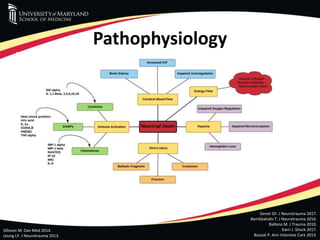
Pathophysiology
Genet GF. J Neurotrauma 2017.
Bambbakidis T. J Neurotrauma 2016.
Balbino M. J Trauma 2010.
Karri J. Shock 2017.
Bouzat P. Ann Intensive Care 2013.
Silleson M. Dan Med 2014.
Leung LY. J Neurotrauma 2013.
R ADAMS COWLEY SHOCK TRAUMA CENTER
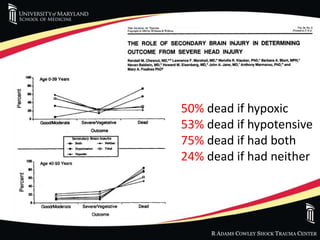
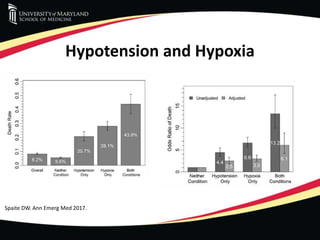
50% dead if hypoxic
53% dead if hypotensive
75% dead if had both
24% dead if had neither
Hypotension and Hypoxia
Spaite DW. Ann Emerg Med 2017.
R ADAMS COWLEY SHOCK TRAUMA CENTER
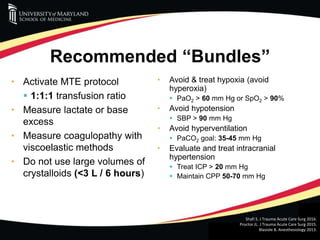
Recommended “Bundles”
• Activate MTE protocol
 1:1:1 transfusion ratio
• Measure lactate or base
excess
• Measure coagulopathy with
viscoelastic methods
• Do not use large volumes of
crystalloids (<3 L / 6 hours)
• Avoid & treat hypoxia (avoid
hyperoxia)
 PaO2 > 60 mm Hg or SpO2 > 90%
• Avoid hypotension
 SBP > 90 mm Hg
• Avoid hyperventilation
 PaCO2 goal: 35-45 mm Hg
• Evaluate and treat intracranial
hypertension
 Treat ICP > 20 mm Hg
 Maintain CPP 50-70 mm Hg
Shafi S. J Trauma Acute Care Surg 2016.
Proctor JL. J Trauma Acute Care Surg 2015.
Blasiole B. Anesthesiology 2013.
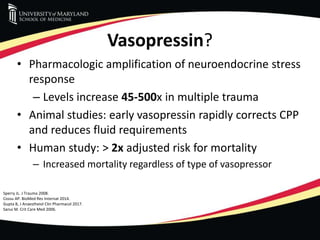
Vasopressin?
• Pharmacologic amplification of neuroendocrine stress
response
– Levels increase 45-500x in multiple trauma
• Animal studies: early vasopressin rapidly corrects CPP
and reduces fluid requirements
• Human study: > 2x adjusted risk for mortality
– Increased mortality regardless of type of vasopressor
Sperry JL. J Trauma 2008.
Cossu AP. BioMed Res Internat 2014.
Gupta B, J Anaestheiol Clin Pharmacol 2017.
Sanui M. Crit Care Med 2006.
R ADAMS COWLEY SHOCK TRAUMA CENTER
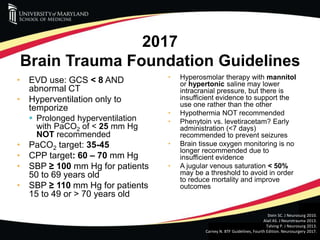
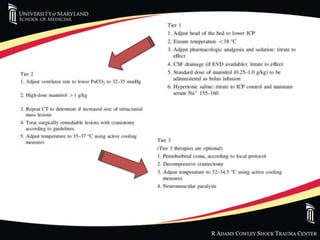
2017
Brain Trauma Foundation Guidelines
• EVD use: GCS < 8 AND
abnormal CT
• Hyperventilation only to
temporize
 Prolonged hyperventilation
with PaCO2 of < 25 mm Hg
NOT recommended
• PaCO2 target: 35-45
• CPP target: 60 – 70 mm Hg
• SBP ≥ 100 mm Hg for patients
50 to 69 years old
• SBP ≥ 110 mm Hg for patients
15 to 49 or > 70 years old
• Hyperosmolar therapy with mannitol
or hypertonic saline may lower
intracranial pressure, but there is
insufficient evidence to support the
use one rather than the other
• Hypothermia NOT recommended
• Phenytoin vs. levetiracetam? Early
administration (<7 days)
recommended to prevent seizures
• Brain tissue oxygen monitoring is no
longer recommended due to
insufficient evidence
• A jugular venous saturation < 50%
may be a threshold to avoid in order
to reduce mortality and improve
outcomes
Stein SC. J Neurosurg 2010.
Alail AS. J Neurotrauma 2013.
Talving P. J Neurosurg 2013.
Carney N. BTF Guidelines, Fourth Edition. Neurosurgery 2017.
Fluid Choice
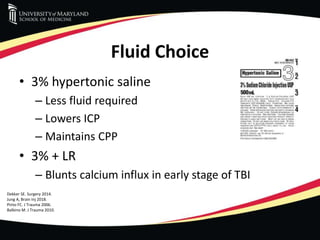
• 3% hypertonic saline
– Less fluid required
– Lowers ICP
– Maintains CPP
• 3% + LR
– Blunts calcium influx in early stage of TBI
Dekker SE. Surgery 2014.
Jung A, Brain Inj 2018.
Pinto FC. J Trauma 2006.
Balbino M. J Trauma 2010.
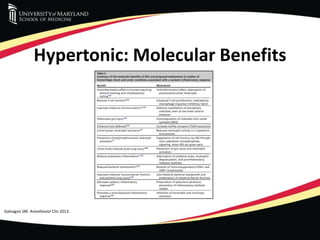
Hypertonic: Molecular Benefits
Galvagno SM. Anesthesiol Clin 2013.
Valproic Acid
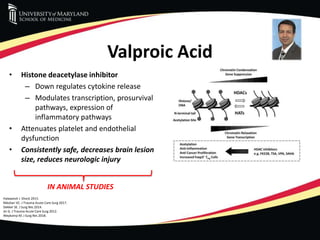
• Histone deacetylase inhibitor
– Down regulates cytokine release
– Modulates transcription, prosurvival
pathways, expression of
inflammatory pathways
• Attenuates platelet and endothelial
dysfunction
• Consistently safe, decreases brain lesion
size, reduces neurologic injury
IN ANIMAL STUDIES
Halaweish I. Shock 2015.
Nikolian VC. J Trauma Acute Care Surg 2017.
Dekker SE. J Surg Res 2014.
Jin G. J Trauma Acute Care Surg 2012.
Weykamp M. J Surg Res 2018.
Plasma Resuscitation
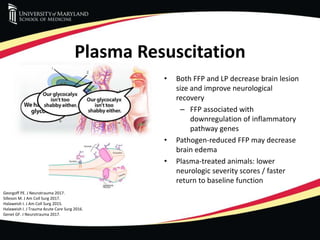
• Both FFP and LP decrease brain lesion
size and improve neurological
recovery
– FFP associated with
downregulation of inflammatory
pathway genes
• Pathogen-reduced FFP may decrease
brain edema
• Plasma-treated animals: lower
neurologic severity scores / faster
return to baseline function
Georgoff PE. J Neurotrauma 2017.
Silleson M. J Am Coll Surg 2017.
Halaweish I. J Am Coll Surg 2015.
Halaweish I. J Trauma Acute Care Surg 2016.
Genet GF. J Neurotrauma 2017.
R ADAMS COWLEY SHOCK TRAUMA CENTER
3 Important TBI Studies
Brain oxygenation optimization in Severe Traumatic Brain Injury (BOOST-II)
Okonkwo DO, Shutter LA, Moore C, et al. .
10 Trauma Centers (Pittsburgh, Washington, UT Southwestern, Cincinnati, Miami, Stanford, Ohio State, Temple, Thomas Jefferson, Baylor, Penn)
Crit Care Med 2017; 45: 1907-1914.
• 2 arm, prospective RCT, 10 level 1 trauma centers
• ICP + PbtO2 vs. ICP monitor
• Interventions based either/or ICP ≥ 20 or PbtO2 < 20
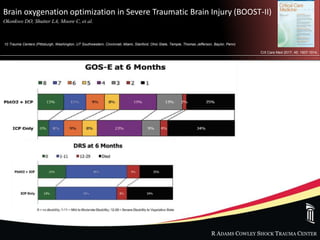
• Primary outcome: efficacy of PbtO2 treatment
• PbtO2 group ↓ hypoxia by 66% and ↓ depth of hypoxia
by 77%
• Trend toward lower mortality (34 vs. 25%)
R ADAMS COWLEY SHOCK TRAUMA CENTER
Brain oxygenation optimization in Severe Traumatic Brain Injury (BOOST-II)
Okonkwo DO, Shutter LA, Moore C, et al. .
10 Trauma Centers (Pittsburgh, Washington, UT Southwestern, Cincinnati, Miami, Stanford, Ohio State, Temple, Thomas Jefferson, Baylor, Penn)
Crit Care Med 2017; 45: 1907-1914.
Brain Tissue Oxygenation:
What is it and does it tell us?
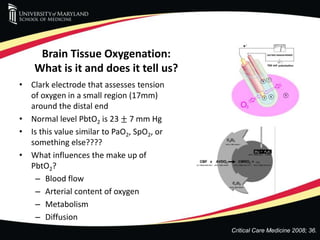
• Clark electrode that assesses tension
of oxygen in a small region (17mm)
around the distal end
• Normal level PbtO2 is 23 ± 7 mm Hg
• Is this value similar to PaO2, SpO2, or
something else????
• What influences the make up of
PbtO2?
– Blood flow
– Arterial content of oxygen
– Metabolism
– Diffusion
Critical Care Medicine 2008; 36.
R ADAMS COWLEY SHOCK TRAUMA CENTER
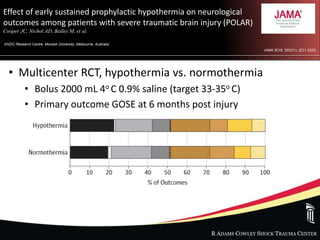
Effect of early sustained prophylactic hypothermia on neurological
outcomes among patients with severe traumatic brain injury (POLAR)
Cooper JC, Nichol AD, Bailey M, et al.
ANZIC Research Centre, Monash University, Melbourne, Australia
JAMA 2018; 320(21): 2211-2220.
• Multicenter RCT, hypothermia vs. normothermia
• Bolus 2000 mL 4o C 0.9% saline (target 33-35o C)
• Primary outcome GOSE at 6 months post injury
R ADAMS COWLEY SHOCK TRAUMA CENTER
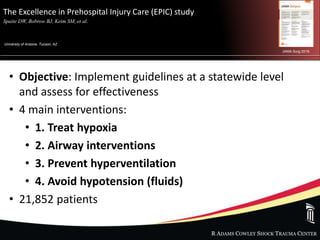
The Excellence in Prehospital Injury Care (EPIC) study
Spaite DW, Bobrow BJ, Keim SM, et al. .
University of Arizona, Tucson, AZ
JAMA Surg 2019.
• Objective: Implement guidelines at a statewide level
and assess for effectiveness
• 4 main interventions:
• 1. Treat hypoxia
• 2. Airway interventions
• 3. Prevent hyperventilation
• 4. Avoid hypotension (fluids)
• 21,852 patients
R ADAMS COWLEY SHOCK TRAUMA CENTER
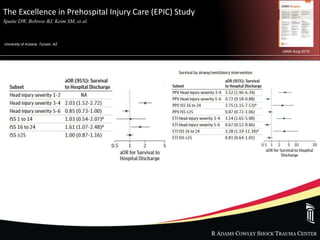
The Excellence in Prehospital Injury Care (EPIC) Study
Spaite DW, Bobrow BJ, Keim SM, et al. .
University of Arizona, Tucson, AZ
JAMA Surg 2019.
R ADAMS COWLEY SHOCK TRAUMA CENTER
Thank you!
sgalvagno@som.umaryland.edu
Problems with Animal Studies
• Animals anesthetized
• Hypercoagulable (swine)
• Experimental setup – “controlled” condition
– To maximize reproducibility / standardization
• Focal vs. diffuse TBI
• Poor reproducibility with uncontrolled
hemorrhage models
Combes RD. Altern Lab Anim 2013.
Namas R. LJM 2009.
Angoa-Perez M. J Neurochem 2014.

Brain by Associate Professor Samuel Galvagno

  • 1.
    R ADAMS COWLEYSHOCK TRAUMA CENTER Rapid Review: Traumatic Brain Injury Sam Galvagno, DO, PhD, FCCM Col, USAF, MC, SFS Associate Professor Medical Director, Lung Rescue Unit (LRU) University of Maryland School of Medicine R Adams Cowley Shock Trauma Center Baltimore, MD, USA
  • 2.
    R ADAMS COWLEYSHOCK TRAUMA CENTER Disclosures • United States Air Force Reserve • UpToDate® Author • Department of Defense Funding
  • 3.
    R ADAMS COWLEYSHOCK TRAUMA CENTER Objectives • Review treatment guidelines for the management of TBI • List evidence-based interventions for TBI • Assess key publications published in the last year
  • 4.
    R ADAMS COWLEYSHOCK TRAUMA CENTER R Adams Cowley Shock Trauma Center
  • 5.
    Context • TBI +hemorrhage  leading cause of death from injuries • Paucity of data to help guide decision making – MAP target? Monitoring modalities? – Physiological phenotypes? Dutton RP. J Trauma 2010. Eastridge BJ. J Trauma Acute Care Surg 2012. Bogert JN. J Intensive Care Med 2016. Brasel KH. J Trauma 2011. Galvagno SM. J Trauma Acute Care Surg 2017. Bouzat P. Ann Intensive Care 2013.
  • 6.
    Pathophysiology Genet GF. JNeurotrauma 2017. Bambbakidis T. J Neurotrauma 2016. Balbino M. J Trauma 2010. Karri J. Shock 2017. Bouzat P. Ann Intensive Care 2013. Silleson M. Dan Med 2014. Leung LY. J Neurotrauma 2013.
  • 7.
    R ADAMS COWLEYSHOCK TRAUMA CENTER 50% dead if hypoxic 53% dead if hypotensive 75% dead if had both 24% dead if had neither
  • 8.
    Hypotension and Hypoxia SpaiteDW. Ann Emerg Med 2017.
  • 9.
    R ADAMS COWLEYSHOCK TRAUMA CENTER Recommended “Bundles” • Activate MTE protocol  1:1:1 transfusion ratio • Measure lactate or base excess • Measure coagulopathy with viscoelastic methods • Do not use large volumes of crystalloids (<3 L / 6 hours) • Avoid & treat hypoxia (avoid hyperoxia)  PaO2 > 60 mm Hg or SpO2 > 90% • Avoid hypotension  SBP > 90 mm Hg • Avoid hyperventilation  PaCO2 goal: 35-45 mm Hg • Evaluate and treat intracranial hypertension  Treat ICP > 20 mm Hg  Maintain CPP 50-70 mm Hg Shafi S. J Trauma Acute Care Surg 2016. Proctor JL. J Trauma Acute Care Surg 2015. Blasiole B. Anesthesiology 2013.
  • 10.
    Vasopressin? • Pharmacologic amplificationof neuroendocrine stress response – Levels increase 45-500x in multiple trauma • Animal studies: early vasopressin rapidly corrects CPP and reduces fluid requirements • Human study: > 2x adjusted risk for mortality – Increased mortality regardless of type of vasopressor Sperry JL. J Trauma 2008. Cossu AP. BioMed Res Internat 2014. Gupta B, J Anaestheiol Clin Pharmacol 2017. Sanui M. Crit Care Med 2006.
  • 11.
    R ADAMS COWLEYSHOCK TRAUMA CENTER 2017 Brain Trauma Foundation Guidelines • EVD use: GCS < 8 AND abnormal CT • Hyperventilation only to temporize  Prolonged hyperventilation with PaCO2 of < 25 mm Hg NOT recommended • PaCO2 target: 35-45 • CPP target: 60 – 70 mm Hg • SBP ≥ 100 mm Hg for patients 50 to 69 years old • SBP ≥ 110 mm Hg for patients 15 to 49 or > 70 years old • Hyperosmolar therapy with mannitol or hypertonic saline may lower intracranial pressure, but there is insufficient evidence to support the use one rather than the other • Hypothermia NOT recommended • Phenytoin vs. levetiracetam? Early administration (<7 days) recommended to prevent seizures • Brain tissue oxygen monitoring is no longer recommended due to insufficient evidence • A jugular venous saturation < 50% may be a threshold to avoid in order to reduce mortality and improve outcomes Stein SC. J Neurosurg 2010. Alail AS. J Neurotrauma 2013. Talving P. J Neurosurg 2013. Carney N. BTF Guidelines, Fourth Edition. Neurosurgery 2017.
  • 12.
    Fluid Choice • 3%hypertonic saline – Less fluid required – Lowers ICP – Maintains CPP • 3% + LR – Blunts calcium influx in early stage of TBI Dekker SE. Surgery 2014. Jung A, Brain Inj 2018. Pinto FC. J Trauma 2006. Balbino M. J Trauma 2010.
  • 13.
    Hypertonic: Molecular Benefits GalvagnoSM. Anesthesiol Clin 2013.
  • 14.
    Valproic Acid • Histonedeacetylase inhibitor – Down regulates cytokine release – Modulates transcription, prosurvival pathways, expression of inflammatory pathways • Attenuates platelet and endothelial dysfunction • Consistently safe, decreases brain lesion size, reduces neurologic injury IN ANIMAL STUDIES Halaweish I. Shock 2015. Nikolian VC. J Trauma Acute Care Surg 2017. Dekker SE. J Surg Res 2014. Jin G. J Trauma Acute Care Surg 2012. Weykamp M. J Surg Res 2018.
  • 15.
    Plasma Resuscitation • BothFFP and LP decrease brain lesion size and improve neurological recovery – FFP associated with downregulation of inflammatory pathway genes • Pathogen-reduced FFP may decrease brain edema • Plasma-treated animals: lower neurologic severity scores / faster return to baseline function Georgoff PE. J Neurotrauma 2017. Silleson M. J Am Coll Surg 2017. Halaweish I. J Am Coll Surg 2015. Halaweish I. J Trauma Acute Care Surg 2016. Genet GF. J Neurotrauma 2017.
  • 16.
    R ADAMS COWLEYSHOCK TRAUMA CENTER 3 Important TBI Studies
  • 17.
    Brain oxygenation optimizationin Severe Traumatic Brain Injury (BOOST-II) Okonkwo DO, Shutter LA, Moore C, et al. . 10 Trauma Centers (Pittsburgh, Washington, UT Southwestern, Cincinnati, Miami, Stanford, Ohio State, Temple, Thomas Jefferson, Baylor, Penn) Crit Care Med 2017; 45: 1907-1914. • 2 arm, prospective RCT, 10 level 1 trauma centers • ICP + PbtO2 vs. ICP monitor • Interventions based either/or ICP ≥ 20 or PbtO2 < 20 • Primary outcome: efficacy of PbtO2 treatment • PbtO2 group ↓ hypoxia by 66% and ↓ depth of hypoxia by 77% • Trend toward lower mortality (34 vs. 25%)
  • 18.
    R ADAMS COWLEYSHOCK TRAUMA CENTER Brain oxygenation optimization in Severe Traumatic Brain Injury (BOOST-II) Okonkwo DO, Shutter LA, Moore C, et al. . 10 Trauma Centers (Pittsburgh, Washington, UT Southwestern, Cincinnati, Miami, Stanford, Ohio State, Temple, Thomas Jefferson, Baylor, Penn) Crit Care Med 2017; 45: 1907-1914.
  • 19.
    Brain Tissue Oxygenation: Whatis it and does it tell us? • Clark electrode that assesses tension of oxygen in a small region (17mm) around the distal end • Normal level PbtO2 is 23 ± 7 mm Hg • Is this value similar to PaO2, SpO2, or something else???? • What influences the make up of PbtO2? – Blood flow – Arterial content of oxygen – Metabolism – Diffusion Critical Care Medicine 2008; 36.
  • 20.
    R ADAMS COWLEYSHOCK TRAUMA CENTER
  • 21.
    R ADAMS COWLEYSHOCK TRAUMA CENTER Effect of early sustained prophylactic hypothermia on neurological outcomes among patients with severe traumatic brain injury (POLAR) Cooper JC, Nichol AD, Bailey M, et al. ANZIC Research Centre, Monash University, Melbourne, Australia JAMA 2018; 320(21): 2211-2220. • Multicenter RCT, hypothermia vs. normothermia • Bolus 2000 mL 4o C 0.9% saline (target 33-35o C) • Primary outcome GOSE at 6 months post injury
  • 22.
    R ADAMS COWLEYSHOCK TRAUMA CENTER The Excellence in Prehospital Injury Care (EPIC) study Spaite DW, Bobrow BJ, Keim SM, et al. . University of Arizona, Tucson, AZ JAMA Surg 2019. • Objective: Implement guidelines at a statewide level and assess for effectiveness • 4 main interventions: • 1. Treat hypoxia • 2. Airway interventions • 3. Prevent hyperventilation • 4. Avoid hypotension (fluids) • 21,852 patients
  • 23.
    R ADAMS COWLEYSHOCK TRAUMA CENTER The Excellence in Prehospital Injury Care (EPIC) Study Spaite DW, Bobrow BJ, Keim SM, et al. . University of Arizona, Tucson, AZ JAMA Surg 2019.
  • 24.
    R ADAMS COWLEYSHOCK TRAUMA CENTER Thank you! sgalvagno@som.umaryland.edu
  • 25.
    Problems with AnimalStudies • Animals anesthetized • Hypercoagulable (swine) • Experimental setup – “controlled” condition – To maximize reproducibility / standardization • Focal vs. diffuse TBI • Poor reproducibility with uncontrolled hemorrhage models Combes RD. Altern Lab Anim 2013. Namas R. LJM 2009. Angoa-Perez M. J Neurochem 2014.

Editor's Notes

  • #5 PARC >7000 admissions per year 130 beds, 9 dedicated ORs (including hybrid suite), 2 CT scanners, 13 bed TRU, 10 bed PACU 17% by HEMS 38% MVCs, 20% violence 96% survival
  • #6 TBI is the leading cause of morbidity and mortality in patients after injury, and hemorrhage is the second—and most preventable—cause of death Treatment of combined traumatic brain injury and hemorrhagic shock, poses a particular challenge due to the possible conflicting consequences
  • #7 Coagulation and innate immunity pathways respond to trauma within minutes. DAMPs reactivate and propagate the production of inflammatory mediators. TBI elicits complex inflammatory response that contributes to secondary brain injury. Up to 70% loss in regional blood flow & sustained reduction in PbO2 >50% of baseline. Disruption of the BBB. Secondary brain injury from increased inflammation due to HS. Calcium is one of the triggers involved in ischemic neuronal death.
  • #8 \
  • #9 At least 1 hypotension episode (SBP<90, SpO2 < 90%) AIS head > 3 and ICD-9 codes N= 13,141 Adjusted analysis: AGE, SEX, RACE, Payment source, Trauma MXSM (blunt vs. pene), AIS score, ISS
  • #10 The survival of rats following controlled cortical impact plus HS was greater following hyperoxic resuscitation. In contrast, neurologic outcomes were better following normoxic resuscitation (Proctor JL, J Trauma Acute Care Surg, 2015) Hyperoxic resuscitation of cortical impact plus hemorrhagic shock reduced fluid requirements and increased brain tissue oxygen tension and hippocampal neuronal survival but exacerbated ascorbate depletion and neuroinflammation (Blasiole B, Anesthesiology, 2013)
  • #11 Fluid resuscitation alone cannot stabilize uncontrolled haemorrhagic shock Acidosis downregulates AVP receptors Multicenter, prospective, cohort study (Sperry, 2008), early use of vasopressors versus aggressive early crystalloid resuscitation and their association with mortality was evaluated in severely injured adults in hemorrhagic shock. Cox proportional hazard regression revealed an 80% increase in mortality at 12 h and a 2-fold increased risk of mortality within 12 h in the early vasopressor group, independent of the amount of crystalloid resuscitation a patient received. This increase in mortality was observed irrespective of the type of vasopressor (vasopressin, phenylephrine, dopamine, or norepinephrine) used In animal experiments, arginine vasopressin (0.4 IU/kg bolus injection followed by 0.4 IU/kg/min continuous infusion) could reduce blood loss as well as the amount of fluid resuscitation and increase arterial blood pressure and survival time when compared with fluid resuscitation or epinephrine.
  • #12 Abnormal CT scan: a scan that reveals hematomas, contusions, swelling, herniation, or compressed basal cisterns Duration of antiseizure prophylaxis unclear: many give for the entire hospital stay
  • #16 Plasma-based resuscitation strategies are safe and result in neurocognitive recovery that is faster than recovery after NS-based resuscitation neurologic impairment Lyophilized plasma (LP) is a logistically superior alternative to FFP, but data are limited regarding its efficacy was lower and speed of recovery was considerably faster in the FFP-treated animals
  • #18 119 patients Complex management protocol 19% of patients in experimental gp still had untreated PbtO2 < 15 for more than 30 min
  • #19 DSMC stopped trial early due to successful demonstration of primary outcome (tx of PbtO2) BOOST III will look at actual neurological outcomes
  • #22 Aust, New Zeal, France, Switz, Saudi, Qatar 2010- final patient outcomes 2018 2 patients with PIF in tx group, 1 in normotherm gp Consistent with Eurotherm3235 (late rescue hypothermia) NEGATIVE trial LABORATORY TRIALS OF HYPOTHERMIA DON’T TRANSLATE TO TRAUMA PATIENTS
  • #24 No overall signif improved survival BUT Pts with severe TBI had 2x better survival In patients with severe TBI and requiring intubation, adjusted survival tripled in this cohort