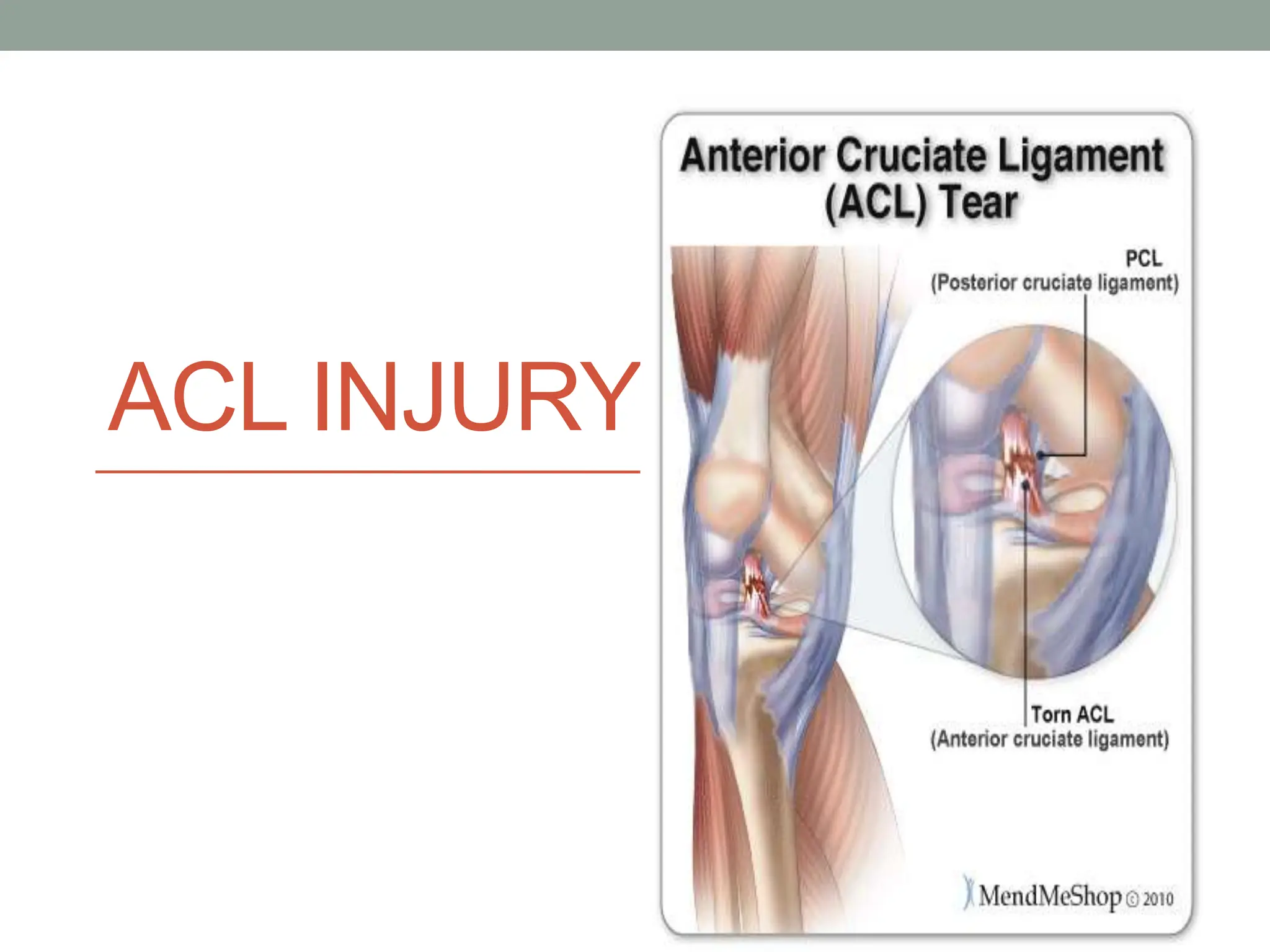
ACL INJURY
OUTLINE OF TOPIC
• INTRODUCTION
• GRADING/ CLASSIFICATION OF INJURY
• MECHANISM OF INJURY
• SYMPTOMS
• DIAGNOSIS
• MANAGEMENT
Introduction
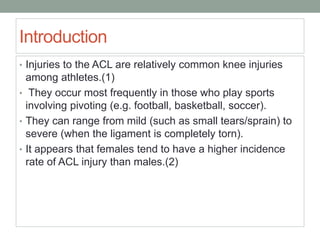
• Injuries to the ACL are relatively common knee injuries
among athletes.(1)
• They occur most frequently in those who play sports
involving pivoting (e.g. football, basketball, soccer).
• They can range from mild (such as small tears/sprain) to
severe (when the ligament is completely torn).
• It appears that females tend to have a higher incidence
rate of ACL injury than males.(2)
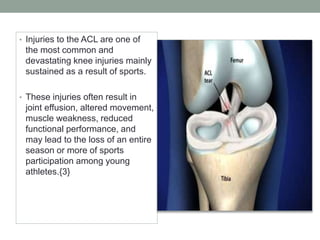
• Injuries to the ACL are one of
the most common and
devastating knee injuries mainly
sustained as a result of sports.
• These injuries often result in
joint effusion, altered movement,
muscle weakness, reduced
functional performance, and
may lead to the loss of an entire
season or more of sports
participation among young
athletes.{3}
FunctionalAnatomy
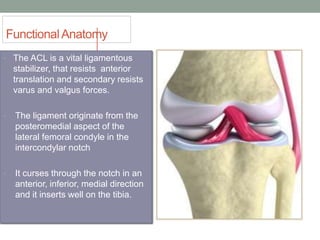
• The ACL is a vital ligamentous
stabilizer, that resists anterior
translation and secondary resists
varus and valgus forces.
• The ligament originate from the
posteromedial aspect of the
lateral femoral condyle in the
intercondylar notch
• It curses through the notch in an
anterior, inferior, medial direction
and it inserts well on the tibia.
Classification of injury or Grades of ACL
Injury(11)
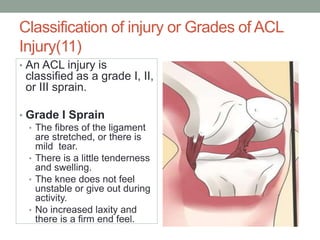
• An ACL injury is
classified as a grade I, II,
or III sprain.
• Grade I Sprain
• The fibres of the ligament
are stretched, or there is
mild tear.
• There is a little tenderness
and swelling.
• The knee does not feel
unstable or give out during
activity.
• No increased laxity and
there is a firm end feel.
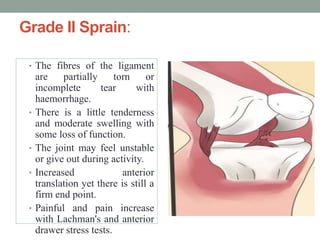
Grade II Sprain:
• The fibres of the ligament
are partially torn or
incomplete tear with
haemorrhage.
• There is a little tenderness
and moderate swelling with
some loss of function.
• The joint may feel unstable
or give out during activity.
• Increased anterior
translation yet there is still a
firm end point.
• Painful and pain increase
with Lachman's and anterior
drawer stress tests.
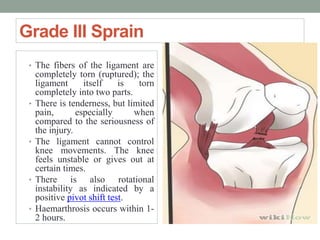
Grade III Sprain
• The fibers of the ligament are
completely torn (ruptured); the
ligament itself is torn
completely into two parts.
• There is tenderness, but limited
pain, especially when
compared to the seriousness of
the injury.
• The ligament cannot control
knee movements. The knee
feels unstable or gives out at
certain times.
• There is also rotational
instability as indicated by a
positive pivot shift test.
• Haemarthrosis occurs within 1-
2 hours.
Mechanism of injury
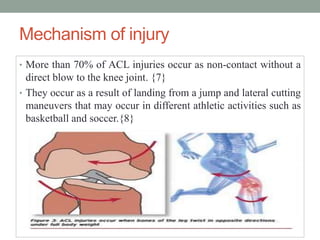
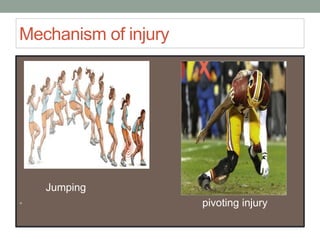
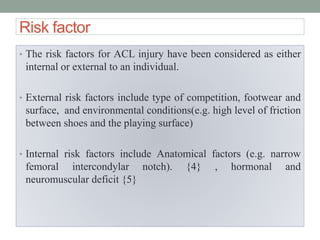
• More than 70% of ACL injuries occur as non-contact without a
direct blow to the knee joint. {7}
• They occur as a result of landing from a jump and lateral cutting
maneuvers that may occur in different athletic activities such as
basketball and soccer.{8}
Mechanism of injury
Jumping
• pivoting injury
Risk factor
• The risk factors for ACL injury have been considered as either
internal or external to an individual.
• External risk factors include type of competition, footwear and
surface, and environmental conditions(e.g. high level of friction
between shoes and the playing surface)
• Internal risk factors include Anatomical factors (e.g. narrow
femoral intercondylar notch). {4} , hormonal and
neuromuscular deficit {5}
Symptoms of ACL injury
• Audible pop or crack at the time of injury
• A feeling of initial instability which may be masked later by
extensive swelling
• Episodes of giving way especially on pivoting or twisting
motions.
• A torn ACL is extremely painful, particularly immediately after
sustaining the injury
• Swelling of the knee, usually immediate and extensive,
• Restricted movement, especially an inability to fully extend
the knee
• Possible widespread mild tenderness
• Tenderness at the medial side of the joint which may indicate
cartilage injury
Assessment
Observation/ INSPECTION
• While inspecting, the examiner should look for the
following
• Overall alignment of the knee.
• Any gross effusion
• Bony abnormality
• Patient presents with swelling, redness, ecchymosis, or
may come with an obvious flexion attitude of the knee in
case of acute injury
Palpation
• Palpation follows inspection and should begin with the
uninvolved extremity.
• Palpation confirms the presence and degree of effusion and
bony injury.
• Subtle effusions missed during inspection should be picked up
by the careful manual examination.
• Palpation of joint lines and collateral ligaments can rule out a
possible associated meniscus tear or sprained collateral
ligaments.
• Palpation for tenderness, spasm and swelling.
• Grades of tenderness are as follows:
Grade 1 – mild tenderness to palpation
Grade 2 – mild tenderness with grimace and flinch to moderate
palpation.
Grade 3 – severe tenderness with withdrawal ( positive jump
sign).
Grade 4 – severe tenderness with non noxious stimuli.
.
ROM
• Assessing the patient’s range of motion (ROM) should be
carried out to look for lack of complete extension, secondary to
a possible bucket-handle meniscus tear or associated loose
fragment
- Active movements: are done in such a way that the most painful
ones are done last.
- Passive movements : If ranges are not full and therapist is
unable to test end feel during active movements then PROM are
performed.
* in case of ACL injury knee extension is limited due to pain
Asses about the strength of muscles. It has
following grades :
0- no contraction
1- Slight Flickering
2 – Active movement in gravity eliminated
plane
3 – Active movement against gravity
4 – Active movement against gravity with
mild to moderate resistance
5 – Active movement against gravity with
moderate to heavy resistance.
Clinical diagnosis
• The skilled clinician can diagnosed as many as 90% of
ACL tears based on history( Acceleration, Deceleration)
and physical examination finding.
• Patient typically report an audible pop and giving way at
the time of injury. And knee effusion develops over next
24 hours.
Diagnosis
• An exact diagnosis can be made by the following
procedures:
• A tear is confirmed by the physical examination, primarily
by performing
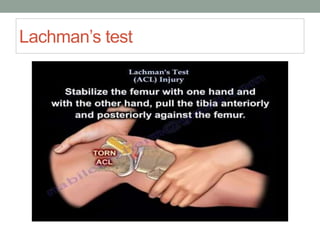
• Lachman Test
• Anterior Drawer Test of the Knee
• and arthrometric examination may be contributory.
Lachman’s test
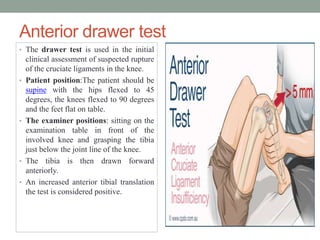
Anterior drawer test
• The drawer test is used in the initial
clinical assessment of suspected rupture
of the cruciate ligaments in the knee.
• Patient position:The patient should be
supine with the hips flexed to 45
degrees, the knees flexed to 90 degrees
and the feet flat on table.
• The examiner positions: sitting on the
examination table in front of the
involved knee and grasping the tibia
just below the joint line of the knee.
• The tibia is then drawn forward
anteriorly.
• An increased anterior tibial translation
the test is considered positive.
Instrumented laxity testing/arthrometric evaluation of
the knee
• An adjunct to the clinical special tests in assessing
anterior translation is the use of instrumented laxity
testing.
• It supplements the Lachman test in ACL injury.
• It can be particularly useful in the examination of acutely
injured patients in whom pain and guarding may preclude
evaluation.
Magnetic Resonate Imaging
• A primary role of MRI in the management of the patient with
ACL injury lies in allowing confident diagnosis of tear in the
patient with equivocal physical examination findings.
• MRI has the advantage of providing a clearly defined image
of all the anatomic structures of the knee.
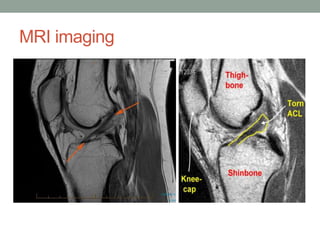
• A normal ACL is seen as a well-defined band of low signal
intensity on sagittal image through the intercondylar notch.

• With an acute injury to the ACL, the continuity of the
ligament fibers appears disrupted and the ligament
substance is ill defined, with a mixed signal intensity
representing local edema and haemorrhage.{9}
MRI imaging
Differential diagnosis
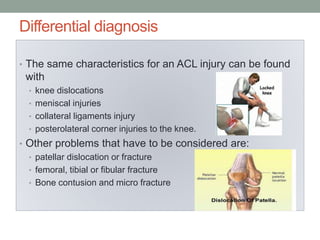
• The same characteristics for an ACL injury can be found
with
• knee dislocations
• meniscal injuries
• collateral ligaments injury
• posterolateral corner injuries to the knee.
• Other problems that have to be considered are:
• patellar dislocation or fracture
• femoral, tibial or fibular fracture
• Bone contusion and micro fracture
Management ACL injury
• For an ACL injury there is surgical and non-surgical treatment options.
• Athletes or people who work in intensive jobs who are more demanding on
their knees would likely benefit most from ACL reconstruction surgery.
• For less active people leg strengthening exercises of the gluteal, quadriceps
and the hamstrings are required, as well as possibly wearing of a support
brace for a period of time can achieve excellent levels of function.
• The surgical option usually involves taking a graft of another ligament and
then used to replace the original ACL, fixing in place using a screw, glue, or
a staple. During the recovery period the new ligament is eventually
‘accepted’ by the body in replace of the original ACL.
Physical Therapy
• The primary goals in the treatment of anterior cruciate
ligament (ACL) rupture are restoration of function in the
short term
• The prevention of long-term pathologic changes in the
knee.
• Nonoperative treatment is a reasonable approach in
patients who are not athletically active
• The key to successful treatment of an anterior cruciate
ligament (ACL) tear is proper and early rehabilitation.
• Preoperative and postoperative rehabilitation programs
are similar initially. Swelling control and restoration of
motion and strength are the goals of each.
Post operative rehabilitation
• The postoperative rehabilitation program begins as soon
as the patient awakens from anesthesia.
• Quadriceps co-contractions make up the first exercise
that patients should be taught for the maintenance of
terminal extension.
• Passive motion is emphasized with active flexion and
assisted extension in the sitting or prone position to
ensure good leg control (i.e., ability to flex the hip and lift
the leg against gravity without assistance.)
Phase 1: week 0- 2
• Goals
• Protect graft fixation
• Minimize effects of immobilization
• Control inflammation
• Achieve full extension and 90 degree knee flexion
• Educate patient about rehabilitation progress
• Brace
• Locked in extension for ambulation
• Weight bearing
• Wt. bearing as tolerated with crutches
• Discontinue crutches as tolerated after 7 days
• Therapeutic exercise
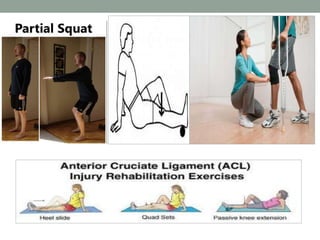
• Heel slides
• Quadriceps isometrics, hamstring isometrics
• Patellar mobilisation
• Non weight bearing hamstring and gastrocnemius stretches
• Sitting assisted flexion hang
• Prone leg hang for extension
• Straight Leg Raise
Phase 2: weeks 2-4
• Goals :
• Restore normal gait
• Restore full range of motion
• Protect graft fixation
• Improve strength, endurance and proprioception to prepare for functional activities
• Weight bearing:
• Unlock brace for sitting and sleeping , may remove brace for Range of motion
exercises
• Therapeutic exercises:
• Mini squat 0-30 degree
• Stationary bicycle
• Closed chain exercises
• Continue hamstring stretches , progress to weight bearing gastrocnemius stretches
• Prone leg hang for extension
• Initiation of functional training
Phase 3: week 6- 4 months
• Criteria for progression
• Normal gait
• Full Range of motion
• Sufficient strength and proprioception
• Goals
• Improve confidence in knee
• Progress strength, and proprioception to prepare for functional activities
• Therapeutic exercises
• Continues flexibility exercises as appropriate for the patient
• Advanced closed chain exercises (one leg squat 0-60 degree)
• Stair stepper
• Start phase 3 functional training
Phase 4: month 4 - 8
• Criteria for progression
• Full painless range of motion
• No evidence of patellofemoral joint
irritation/pain
• Sufficient strength and proprioception to
progress functional activities
• Physician clearance to initiate advanced
closed kinetic chain exercises and
functional progress
• Goal
• Return to unrestricted activities
• Therapeutic exercises
• Aerobic conditioning
• Bicycling and upper extremity ergometry
• Stair stepper
• Agility
• Shuttle run
• Lateral slides
• Carioca cross over
• Proprioception
• Lateral slide board
• Mini tramp bouncing
• Ball catching and throwing on unstable
surface
• Running
• Figure of eight and small circle running
• Plyometric
• Box jump (1-2 feet height)
• Stair jogging
Open kinetic chain (OKC) v/s closed
kinetic chain (CKC) exercises
• CKC exercises are safer than OKC exercises because
they place less strain on the ACL graft, producing less
patellofemoral pain.
• The second assumption is that CKC exercises are more
functional and are equally effective in improving
quadriceps muscle force production.
Refrences
1. Yasuharu Nagano, Hirofumi Ida, Masami Akai, Toru Fukubayashi.
Biomechanical characteristics of the knee joint in female athletes during
tasks associated with anterior cruciate ligament injury. Knee 2009; 16(2):
153-158
2.Arendt E,Dick R. Knee injuries patterns among men and women in
collegiate basketball and soccer. NCAA data and review of literature. Am J
Sports Med 995;23:694-701
3. Hewett TE, Di Stasi SL, Myer GD. Current concepts for injury prevention in athletes
after anterior cruciate ligament reconstruction. Am J Sports Med 2013;41:216–224.
4. Haim A. et al. Anterior cruciate ligament injuries. Harefuah 2006;145(3): 208-14, 244-5.
5. Hewett TE. et al. Anterior Cruciate Ligament Injuries in Female Athletes: Part 1,
Mechanisms and Risk Factors. Am J Sports Med. 2006; 34:299-311.
Cont….
6. Timothy E. Hewett et al UNDERSTANDING AND PREVENTING ACL
INJURIES: CURRENT BIOMECHANICAL AND EPIDEMIOLOGIC
CONSIDERATIONS - UPDATE 2010 North American Journal of Sports
Physical Therapy | Volume 5, Number 4 | December 2010 | Page 234.
7. Kiapour AM, Wordeman SC, Paterno MV, et al. Diagnostic value of knee
arthrometry in the prediction of anterior cruciate ligament strain during landing.
Am J Sports Med 2013;(Epub).
8. Arendt E, Dick R. Knee injury patterns among men and women in collegiate
basketball and soccer: NCAA data and review of literature. Am J Sports Med
1995;23:694– 701.
9. Turner da,Podromos CC, Petsnick JP, Clark JW: Acute injury of the knee:
Magnetic resonance evaluation.Radiology 154:711-722,1985.
10. DeLee, Drez, Muller. Orthopaedic sports Medicine,Principles and Practice.
Vol 2; 2nd edition.Saunder's publication, printed in USA
ACL.injury.final year.pptx

ACL.injury.final year.pptx

  • 1.
  • 2.
    OUTLINE OF TOPIC •INTRODUCTION • GRADING/ CLASSIFICATION OF INJURY • MECHANISM OF INJURY • SYMPTOMS • DIAGNOSIS • MANAGEMENT
  • 3.
    Introduction • Injuries tothe ACL are relatively common knee injuries among athletes.(1) • They occur most frequently in those who play sports involving pivoting (e.g. football, basketball, soccer). • They can range from mild (such as small tears/sprain) to severe (when the ligament is completely torn). • It appears that females tend to have a higher incidence rate of ACL injury than males.(2)
  • 4.
    • Injuries tothe ACL are one of the most common and devastating knee injuries mainly sustained as a result of sports. • These injuries often result in joint effusion, altered movement, muscle weakness, reduced functional performance, and may lead to the loss of an entire season or more of sports participation among young athletes.{3}
  • 5.
    FunctionalAnatomy • The ACLis a vital ligamentous stabilizer, that resists anterior translation and secondary resists varus and valgus forces. • The ligament originate from the posteromedial aspect of the lateral femoral condyle in the intercondylar notch • It curses through the notch in an anterior, inferior, medial direction and it inserts well on the tibia.
  • 6.
    Classification of injuryor Grades of ACL Injury(11) • An ACL injury is classified as a grade I, II, or III sprain. • Grade I Sprain • The fibres of the ligament are stretched, or there is mild tear. • There is a little tenderness and swelling. • The knee does not feel unstable or give out during activity. • No increased laxity and there is a firm end feel.
  • 7.
    Grade II Sprain: •The fibres of the ligament are partially torn or incomplete tear with haemorrhage. • There is a little tenderness and moderate swelling with some loss of function. • The joint may feel unstable or give out during activity. • Increased anterior translation yet there is still a firm end point. • Painful and pain increase with Lachman's and anterior drawer stress tests.
  • 8.
    Grade III Sprain •The fibers of the ligament are completely torn (ruptured); the ligament itself is torn completely into two parts. • There is tenderness, but limited pain, especially when compared to the seriousness of the injury. • The ligament cannot control knee movements. The knee feels unstable or gives out at certain times. • There is also rotational instability as indicated by a positive pivot shift test. • Haemarthrosis occurs within 1- 2 hours.
  • 9.
    Mechanism of injury •More than 70% of ACL injuries occur as non-contact without a direct blow to the knee joint. {7} • They occur as a result of landing from a jump and lateral cutting maneuvers that may occur in different athletic activities such as basketball and soccer.{8}
  • 10.
  • 11.
    Risk factor • Therisk factors for ACL injury have been considered as either internal or external to an individual. • External risk factors include type of competition, footwear and surface, and environmental conditions(e.g. high level of friction between shoes and the playing surface) • Internal risk factors include Anatomical factors (e.g. narrow femoral intercondylar notch). {4} , hormonal and neuromuscular deficit {5}
  • 12.
    Symptoms of ACLinjury • Audible pop or crack at the time of injury • A feeling of initial instability which may be masked later by extensive swelling • Episodes of giving way especially on pivoting or twisting motions. • A torn ACL is extremely painful, particularly immediately after sustaining the injury • Swelling of the knee, usually immediate and extensive, • Restricted movement, especially an inability to fully extend the knee • Possible widespread mild tenderness • Tenderness at the medial side of the joint which may indicate cartilage injury
  • 13.
    Assessment Observation/ INSPECTION • Whileinspecting, the examiner should look for the following • Overall alignment of the knee. • Any gross effusion • Bony abnormality • Patient presents with swelling, redness, ecchymosis, or may come with an obvious flexion attitude of the knee in case of acute injury
  • 14.
    Palpation • Palpation followsinspection and should begin with the uninvolved extremity. • Palpation confirms the presence and degree of effusion and bony injury. • Subtle effusions missed during inspection should be picked up by the careful manual examination. • Palpation of joint lines and collateral ligaments can rule out a possible associated meniscus tear or sprained collateral ligaments.
  • 15.
    • Palpation fortenderness, spasm and swelling. • Grades of tenderness are as follows: Grade 1 – mild tenderness to palpation Grade 2 – mild tenderness with grimace and flinch to moderate palpation. Grade 3 – severe tenderness with withdrawal ( positive jump sign). Grade 4 – severe tenderness with non noxious stimuli. .
  • 16.
    ROM • Assessing thepatient’s range of motion (ROM) should be carried out to look for lack of complete extension, secondary to a possible bucket-handle meniscus tear or associated loose fragment - Active movements: are done in such a way that the most painful ones are done last. - Passive movements : If ranges are not full and therapist is unable to test end feel during active movements then PROM are performed. * in case of ACL injury knee extension is limited due to pain
  • 17.
    Asses about thestrength of muscles. It has following grades : 0- no contraction 1- Slight Flickering 2 – Active movement in gravity eliminated plane 3 – Active movement against gravity 4 – Active movement against gravity with mild to moderate resistance 5 – Active movement against gravity with moderate to heavy resistance.
  • 18.
    Clinical diagnosis • Theskilled clinician can diagnosed as many as 90% of ACL tears based on history( Acceleration, Deceleration) and physical examination finding. • Patient typically report an audible pop and giving way at the time of injury. And knee effusion develops over next 24 hours.
  • 19.
    Diagnosis • An exactdiagnosis can be made by the following procedures: • A tear is confirmed by the physical examination, primarily by performing • Lachman Test • Anterior Drawer Test of the Knee • and arthrometric examination may be contributory.
  • 20.
  • 21.
    Anterior drawer test •The drawer test is used in the initial clinical assessment of suspected rupture of the cruciate ligaments in the knee. • Patient position:The patient should be supine with the hips flexed to 45 degrees, the knees flexed to 90 degrees and the feet flat on table. • The examiner positions: sitting on the examination table in front of the involved knee and grasping the tibia just below the joint line of the knee. • The tibia is then drawn forward anteriorly. • An increased anterior tibial translation the test is considered positive.
  • 22.
    Instrumented laxity testing/arthrometricevaluation of the knee • An adjunct to the clinical special tests in assessing anterior translation is the use of instrumented laxity testing. • It supplements the Lachman test in ACL injury. • It can be particularly useful in the examination of acutely injured patients in whom pain and guarding may preclude evaluation.
  • 23.
    Magnetic Resonate Imaging •A primary role of MRI in the management of the patient with ACL injury lies in allowing confident diagnosis of tear in the patient with equivocal physical examination findings. • MRI has the advantage of providing a clearly defined image of all the anatomic structures of the knee. • A normal ACL is seen as a well-defined band of low signal intensity on sagittal image through the intercondylar notch. • With an acute injury to the ACL, the continuity of the ligament fibers appears disrupted and the ligament substance is ill defined, with a mixed signal intensity representing local edema and haemorrhage.{9}
  • 24.
  • 25.
    Differential diagnosis • Thesame characteristics for an ACL injury can be found with • knee dislocations • meniscal injuries • collateral ligaments injury • posterolateral corner injuries to the knee. • Other problems that have to be considered are: • patellar dislocation or fracture • femoral, tibial or fibular fracture • Bone contusion and micro fracture
  • 26.
    Management ACL injury •For an ACL injury there is surgical and non-surgical treatment options. • Athletes or people who work in intensive jobs who are more demanding on their knees would likely benefit most from ACL reconstruction surgery. • For less active people leg strengthening exercises of the gluteal, quadriceps and the hamstrings are required, as well as possibly wearing of a support brace for a period of time can achieve excellent levels of function. • The surgical option usually involves taking a graft of another ligament and then used to replace the original ACL, fixing in place using a screw, glue, or a staple. During the recovery period the new ligament is eventually ‘accepted’ by the body in replace of the original ACL.
  • 27.
    Physical Therapy • Theprimary goals in the treatment of anterior cruciate ligament (ACL) rupture are restoration of function in the short term • The prevention of long-term pathologic changes in the knee. • Nonoperative treatment is a reasonable approach in patients who are not athletically active • The key to successful treatment of an anterior cruciate ligament (ACL) tear is proper and early rehabilitation. • Preoperative and postoperative rehabilitation programs are similar initially. Swelling control and restoration of motion and strength are the goals of each.
  • 28.
    Post operative rehabilitation •The postoperative rehabilitation program begins as soon as the patient awakens from anesthesia. • Quadriceps co-contractions make up the first exercise that patients should be taught for the maintenance of terminal extension. • Passive motion is emphasized with active flexion and assisted extension in the sitting or prone position to ensure good leg control (i.e., ability to flex the hip and lift the leg against gravity without assistance.)
  • 29.
    Phase 1: week0- 2 • Goals • Protect graft fixation • Minimize effects of immobilization • Control inflammation • Achieve full extension and 90 degree knee flexion • Educate patient about rehabilitation progress • Brace • Locked in extension for ambulation • Weight bearing • Wt. bearing as tolerated with crutches • Discontinue crutches as tolerated after 7 days • Therapeutic exercise • Heel slides • Quadriceps isometrics, hamstring isometrics • Patellar mobilisation • Non weight bearing hamstring and gastrocnemius stretches • Sitting assisted flexion hang • Prone leg hang for extension • Straight Leg Raise
  • 31.
    Phase 2: weeks2-4 • Goals : • Restore normal gait • Restore full range of motion • Protect graft fixation • Improve strength, endurance and proprioception to prepare for functional activities • Weight bearing: • Unlock brace for sitting and sleeping , may remove brace for Range of motion exercises • Therapeutic exercises: • Mini squat 0-30 degree • Stationary bicycle • Closed chain exercises • Continue hamstring stretches , progress to weight bearing gastrocnemius stretches • Prone leg hang for extension • Initiation of functional training
  • 32.
    Phase 3: week6- 4 months • Criteria for progression • Normal gait • Full Range of motion • Sufficient strength and proprioception • Goals • Improve confidence in knee • Progress strength, and proprioception to prepare for functional activities • Therapeutic exercises • Continues flexibility exercises as appropriate for the patient • Advanced closed chain exercises (one leg squat 0-60 degree) • Stair stepper • Start phase 3 functional training
  • 33.
    Phase 4: month4 - 8 • Criteria for progression • Full painless range of motion • No evidence of patellofemoral joint irritation/pain • Sufficient strength and proprioception to progress functional activities • Physician clearance to initiate advanced closed kinetic chain exercises and functional progress • Goal • Return to unrestricted activities • Therapeutic exercises • Aerobic conditioning • Bicycling and upper extremity ergometry • Stair stepper • Agility • Shuttle run • Lateral slides • Carioca cross over • Proprioception • Lateral slide board • Mini tramp bouncing • Ball catching and throwing on unstable surface • Running • Figure of eight and small circle running • Plyometric • Box jump (1-2 feet height) • Stair jogging
  • 34.
    Open kinetic chain(OKC) v/s closed kinetic chain (CKC) exercises • CKC exercises are safer than OKC exercises because they place less strain on the ACL graft, producing less patellofemoral pain. • The second assumption is that CKC exercises are more functional and are equally effective in improving quadriceps muscle force production.
  • 35.
    Refrences 1. Yasuharu Nagano,Hirofumi Ida, Masami Akai, Toru Fukubayashi. Biomechanical characteristics of the knee joint in female athletes during tasks associated with anterior cruciate ligament injury. Knee 2009; 16(2): 153-158 2.Arendt E,Dick R. Knee injuries patterns among men and women in collegiate basketball and soccer. NCAA data and review of literature. Am J Sports Med 995;23:694-701 3. Hewett TE, Di Stasi SL, Myer GD. Current concepts for injury prevention in athletes after anterior cruciate ligament reconstruction. Am J Sports Med 2013;41:216–224. 4. Haim A. et al. Anterior cruciate ligament injuries. Harefuah 2006;145(3): 208-14, 244-5. 5. Hewett TE. et al. Anterior Cruciate Ligament Injuries in Female Athletes: Part 1, Mechanisms and Risk Factors. Am J Sports Med. 2006; 34:299-311.
  • 36.
    Cont…. 6. Timothy E.Hewett et al UNDERSTANDING AND PREVENTING ACL INJURIES: CURRENT BIOMECHANICAL AND EPIDEMIOLOGIC CONSIDERATIONS - UPDATE 2010 North American Journal of Sports Physical Therapy | Volume 5, Number 4 | December 2010 | Page 234. 7. Kiapour AM, Wordeman SC, Paterno MV, et al. Diagnostic value of knee arthrometry in the prediction of anterior cruciate ligament strain during landing. Am J Sports Med 2013;(Epub). 8. Arendt E, Dick R. Knee injury patterns among men and women in collegiate basketball and soccer: NCAA data and review of literature. Am J Sports Med 1995;23:694– 701. 9. Turner da,Podromos CC, Petsnick JP, Clark JW: Acute injury of the knee: Magnetic resonance evaluation.Radiology 154:711-722,1985. 10. DeLee, Drez, Muller. Orthopaedic sports Medicine,Principles and Practice. Vol 2; 2nd edition.Saunder's publication, printed in USA