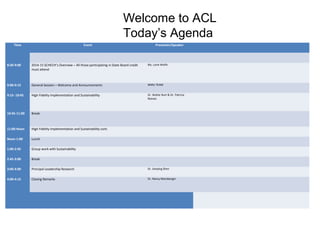
Time Event Presenter/Speaker


8:30-9:00 2014-15 SCHECH’s Overview – All those participating in State Board credit 
must attend
Ms. Lorie Wolfe
 
9:00-9:15 General Session – Welcome and Announcements WMU TEAM
 
9:15- 10:45 High Fidelity Implementation and Sustainability Dr. Walter Burt & Dr. Patricia 
Reeves
 
10:45-11:00 Break    
 
11:00-Noon High Fidelity Implementation and Sustainability cont.  
 
Noon-1:00 Lunch  
 
1:00-2:45 Group work with Sustainability  
 
2:45-3:00 Break  
 
3:00-4:00 Principal Leadership Research Dr. Jianping Shen
 
4:00-4:15 Closing Remarks Dr. Nancy Mansberger
 
   
Welcome to ACL
Today’s Agenda
Photo by VinothChandar - Creative Commons Attribution License  http://www.flickr.com/photos/44345361@N06 Created with Haiku Deck
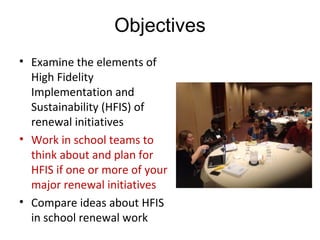
Objectives
• Examine the elements of 

High Fidelity 
Implementation and 
Sustainability (HFIS) of 
renewal initiatives
• Work in school teams to 
think about and plan for 
HFIS if one or more of your 
major renewal initiatives
• Compare ideas about HFIS 
in school renewal work  
Deliverables
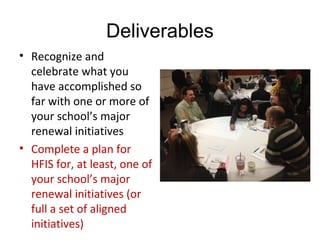
• Recognize and 
celebrate what you 
have accomplished so 
far with one or more of 
your school’s major 
renewal initiatives
• Complete a plan for 
HFIS for, at least, one of 
your school’s major 
renewal initiatives (or 
full a set of aligned 
initiatives)
Introduction
NCLB and RTTT legislative fiats 
have placed tremendous 
pressure on school staff to 
improved student achievement
In many cases, this requires 
deep, second order change
That kind of change requires 
strategies to achieve full and 
sustainable implementation
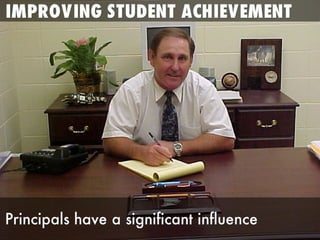
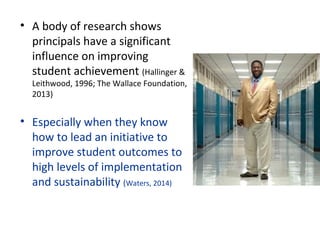
• A body of research shows 
principals have a significant 
influence on improving 
student achievement (Hallinger & 
Leithwood, 1996; The Wallace Foundation, 
2013)
• Especially when they know 
how to lead an initiative to 
improve student outcomes to 
high levels of implementation 
and sustainability (Waters, 2014)
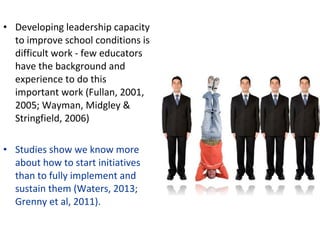
• Developing leadership capacity 
to improve school conditions is 
difficult work - few educators 
have the background and 
experience to do this 
important work (Fullan, 2001, 
2005; Wayman, Midgley & 
Stringfield, 2006)
• Studies show we know more 
about how to start initiatives 
than to fully implement and 
sustain them (Waters, 2013; 
Grenny et al, 2011).
An increasing number of studies 
suggest excellent schools have 
excellent principals (Hallinger & 
Leithwood, 1996; Leithwood, 
2003)
But, many excellent principals 
have limited experience 
pushing a change initiative to 
deep and sustainable levels of 
implementation (Marzano, 
2013)
• Principals must, not only focus 
on student achievement, they 
must also support the 
intellectual and emotional work 
of teachers (Hargraves, Moore, 
& Manning, 2001)
• And, it often requires deep 
emotional and intellectual work 
to work through the complexity 
of second order change 
(Marzano, Waters, & McNally, 
2009)   
Achievement Centered Leadership
Renewal Work
As your renewal work 
support team, we are 
interested in how our 
work together 
translates to 
sustainable change in 
your schools for 
improved student 
success
You have worked hard to plan
renewal work, so…
Today, our work will focus
on just that…
Helping you think about
and plan for HFIS of the
renewal work you build
together for your school
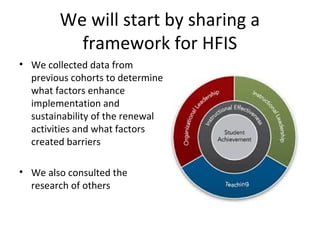
We will start by sharing a
framework for HFIS
• We collected data from
previous cohorts to determine
what factors enhance
implementation and
sustainability of the renewal
activities and what factors
created barriers
• We also consulted the
research of others
THE STUDY FINDINGS
First, we looked at responses regarding
the implementation and sustainability
of renewal activities that involve
Data Informed Decision Making (DDIM)
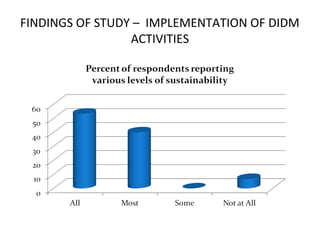
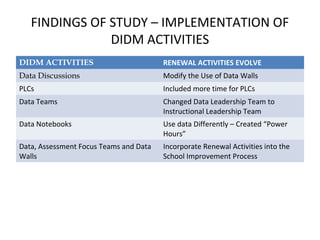
FINDINGS OF STUDY – IMPLEMENTATION OF DIDM
ACTIVITIES
FINDINGS OF STUDY – IMPLEMENTATION OF
DIDM ACTIVITIES
DIDM ACTIVITIES RENEWAL ACTIVITIES EVOLVE
Data Discussions Modify the Use of Data Walls
PLCs Included more time for PLCs
Data Teams Changed Data Leadership Team to
Instructional Leadership Team
Data Notebooks Use data Differently – Created “Power
Hours”
Data, Assessment Focus Teams and Data
Walls
Incorporate Renewal Activities into the
School Improvement Process
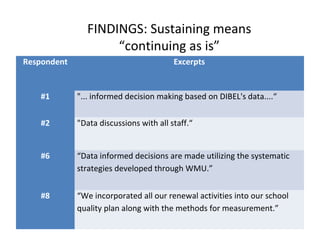
FINDINGS: Sustaining means
“continuing as is”
Respondent Excerpts
#1 "... informed decision making based on DIBEL's data....“
#2 "Data discussions with all staff.“
#6 “Data informed decisions are made utilizing the systematic
strategies developed through WMU.”
#8 “We incorporated all our renewal activities into our school
quality plan along with the methods for measurement.”
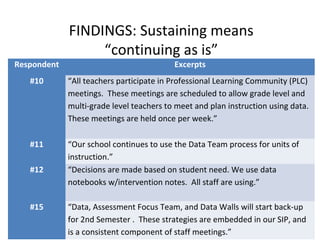
FINDINGS: Sustaining means
“continuing as is”
Respondent Excerpts
#10 “All teachers participate in Professional Learning Community (PLC)
meetings. These meetings are scheduled to allow grade level and
multi-grade level teachers to meet and plan instruction using data.
These meetings are held once per week.”
#11 “Our school continues to use the Data Team process for units of
instruction.”
#12 “Decisions are made based on student need. We use data
notebooks w/intervention notes. All staff are using.”
#15 “Data, Assessment Focus Team, and Data Walls will start back-up
for 2nd Semester . These strategies are embedded in our SIP, and
is a consistent component of staff meetings.”
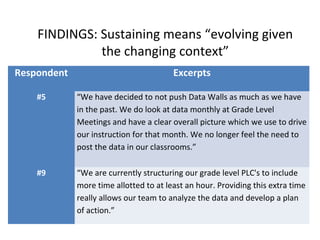
FINDINGS: Sustaining means “evolving given
the changing context”
Respondent Excerpts
#5 “We have decided to not push Data Walls as much as we have
in the past. We do look at data monthly at Grade Level
Meetings and have a clear overall picture which we use to drive
our instruction for that month. We no longer feel the need to
post the data in our classrooms.”
#9 “We are currently structuring our grade level PLC's to include
more time allotted to at least an hour. Providing this extra time
really allows our team to analyze the data and develop a plan
of action.”
FINDINGS: Sustaining means “evolving
given the changing context”
Respondent Excerpts
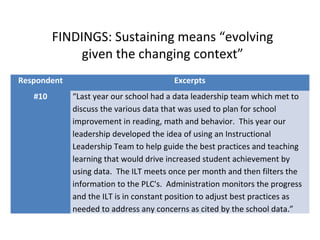
#10 “Last year our school had a data leadership team which met to
discuss the various data that was used to plan for school
improvement in reading, math and behavior. This year our
leadership developed the idea of using an Instructional
Leadership Team to help guide the best practices and teaching
learning that would drive increased student achievement by
using data. The ILT meets once per month and then filters the
information to the PLC's. Administration monitors the progress
and the ILT is in constant position to adjust best practices as
needed to address any concerns as cited by the school data.”
FINDINGS: Sustaining means “evolving
given the changing context”
Respondent Excerpts
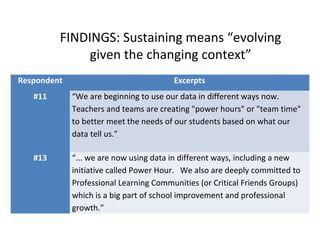
#11 “We are beginning to use our data in different ways now.
Teachers and teams are creating "power hours" or "team time"
to better meet the needs of our students based on what our
data tell us.”
#13 “... we are now using data in different ways, including a new
initiative called Power Hour. We also are deeply committed to
Professional Learning Communities (or Critical Friends Groups)
which is a big part of school improvement and professional
growth.”
FINDINGS: Sustaining means “incorporating into
the overall school improvement process”
Respondent #13: “EVERYTHING is based on
data”
respondents #8: “We incorporated all our
renewal activities into our school quality plan”
FINDINGS OF STUDY
FINDINGS: Changes attributed to the Grant
Project by the respondents
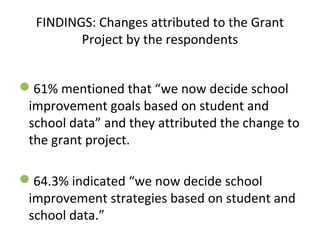
61% mentioned that “we now decide school
improvement goals based on student and
school data” and they attributed the change to
the grant project.
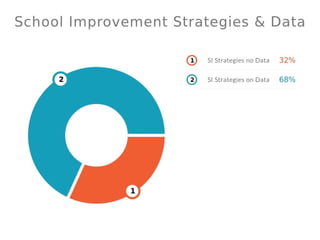
64.3% indicated “we now decide school
improvement strategies based on student and
school data.”
Additional Changes attributed to the Grant
Project by the respondents
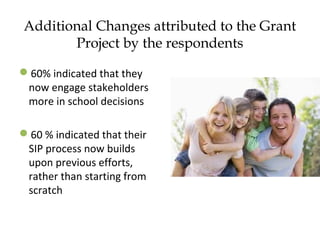
60% indicated that they
now engage stakeholders
more in school decisions
60 % indicated that their
SIP process now builds
upon previous efforts,
rather than starting from
scratch
53.3% indicated that their
school improvement process
is more focused on improving
student achievement
53.3 % indicated that they
now have a process in place
to ensure that SIP work is
continuous
Additional Changes attributed to the Grant
Project by the respondents
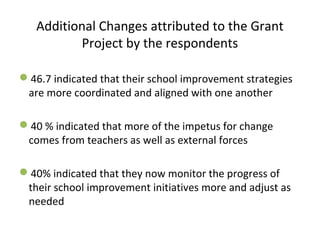
46.7 indicated that their school improvement strategies
are more coordinated and aligned with one another
40 % indicated that more of the impetus for change
comes from teachers as well as external forces
40% indicated that they now monitor the progress of
their school improvement initiatives more and adjust as
needed
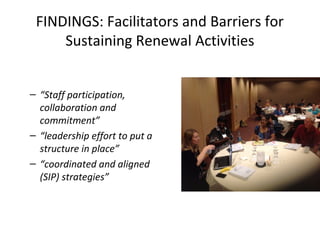
FINDINGS: Facilitators and Barriers for
Sustaining Renewal Activities
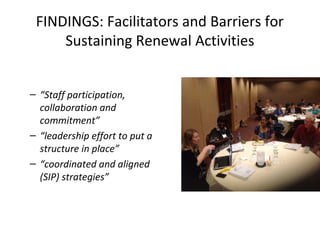
– “Staff participation,
collaboration and
commitment”
– “leadership effort to put a
structure in place”
– “coordinated and aligned
(SIP) strategies”
FINDINGS: Facilitators and Barriers for
Sustaining Renewal Activities
Barriers
Leadership and staff turnover
Time availability to follow through
District level factors, e.g. finances, support, and focus
“Re-allocating” or “micro-managing”
Staff commitment – “not all on board”
FINDINGS: Facilitators and Barriers for
Sustaining Renewal Activities
– “Staff participation,
collaboration and
commitment”
– “leadership effort to put a
structure in place”
– “coordinated and aligned
(SIP) strategies”
Sustainability – Lessons Learned From the
Literature and WMU Research
Big Idea 1: Sustainability is a by-
product of high fidelity
implementation
Sustainability – Lessons Learned From the
Literature and WMU Research
Big Idea 2: High Fidelity
Implementation requires ongoing
monitoring and adjusting
Sustainability – Lessons Learned From the
Literature and WMU Research
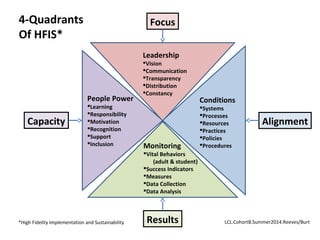
We Created a
Framework to Guide
Your HFIS Efforts
(From our findings
and other Studies)
Leadership
Vision
Communication
Transparency
Distribution
Constancy
People Power
Learning
Responsibility
Motivation
Recognition
Support
Inclusion
Conditions
Systems
Processes
Resources
Practices
Policies
ProceduresMonitoring
Vital Behaviors
(adult & student)
Success Indicators
Measures
Data Collection
Data Analysis
Focus
Results
AlignmentCapacity
4-Quadrants
Of HFIS*
LCL.CohortB.Summer2014.Reeves/Burt*High Fidelity Implementation and Sustainability
Today, we will work with you to
put our findings to work
As you plan for HFI&S
in Your Renewal Work
Identify one or more of your school’s
renewal initiatives that you believe will
require significant effort to fully
implement and sustain. Write the
initiative or initiatives at the top of your
HFI&S planning guide handout along
with your school name.
Prepare to Work
Please have ready the ACL
Framework for High Fidelity
Implementation and Sustainability
Handout
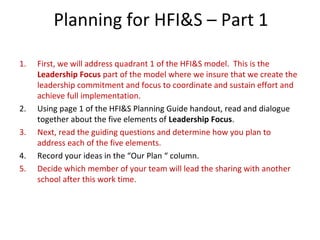
Planning for HFI&S – Part 1
1. First, we will address quadrant 1 of the HFI&S model. This is the
Leadership Focus part of the model where we insure that we create the
leadership commitment and focus to coordinate and sustain effort and
achieve full implementation.
2. Using page 1 of the HFI&S Planning Guide handout, read and dialogue
together about the five elements of Leadership Focus.
3. Next, read the guiding questions and determine how you plan to
address each of the five elements.
4. Record your ideas in the “Our Plan “ column.
5. Decide which member of your team will lead the sharing with another
school after this work time.
Now, it is time to share
your Leadership Focus
ideas with another school.
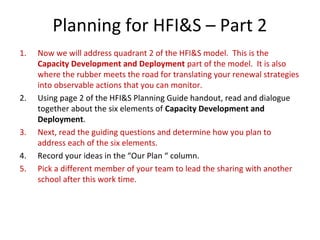
Planning for HFI&S – Part 2
1. Now we will address quadrant 2 of the HFI&S model. This is the
Capacity Development and Deployment part of the model. It is also
where the rubber meets the road for translating your renewal strategies
into observable actions that you can monitor.
2. Using page 2 of the HFI&S Planning Guide handout, read and dialogue
together about the six elements of Capacity Development and
Deployment.
3. Next, read the guiding questions and determine how you plan to
address each of the six elements.
4. Record your ideas in the “Our Plan “ column.
5. Pick a different member of your team to lead the sharing with another
school after this work time.
Now, it is time to share
your Capacity
Development and
Deployment ideas with
another school.
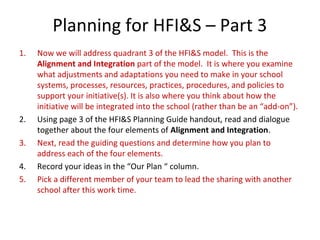
Planning for HFI&S – Part 3
1. Now we will address quadrant 3 of the HFI&S model. This is the
Alignment and Integration part of the model. It is where you examine
what adjustments and adaptations you need to make in your school
systems, processes, resources, practices, procedures, and policies to
support your initiative(s). It is also where you think about how the
initiative will be integrated into the school (rather than be an “add-on”).
2. Using page 3 of the HFI&S Planning Guide handout, read and dialogue
together about the four elements of Alignment and Integration.
3. Next, read the guiding questions and determine how you plan to
address each of the four elements.
4. Record your ideas in the “Our Plan “ column.
5. Pick a different member of your team to lead the sharing with another
school after this work time.
Now, it is time to share
your Alignment and
Integration ideas with
another school.
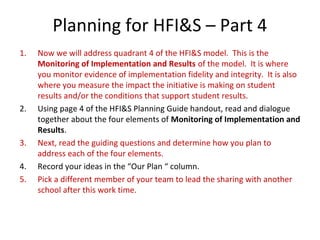
Planning for HFI&S – Part 4
1. Now we will address quadrant 4 of the HFI&S model. This is the
Monitoring of Implementation and Results of the model. It is where
you monitor evidence of implementation fidelity and integrity. It is also
where you measure the impact the initiative is making on student
results and/or the conditions that support student results.
2. Using page 4 of the HFI&S Planning Guide handout, read and dialogue
together about the four elements of Monitoring of Implementation and
Results.
3. Next, read the guiding questions and determine how you plan to
address each of the four elements.
4. Record your ideas in the “Our Plan “ column.
5. Pick a different member of your team to lead the sharing with another
school after this work time.
Now, it is time to share your
Monitoring of
Implementation and Results
ideas with another school.
Thank you for working on and sharing
your HFI&S ideas and Plans!
• Now, we would like to debrief our experience
with HFI&S thinking and planning…
• What did you learn from today’s work?

Acl oct.2015 session hfis_reeves.burt

Editor's Notes

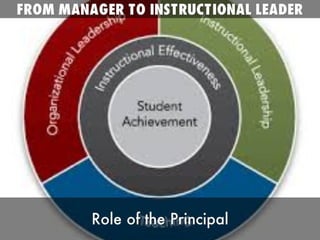
  • #8 In an era of increased accountability, the role of the principal has evolved from that of a manager to an instructional leader (Hargraves, Moore, & Manning, 2001).