Transitioning to New Standards Using
  Formative Instructional Practices
                                       1  
Today’s Learning Targets

Participants will understand:
•   The importance of formative instructional practices
•   How formative instructional practices support the
    Common Core State Standards
•   How FIP Your School Ohio can assist with
    transitioning to new standards


                                                        2  
WHAT ARE FORMATIVE
INSTRUCTIONAL PRACTICES?


                           3  
What Are Formative
Instructional Practices?


•   Formative instructional practices (FIP) are the
    formal and informal ways that teachers and
    students gather and respond to evidence of
    student learning.


                                                      4  
What is the difference?


  •   Formative Assessment

  •   Assessment for Learning

  •   Assessment of Learning

  •   Formative Instructional Practices


                                          5  
What Matters Most?

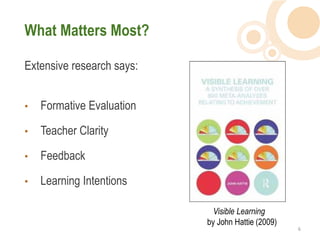
Extensive research says:


•   Formative Evaluation

•   Teacher Clarity

•   Feedback

•   Learning Intentions

                             Visible Learning
                           by John Hattie (2009)
                                                   6  
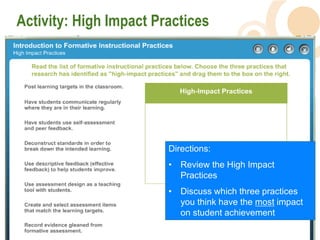
Activity: High Impact Practices


                        Directions:
                        • Review the High Impact
                          Practices
                        • Discuss which three practices
                          you think have the most impact
                          on student achievement
Core Components of Formative
Instructional Practices

       Using clear learning targets

       Collecting and documenting evidence of
       student learning

       Providing effective feedback

       Student ownership of learning
                                                8  
Core Components of Formative
Instructional Practices

       Are we creating and communicating clear,
       student-friendly learning targets?

       Have we been collecting and documenting
       evidence of student learning?

       Are we analyzing evidence of student learning
       and providing effective feedback?

       How have we been increasing opportunities for
       students to take ownership of their learning?
                          9  
FIP in Action:
What Practices Did You See?

       Using clear learning targets

       Collecting and documenting evidence of
       student learning

       Providing effective feedback

       Student ownership of learning
                                                10  
HOW DO FORMATIVE INSTRUCTIONAL PRACTICES
 SUPPORT COMMON CORE STATE STANDARDS?


                                      11  
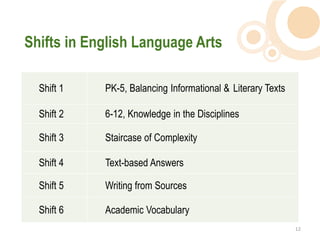
Shifts in English Language Arts

  Shift 1   PK-5, Balancing Informational & Literary Texts

  Shift 2   6-12, Knowledge in the Disciplines

  Shift 3   Staircase of Complexity

  Shift 4   Text-based Answers

  Shift 5   Writing from Sources

  Shift 6   Academic Vocabulary
                                                             12  
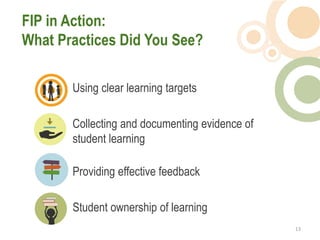
FIP in Action:
What Practices Did You See?

       Using clear learning targets

       Collecting and documenting evidence of
       student learning

       Providing effective feedback

       Student ownership of learning
                                                13  
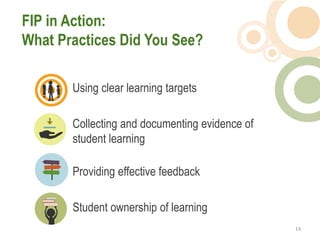
FIP in Action:
What Practices Did You See?

       Using clear learning targets

       Collecting and documenting evidence of
       student learning

       Providing effective feedback

       Student ownership of learning
                                                14  
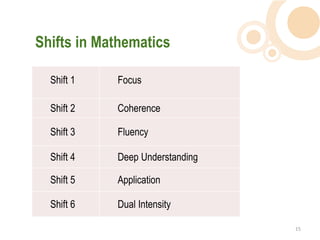
Shifts in Mathematics

  Shift 1   Focus

  Shift 2   Coherence

  Shift 3   Fluency

  Shift 4   Deep Understanding

  Shift 5   Application

  Shift 6   Dual Intensity

                                 15  
FIP in Action:
What Practices Did You See?

       Using clear learning targets

       Collecting and documenting evidence of
       student learning

       Providing effective feedback

       Student ownership of learning
                                                16  
FIP in Action:
What Practices Did You See?

       Using clear learning targets

       Collecting and documenting evidence of
       student learning

       Providing effective feedback

       Student ownership of learning
                                                17  
FIP in Action:
What Practices Did You See?

       Using clear learning targets

       Collecting and documenting evidence of
       student learning

       Providing effective feedback

       Student ownership of learning
                                                18  
WHAT SHOULD DISTRICTS BE DOING NOW?


                                  19  
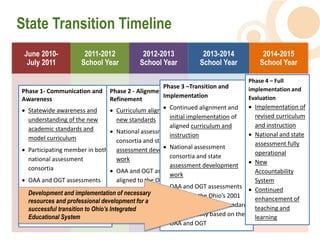
State Transition Timeline
 June 2010-              2011-2012               2012-2013                2013-2014                2014-2015
  July 2011             School Year             School Year              School Year              School Year

                                                                                             Phase  4  –  Full  
                                                         Phase  3  –Transition  and           implementation  and  
Phase  1-­‐  Communication  and   Phase  2  -­‐  Alignment  and  
                                                         Implementation                       Evaluation  
Awareness                          Refinement  
                                                                                                Implementation  of  
  Statewide  awareness  and          Curriculum  alignment  to  the   alignment  and  
                                                             Continued  
                                                                                                revised  curriculum  
  understanding  of  the  new        new  standards       initial  implementation  of  
                                                             aligned  curriculum  and           and  instruction  
  academic  standards  and           National  assessment  
                                                             instruction                        National  and  state  
  model  curriculum                  consortia  and  state  
                                                             National  assessment               assessment  fully  
  Participating  member  in  both   assessment  development                                     operational    
  national  assessment               work                    consortia  and  state  
                                                             assessment  development            New  
  consortia                          OAA  and  OGT  assessments                                 Accountability  
                                                             work    
  OAA  and  OGT  assessments         aligned  to  the  Ohio’s  2001                             System  
  aligned  to  the  Ohio’s  2001     and  2002  academic  standards   GT  assessments  
                                                             OAA  and  O                        Continued  
  Development and implementation of necessary                aligned  to  the  Ohio’s  2001  
  and  2002  academic  standards   Accountability  based  on  the  
  resources and professional development for a                                                  enhancement  of  
                                                             and  2002  academic  standards   teaching  and  
  successful transition to Ohio’s Integrated OGT  
  Accountability  based  on  the     OAA  and  
  Educational System                                         Accountability  based  on  the   learning  
  OAA  and  OGT  
                                                             OAA  and  OGT  
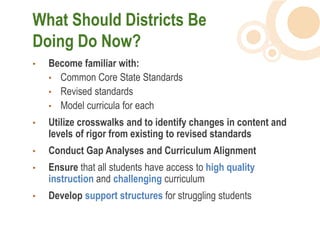
What Should Districts Be
Doing Do Now?
•   Become familiar with:
    • Common Core State Standards
    • Revised standards
    • Model curricula for each
•   Utilize crosswalks and to identify changes in content and
    levels of rigor from existing to revised standards
•   Conduct Gap Analyses and Curriculum Alignment
•   Ensure that all students have access to high quality
    instruction and challenging curriculum
•   Develop support structures for struggling students
Common Core Transition


Educational Testing Service (ETS)
       www.k12center.org


                                    22  
What Can We Do Now in ELA?

•   Study the standards
•   Support teachers as they expand their skills and
    knowledge
•   Engage in job-embedded professional
    development
•   Collaborate for shared learning
•   Create time for collaboration


                                                   23  
What Can We Do Now in
Mathematics?
•   Communicate that CCSS Mathematics requires significant
    shifts
•   Promote understanding and implementation of the
    standards
•   Provide professional development on instructional practices
•   Develop a plan to phase-in curricular changes
•   Assess students’ conceptual understandings and
    mathematical practices
•   Center professional development around teacher
    collaboration
                                                              24  
RESOURCES AVAILABLE FROM
    FIP YOUR SCHOOL


                           25  
Race to the Top Scope of Work
A.   State Success Factors

B.   Standards and Assessment

C.   Data Systems to Support Instruction

D.   Great Teachers and Leaders

E.   Turning Around the Lowest Achieving Schools

                                                   26  
FIP Your School
Support for LEAs
•   System of Support
    •   Regional FIP Specialists
    •   Local FIP Facilitators
    •   ESC Partners
•   Professional Development Tools
    •   Online learning modules
    •   Facilitation materials
    •   Online FIP Campus
                                   27  
Professional Development Tools

Online Learning Modules
•   Foundations of Formative Instructional Practices
    (5 modules)
•   Coaching and Leading Formative Instructional Practices
    (2 module)
•   Applications of Formative Instructional Practices
    (30+ modules / online learning tools)


                              28  
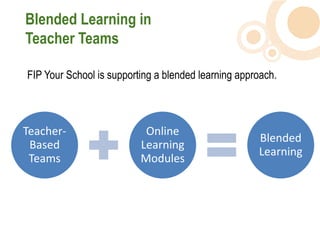
Blended Learning in
Teacher Teams

FIP Your School is supporting a blended learning approach.


Teacher-­‐                 Online  
                                                     Blended  
 Based                    Learning  
                                                     Learning  
 Teams                    Modules  
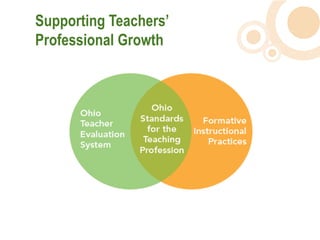
Supporting Teachers’
Professional Growth
Ohio Standards for the
Teaching Profession
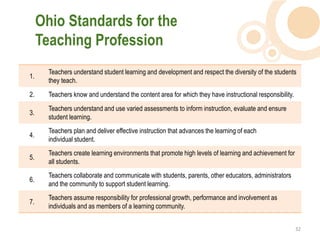
Ohio Standards for the
     Teaching Profession
       Teachers understand student learning and development and respect the diversity of the students
1.
       they teach.
2.     Teachers know and understand the content area for which they have instructional responsibility.
       Teachers understand and use varied assessments to inform instruction, evaluate and ensure
3.
       student learning.
       Teachers plan and deliver effective instruction that advances the learning of each
4.
       individual student.
       Teachers create learning environments that promote high levels of learning and achievement for
5.
       all students.
       Teachers collaborate and communicate with students, parents, other educators, administrators
6.
       and the community to support student learning.
       Teachers assume responsibility for professional growth, performance and involvement as
7.
       individuals and as members of a learning community.


                                                                                                         32  
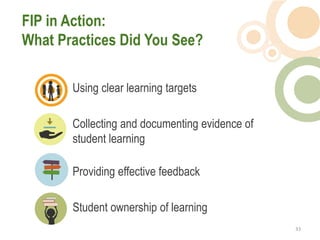
FIP in Action:
What Practices Did You See?

       Using clear learning targets

       Collecting and documenting evidence of
       student learning

       Providing effective feedback

       Student ownership of learning
                                                33  
Access Online Resources
Access module facilitation materials at
www.bit.ly/FacilitatingFIP


                    Once logged in, click the “Facilitating
                    Formative Instructional Practices” link
                    in the Tools section.


                                                          34  
Want to Learn More?

Visit www.FIPYourSchoolOhio.org to find an information
session in your region and meet your FIP Specialist!


FIP Your School Ohio
Virginia Ressa
Project Coordinator
(614) 728-6920
virginia.ressa@ode.state.oh.us

                                                     35  

Transitioning to New Standards Using Formative Instructional Practices

  • 1.
    Transitioning to NewStandards Using Formative Instructional Practices 1  
  • 2.
    Today’s Learning Targets Participantswill understand: • The importance of formative instructional practices • How formative instructional practices support the Common Core State Standards • How FIP Your School Ohio can assist with transitioning to new standards 2  
  • 3.
  • 4.
    What Are Formative InstructionalPractices? • Formative instructional practices (FIP) are the formal and informal ways that teachers and students gather and respond to evidence of student learning. 4  
  • 5.
    What is thedifference? • Formative Assessment • Assessment for Learning • Assessment of Learning • Formative Instructional Practices 5  
  • 6.
    What Matters Most? Extensiveresearch says: • Formative Evaluation • Teacher Clarity • Feedback • Learning Intentions Visible Learning by John Hattie (2009) 6  
  • 7.
    Activity: High ImpactPractices Directions: • Review the High Impact Practices • Discuss which three practices you think have the most impact on student achievement
  • 8.
    Core Components ofFormative Instructional Practices Using clear learning targets Collecting and documenting evidence of student learning Providing effective feedback Student ownership of learning 8  
  • 9.
    Core Components ofFormative Instructional Practices Are we creating and communicating clear, student-friendly learning targets? Have we been collecting and documenting evidence of student learning? Are we analyzing evidence of student learning and providing effective feedback? How have we been increasing opportunities for students to take ownership of their learning? 9  
  • 10.
    FIP in Action: WhatPractices Did You See? Using clear learning targets Collecting and documenting evidence of student learning Providing effective feedback Student ownership of learning 10  
  • 11.
    HOW DO FORMATIVEINSTRUCTIONAL PRACTICES SUPPORT COMMON CORE STATE STANDARDS? 11  
  • 12.
    Shifts in EnglishLanguage Arts Shift 1 PK-5, Balancing Informational & Literary Texts Shift 2 6-12, Knowledge in the Disciplines Shift 3 Staircase of Complexity Shift 4 Text-based Answers Shift 5 Writing from Sources Shift 6 Academic Vocabulary 12  
  • 13.
    FIP in Action: WhatPractices Did You See? Using clear learning targets Collecting and documenting evidence of student learning Providing effective feedback Student ownership of learning 13  
  • 14.
    FIP in Action: WhatPractices Did You See? Using clear learning targets Collecting and documenting evidence of student learning Providing effective feedback Student ownership of learning 14  
  • 15.
    Shifts in Mathematics Shift 1 Focus Shift 2 Coherence Shift 3 Fluency Shift 4 Deep Understanding Shift 5 Application Shift 6 Dual Intensity 15  
  • 16.
    FIP in Action: WhatPractices Did You See? Using clear learning targets Collecting and documenting evidence of student learning Providing effective feedback Student ownership of learning 16  
  • 17.
    FIP in Action: WhatPractices Did You See? Using clear learning targets Collecting and documenting evidence of student learning Providing effective feedback Student ownership of learning 17  
  • 18.
    FIP in Action: WhatPractices Did You See? Using clear learning targets Collecting and documenting evidence of student learning Providing effective feedback Student ownership of learning 18  
  • 19.
    WHAT SHOULD DISTRICTSBE DOING NOW? 19  
  • 20.
    State Transition Timeline June 2010- 2011-2012 2012-2013 2013-2014 2014-2015 July 2011 School Year School Year School Year School Year Phase  4  –  Full   Phase  3  –Transition  and   implementation  and   Phase  1-­‐  Communication  and   Phase  2  -­‐  Alignment  and   Implementation   Evaluation   Awareness   Refinement   Implementation  of   Statewide  awareness  and   Curriculum  alignment  to  the   alignment  and   Continued   revised  curriculum   understanding  of  the  new   new  standards       initial  implementation  of   aligned  curriculum  and   and  instruction   academic  standards  and   National  assessment   instruction       National  and  state   model  curriculum   consortia  and  state   National  assessment   assessment  fully   Participating  member  in  both   assessment  development   operational     national  assessment   work     consortia  and  state   assessment  development   New   consortia   OAA  and  OGT  assessments   Accountability   work     OAA  and  OGT  assessments   aligned  to  the  Ohio’s  2001   System   aligned  to  the  Ohio’s  2001   and  2002  academic  standards   GT  assessments   OAA  and  O Continued   Development and implementation of necessary aligned  to  the  Ohio’s  2001   and  2002  academic  standards   Accountability  based  on  the   resources and professional development for a enhancement  of   and  2002  academic  standards   teaching  and   successful transition to Ohio’s Integrated OGT   Accountability  based  on  the   OAA  and   Educational System Accountability  based  on  the   learning   OAA  and  OGT   OAA  and  OGT  
  • 21.
    What Should DistrictsBe Doing Do Now? • Become familiar with: • Common Core State Standards • Revised standards • Model curricula for each • Utilize crosswalks and to identify changes in content and levels of rigor from existing to revised standards • Conduct Gap Analyses and Curriculum Alignment • Ensure that all students have access to high quality instruction and challenging curriculum • Develop support structures for struggling students
  • 22.
    Common Core Transition EducationalTesting Service (ETS) www.k12center.org 22  
  • 23.
    What Can WeDo Now in ELA? • Study the standards • Support teachers as they expand their skills and knowledge • Engage in job-embedded professional development • Collaborate for shared learning • Create time for collaboration 23  
  • 24.
    What Can WeDo Now in Mathematics? • Communicate that CCSS Mathematics requires significant shifts • Promote understanding and implementation of the standards • Provide professional development on instructional practices • Develop a plan to phase-in curricular changes • Assess students’ conceptual understandings and mathematical practices • Center professional development around teacher collaboration 24  
  • 25.
    RESOURCES AVAILABLE FROM FIP YOUR SCHOOL 25  
  • 26.
    Race to theTop Scope of Work A. State Success Factors B. Standards and Assessment C. Data Systems to Support Instruction D. Great Teachers and Leaders E. Turning Around the Lowest Achieving Schools 26  
  • 27.
    FIP Your School Supportfor LEAs • System of Support • Regional FIP Specialists • Local FIP Facilitators • ESC Partners • Professional Development Tools • Online learning modules • Facilitation materials • Online FIP Campus 27  
  • 28.
    Professional Development Tools OnlineLearning Modules • Foundations of Formative Instructional Practices (5 modules) • Coaching and Leading Formative Instructional Practices (2 module) • Applications of Formative Instructional Practices (30+ modules / online learning tools) 28  
  • 29.
    Blended Learning in TeacherTeams FIP Your School is supporting a blended learning approach. Teacher-­‐ Online   Blended   Based   Learning   Learning   Teams   Modules  
  • 30.
  • 31.
    Ohio Standards forthe Teaching Profession
  • 32.
    Ohio Standards forthe Teaching Profession Teachers understand student learning and development and respect the diversity of the students 1. they teach. 2. Teachers know and understand the content area for which they have instructional responsibility. Teachers understand and use varied assessments to inform instruction, evaluate and ensure 3. student learning. Teachers plan and deliver effective instruction that advances the learning of each 4. individual student. Teachers create learning environments that promote high levels of learning and achievement for 5. all students. Teachers collaborate and communicate with students, parents, other educators, administrators 6. and the community to support student learning. Teachers assume responsibility for professional growth, performance and involvement as 7. individuals and as members of a learning community. 32  
  • 33.
    FIP in Action: WhatPractices Did You See? Using clear learning targets Collecting and documenting evidence of student learning Providing effective feedback Student ownership of learning 33  
  • 34.
    Access Online Resources Accessmodule facilitation materials at www.bit.ly/FacilitatingFIP Once logged in, click the “Facilitating Formative Instructional Practices” link in the Tools section. 34  
  • 35.
    Want to LearnMore? Visit www.FIPYourSchoolOhio.org to find an information session in your region and meet your FIP Specialist! FIP Your School Ohio Virginia Ressa Project Coordinator (614) 728-6920 virginia.ressa@ode.state.oh.us 35