Coherent and Rigorous Instructional 
Programs 
Achievement-Centered Leadership Development Program for Practicing and 
Aspiring Principals 
Western Michigan University 
A Project funded by the United States Department of Education (USDOE), Washington, DC 
Session Designers: 
Dr. Patricia (Pat) Reeves 
Dr. Robert (Bob) Leneway
2 
Agenda 
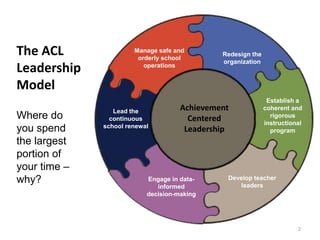
Manage safe and 
orderly school 
Redesign the 
organization 
Real-time and 
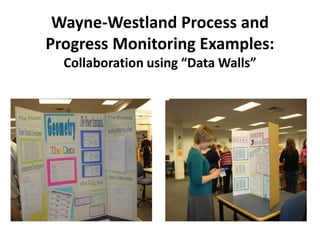
Embedded 
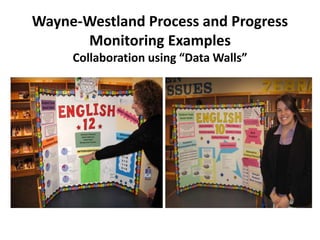
Instructional 
Assessment 
Achievement 
Coherent Curricular 
Programs 
Centered 
Leadership 
operations 
Engage in data-informed 
decision-making 
Develop teacher 
leaders 
Establish a 
coherent and 
rigorous 
instructional 
program 
Lead the 
continuous 
school renewal 
The ACL 
Leadership 
Model 
Where do 
you spend 
the largest 
portion of 
your time – 
why?
Session Goals 
• Explore the importance of insuring that our schools offer 
Coherent and Rigorous Instructional Programs 
• Explore the characteristics of Coherent and Rigorous 
Instruction Programs 
• Examine the status of our own schools Instructional 

Programs 
• Explore possible ways to increase learning opportunity and 
learning results for our students by strengthening 
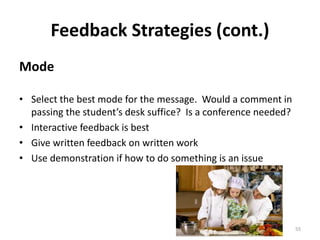
Instructional Programs 
3
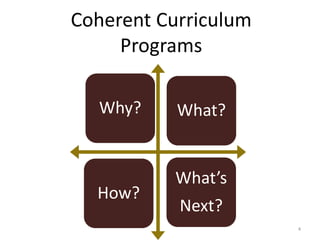
Coherent Curriculum 
Programs 
4 
Why? What? 
How? 
What’s 
Next?
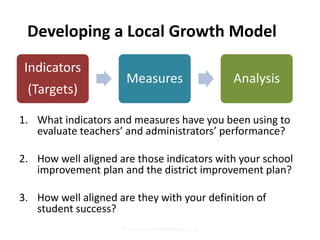
Why and how much should we care? 
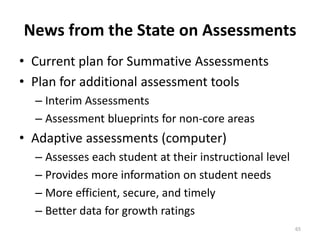
• Per McREL research (Marzano, et al), 
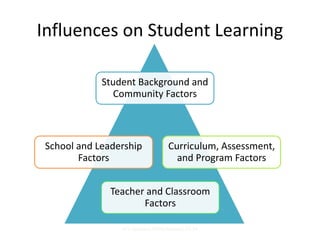
Guaranteed and Viable Curriculum 
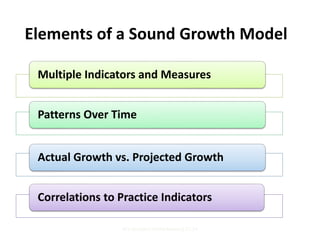
shows one of the highest correlations to 

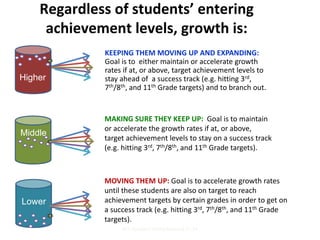
improving student achievement 
• Effect sizes for evidence based 
instructional strategies drop 
precipitously when not coupled with a 
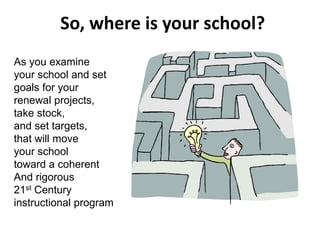
guaranteed and viable curriculum 
Talk with your 
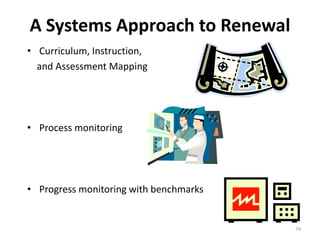
table partners 
about how you 
have encountered 
this in your school. 
5
How do we know where we are? 
Let’s look at one strategy 
for understanding where 
we stand in our schools 
when it comes to 
providing Coherent and 
Rigorous Instructional 
Programs (CRIP) 
for all students 
6
Doing a Scan 
1. Using the “Doing a Scan” handout, use your 
time here to quickly assess where your 
school may be falling short on delivering a 
Coherent and Rigorous Instructional Program 
(CRIP) 
2. As we discuss each element of CRIP, think 
about how the markers of each element 
apply to your school. Be ready to record.
What are the Markers of CRIP? 
Part 1 - The Written Curriculum: What we teach 
1. Core curriculum standards aligned to state and/or 
national standards 
2. Local District or school level standards 
3. Essential or “power standards” aligned to both the 
core and local curricula 
4. Horizontal and vertical alignment and articulation 
Discuss your school’s status; 
Circle areas of concern and make a few notes 
8
What are the Markers of CRIP? 
Part 2 - The Interpreted Curriculum: What we have 
students do 
1. Demonstration of essential understandings 
2. Applied skills 
3. Applied concepts 
4. Performances – how we ask students to apply what 
they know 
5. Integration – how we weave curricular elements 
together 
Discuss your school’s status; 
Circle areas of concern and make a few notes 9
What are the Markers of CRIP? 
Part 3 – The Taught Curriculum: How we support 
student learning 
1. Aligned and appropriate learning resources (hard and 
electronic) 
2. Aligned and effective classroom instruction 
3. Engaging and meaningful learning experiences 
4. High expectations and supportive encouragement 
5. Sufficient learning time 
Discuss your school’s status; 
Circle areas of concern and make a few notes 
10
What are the Markers of CRIP? 
Part 4 – The Communicated Curriculum: How we engage 
staff, students, parents and others 
1. Learning focused leadership 
2. Clear and consistent communication about learning 
expectations and learning progress 
3. Affirmation and celebration of success 
4. Student parent, and stakeholder feedback 
Discuss your school’s status; 
Circle areas of concern and make a few notes 
11
What are the Markers of CRIP? 
Part 5 –The Assessed Curriculum: How we monitor 
student learning 
1. Aligned and authentic curriculum based assessments 
– both formative and summative 
2. Immediate and targeted feedback 
3. Continuous progress monitoring 
4. Student developed personal learning goals 
5. Student managed personal learning plans 
Discuss your school’s status; 
Circle areas of concern and make a few notes 
12
What are the Markers of CRIP? 
Part 6 – The Adapted Curriculum: What we do when 
students struggle or accelerate? 
1. Differentiated instructional strategies 
2. Tiered interventions that start in the classroom 
3. Adjusted learning plans 
Discuss your school’s status; 
Circle areas of concern and make a few notes 
13
A Recap of 6 Elements of CRIP 
We just looked at your school’s status on five 
elements of CRIP: 
• The written curriculum 
• The interpreted curriculum 
• The taught curriculum 
• The communicated curriculum 
• The assessed curriculum 
• The adapted curriculum 
Count all the circled 
items for your school 
under each of the six 
elements. Put that 
number of dots on the 
chart at the front of 
the room under each 
of six elements 
Where do you see the 
most common areas 
of concern? Why do 
you think that is?
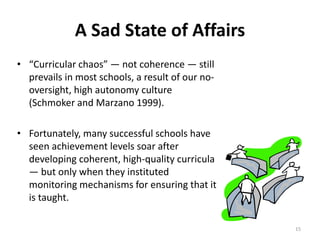
A Sad State of Affairs 
• “Curricular chaos” — not coherence — still 
prevails in most schools, a result of our no-oversight, 
high autonomy culture 
(Schmoker and Marzano 1999). 
• Fortunately, many successful schools have 
seen achievement levels soar after 
developing coherent, high-quality curricula 
— but only when they instituted 
monitoring mechanisms for ensuring that it 
is taught. 
15
Wayne-Westland Process and 
Progress Monitoring Examples: 
Collaboration using “Data Walls”
Wayne-Westland Process and Progress 
Monitoring Examples 
Collaboration using “Data Walls”
ACL’s Renewal Focus 
• 6 Research Grounded School Leadership 
Dimensions 
• Renewal Planning Matrix 
• School Teams 
• Assessment of renewal needs 
• Building on previous renewal 
(improvement work) 
• Future Oriented
How do you want to move forward? 
Student 
Centered 
Mandated 
Standards 
19 
If your answer is both…
Strike a balance between State Curriculum 
and Identified Student Needs 
20
Align with State Assessments, 
but don’t stop there! 
21
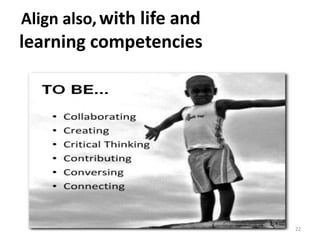
Align also, with life and 
learning competencies 
22
They are Not mutually exclusive 
Our Students Can and Must Have the Best of Both 
23 
To Compete in an emerging and shifting global context
Decisions to Avoid 
24 
Over focus on a few Tests; 
giving short shrift to the rest
Decisions to Avoid 
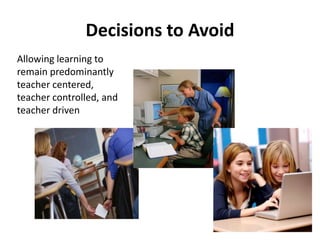
Allowing learning to 
remain predominantly 
teacher centered, 
teacher controlled, and 
teacher driven 
25
Decisions to Avoid 
Limiting learning to 
traditional time slots, 
traditional learning 
tools, and traditional 
learning activities; 
in fact, 
limiting learning 
at all! 
26
Decisions to Consider 
Make the Curriculum an 
Open Door to the World 
27
What is a Classroom? 
Is it This?
Is it Any of These?
Ask any Student …
What Would They Tell Us? 
Don’t prepare us for your world, 
prepare us for ours! 
http://www.youtube.com/watch?v=xoSJ3_dZcm8
Decisions to Consider 
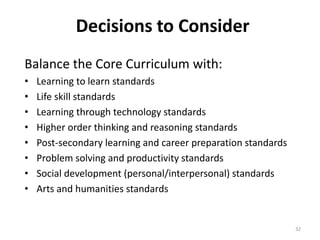
Balance the Core Curriculum with: 
• Learning to learn standards 
• Life skill standards 
• Learning through technology standards 
• Higher order thinking and reasoning standards 
• Post-secondary learning and career preparation standards 
• Problem solving and productivity standards 
• Social development (personal/interpersonal) standards 
• Arts and humanities standards 
32
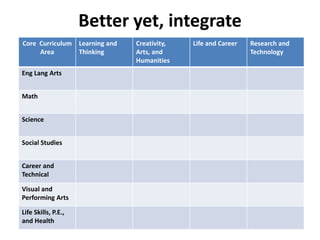
Better yet, integrate 
Core Curriculum 
Area 
Learning and 
Thinking 
Creativity, 
Arts, and 
Humanities 
Life and Career Research and 
Technology 
Eng Lang Arts 
Math 
Science 
Social Studies 
Career and 
Technical 
Visual and 
Performing Arts 
Life Skills, P.E., 
and Health
The Power of Curriculum Integration 
Start with these research findings: 
Students in any type of interdisciplinary or integrative 
curriculum do as well as, and often better than, students in a 
conventional departmentalized program. (National 
Association for Core Curriculum, 2000; Vars, 1996, 1997; 
Arhar, 1997) 
How might curriculum integration coupled with technology 
integration better serve students in your schools? 
34
The Power of High Impact Instruction 
How might these 9 high impact instructional 
strategies (Marzano, Pickering, & Pollack, 2001) 
improve student learning in your school? 
1. Identifying similarities and differences 
2. Summarizing and note taking 
3. Reinforcing effort and providing recognition 
4. Homework and practice 
5. Nonlinguistic representations 
6. Cooperative learning 
7. Setting objectives and providing feedback 
8. Generating and testing hypotheses 
9. Cues, questions, and advance organizers 
35
The Power of Technology
When we connect students with the 
power of Technology…
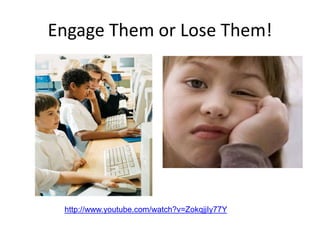
Engage Them or Lose Them! 
http://www.youtube.com/watch?v=ZokqjjIy77Y
We make learning fit today’s learners by… 
• Making learning multi-dimensional 
• Making the world their classroom 
• Integrating curriculum 
• Personalizing learning 
• Differentiating instruction 
• Providing learning on-demand 
• Empowering learners to set goals and benchmark 
their progress
Circling Back 
• Look at all the areas you circled 
• Look at your notes 
• Together, identify 3-5 top priorities 
• Be ready to share your priorities and why 
• How will these ideas inform your renewal work? 
– 21 Century Learning 
– High Impact Instructional Strategies 
– Curriculum Integration 
– Going beyond the Core
The Role of Assessments
Some Types of Assessments 
• Authentic 
• Portfolios 
• Observations 
• Formative 
• Summative 
• Norm Referenced 
• Criterion Reverenced 
• Pre-Interim-Post 
• Adaptive 
• Diagnostic 
42
Real Time Embedded Assessments 
Kellough (1999) lists the purposes of assessments 
• To assist student learning 
• To identify students’ strengths and weaknesses 
• To assess the effectiveness of a particular instructional 
strategy 
• To assess and improve the effectiveness of curriculum 
programs 
• To assess and improve teaching effectiveness 
• To provide data that assist in decision making 
• To communicate with and involve parents 
43
Real Time Embedded Assessments 
Kellough also suggests that students need the answers to 
the following questions: 
• Where am I going? 
• Where am I now? 
• How do I get where I am going? 
• How will I know when I get there? 
• Am I on the right track for getting there? 
44
Formative Assessments - definitions 
Bell and Cowie (2001) “the process used by teachers and students to 
recognize and respond to learning in order to enhance that learning, 
during the learning.” 
Popham (2008) as a planned process in which assessment-elicited evidence of 
students’ status is used by teachers to adjust their ongoing instructional 
procedures or by students to adjust their current learning tactics. 
Garrison and Ehringhaus (2011) view 
formative assessments as providing 
the information necessary to adjust 
teaching and learning while they 
are happening. 
45
The Value of Formative Assessments 
Research has shown the formative assessments implemented 
properly provide dramatic gains in learning. 
The work of Black and William (1998) found that the gains in 
learning by using formative assessments were “amongst the 
largest ever reported for educational interventions.” 
Formative assessment works and there is no particular formula 
to follow and it appears to work very well for slow learners 
(Popham, 2008) 
46
Formative Assessment 
Marzano (2010) explains the elements of formative assessment 
• Formative assessment is a process, not any particular test 
• It is used not just by teachers, but by both teachers and students 
• Formative assessment takes place during instruction 
• It provides assessment-based feedback to teachers and students 
• The function of this feedback is to help teachers and students make 
adjustments that will improve students’ achievement of intended 
curricular aims 
47
Feedback 
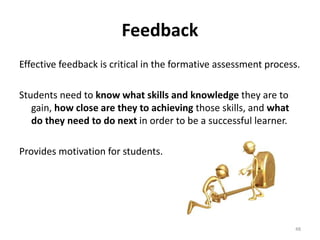
Effective feedback is critical in the formative assessment process. 
Students need to know what skills and knowledge they are to 
gain, how close are they to achieving those skills, and what 
do they need to do next in order to be a successful learner. 
Provides motivation for students. 
48
Feedback 
Hattie and Timperley (2007) model for feedback 
• Feedback about the task – whether answers are right or 
wrong or directions to get more information. 
• Feedback about the processing of the task – strategies used 
or strategies that could be used. 
• Feedback about self-regulation – feedback about student self 
evaluation or self confidence. 
• Feedback about the student as a person. 
49
Feedback 
Marzano’s (2003) best ways to use feedback: 
• Feedback should be “corrective” in nature – provide students 
with an explanation of what they did right and wrong. 
• Feedback should be timely – immediately following an 
assessment 
• Feedback should be specific to a criterion – it should reference a 
specific level or skill or knowledge. 
• Students can effectively provide some of their own feedback – 
students keeping track of their performance as learning occurs. 
50
Feedback Based on Goals 
Marzano indicates that feedback must be based on criterion or 
goals. 
• Instructional goals narrow what students focus on. 
• Instructional goals should not be too specific. 
• Students should be encouraged to 
personalize the teacher’s goals. 
51
Meaningful Goals 
Brookhart (2008) states that teachers must be sure to do the 
following with each assignment: 
• Require student work to demonstrate the content knowledge or 
skills specified in the learning target. 
• Require students to demonstrate the cognitive process specified 
in the learning target. 
• Provide students with complete and clear directions. 
• Specify the criteria for good work 
52
Feedback Strategies 
Timing 
• Provide immediate feedback for knowledge of facts 
• Delay feedback slightly for more comprehensive reviews of 
student thinking and processing 
• Never delay feedback beyond when it would make a 
difference to students 
• Provide feedback as often as is practical, for all major 
assignments 
53
Feedback Strategies (cont.) 
Amount 
• Prioritize – pick the most important points 
• Choose points that relate to major learning goals 
• Consider the student’s developmental level 
54
Feedback Strategies (cont.) 
Mode 
• Select the best mode for the message. Would a comment in 
passing the student’s desk suffice? Is a conference needed? 
• Interactive feedback is best 
• Give written feedback on written work 
• Use demonstration if how to do something is an issue 
55
Feedback Strategies (cont.) 
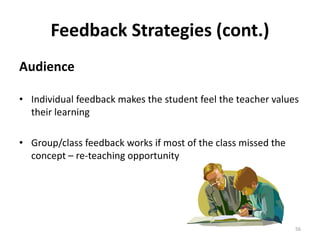
Audience 
• Individual feedback makes the student feel the teacher values 
their learning 
• Group/class feedback works if most of the class missed the 
concept – re-teaching opportunity 
56
Feedback Strategies (cont.) 
Focus 
• When possible, describe both the work and the process 
• Comment on the student’s self-regulation if the comment will 
foster self-efficacy 
• Avoid personal comments 
57
Feedback Strategies (cont.) 
Function 
• Describe – don’t judge 
Balance 
• Use positive comments that describe what was done well 
• Accompany negative descriptions of the work with positive 
suggestions for improvement 
58
Feedback Strategies (cont.) 
Clarity 
• Use vocabulary and concepts the student will understand 
• Tailor the amount and content of feedback to the student’s 
developmental level 
59
Feedback Strategies (cont.) 
Specificity 
• Match the degree of specificity to the 
student and the task 
• Make feedback specific enough that they know what to do, 
but not so specific that it is done for them 
• Identify errors or types of errors, but do not correct everyone 
– leave some for the student to correct 
60
Status of Formative Assessments 
• How effectively are teachers using formative 
assessments in your school? 
• How might improving or expanding the use of 
formative assessments fit into your school 
renewal work? 
• Take another look at the element of the 
Assessed Curriculum and talk about where 
you are and where you need to go.
Assessments in a Growth Model 
• Growth Models are used to determine school, 
teacher and other influences on student 
outcomes 
• Michigan now requires that districts develop 
and use a growth model to estimate teacher 
and administrator influence on student 
achievement
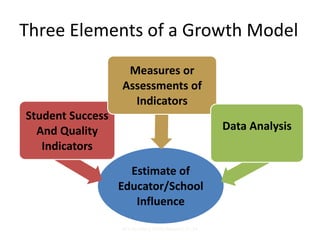
Three Elements of a Growth Model 
Estimate of 
Educator/School 
Influence 
Student Success 
And Quality 
Indicators 
Measures or 
Assessments of 
Indicators 
Data Analysis 
63 ACL:Session1:DDIM.Reeves2.27.14
Developing a Local Growth Model 
Indicators 
(Targets) 
Measures Analysis 
1. What indicators and measures have you been using to 
evaluate teachers’ and administrators’ performance? 
2. How well aligned are those indicators with your school 
improvement plan and the district improvement plan? 
3. How well aligned are they with your definition of 
student success? 
64 ACL:Session1:DDIM.Reeves2.27.14
News from the State on Assessments 
• Current plan for Summative Assessments 
• Plan for additional assessment tools 
– Interim Assessments 
– Assessment blueprints for non-core areas 
• Adaptive assessments (computer) 
– Assesses each student at their instructional level 
– Provides more information on student needs 
– More efficient, secure, and timely 
– Better data for growth ratings 
65
Influences on Student Learning 
Student Background and 
Community Factors 
Curriculum, Assessment, 
and Program Factors 
School and Leadership 
Teacher and Classroom 
Factors 
Factors 
66 ACL:Session1:DDIM.Reeves2.27.14
Elements of a Sound Growth Model 
Multiple Indicators and Measures 
Patterns Over Time 
Actual Growth vs. Projected Growth 
Correlations to Practice Indicators 
67 ACL:Session1:DDIM.Reeves2.27.14
Regardless of students’ entering 
achievement levels, growth is: 
KEEPING THEM MOVING UP AND EXPANDING: 
Goal is to either maintain or accelerate growth 
rates if at, or above, target achievement levels to 
stay ahead of a success track (e.g. hitting 3rd, 
7th/8th, and 11th Grade targets) and to branch out. 
MAKING SURE THEY KEEP UP: Goal is to maintain 
or accelerate the growth rates if at, or above, 
target achievement levels to stay on a success track 
(e.g. hitting 3rd, 7th/8th, and 11th Grade targets). 
MOVING THEM UP: Goal is to accelerate growth rates 
until these students are also on target to reach 
achievement targets by certain grades in order to get on 
a success track (e.g. hitting 3rd, 7th/8th, and 11th Grade 
targets). 
Higher 
Middle 
Lower 
68 ACL:Session1:DDIM.Reeves2.27.14
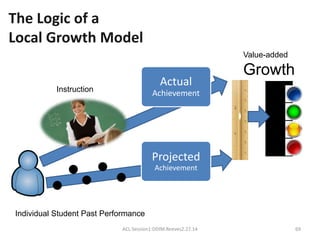
The Logic of a 
Local Growth Model 
Actual 
Achievement 
Projected 
Achievement 
Value-added 
Growth 
Instruction 
Individual Student Past Performance 
ACL:Session1:DDIM.Reeves2.27.14 69
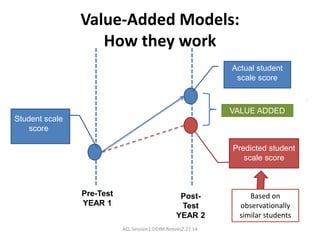
Value-Added Models: 
How they work 
Pre-Test 
YEAR 1 
Post- 
Test 
YEAR 2 
Actual student 
scale score 
VALUE ADDED 
Predicted student 
scale score 
Student scale 
score 
Based on 
observationally 
similar students 
70 
ACL:Session1:DDIM.Reeves2.27.14
Growth Model for Your School 
• Districts will be developing growth 
models per State requirements 
• Local districts will need to define 
success indicators and measures 
• How will your school influence and 
contribute to that work?
So, where is your school? 
72 
As you examine 
your school and set 
goals for your 
renewal projects, 
take stock, 
and set targets, 
that will move 
your school 
toward a coherent 
And rigorous 
21st Century 
instructional program
Circling Back 1 More Time 
• How will these ideas inform your renewal work? 
– Real Time Embedded Assessments 
– Contributions to your District Growth Model
A Systems Approach to Renewal 
• Curriculum, Instruction, 
and Assessment Mapping 
• Process monitoring 
• Progress monitoring with benchmarks 
74
A Systems Approach 
75 
Changing how you work together to 
renew your school for 21st Century Learners through the: 
Written, 
Interpreted, 
Taught, 
Communicated, 
Assessed, 
Adapted, 
And, ultimately, the Learned Curriculum
Where do you need to go and how 
will you get there? 
76
School Renewal Decisions 
• How will you harness the 
power of coherent and 
rigorous instructional 
programs (CRIP)in your 
school renewal work? 
• How will you use the six ACL 
dimensions in a systems 
approach to school renewal? 
77
78 
On behalf of Michigan’s most 
Precious resource… 
Thank you for being learning 
Leaders

Coherent and Rigorous Instructional Programs

  • 1.
    Coherent and RigorousInstructional Programs Achievement-Centered Leadership Development Program for Practicing and Aspiring Principals Western Michigan University A Project funded by the United States Department of Education (USDOE), Washington, DC Session Designers: Dr. Patricia (Pat) Reeves Dr. Robert (Bob) Leneway
  • 2.
    2 Agenda Managesafe and orderly school Redesign the organization Real-time and Embedded Instructional Assessment Achievement Coherent Curricular Programs Centered Leadership operations Engage in data-informed decision-making Develop teacher leaders Establish a coherent and rigorous instructional program Lead the continuous school renewal The ACL Leadership Model Where do you spend the largest portion of your time – why?
  • 3.
    Session Goals •Explore the importance of insuring that our schools offer Coherent and Rigorous Instructional Programs • Explore the characteristics of Coherent and Rigorous Instruction Programs • Examine the status of our own schools Instructional Programs • Explore possible ways to increase learning opportunity and learning results for our students by strengthening Instructional Programs 3
  • 4.
    Coherent Curriculum Programs 4 Why? What? How? What’s Next?
  • 5.
    Why and howmuch should we care? • Per McREL research (Marzano, et al), Guaranteed and Viable Curriculum shows one of the highest correlations to improving student achievement • Effect sizes for evidence based instructional strategies drop precipitously when not coupled with a guaranteed and viable curriculum Talk with your table partners about how you have encountered this in your school. 5
  • 6.
    How do weknow where we are? Let’s look at one strategy for understanding where we stand in our schools when it comes to providing Coherent and Rigorous Instructional Programs (CRIP) for all students 6
  • 7.
    Doing a Scan 1. Using the “Doing a Scan” handout, use your time here to quickly assess where your school may be falling short on delivering a Coherent and Rigorous Instructional Program (CRIP) 2. As we discuss each element of CRIP, think about how the markers of each element apply to your school. Be ready to record.
  • 8.
    What are theMarkers of CRIP? Part 1 - The Written Curriculum: What we teach 1. Core curriculum standards aligned to state and/or national standards 2. Local District or school level standards 3. Essential or “power standards” aligned to both the core and local curricula 4. Horizontal and vertical alignment and articulation Discuss your school’s status; Circle areas of concern and make a few notes 8
  • 9.
    What are theMarkers of CRIP? Part 2 - The Interpreted Curriculum: What we have students do 1. Demonstration of essential understandings 2. Applied skills 3. Applied concepts 4. Performances – how we ask students to apply what they know 5. Integration – how we weave curricular elements together Discuss your school’s status; Circle areas of concern and make a few notes 9
  • 10.
    What are theMarkers of CRIP? Part 3 – The Taught Curriculum: How we support student learning 1. Aligned and appropriate learning resources (hard and electronic) 2. Aligned and effective classroom instruction 3. Engaging and meaningful learning experiences 4. High expectations and supportive encouragement 5. Sufficient learning time Discuss your school’s status; Circle areas of concern and make a few notes 10
  • 11.
    What are theMarkers of CRIP? Part 4 – The Communicated Curriculum: How we engage staff, students, parents and others 1. Learning focused leadership 2. Clear and consistent communication about learning expectations and learning progress 3. Affirmation and celebration of success 4. Student parent, and stakeholder feedback Discuss your school’s status; Circle areas of concern and make a few notes 11
  • 12.
    What are theMarkers of CRIP? Part 5 –The Assessed Curriculum: How we monitor student learning 1. Aligned and authentic curriculum based assessments – both formative and summative 2. Immediate and targeted feedback 3. Continuous progress monitoring 4. Student developed personal learning goals 5. Student managed personal learning plans Discuss your school’s status; Circle areas of concern and make a few notes 12
  • 13.
    What are theMarkers of CRIP? Part 6 – The Adapted Curriculum: What we do when students struggle or accelerate? 1. Differentiated instructional strategies 2. Tiered interventions that start in the classroom 3. Adjusted learning plans Discuss your school’s status; Circle areas of concern and make a few notes 13
  • 14.
    A Recap of6 Elements of CRIP We just looked at your school’s status on five elements of CRIP: • The written curriculum • The interpreted curriculum • The taught curriculum • The communicated curriculum • The assessed curriculum • The adapted curriculum Count all the circled items for your school under each of the six elements. Put that number of dots on the chart at the front of the room under each of six elements Where do you see the most common areas of concern? Why do you think that is?
  • 15.
    A Sad Stateof Affairs • “Curricular chaos” — not coherence — still prevails in most schools, a result of our no-oversight, high autonomy culture (Schmoker and Marzano 1999). • Fortunately, many successful schools have seen achievement levels soar after developing coherent, high-quality curricula — but only when they instituted monitoring mechanisms for ensuring that it is taught. 15
  • 16.
    Wayne-Westland Process and Progress Monitoring Examples: Collaboration using “Data Walls”
  • 17.
    Wayne-Westland Process andProgress Monitoring Examples Collaboration using “Data Walls”
  • 18.
    ACL’s Renewal Focus • 6 Research Grounded School Leadership Dimensions • Renewal Planning Matrix • School Teams • Assessment of renewal needs • Building on previous renewal (improvement work) • Future Oriented
  • 19.
    How do youwant to move forward? Student Centered Mandated Standards 19 If your answer is both…
  • 20.
    Strike a balancebetween State Curriculum and Identified Student Needs 20
  • 21.
    Align with StateAssessments, but don’t stop there! 21
  • 22.
    Align also, withlife and learning competencies 22
  • 23.
    They are Notmutually exclusive Our Students Can and Must Have the Best of Both 23 To Compete in an emerging and shifting global context
  • 24.
    Decisions to Avoid 24 Over focus on a few Tests; giving short shrift to the rest
  • 25.
    Decisions to Avoid Allowing learning to remain predominantly teacher centered, teacher controlled, and teacher driven 25
  • 26.
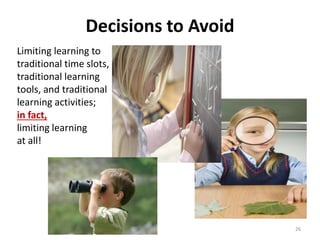
    Decisions to Avoid Limiting learning to traditional time slots, traditional learning tools, and traditional learning activities; in fact, limiting learning at all! 26
  • 27.
    Decisions to Consider Make the Curriculum an Open Door to the World 27
  • 28.
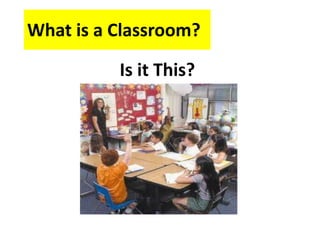
    What is aClassroom? Is it This?
  • 29.
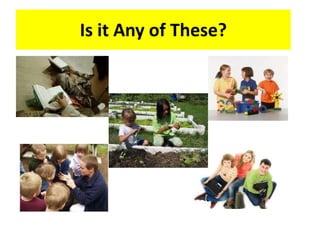
    Is it Anyof These?
  • 30.
  • 31.
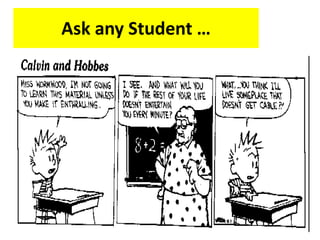
    What Would TheyTell Us? Don’t prepare us for your world, prepare us for ours! http://www.youtube.com/watch?v=xoSJ3_dZcm8
  • 32.
    Decisions to Consider Balance the Core Curriculum with: • Learning to learn standards • Life skill standards • Learning through technology standards • Higher order thinking and reasoning standards • Post-secondary learning and career preparation standards • Problem solving and productivity standards • Social development (personal/interpersonal) standards • Arts and humanities standards 32
  • 33.
    Better yet, integrate Core Curriculum Area Learning and Thinking Creativity, Arts, and Humanities Life and Career Research and Technology Eng Lang Arts Math Science Social Studies Career and Technical Visual and Performing Arts Life Skills, P.E., and Health
  • 34.
    The Power ofCurriculum Integration Start with these research findings: Students in any type of interdisciplinary or integrative curriculum do as well as, and often better than, students in a conventional departmentalized program. (National Association for Core Curriculum, 2000; Vars, 1996, 1997; Arhar, 1997) How might curriculum integration coupled with technology integration better serve students in your schools? 34
  • 35.
    The Power ofHigh Impact Instruction How might these 9 high impact instructional strategies (Marzano, Pickering, & Pollack, 2001) improve student learning in your school? 1. Identifying similarities and differences 2. Summarizing and note taking 3. Reinforcing effort and providing recognition 4. Homework and practice 5. Nonlinguistic representations 6. Cooperative learning 7. Setting objectives and providing feedback 8. Generating and testing hypotheses 9. Cues, questions, and advance organizers 35
  • 36.
    The Power ofTechnology
  • 37.
    When we connectstudents with the power of Technology…
  • 38.
    Engage Them orLose Them! http://www.youtube.com/watch?v=ZokqjjIy77Y
  • 39.
    We make learningfit today’s learners by… • Making learning multi-dimensional • Making the world their classroom • Integrating curriculum • Personalizing learning • Differentiating instruction • Providing learning on-demand • Empowering learners to set goals and benchmark their progress
  • 40.
    Circling Back •Look at all the areas you circled • Look at your notes • Together, identify 3-5 top priorities • Be ready to share your priorities and why • How will these ideas inform your renewal work? – 21 Century Learning – High Impact Instructional Strategies – Curriculum Integration – Going beyond the Core
  • 41.
    The Role ofAssessments
  • 42.
    Some Types ofAssessments • Authentic • Portfolios • Observations • Formative • Summative • Norm Referenced • Criterion Reverenced • Pre-Interim-Post • Adaptive • Diagnostic 42
  • 43.
    Real Time EmbeddedAssessments Kellough (1999) lists the purposes of assessments • To assist student learning • To identify students’ strengths and weaknesses • To assess the effectiveness of a particular instructional strategy • To assess and improve the effectiveness of curriculum programs • To assess and improve teaching effectiveness • To provide data that assist in decision making • To communicate with and involve parents 43
  • 44.
    Real Time EmbeddedAssessments Kellough also suggests that students need the answers to the following questions: • Where am I going? • Where am I now? • How do I get where I am going? • How will I know when I get there? • Am I on the right track for getting there? 44
  • 45.
    Formative Assessments -definitions Bell and Cowie (2001) “the process used by teachers and students to recognize and respond to learning in order to enhance that learning, during the learning.” Popham (2008) as a planned process in which assessment-elicited evidence of students’ status is used by teachers to adjust their ongoing instructional procedures or by students to adjust their current learning tactics. Garrison and Ehringhaus (2011) view formative assessments as providing the information necessary to adjust teaching and learning while they are happening. 45
  • 46.
    The Value ofFormative Assessments Research has shown the formative assessments implemented properly provide dramatic gains in learning. The work of Black and William (1998) found that the gains in learning by using formative assessments were “amongst the largest ever reported for educational interventions.” Formative assessment works and there is no particular formula to follow and it appears to work very well for slow learners (Popham, 2008) 46
  • 47.
    Formative Assessment Marzano(2010) explains the elements of formative assessment • Formative assessment is a process, not any particular test • It is used not just by teachers, but by both teachers and students • Formative assessment takes place during instruction • It provides assessment-based feedback to teachers and students • The function of this feedback is to help teachers and students make adjustments that will improve students’ achievement of intended curricular aims 47
  • 48.
    Feedback Effective feedbackis critical in the formative assessment process. Students need to know what skills and knowledge they are to gain, how close are they to achieving those skills, and what do they need to do next in order to be a successful learner. Provides motivation for students. 48
  • 49.
    Feedback Hattie andTimperley (2007) model for feedback • Feedback about the task – whether answers are right or wrong or directions to get more information. • Feedback about the processing of the task – strategies used or strategies that could be used. • Feedback about self-regulation – feedback about student self evaluation or self confidence. • Feedback about the student as a person. 49
  • 50.
    Feedback Marzano’s (2003)best ways to use feedback: • Feedback should be “corrective” in nature – provide students with an explanation of what they did right and wrong. • Feedback should be timely – immediately following an assessment • Feedback should be specific to a criterion – it should reference a specific level or skill or knowledge. • Students can effectively provide some of their own feedback – students keeping track of their performance as learning occurs. 50
  • 51.
    Feedback Based onGoals Marzano indicates that feedback must be based on criterion or goals. • Instructional goals narrow what students focus on. • Instructional goals should not be too specific. • Students should be encouraged to personalize the teacher’s goals. 51
  • 52.
    Meaningful Goals Brookhart(2008) states that teachers must be sure to do the following with each assignment: • Require student work to demonstrate the content knowledge or skills specified in the learning target. • Require students to demonstrate the cognitive process specified in the learning target. • Provide students with complete and clear directions. • Specify the criteria for good work 52
  • 53.
    Feedback Strategies Timing • Provide immediate feedback for knowledge of facts • Delay feedback slightly for more comprehensive reviews of student thinking and processing • Never delay feedback beyond when it would make a difference to students • Provide feedback as often as is practical, for all major assignments 53
  • 54.
    Feedback Strategies (cont.) Amount • Prioritize – pick the most important points • Choose points that relate to major learning goals • Consider the student’s developmental level 54
  • 55.
    Feedback Strategies (cont.) Mode • Select the best mode for the message. Would a comment in passing the student’s desk suffice? Is a conference needed? • Interactive feedback is best • Give written feedback on written work • Use demonstration if how to do something is an issue 55
  • 56.
    Feedback Strategies (cont.) Audience • Individual feedback makes the student feel the teacher values their learning • Group/class feedback works if most of the class missed the concept – re-teaching opportunity 56
  • 57.
    Feedback Strategies (cont.) Focus • When possible, describe both the work and the process • Comment on the student’s self-regulation if the comment will foster self-efficacy • Avoid personal comments 57
  • 58.
    Feedback Strategies (cont.) Function • Describe – don’t judge Balance • Use positive comments that describe what was done well • Accompany negative descriptions of the work with positive suggestions for improvement 58
  • 59.
    Feedback Strategies (cont.) Clarity • Use vocabulary and concepts the student will understand • Tailor the amount and content of feedback to the student’s developmental level 59
  • 60.
    Feedback Strategies (cont.) Specificity • Match the degree of specificity to the student and the task • Make feedback specific enough that they know what to do, but not so specific that it is done for them • Identify errors or types of errors, but do not correct everyone – leave some for the student to correct 60
  • 61.
    Status of FormativeAssessments • How effectively are teachers using formative assessments in your school? • How might improving or expanding the use of formative assessments fit into your school renewal work? • Take another look at the element of the Assessed Curriculum and talk about where you are and where you need to go.
  • 62.
    Assessments in aGrowth Model • Growth Models are used to determine school, teacher and other influences on student outcomes • Michigan now requires that districts develop and use a growth model to estimate teacher and administrator influence on student achievement
  • 63.
    Three Elements ofa Growth Model Estimate of Educator/School Influence Student Success And Quality Indicators Measures or Assessments of Indicators Data Analysis 63 ACL:Session1:DDIM.Reeves2.27.14
  • 64.
    Developing a LocalGrowth Model Indicators (Targets) Measures Analysis 1. What indicators and measures have you been using to evaluate teachers’ and administrators’ performance? 2. How well aligned are those indicators with your school improvement plan and the district improvement plan? 3. How well aligned are they with your definition of student success? 64 ACL:Session1:DDIM.Reeves2.27.14
  • 65.
    News from theState on Assessments • Current plan for Summative Assessments • Plan for additional assessment tools – Interim Assessments – Assessment blueprints for non-core areas • Adaptive assessments (computer) – Assesses each student at their instructional level – Provides more information on student needs – More efficient, secure, and timely – Better data for growth ratings 65
  • 66.
    Influences on StudentLearning Student Background and Community Factors Curriculum, Assessment, and Program Factors School and Leadership Teacher and Classroom Factors Factors 66 ACL:Session1:DDIM.Reeves2.27.14
  • 67.
    Elements of aSound Growth Model Multiple Indicators and Measures Patterns Over Time Actual Growth vs. Projected Growth Correlations to Practice Indicators 67 ACL:Session1:DDIM.Reeves2.27.14
  • 68.
    Regardless of students’entering achievement levels, growth is: KEEPING THEM MOVING UP AND EXPANDING: Goal is to either maintain or accelerate growth rates if at, or above, target achievement levels to stay ahead of a success track (e.g. hitting 3rd, 7th/8th, and 11th Grade targets) and to branch out. MAKING SURE THEY KEEP UP: Goal is to maintain or accelerate the growth rates if at, or above, target achievement levels to stay on a success track (e.g. hitting 3rd, 7th/8th, and 11th Grade targets). MOVING THEM UP: Goal is to accelerate growth rates until these students are also on target to reach achievement targets by certain grades in order to get on a success track (e.g. hitting 3rd, 7th/8th, and 11th Grade targets). Higher Middle Lower 68 ACL:Session1:DDIM.Reeves2.27.14
  • 69.
    The Logic ofa Local Growth Model Actual Achievement Projected Achievement Value-added Growth Instruction Individual Student Past Performance ACL:Session1:DDIM.Reeves2.27.14 69
  • 70.
    Value-Added Models: Howthey work Pre-Test YEAR 1 Post- Test YEAR 2 Actual student scale score VALUE ADDED Predicted student scale score Student scale score Based on observationally similar students 70 ACL:Session1:DDIM.Reeves2.27.14
  • 71.
    Growth Model forYour School • Districts will be developing growth models per State requirements • Local districts will need to define success indicators and measures • How will your school influence and contribute to that work?
  • 72.
    So, where isyour school? 72 As you examine your school and set goals for your renewal projects, take stock, and set targets, that will move your school toward a coherent And rigorous 21st Century instructional program
  • 73.
    Circling Back 1More Time • How will these ideas inform your renewal work? – Real Time Embedded Assessments – Contributions to your District Growth Model
  • 74.
    A Systems Approachto Renewal • Curriculum, Instruction, and Assessment Mapping • Process monitoring • Progress monitoring with benchmarks 74
  • 75.
    A Systems Approach 75 Changing how you work together to renew your school for 21st Century Learners through the: Written, Interpreted, Taught, Communicated, Assessed, Adapted, And, ultimately, the Learned Curriculum
  • 76.
    Where do youneed to go and how will you get there? 76
  • 77.
    School Renewal Decisions • How will you harness the power of coherent and rigorous instructional programs (CRIP)in your school renewal work? • How will you use the six ACL dimensions in a systems approach to school renewal? 77
  • 78.
    78 On behalfof Michigan’s most Precious resource… Thank you for being learning Leaders

Editor's Notes

  • #4 Set Goals for the session
  • #5 Frame the way we will move through the session; i.e. exploring why Coherent and Rigorous Instructional Programs are important; Identifying what our schools need to focus on in order to provide Coherent and Rigorous Instructional Programs; working together to identify ways to insure that our schools meet the markers for Coherent and Rigorous Instructional Programs; Identify some next steps
  • #7 Lead in to using the Assessing Teacher, Principal, and School Practices – Provide time to process
  • #16 Raising level of concern
  • #21 One research team estimates that it would take even a very competent student nine additional years in school to reach acceptable performance in all of the standards recommended by national organizations! Discuss the need to unpack our over packed state curricula and identify Core, Essential or Power Standards
  • #22 Begin the conversation about why this approach alone will only get the first margin of improvement in student results
  • #23 Begin the conversation about what schools might include in a guaranteed and viable curriculum beyond what the state and national assessments can or will measure.
  • #24 Get participants to discuss and share examples of how teachers are making sure that students do get the best of both
  • #28 Have participants discuss the difference between learning on demand (student centered) and learning by fiat (teacher centered) – why it is important – how to make it happen
  • #35 Open discussion on curriculum integration
  • #36 Discussion prompt
  • #37 Technology is always changing, and making our current concepts of curriculum obsolete, i.e. cursive writing.
  • #38 Discuss using technology to create new and different learning experiences; not just replicate learning experiences traditionally done through print
  • #39 When we observe classrooms, what do we watch?
  • #40 Watch and discuss implications of this short video
  • #64 It is important to separate in our minds the parts of a growth model First a district must identify what indicators of student success they wish to track on an ongoing basis Second, the district must identify the measures that will allow them to track those indicators Third, the district must decide how the data from those measures will be analyzed to: (a) establish priority growth goals; (b) measure growth; and (c) make estimates of how teachers, administrators, and the superintendent are influencing that growth
  • #65 Most districts have been exploring and experimenting with how to develop local growth indicators, measures, and analysis. Boards should expect that their districts are in the early stages of understanding and building local growth models. Districts will continue to need guidance, training, and support on this work. In the meantime, to get started, let’s work with these questions: (Processing and facilitated table talk)
  • #67 Estimating influence on growth can be tricky because there are so many factors that are associated with how and at what rates students grow. These are the major categories of those factors. The trick is to come up with a process of data analysis that factors out non-school based influences.
  • #68 The most commonly accepted approach to isolating growth that is actually influenced by the schools through the work of teachers and administrators uses the three types of analysis listed on this slide. Discuss each one briefly
  • #69 Most state and local growth models look at growth for all students as illustrated above Most are also focused on growth to proficiency and beyond
  • #70 Reeves
  • #71 Reeves: When this model is used for teacher evaluation, the student’s growth in a teacher’s class is compared to a similar student’s growth in another teacher’s class
  • #73 Lead in to using the Assessing Teacher, Principal, and School Practices – Provide time to process
  • #75 Get them thinking systemically about their renewal work
  • #76 Get them thinking systemically about their renewal work
  • #77 Have participants work together to plot their course and share with others.