Qualitative analysis
Classifications of acid radicals
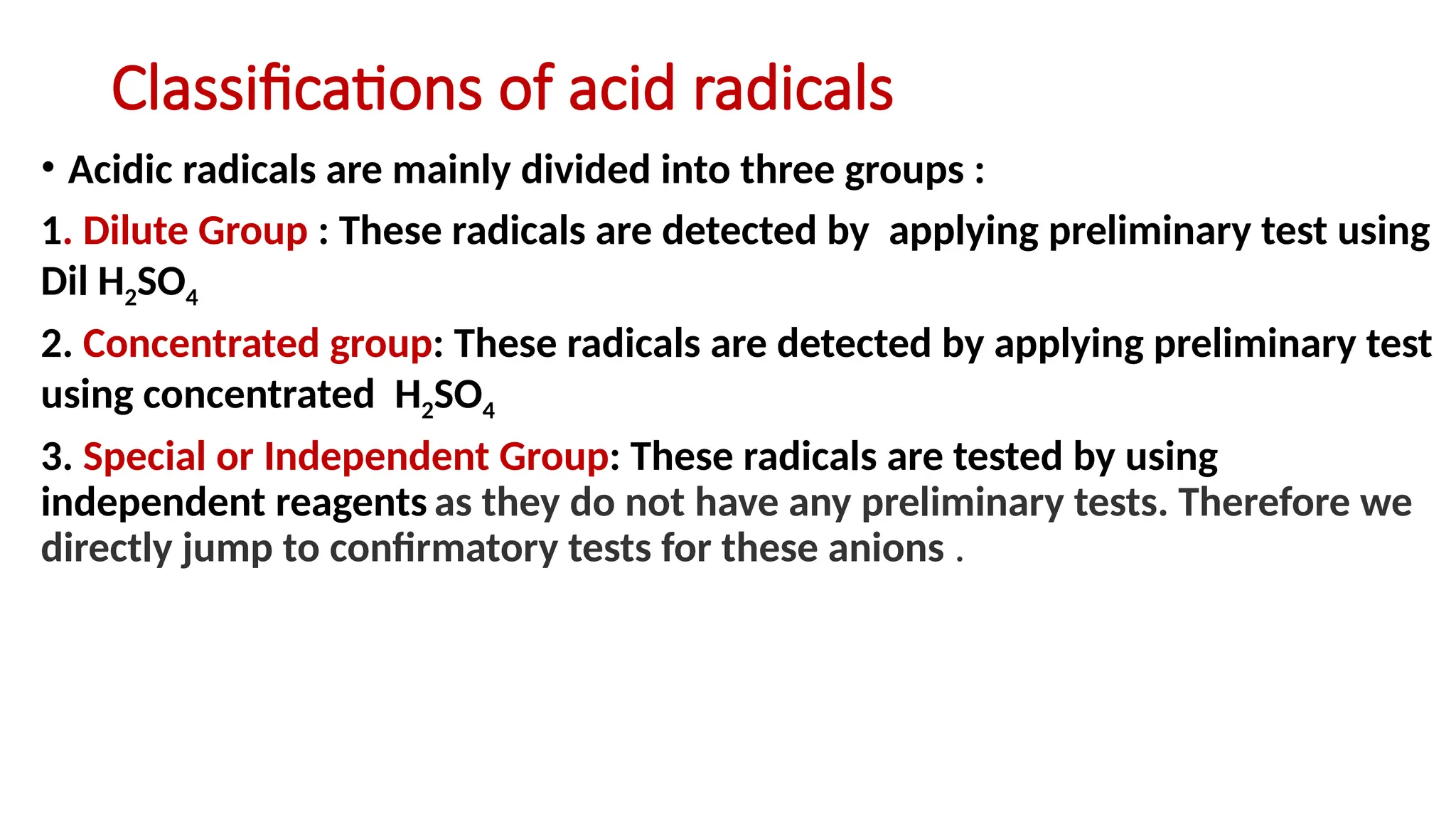
• Acidic radicals are mainly divided into three groups :
1. Dilute Group : These radicals are detected by applying preliminary test using
Dil H2SO4
2. Concentrated group: These radicals are detected by applying preliminary test
using concentrated H2SO4
3. Special or Independent Group: These radicals are tested by using
independent reagents as they do not have any preliminary tests. Therefore we
directly jump to confirmatory tests for these anions .
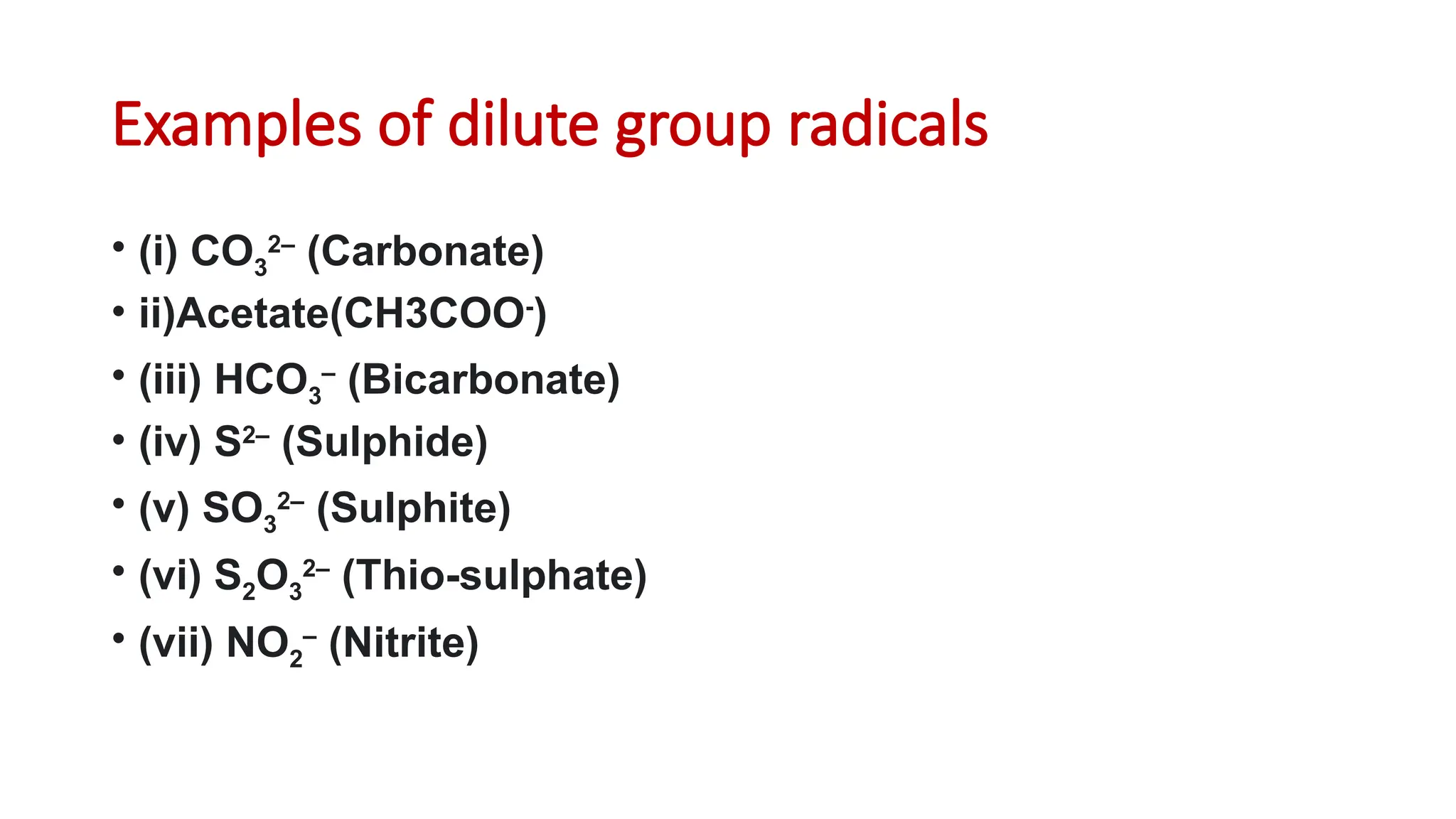
Examples of dilute group radicals
• (i) CO3
2–
(Carbonate)
• ii)Acetate(CH3COO-
)
• (iii) HCO3
–
(Bicarbonate)
• (iv) S2–
(Sulphide)
• (v) SO3
2–
(Sulphite)
• (vi) S2O3
2–
(Thio-sulphate)
• (vii) NO2
–
(Nitrite)
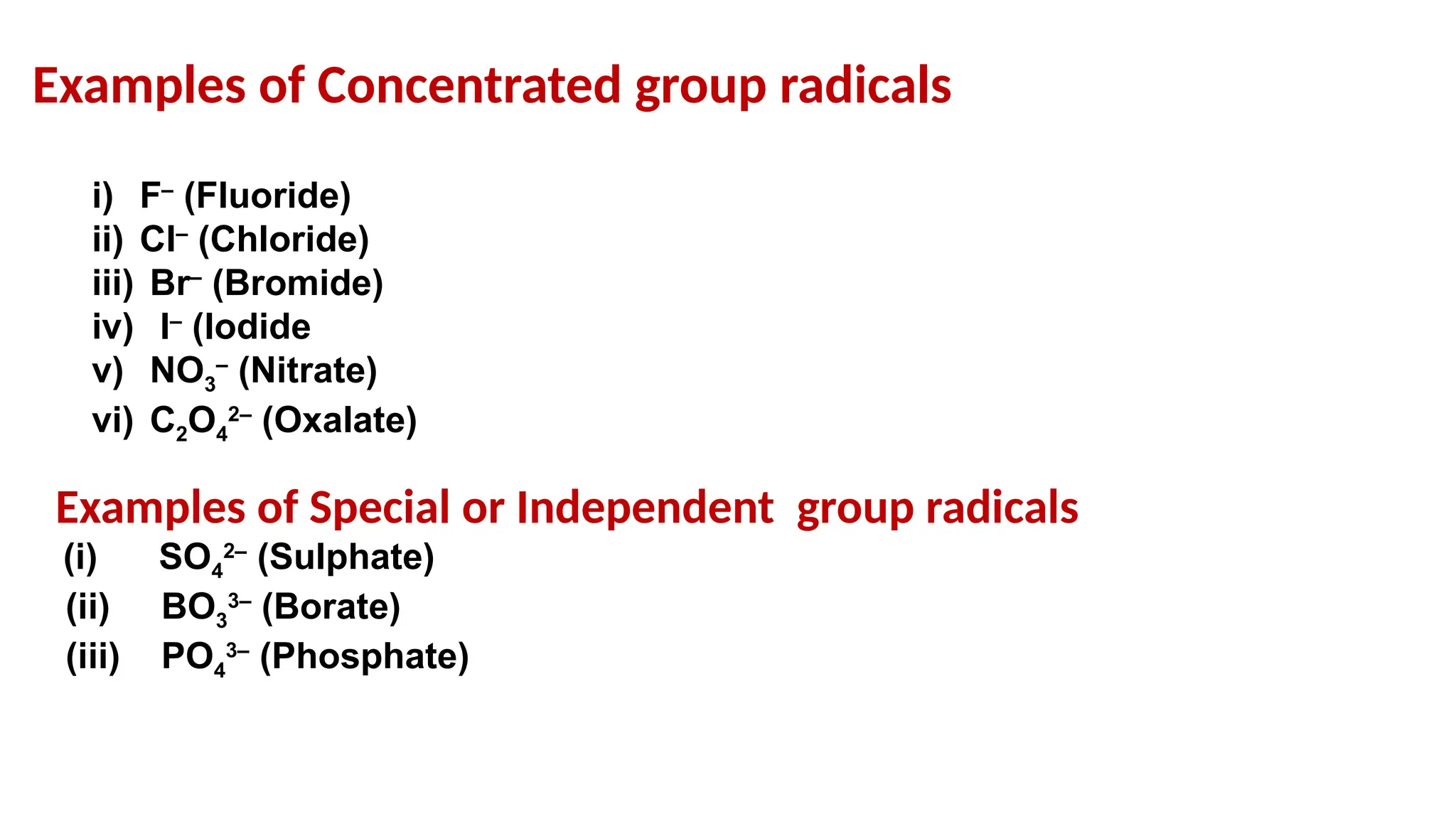
Examples of Concentrated group radicals
i) F–
(Fluoride)
ii) CI–
(Chloride)
iii) Br–
(Bromide)
iv) I–
(Iodide
v) NO3
–
(Nitrate)
vi) C2O4
2–
(Oxalate)
Examples of Special or Independent group radicals
(i) SO4
2–
(Sulphate)
(ii) BO3
3–
(Borate)
(iii) PO4
3–
(Phosphate)
Classification of Basic Radicals
• Basic radicals are divided into Group I to Group VI and Zero Group .
• From Group I to VI we use a common group Reagent to apply the
preliminary test for all the radicals present in a particular group.
Whereas for Zero group there is no group reagent as there is only one
cation present in zero group.
List of cations of various group and their group Reagent
group reagent is that reagent that when reacted with all ions present in a
particular group will give the same reaction. Ions present in other group will not give that
reaction and that's how ions are differentiated and that is the basis of salt analysis
Test for Acidic Radical (CO3
2-
)
S.No EXPERIMENT OBSERVATION INFERENCE
1. To a pinch of salt add dil
H2SO4
A colourless and odourless gas is evolved
with a brisk effervescence.
Na2CO3 + H2SO4→ Na2SO4 + H2O +CO2
Dil group present . May
be carbonate, CO3
2- .
2. Pass the above gas through
lime water
Lime water turns milky
Ca(OH)2 + CO2 → CaCO3 + H2O
CO3
2-
present
3. Pass excess of CO2 in the
above solution .
Milkiness disappears
CaCO3 + H2O + CO2 → Ca(HCO3)2
CO3
2-
confirmed
Ca(OH)2 + CO2 → CaCO3 + H2O
Test for Acidic Radical (CH3COO-
)
S.No EXPERIMENT OBSERVATION INFERENCE
1. To a pinch of salt add dil H2SO4 No characteristic reaction CO3
2-
absent
2. Take a pinch of salt in a
petridish and add few drops of
water. Then add a pinch of
oxalic acid . Then rub it and
smell it
Smell of vinegar is evolved
2CH3COONa + H2SO4 → CH3COOH + 2CH3COOH
Dil Group present May be
CH3COO-
3. FeCl3 test
To the salt solution addfew
drops of neutral ferric chloride
solution
Solution with Deep red colouration formed.
FeCl3 + 3CH3COOH -> (CH3COO)3Fe + 3HCl
CH3COO-
confirmed
Test for Acidic Radical (NO3
-
)
S.No EXPERIMENT OBSERVATION INFERENCE
1. To a pinch of salt add dil H2SO4 No characteristic reaction CO3
2-
absent
2. Take a pinch of salt in a petridish
and add few drops of water.
Then add a pinch of oxalic acid .
Then rub it and smell it
No characteristic reaction CH3COO-
absent
3. To a pinch of salt add
concentrated H2SO4
Brown fumes are evolved which become
dense by adding paper chips .
MNO3​
−+H2SO4​
→HNO3+M2SO4
HNO3→NO2​
+H2​
O
Concentrated group
present .May be NO3
-
4 Ring Test: To the salt solution,
add 1 ml of freshly prepared
ferrous sulphate and then add
conc slowly from the side of the
test tube
A brown ring is formed at the junction of two
liquids .
HNO3+ 3H2SO4 + 6FeSO4 —>3Fe2(SO4)3 + 2NO + 4H2O
( [Fe(H2O)6]SO4 + NO → [Fe(H2O)5(NO)]SO4+ H2O
NO3
-
Confirmed
NO2 Brown gas Brown ring of [Fe(H2O)5(NO)]SO4
Test for Acidic Radical (Cl-
)
S.No EXPERIMENT OBSERVATION INFERENCE
1. To a pinch of salt add dil H2SO4 No characteristic reaction CO3
2-
absent
2. Take a pinch of salt in a petridish
and add few drops of water.
Then add a pinch of oxalic acid .
Then rub it and smell it
No characteristic reaction CH3COO-
absent
3. To a pinch of salt add
concentrated H2SO4
Colourless gas evolved with pungent smell
2NH4Cl + H2SO4 → (NH4)2SO4 +2HCl
white fumes
Concentrated group
present May be Cl-
4 Salt solution + dil HNO3 +
AgNO3
White ppt formed insoluble in excess of
NH4OH
NH4Cl +AgNO3→ AgCl + NH4NO3
White ppt
Cl-
confirmed
Test for Acidic Radical (SO4
2-
)
S.No EXPERIMENT OBSERVATION INFERENCE
1. To a pinch of salt add dil H2SO4 No characteristic reaction CO3
2-
absent
2. Take a pinch of salt in a petridish
and add few drops of water. Then
add a pinch of oxalic acid . Then
rub it and smell it
No characteristic reaction CH3COO-
absent
3. To a pinch of salt add
concentrated H2SO4
No characteristic reaction Conc group absent
4. To the salt solution add dil HCl
and few drops of BaCl2 solution
A white ppt formed which is insoluble in any
mineral acid
MgSO4(aq) + BaCl2(aq) -> BaSO4(s) + MgCl2(aq)
Special group present
SO4
2-
Confirmed
BaSO4

Acidic radicals ARE VERY GGOD RADICA.pptx

  • 1.
  • 2.
    Classifications of acidradicals • Acidic radicals are mainly divided into three groups : 1. Dilute Group : These radicals are detected by applying preliminary test using Dil H2SO4 2. Concentrated group: These radicals are detected by applying preliminary test using concentrated H2SO4 3. Special or Independent Group: These radicals are tested by using independent reagents as they do not have any preliminary tests. Therefore we directly jump to confirmatory tests for these anions .
  • 3.
    Examples of dilutegroup radicals • (i) CO3 2– (Carbonate) • ii)Acetate(CH3COO- ) • (iii) HCO3 – (Bicarbonate) • (iv) S2– (Sulphide) • (v) SO3 2– (Sulphite) • (vi) S2O3 2– (Thio-sulphate) • (vii) NO2 – (Nitrite)
  • 4.
    Examples of Concentratedgroup radicals i) F– (Fluoride) ii) CI– (Chloride) iii) Br– (Bromide) iv) I– (Iodide v) NO3 – (Nitrate) vi) C2O4 2– (Oxalate) Examples of Special or Independent group radicals (i) SO4 2– (Sulphate) (ii) BO3 3– (Borate) (iii) PO4 3– (Phosphate)
  • 5.
    Classification of BasicRadicals • Basic radicals are divided into Group I to Group VI and Zero Group . • From Group I to VI we use a common group Reagent to apply the preliminary test for all the radicals present in a particular group. Whereas for Zero group there is no group reagent as there is only one cation present in zero group.
  • 6.
    List of cationsof various group and their group Reagent group reagent is that reagent that when reacted with all ions present in a particular group will give the same reaction. Ions present in other group will not give that reaction and that's how ions are differentiated and that is the basis of salt analysis
  • 7.
    Test for AcidicRadical (CO3 2- ) S.No EXPERIMENT OBSERVATION INFERENCE 1. To a pinch of salt add dil H2SO4 A colourless and odourless gas is evolved with a brisk effervescence. Na2CO3 + H2SO4→ Na2SO4 + H2O +CO2 Dil group present . May be carbonate, CO3 2- . 2. Pass the above gas through lime water Lime water turns milky Ca(OH)2 + CO2 → CaCO3 + H2O CO3 2- present 3. Pass excess of CO2 in the above solution . Milkiness disappears CaCO3 + H2O + CO2 → Ca(HCO3)2 CO3 2- confirmed
  • 8.
    Ca(OH)2 + CO2→ CaCO3 + H2O
  • 9.
    Test for AcidicRadical (CH3COO- ) S.No EXPERIMENT OBSERVATION INFERENCE 1. To a pinch of salt add dil H2SO4 No characteristic reaction CO3 2- absent 2. Take a pinch of salt in a petridish and add few drops of water. Then add a pinch of oxalic acid . Then rub it and smell it Smell of vinegar is evolved 2CH3COONa + H2SO4 → CH3COOH + 2CH3COOH Dil Group present May be CH3COO- 3. FeCl3 test To the salt solution addfew drops of neutral ferric chloride solution Solution with Deep red colouration formed. FeCl3 + 3CH3COOH -> (CH3COO)3Fe + 3HCl CH3COO- confirmed
  • 10.
    Test for AcidicRadical (NO3 - ) S.No EXPERIMENT OBSERVATION INFERENCE 1. To a pinch of salt add dil H2SO4 No characteristic reaction CO3 2- absent 2. Take a pinch of salt in a petridish and add few drops of water. Then add a pinch of oxalic acid . Then rub it and smell it No characteristic reaction CH3COO- absent 3. To a pinch of salt add concentrated H2SO4 Brown fumes are evolved which become dense by adding paper chips . MNO3​ −+H2SO4​ →HNO3+M2SO4 HNO3→NO2​ +H2​ O Concentrated group present .May be NO3 - 4 Ring Test: To the salt solution, add 1 ml of freshly prepared ferrous sulphate and then add conc slowly from the side of the test tube A brown ring is formed at the junction of two liquids . HNO3+ 3H2SO4 + 6FeSO4 —>3Fe2(SO4)3 + 2NO + 4H2O ( [Fe(H2O)6]SO4 + NO → [Fe(H2O)5(NO)]SO4+ H2O NO3 - Confirmed
  • 11.
    NO2 Brown gasBrown ring of [Fe(H2O)5(NO)]SO4
  • 12.
    Test for AcidicRadical (Cl- ) S.No EXPERIMENT OBSERVATION INFERENCE 1. To a pinch of salt add dil H2SO4 No characteristic reaction CO3 2- absent 2. Take a pinch of salt in a petridish and add few drops of water. Then add a pinch of oxalic acid . Then rub it and smell it No characteristic reaction CH3COO- absent 3. To a pinch of salt add concentrated H2SO4 Colourless gas evolved with pungent smell 2NH4Cl + H2SO4 → (NH4)2SO4 +2HCl white fumes Concentrated group present May be Cl- 4 Salt solution + dil HNO3 + AgNO3 White ppt formed insoluble in excess of NH4OH NH4Cl +AgNO3→ AgCl + NH4NO3 White ppt Cl- confirmed
  • 13.
    Test for AcidicRadical (SO4 2- ) S.No EXPERIMENT OBSERVATION INFERENCE 1. To a pinch of salt add dil H2SO4 No characteristic reaction CO3 2- absent 2. Take a pinch of salt in a petridish and add few drops of water. Then add a pinch of oxalic acid . Then rub it and smell it No characteristic reaction CH3COO- absent 3. To a pinch of salt add concentrated H2SO4 No characteristic reaction Conc group absent 4. To the salt solution add dil HCl and few drops of BaCl2 solution A white ppt formed which is insoluble in any mineral acid MgSO4(aq) + BaCl2(aq) -> BaSO4(s) + MgCl2(aq) Special group present SO4 2- Confirmed
  • 14.