CRITICAL
REGIONALISM
 Critical regionalism is an approach to architecture that strives to counter the
placelessness and lack of identity of the International Style, but also rejects the
whimsical individualism and ornamentation of Postmodern architecture.
 The stylings of critical regionalism seek to provide an architecture rooted in the
modern tradition, but tied to geographical and cultural context.
 Critical regionalism is not simply regionalism in the sense of vernacular
It is a progressive approach to design that seeks to mediate between the global
the local languages of architecture.
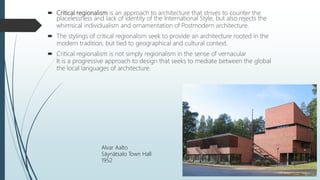
Alvar Aalto
Säynätsalo Town Hall
1952
 The phrase "critical regionalism" was first used by the architectural
theorists Alexander Tzonis and Liane Lefaivre and, with a slightly different meaning,
by the historian-theorist Kenneth Frampton.
 Critical Regionalists thus hold that both modern and post-modern architecture are
"deeply problematic".
 Critical Regionalism is not commonly understood regionalism referring to the local
architectural tradition, not derived from the archetypal sentiments or from direct
opposition to modernism.
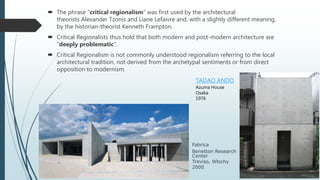
TADAO ANDO
Azuma House
Osaka
1976
Fabrica
Benetton Research
Center
Treviso, Włochy
2000
 The main problem of critical regionalism is to seek answers to the question of Paul
Ricour:
"How to be modern and to continue the tradition, how to revive
old
dormant civilization as part of universal civilization.“
 Frampton in his essay argues that it is "critical to adopt" universal values of modernism,
taking into account the geographical context of the building. Frampton does not want
to refer directly to "folklore", but to the climate, light, topography, and "local tectonic
form", which should be understood as historical and geographical conditions of the
construction industry.
 Track of phenomenology in a critical regionalism can be read with an attitude,
according to which any form of modernism can be criticized without prejudice, AS IT IS,
and not through the prism of sins, for which you may not bear the responsibility.
 In this perspective, critical regionalism should be treated as a "reformed modernism"
and probably for this reason, the best designs are made by architects from countries far
from a universal bustle of big cities, in which - perhaps most important - they have not
forgotten that these countries are autonomous region.
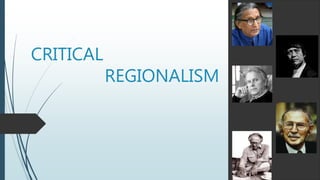
Critical regionalist architects
 In addition to Aalto and Utzon, the following architects have used Critical
Regionalism (in the Frampton sense) in their work: Studio Granda, Mario
Botta, Eduardo Souto de Moura, Mahesh Naik, Mazharul Islam, B. V. Doshi, Charles
Correa,Christopher Benninger, Alvaro Siza, Jorge Ferreira Chaves, Rafael
Moneo, Geoffrey Bawa, Raj Rewal, Dharmesh Vadavala, Ashok "Bihari"
Lall Neelkanth Chhaya (Kaka), Soumitro Ghosh, Nisha Mathew Ghosh, Tadao Ando,
Mack Scogin / Merrill Elam, Glenn Murcutt, Ken Yeang, Philippe Madec, William
S.W. Lim, Tay Kheng Soon, Juhani Pallasmaa, Wang Shu, Juha Leiviskä, Peter
Zumthor, Carlo Scarpa, Tan Hock Being. Peter Stutchbury, Lake Flato, Rick Joy, Tom
Kundig, Sverre Fehn, Dimitris & Suzana Antonakakis are the two Greek architects
for whom the term was first used by Tzonis and Lefaivre.
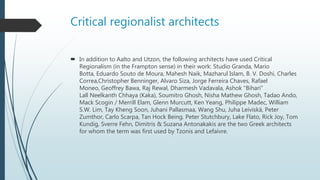
Hyogo
Prefectural
Museum of Art
Kobe
2002
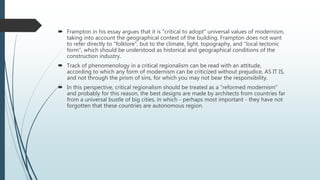
Expo'92
Japan Pavillon
Sevilla
1992
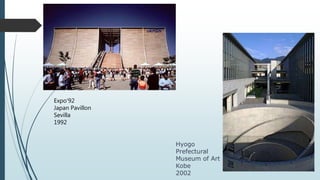
TADAO ANDO
 Japanese architect Tadao Ando spent his early years as a professional boxer and
truck driver, until he changed course, taught himself architecture and eventually
became one of the Great Fathers of contemporary architecture.
 The first building to bring real attention to Japanese architect Tadao Ando (b.
1941), six years after he founded his studio, was his iconic Azuma House /
Rowhouse in Sumiyoishi, completed in 1976 in Osaka. The small concrete house
took a radical approach toward the city, closing itself completely off and letting the
inhabitant enter an entirely private and beautifully organized microcosmos in the
middle of a bustling city that had, in the public's opinion, grown ugly and full of
houses bereft of charm.
 Since then, Ando has completed an almost endless list of buildings both in Japan
and other countries, and his buildings all demonstrate the celebration of classical
beauty: austere, yet complex compositions of geometric shapes, impressive in situ
concrete elements and striking daylight effects are among Ando's trademarks.
 It seems that Ando does not do 'subtle', and his grandiose style has made him a
popular designer of religious buildings as well as art museums, including his
comprehensive work at Benesse Art Site Naoshima. Meanwhile, Ando has also
continued to design smaller houses - among others 4x4 House on a beachfront site
in Kobe, completed in 2003.
 The self-taught architect learned his first lessons by studying the buildings of Le
Corbusier, Frank Lloyd Wright and Louis Kahn, and the inspiration from Western
modernism is evident throughout his work.
 During his long and prosperous career, Tadao Ando has received almost every
conceivable prize of architecture, counting among many others the Carlsberg
Architectural Prize (1992), the Pritzker Architecture Prize (1995) and the Gold Medal
of the AIA (2002).
DESIGN PHYLOSOPHIES
 Designs is their clean line,and sheer simplicity.
 Simple geometric forms have characterized his work over the past three decades.
Ando orchestrates masses and voids, choreographing their interaction with
trademark Tadao Ando precision.
 In spite of his consistent use of materials and the elements of pillar, wall and vault,
his various combinations of these elements constantly prove exhilarating and
dynamic.
 The materiality of his works is of great importance. Working with smooth-as-silk
concrete, Ando creates spaces using walls which he defines as the most basic
elements of architecture, but also the most enriching.
 Honesty of materials is what sets Ando apart from many architects. He does not
veneer, rather he uses the brutal beauty of concrete formwork to texture his
buildings, inside and out.
 designs have ushered accurate and moving design concepts and themes by
emulating delightful and moving feelings, which provide people with a good poetic
experience in such spatial structures.
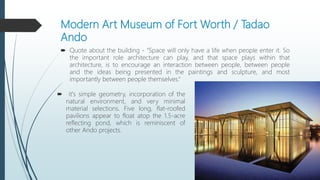
Modern Art Museum of Fort Worth / Tadao
Ando
 Quote about the building - "Space will only have a life when people enter it. So
the important role architecture can play, and that space plays within that
architecture, is to encourage an interaction between people, between people
and the ideas being presented in the paintings and sculpture, and most
importantly between people themselves.“
 it's simple geometry, incorporation of the
natural environment, and very minimal
material selections. Five long, flat-roofed
pavilions appear to float atop the 1.5-acre
reflecting pond, which is reminiscent of
other Ando projects.
Modern Art Museum of Fort Worth / Tadao
Ando
 Constructed with only concrete, steel,
aluminum, glass and granite, the museum is
perfectly reflected in the surrounding pond.
Beautiful trees and hills enclose the museum,
which is typical of Ando's architecture. Through
its pure design, the museum has a striking
presence as a modern work of art.
 The environment becomes as beautiful as the
artwork that the museum displays, as it is
heavily intertwined with the display spaces
through large windows. The glass and water
are very complimentary, as the still pond
reflects the spaces just as glass reflects the
water.
Modern Art Museum of Fort Worth / Tadao
Ando
 By using glass as a wall, physically there is a
barrier, a protection from the outside, but
visually there is no boundary between outside
and inside. There is also the light that comes
off the water through the glass that indicates a
lack of boundary and can make its presence
felt on the wall.
 The use of concrete indicates Ando's passion in
planes and sharp, clean edges that the material
allows. The massive planar walls help tell of the
building's basic structure. Contrasted with the
natural environment that typically surrounds his
architecture, the two elements become even
more dynamic.
Modern Art Museum of Fort Worth / Tadao
Ando
 Light also became key in the design of the museum, with an
emphasis on both diffused and reflected natural light.
Cantilevered cast-concrete roofs support linear skylights and
clerestory windows, which accomodate natural light. Five Y-
shaped columns standing 40 feet high support the roof slabs,
and have become a symbol of the museum.
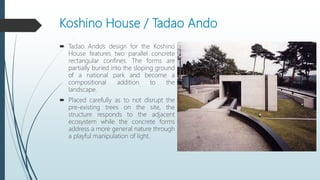
Koshino House / Tadao Ando
 Tadao Ando’s design for the Koshino
House features two parallel concrete
rectangular confines. The forms are
partially buried into the sloping ground
of a national park and become a
compositional addition to the
landscape.
 Placed carefully as to not disrupt the
pre-existing trees on the site, the
structure responds to the adjacent
ecosystem while the concrete forms
address a more general nature through
a playful manipulation of light.
Koshino House / Tadao Ando
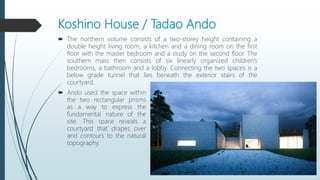
 The northern volume consists of a two-storey height containing a
double height living room, a kitchen and a dining room on the first
floor with the master bedroom and a study on the second floor. The
southern mass then consists of six linearly organized children’s
bedrooms, a bathroom and a lobby. Connecting the two spaces is a
below grade tunnel that lies beneath the exterior stairs of the
courtyard.
 Ando used the space within
the two rectangular prisms
as a way to express the
fundamental nature of the
site. This space reveals a
courtyard that drapes over
and contours to the natural
topography.
Koshino House / Tadao Ando
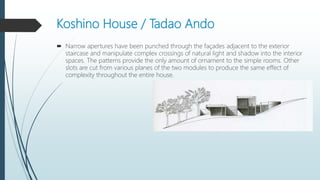
 Narrow apertures have been punched through the façades adjacent to the exterior
staircase and manipulate complex crossings of natural light and shadow into the interior
spaces. The patterns provide the only amount of ornament to the simple rooms. Other
slots are cut from various planes of the two modules to produce the same effect of
complexity throughout the entire house.

Critical regionalism

  • 1.
  • 2.
     Critical regionalismis an approach to architecture that strives to counter the placelessness and lack of identity of the International Style, but also rejects the whimsical individualism and ornamentation of Postmodern architecture.  The stylings of critical regionalism seek to provide an architecture rooted in the modern tradition, but tied to geographical and cultural context.  Critical regionalism is not simply regionalism in the sense of vernacular It is a progressive approach to design that seeks to mediate between the global the local languages of architecture. Alvar Aalto Säynätsalo Town Hall 1952
  • 3.
     The phrase"critical regionalism" was first used by the architectural theorists Alexander Tzonis and Liane Lefaivre and, with a slightly different meaning, by the historian-theorist Kenneth Frampton.  Critical Regionalists thus hold that both modern and post-modern architecture are "deeply problematic".  Critical Regionalism is not commonly understood regionalism referring to the local architectural tradition, not derived from the archetypal sentiments or from direct opposition to modernism. TADAO ANDO Azuma House Osaka 1976 Fabrica Benetton Research Center Treviso, Włochy 2000
  • 4.
     The mainproblem of critical regionalism is to seek answers to the question of Paul Ricour: "How to be modern and to continue the tradition, how to revive old dormant civilization as part of universal civilization.“
  • 5.
     Frampton inhis essay argues that it is "critical to adopt" universal values of modernism, taking into account the geographical context of the building. Frampton does not want to refer directly to "folklore", but to the climate, light, topography, and "local tectonic form", which should be understood as historical and geographical conditions of the construction industry.  Track of phenomenology in a critical regionalism can be read with an attitude, according to which any form of modernism can be criticized without prejudice, AS IT IS, and not through the prism of sins, for which you may not bear the responsibility.  In this perspective, critical regionalism should be treated as a "reformed modernism" and probably for this reason, the best designs are made by architects from countries far from a universal bustle of big cities, in which - perhaps most important - they have not forgotten that these countries are autonomous region.
  • 6.
    Critical regionalist architects In addition to Aalto and Utzon, the following architects have used Critical Regionalism (in the Frampton sense) in their work: Studio Granda, Mario Botta, Eduardo Souto de Moura, Mahesh Naik, Mazharul Islam, B. V. Doshi, Charles Correa,Christopher Benninger, Alvaro Siza, Jorge Ferreira Chaves, Rafael Moneo, Geoffrey Bawa, Raj Rewal, Dharmesh Vadavala, Ashok "Bihari" Lall Neelkanth Chhaya (Kaka), Soumitro Ghosh, Nisha Mathew Ghosh, Tadao Ando, Mack Scogin / Merrill Elam, Glenn Murcutt, Ken Yeang, Philippe Madec, William S.W. Lim, Tay Kheng Soon, Juhani Pallasmaa, Wang Shu, Juha Leiviskä, Peter Zumthor, Carlo Scarpa, Tan Hock Being. Peter Stutchbury, Lake Flato, Rick Joy, Tom Kundig, Sverre Fehn, Dimitris & Suzana Antonakakis are the two Greek architects for whom the term was first used by Tzonis and Lefaivre.
  • 7.
  • 8.
  • 9.
     Japanese architectTadao Ando spent his early years as a professional boxer and truck driver, until he changed course, taught himself architecture and eventually became one of the Great Fathers of contemporary architecture.  The first building to bring real attention to Japanese architect Tadao Ando (b. 1941), six years after he founded his studio, was his iconic Azuma House / Rowhouse in Sumiyoishi, completed in 1976 in Osaka. The small concrete house took a radical approach toward the city, closing itself completely off and letting the inhabitant enter an entirely private and beautifully organized microcosmos in the middle of a bustling city that had, in the public's opinion, grown ugly and full of houses bereft of charm.  Since then, Ando has completed an almost endless list of buildings both in Japan and other countries, and his buildings all demonstrate the celebration of classical beauty: austere, yet complex compositions of geometric shapes, impressive in situ concrete elements and striking daylight effects are among Ando's trademarks.  It seems that Ando does not do 'subtle', and his grandiose style has made him a popular designer of religious buildings as well as art museums, including his comprehensive work at Benesse Art Site Naoshima. Meanwhile, Ando has also continued to design smaller houses - among others 4x4 House on a beachfront site in Kobe, completed in 2003.
  • 10.
     The self-taughtarchitect learned his first lessons by studying the buildings of Le Corbusier, Frank Lloyd Wright and Louis Kahn, and the inspiration from Western modernism is evident throughout his work.  During his long and prosperous career, Tadao Ando has received almost every conceivable prize of architecture, counting among many others the Carlsberg Architectural Prize (1992), the Pritzker Architecture Prize (1995) and the Gold Medal of the AIA (2002).
  • 11.
    DESIGN PHYLOSOPHIES  Designsis their clean line,and sheer simplicity.  Simple geometric forms have characterized his work over the past three decades. Ando orchestrates masses and voids, choreographing their interaction with trademark Tadao Ando precision.  In spite of his consistent use of materials and the elements of pillar, wall and vault, his various combinations of these elements constantly prove exhilarating and dynamic.  The materiality of his works is of great importance. Working with smooth-as-silk concrete, Ando creates spaces using walls which he defines as the most basic elements of architecture, but also the most enriching.  Honesty of materials is what sets Ando apart from many architects. He does not veneer, rather he uses the brutal beauty of concrete formwork to texture his buildings, inside and out.  designs have ushered accurate and moving design concepts and themes by emulating delightful and moving feelings, which provide people with a good poetic experience in such spatial structures.
  • 12.
    Modern Art Museumof Fort Worth / Tadao Ando  Quote about the building - "Space will only have a life when people enter it. So the important role architecture can play, and that space plays within that architecture, is to encourage an interaction between people, between people and the ideas being presented in the paintings and sculpture, and most importantly between people themselves.“  it's simple geometry, incorporation of the natural environment, and very minimal material selections. Five long, flat-roofed pavilions appear to float atop the 1.5-acre reflecting pond, which is reminiscent of other Ando projects.
  • 13.
    Modern Art Museumof Fort Worth / Tadao Ando  Constructed with only concrete, steel, aluminum, glass and granite, the museum is perfectly reflected in the surrounding pond. Beautiful trees and hills enclose the museum, which is typical of Ando's architecture. Through its pure design, the museum has a striking presence as a modern work of art.  The environment becomes as beautiful as the artwork that the museum displays, as it is heavily intertwined with the display spaces through large windows. The glass and water are very complimentary, as the still pond reflects the spaces just as glass reflects the water.
  • 14.
    Modern Art Museumof Fort Worth / Tadao Ando  By using glass as a wall, physically there is a barrier, a protection from the outside, but visually there is no boundary between outside and inside. There is also the light that comes off the water through the glass that indicates a lack of boundary and can make its presence felt on the wall.  The use of concrete indicates Ando's passion in planes and sharp, clean edges that the material allows. The massive planar walls help tell of the building's basic structure. Contrasted with the natural environment that typically surrounds his architecture, the two elements become even more dynamic.
  • 15.
    Modern Art Museumof Fort Worth / Tadao Ando  Light also became key in the design of the museum, with an emphasis on both diffused and reflected natural light. Cantilevered cast-concrete roofs support linear skylights and clerestory windows, which accomodate natural light. Five Y- shaped columns standing 40 feet high support the roof slabs, and have become a symbol of the museum.
  • 16.
    Koshino House /Tadao Ando  Tadao Ando’s design for the Koshino House features two parallel concrete rectangular confines. The forms are partially buried into the sloping ground of a national park and become a compositional addition to the landscape.  Placed carefully as to not disrupt the pre-existing trees on the site, the structure responds to the adjacent ecosystem while the concrete forms address a more general nature through a playful manipulation of light.
  • 17.
    Koshino House /Tadao Ando  The northern volume consists of a two-storey height containing a double height living room, a kitchen and a dining room on the first floor with the master bedroom and a study on the second floor. The southern mass then consists of six linearly organized children’s bedrooms, a bathroom and a lobby. Connecting the two spaces is a below grade tunnel that lies beneath the exterior stairs of the courtyard.  Ando used the space within the two rectangular prisms as a way to express the fundamental nature of the site. This space reveals a courtyard that drapes over and contours to the natural topography.
  • 18.
    Koshino House /Tadao Ando  Narrow apertures have been punched through the façades adjacent to the exterior staircase and manipulate complex crossings of natural light and shadow into the interior spaces. The patterns provide the only amount of ornament to the simple rooms. Other slots are cut from various planes of the two modules to produce the same effect of complexity throughout the entire house.