Common Core, College
Readiness, and the Teacher
Librarian
Doug Achterman
Gavilan College
dachterman@gavilan.edu
• Key Issues for Teacher Librarians re: Common
Core State Standards (CCSS)
• College Readiness: a picture
• College instructors’ expectations for reading and
research
• Alignment of expectations with CCSS
• Implications for Teacher Librarians
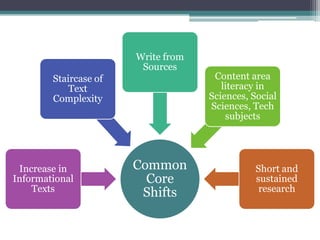
Write from
Sources
Staircase of
Text
Complexity

Increase in
Informational
Texts

Common
Core
Shifts

Content area
literacy in
Sciences, Social
Sciences, Tech
subjects

Short and
sustained
research
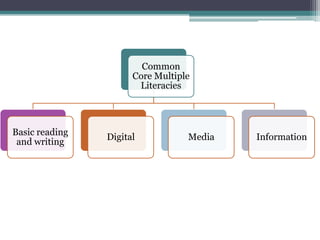
Common
Core Multiple
Literacies

Basic reading
and writing

Digital

Media

Information
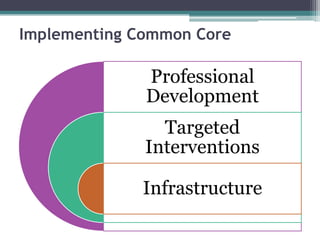
Implementing Common Core

Professional
Development
Targeted
Interventions
Infrastructure
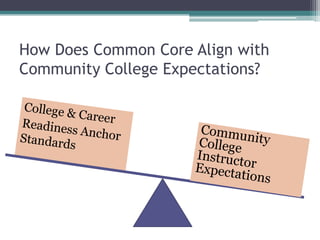
How Does Common Core Align with
Community College Expectations?
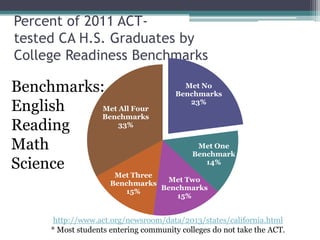
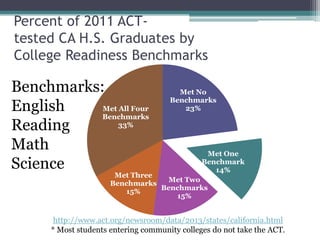
Percent of 2011 ACTtested CA H.S. Graduates by
College Readiness Benchmarks

Benchmarks:
English
Met All Four
Benchmarks
33%
Reading
Math
Science

Met No
Benchmarks
23%

Met One
Benchmark
14%

Met Three
Met Two
Benchmarks
Benchmarks
15%
15%

http://www.act.org/newsroom/data/2013/states/california.html
* Most students entering community colleges do not take the ACT.
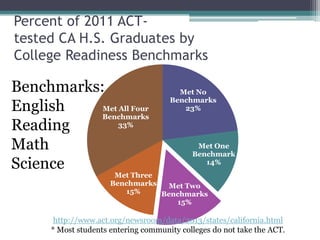
Percent of 2011 ACTtested CA H.S. Graduates by
College Readiness Benchmarks

Benchmarks:
English
Met All Four
Benchmarks
33%
Reading
Math
Science

Met No
Benchmarks
23%

Met One
Benchmark
14%

Met Three
Met Two
Benchmarks
Benchmarks
15%
15%

http://www.act.org/newsroom/data/2013/states/california.html
* Most students entering community colleges do not take the ACT.
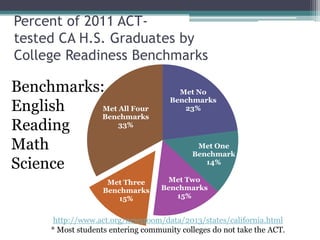
Percent of 2011 ACTtested CA H.S. Graduates by
College Readiness Benchmarks

Benchmarks:
English
Met All Four
Benchmarks
33%
Reading
Math
Science

Met No
Benchmarks
23%

Met One
Benchmark
14%

Met Three
Benchmarks
Met Two
15%
Benchmarks
15%

http://www.act.org/newsroom/data/2013/states/california.html
* Most students entering community colleges do not take the ACT.
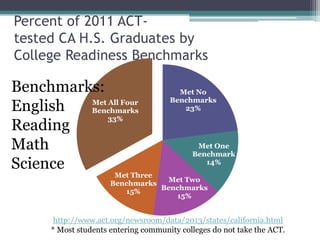
Percent of 2011 ACTtested CA H.S. Graduates by
College Readiness Benchmarks

Benchmarks:
English
Met All Four
Benchmarks
33%
Reading
Math
Science
Met Three
Benchmarks
15%

Met No
Benchmarks
23%

Met One
Benchmark
14%
Met Two
Benchmarks
15%

http://www.act.org/newsroom/data/2013/states/california.html
* Most students entering community colleges do not take the ACT.
Percent of 2011 ACTtested CA H.S. Graduates by
College Readiness Benchmarks

Benchmarks:
Met All Four
English
Benchmarks
33%
Reading
Math
Science

Met No
Benchmarks
23%

Met One
Benchmark
14%

Met Three
Met Two
Benchmarks
Benchmarks
15%
15%

http://www.act.org/newsroom/data/2013/states/california.html
* Most students entering community colleges do not take the ACT.
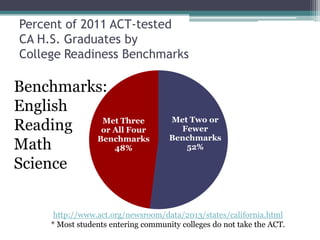
Percent of 2011 ACT-tested
CA H.S. Graduates by
College Readiness Benchmarks

Benchmarks:
English
Met Three
Reading
or All Four
Benchmarks
Math
48%
Science

Met Two or
Fewer
Benchmarks
52%

http://www.act.org/newsroom/data/2013/states/california.html
* Most students entering community colleges do not take the ACT.
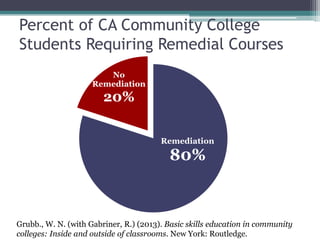
Percent of CA Community College
Students Requiring Remedial Courses
No
Remediation

20%
Remediation

80%

Grubb., W. N. (with Gabriner, R.) (2013). Basic skills education in community
colleges: Inside and outside of classrooms. New York: Routledge.
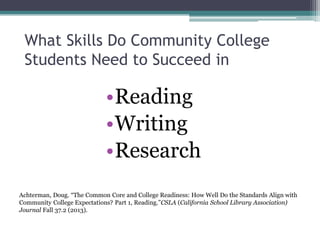
What Skills Do Community College
Students Need to Succeed in

•Reading
•Writing
•Research
Achterman, Doug. “The Common Core and College Readiness: How Well Do the Standards Align with
Community College Expectations? Part 1, Reading.”CSLA (California School Library Association)
Journal Fall 37.2 (2013).
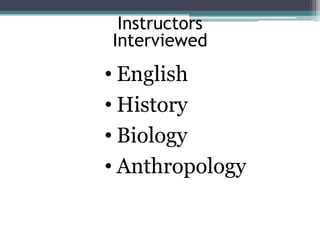
Instructors
Interviewed

• English
• History
• Biology
• Anthropology
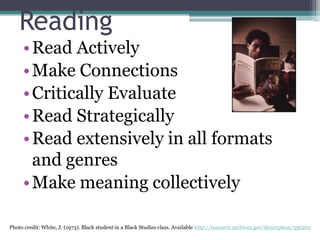
Reading
• Read Actively
• Make Connections
• Critically Evaluate
• Read Strategically
• Read extensively in all formats
and genres
• Make meaning collectively
Photo credit: White, J. (1973). Black student in a Black Studies class. Available http://research.archives.gov/description/556263
College and Career Readiness
Anchor Standards for Reading
• Determine central ideas or themes of a text
and analyze their development; summarize the key
supporting details and ideas.

• Analyze how and why individuals, events, and
ideas develop and interact over the course of a text.

• Interpret words and phrases as they are used in a text,

including determining technical, connotative, and figurative meanings, and
analyze how specific word choices shape meaning or tone.

• Analyze the structure of texts,

including how specific sentences, paragraphs, and larger portions of the text
(e.g., a section, chapter, scene, or stanza) relate to each other and the whole.
College and Career Readiness
Anchor Standards for Reading
• Integrate and evaluate content presented
in diverse media and formats,
including visually and quantitatively, as well as in words.

• Delineate and evaluate the argument and specific claims in a

validity of the reasoning as well as
the relevance and sufficiency of the
text, including the
evidence.

comprehend complex
literary and informational texts

• Read and

independently and proficiently.
So What?
What is the value-added teacher librarians provide
in preparing students to be college-ready in
reading?

Share in groups of 4
So What?
• What can YOU do to help your school
community realize the Teacher-Librarian’s
unique role in implementing CCSS in reading?
So What?
• What ELSE can YOU do to help your school
community realize the Teacher-Librarian’s
unique role in implementing CCSS in reading?

Reflect
Share w/partner
So What?
Specific ideas for helping students
• Read Actively
• Make Connections
• Critically Evaluate
• Read Strategically
• Read extensively in all formats and genres
• Make meaning collectively
So What? Specific ideas to help
students
• Integrate and evaluate content presented
in diverse media and formats,
including visually and quantitatively, as well as in words.
• Delineate and evaluate the argument and specific claims in a

validity of the reasoning as well as
the relevance and sufficiency of the
text, including the

evidence.

comprehend complex
literary and informational texts

• Read and

independently and proficiently.
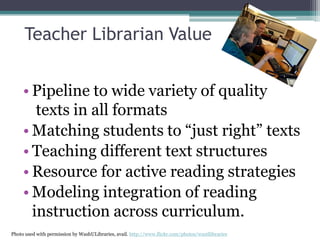
Teacher Librarian Value
• Pipeline to wide variety of quality
texts in all formats
• Matching students to “just right” texts
• Teaching different text structures
• Resource for active reading strategies
• Modeling integration of reading
instruction across curriculum.
Photo used with permission by WashULibraries, avail. http://www.flickr.com/photos/wustllibraries
So What? Action Items
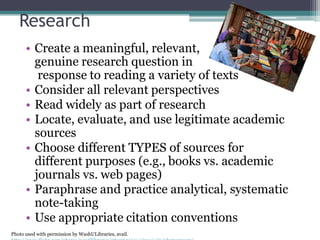
Research
• Create a meaningful, relevant,
genuine research question in
response to reading a variety of texts
• Consider all relevant perspectives
• Read widely as part of research
• Locate, evaluate, and use legitimate academic
sources
• Choose different TYPES of sources for
different purposes (e.g., books vs. academic
journals vs. web pages)
• Paraphrase and practice analytical, systematic
note-taking
• Use appropriate citation conventions
Photo used with permission by WashULibraries, avail.
College and Career Readiness Anchor
Standards related to Research

• Integrate and evaluate content presented in
diverse media and formats, including
visually and quantitatively, as well as in words.

• Delineate and evaluate the argument and specific
claims in a text, including the validity of the
reasoning as well as the relevance and
sufficiency of the evidence.

• Read and comprehend complex
literary and informational texts
independently and proficiently.
College and Career Readiness Anchor
Standards related to Research
• Conduct short as well as more sustained research
projects based on focused questions, demonstrating
understanding of the subject under investigation.
• Gather relevant information from multiple
print and digital sources, assess the
credibility and accuracy of each source, and integrate
the information while avoiding plagiarism.

• Draw evidence from literary and or
informational texts to support
analysis, reflection, and research.
So What?
What is the value-added teacher librarians provide
in preparing students to be college-ready in
research?

Share in groups of 4
So What?
• What can YOU do to help your school
community realize the Teacher-Librarian’s
unique role in implementing CCSS in research?
So What?
• What ELSE can YOU do to help your school
community realize the Teacher-Librarian’s
unique role in implementing CCSS in research?

Reflect
Share w/partner
Teacher Librarian Value
• Expertise in teaching students to locate,
evaluate and use information ethically and
effectively
• Experience in planning and teaching units that
scaffold research, reading and writing skills in
an integrated, content-specific way.
• Deep knowledge of school’s curriculum and a
collection to support it.
• Collaborative partner/mentor in introducing
increasingly complex texts into learning
Photo used with permission by WashULibraries, avail. http://www.flickr.com/photos/wustllibraries
So What? Action Items
So What?
• Too many CA students come to college
unprepared
• CCSS supports community college objectives
• Teacher Librarians are uniquely positioned to
provide Common Core instruction, mentoring,
and professional development toward this end.
If You’d Like to Learn More About Common Core Standards and
College Readiness:
Achterman, D. (2013). The Common Core and college readiness: How well do the standards align with community college expectations? Part 1,
Reading. CSLA Journal 37(2), 8, 10, 21. Available http://csla.net/wp-content/uploads/2012/09/2013_CSLA_Spring_Journal_372.pdf
Achterman, D. (in press). The Common Core and college readiness: How well do the standards align with community college expectations? Part 2,
Writing and Research. CSLA Journal 38(1).
ACT, Inc. (2010). A First Look at the Common Core and College and Career Readiness. Iowa City, IA: ACT, Inc.
Barnett, E. A., & Fay, M. (2013). The common core state standards: implications for community colleges and student preparedness for college (An
NCPR working paper). New York: National Center for Postsecondary Research.
Brint, S. & Teele, S. (2008). Professionalism under siege:Teachers’ views of NCLB. In A.R. Sadovnik, J.A. O’Day, G.W. Bohrnstedt, & K.M.
Borman (Eds.), No child left behind and the reduction of the achievement gap: Sociological perspectives on federal education policy. New
York: Routledge.
California Department of Education (2012). School library standards supporting common core. Sacramento, CA: Author.

California Department of Education (2013). California common core state standards for English language arts and literacy in history/social
studies, science, and technical subjects. Sacramento, CA: Author.
Conley, D., Drummond, K., deGonzalez, A., Rooseboom, J., & Stout, O. (2011). Reaching the goal: The applicability and importance of the
common core state standards to college and career readiness. Eugene, OR: Educational Policy Improvement Center.
Grubb., W. N. (with Gabriner, R.) (2013). Basic skills education in community colleges: Inside and outside of classrooms. New York: Routledge.
Head, A. (2013). Deconstructing college readiness. Project Information Literacy “Smart Talks” Interview no. 17. Available
http://projectinfolit.org/st/conley.asp
Rothman, R. (2012). A common core of readiness. Educational Leadership 69(7), 11-15.
Schoenbach, R., Greenleaf, C., & Murphy, L. (2012). Reading for understanding: how reading apprenticeship improves disciplinary learning in
secondary and college classrooms. New York: Jossey-Bass.

The Common Core, College Readiness and the Teacher Librarian

  • 1.
    Common Core, College Readiness,and the Teacher Librarian Doug Achterman Gavilan College dachterman@gavilan.edu
  • 2.
    • Key Issuesfor Teacher Librarians re: Common Core State Standards (CCSS) • College Readiness: a picture • College instructors’ expectations for reading and research • Alignment of expectations with CCSS • Implications for Teacher Librarians
  • 4.
    Write from Sources Staircase of Text Complexity Increasein Informational Texts Common Core Shifts Content area literacy in Sciences, Social Sciences, Tech subjects Short and sustained research
  • 5.
    Common Core Multiple Literacies Basic reading andwriting Digital Media Information
  • 6.
  • 7.
    How Does CommonCore Align with Community College Expectations?
  • 8.
    Percent of 2011ACTtested CA H.S. Graduates by College Readiness Benchmarks Benchmarks: English Met All Four Benchmarks 33% Reading Math Science Met No Benchmarks 23% Met One Benchmark 14% Met Three Met Two Benchmarks Benchmarks 15% 15% http://www.act.org/newsroom/data/2013/states/california.html * Most students entering community colleges do not take the ACT.
  • 9.
    Percent of 2011ACTtested CA H.S. Graduates by College Readiness Benchmarks Benchmarks: English Met All Four Benchmarks 33% Reading Math Science Met No Benchmarks 23% Met One Benchmark 14% Met Three Met Two Benchmarks Benchmarks 15% 15% http://www.act.org/newsroom/data/2013/states/california.html * Most students entering community colleges do not take the ACT.
  • 10.
    Percent of 2011ACTtested CA H.S. Graduates by College Readiness Benchmarks Benchmarks: English Met All Four Benchmarks 33% Reading Math Science Met No Benchmarks 23% Met One Benchmark 14% Met Three Benchmarks Met Two 15% Benchmarks 15% http://www.act.org/newsroom/data/2013/states/california.html * Most students entering community colleges do not take the ACT.
  • 11.
    Percent of 2011ACTtested CA H.S. Graduates by College Readiness Benchmarks Benchmarks: English Met All Four Benchmarks 33% Reading Math Science Met Three Benchmarks 15% Met No Benchmarks 23% Met One Benchmark 14% Met Two Benchmarks 15% http://www.act.org/newsroom/data/2013/states/california.html * Most students entering community colleges do not take the ACT.
  • 12.
    Percent of 2011ACTtested CA H.S. Graduates by College Readiness Benchmarks Benchmarks: Met All Four English Benchmarks 33% Reading Math Science Met No Benchmarks 23% Met One Benchmark 14% Met Three Met Two Benchmarks Benchmarks 15% 15% http://www.act.org/newsroom/data/2013/states/california.html * Most students entering community colleges do not take the ACT.
  • 13.
    Percent of 2011ACT-tested CA H.S. Graduates by College Readiness Benchmarks Benchmarks: English Met Three Reading or All Four Benchmarks Math 48% Science Met Two or Fewer Benchmarks 52% http://www.act.org/newsroom/data/2013/states/california.html * Most students entering community colleges do not take the ACT.
  • 14.
    Percent of CACommunity College Students Requiring Remedial Courses No Remediation 20% Remediation 80% Grubb., W. N. (with Gabriner, R.) (2013). Basic skills education in community colleges: Inside and outside of classrooms. New York: Routledge.
  • 15.
    What Skills DoCommunity College Students Need to Succeed in •Reading •Writing •Research Achterman, Doug. “The Common Core and College Readiness: How Well Do the Standards Align with Community College Expectations? Part 1, Reading.”CSLA (California School Library Association) Journal Fall 37.2 (2013).
  • 16.
  • 17.
    Reading • Read Actively •Make Connections • Critically Evaluate • Read Strategically • Read extensively in all formats and genres • Make meaning collectively Photo credit: White, J. (1973). Black student in a Black Studies class. Available http://research.archives.gov/description/556263
  • 18.
    College and CareerReadiness Anchor Standards for Reading • Determine central ideas or themes of a text and analyze their development; summarize the key supporting details and ideas. • Analyze how and why individuals, events, and ideas develop and interact over the course of a text. • Interpret words and phrases as they are used in a text, including determining technical, connotative, and figurative meanings, and analyze how specific word choices shape meaning or tone. • Analyze the structure of texts, including how specific sentences, paragraphs, and larger portions of the text (e.g., a section, chapter, scene, or stanza) relate to each other and the whole.
  • 19.
    College and CareerReadiness Anchor Standards for Reading • Integrate and evaluate content presented in diverse media and formats, including visually and quantitatively, as well as in words. • Delineate and evaluate the argument and specific claims in a validity of the reasoning as well as the relevance and sufficiency of the text, including the evidence. comprehend complex literary and informational texts • Read and independently and proficiently.
  • 21.
    So What? What isthe value-added teacher librarians provide in preparing students to be college-ready in reading? Share in groups of 4
  • 22.
    So What? • Whatcan YOU do to help your school community realize the Teacher-Librarian’s unique role in implementing CCSS in reading?
  • 23.
    So What? • WhatELSE can YOU do to help your school community realize the Teacher-Librarian’s unique role in implementing CCSS in reading? Reflect Share w/partner
  • 24.
    So What? Specific ideasfor helping students • Read Actively • Make Connections • Critically Evaluate • Read Strategically • Read extensively in all formats and genres • Make meaning collectively
  • 25.
    So What? Specificideas to help students • Integrate and evaluate content presented in diverse media and formats, including visually and quantitatively, as well as in words. • Delineate and evaluate the argument and specific claims in a validity of the reasoning as well as the relevance and sufficiency of the text, including the evidence. comprehend complex literary and informational texts • Read and independently and proficiently.
  • 26.
    Teacher Librarian Value •Pipeline to wide variety of quality texts in all formats • Matching students to “just right” texts • Teaching different text structures • Resource for active reading strategies • Modeling integration of reading instruction across curriculum. Photo used with permission by WashULibraries, avail. http://www.flickr.com/photos/wustllibraries
  • 27.
  • 28.
    Research • Create ameaningful, relevant, genuine research question in response to reading a variety of texts • Consider all relevant perspectives • Read widely as part of research • Locate, evaluate, and use legitimate academic sources • Choose different TYPES of sources for different purposes (e.g., books vs. academic journals vs. web pages) • Paraphrase and practice analytical, systematic note-taking • Use appropriate citation conventions Photo used with permission by WashULibraries, avail.
  • 29.
    College and CareerReadiness Anchor Standards related to Research • Integrate and evaluate content presented in diverse media and formats, including visually and quantitatively, as well as in words. • Delineate and evaluate the argument and specific claims in a text, including the validity of the reasoning as well as the relevance and sufficiency of the evidence. • Read and comprehend complex literary and informational texts independently and proficiently.
  • 30.
    College and CareerReadiness Anchor Standards related to Research • Conduct short as well as more sustained research projects based on focused questions, demonstrating understanding of the subject under investigation. • Gather relevant information from multiple print and digital sources, assess the credibility and accuracy of each source, and integrate the information while avoiding plagiarism. • Draw evidence from literary and or informational texts to support analysis, reflection, and research.
  • 31.
    So What? What isthe value-added teacher librarians provide in preparing students to be college-ready in research? Share in groups of 4
  • 32.
    So What? • Whatcan YOU do to help your school community realize the Teacher-Librarian’s unique role in implementing CCSS in research?
  • 33.
    So What? • WhatELSE can YOU do to help your school community realize the Teacher-Librarian’s unique role in implementing CCSS in research? Reflect Share w/partner
  • 34.
    Teacher Librarian Value •Expertise in teaching students to locate, evaluate and use information ethically and effectively • Experience in planning and teaching units that scaffold research, reading and writing skills in an integrated, content-specific way. • Deep knowledge of school’s curriculum and a collection to support it. • Collaborative partner/mentor in introducing increasingly complex texts into learning Photo used with permission by WashULibraries, avail. http://www.flickr.com/photos/wustllibraries
  • 35.
  • 36.
    So What? • Toomany CA students come to college unprepared • CCSS supports community college objectives • Teacher Librarians are uniquely positioned to provide Common Core instruction, mentoring, and professional development toward this end.
  • 37.
    If You’d Liketo Learn More About Common Core Standards and College Readiness: Achterman, D. (2013). The Common Core and college readiness: How well do the standards align with community college expectations? Part 1, Reading. CSLA Journal 37(2), 8, 10, 21. Available http://csla.net/wp-content/uploads/2012/09/2013_CSLA_Spring_Journal_372.pdf Achterman, D. (in press). The Common Core and college readiness: How well do the standards align with community college expectations? Part 2, Writing and Research. CSLA Journal 38(1). ACT, Inc. (2010). A First Look at the Common Core and College and Career Readiness. Iowa City, IA: ACT, Inc. Barnett, E. A., & Fay, M. (2013). The common core state standards: implications for community colleges and student preparedness for college (An NCPR working paper). New York: National Center for Postsecondary Research. Brint, S. & Teele, S. (2008). Professionalism under siege:Teachers’ views of NCLB. In A.R. Sadovnik, J.A. O’Day, G.W. Bohrnstedt, & K.M. Borman (Eds.), No child left behind and the reduction of the achievement gap: Sociological perspectives on federal education policy. New York: Routledge. California Department of Education (2012). School library standards supporting common core. Sacramento, CA: Author. California Department of Education (2013). California common core state standards for English language arts and literacy in history/social studies, science, and technical subjects. Sacramento, CA: Author. Conley, D., Drummond, K., deGonzalez, A., Rooseboom, J., & Stout, O. (2011). Reaching the goal: The applicability and importance of the common core state standards to college and career readiness. Eugene, OR: Educational Policy Improvement Center. Grubb., W. N. (with Gabriner, R.) (2013). Basic skills education in community colleges: Inside and outside of classrooms. New York: Routledge. Head, A. (2013). Deconstructing college readiness. Project Information Literacy “Smart Talks” Interview no. 17. Available http://projectinfolit.org/st/conley.asp Rothman, R. (2012). A common core of readiness. Educational Leadership 69(7), 11-15. Schoenbach, R., Greenleaf, C., & Murphy, L. (2012). Reading for understanding: how reading apprenticeship improves disciplinary learning in secondary and college classrooms. New York: Jossey-Bass.