Higher learning
Effective and Engaging
Information Literacy
Instruction for Upper-Level
Students
Introductions
• Please introduce yourselves around
  your table, sharing:
 – Your name
 – Your home institution
 – Why you’re interested in upper-level
   information literacy instruction
Poll
   • What’s the main reason your table is
     interested in upper-level information
     literacy instruction?
       – Text response: 194568 and your
         answer to 22333
       – Tweet: @poll 194568
       – Web: http://tinyurl.com/acrluppers

poll
Why Uppers?
• “In the zeal to impart generalized skills of
  analytical reasoning, critical thinking, and
  learning to learn, however, care should
  be taken to avoid overlooking the
  importance of subject-based knowledge
  in facilitating these very goals.”
  (Grafstein 2002, 200)
Perry’s Positions of Intellectual Development

•   Perry, William G., Jr. (1970),
    Forms of Intellectual and Ethical Development in the College Years: A Sch
    (New York: Holt, Rinehart, and Winston).
•   Dualism (either/or thinking)
•   Multiplicity (subjective knowledge)
•   Relativist (constructed knowledge)
•   http://www.csub.edu/tlc/options/resources/handouts/scholarship_teaching/


                                                                      5
Think/Pair/Share
• What differences do you see between
  first-year and upper-level students?
• Based on these differences, what
  challenges do we face in teaching
  upper-level information literacy
  sessions?
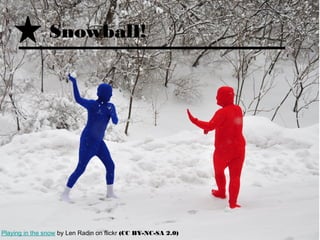
Snowball!


Playing in the snow by Len Radin on flickr (CC BY-NC-SA 2.0)
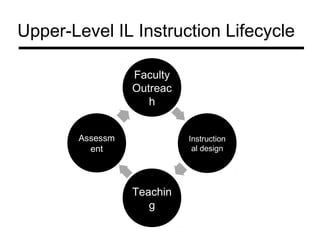
Upper-Level IL Instruction Lifecycle

                 Faculty
                 Outreac
                    h


       Assessm             Instruction
         ent                al design


                 Teachin
                    g
Faculty outreach
Faculty Outreach
Virtue, A. & Esparza, L. (2013). Faculty reconnect.
College & Research Libraries News, 74 (2): 80-99.

•Multidimensional outreach program
•“The Librarian Is In”
•Library Salons
•FacPack
Faculty Outreach
Meulemans, Y., & Carr, A. (2013). Not at your service:
Building genuine faculty-librarian partnerships. Reference
Services Review, 41(1), 80-90.

•Best practices for working faculty in collaborative
relationship.
•“While we may market these programs, it is the quality of
relationships that individual librarians have with their faculty
is the major driver of an instruction program’s success.” (84)
Models for Faculty Outreach
• Information literacy curriculum
  integration
• Assignment creation workshops
• Faculty LibGuides
Activity
• At your table, discuss faculty outreach
  models that you’ve seen or tried that
  have been effective.
Best Practices for Faculty
   Outreach
   • Based on your conversations, what do
     you think are best practices for faculty
     outreach?
       – Text response: 272063 and your
         answer to 22333
       – Tweet: @poll 272063
       – Web:
         http://tinyurl.com/acrluppers2
poll
Worksheet
• Complete the Faculty Outreach
  section on your worksheet.
Instructional Design
• The ADDIE Model
 – Analysis
 – Design
 – Development
 – Implementation
 – Evaluation
Getting Started with ADDIE
• Sample scenario:
 – Assignment: Write an 8-10 page paper
   applying one of the communication
   theories discussed in class (like
   attachment theory) to a situation of your
   choice. Use a minimum of 5 primary
   research articles.
Analyze
• Instructional scenario
• Learner characteristics
• Instructor goals

•     Complete Analyze 1 and 2.
Writing Student Learning Outcomes

• Relevant to instructional scenario
• Appropriate for learners
• Specific enough to be measurable
So, farewell then British Summer Time by Mukumbura on flickr (CC BY-SA 2.0)
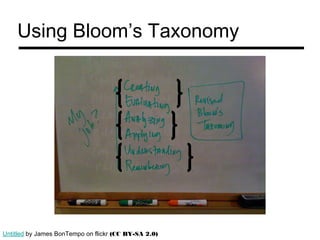
Using Bloom’s Taxonomy


Untitled by James BonTempo on flickr (CC BY-SA 2.0)
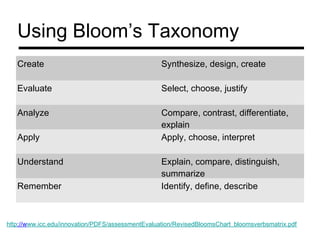
Using Bloom’s Taxonomy
   Create                                          Synthesize, design, create

   Evaluate                                        Select, choose, justify

   Analyze                                         Compare, contrast, differentiate,
                                                   explain
   Apply                                           Apply, choose, interpret

   Understand                                      Explain, compare, distinguish,
                                                   summarize
   Remember                                        Identify, define, describe


http://www.icc.edu/innovation/PDFS/assessmentEvaluation/RevisedBloomsChart_bloomsverbsmatrix.pdf
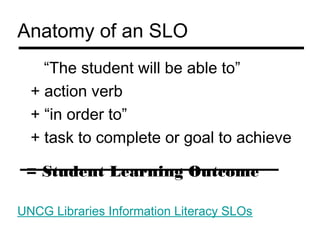
Anatomy of an SLO
    “The student will be able to”
  + action verb
  + “in order to”
  + task to complete or goal to achieve

 = Student Learning Outcome

UNCG Libraries Information Literacy SLOs
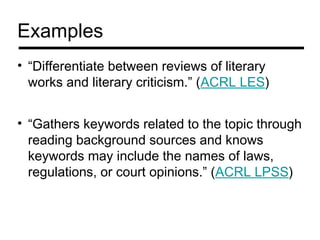
Examples
• “Differentiate between reviews of literary
  works and literary criticism.” (ACRL LES)


• “Gathers keywords related to the topic through
  reading background sources and knows
  keywords may include the names of laws,
  regulations, or court opinions.” (ACRL LPSS)
Worksheet
• Complete Analyze 3.
SLO Workshop
• Share your SLOs with someone sitting
  near you.
 – What suggestions do they have for you?
 – How could you revise your SLOs?
Teaching
Worksheet
• Complete the Design section.
From SLOs to Instruction
Session
•   Political Science 302
•   Political Science 511J
•   English 303
•   Kinesiology 711

“Decontextualized data and information become knowledge only when
  someone, working within the framework of a discipline, integrates it
  into the knowledge-base of that discipline.” (Grafstein 2002, 200)
Brainstorm
• What strategies have you found useful
  in your upper-level classes?
  – Text response: 326684 and your
    answer to 22333
  – Tweet: @poll 326684
  – Web:
    http://tinyurl.com/acrluppers3
Classroom Strategies that Work
• Active learning
• Sample strategies
  – Peer-teaching
  – Synthesis exercise
  – Think/Pair/Share or Write/Pair/Share
  – Jigsawing
  – Worksheets as both active learning and
    authentic assessment
Write/Pair/Share
•         Complete the Implementation
    section.
• Share your tips with a partner.
Assessment
Assessment 101
Two main types: formative and summative
•Formative: formal or informal ongoing
assessments used to improve teaching and
student learning
•Summative: formal assessment used to
determine program effectiveness and/or
student learning
Classroom Assessment
•   Learner-Centered
•   Teacher-Directed
•   Mutually Beneficial
•   Formative
•   Context-Specific
•   Ongoing
•   Rooted in Good Teaching Practice
     (Angelo & Cross, 1993)
What can we assess?
• Student learning
• Our teaching
What tech tools can we use?
•   Clickers/Audience response systems
•   Learning management system
•   Google Forms
•   PollEverywhere
•   What else?
No tech options
• One-minute paper / Muddiest point
• Exit ticket
•   Paper survey
•   Worksheet
•   Fist to five
•   Voting cards
Worksheet
• Complete the Assessment section.
Final thoughts
•   Complete the Wrap-up section.
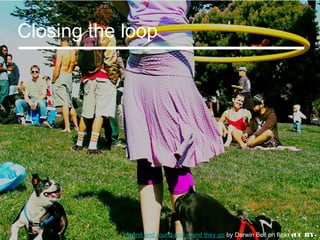
Closing the loop


            round and round and round they go by Darwin Bell on flickr (CC BY-
Thank you!
• Jenny Dale – jedale2@uncg.edu
• Lynda Kellam – lmkellam@uncg.edu
References
•   Angelo, T. A., & Cross, K. P. (1993). Classroom assessment techniques: A handbook
    for college teachers. San Francisco: Jossey-Bass Publishers.
•   Anthony, K. (2010). Reconnecting the disconnects: Library outreach to faculty as
    addressed in the literature. College & Undergraduate Libraries, 17(1): 79-92.
    doi:10.1080/10691310903584817
•   Calkins, K.J. (2007). Best of the literature: Graduate student instruction. Public
    Services Quarterly, 3(3/4): 221-226.
•   Grafstein, A. (2002). A discipline-based approach to information literacy. The Journal
    of Academic Librarianship, 28(4): 197–204.
•   Hopkins, E. S. & Julian, S. (2008). “An evaluation of an upper-division, general
    education literacy program.” Communications in Information Literacy, 2(2).
•   Meulemans, Y., & Carr, A. (2013). Not at your service: Building genuine faculty-
    librarian partnerships. Reference Services Review, 41(1), 80-90.
•   O‘Malley, D. & Delwiche, F. A. (2012). Aligning library instruction with the needs of
    basic sciences graduate students: A case study.” Journal of the Medical Library
    Association, 100(4): 284-290.
•   Rosenblatt, S. (2010). They can find it, but they don't know what to do with it:
    Describing the use of scholarly literature by undergraduate students. Journal of
    Information Literacy, 4(2): 50-61.
•   Virtue, A. & Esparza, L. (2013). Faculty reconnect. College & Research Libraries News,
    74 (2): 80-99.

Higher learning share

  • 1.
    Higher learning Effective andEngaging Information Literacy Instruction for Upper-Level Students
  • 2.
    Introductions • Please introduceyourselves around your table, sharing: – Your name – Your home institution – Why you’re interested in upper-level information literacy instruction
  • 3.
    Poll • What’s the main reason your table is interested in upper-level information literacy instruction? – Text response: 194568 and your answer to 22333 – Tweet: @poll 194568 – Web: http://tinyurl.com/acrluppers poll
  • 4.
    Why Uppers? • “Inthe zeal to impart generalized skills of analytical reasoning, critical thinking, and learning to learn, however, care should be taken to avoid overlooking the importance of subject-based knowledge in facilitating these very goals.” (Grafstein 2002, 200)
  • 5.
    Perry’s Positions ofIntellectual Development • Perry, William G., Jr. (1970), Forms of Intellectual and Ethical Development in the College Years: A Sch (New York: Holt, Rinehart, and Winston). • Dualism (either/or thinking) • Multiplicity (subjective knowledge) • Relativist (constructed knowledge) • http://www.csub.edu/tlc/options/resources/handouts/scholarship_teaching/ 5
  • 6.
    Think/Pair/Share • What differencesdo you see between first-year and upper-level students? • Based on these differences, what challenges do we face in teaching upper-level information literacy sessions?
  • 7.
    Snowball! Playing in thesnow by Len Radin on flickr (CC BY-NC-SA 2.0)
  • 8.
    Upper-Level IL InstructionLifecycle Faculty Outreac h Assessm Instruction ent al design Teachin g
  • 9.
  • 10.
    Faculty Outreach Virtue, A.& Esparza, L. (2013). Faculty reconnect. College & Research Libraries News, 74 (2): 80-99. •Multidimensional outreach program •“The Librarian Is In” •Library Salons •FacPack
  • 11.
    Faculty Outreach Meulemans, Y.,& Carr, A. (2013). Not at your service: Building genuine faculty-librarian partnerships. Reference Services Review, 41(1), 80-90. •Best practices for working faculty in collaborative relationship. •“While we may market these programs, it is the quality of relationships that individual librarians have with their faculty is the major driver of an instruction program’s success.” (84)
  • 12.
    Models for FacultyOutreach • Information literacy curriculum integration • Assignment creation workshops • Faculty LibGuides
  • 13.
    Activity • At yourtable, discuss faculty outreach models that you’ve seen or tried that have been effective.
  • 14.
    Best Practices forFaculty Outreach • Based on your conversations, what do you think are best practices for faculty outreach? – Text response: 272063 and your answer to 22333 – Tweet: @poll 272063 – Web: http://tinyurl.com/acrluppers2 poll
  • 15.
    Worksheet • Complete theFaculty Outreach section on your worksheet.
  • 16.
  • 17.
    Instructional Design • TheADDIE Model – Analysis – Design – Development – Implementation – Evaluation
  • 18.
    Getting Started withADDIE • Sample scenario: – Assignment: Write an 8-10 page paper applying one of the communication theories discussed in class (like attachment theory) to a situation of your choice. Use a minimum of 5 primary research articles.
  • 19.
    Analyze • Instructional scenario •Learner characteristics • Instructor goals • Complete Analyze 1 and 2.
  • 20.
    Writing Student LearningOutcomes • Relevant to instructional scenario • Appropriate for learners • Specific enough to be measurable
  • 21.
    So, farewell thenBritish Summer Time by Mukumbura on flickr (CC BY-SA 2.0)
  • 22.
    Using Bloom’s Taxonomy Untitledby James BonTempo on flickr (CC BY-SA 2.0)
  • 23.
    Using Bloom’s Taxonomy Create Synthesize, design, create Evaluate Select, choose, justify Analyze Compare, contrast, differentiate, explain Apply Apply, choose, interpret Understand Explain, compare, distinguish, summarize Remember Identify, define, describe http://www.icc.edu/innovation/PDFS/assessmentEvaluation/RevisedBloomsChart_bloomsverbsmatrix.pdf
  • 24.
    Anatomy of anSLO “The student will be able to” + action verb + “in order to” + task to complete or goal to achieve = Student Learning Outcome UNCG Libraries Information Literacy SLOs
  • 25.
    Examples • “Differentiate betweenreviews of literary works and literary criticism.” (ACRL LES) • “Gathers keywords related to the topic through reading background sources and knows keywords may include the names of laws, regulations, or court opinions.” (ACRL LPSS)
  • 26.
  • 27.
    SLO Workshop • Shareyour SLOs with someone sitting near you. – What suggestions do they have for you? – How could you revise your SLOs?
  • 28.
  • 29.
  • 30.
    From SLOs toInstruction Session • Political Science 302 • Political Science 511J • English 303 • Kinesiology 711 “Decontextualized data and information become knowledge only when someone, working within the framework of a discipline, integrates it into the knowledge-base of that discipline.” (Grafstein 2002, 200)
  • 31.
    Brainstorm • What strategieshave you found useful in your upper-level classes? – Text response: 326684 and your answer to 22333 – Tweet: @poll 326684 – Web: http://tinyurl.com/acrluppers3
  • 32.
    Classroom Strategies thatWork • Active learning • Sample strategies – Peer-teaching – Synthesis exercise – Think/Pair/Share or Write/Pair/Share – Jigsawing – Worksheets as both active learning and authentic assessment
  • 33.
    Write/Pair/Share • Complete the Implementation section. • Share your tips with a partner.
  • 34.
  • 35.
    Assessment 101 Two maintypes: formative and summative •Formative: formal or informal ongoing assessments used to improve teaching and student learning •Summative: formal assessment used to determine program effectiveness and/or student learning
  • 36.
    Classroom Assessment • Learner-Centered • Teacher-Directed • Mutually Beneficial • Formative • Context-Specific • Ongoing • Rooted in Good Teaching Practice (Angelo & Cross, 1993)
  • 37.
    What can weassess? • Student learning • Our teaching
  • 38.
    What tech toolscan we use? • Clickers/Audience response systems • Learning management system • Google Forms • PollEverywhere • What else?
  • 39.
    No tech options •One-minute paper / Muddiest point • Exit ticket • Paper survey • Worksheet • Fist to five • Voting cards
  • 40.
    Worksheet • Complete theAssessment section.
  • 41.
    Final thoughts • Complete the Wrap-up section.
  • 42.
    Closing the loop round and round and round they go by Darwin Bell on flickr (CC BY-
  • 43.
    Thank you! • JennyDale – jedale2@uncg.edu • Lynda Kellam – lmkellam@uncg.edu
  • 44.
    References • Angelo, T. A., & Cross, K. P. (1993). Classroom assessment techniques: A handbook for college teachers. San Francisco: Jossey-Bass Publishers. • Anthony, K. (2010). Reconnecting the disconnects: Library outreach to faculty as addressed in the literature. College & Undergraduate Libraries, 17(1): 79-92. doi:10.1080/10691310903584817 • Calkins, K.J. (2007). Best of the literature: Graduate student instruction. Public Services Quarterly, 3(3/4): 221-226. • Grafstein, A. (2002). A discipline-based approach to information literacy. The Journal of Academic Librarianship, 28(4): 197–204. • Hopkins, E. S. & Julian, S. (2008). “An evaluation of an upper-division, general education literacy program.” Communications in Information Literacy, 2(2). • Meulemans, Y., & Carr, A. (2013). Not at your service: Building genuine faculty- librarian partnerships. Reference Services Review, 41(1), 80-90. • O‘Malley, D. & Delwiche, F. A. (2012). Aligning library instruction with the needs of basic sciences graduate students: A case study.” Journal of the Medical Library Association, 100(4): 284-290. • Rosenblatt, S. (2010). They can find it, but they don't know what to do with it: Describing the use of scholarly literature by undergraduate students. Journal of Information Literacy, 4(2): 50-61. • Virtue, A. & Esparza, L. (2013). Faculty reconnect. College & Research Libraries News, 74 (2): 80-99.