CURRICULUM:
CONNECTIONS AND
COMMON GROUND
Allison Mackley
Hershey High School
November 2014
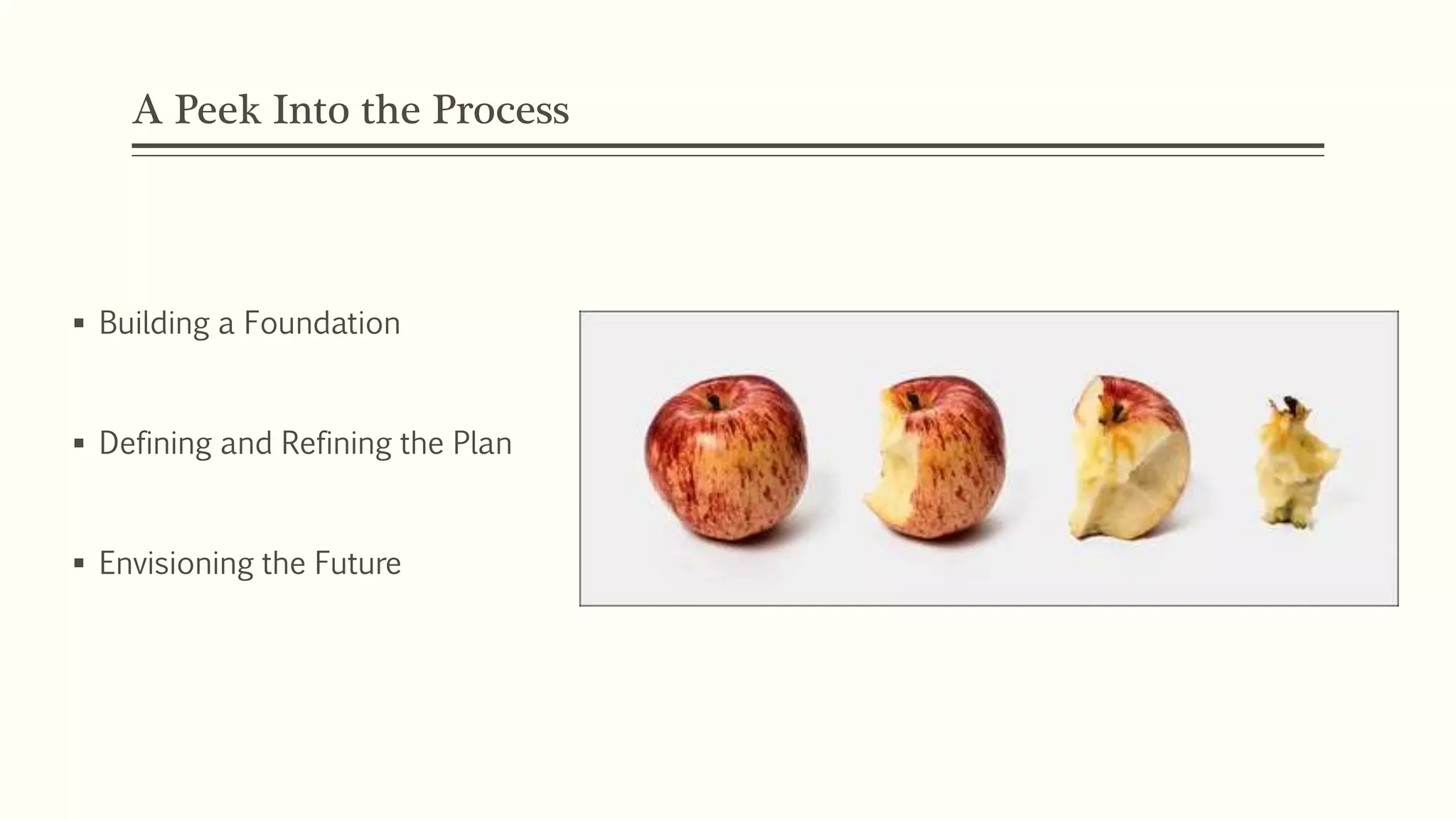
A Peek Into the Process
 Building a Foundation
 Defining and Refining the Plan
 Envisioning the Future
BUILDING A FOUNDATION
2007 - 2008
Start Small
 Academic Culture
 Accessibility
 Communication
Create Connections
 Building on Current Relationships
 Finding Common Ground
 Reinventing Library Orientation
Curriculum Without Students
 Information Literacy Instructional Timeline
 Goals:
 Empower students to become effective information problem solvers, discerning readers, and successful life-
long learners.
 Provide students with the resources and skills that will be needed in today’s information-based society.
 Information literacy skills and strategies cannot stand in isolation; therefore, library lessons are
integrated with academic subjects across the curriculum throughout the year. This collaboration
with content area teachers promotes the students’ development towards enhancing and expanding
upon the lessons and topics taught elsewhere in the school. The library experience should
supplement the objectives of each content area as students refine information problem solving skills
and increase technology-for-learning proficiency. Students build on previous learning and benefit
from increased academic success by refining their skills and developing the ability to think carefully,
critically, and creatively about the world around them.
 The scope and sequence provides teacher-librarians with the structure needed to plan for students’
library experiences, thus ensuring an exposure to the range of information literacy and library-
specific skills needed for life-long learning.
Plugging in the Standards
 Concepts for Life-long Learning
 Existence of Libraries and Librarians
 Essential Nature of Information Literacy Skills
 Standards
 AASL Standards for the 21st Century Learner
 Pennsylvania Reading, Writing, Speaking,
Listening Standards
Plugging in the Standards continued
 Skills and Procedural Knowledge
 Scope and Sequence
 Resources Consulted
 AASL – Standards for the 21st Century Learner
 Ephrata School District: K – 12 Information Literacy
and Technology Skills Curriculum
 Pittsburgh Public School: Information Literacy for
Life-long Learning
 Upper Merion School District: K-12 Library
Curriculum
Hit and Miss
 Too Many Targets
 Consistency
 Equal Access to Instruction
 Systemic Implications
DEFINING AND REFINING THE PLAN
2008 - 2014
Core Subjects: English, Science and Social Studies
Supports
 Director of Curriculum and Instruction
 Principal
 Department Coordinators
 Department Members
 Curriculum Mapping Process
 Curriculum Consultant
 Technology
Barriers
 Collaborative Planning Time
 Urgency to Cover Curriculum
 PSSA Tests
 Keystone Tests
 Culture of Independence
 Teaching Spaces
 Technology
Science: Biology – Advancing Genetic Applications
PA
Standards
Collins
Writing
Technology
Integration
Project
Outline
2008 -
2009
Implement
Librarian as
Instructor
Phase Out
2009 -
2012
Keystone
Tests
2012 –
2013
Curriculum
Review
2013 -
2015
English: 9th Grade - Social Survival
PA
Standards
Upcoming
Keystones
Embedded
Research
Skills
Librarian as
Resource
Project
Outline
2009 -
2010 Consistency
and Equal
Access
Resource
Sharing
Librarian as
Instructor
Librarian as
Co-teacher
2010 -
2012 Librarian as
Consultant
Project
Revision
2013 -
2014 Curriculum
Review
2015
11th Grade English: American Dream
 Research Resulting from Of Mice and Men
 Ownership of Topic
 Self-selection from a Variety of Research
Strategies
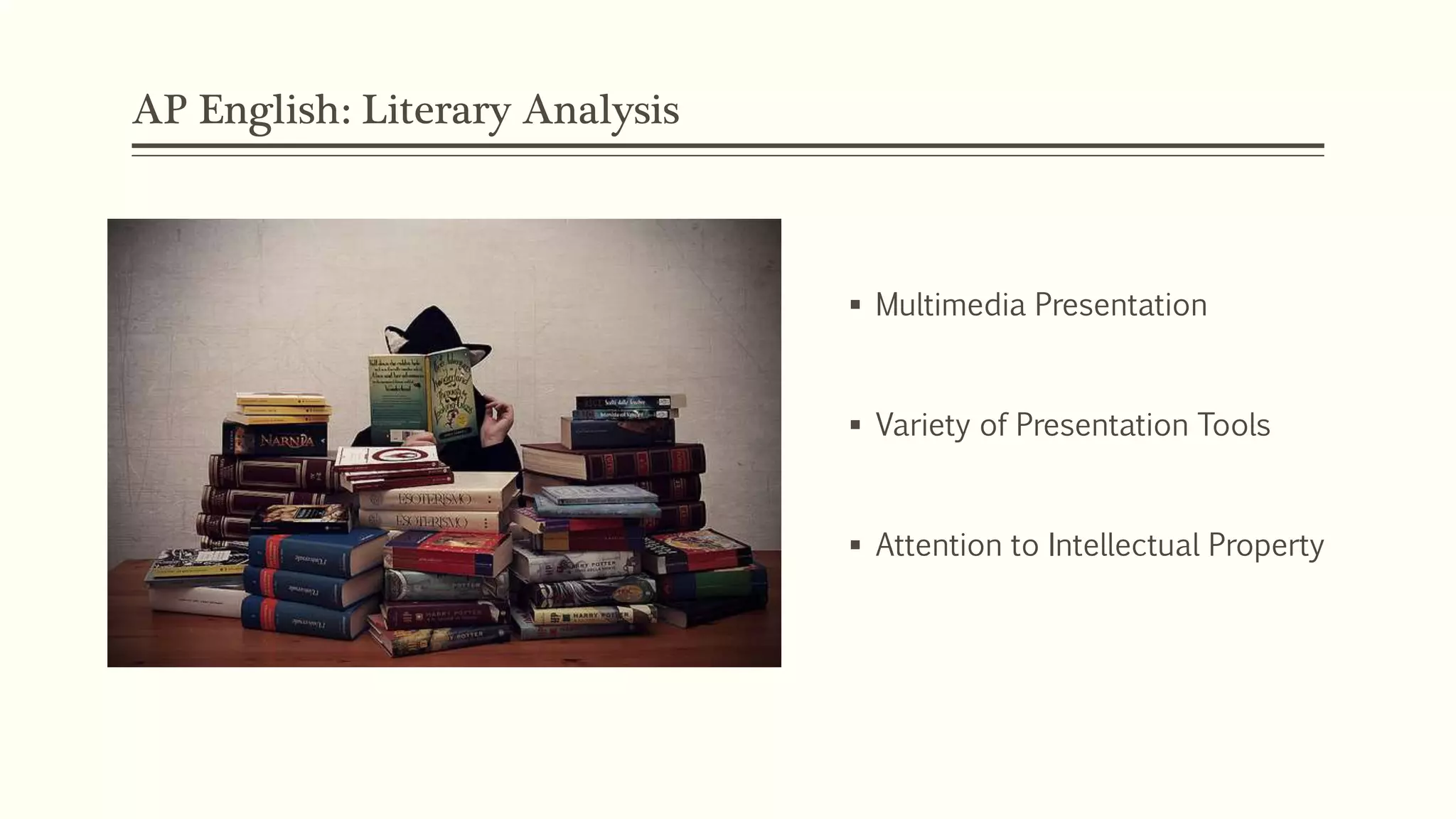
AP English: Literary Analysis
 Multimedia Presentation
 Variety of Presentation Tools
 Attention to Intellectual Property
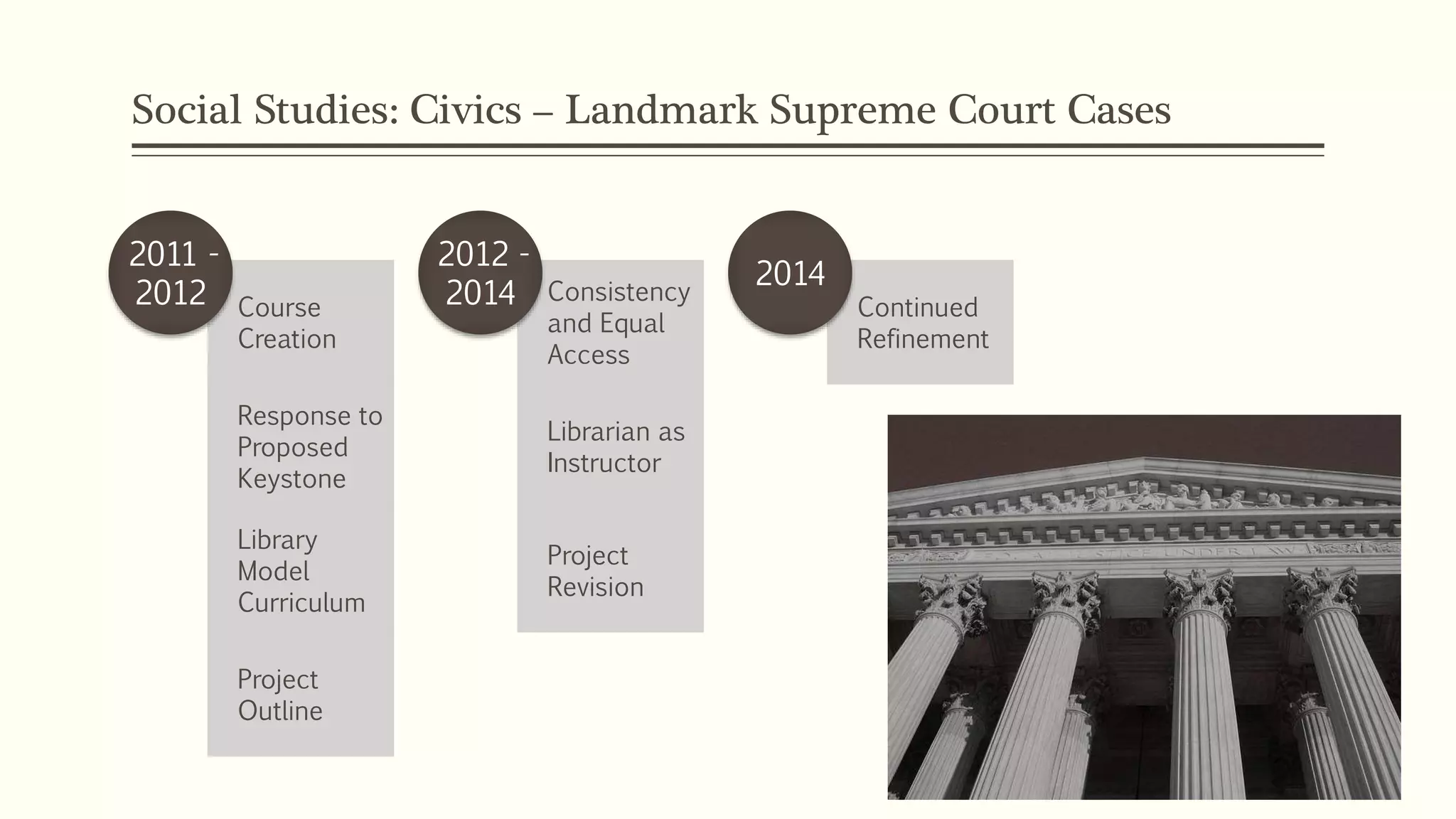
Social Studies: Civics – Landmark Supreme Court Cases
Course
Creation
Response to
Proposed
Keystone
Library
Model
Curriculum
Project
Outline
2011 -
2012 Consistency
and Equal
Access
Librarian as
Instructor
Project
Revision
2012 -
2014 Continued
Refinement
2014
Social Studies: World History – Divided by Districts/Rescued by
Rivers
Combined
I & II
Model
Library
Curriculum
Skills vs.
Content
Shared
Rubric
2012 -
2013 Consistency
and Equal
Access
Library as
Instructor
Balanced
Literacy
2013 -
2014 Project
Revision
2014
ENVISIONING THE FUTURE
2015 and Beyond
Mapping Our Way: Elementary School
 K-12 Department Writing Team
 Summer 2013
 2013 – 2014 Implement and Refine
 Unit Maps
 Course Essential Question
 Unit/Topic
 Unit Essential Question
 PA Core Standards
 Concepts
 Skills
 Content Vocabulary
 Resources
 Formative/Summative Assessments
 Key Lesson Questions
Everything New- Middle School
 Librarian
 Academic Support Team
 PLCs
 Articulation
12th Grade English: Research Rotation
 Choice of 4 Electives
 Film Studies
 Science Fiction
 Creative Nonfiction
 Words That Changes the World – Literature of Peace,
War, and Social Justice
 First Semester
 Written Presentation
 Second Semester
 Multimedia Multimedia Presentation
Foundations of Ethical Research
Rationale
• Empower Students
• Effective Information Problem Solvers
• Discerning Readers
• Successful Life-long Learners
• Apply Critical Thinking Skills in Collecting, Organizing, Evaluating, and Using Information
CONTACT
Allison Mackley
amackley@hershey.k12.pa.us
717-508-2259
Image Credits
 Bertalan Szuros – Timeline: Minutes
 Nomadic Lass – Dream Big
 Daniela Hartmann – Close Connection –
Verbundenheit
 Rennett Stowe – Wall Plug
 James Wheeler – Yoho Road
 Mararie – darts at the biennale (jacob
dahlgren)
 Journal of Cell Biology - Vol.193 Issue 1-
toc1
 Chris – Diversity Clucks
 Rita M – American Dream
 Gioia De Antoniis – Our Armor
 Neil R – Supreme Court – Sepia
 Praveen Selvam – Indus River
 Paul Papadimitriou – Requests.
 Josef.stuefer – Birth
 Fotografeleen – Research Before
Producing a Video

Curriculum: Connections and Common Ground

  • 1.
    CURRICULUM: CONNECTIONS AND COMMON GROUND AllisonMackley Hershey High School November 2014
  • 2.
    A Peek Intothe Process  Building a Foundation  Defining and Refining the Plan  Envisioning the Future
  • 3.
  • 4.
    Start Small  AcademicCulture  Accessibility  Communication
  • 5.
    Create Connections  Buildingon Current Relationships  Finding Common Ground  Reinventing Library Orientation
  • 6.
    Curriculum Without Students Information Literacy Instructional Timeline  Goals:  Empower students to become effective information problem solvers, discerning readers, and successful life- long learners.  Provide students with the resources and skills that will be needed in today’s information-based society.  Information literacy skills and strategies cannot stand in isolation; therefore, library lessons are integrated with academic subjects across the curriculum throughout the year. This collaboration with content area teachers promotes the students’ development towards enhancing and expanding upon the lessons and topics taught elsewhere in the school. The library experience should supplement the objectives of each content area as students refine information problem solving skills and increase technology-for-learning proficiency. Students build on previous learning and benefit from increased academic success by refining their skills and developing the ability to think carefully, critically, and creatively about the world around them.  The scope and sequence provides teacher-librarians with the structure needed to plan for students’ library experiences, thus ensuring an exposure to the range of information literacy and library- specific skills needed for life-long learning.
  • 7.
    Plugging in theStandards  Concepts for Life-long Learning  Existence of Libraries and Librarians  Essential Nature of Information Literacy Skills  Standards  AASL Standards for the 21st Century Learner  Pennsylvania Reading, Writing, Speaking, Listening Standards
  • 8.
    Plugging in theStandards continued  Skills and Procedural Knowledge  Scope and Sequence  Resources Consulted  AASL – Standards for the 21st Century Learner  Ephrata School District: K – 12 Information Literacy and Technology Skills Curriculum  Pittsburgh Public School: Information Literacy for Life-long Learning  Upper Merion School District: K-12 Library Curriculum
  • 9.
    Hit and Miss Too Many Targets  Consistency  Equal Access to Instruction  Systemic Implications
  • 10.
    DEFINING AND REFININGTHE PLAN 2008 - 2014
  • 11.
    Core Subjects: English,Science and Social Studies Supports  Director of Curriculum and Instruction  Principal  Department Coordinators  Department Members  Curriculum Mapping Process  Curriculum Consultant  Technology Barriers  Collaborative Planning Time  Urgency to Cover Curriculum  PSSA Tests  Keystone Tests  Culture of Independence  Teaching Spaces  Technology
  • 12.
    Science: Biology –Advancing Genetic Applications PA Standards Collins Writing Technology Integration Project Outline 2008 - 2009 Implement Librarian as Instructor Phase Out 2009 - 2012 Keystone Tests 2012 – 2013 Curriculum Review 2013 - 2015
  • 13.
    English: 9th Grade- Social Survival PA Standards Upcoming Keystones Embedded Research Skills Librarian as Resource Project Outline 2009 - 2010 Consistency and Equal Access Resource Sharing Librarian as Instructor Librarian as Co-teacher 2010 - 2012 Librarian as Consultant Project Revision 2013 - 2014 Curriculum Review 2015
  • 14.
    11th Grade English:American Dream  Research Resulting from Of Mice and Men  Ownership of Topic  Self-selection from a Variety of Research Strategies
  • 15.
    AP English: LiteraryAnalysis  Multimedia Presentation  Variety of Presentation Tools  Attention to Intellectual Property
  • 16.
    Social Studies: Civics– Landmark Supreme Court Cases Course Creation Response to Proposed Keystone Library Model Curriculum Project Outline 2011 - 2012 Consistency and Equal Access Librarian as Instructor Project Revision 2012 - 2014 Continued Refinement 2014
  • 17.
    Social Studies: WorldHistory – Divided by Districts/Rescued by Rivers Combined I & II Model Library Curriculum Skills vs. Content Shared Rubric 2012 - 2013 Consistency and Equal Access Library as Instructor Balanced Literacy 2013 - 2014 Project Revision 2014
  • 18.
  • 19.
    Mapping Our Way:Elementary School  K-12 Department Writing Team  Summer 2013  2013 – 2014 Implement and Refine  Unit Maps  Course Essential Question  Unit/Topic  Unit Essential Question  PA Core Standards  Concepts  Skills  Content Vocabulary  Resources  Formative/Summative Assessments  Key Lesson Questions
  • 20.
    Everything New- MiddleSchool  Librarian  Academic Support Team  PLCs  Articulation
  • 21.
    12th Grade English:Research Rotation  Choice of 4 Electives  Film Studies  Science Fiction  Creative Nonfiction  Words That Changes the World – Literature of Peace, War, and Social Justice  First Semester  Written Presentation  Second Semester  Multimedia Multimedia Presentation
  • 22.
    Foundations of EthicalResearch Rationale • Empower Students • Effective Information Problem Solvers • Discerning Readers • Successful Life-long Learners • Apply Critical Thinking Skills in Collecting, Organizing, Evaluating, and Using Information
  • 23.
  • 24.
    Image Credits  BertalanSzuros – Timeline: Minutes  Nomadic Lass – Dream Big  Daniela Hartmann – Close Connection – Verbundenheit  Rennett Stowe – Wall Plug  James Wheeler – Yoho Road  Mararie – darts at the biennale (jacob dahlgren)  Journal of Cell Biology - Vol.193 Issue 1- toc1  Chris – Diversity Clucks  Rita M – American Dream  Gioia De Antoniis – Our Armor  Neil R – Supreme Court – Sepia  Praveen Selvam – Indus River  Paul Papadimitriou – Requests.  Josef.stuefer – Birth  Fotografeleen – Research Before Producing a Video

Editor's Notes

  • #5 Teacher-Librarian Collaboration Equals Student Success Test Center Service-Oriented Flexible Schedule In-service Department Meetings Faculty meetings Board Meetings PTO/Building Advisory
  • #6 Night Holocaust Museum
  • #8 Building a Foundation for the Future Rationale for Curriculum Conversations AASL PA RWSL 1.8 – Research: Inquiry-based process, location of information, citing sources, organization of product 1.5 – Quality of Writing 1.2 – Reading, Analyzing, and Interpreting Text: Text Organization, Fact from Opinion, essential and non-essential text, inferences, text analysis and evaluation
  • #9 Scope and Sequence – projected ideal learning experiences Experts paved the road, but couldn’t see around bend
  • #10 Too many targets Sporadic instruction – lack of consistency Conversation starting points
  • #13 Locate Resources – print and online Access Information - Cornell Notes Analyzing Text Pro/Con – Embryonic Stem Cell and Adult Stem Cell Venn Diagram – science of using stem cells vs. other stem cells or stem cell use for therapies vs. specific diseases/conditions
  • #14 Blog Post – Literary Techniques/Appeal Blog Post – Realistic Representation Locate Fiction and Non-fiction Background Reading and Research Cornell Notes Analyze Fiction vs. Non-fiction text Annotated Bibliography Blog Post and Response – online etiquette
  • #15 Topic Selection – Widen/Narrow Advanced Search Techniques Analyzing Search Strategies – Problem-based Website Evaluation Notetaking Strategies Identifying Information based on Research Question
  • #17 Location of Resources Note-taking Works Cited Added – trace to contemporary event Added contemporary application and/or should decision be revisited based on our current climate/culture/issues Added – presentation with ethical use of political cartoons, charts, graphs, images, etc.
  • #18 Task Definition Location of Resources Note-taking Website Evaluation Food First vs. Divided by Districts/Rescued by Rivers scenario
  • #20 Need work on assessments – now that phase 3 of Model Lib Curriculum has been published Instructional Timeline for Key Lesson Questions
  • #22 How does research help a writer develop his/her ideas? How can a writer be creative while using facts? What resources are available for research? How do writers know which resources to use? How does a writer know if a source is valid and reliable? How does a writer know what kind of information to pull from his/her research? How does a writer incorporate researched information into his/her writing?
  • #23 Online Course – semester elective Blended Course – 9th grade core classes Model Library Curriculum Essential Questions How does a person inquire, think critically, and gain knowledge? How can information be used to foster independent learning? How does a researcher access and manage information to make informed decisions, apply knowledge to new situations, and create new knowledge? How does a researcher discover the most relevant resources? How does a researcher know a source can be trusted? How does a researcher determine the usefulness of a source? How do researchers share knowledge ethically? How do researchers participate ethically and productively as members of our society Objectives Recognize the need for information. Determine the extent of information needed. Access information effectively and efficiently. Evaluate information and its sources critically. Incorporate selected information into one's knowledge base. Use information effectively to accomplish a specific purpose. Use information ethically. Personalized Learning Mobile Education with Personal Learning Devices Varied Learning Spaces Flexible Schedules Ownership of Learning Academic Community Dynamic Learning Opportunities Multiple Learning Pathways Authentic Assessments Mastery Learning