Teaching & Assessing with the ACRL Framework
DIANE FULKERSON
UNIVERSITY OF SOUTH FLORIDA SARASOTA-MANATEE
PLAN FLA MINI -CONFERENCE GULF COAST STATE COLLEGE
SEPTEMBER 11, 2015
Pre-Test
A Threshold Concept is…
•New way to solve problems
•An easily grasped lesson for one-shots
•A problem encountered by newly weds
•Theoretical approach to learning focused on the transformative,
educationally critical content of a discipline
When I define “information literacy” for a non-librarian
colleague I…
•Tell them it is librarian terminology for research skills
•Give them a copy of the ACRL Framework or Standards
•Tell them it is a librarian thing
•Change the subject
Teaching with the Framework
Do we need to use the Framework?
Threshold Concept theory
Teaching with the Frames
Assessing Instruction
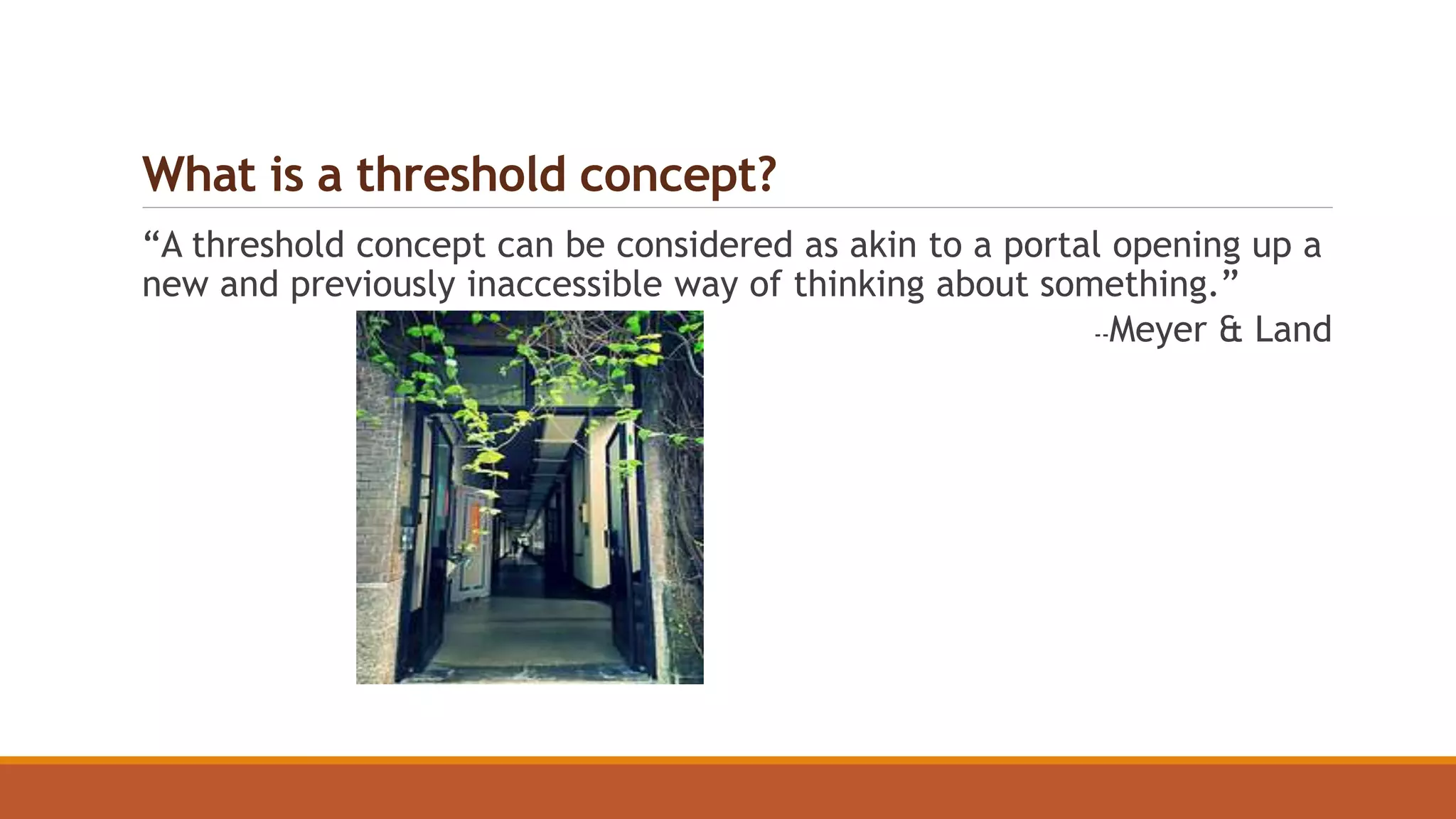
What is a threshold concept?
“A threshold concept can be considered as akin to a portal opening up a
new and previously inaccessible way of thinking about something.”
--Meyer & Land
Threshold Concepts are…
Transformative—cause a shift in perspective
Irreversible—once learned cannot be unlearned
Integrative—unifies facts/lessons/concepts
Bounded—defines the boundaries of a particular discipline
Troublesome—counter-intuitive
One-Shot Classes
New Opportunities
Less is more
More flexibility
Move away from skills
Knowledge based learning/discovery
Assignment focused one-shots
Explore your options
Combine Frames
Instructional Design
Understanding by Design—Wiggins and McTighe
Develop “essential questions” and “understandings”
Understandings=Learning Outcomes
Use Frames to create “essential questions”
Interactive learning
Predictable misunderstandings
Understandings/Learning Outcomes
Important inferences—specific and useful generalization
Transferable big ideas—enduring value
Abstract, counterintuitive, easily misunderstood
Developed by “uncovering” and “doing”—realistic
Summarizes important strategic principles in skill areas
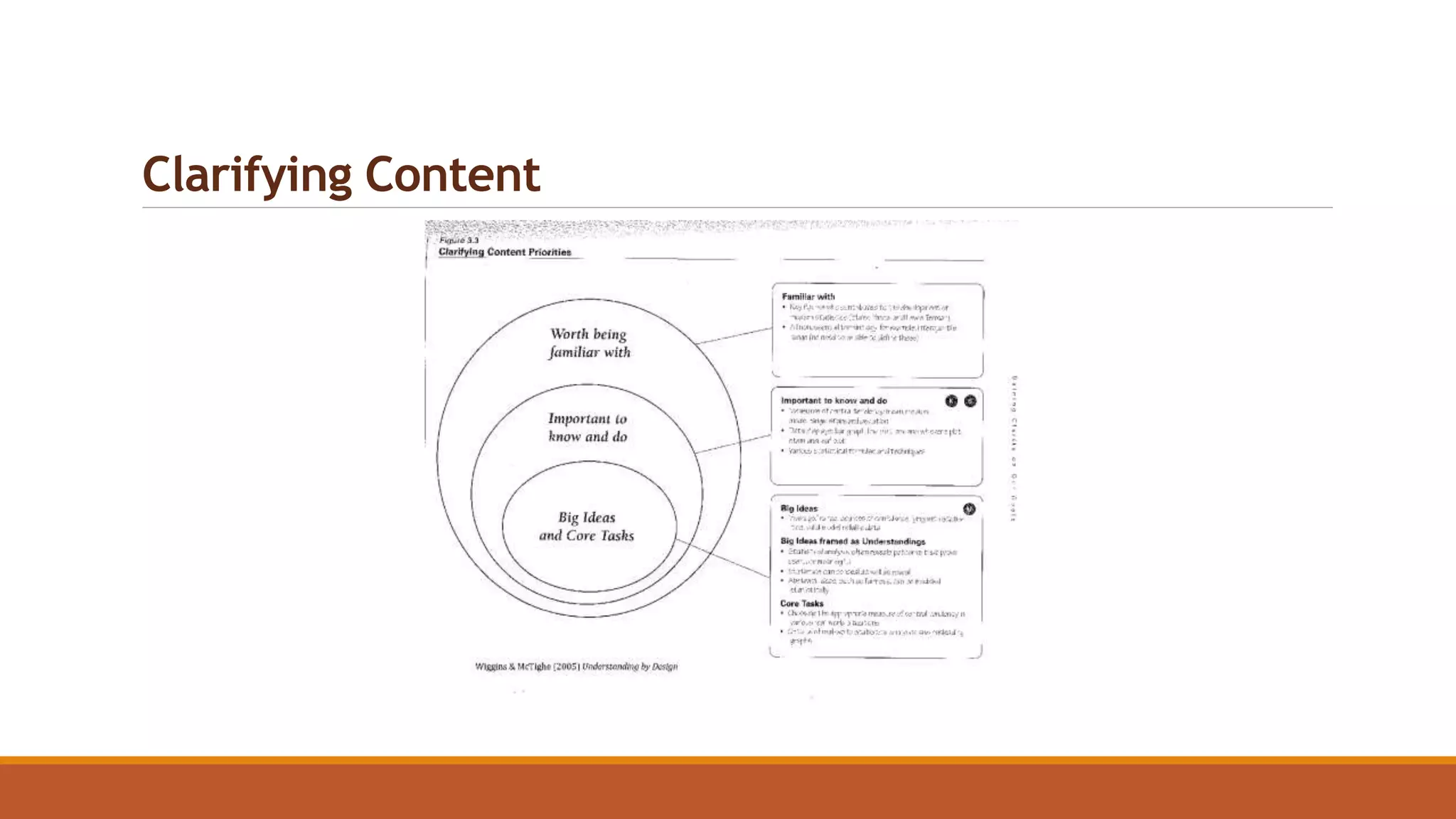
Clarifying Content
Creating a One-Shot Class
Three stages of design development are:
Desired result is for learners to…(Stage 1)
Student evidence of their ability to…(Stage 2)
Learning activities need to…(Stage 3)
Let’s create a class focused on the Frame--
◦ Searching as Strategic Exploration
◦ This frame can be used in combination with:
◦ Authority is Constructed and Contextual
◦ Information Creation as Process
Stage 1 Desired Result
Students can search effectively and efficiently
◦ Develop a search strategy
◦ Use database resources to find other articles
◦ Determine information need
◦ Identify scholarly and non-scholarly sources
Stage 2 Student Evidence of Ability to…
Develop a search strategy
Use search limiters to expand or narrow results
Find information from different sources
Stage 3 Learning Activities
Provide students with a search scenario
◦ Ask two questions
◦ What do you know?
◦ Where will you find the information?
◦ Provide an overview of relevant library resources
◦ Ask them to develop a search strategy
◦ Identify a blog/wiki they would use
◦ Evaluate the blog for content/purpose/authority
Assessment
Two questions to ask when developing assessment
◦ How will you know students achieved the outcome?
◦ How will students demonstrate they’ve achieved it?
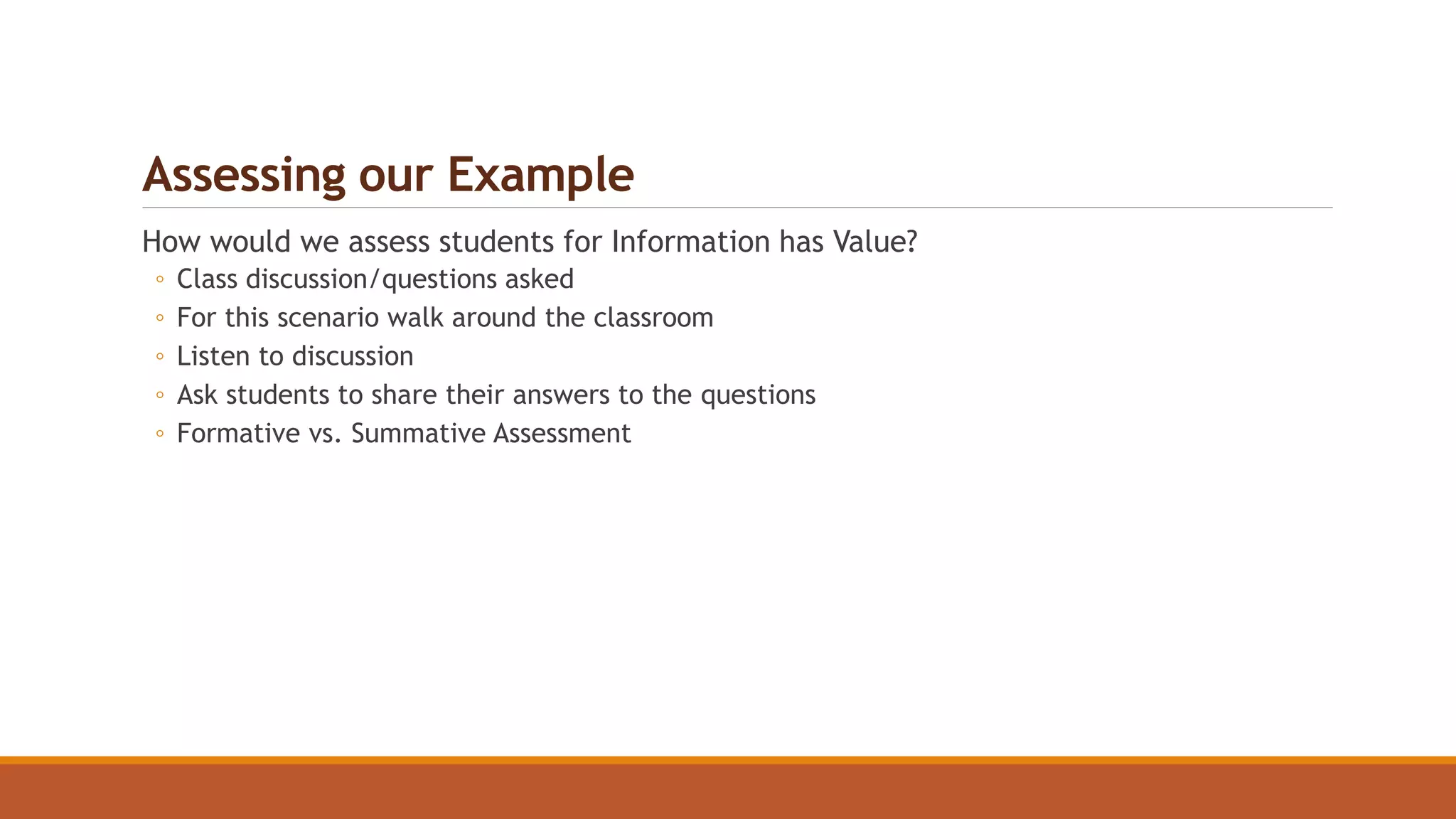
Assessing our Example
How would we assess students for Information has Value?
◦ Class discussion/questions asked
◦ For this scenario walk around the classroom
◦ Listen to discussion
◦ Ask students to share their answers to the questions
◦ Formative vs. Summative Assessment
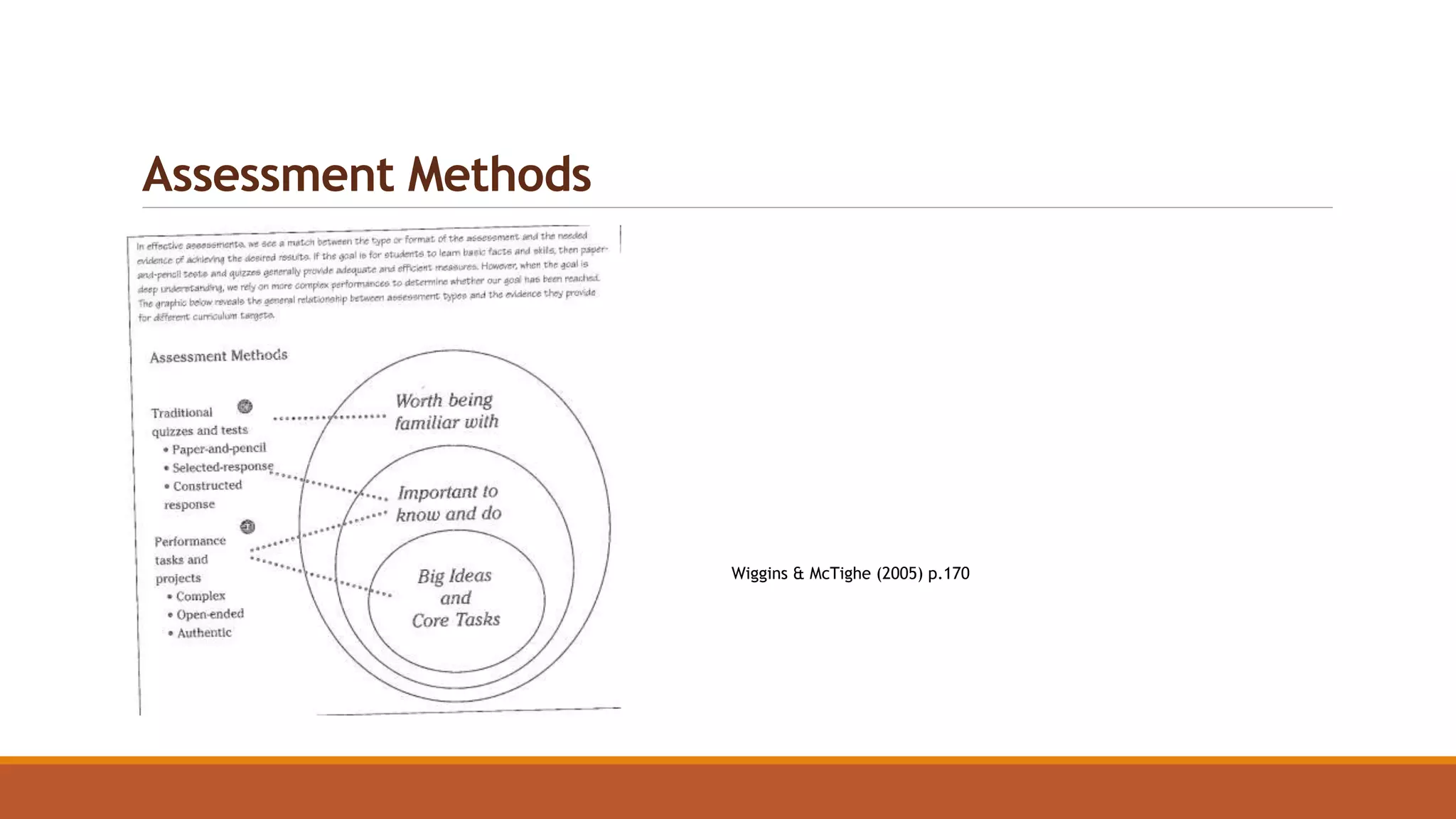
Assessment Methods
Wiggins & McTighe (2005) p.170
Performance Assessment Examples
Research log
Reflective writing
Self or Peer evaluations
Open-ended questions
Worksheets
Concept maps
Examples
Using the Frames
In
One-Shot Classes
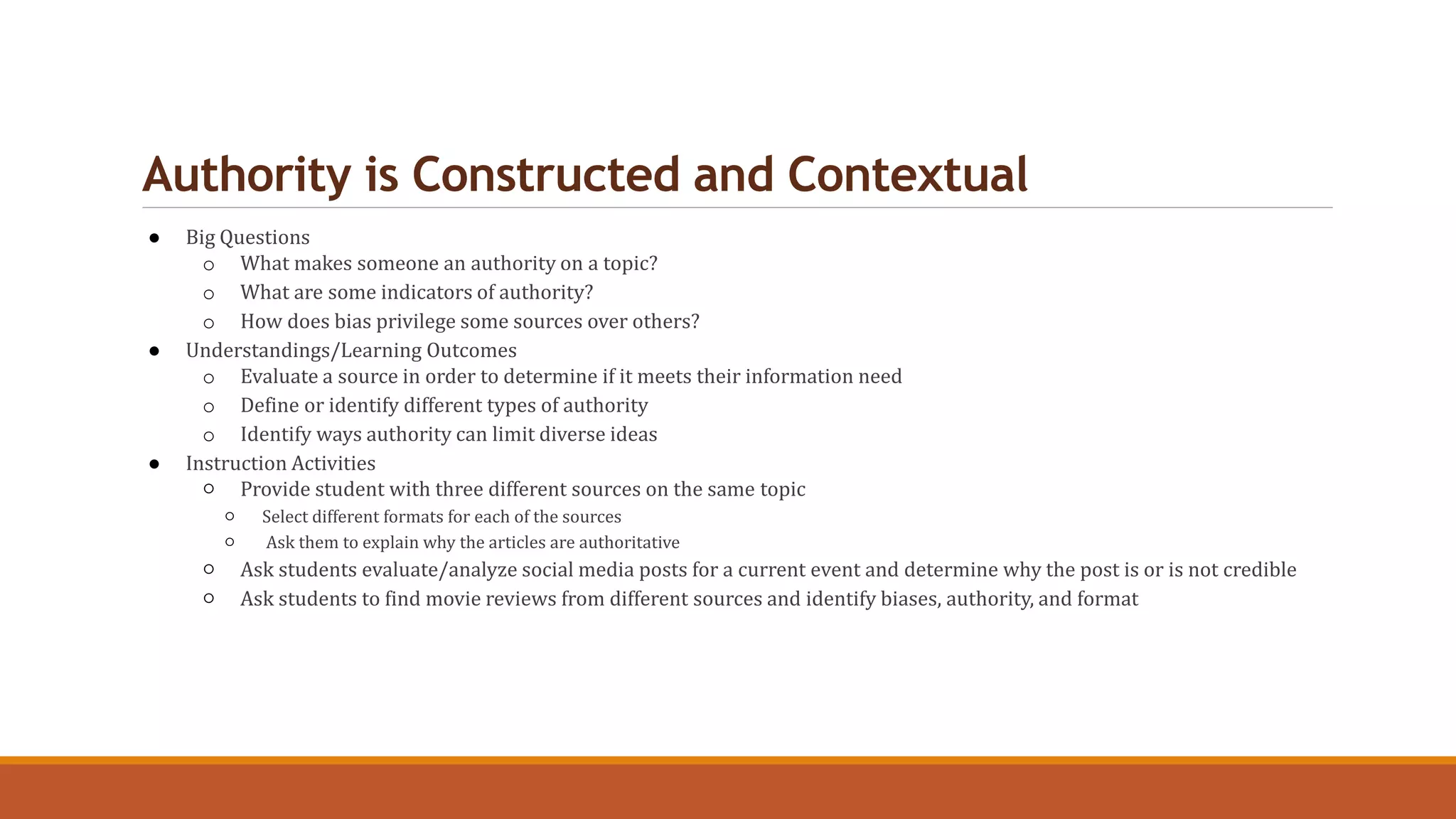
Authority is Constructed and Contextual
● Big Questions
o What makes someone an authority on a topic?
o What are some indicators of authority?
o How does bias privilege some sources over others?
● Understandings/Learning Outcomes
o Evaluate a source in order to determine if it meets their information need
o Define or identify different types of authority
o Identify ways authority can limit diverse ideas
● Instruction Activities
○ Provide student with three different sources on the same topic
○ Select different formats for each of the sources
○ Ask them to explain why the articles are authoritative
○ Ask students evaluate/analyze social media posts for a current event and determine why the post is or is not credible
○ Ask students to find movie reviews from different sources and identify biases, authority, and format
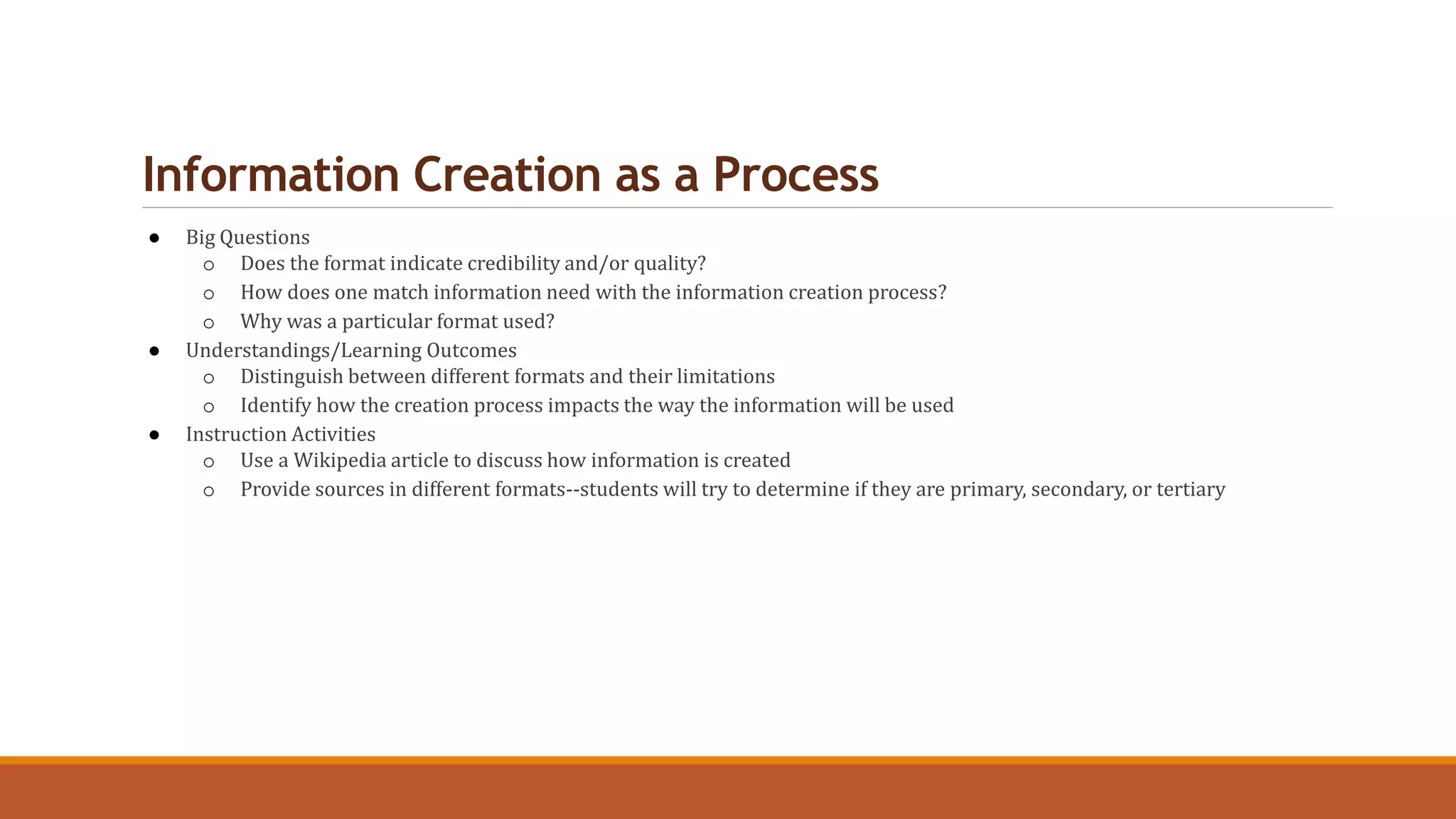
Information Creation as a Process
● Big Questions
o Does the format indicate credibility and/or quality?
o How does one match information need with the information creation process?
o Why was a particular format used?
● Understandings/Learning Outcomes
o Distinguish between different formats and their limitations
o Identify how the creation process impacts the way the information will be used
● Instruction Activities
o Use a Wikipedia article to discuss how information is created
o Provide sources in different formats--students will try to determine if they are primary, secondary, or tertiary
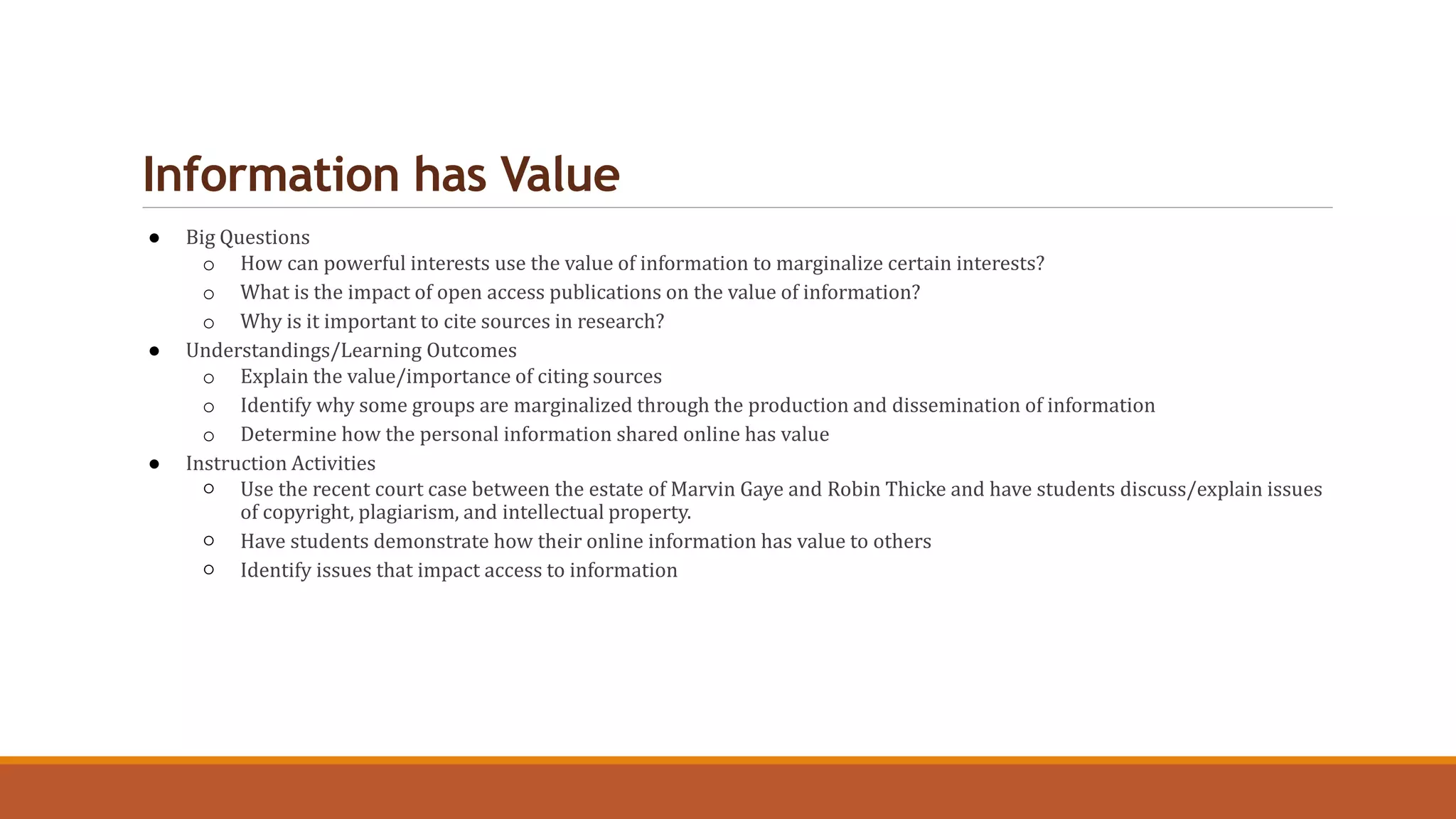
Information has Value
● Big Questions
o How can powerful interests use the value of information to marginalize certain interests?
o What is the impact of open access publications on the value of information?
o Why is it important to cite sources in research?
● Understandings/Learning Outcomes
o Explain the value/importance of citing sources
o Identify why some groups are marginalized through the production and dissemination of information
o Determine how the personal information shared online has value
● Instruction Activities
○ Use the recent court case between the estate of Marvin Gaye and Robin Thicke and have students discuss/explain issues
of copyright, plagiarism, and intellectual property.
○ Have students demonstrate how their online information has value to others
○ Identify issues that impact access to information
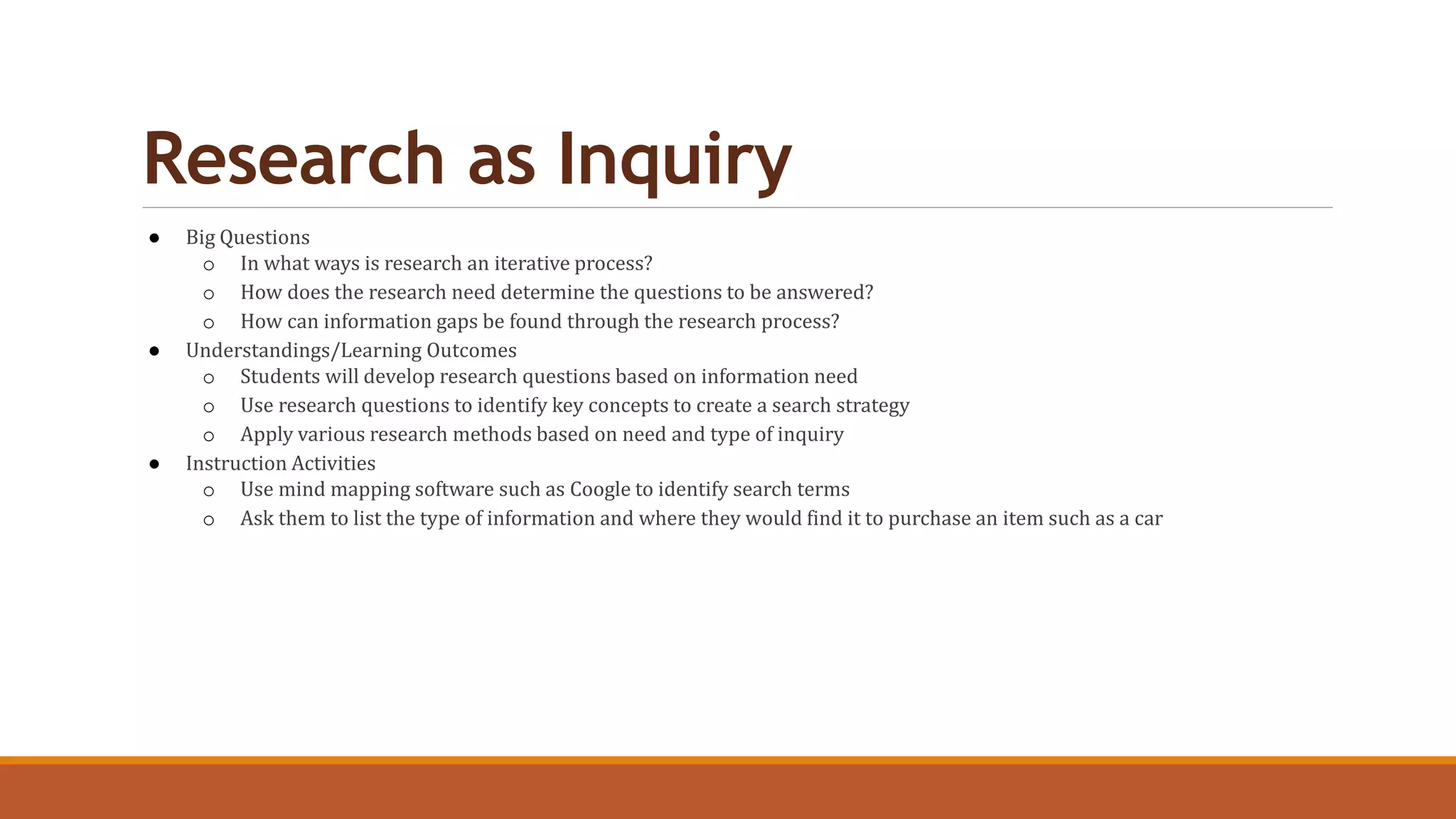
Research as Inquiry
● Big Questions
o In what ways is research an iterative process?
o How does the research need determine the questions to be answered?
o How can information gaps be found through the research process?
● Understandings/Learning Outcomes
o Students will develop research questions based on information need
o Use research questions to identify key concepts to create a search strategy
o Apply various research methods based on need and type of inquiry
● Instruction Activities
o Use mind mapping software such as Coogle to identify search terms
o Ask them to list the type of information and where they would find it to purchase an item such as a car
Scholarship as Conversation
● Big Questions
o How does someone become part of the scholarly conversation?
o Why is it important to find more than one perspective about a topic?
o How do authority structures limit the ability to enter into the scholarly conversation?
● Understanding/Learning Outcomes
o Citing sources in the creation of information
o Become a contributor at the appropriate level
o Identify the contribution of scholarly materials to disciplinary knowledge
● Instruction Activities
o Provide reference page from an article and ask students to find one of the articles listed using the citations provided
o Divide students into group and have them search for different types of information then teach other how to find
information
o Peer review of their evaluation of a scholarly article
Searching as Strategic Exploration
● Big Questions
o What role does serendipity play in the search process?
o How does the research need determine the type of search strategy to use?
o Why is it necessary to search a variety of sources to find the needed information?
● Understandings/Learning Outcomes
o Use brainstorming and other techniques when searching
o Match information need with search strategy.
o Use previous search results to expand or refine search strategies
● Instruction Activities
o Concept Maps
o Use bibliography to find another source
o Jigsaw method to develop a search strategy
o Identify the types of sources needed
Post-Test
When a colleague asks me about information literacy and threshold concepts I will tell
them….
Sources
ACRL Framework for Information Literacy for Higher Education http://www.ala.org/acrl/standards/ilframework
Cowan, S.M. (2014) “Information Literacy: The Battle We Won That We Lost? portal: Libraries and the Academy, 14(1), 23-32
Fister, B. (2015) A Bit of a Tall Order. Retrieved from: http://goo.gl/d8vPoN
Fister, B. (2015) Standards, Frameworks, and the Work We Need To Do. Retrieved from: http://goo.gl/pf84zr
Hofer, A., Brunetti, K. & Townsend, L. (2013) A Thresholds Concepts Approach To The Standards Revision. Communications in Information Literacy, 7(2)
108-113
Knapp, M. & Brower, S. (2014) The ACRL Framework for Information Literacy in Higher Education: Implications for Health Sciences Librarianship. Medical
Reference Services Quarterly, 33(4) 460-468. http://dx.doi.org/10.1080/02763869.2014.957098
Launius, C. & Hassel, H. (2015) Threshold Concepts in Women’s and Gender Studies: Ways of Seeing, Thinking, and Knowing. New York, NY: Routledge
Meyer, J. & Land, R. (2003) Threshold Concepts and Troublesome Knowledge: Linkages to Ways of Thinking and Practising within the Disciplines.
Enhancing Teaching-Learning Environments in Undergraduate Courses Project, Occasional Report 4. Retrieved from: http://www.etl.tla.ed.ac.uk/
Oakleaf, M.(2014) A Roadmap for Assessing Student Learning Using the New Framework for Information Literacy for Higher Education. The Journal of
Academic Librarianship, 40(5) 510-514. http://dx.doi.org/10.1016/j.aclib.2014.08.001
Sources
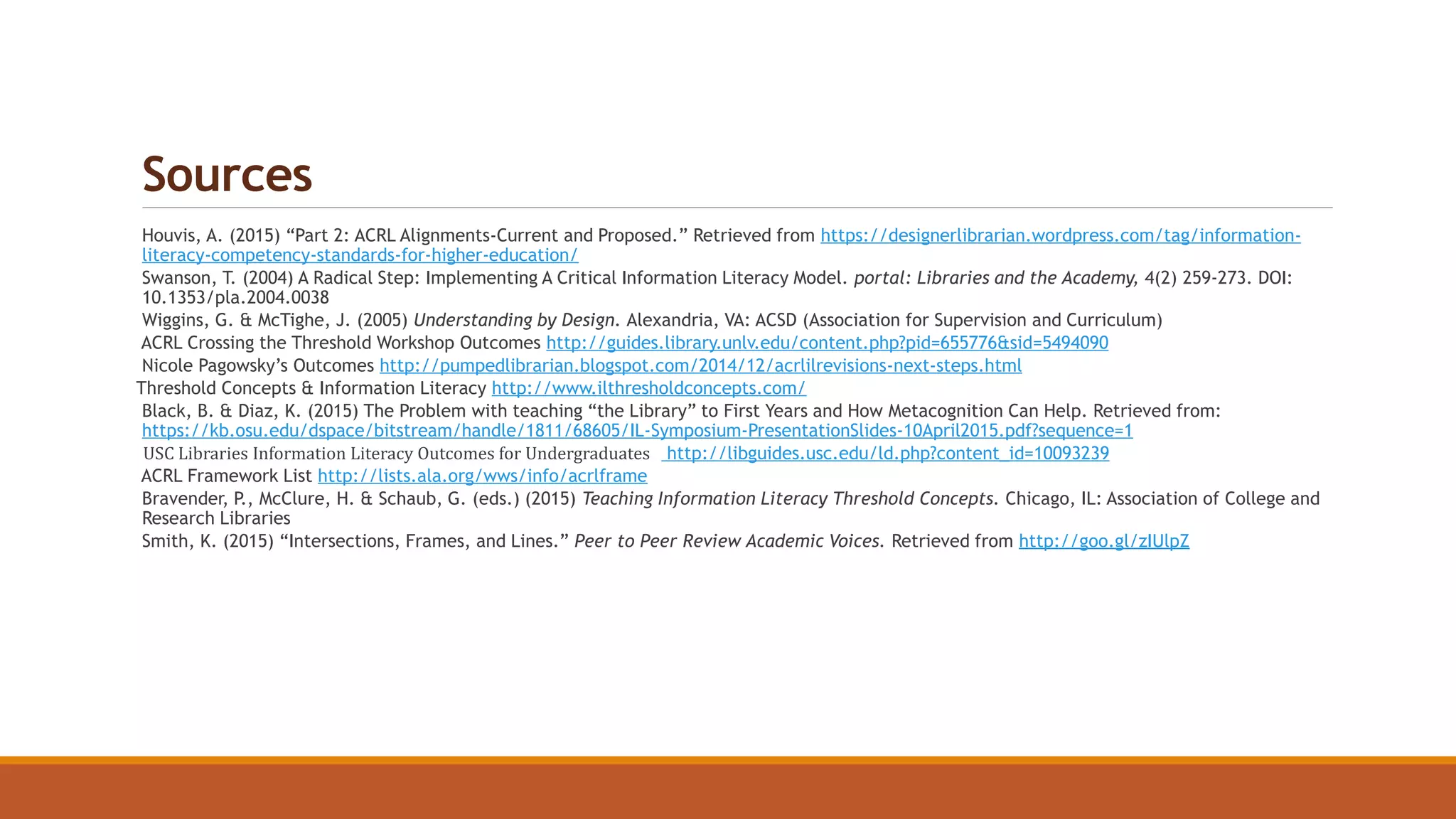
Houvis, A. (2015) “Part 2: ACRL Alignments-Current and Proposed.” Retrieved from https://designerlibrarian.wordpress.com/tag/information-
literacy-competency-standards-for-higher-education/
Swanson, T. (2004) A Radical Step: Implementing A Critical Information Literacy Model. portal: Libraries and the Academy, 4(2) 259-273. DOI:
10.1353/pla.2004.0038
Wiggins, G. & McTighe, J. (2005) Understanding by Design. Alexandria, VA: ACSD (Association for Supervision and Curriculum)
ACRL Crossing the Threshold Workshop Outcomes http://guides.library.unlv.edu/content.php?pid=655776&sid=5494090
Nicole Pagowsky’s Outcomes http://pumpedlibrarian.blogspot.com/2014/12/acrlilrevisions-next-steps.html
Threshold Concepts & Information Literacy http://www.ilthresholdconcepts.com/
Black, B. & Diaz, K. (2015) The Problem with teaching “the Library” to First Years and How Metacognition Can Help. Retrieved from:
https://kb.osu.edu/dspace/bitstream/handle/1811/68605/IL-Symposium-PresentationSlides-10April2015.pdf?sequence=1
USC Libraries Information Literacy Outcomes for Undergraduates http://libguides.usc.edu/ld.php?content_id=10093239
ACRL Framework List http://lists.ala.org/wws/info/acrlframe
Bravender, P., McClure, H. & Schaub, G. (eds.) (2015) Teaching Information Literacy Threshold Concepts. Chicago, IL: Association of College and
Research Libraries
Smith, K. (2015) “Intersections, Frames, and Lines.” Peer to Peer Review Academic Voices. Retrieved from http://goo.gl/zIUlpZ

Teaching & assessment with the acrl framework

  • 1.
    Teaching & Assessingwith the ACRL Framework DIANE FULKERSON UNIVERSITY OF SOUTH FLORIDA SARASOTA-MANATEE PLAN FLA MINI -CONFERENCE GULF COAST STATE COLLEGE SEPTEMBER 11, 2015
  • 2.
  • 3.
    A Threshold Conceptis… •New way to solve problems •An easily grasped lesson for one-shots •A problem encountered by newly weds •Theoretical approach to learning focused on the transformative, educationally critical content of a discipline
  • 4.
    When I define“information literacy” for a non-librarian colleague I… •Tell them it is librarian terminology for research skills •Give them a copy of the ACRL Framework or Standards •Tell them it is a librarian thing •Change the subject
  • 5.
    Teaching with theFramework Do we need to use the Framework? Threshold Concept theory Teaching with the Frames Assessing Instruction
  • 6.
    What is athreshold concept? “A threshold concept can be considered as akin to a portal opening up a new and previously inaccessible way of thinking about something.” --Meyer & Land
  • 7.
    Threshold Concepts are… Transformative—causea shift in perspective Irreversible—once learned cannot be unlearned Integrative—unifies facts/lessons/concepts Bounded—defines the boundaries of a particular discipline Troublesome—counter-intuitive
  • 8.
  • 9.
    New Opportunities Less ismore More flexibility Move away from skills Knowledge based learning/discovery Assignment focused one-shots Explore your options Combine Frames
  • 10.
    Instructional Design Understanding byDesign—Wiggins and McTighe Develop “essential questions” and “understandings” Understandings=Learning Outcomes Use Frames to create “essential questions” Interactive learning Predictable misunderstandings
  • 11.
    Understandings/Learning Outcomes Important inferences—specificand useful generalization Transferable big ideas—enduring value Abstract, counterintuitive, easily misunderstood Developed by “uncovering” and “doing”—realistic Summarizes important strategic principles in skill areas
  • 12.
  • 13.
    Creating a One-ShotClass Three stages of design development are: Desired result is for learners to…(Stage 1) Student evidence of their ability to…(Stage 2) Learning activities need to…(Stage 3) Let’s create a class focused on the Frame-- ◦ Searching as Strategic Exploration ◦ This frame can be used in combination with: ◦ Authority is Constructed and Contextual ◦ Information Creation as Process
  • 14.
    Stage 1 DesiredResult Students can search effectively and efficiently ◦ Develop a search strategy ◦ Use database resources to find other articles ◦ Determine information need ◦ Identify scholarly and non-scholarly sources
  • 15.
    Stage 2 StudentEvidence of Ability to… Develop a search strategy Use search limiters to expand or narrow results Find information from different sources
  • 16.
    Stage 3 LearningActivities Provide students with a search scenario ◦ Ask two questions ◦ What do you know? ◦ Where will you find the information? ◦ Provide an overview of relevant library resources ◦ Ask them to develop a search strategy ◦ Identify a blog/wiki they would use ◦ Evaluate the blog for content/purpose/authority
  • 17.
    Assessment Two questions toask when developing assessment ◦ How will you know students achieved the outcome? ◦ How will students demonstrate they’ve achieved it?
  • 18.
    Assessing our Example Howwould we assess students for Information has Value? ◦ Class discussion/questions asked ◦ For this scenario walk around the classroom ◦ Listen to discussion ◦ Ask students to share their answers to the questions ◦ Formative vs. Summative Assessment
  • 19.
    Assessment Methods Wiggins &McTighe (2005) p.170
  • 20.
    Performance Assessment Examples Researchlog Reflective writing Self or Peer evaluations Open-ended questions Worksheets Concept maps
  • 21.
  • 22.
    Authority is Constructedand Contextual ● Big Questions o What makes someone an authority on a topic? o What are some indicators of authority? o How does bias privilege some sources over others? ● Understandings/Learning Outcomes o Evaluate a source in order to determine if it meets their information need o Define or identify different types of authority o Identify ways authority can limit diverse ideas ● Instruction Activities ○ Provide student with three different sources on the same topic ○ Select different formats for each of the sources ○ Ask them to explain why the articles are authoritative ○ Ask students evaluate/analyze social media posts for a current event and determine why the post is or is not credible ○ Ask students to find movie reviews from different sources and identify biases, authority, and format
  • 23.
    Information Creation asa Process ● Big Questions o Does the format indicate credibility and/or quality? o How does one match information need with the information creation process? o Why was a particular format used? ● Understandings/Learning Outcomes o Distinguish between different formats and their limitations o Identify how the creation process impacts the way the information will be used ● Instruction Activities o Use a Wikipedia article to discuss how information is created o Provide sources in different formats--students will try to determine if they are primary, secondary, or tertiary
  • 24.
    Information has Value ●Big Questions o How can powerful interests use the value of information to marginalize certain interests? o What is the impact of open access publications on the value of information? o Why is it important to cite sources in research? ● Understandings/Learning Outcomes o Explain the value/importance of citing sources o Identify why some groups are marginalized through the production and dissemination of information o Determine how the personal information shared online has value ● Instruction Activities ○ Use the recent court case between the estate of Marvin Gaye and Robin Thicke and have students discuss/explain issues of copyright, plagiarism, and intellectual property. ○ Have students demonstrate how their online information has value to others ○ Identify issues that impact access to information
  • 25.
    Research as Inquiry ●Big Questions o In what ways is research an iterative process? o How does the research need determine the questions to be answered? o How can information gaps be found through the research process? ● Understandings/Learning Outcomes o Students will develop research questions based on information need o Use research questions to identify key concepts to create a search strategy o Apply various research methods based on need and type of inquiry ● Instruction Activities o Use mind mapping software such as Coogle to identify search terms o Ask them to list the type of information and where they would find it to purchase an item such as a car
  • 26.
    Scholarship as Conversation ●Big Questions o How does someone become part of the scholarly conversation? o Why is it important to find more than one perspective about a topic? o How do authority structures limit the ability to enter into the scholarly conversation? ● Understanding/Learning Outcomes o Citing sources in the creation of information o Become a contributor at the appropriate level o Identify the contribution of scholarly materials to disciplinary knowledge ● Instruction Activities o Provide reference page from an article and ask students to find one of the articles listed using the citations provided o Divide students into group and have them search for different types of information then teach other how to find information o Peer review of their evaluation of a scholarly article
  • 27.
    Searching as StrategicExploration ● Big Questions o What role does serendipity play in the search process? o How does the research need determine the type of search strategy to use? o Why is it necessary to search a variety of sources to find the needed information? ● Understandings/Learning Outcomes o Use brainstorming and other techniques when searching o Match information need with search strategy. o Use previous search results to expand or refine search strategies ● Instruction Activities o Concept Maps o Use bibliography to find another source o Jigsaw method to develop a search strategy o Identify the types of sources needed
  • 28.
    Post-Test When a colleagueasks me about information literacy and threshold concepts I will tell them….
  • 29.
    Sources ACRL Framework forInformation Literacy for Higher Education http://www.ala.org/acrl/standards/ilframework Cowan, S.M. (2014) “Information Literacy: The Battle We Won That We Lost? portal: Libraries and the Academy, 14(1), 23-32 Fister, B. (2015) A Bit of a Tall Order. Retrieved from: http://goo.gl/d8vPoN Fister, B. (2015) Standards, Frameworks, and the Work We Need To Do. Retrieved from: http://goo.gl/pf84zr Hofer, A., Brunetti, K. & Townsend, L. (2013) A Thresholds Concepts Approach To The Standards Revision. Communications in Information Literacy, 7(2) 108-113 Knapp, M. & Brower, S. (2014) The ACRL Framework for Information Literacy in Higher Education: Implications for Health Sciences Librarianship. Medical Reference Services Quarterly, 33(4) 460-468. http://dx.doi.org/10.1080/02763869.2014.957098 Launius, C. & Hassel, H. (2015) Threshold Concepts in Women’s and Gender Studies: Ways of Seeing, Thinking, and Knowing. New York, NY: Routledge Meyer, J. & Land, R. (2003) Threshold Concepts and Troublesome Knowledge: Linkages to Ways of Thinking and Practising within the Disciplines. Enhancing Teaching-Learning Environments in Undergraduate Courses Project, Occasional Report 4. Retrieved from: http://www.etl.tla.ed.ac.uk/ Oakleaf, M.(2014) A Roadmap for Assessing Student Learning Using the New Framework for Information Literacy for Higher Education. The Journal of Academic Librarianship, 40(5) 510-514. http://dx.doi.org/10.1016/j.aclib.2014.08.001
  • 30.
    Sources Houvis, A. (2015)“Part 2: ACRL Alignments-Current and Proposed.” Retrieved from https://designerlibrarian.wordpress.com/tag/information- literacy-competency-standards-for-higher-education/ Swanson, T. (2004) A Radical Step: Implementing A Critical Information Literacy Model. portal: Libraries and the Academy, 4(2) 259-273. DOI: 10.1353/pla.2004.0038 Wiggins, G. & McTighe, J. (2005) Understanding by Design. Alexandria, VA: ACSD (Association for Supervision and Curriculum) ACRL Crossing the Threshold Workshop Outcomes http://guides.library.unlv.edu/content.php?pid=655776&sid=5494090 Nicole Pagowsky’s Outcomes http://pumpedlibrarian.blogspot.com/2014/12/acrlilrevisions-next-steps.html Threshold Concepts & Information Literacy http://www.ilthresholdconcepts.com/ Black, B. & Diaz, K. (2015) The Problem with teaching “the Library” to First Years and How Metacognition Can Help. Retrieved from: https://kb.osu.edu/dspace/bitstream/handle/1811/68605/IL-Symposium-PresentationSlides-10April2015.pdf?sequence=1 USC Libraries Information Literacy Outcomes for Undergraduates http://libguides.usc.edu/ld.php?content_id=10093239 ACRL Framework List http://lists.ala.org/wws/info/acrlframe Bravender, P., McClure, H. & Schaub, G. (eds.) (2015) Teaching Information Literacy Threshold Concepts. Chicago, IL: Association of College and Research Libraries Smith, K. (2015) “Intersections, Frames, and Lines.” Peer to Peer Review Academic Voices. Retrieved from http://goo.gl/zIUlpZ