FIRE PROTECTION IN THE
2008 NEW YORK CITY BUILDING CODE
New York Society of Architects
24 January 2008
Presented by
Joseph Razza, PE Rolf Jensen & Associates, Inc.
John Lee, RA NYC Department of Buildings
Copyright © 2007 by NYC Department of Buildings
“The New York Society of Architects” is a Registered
Provider with the American Institute of Architects
Continuing Education Systems. Credit earned on
completion of this program will be reported to CES
Records for AIA members. Certificates of Completion
for non-AIA members are available on request.
This program is registered with the AIA/CES for
continuing professional education. As such, it does not
include content that may be deemed or construed to be
an approval or endorsement by the AIA of any material
of construction or any method or manner of handling,
using, distributing, or dealing in any material or product.
Questions related to specific materials, methods, and
services will be addressed at the conclusion of the
presentation.
Learning Objectives
This forum will discuss in general the fire protection requirements in
the 2008 New York City Building Code in the following areas:
• Participants will be able to understand the various types of fire-resistance-rated
construction required by the code
• Participants will be able to apply fire-resistive and smoke-resistive requirements to
construction practices
• Participants will be able to understand the conditions that require installation of
automatic fire extinguishing systems
• Participants will be able to apply standpipe design standards to building
construction
• Participants will be able to understand the conditions that require installation of fire
alarm systems
• Participants will be able to apply fire alarm system design standards to buidling
construction
Local Law 99 of 2005
Local Law 33 of 2007
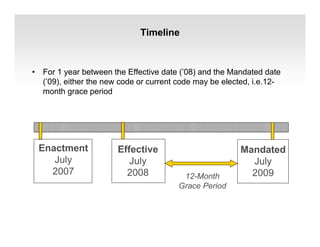
Timeline
• For 1 year between the Effective date (’08) and the Mandated date
(’09), either the new code or current code may be elected, i.e.12-
month grace period
Enactment
July
2007
Mandated
July
2009
Effective
July
2008 12-Month
Grace Period
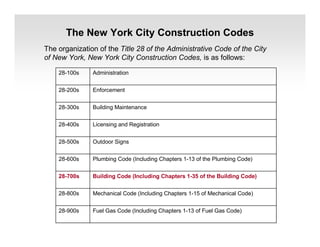
The New York City Construction Codes
The organization of the Title 28 of the Administrative Code of the City
of New York, New York City Construction Codes, is as follows:
Fuel Gas Code (Including Chapters 1-13 of Fuel Gas Code)
28-900s
Mechanical Code (Including Chapters 1-15 of Mechanical Code)
28-800s
Building Code (Including Chapters 1-35 of the Building Code)
28-700s
Plumbing Code (Including Chapters 1-13 of the Plumbing Code)
28-600s
Outdoor Signs
28-500s
Licensing and Registration
28-400s
Building Maintenance
28-300s
Enforcement
28-200s
Administration
28-100s
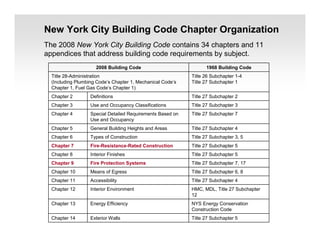
The 2008 New York City Building Code contains 34 chapters and 11
appendices that address building code requirements by subject.
Title 27 Subchapter 5
Exterior Walls
Chapter 14
NYS Energy Conservation
Construction Code
Energy Efficiency
Chapter 13
HMC, MDL, Title 27 Subchapter
12
Interior Environment
Chapter 12
Title 27 Subchapter 4
Accessibility
Chapter 11
Title 27 Subchapter 6, 8
Means of Egress
Chapter 10
Title 27 Subchapter 7, 17
Fire Protection Systems
Chapter 9
Title 27 Subchapter 5
Interior Finishes
Chapter 8
Title 27 Subchapter 5
Fire-Resistance-Rated Construction
Chapter 7
Title 27 Subchapter 3, 5
Types of Construction
Chapter 6
Title 27 Subchapter 4
General Building Heights and Areas
Chapter 5
Title 27 Subchapter 7
Special Detailed Requirements Based on
Use and Occupancy
Chapter 4
Title 27 Subchapter 3
Use and Occupancy Classifications
Chapter 3
Title 27 Subchapter 2
Definitions
Chapter 2
Title 26 Subchapter 1-4
Title 27 Subchapter 1
Title 28-Administration
(Including Plumbing Code’s Chapter 1, Mechanical Code’s
Chapter 1, Fuel Gas Code’s Chapter 1)
1968 Building Code
2008 Building Code
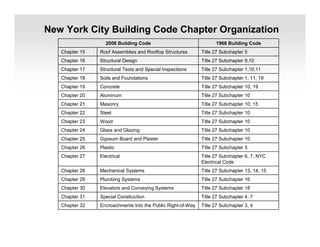
New York City Building Code Chapter Organization
Title 27 Subchapter 3, 4
Encroachments Into the Public Right-of-Way
Chapter 32
Title 27 Subchapter 4, 7
Special Construction
Chapter 31
Title 27 Subchapter 18
Elevators and Conveying Systems
Chapter 30
Title 27 Subchapter 16
Plumbing Systems
Chapter 29
Title 27 Subchapter 13, 14, 15
Mechanical Systems
Chapter 28
Title 27 Subchapter 6, 7, NYC
Electrical Code
Electrical
Chapter 27
Title 27 Subchapter 5
Plastic
Chapter 26
Title 27 Subchapter 10
Gypsum Board and Plaster
Chapter 25
Title 27 Subchapter 10
Glass and Glazing
Chapter 24
Title 27 Subchapter 10
Wood
Chapter 23
Title 27 Subchapter 10
Steel
Chapter 22
Title 27 Subchapter 10, 15
Masonry
Chapter 21
Title 27 Subchapter 10
Aluminum
Chapter 20
Title 27 Subchapter 10, 19
Concrete
Chapter 19
Title 27 Subchapter 1, 11, 19
Soils and Foundations
Chapter 18
Title 27 Subchapter 1,10,11
Structural Tests and Special Inspections
Chapter 17
Title 27 Subchapter 9,10
Structural Design
Chapter 16
Title 27 Subchapter 5
Roof Assemblies and Rooftop Structures
Chapter 15
1968 Building Code
2008 Building Code
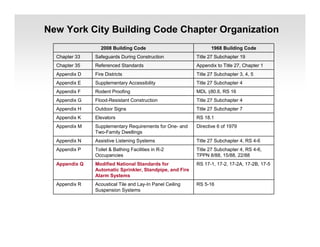
New York City Building Code Chapter Organization
RS 5-16
Acoustical Tile and Lay-In Panel Ceiling
Suspension Systems
Appendix R
RS 17-1, 17-2, 17-2A, 17-2B, 17-5
Modified National Standards for
Automatic Sprinkler, Standpipe, and Fire
Alarm Systems
Appendix Q
Title 27 Subchapter 4, RS 4-6,
TPPN 8/88, 15/88, 22/88
Toilet & Bathing Facilities in R-2
Occupancies
Appendix P
Title 27 Subchapter 4, RS 4-6
Assistive Listening Systems
Appendix N
Directive 6 of 1979
Supplementary Requirements for One- and
Two-Family Dwellings
Appendix M
RS 18.1
Elevators
Appendix K
Title 27 Subchapter 7
Outdoor Signs
Appendix H
Title 27 Subchapter 4
Flood-Resistant Construction
Appendix G
MDL §80.6, RS 16
Rodent Proofing
Appendix F
Title 27 Subchapter 4
Supplementary Accessibility
Appendix E
Title 27 Subchapter 3, 4, 5
Fire Districts
Appendix D
Appendix to Title 27, Chapter 1
Referenced Standards
Chapter 35
Title 27 Subchapter 19
Safeguards During Construction
Chapter 33
1968 Building Code
2008 Building Code
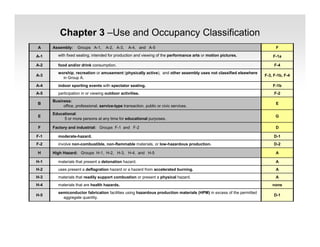
Chapter 3 –Use and Occupancy Classification
D-1
semiconductor fabrication facilities using hazardous production materials (HPM) in excess of the permitted
aggregate quantity.
H-5
none
materials that are health hazards.
H-4
A
materials that readily support combustion or present a physical hazard.
H-3
A
uses present a deflagration hazard or a hazard from accelerated burning.
H-2
A
materials that present a detonation hazard.
H-1
A
High Hazard: Groups H-1, H-2, H-3, H-4, and H-5
H
D-2
involve non-combustible, non-flammable materials, or low-hazardous production.
F-2
D-1
moderate-hazard.
F-1
D
Factory and industrial: Groups F-1 and F-2
F
G
Educational:
5 or more persons at any time for educational purposes.
E
E
Business:
office, professional, service-type transaction, public or civic services.
B
F-2
participation in or viewing outdoor activities.
A-5
F-1b
indoor sporting events with spectator seating.
A-4
F-3, F-1b, F-4
worship, recreation or amusement (physically active), and other assembly uses not classified elsewhere
in Group A.
A-3
F-4
food and/or drink consumption.
A-2
F-1a
with fixed seating, intended for production and viewing of the performance arts or motion pictures.
A-1
F
Assembly: Groups A-1, A-2, A-3, A-4, and A-5
A
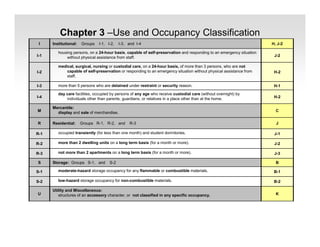
Chapter 3 –Use and Occupancy Classification
K
Utility and Miscellaneous:
structures of an accessory character, or not classified in any specific occupancy.
U
B-2
low-hazard storage occupancy for non-combustible materials.
S-2
B-1
moderate-hazard storage occupancy for any flammable or combustible materials.
S-1
B
Storage: Groups S-1, and S-2
S
J-3
not more than 2 apartments on a long term basis (for a month or more).
R-3
J-2
more than 2 dwelling units on a long term basis (for a month or more).
R-2
J-1
occupied transiently (for less than one month) and student dormitories.
R-1
J
Residential: Groups R-1, R-2, and R-3
R
C
Mercantile:
display and sale of merchandise.
M
H-2
day care facilities, occupied by persons of any age who receive custodial care (without overnight) by
individuals other than parents, guardians, or relatives in a place other than at the home.
I-4
H-1
more than 5 persons who are detained under restraint or security reason.
I-3
H-2
medical, surgical, nursing or custodial care, on a 24-hour basis, of more than 3 persons, who are not
capable of self-preservation or responding to an emergency situation without physical assistance from
staff.
I-2
J-2
housing persons, on a 24-hour basis, capable of self-preservation and responding to an emergency situation
without physical assistance from staff.
I-1
H, J-2
Institutional: Groups I-1, I-2, I-3, and I-4
I
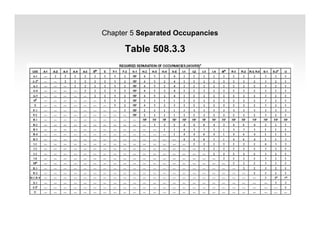
Chapter 5 Separated Occupancies
Table 508.3.3
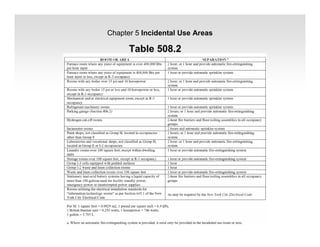
Chapter 5 Incidental Use Areas
Table 508.2
Chapter 7
Fire-Resistance Rated Construction
Chapter 7 – Fire-Resistance Rated Construction
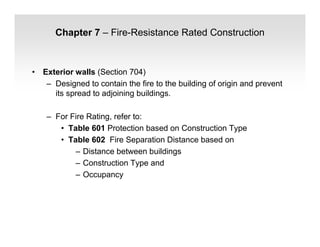
• Exterior walls (Section 704)
– Designed to contain the fire to the building of origin and prevent
its spread to adjoining buildings.
– For Fire Rating, refer to:
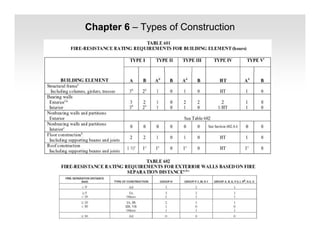
• Table 601 Protection based on Construction Type
• Table 602 Fire Separation Distance based on
– Distance between buildings
– Construction Type and
– Occupancy
Chapter 6 – Types of Construction
Chapter 7 – Fire-Resistance Rated Construction
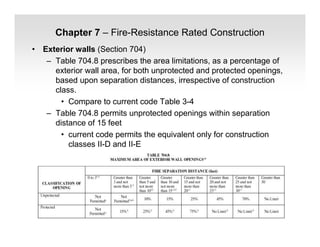
• Exterior walls (Section 704)
– Table 704.8 prescribes the area limitations, as a percentage of
exterior wall area, for both unprotected and protected openings,
based upon separation distances, irrespective of construction
class.
• Compare to current code Table 3-4
– Table 704.8 permits unprotected openings within separation
distance of 15 feet
• current code permits the equivalent only for construction
classes II-D and II-E
Chapter 7 – Fire-Resistance Rated Construction
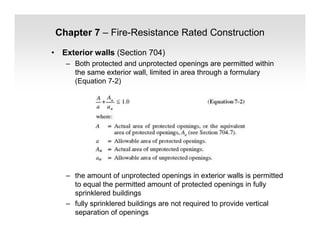
• Exterior walls (Section 704)
– Both protected and unprotected openings are permitted within
the same exterior wall, limited in area through a formulary
(Equation 7-2)
– the amount of unprotected openings in exterior walls is permitted
to equal the permitted amount of protected openings in fully
sprinklered buildings
– fully sprinklered buildings are not required to provide vertical
separation of openings
Chapter 7 – Fire-Resistance Rated Construction
Elements of Fire and Smoke Separation
• Fire Separation of Occupied Spaces
– FIRE WALL
– FIRE BARRIER
– FIRE PARTITION
• Smoke Separation of Occupied Spaces
– SMOKE BARRIER
– SMOKE PARTITION
• Separation of Concealed Spaces
– FIRESTOPPING
– FIREBLOCKING
– DRAFT STOP
Chapter 7 – Fire-Resistance Rated Construction
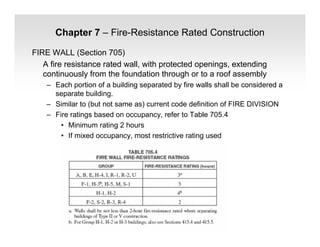
FIRE WALL (Section 705)
A fire resistance rated wall, with protected openings, extending
continuously from the foundation through or to a roof assembly
– Each portion of a building separated by fire walls shall be considered a
separate building.
– Similar to (but not same as) current code definition of FIRE DIVISION
– Fire ratings based on occupancy, refer to Table 705.4
• Minimum rating 2 hours
• If mixed occupancy, most restrictive rating used
Chapter 7 – Fire-Resistance Rated Construction
FIRE WALL (Section 705)
MATERIALS
– Materials are non-combustible
• Only Exception: Type V Construction
OPENINGS
– Unsprinklered buildings
• Each opening shall not exceed 120 sq ft
• Aggregate width of openings at any floor level not to exceed 25% of
length of wall
– Both buildings sprinklered
• Individual openings not limited to 120 sq ft
• Aggregate width of openings at any floor level not to exceed 25% of
length of wall
Chapter 7 – Fire-Resistance Rated Construction
FIRE WALL (Section 705)
PARTY WALLS
– All party walls, which are built on property lines between
adjoining buildings, are to be constructed as fire walls
(Section 503.2)
– Attached one-and two-family dwellings shall be separated by
walls constructed in accordance with Section 705 or
Appendix M (one- and two-family dwellings not more than 3
stories in height)
Chapter 7 – Fire-Resistance Rated Construction
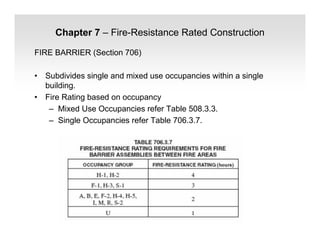
FIRE BARRIER (Section 706)
• Subdivides single and mixed use occupancies within a single
building.
• Fire Rating based on occupancy
– Mixed Use Occupancies refer Table 508.3.3.
– Single Occupancies refer Table 706.3.7.
Chapter 7 – Fire-Resistance Rated Construction
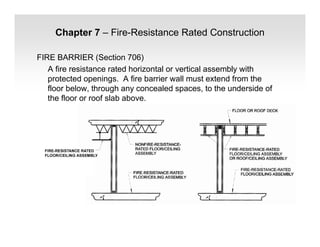
FIRE BARRIER (Section 706)
A fire resistance rated horizontal or vertical assembly with
protected openings. A fire barrier wall must extend from the
floor below, through any concealed spaces, to the underside of
the floor or roof slab above.
Chapter 7 – Fire-Resistance Rated Construction
FIRE BARRIER (Section 706)
• Both vertical and Horizontal Continuity
• Vertical
– Continuous from top of fire rated floor/ceiling assembly below
to underside of floor/roof assembly above
– No circumstances where top of a fire barrier is permitted to
terminate at ceiling level
– Hollow spaces firestopped at every floor level
• Horizontal
– Continuous without openings except as permitted
Chapter 7 – Fire-Resistance Rated Construction
FIRE BARRIER (Section 706)
• For separating
– Fire Areas
– Public corridors
– Incidental Use Areas
– Shafts
– Hazardous Material Control Areas
Chapter 7 – Fire-Resistance Rated Construction
FIRE BARRIER (Section 706)
Hazardous Materials Control Area
• Design alternative for handling HM
• Enclosed spaces within a building bounded by exterior walls, fire
walls, fire barriers, roofs and/or a combination thereof
– Compartmentation and separation of HM’s into pre-defined
quantities based on properties and physical/health hazards as
per Table 307.1 &2
• Permits non-hazard occupancies to keep their occupancy
designation without being classified as H
Chapter 7 – Fire-Resistance Rated Construction
• Shaft enclosures (Section 707)
– shaft enclosure materials as permitted by the building type of
construction,
• except Groups I-1, R-1 and R-2 buildings require shafts of
noncombustible materials.
– 2-hour fire-resistance rating required, or 1 hour if connecting
fewer than 4 stories
– Impact resistant stair and elevator shaft requirement for high-rise
buildings of any occupancy
Chapter 7 – Fire-Resistance Rated Construction
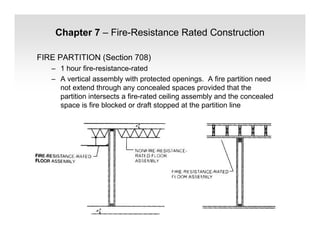
FIRE PARTITION (Section 708)
– 1 hour fire-resistance-rated
– A vertical assembly with protected openings. A fire partition need
not extend through any concealed spaces provided that the
partition intersects a fire-rated ceiling assembly and the concealed
space is fire blocked or draft stopped at the partition line
Chapter 7 – Fire-Resistance Rated Construction
FIRE PARTITION (Section 708)
• For separating
– Interior corridors
– Tenant separations in fully sprinklered covered mall buildings
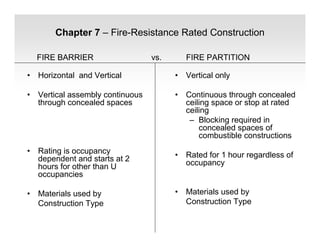
Chapter 7 – Fire-Resistance Rated Construction
FIRE BARRIER vs. FIRE PARTITION
• Horizontal and Vertical
• Vertical assembly continuous
through concealed spaces
• Rating is occupancy
dependent and starts at 2
hours for other than U
occupancies
• Materials used by
Construction Type
• Vertical only
• Continuous through concealed
ceiling space or stop at rated
ceiling
– Blocking required in
concealed spaces of
combustible constructions
• Rated for 1 hour regardless of
occupancy
• Materials used by
Construction Type
Chapter 7 – Fire-Resistance Rated Construction
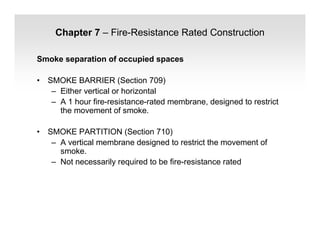
Smoke separation of occupied spaces
• SMOKE BARRIER (Section 709)
– Either vertical or horizontal
– A 1 hour fire-resistance-rated membrane, designed to restrict
the movement of smoke.
• SMOKE PARTITION (Section 710)
– A vertical membrane designed to restrict the movement of
smoke.
– Not necessarily required to be fire-resistance rated
Chapter 7 – Fire-Resistance Rated Construction
SMOKE BARRIER (Section 709)
• Create ‘smoke compartments’
as horizontal areas of refuge in
special use buildings covered
in Chapter 4
– I-2 – hospitals, nursing
homes
– I-3 - prisons, jails,
detention centers
– Underground buildings –
building spaces for human
occupancy more than 30 ft
below lowest level of exit
discharge
SMOKE BARRIER, WALL SECTION
Chapter 7 – Fire-Resistance Rated Construction
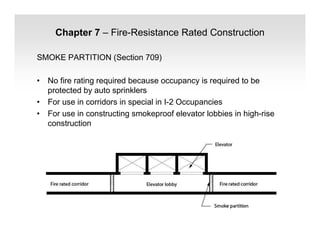
SMOKE PARTITION (Section 709)
• No fire rating required because occupancy is required to be
protected by auto sprinklers
• For use in corridors in special in I-2 Occupancies
• For use in constructing smokeproof elevator lobbies in high-rise
construction
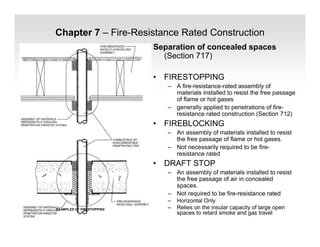
Chapter 7 – Fire-Resistance Rated Construction
Separation of concealed spaces
(Section 717)
• FIRESTOPPING
– A fire-resistance-rated assembly of
materials installed to resist the free passage
of flame or hot gases
– generally applied to penetrations of fire-
resistance rated construction (Section 712)
• FIREBLOCKING
– An assembly of materials installed to resist
the free passage of flame or hot gases.
– Not necessarily required to be fire-
resistance rated
• DRAFT STOP
– An assembly of materials installed to resist
the free passage of air in concealed
spaces.
– Not required to be fire-resistance rated
– Horizontal Only
– Relies on the insular capacity of large open
spaces to retard smoke and gas travel
EXAMPLES OF FIRESTOPPING
Chapter 7 – Fire-Resistance Rated Construction
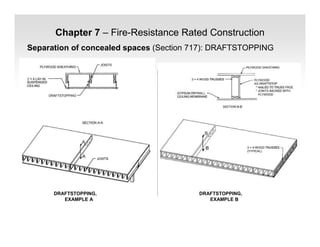
Separation of concealed spaces (Section 717): DRAFTSTOPPING
DRAFTSTOPPING,
EXAMPLE A
DRAFTSTOPPING,
EXAMPLE B
Chapter 9
Fire Protection Systems
Chapter 9
Fire Protection Systems
• Sprinkler Systems
• Alternative Systems
• Standpipe Systems
• Fire Alarm Systems
• Carbon Monoxide Alarms
• Smoke Control Systems
• Post-Fire Smoke Purge Systems
Section 903 Automatic Sprinkler Systems
As per the DOB’s summary of the NYC’s New Construction Code:
•This section is organized by Occupancy Group and establishes
the conditions that require installation of an automatic sprinkler
system, based upon occupant load, fire area and building area.
•For nearly all Occupancy Groups, this section is more
restrictive than the current code and will require sprinkler
systems in spaces and buildings where such systems are
currently not required.
Section 903 Automatic Sprinkler Systems
•This section also the provides the requirements for locations that
are exempt from the provisions of this section and are protected
by alternative fire extinguishing systems. The current code does
not provide an equivalent provision, although alternative systems
have been approved for use in New York City in the past. This
section codifes the practice.
•This section requires all residential occupancies to be equipped
with an automatic sprinkler system, with exceptions for one- and
two-family homes and townhouses. The current code requires
sprinkler systems only in residential occupancies J-1 and J-2 and
does not extend the requirement to all residential occupancies.
Section 903 Automatic Sprinkler Systems
•This section provides specific locations for quick-response
automatic sprinklers in spaces and buildings that require
automatic sprinkler system protection. The equivalent does not
appear in the current code.
•This section requires high rise buildings to provide secondary
on-site water supply equal to the hydraulically calculated
sprinkler demand. The equivalent does not appear in the current
code.
•All other provisions of this section are equivalent to the current
code.
Section 903 Automatic Sprinkler Systems
Sprinkler systems
Where required - Section 903
Based on:
• Building Use Group/size
– i.e. Use Group A-1, A-3 or A-4 exceeding 12,000
s.f.
– or O.L. = 300 or more
– or fire area on floor other than level of exit
discharge
• Specific occupancies
– i.e. high-rise, atrium, underground structures
• To meet height/area for desired construction type per
Chapter 5
Section 903 Automatic Sprinkler Systems
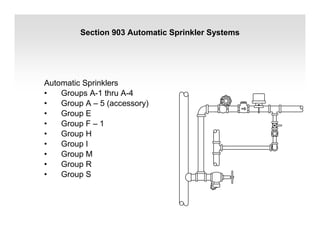
Automatic Sprinklers
• Groups A-1 thru A-4
• Group A – 5 (accessory)
• Group E
• Group F – 1
• Group H
• Group I
• Group M
• Group R
• Group S
Section 903 Automatic Sprinkler Systems
Automatic sprinkler system required for:
Assembly Groups A-1, A-2, A-3 and A-4 occupancies, throughout the
floor area where located, and in all floors between the Group A
occupancy and the level of exit discharge where:
• Fire area > 12,000 sq. ft. (5,000 sq. ft. in A-2).
• Fire area has an occupant load of 300 or more.
• The aggregate occupant load of all fire areas by Group A, located
on any given floor other than level of exit discharge, is 300 or more.
• Group A-1 fire area contains a multi-theater complex.
• Group A-2 occupancy used as a cabaret.
Section 903 Automatic Sprinkler Systems
Automatic sprinkler system required in all enclosed
areas of Assembly Group A-5 (outdoor assembly)
structures including but not limited to:
• Concession concourse and stands
• Retail areas
• Press Boxes
• Other accessory areas in excess of 1,000 sq. ft.
Section 903 Automatic Sprinkler Systems
Automatic sprinkler system required for
Educational Group E (through 12th grade)
• Throughout all Group E fire areas greater than 20,000 sq. ft.
• Throughout every portion of educational buildings below level
of exit discharge
Section 903 Automatic Sprinkler Systems
Automatic sprinkler system required throughout all buildings
containing a Group F occupancy where any one of the
following conditions exists:
• Group F-1 fire area exceeds 12,000 sq. ft.;
• Group F-1 fire area is located more than 3 stories above
grade; or
• Combined area of all Group F-1 fire areas on all floors,
including mezz., exceeds 24,000 sq. ft.; or
• Where required by Section 280 of NYS Labor Law.
Section 903 Automatic Sprinkler Systems
Automatic sprinkler system required throughout any
Group F-1 fire area where any one of the following
conditions exists:
• The fire area exceeds 7,500 sq. ft.
• The fire area of any size is located more than 3 stories above
grade.
Section 903 Automatic Sprinkler Systems
Automatic sprinkler system required throughout
buildings containing a Groups M occupancy where
any one of the following conditions exists:
• Group M fire area exceeds 12,000 sq. ft.
• Combined area of all Group M fire areas on all floors,
including mezz., exceeds 24,000 sq. ft.
Section 903 Automatic Sprinkler Systems
Automatic sprinkler system required throughout
any Group M occupancy fire area where any one of
the following conditions exists:
• Fire area exceeds 7,500 sq. ft.
• Fire area of any size is located more than 3 stories above
grade.
• Fire area of any size is located in a high-rise building.
• Fire area of any size contains an unenclosed stair or
escalator connecting two or more floors.
Section 903 Automatic Sprinkler Systems
Automatic sprinkler system required throughout all
buildings containing a Group S-1 occupancy where
any one of the following conditions exists:
• Group S-1 fire area exceeds 12,000 sq. ft.
• The building is greater than 1,000 sq. ft. in area, and the
main use or dominant occupancy is Group S-1.
• The combined area of all S-1 fire areas on all floors, including
mezz., exceeds 24,000 sq. ft.
Section 903 Automatic Sprinkler Systems
Automatic sprinkler system required throughout any
Group S-1 occupancy fire area where any one of the
following conditions exists:
• The fire area exceeds 500 sq. ft.
• The fire area of any size is located more than 3 stories above
grade.
Section 903 Automatic Sprinkler Systems
Automatic sprinkler system required throughout
buildings greater than 5,000 sq. ft. in area where the
main use or dominant occupancy is Group S-2, and
throughout:
• Commercial parking garages greater than 5,000 sf. used for
storage of commercial trucks or buses.
• Group S-2 occupancy fire area greater than 5,000 sq. ft.
• Enclosed parking garages and where an open or enclosed
garage is located beneath other groups.
Section 903 Automatic Sprinkler Systems
Automatic sprinkler system required throughout
all occupancies and buildings with a main use or
dominant occupancy of:
• High-Hazard Group H occupancies
• Institutional Group I fire area
• Residential Group R fire area
• Exception: Detached one- and two-family dwellings and
multiple single-family dwellings (townhouses), provided
such structures are not more than 3 stories above grade
plane and have separate means of egress.
Section 903 Automatic Sprinkler Systems
Buildings Over 55 Feet in Height
Automatic sprinkler system required throughout buildings
with a floor level having an occupant load of 30 or more that
is located 55 feet or more above the lowest level of fire
department vehicle access.
Section 903 Automatic Sprinkler Systems
Additional Required Suppression Systems
Covered malls Special amusement buildings
High-rise buildings Group H-2
Atriums Flammable Finishes
Underground buildings Unlimited area buildings
Group I-2 NFPA 13 as modified for NYC
Stages
Section 903 Automatic Sprinkler Systems
Sprinkler systems designed, installed and
maintained in accordance with:
• NFPA 13 – 2002, as modified for NYC
• NFPA 13R – 2002, as modified for NYC
• NFPA 13D – 2002, as modified for NYC
Testing and maintenance per NYC Fire Code
Section 903 Automatic Sprinkler Systems
Where automatic sprinkler systems are required, Quick-
response and residential sprinklers are required to be
installed in the following areas:
• Throughout all spaces within a smoke compartment containing
patient dwelling units in Group I-2.
• Dwelling units in Group R and I-1 occupancies.
• Light hazard occupancies as defined by NFPA 13.
Section 903 Automatic Sprinkler Systems
SECTION 903.5.2 Secondary Water Supply
A secondary on-site water supply equal to the hydraulically calculated
sprinkler demand, including the hose stream requirement, shall be
provided for high-rise buildings in Seismic Design Category C or D as
determined by this code, and in any high-rise building greater than
300 feet in height. The secondary water supply shall have a duration
not less than 30 minutes as determined by the occupancy hazard
classification in accordance with NFPA 13.
Section 904 Alternative Automatic Fire Extinguishing Systems
Automatic fire-extinguishing systems, other than automatic
sprinkler systems, shall be designed, installed, inspected, tested
and maintained in accordance with the provisions of the New
York City Fire Code and the applicable reference standards.
Except: Commercial cooking systems are required to be
protected by carbon dioxide extinguishing systems or wet-
chemical extinguishing systems
Section 904 Alternative Automatic Fire Extinguishing Systems
Standards as per the NYC Fire Code:
• Dry-chemical NFPA 17
• Wet-chemical NFPA 17A
• Foam systems NFPA 11 and NFPA 16
• Carbon dioxide NFPA 12
• Halon systems NFPA 12A
• Clean-agent NFPA 2001
• Water-mist NFPA 750
Section 905 Standpipe Systems
This section provides the conditions under which standpipe
systems are required for buildings and the locations for hose
connections. This section permits combined standpipe
systems for all installations. The current code only permits
such systems for certain buildings. This is an improvement
that resolves a peculiarity of the current code.
Standpipe systems shall be installed in accordance with this
section and NFPA 14 as modified in Appendix Q.
Standpipe systems are permitted to be combined with automatic
sprinkler systems.
Section 905 Standpipe Systems
Applicability. Standpipe systems shall be installed throughout
the following buildings:
- Buildings 2 stories or more in height with floor area of 10,000
sq. ft. or greater on any story;
- Buildings 3 stories or more in height with floor area of 7,500
sq. ft. or greater on any story;
- Buildings of any area with a floor level having an occupant
load of 30 or more that is located 55 feet or more above the
lowest level of fire department vehicle access.
- Buildings of any area, constructed in accordance with
Section 403 (High Rise), with occupied floors located 75 feet
or more above the lowest level of fire department vehicle
access.
Section 905 Standpipe Systems
Applicability. Standpipe systems shall be installed throughout
the following buildings:
- Nonsprinklered Group A buildings having an occupant load
exceeding 1,000 persons.
- Covered mall buildings
- Stages
- Underground buildings
- Helistops and heliports
Section 907 Fire Alarm and Detection Systems
907.1 General. This section covers the application, installation,
performance and maintenance of fire alarm systems and their
components. Systems shall be designed and installed in
accordance with NFPA 72 as modified in Appendix Q and the
New York City Electrical Code.
Section 907 Fire Alarm and Detection Systems
As per the DOB’s summary of the NYC’s New Construction Code:
•This section is organized by Occupancy Group and establishes
the conditions that require installation of fire alarm systems,
based upon occupant load, fire area and building area.
•For nearly all Occupancy Groups, this section is more
restrictive than the current code and will require fire alarm
systems in spaces and buildings where such systems are
currently not required.”
Section 907 Fire Alarm and Detection Systems
• New Code requires mechanical and electrical equipment rooms
of any size to be equipped with smoke detectors connected to a
fire alarm system vs. current (only if the room is greater than 75
sq. ft.)
• New Code requires smoke detectors to be installed in elevator
lobbies.
Section 907 Fire Alarm and Detection Systems
907.1 Construction Documents shall include, but not be
limited to, all of the following:
1. A floor plan that indicates the use of all rooms.
2. Locations of alarm-initiating and notification appliances.
3. Alarm control and trouble signaling equipment.
4. Annunciation.
5, Power connection.
6. Fire alarm riser diagram and all fire alarm devices indicated
on the floor plans. Quantities of devices on the floor plans
shall match the quantities indicated on the riser diagram.
Section 907 Fire Alarm and Detection Systems
907.1 Construction Documents shall include, but not
be limited to, all of the following: (continued)
7. Copies of any variances granted by the department or the Fire
Department.
8. Legend of all fire alarm symbols and abbreviations.
9. Design criteria for fire alarm audibility in various occupancies
indicated on plans.
10. Fire alarm sequence of operation for the fire alarm control
panel and the central station transmitter.
11. The interface of fire safety control functions.
Section 907 Fire Alarm and Detection Systems
Where required:
– Section 907.2.Fire alarm & detection
Based on:
• Building use group/size
– i.e. Alarm in Use Group B with O.L. > 500…
• Specific occupancies
– i.e. high-rise, smoke control systems, underground
structures
71
Section 907 Fire Alarm and Detection Systems
Fire Detection and Alarm
• Group A
• Group B
• Group E
• Group F
• Group H
• Group I
• Group M
• Group R – 1 and R –2
Section 907 Fire Alarm and Detection Systems
Fire Detection and Alarm
• High rise buildings
• Buildings with an atrium
• Covered mall buildings
• Underground buildings
• Special amusement buildings
• Others
907.2 Where required. An approved manual, automatic or manual
and automatic fire alarm system shall be provided in accordance
with Sections 907.2.1 through 907.2.21. Where automatic sprinkler
protection is provided and connected to the building fire alarm
system, automatic heat detection required by this section shall not
be require. An approved automatic fire detection system shall be
installed in accordance with the provisions of this code, the New
York City Mechanical Code, and NFPA 72…
Section 907 Fire Alarm and Detection Systems
907.2 (continued) In all occupancies where an automatic fire alarm
system is required by this section, selective coverage smoke
detectors shall be located as follows, unless partial or total coverage
automatic detection is specified:
1. In each mechanical equipment, electrical, transformer,
telephone equipment or similar room, in elevator machine rooms,
and in elevator lobbies.
2. In air distribution systems in accordance with Section 606 of the
New York City Mechanical Code.
Section 907 Fire Alarm and Detection Systems
A manual and automatic fire alarm system shall be
installed in:
• Group A with occupant load of 300 or more
• Group B and M with an occupant load of 500 or more
persons, or more than 100 persons above or below lowest
level of exit discharge
• Group E occupancies
• Group F occupancies that are 2 or more stories in height and
have an occupant load of [500] 100 or more, or when 25
persons or more are above or below lowest level of exit
discharge
Section 907 Fire Alarm and Detection Systems
A manual and automatic fire alarm system shall be
installed in:
• High-Hazard Group H
• Institutional Group I
• Mercantile Group M
• Residential Group R
Section 907 Fire Alarm and Detection Systems
Smoke detectors within dwelling units in R-1 occupancies
Smoke detectors and audible notification appliances shall be installed
in dwelling units and shall be annunciated by dwelling unit at a
constantly attended location from which the fire alarm system is
capable of being manually activated. Smoke detectors are required in
the following areas:
1. In sleeping areas.
2. In every room in the path of means of egress from the sleeping area
to the door leading from the dwelling unit.
3. In each story within a dwelling unit, including below-grade stories.
Section 907 Fire Alarm and Detection Systems
Group R-2
An automatic fire alarm system without alarm notification in Group R-2
occupancies, other than student apartments.
Actuation of smoke detectors shall not initiate a signal to alarm
notification appliances. The activation of any detector shall initiate a
signal at a central station or a constantly attended location. Smoke
detectors located as follows:
1. Mechanical equipment, electrical, transformer, telephone equipment
or similar room greater than 75 sq. ft.
2. In air distribution systems per NYC Mechanical Code.
3. In elevator machine rooms and in elevator lobbies.
Section 907 Fire Alarm and Detection Systems
Group R-2 student apartments
Where the main use of dominant occupancy of a building is classified
as R-2 student apartment, fire alarm system shall be installed in
accordance with the requirements for R-1 occupancies.
Where the main use or dominant occupancy of a building is not
classified as R-2 student apartments and the building is occupied
partially by Group R-2 student apartments:
Manual fire alarm system installed throughout all public corridors
serving student apartments and student related uses including
recreation rooms, lounges, dining rooms, laundry rooms and storage
rooms.
Section 907 Fire Alarm and Detection Systems
Single- and Multiple-Station Smoke Alarms
Required in Groups R-2, R-3 and I-1 located as follows:
1.On the ceiling or wall outside of each room used for sleeping
purposes within 15 feet from the door to room.
2.In each room used for sleeping purposes.
3.In each story within a dwelling unit, including below-grade stories and
penthouses of any area.
Where more than one smoke alarm or detector is required to be
installed within an individual dwelling unit, the smoke alarms or
detectors shall be interconnected in such a manner that activation of
one alarm activates all alarms.
Section 907 Fire Alarm and Detection Systems
An emergency voice/alarm communications
system required in:
• Group A occupancies with an occupant load of 1,000 or more
• Special amusement buildings
• High-rise buildings
• Atriums
• Covered mall buildings
Section 907 Fire Alarm and Detection Systems
Emergency voice/alarm communications system
Operation of initiating devices shall automatically sound an alarm
tone followed by live voice instructions giving approved information
and directions on a general or selective basis to the following areas
on a minimum of the alarming floor, floor above and floor below:
1.Elevator lobbies.
2.Corridors.
3.Rooms and tenant spaces exceeding 1,000 sq. ft.
4.Dwelling units in R-1 occupancies.
5.Areas of rescue assistance.
Section 907 Fire Alarm and Detection Systems
Emergency voice/alarm communications system
Exceptions:
1. Group I-1 and I-2 occupancies.
2. Group R-2 occupancies 125 feet or less in height.
3. Group R-2 occupancies greater than 125 feet.
Section 908 – Emergency Alarm Systems
This section provides the requirements for:
• Emergency alarms to detect and notify of emergency
conditions in Group H occupancies.
• Emergency alarms in a Hazardous Production Material
facility.
• Gas detection systems in spaces storing or using highly toxic
and toxic gases.
• Gas detection systems in ozone gas-generator rooms.
Section 908 – Emergency Alarm Systems
(continued):
• Flammable-gas detection systems in repair garages.
• Refrigerant detector with an audible and visual alarm in
machinery rooms.
Incorporates the location and installation requirements
for carbon monoxide alarms to an equivalent extent as
the current code as amended by Local Law #7/2004.
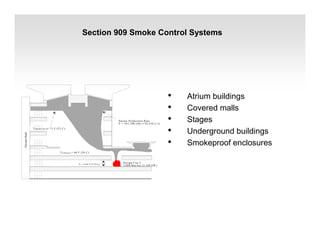
Section 909 Smoke Control Systems
• Atrium buildings
• Covered malls
• Stages
• Underground buildings
• Smokeproof enclosures
D esign Fire 2
2,000 B tu/sec (2,108 kW )
Elevator
Shaft
Z = 9.66 ft (2.94 m )
l
Sm oke Production R ate
V = 261,500 cfm (124,430 L/s)
T = 68 F (20 C )
am bient
T = 71 F (22 C ).
sm oke layer
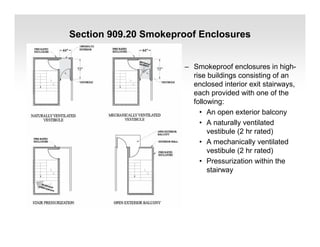
Section 909.20 Smokeproof Enclosures
– Smokeproof enclosures in high-
rise buildings consisting of an
enclosed interior exit stairways,
each provided with one of the
following:
• An open exterior balcony
• A naturally ventilated
vestibule (2 hr rated)
• A mechanically ventilated
vestibule (2 hr rated)
• Pressurization within the
stairway
Section 912 Post-fire Smoke Purge Systems
Required in:
• High-rise buildings subject to Section 403
• Buildings with any story exceeding 50,000 sq. ft.
• Buildings with spaces exceeding 100 feet from natural
ventilation openings.
• High piled stock or rack storage in accordance with the NYC
Fire Code.
Section 912 Post-fire Smoke Purge Systems
As per the DOB’s summary of the NYC’s New Construction Code:
•This section provides the requirements for the design and
installation of post-fire smoke purge systems intended for the
timely restoration of operations and overhaul activities once a
fire has been extinguished. This section is equivalent to the
current code, with the exception that R-2 occupancies are not
required to provide a smoke purge system if the building is
provided with smokeproof enclosures.
Appendix Q – Modified National Standards for Automatic Sprinkler,
Standpipe, and Fire Alarm Systems
Q101 Scope. This appendix provides the modifications to
the nationally recognized standards NFPA 13, NFPA 13D,
NFPA 13R, NFPA 14 and NFPA 72, governing the installation
and maintenance requirements of automatic sprinkler,
standpipe and hose systems, and fire alarm systems.
Appendix Q – Modified National Standards for Automatic Sprinkler,
Standpipe, and Fire Alarm Systems
Q102. Installation of Sprinkler Systems.
Provides the NYC modifications of the nationally recognized
standard NFPA 13 Standard for the Installation of Sprinkler
Systems, 2002 edition. The current code references
ANSI/NFiPA No. 13 – 1989, Standard for the Installation of
Sprinkler Systems. Though the majority of the modifications
are equivalent in scope, the referenced standard in this
section is up-to-date and more relevant to current
technologies and practices
Appendix Q – Modified National Standards for Automatic Sprinkler,
Standpipe, and Fire Alarm Systems
Q102. Installation of Sprinkler Systems.
The requirements for sprinklers in commercial cooking
applications are deleted in their entirety from NFPA 13 since
the proposed code does not permit the use of water sprinkler
systems in such applications. The current code permits
such system in the modifications of ANSI/NFiPA No. 13.
Appendix Q – Modified National Standards for Automatic Sprinkler,
Standpipe, and Fire Alarm Systems
Q102. Installation of Sprinkler Systems.
The current code modifications to ANSI/NFiPA No. 13 require
approval by the Department of specified devices and
systems. The modifications to NFPA 13 by the proposed
code do not require Department approval and wholly accept
devices and systems listed for their use by nationally
recognized testing entities.
Appendix Q – Modified National Standards for Automatic Sprinkler,
Standpipe, and Fire Alarm Systems
Q103. Installation of Sprinkler Systems in One- and Two-
Family Dwellings and Manufactured Homes
Provides the NYC modifications of the nationally recognized
standard NFPA 13D, Standard for the Installation of Sprinkler
Systems in One- and Two-Family Dwellings and
Manufactured Homes, 2002 edition. The current code
references ANSI/NFiPA No. 13 – 1994, Standard for the
Installation of Sprinkler Systems in One- and Two-Family
Dwellings and Manufactured Homes. Though the majority of
the modifications are equivalent in scope, the referenced
standard in this section is up-to-date and more relevant to
current technologies and practices.
Appendix Q – Modified National Standards for Automatic Sprinkler,
Standpipe, and Fire Alarm Systems
Q104. Installation of Sprinkler Systems in Residential
Occupancies up to and Including Six Stories in Height
Provides the NYC modifications of the nationally recognized
standard NFPA 13R, Standard for the Installation of Sprinkler
Systems in Residential Occupancies up to and Including
Four Stories in Height, 2002 edition. The current code
references ANSI/NFiPA No. 13R – 1994, Standard for the
Installation of Sprinkler Systems in Residential Occupancies
up to and Including Four Stories in Height. Though the
majority of the modifications are equivalent in scope, the
referenced standard in this section is up-to-date and more
relevant to current technologies and practices.
Appendix Q – Modified National Standards for Automatic Sprinkler,
Standpipe, and Fire Alarm Systems
Q105. Installation of Standpipe and Hose Systems
Provides the NYC modifications of the nationally recognized
standard NFPA 14, Standard for the Installation of Standpipe
and Hose Systems, 2003 edition. The current code does not
modify a nationally recognized standard, and instead
provides requirements in Subchapter 17 of the Building Code
and the Reference Standards. Furthermore, systems and
devices that are listed in accordance with this standard are
permitted as-of-right and do not require Department approval
as per the current code.
Appendix Q – Modified National Standards for Automatic Sprinkler,
Standpipe, and Fire Alarm Systems
Q105. Installation of Standpipe and Hose Systems
The modifications of NFPA 14 are equivalent to the current
code in most applications. However, the modifications
provided by this section differ from the current code for
those regulations that apply to very tall buildings.
-Manual Fire Pumps no longer required
-Redundant automatic and gravity-fed water supplies required
-Design requirements exceed the requirements of the current
codes through the requirement for much larger tank sizes for on-
site storage of water for fire-fighting purposes, through the
requirement for a dedicated high pressure siamese riser, and
through a zoned system that improves fire fighting capabilities.
Appendix Q – Modified National Standards for Automatic Sprinkler,
Standpipe, and Fire Alarm Systems
Q106. Installation and Maintenance of Fire Alarm Systems
Provides the NYC modifications of the nationally recognized
standard NFPA 72, National Fire Alarm Code, 2002 edition.
The current code references ANSI/NFiPA No. 72 – 1993,
National Fire Alarm Code. Though the majority of the
modifications are equivalent in scope, the referenced
standard in this section is up-to-date and more relevant to
current technologies and practices. Furthermore, systems
and devices that are listed in accordance with this standard
are permitted as-of-right and do not require Department
approval as per the current code.
International Fire Code
Intent. The purpose of this code is to establish the minimum
requirements consistent with nationally recognized good practice
for providing a reasonable level of life safety and property
protection from the hazards of fire, explosion, or dangerous
conditions in new and existing buildings, structures and premises
and to provide safety to fire fighters and emergency responders
during emergency operations.
Proposed New York City Fire Code
Intent. The purpose of this code is to establish reasonable minimum
requirements and standards for life safety and property protection,
to accomplish the purposes set forth in Section 101.2.
Questions?
This concludes The American Institute of Architects
Continuing Education Systems Program
299 Broadway, Ste. 206
New York, NY 10007
212-385-38950
www.nysarch.com

DOBTechForumNewCodechapter78.pdf

  • 1.
    FIRE PROTECTION INTHE 2008 NEW YORK CITY BUILDING CODE New York Society of Architects 24 January 2008 Presented by Joseph Razza, PE Rolf Jensen & Associates, Inc. John Lee, RA NYC Department of Buildings Copyright © 2007 by NYC Department of Buildings
  • 2.
    “The New YorkSociety of Architects” is a Registered Provider with the American Institute of Architects Continuing Education Systems. Credit earned on completion of this program will be reported to CES Records for AIA members. Certificates of Completion for non-AIA members are available on request. This program is registered with the AIA/CES for continuing professional education. As such, it does not include content that may be deemed or construed to be an approval or endorsement by the AIA of any material of construction or any method or manner of handling, using, distributing, or dealing in any material or product. Questions related to specific materials, methods, and services will be addressed at the conclusion of the presentation.
  • 3.
    Learning Objectives This forumwill discuss in general the fire protection requirements in the 2008 New York City Building Code in the following areas: • Participants will be able to understand the various types of fire-resistance-rated construction required by the code • Participants will be able to apply fire-resistive and smoke-resistive requirements to construction practices • Participants will be able to understand the conditions that require installation of automatic fire extinguishing systems • Participants will be able to apply standpipe design standards to building construction • Participants will be able to understand the conditions that require installation of fire alarm systems • Participants will be able to apply fire alarm system design standards to buidling construction
  • 4.
    Local Law 99of 2005 Local Law 33 of 2007
  • 5.
    Timeline • For 1year between the Effective date (’08) and the Mandated date (’09), either the new code or current code may be elected, i.e.12- month grace period Enactment July 2007 Mandated July 2009 Effective July 2008 12-Month Grace Period
  • 6.
    The New YorkCity Construction Codes The organization of the Title 28 of the Administrative Code of the City of New York, New York City Construction Codes, is as follows: Fuel Gas Code (Including Chapters 1-13 of Fuel Gas Code) 28-900s Mechanical Code (Including Chapters 1-15 of Mechanical Code) 28-800s Building Code (Including Chapters 1-35 of the Building Code) 28-700s Plumbing Code (Including Chapters 1-13 of the Plumbing Code) 28-600s Outdoor Signs 28-500s Licensing and Registration 28-400s Building Maintenance 28-300s Enforcement 28-200s Administration 28-100s
  • 7.
    The 2008 NewYork City Building Code contains 34 chapters and 11 appendices that address building code requirements by subject. Title 27 Subchapter 5 Exterior Walls Chapter 14 NYS Energy Conservation Construction Code Energy Efficiency Chapter 13 HMC, MDL, Title 27 Subchapter 12 Interior Environment Chapter 12 Title 27 Subchapter 4 Accessibility Chapter 11 Title 27 Subchapter 6, 8 Means of Egress Chapter 10 Title 27 Subchapter 7, 17 Fire Protection Systems Chapter 9 Title 27 Subchapter 5 Interior Finishes Chapter 8 Title 27 Subchapter 5 Fire-Resistance-Rated Construction Chapter 7 Title 27 Subchapter 3, 5 Types of Construction Chapter 6 Title 27 Subchapter 4 General Building Heights and Areas Chapter 5 Title 27 Subchapter 7 Special Detailed Requirements Based on Use and Occupancy Chapter 4 Title 27 Subchapter 3 Use and Occupancy Classifications Chapter 3 Title 27 Subchapter 2 Definitions Chapter 2 Title 26 Subchapter 1-4 Title 27 Subchapter 1 Title 28-Administration (Including Plumbing Code’s Chapter 1, Mechanical Code’s Chapter 1, Fuel Gas Code’s Chapter 1) 1968 Building Code 2008 Building Code New York City Building Code Chapter Organization
  • 8.
    New York CityBuilding Code Chapter Organization Title 27 Subchapter 3, 4 Encroachments Into the Public Right-of-Way Chapter 32 Title 27 Subchapter 4, 7 Special Construction Chapter 31 Title 27 Subchapter 18 Elevators and Conveying Systems Chapter 30 Title 27 Subchapter 16 Plumbing Systems Chapter 29 Title 27 Subchapter 13, 14, 15 Mechanical Systems Chapter 28 Title 27 Subchapter 6, 7, NYC Electrical Code Electrical Chapter 27 Title 27 Subchapter 5 Plastic Chapter 26 Title 27 Subchapter 10 Gypsum Board and Plaster Chapter 25 Title 27 Subchapter 10 Glass and Glazing Chapter 24 Title 27 Subchapter 10 Wood Chapter 23 Title 27 Subchapter 10 Steel Chapter 22 Title 27 Subchapter 10, 15 Masonry Chapter 21 Title 27 Subchapter 10 Aluminum Chapter 20 Title 27 Subchapter 10, 19 Concrete Chapter 19 Title 27 Subchapter 1, 11, 19 Soils and Foundations Chapter 18 Title 27 Subchapter 1,10,11 Structural Tests and Special Inspections Chapter 17 Title 27 Subchapter 9,10 Structural Design Chapter 16 Title 27 Subchapter 5 Roof Assemblies and Rooftop Structures Chapter 15 1968 Building Code 2008 Building Code
  • 9.
    New York CityBuilding Code Chapter Organization RS 5-16 Acoustical Tile and Lay-In Panel Ceiling Suspension Systems Appendix R RS 17-1, 17-2, 17-2A, 17-2B, 17-5 Modified National Standards for Automatic Sprinkler, Standpipe, and Fire Alarm Systems Appendix Q Title 27 Subchapter 4, RS 4-6, TPPN 8/88, 15/88, 22/88 Toilet & Bathing Facilities in R-2 Occupancies Appendix P Title 27 Subchapter 4, RS 4-6 Assistive Listening Systems Appendix N Directive 6 of 1979 Supplementary Requirements for One- and Two-Family Dwellings Appendix M RS 18.1 Elevators Appendix K Title 27 Subchapter 7 Outdoor Signs Appendix H Title 27 Subchapter 4 Flood-Resistant Construction Appendix G MDL §80.6, RS 16 Rodent Proofing Appendix F Title 27 Subchapter 4 Supplementary Accessibility Appendix E Title 27 Subchapter 3, 4, 5 Fire Districts Appendix D Appendix to Title 27, Chapter 1 Referenced Standards Chapter 35 Title 27 Subchapter 19 Safeguards During Construction Chapter 33 1968 Building Code 2008 Building Code
  • 10.
    Chapter 3 –Useand Occupancy Classification D-1 semiconductor fabrication facilities using hazardous production materials (HPM) in excess of the permitted aggregate quantity. H-5 none materials that are health hazards. H-4 A materials that readily support combustion or present a physical hazard. H-3 A uses present a deflagration hazard or a hazard from accelerated burning. H-2 A materials that present a detonation hazard. H-1 A High Hazard: Groups H-1, H-2, H-3, H-4, and H-5 H D-2 involve non-combustible, non-flammable materials, or low-hazardous production. F-2 D-1 moderate-hazard. F-1 D Factory and industrial: Groups F-1 and F-2 F G Educational: 5 or more persons at any time for educational purposes. E E Business: office, professional, service-type transaction, public or civic services. B F-2 participation in or viewing outdoor activities. A-5 F-1b indoor sporting events with spectator seating. A-4 F-3, F-1b, F-4 worship, recreation or amusement (physically active), and other assembly uses not classified elsewhere in Group A. A-3 F-4 food and/or drink consumption. A-2 F-1a with fixed seating, intended for production and viewing of the performance arts or motion pictures. A-1 F Assembly: Groups A-1, A-2, A-3, A-4, and A-5 A
  • 11.
    Chapter 3 –Useand Occupancy Classification K Utility and Miscellaneous: structures of an accessory character, or not classified in any specific occupancy. U B-2 low-hazard storage occupancy for non-combustible materials. S-2 B-1 moderate-hazard storage occupancy for any flammable or combustible materials. S-1 B Storage: Groups S-1, and S-2 S J-3 not more than 2 apartments on a long term basis (for a month or more). R-3 J-2 more than 2 dwelling units on a long term basis (for a month or more). R-2 J-1 occupied transiently (for less than one month) and student dormitories. R-1 J Residential: Groups R-1, R-2, and R-3 R C Mercantile: display and sale of merchandise. M H-2 day care facilities, occupied by persons of any age who receive custodial care (without overnight) by individuals other than parents, guardians, or relatives in a place other than at the home. I-4 H-1 more than 5 persons who are detained under restraint or security reason. I-3 H-2 medical, surgical, nursing or custodial care, on a 24-hour basis, of more than 3 persons, who are not capable of self-preservation or responding to an emergency situation without physical assistance from staff. I-2 J-2 housing persons, on a 24-hour basis, capable of self-preservation and responding to an emergency situation without physical assistance from staff. I-1 H, J-2 Institutional: Groups I-1, I-2, I-3, and I-4 I
  • 12.
    Chapter 5 SeparatedOccupancies Table 508.3.3
  • 13.
    Chapter 5 IncidentalUse Areas Table 508.2
  • 14.
  • 15.
    Chapter 7 –Fire-Resistance Rated Construction • Exterior walls (Section 704) – Designed to contain the fire to the building of origin and prevent its spread to adjoining buildings. – For Fire Rating, refer to: • Table 601 Protection based on Construction Type • Table 602 Fire Separation Distance based on – Distance between buildings – Construction Type and – Occupancy
  • 16.
    Chapter 6 –Types of Construction
  • 17.
    Chapter 7 –Fire-Resistance Rated Construction • Exterior walls (Section 704) – Table 704.8 prescribes the area limitations, as a percentage of exterior wall area, for both unprotected and protected openings, based upon separation distances, irrespective of construction class. • Compare to current code Table 3-4 – Table 704.8 permits unprotected openings within separation distance of 15 feet • current code permits the equivalent only for construction classes II-D and II-E
  • 18.
    Chapter 7 –Fire-Resistance Rated Construction • Exterior walls (Section 704) – Both protected and unprotected openings are permitted within the same exterior wall, limited in area through a formulary (Equation 7-2) – the amount of unprotected openings in exterior walls is permitted to equal the permitted amount of protected openings in fully sprinklered buildings – fully sprinklered buildings are not required to provide vertical separation of openings
  • 19.
    Chapter 7 –Fire-Resistance Rated Construction Elements of Fire and Smoke Separation • Fire Separation of Occupied Spaces – FIRE WALL – FIRE BARRIER – FIRE PARTITION • Smoke Separation of Occupied Spaces – SMOKE BARRIER – SMOKE PARTITION • Separation of Concealed Spaces – FIRESTOPPING – FIREBLOCKING – DRAFT STOP
  • 20.
    Chapter 7 –Fire-Resistance Rated Construction FIRE WALL (Section 705) A fire resistance rated wall, with protected openings, extending continuously from the foundation through or to a roof assembly – Each portion of a building separated by fire walls shall be considered a separate building. – Similar to (but not same as) current code definition of FIRE DIVISION – Fire ratings based on occupancy, refer to Table 705.4 • Minimum rating 2 hours • If mixed occupancy, most restrictive rating used
  • 21.
    Chapter 7 –Fire-Resistance Rated Construction FIRE WALL (Section 705) MATERIALS – Materials are non-combustible • Only Exception: Type V Construction OPENINGS – Unsprinklered buildings • Each opening shall not exceed 120 sq ft • Aggregate width of openings at any floor level not to exceed 25% of length of wall – Both buildings sprinklered • Individual openings not limited to 120 sq ft • Aggregate width of openings at any floor level not to exceed 25% of length of wall
  • 22.
    Chapter 7 –Fire-Resistance Rated Construction FIRE WALL (Section 705) PARTY WALLS – All party walls, which are built on property lines between adjoining buildings, are to be constructed as fire walls (Section 503.2) – Attached one-and two-family dwellings shall be separated by walls constructed in accordance with Section 705 or Appendix M (one- and two-family dwellings not more than 3 stories in height)
  • 23.
    Chapter 7 –Fire-Resistance Rated Construction FIRE BARRIER (Section 706) • Subdivides single and mixed use occupancies within a single building. • Fire Rating based on occupancy – Mixed Use Occupancies refer Table 508.3.3. – Single Occupancies refer Table 706.3.7.
  • 24.
    Chapter 7 –Fire-Resistance Rated Construction FIRE BARRIER (Section 706) A fire resistance rated horizontal or vertical assembly with protected openings. A fire barrier wall must extend from the floor below, through any concealed spaces, to the underside of the floor or roof slab above.
  • 25.
    Chapter 7 –Fire-Resistance Rated Construction FIRE BARRIER (Section 706) • Both vertical and Horizontal Continuity • Vertical – Continuous from top of fire rated floor/ceiling assembly below to underside of floor/roof assembly above – No circumstances where top of a fire barrier is permitted to terminate at ceiling level – Hollow spaces firestopped at every floor level • Horizontal – Continuous without openings except as permitted
  • 26.
    Chapter 7 –Fire-Resistance Rated Construction FIRE BARRIER (Section 706) • For separating – Fire Areas – Public corridors – Incidental Use Areas – Shafts – Hazardous Material Control Areas
  • 27.
    Chapter 7 –Fire-Resistance Rated Construction FIRE BARRIER (Section 706) Hazardous Materials Control Area • Design alternative for handling HM • Enclosed spaces within a building bounded by exterior walls, fire walls, fire barriers, roofs and/or a combination thereof – Compartmentation and separation of HM’s into pre-defined quantities based on properties and physical/health hazards as per Table 307.1 &2 • Permits non-hazard occupancies to keep their occupancy designation without being classified as H
  • 28.
    Chapter 7 –Fire-Resistance Rated Construction • Shaft enclosures (Section 707) – shaft enclosure materials as permitted by the building type of construction, • except Groups I-1, R-1 and R-2 buildings require shafts of noncombustible materials. – 2-hour fire-resistance rating required, or 1 hour if connecting fewer than 4 stories – Impact resistant stair and elevator shaft requirement for high-rise buildings of any occupancy
  • 29.
    Chapter 7 –Fire-Resistance Rated Construction FIRE PARTITION (Section 708) – 1 hour fire-resistance-rated – A vertical assembly with protected openings. A fire partition need not extend through any concealed spaces provided that the partition intersects a fire-rated ceiling assembly and the concealed space is fire blocked or draft stopped at the partition line
  • 30.
    Chapter 7 –Fire-Resistance Rated Construction FIRE PARTITION (Section 708) • For separating – Interior corridors – Tenant separations in fully sprinklered covered mall buildings
  • 31.
    Chapter 7 –Fire-Resistance Rated Construction FIRE BARRIER vs. FIRE PARTITION • Horizontal and Vertical • Vertical assembly continuous through concealed spaces • Rating is occupancy dependent and starts at 2 hours for other than U occupancies • Materials used by Construction Type • Vertical only • Continuous through concealed ceiling space or stop at rated ceiling – Blocking required in concealed spaces of combustible constructions • Rated for 1 hour regardless of occupancy • Materials used by Construction Type
  • 32.
    Chapter 7 –Fire-Resistance Rated Construction Smoke separation of occupied spaces • SMOKE BARRIER (Section 709) – Either vertical or horizontal – A 1 hour fire-resistance-rated membrane, designed to restrict the movement of smoke. • SMOKE PARTITION (Section 710) – A vertical membrane designed to restrict the movement of smoke. – Not necessarily required to be fire-resistance rated
  • 33.
    Chapter 7 –Fire-Resistance Rated Construction SMOKE BARRIER (Section 709) • Create ‘smoke compartments’ as horizontal areas of refuge in special use buildings covered in Chapter 4 – I-2 – hospitals, nursing homes – I-3 - prisons, jails, detention centers – Underground buildings – building spaces for human occupancy more than 30 ft below lowest level of exit discharge SMOKE BARRIER, WALL SECTION
  • 34.
    Chapter 7 –Fire-Resistance Rated Construction SMOKE PARTITION (Section 709) • No fire rating required because occupancy is required to be protected by auto sprinklers • For use in corridors in special in I-2 Occupancies • For use in constructing smokeproof elevator lobbies in high-rise construction
  • 35.
    Chapter 7 –Fire-Resistance Rated Construction Separation of concealed spaces (Section 717) • FIRESTOPPING – A fire-resistance-rated assembly of materials installed to resist the free passage of flame or hot gases – generally applied to penetrations of fire- resistance rated construction (Section 712) • FIREBLOCKING – An assembly of materials installed to resist the free passage of flame or hot gases. – Not necessarily required to be fire- resistance rated • DRAFT STOP – An assembly of materials installed to resist the free passage of air in concealed spaces. – Not required to be fire-resistance rated – Horizontal Only – Relies on the insular capacity of large open spaces to retard smoke and gas travel EXAMPLES OF FIRESTOPPING
  • 36.
    Chapter 7 –Fire-Resistance Rated Construction Separation of concealed spaces (Section 717): DRAFTSTOPPING DRAFTSTOPPING, EXAMPLE A DRAFTSTOPPING, EXAMPLE B
  • 37.
  • 38.
    Chapter 9 Fire ProtectionSystems • Sprinkler Systems • Alternative Systems • Standpipe Systems • Fire Alarm Systems • Carbon Monoxide Alarms • Smoke Control Systems • Post-Fire Smoke Purge Systems
  • 39.
    Section 903 AutomaticSprinkler Systems As per the DOB’s summary of the NYC’s New Construction Code: •This section is organized by Occupancy Group and establishes the conditions that require installation of an automatic sprinkler system, based upon occupant load, fire area and building area. •For nearly all Occupancy Groups, this section is more restrictive than the current code and will require sprinkler systems in spaces and buildings where such systems are currently not required.
  • 40.
    Section 903 AutomaticSprinkler Systems •This section also the provides the requirements for locations that are exempt from the provisions of this section and are protected by alternative fire extinguishing systems. The current code does not provide an equivalent provision, although alternative systems have been approved for use in New York City in the past. This section codifes the practice. •This section requires all residential occupancies to be equipped with an automatic sprinkler system, with exceptions for one- and two-family homes and townhouses. The current code requires sprinkler systems only in residential occupancies J-1 and J-2 and does not extend the requirement to all residential occupancies.
  • 41.
    Section 903 AutomaticSprinkler Systems •This section provides specific locations for quick-response automatic sprinklers in spaces and buildings that require automatic sprinkler system protection. The equivalent does not appear in the current code. •This section requires high rise buildings to provide secondary on-site water supply equal to the hydraulically calculated sprinkler demand. The equivalent does not appear in the current code. •All other provisions of this section are equivalent to the current code.
  • 42.
    Section 903 AutomaticSprinkler Systems Sprinkler systems Where required - Section 903 Based on: • Building Use Group/size – i.e. Use Group A-1, A-3 or A-4 exceeding 12,000 s.f. – or O.L. = 300 or more – or fire area on floor other than level of exit discharge • Specific occupancies – i.e. high-rise, atrium, underground structures • To meet height/area for desired construction type per Chapter 5
  • 43.
    Section 903 AutomaticSprinkler Systems Automatic Sprinklers • Groups A-1 thru A-4 • Group A – 5 (accessory) • Group E • Group F – 1 • Group H • Group I • Group M • Group R • Group S
  • 44.
    Section 903 AutomaticSprinkler Systems Automatic sprinkler system required for: Assembly Groups A-1, A-2, A-3 and A-4 occupancies, throughout the floor area where located, and in all floors between the Group A occupancy and the level of exit discharge where: • Fire area > 12,000 sq. ft. (5,000 sq. ft. in A-2). • Fire area has an occupant load of 300 or more. • The aggregate occupant load of all fire areas by Group A, located on any given floor other than level of exit discharge, is 300 or more. • Group A-1 fire area contains a multi-theater complex. • Group A-2 occupancy used as a cabaret.
  • 45.
    Section 903 AutomaticSprinkler Systems Automatic sprinkler system required in all enclosed areas of Assembly Group A-5 (outdoor assembly) structures including but not limited to: • Concession concourse and stands • Retail areas • Press Boxes • Other accessory areas in excess of 1,000 sq. ft.
  • 46.
    Section 903 AutomaticSprinkler Systems Automatic sprinkler system required for Educational Group E (through 12th grade) • Throughout all Group E fire areas greater than 20,000 sq. ft. • Throughout every portion of educational buildings below level of exit discharge
  • 47.
    Section 903 AutomaticSprinkler Systems Automatic sprinkler system required throughout all buildings containing a Group F occupancy where any one of the following conditions exists: • Group F-1 fire area exceeds 12,000 sq. ft.; • Group F-1 fire area is located more than 3 stories above grade; or • Combined area of all Group F-1 fire areas on all floors, including mezz., exceeds 24,000 sq. ft.; or • Where required by Section 280 of NYS Labor Law.
  • 48.
    Section 903 AutomaticSprinkler Systems Automatic sprinkler system required throughout any Group F-1 fire area where any one of the following conditions exists: • The fire area exceeds 7,500 sq. ft. • The fire area of any size is located more than 3 stories above grade.
  • 49.
    Section 903 AutomaticSprinkler Systems Automatic sprinkler system required throughout buildings containing a Groups M occupancy where any one of the following conditions exists: • Group M fire area exceeds 12,000 sq. ft. • Combined area of all Group M fire areas on all floors, including mezz., exceeds 24,000 sq. ft.
  • 50.
    Section 903 AutomaticSprinkler Systems Automatic sprinkler system required throughout any Group M occupancy fire area where any one of the following conditions exists: • Fire area exceeds 7,500 sq. ft. • Fire area of any size is located more than 3 stories above grade. • Fire area of any size is located in a high-rise building. • Fire area of any size contains an unenclosed stair or escalator connecting two or more floors.
  • 51.
    Section 903 AutomaticSprinkler Systems Automatic sprinkler system required throughout all buildings containing a Group S-1 occupancy where any one of the following conditions exists: • Group S-1 fire area exceeds 12,000 sq. ft. • The building is greater than 1,000 sq. ft. in area, and the main use or dominant occupancy is Group S-1. • The combined area of all S-1 fire areas on all floors, including mezz., exceeds 24,000 sq. ft.
  • 52.
    Section 903 AutomaticSprinkler Systems Automatic sprinkler system required throughout any Group S-1 occupancy fire area where any one of the following conditions exists: • The fire area exceeds 500 sq. ft. • The fire area of any size is located more than 3 stories above grade.
  • 53.
    Section 903 AutomaticSprinkler Systems Automatic sprinkler system required throughout buildings greater than 5,000 sq. ft. in area where the main use or dominant occupancy is Group S-2, and throughout: • Commercial parking garages greater than 5,000 sf. used for storage of commercial trucks or buses. • Group S-2 occupancy fire area greater than 5,000 sq. ft. • Enclosed parking garages and where an open or enclosed garage is located beneath other groups.
  • 54.
    Section 903 AutomaticSprinkler Systems Automatic sprinkler system required throughout all occupancies and buildings with a main use or dominant occupancy of: • High-Hazard Group H occupancies • Institutional Group I fire area • Residential Group R fire area • Exception: Detached one- and two-family dwellings and multiple single-family dwellings (townhouses), provided such structures are not more than 3 stories above grade plane and have separate means of egress.
  • 55.
    Section 903 AutomaticSprinkler Systems Buildings Over 55 Feet in Height Automatic sprinkler system required throughout buildings with a floor level having an occupant load of 30 or more that is located 55 feet or more above the lowest level of fire department vehicle access.
  • 56.
    Section 903 AutomaticSprinkler Systems Additional Required Suppression Systems Covered malls Special amusement buildings High-rise buildings Group H-2 Atriums Flammable Finishes Underground buildings Unlimited area buildings Group I-2 NFPA 13 as modified for NYC Stages
  • 57.
    Section 903 AutomaticSprinkler Systems Sprinkler systems designed, installed and maintained in accordance with: • NFPA 13 – 2002, as modified for NYC • NFPA 13R – 2002, as modified for NYC • NFPA 13D – 2002, as modified for NYC Testing and maintenance per NYC Fire Code
  • 58.
    Section 903 AutomaticSprinkler Systems Where automatic sprinkler systems are required, Quick- response and residential sprinklers are required to be installed in the following areas: • Throughout all spaces within a smoke compartment containing patient dwelling units in Group I-2. • Dwelling units in Group R and I-1 occupancies. • Light hazard occupancies as defined by NFPA 13.
  • 59.
    Section 903 AutomaticSprinkler Systems SECTION 903.5.2 Secondary Water Supply A secondary on-site water supply equal to the hydraulically calculated sprinkler demand, including the hose stream requirement, shall be provided for high-rise buildings in Seismic Design Category C or D as determined by this code, and in any high-rise building greater than 300 feet in height. The secondary water supply shall have a duration not less than 30 minutes as determined by the occupancy hazard classification in accordance with NFPA 13.
  • 60.
    Section 904 AlternativeAutomatic Fire Extinguishing Systems Automatic fire-extinguishing systems, other than automatic sprinkler systems, shall be designed, installed, inspected, tested and maintained in accordance with the provisions of the New York City Fire Code and the applicable reference standards. Except: Commercial cooking systems are required to be protected by carbon dioxide extinguishing systems or wet- chemical extinguishing systems
  • 61.
    Section 904 AlternativeAutomatic Fire Extinguishing Systems Standards as per the NYC Fire Code: • Dry-chemical NFPA 17 • Wet-chemical NFPA 17A • Foam systems NFPA 11 and NFPA 16 • Carbon dioxide NFPA 12 • Halon systems NFPA 12A • Clean-agent NFPA 2001 • Water-mist NFPA 750
  • 62.
    Section 905 StandpipeSystems This section provides the conditions under which standpipe systems are required for buildings and the locations for hose connections. This section permits combined standpipe systems for all installations. The current code only permits such systems for certain buildings. This is an improvement that resolves a peculiarity of the current code. Standpipe systems shall be installed in accordance with this section and NFPA 14 as modified in Appendix Q. Standpipe systems are permitted to be combined with automatic sprinkler systems.
  • 63.
    Section 905 StandpipeSystems Applicability. Standpipe systems shall be installed throughout the following buildings: - Buildings 2 stories or more in height with floor area of 10,000 sq. ft. or greater on any story; - Buildings 3 stories or more in height with floor area of 7,500 sq. ft. or greater on any story; - Buildings of any area with a floor level having an occupant load of 30 or more that is located 55 feet or more above the lowest level of fire department vehicle access. - Buildings of any area, constructed in accordance with Section 403 (High Rise), with occupied floors located 75 feet or more above the lowest level of fire department vehicle access.
  • 64.
    Section 905 StandpipeSystems Applicability. Standpipe systems shall be installed throughout the following buildings: - Nonsprinklered Group A buildings having an occupant load exceeding 1,000 persons. - Covered mall buildings - Stages - Underground buildings - Helistops and heliports
  • 65.
    Section 907 FireAlarm and Detection Systems 907.1 General. This section covers the application, installation, performance and maintenance of fire alarm systems and their components. Systems shall be designed and installed in accordance with NFPA 72 as modified in Appendix Q and the New York City Electrical Code.
  • 66.
    Section 907 FireAlarm and Detection Systems As per the DOB’s summary of the NYC’s New Construction Code: •This section is organized by Occupancy Group and establishes the conditions that require installation of fire alarm systems, based upon occupant load, fire area and building area. •For nearly all Occupancy Groups, this section is more restrictive than the current code and will require fire alarm systems in spaces and buildings where such systems are currently not required.”
  • 67.
    Section 907 FireAlarm and Detection Systems • New Code requires mechanical and electrical equipment rooms of any size to be equipped with smoke detectors connected to a fire alarm system vs. current (only if the room is greater than 75 sq. ft.) • New Code requires smoke detectors to be installed in elevator lobbies.
  • 68.
    Section 907 FireAlarm and Detection Systems 907.1 Construction Documents shall include, but not be limited to, all of the following: 1. A floor plan that indicates the use of all rooms. 2. Locations of alarm-initiating and notification appliances. 3. Alarm control and trouble signaling equipment. 4. Annunciation. 5, Power connection. 6. Fire alarm riser diagram and all fire alarm devices indicated on the floor plans. Quantities of devices on the floor plans shall match the quantities indicated on the riser diagram.
  • 69.
    Section 907 FireAlarm and Detection Systems 907.1 Construction Documents shall include, but not be limited to, all of the following: (continued) 7. Copies of any variances granted by the department or the Fire Department. 8. Legend of all fire alarm symbols and abbreviations. 9. Design criteria for fire alarm audibility in various occupancies indicated on plans. 10. Fire alarm sequence of operation for the fire alarm control panel and the central station transmitter. 11. The interface of fire safety control functions.
  • 70.
    Section 907 FireAlarm and Detection Systems Where required: – Section 907.2.Fire alarm & detection Based on: • Building use group/size – i.e. Alarm in Use Group B with O.L. > 500… • Specific occupancies – i.e. high-rise, smoke control systems, underground structures
  • 71.
    71 Section 907 FireAlarm and Detection Systems Fire Detection and Alarm • Group A • Group B • Group E • Group F • Group H • Group I • Group M • Group R – 1 and R –2
  • 72.
    Section 907 FireAlarm and Detection Systems Fire Detection and Alarm • High rise buildings • Buildings with an atrium • Covered mall buildings • Underground buildings • Special amusement buildings • Others
  • 73.
    907.2 Where required.An approved manual, automatic or manual and automatic fire alarm system shall be provided in accordance with Sections 907.2.1 through 907.2.21. Where automatic sprinkler protection is provided and connected to the building fire alarm system, automatic heat detection required by this section shall not be require. An approved automatic fire detection system shall be installed in accordance with the provisions of this code, the New York City Mechanical Code, and NFPA 72… Section 907 Fire Alarm and Detection Systems
  • 74.
    907.2 (continued) Inall occupancies where an automatic fire alarm system is required by this section, selective coverage smoke detectors shall be located as follows, unless partial or total coverage automatic detection is specified: 1. In each mechanical equipment, electrical, transformer, telephone equipment or similar room, in elevator machine rooms, and in elevator lobbies. 2. In air distribution systems in accordance with Section 606 of the New York City Mechanical Code. Section 907 Fire Alarm and Detection Systems
  • 75.
    A manual andautomatic fire alarm system shall be installed in: • Group A with occupant load of 300 or more • Group B and M with an occupant load of 500 or more persons, or more than 100 persons above or below lowest level of exit discharge • Group E occupancies • Group F occupancies that are 2 or more stories in height and have an occupant load of [500] 100 or more, or when 25 persons or more are above or below lowest level of exit discharge Section 907 Fire Alarm and Detection Systems
  • 76.
    A manual andautomatic fire alarm system shall be installed in: • High-Hazard Group H • Institutional Group I • Mercantile Group M • Residential Group R Section 907 Fire Alarm and Detection Systems
  • 77.
    Smoke detectors withindwelling units in R-1 occupancies Smoke detectors and audible notification appliances shall be installed in dwelling units and shall be annunciated by dwelling unit at a constantly attended location from which the fire alarm system is capable of being manually activated. Smoke detectors are required in the following areas: 1. In sleeping areas. 2. In every room in the path of means of egress from the sleeping area to the door leading from the dwelling unit. 3. In each story within a dwelling unit, including below-grade stories. Section 907 Fire Alarm and Detection Systems
  • 78.
    Group R-2 An automaticfire alarm system without alarm notification in Group R-2 occupancies, other than student apartments. Actuation of smoke detectors shall not initiate a signal to alarm notification appliances. The activation of any detector shall initiate a signal at a central station or a constantly attended location. Smoke detectors located as follows: 1. Mechanical equipment, electrical, transformer, telephone equipment or similar room greater than 75 sq. ft. 2. In air distribution systems per NYC Mechanical Code. 3. In elevator machine rooms and in elevator lobbies. Section 907 Fire Alarm and Detection Systems
  • 79.
    Group R-2 studentapartments Where the main use of dominant occupancy of a building is classified as R-2 student apartment, fire alarm system shall be installed in accordance with the requirements for R-1 occupancies. Where the main use or dominant occupancy of a building is not classified as R-2 student apartments and the building is occupied partially by Group R-2 student apartments: Manual fire alarm system installed throughout all public corridors serving student apartments and student related uses including recreation rooms, lounges, dining rooms, laundry rooms and storage rooms. Section 907 Fire Alarm and Detection Systems
  • 80.
    Single- and Multiple-StationSmoke Alarms Required in Groups R-2, R-3 and I-1 located as follows: 1.On the ceiling or wall outside of each room used for sleeping purposes within 15 feet from the door to room. 2.In each room used for sleeping purposes. 3.In each story within a dwelling unit, including below-grade stories and penthouses of any area. Where more than one smoke alarm or detector is required to be installed within an individual dwelling unit, the smoke alarms or detectors shall be interconnected in such a manner that activation of one alarm activates all alarms. Section 907 Fire Alarm and Detection Systems
  • 81.
    Section 907 FireAlarm and Detection Systems An emergency voice/alarm communications system required in: • Group A occupancies with an occupant load of 1,000 or more • Special amusement buildings • High-rise buildings • Atriums • Covered mall buildings
  • 82.
    Section 907 FireAlarm and Detection Systems Emergency voice/alarm communications system Operation of initiating devices shall automatically sound an alarm tone followed by live voice instructions giving approved information and directions on a general or selective basis to the following areas on a minimum of the alarming floor, floor above and floor below: 1.Elevator lobbies. 2.Corridors. 3.Rooms and tenant spaces exceeding 1,000 sq. ft. 4.Dwelling units in R-1 occupancies. 5.Areas of rescue assistance.
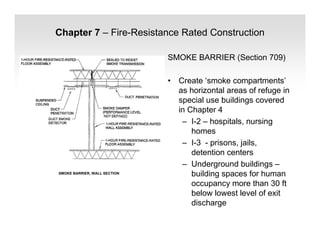
  • 83.
    Section 907 FireAlarm and Detection Systems Emergency voice/alarm communications system Exceptions: 1. Group I-1 and I-2 occupancies. 2. Group R-2 occupancies 125 feet or less in height. 3. Group R-2 occupancies greater than 125 feet.
  • 84.
    Section 908 –Emergency Alarm Systems This section provides the requirements for: • Emergency alarms to detect and notify of emergency conditions in Group H occupancies. • Emergency alarms in a Hazardous Production Material facility. • Gas detection systems in spaces storing or using highly toxic and toxic gases. • Gas detection systems in ozone gas-generator rooms.
  • 85.
    Section 908 –Emergency Alarm Systems (continued): • Flammable-gas detection systems in repair garages. • Refrigerant detector with an audible and visual alarm in machinery rooms. Incorporates the location and installation requirements for carbon monoxide alarms to an equivalent extent as the current code as amended by Local Law #7/2004.
  • 86.
    Section 909 SmokeControl Systems • Atrium buildings • Covered malls • Stages • Underground buildings • Smokeproof enclosures D esign Fire 2 2,000 B tu/sec (2,108 kW ) Elevator Shaft Z = 9.66 ft (2.94 m ) l Sm oke Production R ate V = 261,500 cfm (124,430 L/s) T = 68 F (20 C ) am bient T = 71 F (22 C ). sm oke layer
  • 87.
    Section 909.20 SmokeproofEnclosures – Smokeproof enclosures in high- rise buildings consisting of an enclosed interior exit stairways, each provided with one of the following: • An open exterior balcony • A naturally ventilated vestibule (2 hr rated) • A mechanically ventilated vestibule (2 hr rated) • Pressurization within the stairway
  • 88.
    Section 912 Post-fireSmoke Purge Systems Required in: • High-rise buildings subject to Section 403 • Buildings with any story exceeding 50,000 sq. ft. • Buildings with spaces exceeding 100 feet from natural ventilation openings. • High piled stock or rack storage in accordance with the NYC Fire Code.
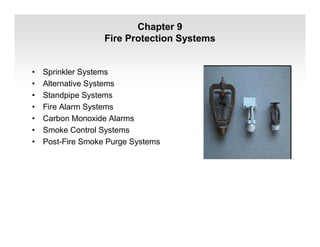
  • 89.
    Section 912 Post-fireSmoke Purge Systems As per the DOB’s summary of the NYC’s New Construction Code: •This section provides the requirements for the design and installation of post-fire smoke purge systems intended for the timely restoration of operations and overhaul activities once a fire has been extinguished. This section is equivalent to the current code, with the exception that R-2 occupancies are not required to provide a smoke purge system if the building is provided with smokeproof enclosures.
  • 90.
    Appendix Q –Modified National Standards for Automatic Sprinkler, Standpipe, and Fire Alarm Systems Q101 Scope. This appendix provides the modifications to the nationally recognized standards NFPA 13, NFPA 13D, NFPA 13R, NFPA 14 and NFPA 72, governing the installation and maintenance requirements of automatic sprinkler, standpipe and hose systems, and fire alarm systems.
  • 91.
    Appendix Q –Modified National Standards for Automatic Sprinkler, Standpipe, and Fire Alarm Systems Q102. Installation of Sprinkler Systems. Provides the NYC modifications of the nationally recognized standard NFPA 13 Standard for the Installation of Sprinkler Systems, 2002 edition. The current code references ANSI/NFiPA No. 13 – 1989, Standard for the Installation of Sprinkler Systems. Though the majority of the modifications are equivalent in scope, the referenced standard in this section is up-to-date and more relevant to current technologies and practices
  • 92.
    Appendix Q –Modified National Standards for Automatic Sprinkler, Standpipe, and Fire Alarm Systems Q102. Installation of Sprinkler Systems. The requirements for sprinklers in commercial cooking applications are deleted in their entirety from NFPA 13 since the proposed code does not permit the use of water sprinkler systems in such applications. The current code permits such system in the modifications of ANSI/NFiPA No. 13.
  • 93.
    Appendix Q –Modified National Standards for Automatic Sprinkler, Standpipe, and Fire Alarm Systems Q102. Installation of Sprinkler Systems. The current code modifications to ANSI/NFiPA No. 13 require approval by the Department of specified devices and systems. The modifications to NFPA 13 by the proposed code do not require Department approval and wholly accept devices and systems listed for their use by nationally recognized testing entities.
  • 94.
    Appendix Q –Modified National Standards for Automatic Sprinkler, Standpipe, and Fire Alarm Systems Q103. Installation of Sprinkler Systems in One- and Two- Family Dwellings and Manufactured Homes Provides the NYC modifications of the nationally recognized standard NFPA 13D, Standard for the Installation of Sprinkler Systems in One- and Two-Family Dwellings and Manufactured Homes, 2002 edition. The current code references ANSI/NFiPA No. 13 – 1994, Standard for the Installation of Sprinkler Systems in One- and Two-Family Dwellings and Manufactured Homes. Though the majority of the modifications are equivalent in scope, the referenced standard in this section is up-to-date and more relevant to current technologies and practices.
  • 95.
    Appendix Q –Modified National Standards for Automatic Sprinkler, Standpipe, and Fire Alarm Systems Q104. Installation of Sprinkler Systems in Residential Occupancies up to and Including Six Stories in Height Provides the NYC modifications of the nationally recognized standard NFPA 13R, Standard for the Installation of Sprinkler Systems in Residential Occupancies up to and Including Four Stories in Height, 2002 edition. The current code references ANSI/NFiPA No. 13R – 1994, Standard for the Installation of Sprinkler Systems in Residential Occupancies up to and Including Four Stories in Height. Though the majority of the modifications are equivalent in scope, the referenced standard in this section is up-to-date and more relevant to current technologies and practices.
  • 96.
    Appendix Q –Modified National Standards for Automatic Sprinkler, Standpipe, and Fire Alarm Systems Q105. Installation of Standpipe and Hose Systems Provides the NYC modifications of the nationally recognized standard NFPA 14, Standard for the Installation of Standpipe and Hose Systems, 2003 edition. The current code does not modify a nationally recognized standard, and instead provides requirements in Subchapter 17 of the Building Code and the Reference Standards. Furthermore, systems and devices that are listed in accordance with this standard are permitted as-of-right and do not require Department approval as per the current code.
  • 97.
    Appendix Q –Modified National Standards for Automatic Sprinkler, Standpipe, and Fire Alarm Systems Q105. Installation of Standpipe and Hose Systems The modifications of NFPA 14 are equivalent to the current code in most applications. However, the modifications provided by this section differ from the current code for those regulations that apply to very tall buildings. -Manual Fire Pumps no longer required -Redundant automatic and gravity-fed water supplies required -Design requirements exceed the requirements of the current codes through the requirement for much larger tank sizes for on- site storage of water for fire-fighting purposes, through the requirement for a dedicated high pressure siamese riser, and through a zoned system that improves fire fighting capabilities.
  • 98.
    Appendix Q –Modified National Standards for Automatic Sprinkler, Standpipe, and Fire Alarm Systems Q106. Installation and Maintenance of Fire Alarm Systems Provides the NYC modifications of the nationally recognized standard NFPA 72, National Fire Alarm Code, 2002 edition. The current code references ANSI/NFiPA No. 72 – 1993, National Fire Alarm Code. Though the majority of the modifications are equivalent in scope, the referenced standard in this section is up-to-date and more relevant to current technologies and practices. Furthermore, systems and devices that are listed in accordance with this standard are permitted as-of-right and do not require Department approval as per the current code.
  • 99.
    International Fire Code Intent.The purpose of this code is to establish the minimum requirements consistent with nationally recognized good practice for providing a reasonable level of life safety and property protection from the hazards of fire, explosion, or dangerous conditions in new and existing buildings, structures and premises and to provide safety to fire fighters and emergency responders during emergency operations. Proposed New York City Fire Code Intent. The purpose of this code is to establish reasonable minimum requirements and standards for life safety and property protection, to accomplish the purposes set forth in Section 101.2.
  • 100.
    Questions? This concludes TheAmerican Institute of Architects Continuing Education Systems Program 299 Broadway, Ste. 206 New York, NY 10007 212-385-38950 www.nysarch.com