Adverse Drugs ReactionsAdverse Drugs Reactions..
Principles of TreatmentPrinciples of Treatment
of Acute Poisoning with Drugsof Acute Poisoning with Drugs
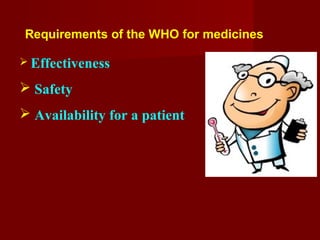
Requirements of the WHO for medicines
 Effectiveness
 Safety
 Availability for a patient
Adverse Drugs Reaction (ADR)Adverse Drugs Reaction (ADR) --
any response to drug that isany response to drug that is noxious andnoxious and
unintended and that occurs atunintended and that occurs at dosesdoses used inused in
man for theman for the prophylaxis, diagnosisprophylaxis, diagnosis oror
therapytherapy of disease or for modification ofof disease or for modification of
physiological functionphysiological function (WHO).(WHO).
It excludesIt excludes ADRsADRs due todue to Drug OverdoseDrug Overdose
((PoisoningPoisoning),), Drug AbuseDrug Abuse andand
Therapeutical ErrorsTherapeutical Errors..
STATISTICS
Mortality from Adverse Effects (AEs) of Drugs
(excluding medical errors and malusage)
takes the 5 place after:
Cardiovascular diseases
Cancer
Respiratory organs diseases
Traumas
AEs as the reason for hospitalization: 4,2 – 6%
Frequency of AEs in hospitalized patients: 5-35%
The drug administration may resultThe drug administration may result
in the development of:in the development of:
 Side effectsSide effects
 Untoward effectsUntoward effects
 Toxic effectsToxic effects
 Allergic and idiosyncratic effectsAllergic and idiosyncratic effects
Adverse Drugs Reaction (ADR)Adverse Drugs Reaction (ADR)
 1) Quantitative Intolerance (1) Quantitative Intolerance (Type AType A ))
 2) Qualitative Intolerance (2) Qualitative Intolerance (Type BType B))
a)a) IdiosyncrasyIdiosyncrasy (Genetic / Unknown(Genetic / Unknown
mechanism)mechanism)
b)b) AllergyAllergy (Immunological):(Immunological):
Types I, II, III and IVTypes I, II, III and IV
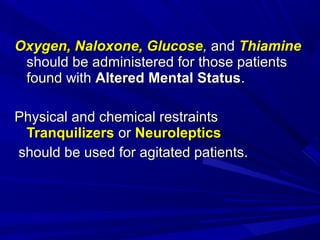
Oxygen, Naloxone, GlucoseOxygen, Naloxone, Glucose,, andand ThiamineThiamine
should be administered for those patientsshould be administered for those patients
found withfound with Altered Mental StatusAltered Mental Status..
Physical and chemical restraintsPhysical and chemical restraints
TranquilizersTranquilizers oror NeurolepticsNeuroleptics
should be used for agitated patients.should be used for agitated patients.
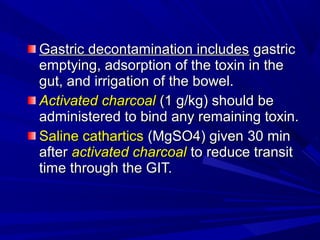
Gastric decontamination includesGastric decontamination includes gastricgastric
emptying, adsorption of the toxin in theemptying, adsorption of the toxin in the
gut, and irrigation of the bowel.gut, and irrigation of the bowel.
Activated charcoalActivated charcoal (1 g/kg) should be(1 g/kg) should be
administered to bind any remaining toxin.administered to bind any remaining toxin.
Saline catharticsSaline cathartics (MgSO4) given(MgSO4) given 30 min30 min
afterafter activated charcoalactivated charcoal toto reduce transitreduce transit
time through the GIT.time through the GIT.
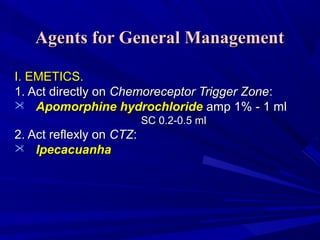
Agents forAgents for GGeneraleneral MManagementanagement
I. EMETICS.I. EMETICS.
1. Act directly on1. Act directly on Chemoreceptor Trigger ZoneChemoreceptor Trigger Zone::
 Apomorphine hydrochlorideApomorphine hydrochloride amp 1% - 1 mlamp 1% - 1 ml
SC 0.2-0.5 mlSC 0.2-0.5 ml
22. Act reflexly on. Act reflexly on CTZCTZ::
 IpecacuanhaIpecacuanha
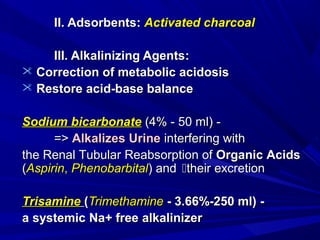
IIII.. AdsorbentsAdsorbents:: Activated charcoalActivated charcoal
III. Alkalinizing AgentsIII. Alkalinizing Agents::
 Correction of metabolic acidosisCorrection of metabolic acidosis
 RRestore acid-base balanceestore acid-base balance
Sodium bicarbonateSodium bicarbonate (4% - 50 ml)(4% - 50 ml) --
=>=> Alkalizes UrineAlkalizes Urine interferinterferinging withwith
thethe RRenalenal TTubularubular RReabsorption ofeabsorption of OOrganicrganic AAcidscids
((AspirinAspirin,, PhenobarbitalPhenobarbital) and) and theirtheir excretionexcretion
TrisamineTrisamine ((TrTriimethaminemethamine - 3.66%-250 ml)- 3.66%-250 ml) --
a systemica systemic Na+ freeNa+ free alkalinizeralkalinizer
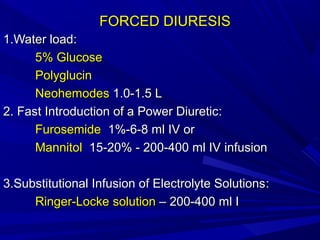
FORCED DIURESISFORCED DIURESIS
1.Water load1.Water load::
5% Glucose5% Glucose
PolyglucinPolyglucin
NeohNeoheemodesmodes 1.0-1.5 L1.0-1.5 L
2.2. FastFast IIntroduction of a Power Diureticntroduction of a Power Diuretic::
FurosemideFurosemide 1%-6-8 ml IV1%-6-8 ml IV oror
MannitolMannitol 15-15-20% - 200-400 ml IV20% - 200-400 ml IV infusioninfusion
3.Substitutional Infusion of Electrolyte Solutions3.Substitutional Infusion of Electrolyte Solutions::
Ringer-LockeRinger-Locke solutionsolution – 200-400 m– 200-400 ml Il I
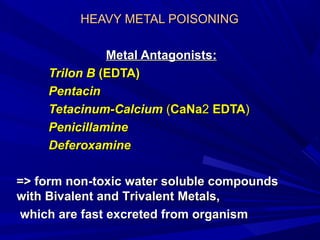
HEAVY METAL POISONINGHEAVY METAL POISONING
Metal AntagonistsMetal Antagonists::
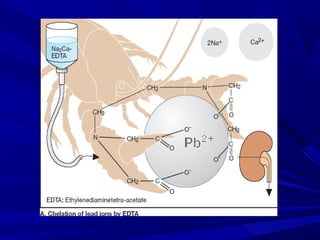
Trilon BTrilon B ((EDTAEDTA))
PentacinPentacin
Tetacinum-Tetacinum-CCalciumalcium ((CaNaCaNa22 EDTAEDTA))
PPenicillamineenicillamine
DeferoxamineDeferoxamine
=>=> form non-toxic water soluble compoundsform non-toxic water soluble compounds
withwith BBivalent andivalent and TTrivalentrivalent MMetals,etals,
which are fast excreted from organismwhich are fast excreted from organism
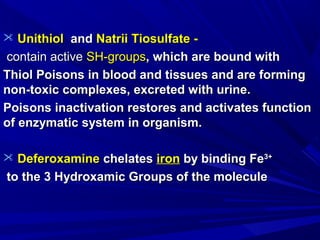
 UnithiolUnithiol andand NatriiNatrii TTiosulfate -iosulfate -
contain activecontain active SH-groupsSH-groups, which are bound with, which are bound with
Thiol Poisons in blood and tissues and are formingThiol Poisons in blood and tissues and are forming
non-toxic complexes, excreted with urine.non-toxic complexes, excreted with urine.
Poisons inactivation restores and activates functionPoisons inactivation restores and activates function
of enzymatic system in organism.of enzymatic system in organism.
 DeferoxamineDeferoxamine chelateschelates ironiron by binding Feby binding Fe3+3+
to the 3 Hydroxamic Groups of the moleculeto the 3 Hydroxamic Groups of the molecule
AdrenalineAdrenaline
⇑⇑ BP,BP, ⇑⇑ Venous Pressure,Venous Pressure, ⇑⇑ heartbeatingheartbeating,,
severe anxiety, nausea and vomiting, respiratorysevere anxiety, nausea and vomiting, respiratory
distress, large pupils, expressed paleness anddistress, large pupils, expressed paleness and
coldness of skin, pulmonary edema, renal failure,coldness of skin, pulmonary edema, renal failure,
metabolic acidosis.metabolic acidosis.
TreatmentTreatment:: symptomatic and supportive measuressymptomatic and supportive measures
asas Adrenaline is rapidly inactivated in the body.Adrenaline is rapidly inactivated in the body.
α-Adrenoblockersα-Adrenoblockers PhentolaminePhentolamine andand TropapheneTropaphene
for hypertensionfor hypertension;;
β-blockerβ-blocker AnaprilineAnapriline for arrhythmias.for arrhythmias.
NoradrenalineNoradrenaline
⇑⇑BP, photophobia, retrosteranal or pharyngealBP, photophobia, retrosteranal or pharyngeal
pain, intense sweating, vomiting,pain, intense sweating, vomiting,
cerebral hemorrhage, convulsions,cerebral hemorrhage, convulsions,
cardiac arrhythmias.cardiac arrhythmias.
TreatmentTreatment::
Atropine sulfateAtropine sulfate for reflex bradycardia,for reflex bradycardia,
PhentolaminePhentolamine for exravasation,for exravasation,
AnaprilineAnapriline for arrhythmias.for arrhythmias.
MesatoneMesatone ((PhenylephrinePhenylephrine))
palpitation,palpitation, ⇑⇑BP, ventricular extrasystoles andBP, ventricular extrasystoles and
other cardiac arrhythmias,other cardiac arrhythmias, myocardial infarctionmyocardial infarction,,
excitability.excitability.
TreatmentTreatment::
α-adrenoblockers:α-adrenoblockers: PhentolaminePhentolamine
β-blockerβ-blocker AnaprilineAnapriline for arrhythmiasfor arrhythmias
NitroglycerineNitroglycerine
VVasodilationasodilation andand MethemoglobinemiaMethemoglobinemia::
⇓⇓BPBP,, ⇑⇑ Intracranial Pressure with Confusion,Intracranial Pressure with Confusion,
throbbing headache, palpitations, visualthrobbing headache, palpitations, visual
disturbances, flushing of the skin, sweating (withdisturbances, flushing of the skin, sweating (with
skin later becoming cold and cyanotic),skin later becoming cold and cyanotic),
bloody diarrhea, initial hyperpnea, dyspnea,bloody diarrhea, initial hyperpnea, dyspnea,
bradycardia, heart block, fever, paralysis, tissuebradycardia, heart block, fever, paralysis, tissue
hypoxia (fromhypoxia (from methemoglobinemiamethemoglobinemia) - cyanosis,) - cyanosis,
and metabolic acidosis, coma, clonic seizures andand metabolic acidosis, coma, clonic seizures and
circulatory collapse.circulatory collapse.
Death may result from circulatory collapse orDeath may result from circulatory collapse or
asphyxia.asphyxia.
AntidotesAntidotes::
GlucoseGlucose 5%-500ml +5%-500ml +Ascorbinic acidAscorbinic acid 5%-10-15 ml,5%-10-15 ml,
Methylene blueMethylene blue (1% - 7-10 ml) or(1% - 7-10 ml) or
ChromosmonChromosmon -1%-1% Methylene BlueMethylene Blue in 5%in 5%GlucoseGlucose
Symptomatic treatemntSymptomatic treatemnt::
Sodium hydrocarbonate,Sodium hydrocarbonate, TrisamineTrisamine,,
SulfocamphocaineSulfocamphocaine (10% 3-4 ml),(10% 3-4 ml), MesatoneMesatone,,
•Noradrenaline hydrotartrateNoradrenaline hydrotartrate 0.2% 1 ml0.2% 1 ml
inin GlucoseGlucose 5% 500 ml IV infusion5% 500 ml IV infusion
AminazineAminazine (Chlorpromazine)(Chlorpromazine)
CNS depressionCNS depression:: deep sleep, coma,deep sleep, coma, ⇓⇓BP andBP and ⇓⇓ t,t,
abnormal involuntary muscle movements, agitation,abnormal involuntary muscle movements, agitation,
seizures, arrhythmiasseizures, arrhythmias
TreatmentTreatment:: IV fluids,IV fluids,
Adrenaline is not given !!!Adrenaline is not given !!!
StrophanthineStrophanthine 0.025%1 ml in 20 ml 0.9% NaCl IV;0.025%1 ml in 20 ml 0.9% NaCl IV;
Prednisolone, HydrocortisonePrednisolone, Hydrocortisone
Seizures are treated with parenteralSeizures are treated with parenteral
DiasepamDiasepam oror GOBAGOBA;;
Arrhythmias – withArrhythmias – with Difenin;Difenin;
Extrapyramidal reactions -Extrapyramidal reactions -
withwith BiperidineBiperidine oror DimedroleDimedrole (Diphenhytdramine)(Diphenhytdramine)
ClozapineClozapine [non-typical Neuroleptic][non-typical Neuroleptic]
Drowsiness, Sedation, Delirium, Coma,Drowsiness, Sedation, Delirium, Coma, ⇓⇓BPBP,, ⇑⇑HR,HR,
hypersalivation,hypersalivation, RRespiratory Depression, Seizures.espiratory Depression, Seizures.
TreatmentTreatment::
Hypotension is treated with IV fluids,Hypotension is treated with IV fluids,
StrophanthineStrophanthine 0.025% 1 ml in 20 ml 0.9% NaCl IV,0.025% 1 ml in 20 ml 0.9% NaCl IV,
PrednisolonePrednisolone oror HydrocortisoneHydrocortisone..
Avoid Adrenaline and derivatives!!!Avoid Adrenaline and derivatives!!!
Seizures are treated withSeizures are treated with DiaDiazzepamepam oror GOBAGOBA;;
ArArrhythmias – withrhythmias – with DifeninDifenin;;
EExtrapyramidal reactions withxtrapyramidal reactions with BiperidineBiperidine oror
parenteralparenteral DimedroleDimedrole ((DiphenhytdramineDiphenhytdramine))
ButadioneButadione ((PhenylbutazonePhenylbutazone))
GIT discomfort, Oliguria, Hematuria, AcuteGIT discomfort, Oliguria, Hematuria, Acute
Renal Failure, Seizures, EnhancedRenal Failure, Seizures, Enhanced
Excitability, Collapse, Hyperthermia,Excitability, Collapse, Hyperthermia,
Hemorrhagic Purpura.Hemorrhagic Purpura.
TreatmentTreatment :: Gastric Lavage,Gastric Lavage, ActivatedActivated
charcoalcharcoal via nasogastric tube,via nasogastric tube,
Symptomatic and Supportive measuresSymptomatic and Supportive measures
(respiratory support and correction of fluid(respiratory support and correction of fluid
and Electrolyte Imbalances).and Electrolyte Imbalances).
AntidotesAntidotes::
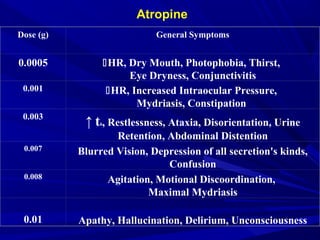
Atropine
Dose (g) General Symptoms
0.0005 HR, Dry Mouth, Photophobia, Thirst,
Eye Dryness, Conjunctivitis
0.001 HR, Increased Intraocular Pressure,
Mydriasis, Constipation
0.003
↑ t0, Restlessness, Ataxia, Disorientation, Urine
Retention, Abdominal Distention
0.007 Blurred Vision, Depression of all secretion's kinds,
Confusion
0.008 Agitation, Motional Discoordination,
Maximal Mydriasis
0.01 Apathy, Hallucination, Delirium, Unconsciousness
TreatmentTreatment::
AntidotesAntidotes PhysostigminePhysostigmine 0.1%-1 ml or0.1%-1 ml or
ProserineProserine ((Neostigmine)Neostigmine) 0.05%-1 ml SC,0.05%-1 ml SC,
General supportive measures –General supportive measures –
gastric lavage withgastric lavage with 0.01% KMnO0.01% KMnO44 - 10-15 L- 10-15 L
Activated charcoalActivated charcoal via nasogastric tube.via nasogastric tube.
For discontinuance of psychomotor excitabilityFor discontinuance of psychomotor excitability
AminazineAminazine (2.5% 2 ml) or(2.5% 2 ml) or DiazepamDiazepam (0.5% 2 ml).(0.5% 2 ml).
Forced diuresisForced diuresis:: equally 1.5 L ofequally 1.5 L of Isotonic SolutionIsotonic Solution
andand 5% Glucose5% Glucose, then, then LazixLazix 1% 8-12 ml IV1% 8-12 ml IV
Pachycarpine hydrobromidePachycarpine hydrobromide
DDizziness, blurred vision,izziness, blurred vision, ⇓⇓BPBP,, ⇑⇑HR,HR,
decreased bronchial secretion, dyspnea,decreased bronchial secretion, dyspnea,
muscular fibrillation, Cardiovascular Collapse,muscular fibrillation, Cardiovascular Collapse,
Respiration Center Paralysis.Respiration Center Paralysis.
TreatmentTreatment::
Proserine or GalanthamineProserine or Galanthamine,,
VVititamine Bamine B11
Ephedrine, Adrenaline, Noradrenaline,Ephedrine, Adrenaline, Noradrenaline,
CordiaminCordiamin
DobutamineDobutamine
StrophanthineStrophanthine
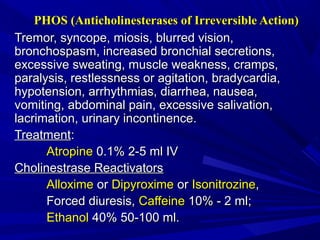
PHOS (Anticholinesterases of Irreversible Action)PHOS (Anticholinesterases of Irreversible Action)
Tremor, syncope, miosis, blurred vision,Tremor, syncope, miosis, blurred vision,
bronchospasm, increased bronchial secretions,bronchospasm, increased bronchial secretions,
excessive sweating, muscle weakness, cramps,excessive sweating, muscle weakness, cramps,
paralysis, restlessness or agitation, bradycardia,paralysis, restlessness or agitation, bradycardia,
hypotension, arrhythmias, diarrhea, nausea,hypotension, arrhythmias, diarrhea, nausea,
vomiting, abdominal pain, excessive salivation,vomiting, abdominal pain, excessive salivation,
lacrimation, urinary incontinence.lacrimation, urinary incontinence.
TreatmentTreatment::
AtropineAtropine 0.1% 2-5 ml IV0.1% 2-5 ml IV
Cholinestrase ReactivatorsCholinestrase Reactivators
AlloximeAlloxime oror DipyroximeDipyroxime oror IsonitrozineIsonitrozine,,
Forced diuresis,Forced diuresis, CaffeineCaffeine 10% - 2 ml10% - 2 ml;;
EthanolEthanol 40% 50-100 ml.40% 50-100 ml.
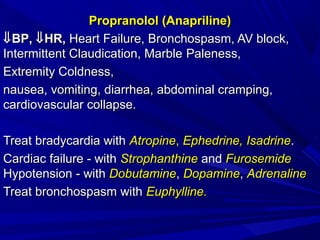
Propranolol (Anapriline)Propranolol (Anapriline)
⇓⇓BPBP,, ⇓⇓HRHR,, Heart Failure, Bronchospasm, AV block,Heart Failure, Bronchospasm, AV block,
Intermittent Claudication, MarbleIntermittent Claudication, Marble Paleness,Paleness,
Extremity Coldness,Extremity Coldness,
nausea, vomiting, diarrhea, abdominal cramping,nausea, vomiting, diarrhea, abdominal cramping,
cardiovascular collapse.cardiovascular collapse.
Treat bradycardia withTreat bradycardia with AtropineAtropine,, Ephedrine, IsadrineEphedrine, Isadrine..
Cardiac failure - withCardiac failure - with StrophanthineStrophanthine andand FurosemideFurosemide
HHypotensionypotension -- withwith DobutamineDobutamine,, DopamineDopamine,, AdrenalineAdrenaline
Treat bronchospasm withTreat bronchospasm with Euphylline.Euphylline.
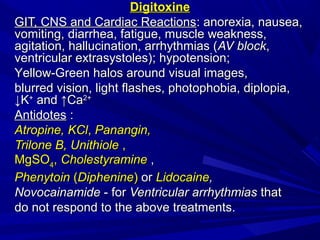
DigitoxineDigitoxine
GIT, CNS and Cardiac ReactionsGIT, CNS and Cardiac Reactions: anorexia, nausea,: anorexia, nausea,
vomiting, diarrhea, fatigue, muscle weakness,vomiting, diarrhea, fatigue, muscle weakness,
agitation, hallucination, arrhythmias (agitation, hallucination, arrhythmias (AV blockAV block,,
ventricular extrasystoles)ventricular extrasystoles);; hypotensionhypotension;;
YYellow-Green halos around visual images,ellow-Green halos around visual images,
blurred vision, light flashes, photophobia, diplopia,blurred vision, light flashes, photophobia, diplopia,
↓K↓K++
and ↑Caand ↑Ca2+2+
AntidotesAntidotes ::
Atropine, KClAtropine, KCl,, Panangin,Panangin,
Trilone B, UnithioleTrilone B, Unithiole ,,
MgSOMgSO44,, CholestyramineCholestyramine ,,
PhenytoinPhenytoin ((DiphenineDiphenine)) oror LidocaineLidocaine,,
NovocainamideNovocainamide - for- for Ventricular arrhythmiasVentricular arrhythmias thatthat
do not respond to the above treatments.do not respond to the above treatments.
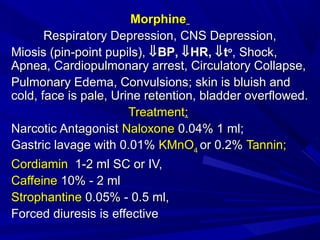
MorphineMorphine
Respiratory Depression, CNS Depression,Respiratory Depression, CNS Depression,
Miosis (pin-point pupils),Miosis (pin-point pupils), ⇓⇓BPBP,, ⇓⇓HRHR,, ⇓⇓ttoo
, Shock,, Shock,
Apnea, Cardiopulmonary arrest, Circulatory Collapse,Apnea, Cardiopulmonary arrest, Circulatory Collapse,
Pulmonary Edema, ConvulsionsPulmonary Edema, Convulsions;; skin is bluish andskin is bluish and
cold, face is pale, Urine retention, bladder overflowed.cold, face is pale, Urine retention, bladder overflowed.
TreatmentTreatment::
Narcotic AntagonistNarcotic Antagonist NaloxoneNaloxone 0.04% 1 ml;0.04% 1 ml;
Gastric lavage with 0.01%Gastric lavage with 0.01% KMnOKMnO44 or 0.2%or 0.2% Tannin;Tannin;
CordiaminCordiamin 1-2 ml SC or IV,1-2 ml SC or IV,
CaffeineCaffeine 10% - 2 ml10% - 2 ml
StrophantineStrophantine 0.05% - 0.5 ml,0.05% - 0.5 ml,
Forced diuresis is effectiveForced diuresis is effective
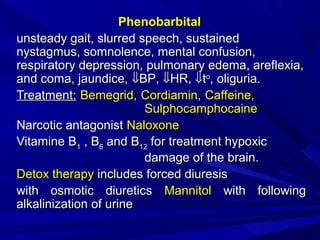
PhenobarbitalPhenobarbital
unsteady gait, slurred speech, sustainedunsteady gait, slurred speech, sustained
nystagmus, somnolence, mental confusion,nystagmus, somnolence, mental confusion,
respiratory depression, pulmonary edema, areflexia,respiratory depression, pulmonary edema, areflexia,
and coma, jaundice,and coma, jaundice, ⇓⇓BPBP,, ⇓⇓HRHR,, ⇓⇓ttoo
, oliguria., oliguria.
TreatmentTreatment:: Bemegrid, Cordiamin, Caffeine,Bemegrid, Cordiamin, Caffeine,
SulphocamphocaineSulphocamphocaine
Narcotic antagonistNarcotic antagonist NaloxoneNaloxone
Vitamine BVitamine B11 , B, B66 and Band B1212 for treatment hypoxicfor treatment hypoxic
damage of the brain.damage of the brain.
Detox therapyDetox therapy includes forced diuresisincludes forced diuresis
with osmotic diureticswith osmotic diuretics MannitolMannitol with followingwith following
alkalinization of urinealkalinization of urine
ClophelineClopheline ((ClonidineClonidine)) [α[α22-agonist]-agonist]
⇓⇓BPBP,, ⇓⇓HRHR,, ⇓⇓ttoo
, CNS and, respiratory depression,, CNS and, respiratory depression,
apnea, seizures, lethargy, irritability.apnea, seizures, lethargy, irritability.
TreatmentTreatment::
Gastric lavage, activated charcoal.Gastric lavage, activated charcoal.
VVasopressors –asopressors – Mesatone, NorepinephrineMesatone, Norepinephrine,,
ββ1 AM1 AM DobutamineDobutamine
AnalepticsAnaleptics Cordiamin, CaffeineCordiamin, Caffeine
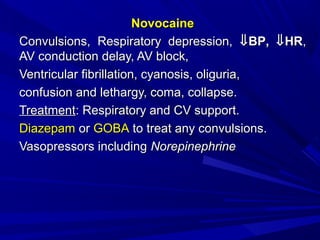
NovocaineNovocaine
Convulsions, Respiratory depression,Convulsions, Respiratory depression, ⇓⇓BPBP,, ⇓⇓HRHR,,
AV conduction delay, AV block,AV conduction delay, AV block,
Ventricular fibrillation, cyanosis, oliguria,Ventricular fibrillation, cyanosis, oliguria,
confusion and lethargy, coma, collapse.confusion and lethargy, coma, collapse.
TreatmentTreatment:: RRespiratory and CV support.espiratory and CV support.
DiazepamDiazepam oror GOBAGOBA to treat any convulsions.to treat any convulsions.
Vasopressors includingVasopressors including NorepinephrineNorepinephrine
 
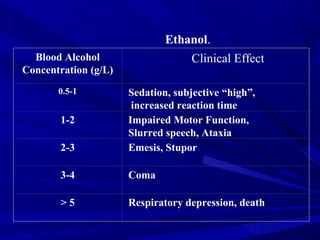
Blood Alcohol
Concentration (g/L)
Clinical Effect 
0.5-1 Sedation, subjective “high”,
increased reaction time
1-2 Impaired Motor Function,
Slurred speech, Ataxia
2-3 Emesis, Stupor
3-4 Coma
> 5 Respiratory depression, death
 
Ethanol. 
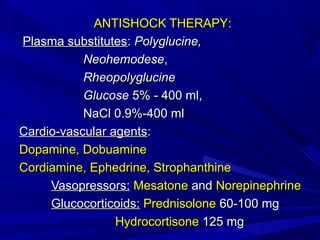
ANTISHOCK THERAPYANTISHOCK THERAPY::
Plasma substitutesPlasma substitutes:: Polyglucine,Polyglucine,
NeohemodeseNeohemodese,,
RheopolyglucineRheopolyglucine
GlucoseGlucose 5% - 400 ml,5% - 400 ml,
NaCl 0.9%-400 mlNaCl 0.9%-400 ml
Cardio-vascular agentsCardio-vascular agents::
Dopamine, DobuamineDopamine, Dobuamine
CordiamineCordiamine, Ephedrine, Strophanthine, Ephedrine, Strophanthine
VasopressorsVasopressors:: MesatoneMesatone andand NorepinephrineNorepinephrine
GlucocorticoidsGlucocorticoids:: PrednisolonePrednisolone 60-100 mg60-100 mg
HydrocortisoneHydrocortisone 125 mg125 mg
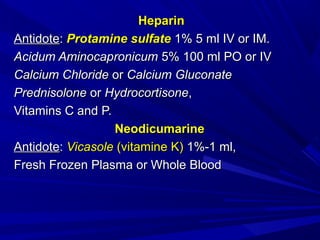
HeparinHeparin
AntidoteAntidote:: Protamine sulfateProtamine sulfate 1% 5 ml IV or IM.1% 5 ml IV or IM.
Acidum AminocapronicumAcidum Aminocapronicum 5% 100 ml PO or IV5% 100 ml PO or IV
Calcium ChlorideCalcium Chloride oror Calcium GluconateCalcium Gluconate
PrednisolonePrednisolone oror HydrocortisoneHydrocortisone,,
Vitamins C and P.Vitamins C and P.
NeodicumarineNeodicumarine
AntidoteAntidote:: VicasoleVicasole (vitamine K)(vitamine K) 1%-1 ml,1%-1 ml,
Fresh Frozen Plasma or Whole BloodFresh Frozen Plasma or Whole Blood
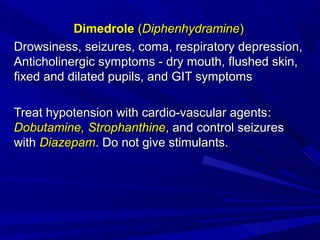
DimedroleDimedrole ((DiphenhydramineDiphenhydramine))
Drowsiness, seizures, coma, respiratory depression,Drowsiness, seizures, coma, respiratory depression,
Anticholinergic symptoms - dry mouth, flushed skin,Anticholinergic symptoms - dry mouth, flushed skin,
fixed and dilated pupils, and GIT symptomsfixed and dilated pupils, and GIT symptoms
Treat hypotension with cardio-vascular agentsTreat hypotension with cardio-vascular agents::
Dobutamine,Dobutamine, StrophanthineStrophanthine, and control seizures, and control seizures
withwith DiazepamDiazepam. Do not give stimulants.. Do not give stimulants.
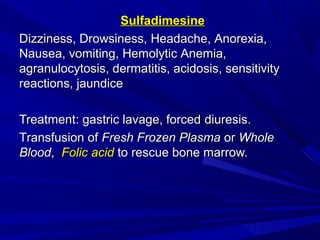
SulfadimesineSulfadimesine
DDizziness,izziness, DDrowsiness,rowsiness, HHeadache,eadache, AAnorexia,norexia,
NNausea, vomitingausea, vomiting,, HHemolyticemolytic AAnemia,nemia,
agranulocytosis, dermatitis, acidosis, sensitivityagranulocytosis, dermatitis, acidosis, sensitivity
reactions, jaundicereactions, jaundice
TreatTreatmentment:: gastric lavage, forcedgastric lavage, forced diuresisdiuresis..
TTransfusion ofransfusion of Fresh Frozen PlasmaFresh Frozen Plasma oror WholeWhole
BloodBlood,, Folic acidFolic acid to rescue bone marrow.to rescue bone marrow.
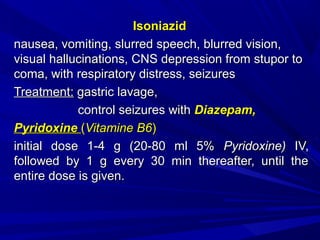
IsoniazidIsoniazid
nausea, vomiting, slurred speech, blurred vision,nausea, vomiting, slurred speech, blurred vision,
visual hallucinations, CNS depression from stupor tovisual hallucinations, CNS depression from stupor to
coma, with respiratory distress, seizurescoma, with respiratory distress, seizures
TreatmentTreatment:: gastric lavagegastric lavage,,
control seizures withcontrol seizures with Diazepam,Diazepam,
PyridoxinePyridoxine ((Vitamine B6Vitamine B6))
initial dose 1-4 g (20-80 ml 5%initial dose 1-4 g (20-80 ml 5% Pyridoxine)Pyridoxine) IV,IV,
followed by 1 g every 30 min thereafter, until thefollowed by 1 g every 30 min thereafter, until the
entire dose is given.entire dose is given.
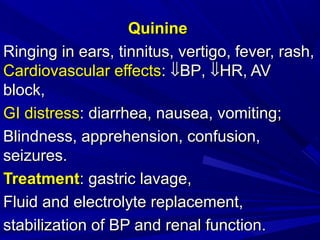
QuinineQuinine
Ringing in ears, tinnitus, vertigo, fever, rash,Ringing in ears, tinnitus, vertigo, fever, rash,
Cardiovascular effectsCardiovascular effects:: ⇓⇓BPBP,, ⇓⇓HRHR, AV, AV
block,block,
GI distressGI distress:: diarrhea, nausea, vomitingdiarrhea, nausea, vomiting;;
Blindness, apprehension, confusion,Blindness, apprehension, confusion,
seizures.seizures.
TreatmentTreatment:: gastric lavage,gastric lavage,
FFluid and electrolyte replacement,luid and electrolyte replacement,
stabilization of BP and renal function.stabilization of BP and renal function.
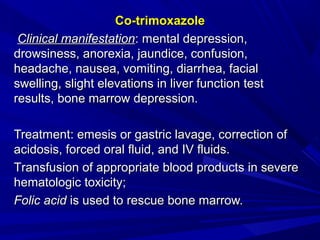
Co-trimoxazoleCo-trimoxazole
Clinical manifestationClinical manifestation:: mental depression,mental depression,
drowsiness, anorexia, jaundice, confusion,drowsiness, anorexia, jaundice, confusion,
headache, nausea, vomiting, diarrhea, facialheadache, nausea, vomiting, diarrhea, facial
swelling, slight elevations in liver function testswelling, slight elevations in liver function test
results, bone marrow depression.results, bone marrow depression.
TreatTreatmentment:: emesis or gastric lavage, correction ofemesis or gastric lavage, correction of
acidosis, forced oral fluid, and IV fluids.acidosis, forced oral fluid, and IV fluids.
TTransfusransfusion ofion of appropriate blood products in severeappropriate blood products in severe
hematologic toxicity;hematologic toxicity;
Folic acidFolic acid is used to rescue bone marrow.is used to rescue bone marrow.
Thank You for Listening!Thank You for Listening!

Adverse Drugs Reactions

  • 1.
    Adverse Drugs ReactionsAdverseDrugs Reactions.. Principles of TreatmentPrinciples of Treatment of Acute Poisoning with Drugsof Acute Poisoning with Drugs
  • 2.
    Requirements of theWHO for medicines  Effectiveness  Safety  Availability for a patient
  • 3.
    Adverse Drugs Reaction(ADR)Adverse Drugs Reaction (ADR) -- any response to drug that isany response to drug that is noxious andnoxious and unintended and that occurs atunintended and that occurs at dosesdoses used inused in man for theman for the prophylaxis, diagnosisprophylaxis, diagnosis oror therapytherapy of disease or for modification ofof disease or for modification of physiological functionphysiological function (WHO).(WHO). It excludesIt excludes ADRsADRs due todue to Drug OverdoseDrug Overdose ((PoisoningPoisoning),), Drug AbuseDrug Abuse andand Therapeutical ErrorsTherapeutical Errors..
  • 4.
    STATISTICS Mortality from AdverseEffects (AEs) of Drugs (excluding medical errors and malusage) takes the 5 place after: Cardiovascular diseases Cancer Respiratory organs diseases Traumas AEs as the reason for hospitalization: 4,2 – 6% Frequency of AEs in hospitalized patients: 5-35%
  • 5.
    The drug administrationmay resultThe drug administration may result in the development of:in the development of:  Side effectsSide effects  Untoward effectsUntoward effects  Toxic effectsToxic effects  Allergic and idiosyncratic effectsAllergic and idiosyncratic effects
  • 6.
    Adverse Drugs Reaction(ADR)Adverse Drugs Reaction (ADR)  1) Quantitative Intolerance (1) Quantitative Intolerance (Type AType A ))  2) Qualitative Intolerance (2) Qualitative Intolerance (Type BType B)) a)a) IdiosyncrasyIdiosyncrasy (Genetic / Unknown(Genetic / Unknown mechanism)mechanism) b)b) AllergyAllergy (Immunological):(Immunological): Types I, II, III and IVTypes I, II, III and IV
  • 9.
    Oxygen, Naloxone, GlucoseOxygen,Naloxone, Glucose,, andand ThiamineThiamine should be administered for those patientsshould be administered for those patients found withfound with Altered Mental StatusAltered Mental Status.. Physical and chemical restraintsPhysical and chemical restraints TranquilizersTranquilizers oror NeurolepticsNeuroleptics should be used for agitated patients.should be used for agitated patients.
  • 10.
    Gastric decontamination includesGastricdecontamination includes gastricgastric emptying, adsorption of the toxin in theemptying, adsorption of the toxin in the gut, and irrigation of the bowel.gut, and irrigation of the bowel. Activated charcoalActivated charcoal (1 g/kg) should be(1 g/kg) should be administered to bind any remaining toxin.administered to bind any remaining toxin. Saline catharticsSaline cathartics (MgSO4) given(MgSO4) given 30 min30 min afterafter activated charcoalactivated charcoal toto reduce transitreduce transit time through the GIT.time through the GIT.
  • 11.
    Agents forAgents forGGeneraleneral MManagementanagement I. EMETICS.I. EMETICS. 1. Act directly on1. Act directly on Chemoreceptor Trigger ZoneChemoreceptor Trigger Zone::  Apomorphine hydrochlorideApomorphine hydrochloride amp 1% - 1 mlamp 1% - 1 ml SC 0.2-0.5 mlSC 0.2-0.5 ml 22. Act reflexly on. Act reflexly on CTZCTZ::  IpecacuanhaIpecacuanha
  • 12.
    IIII.. AdsorbentsAdsorbents:: ActivatedcharcoalActivated charcoal III. Alkalinizing AgentsIII. Alkalinizing Agents::  Correction of metabolic acidosisCorrection of metabolic acidosis  RRestore acid-base balanceestore acid-base balance Sodium bicarbonateSodium bicarbonate (4% - 50 ml)(4% - 50 ml) -- =>=> Alkalizes UrineAlkalizes Urine interferinterferinging withwith thethe RRenalenal TTubularubular RReabsorption ofeabsorption of OOrganicrganic AAcidscids ((AspirinAspirin,, PhenobarbitalPhenobarbital) and) and theirtheir excretionexcretion TrisamineTrisamine ((TrTriimethaminemethamine - 3.66%-250 ml)- 3.66%-250 ml) -- a systemica systemic Na+ freeNa+ free alkalinizeralkalinizer
  • 13.
    FORCED DIURESISFORCED DIURESIS 1.Waterload1.Water load:: 5% Glucose5% Glucose PolyglucinPolyglucin NeohNeoheemodesmodes 1.0-1.5 L1.0-1.5 L 2.2. FastFast IIntroduction of a Power Diureticntroduction of a Power Diuretic:: FurosemideFurosemide 1%-6-8 ml IV1%-6-8 ml IV oror MannitolMannitol 15-15-20% - 200-400 ml IV20% - 200-400 ml IV infusioninfusion 3.Substitutional Infusion of Electrolyte Solutions3.Substitutional Infusion of Electrolyte Solutions:: Ringer-LockeRinger-Locke solutionsolution – 200-400 m– 200-400 ml Il I
  • 14.
    HEAVY METAL POISONINGHEAVYMETAL POISONING Metal AntagonistsMetal Antagonists:: Trilon BTrilon B ((EDTAEDTA)) PentacinPentacin Tetacinum-Tetacinum-CCalciumalcium ((CaNaCaNa22 EDTAEDTA)) PPenicillamineenicillamine DeferoxamineDeferoxamine =>=> form non-toxic water soluble compoundsform non-toxic water soluble compounds withwith BBivalent andivalent and TTrivalentrivalent MMetals,etals, which are fast excreted from organismwhich are fast excreted from organism
  • 16.
     UnithiolUnithiol andandNatriiNatrii TTiosulfate -iosulfate - contain activecontain active SH-groupsSH-groups, which are bound with, which are bound with Thiol Poisons in blood and tissues and are formingThiol Poisons in blood and tissues and are forming non-toxic complexes, excreted with urine.non-toxic complexes, excreted with urine. Poisons inactivation restores and activates functionPoisons inactivation restores and activates function of enzymatic system in organism.of enzymatic system in organism.  DeferoxamineDeferoxamine chelateschelates ironiron by binding Feby binding Fe3+3+ to the 3 Hydroxamic Groups of the moleculeto the 3 Hydroxamic Groups of the molecule
  • 17.
    AdrenalineAdrenaline ⇑⇑ BP,BP, ⇑⇑Venous Pressure,Venous Pressure, ⇑⇑ heartbeatingheartbeating,, severe anxiety, nausea and vomiting, respiratorysevere anxiety, nausea and vomiting, respiratory distress, large pupils, expressed paleness anddistress, large pupils, expressed paleness and coldness of skin, pulmonary edema, renal failure,coldness of skin, pulmonary edema, renal failure, metabolic acidosis.metabolic acidosis. TreatmentTreatment:: symptomatic and supportive measuressymptomatic and supportive measures asas Adrenaline is rapidly inactivated in the body.Adrenaline is rapidly inactivated in the body. α-Adrenoblockersα-Adrenoblockers PhentolaminePhentolamine andand TropapheneTropaphene for hypertensionfor hypertension;; β-blockerβ-blocker AnaprilineAnapriline for arrhythmias.for arrhythmias.
  • 18.
    NoradrenalineNoradrenaline ⇑⇑BP, photophobia, retrosteranalor pharyngealBP, photophobia, retrosteranal or pharyngeal pain, intense sweating, vomiting,pain, intense sweating, vomiting, cerebral hemorrhage, convulsions,cerebral hemorrhage, convulsions, cardiac arrhythmias.cardiac arrhythmias. TreatmentTreatment:: Atropine sulfateAtropine sulfate for reflex bradycardia,for reflex bradycardia, PhentolaminePhentolamine for exravasation,for exravasation, AnaprilineAnapriline for arrhythmias.for arrhythmias.
  • 19.
    MesatoneMesatone ((PhenylephrinePhenylephrine)) palpitation,palpitation, ⇑⇑BP,ventricular extrasystoles andBP, ventricular extrasystoles and other cardiac arrhythmias,other cardiac arrhythmias, myocardial infarctionmyocardial infarction,, excitability.excitability. TreatmentTreatment:: α-adrenoblockers:α-adrenoblockers: PhentolaminePhentolamine β-blockerβ-blocker AnaprilineAnapriline for arrhythmiasfor arrhythmias
  • 20.
    NitroglycerineNitroglycerine VVasodilationasodilation andand MethemoglobinemiaMethemoglobinemia:: ⇓⇓BPBP,,⇑⇑ Intracranial Pressure with Confusion,Intracranial Pressure with Confusion, throbbing headache, palpitations, visualthrobbing headache, palpitations, visual disturbances, flushing of the skin, sweating (withdisturbances, flushing of the skin, sweating (with skin later becoming cold and cyanotic),skin later becoming cold and cyanotic), bloody diarrhea, initial hyperpnea, dyspnea,bloody diarrhea, initial hyperpnea, dyspnea, bradycardia, heart block, fever, paralysis, tissuebradycardia, heart block, fever, paralysis, tissue hypoxia (fromhypoxia (from methemoglobinemiamethemoglobinemia) - cyanosis,) - cyanosis, and metabolic acidosis, coma, clonic seizures andand metabolic acidosis, coma, clonic seizures and circulatory collapse.circulatory collapse. Death may result from circulatory collapse orDeath may result from circulatory collapse or asphyxia.asphyxia.
  • 21.
    AntidotesAntidotes:: GlucoseGlucose 5%-500ml +5%-500ml+Ascorbinic acidAscorbinic acid 5%-10-15 ml,5%-10-15 ml, Methylene blueMethylene blue (1% - 7-10 ml) or(1% - 7-10 ml) or ChromosmonChromosmon -1%-1% Methylene BlueMethylene Blue in 5%in 5%GlucoseGlucose Symptomatic treatemntSymptomatic treatemnt:: Sodium hydrocarbonate,Sodium hydrocarbonate, TrisamineTrisamine,, SulfocamphocaineSulfocamphocaine (10% 3-4 ml),(10% 3-4 ml), MesatoneMesatone,, •Noradrenaline hydrotartrateNoradrenaline hydrotartrate 0.2% 1 ml0.2% 1 ml inin GlucoseGlucose 5% 500 ml IV infusion5% 500 ml IV infusion
  • 22.
    AminazineAminazine (Chlorpromazine)(Chlorpromazine) CNS depressionCNSdepression:: deep sleep, coma,deep sleep, coma, ⇓⇓BP andBP and ⇓⇓ t,t, abnormal involuntary muscle movements, agitation,abnormal involuntary muscle movements, agitation, seizures, arrhythmiasseizures, arrhythmias TreatmentTreatment:: IV fluids,IV fluids, Adrenaline is not given !!!Adrenaline is not given !!! StrophanthineStrophanthine 0.025%1 ml in 20 ml 0.9% NaCl IV;0.025%1 ml in 20 ml 0.9% NaCl IV; Prednisolone, HydrocortisonePrednisolone, Hydrocortisone Seizures are treated with parenteralSeizures are treated with parenteral DiasepamDiasepam oror GOBAGOBA;; Arrhythmias – withArrhythmias – with Difenin;Difenin; Extrapyramidal reactions -Extrapyramidal reactions - withwith BiperidineBiperidine oror DimedroleDimedrole (Diphenhytdramine)(Diphenhytdramine)
  • 23.
    ClozapineClozapine [non-typical Neuroleptic][non-typicalNeuroleptic] Drowsiness, Sedation, Delirium, Coma,Drowsiness, Sedation, Delirium, Coma, ⇓⇓BPBP,, ⇑⇑HR,HR, hypersalivation,hypersalivation, RRespiratory Depression, Seizures.espiratory Depression, Seizures. TreatmentTreatment:: Hypotension is treated with IV fluids,Hypotension is treated with IV fluids, StrophanthineStrophanthine 0.025% 1 ml in 20 ml 0.9% NaCl IV,0.025% 1 ml in 20 ml 0.9% NaCl IV, PrednisolonePrednisolone oror HydrocortisoneHydrocortisone.. Avoid Adrenaline and derivatives!!!Avoid Adrenaline and derivatives!!! Seizures are treated withSeizures are treated with DiaDiazzepamepam oror GOBAGOBA;; ArArrhythmias – withrhythmias – with DifeninDifenin;; EExtrapyramidal reactions withxtrapyramidal reactions with BiperidineBiperidine oror parenteralparenteral DimedroleDimedrole ((DiphenhytdramineDiphenhytdramine))
  • 24.
    ButadioneButadione ((PhenylbutazonePhenylbutazone)) GIT discomfort,Oliguria, Hematuria, AcuteGIT discomfort, Oliguria, Hematuria, Acute Renal Failure, Seizures, EnhancedRenal Failure, Seizures, Enhanced Excitability, Collapse, Hyperthermia,Excitability, Collapse, Hyperthermia, Hemorrhagic Purpura.Hemorrhagic Purpura. TreatmentTreatment :: Gastric Lavage,Gastric Lavage, ActivatedActivated charcoalcharcoal via nasogastric tube,via nasogastric tube, Symptomatic and Supportive measuresSymptomatic and Supportive measures (respiratory support and correction of fluid(respiratory support and correction of fluid and Electrolyte Imbalances).and Electrolyte Imbalances). AntidotesAntidotes::
  • 25.
    Atropine Dose (g) GeneralSymptoms 0.0005 HR, Dry Mouth, Photophobia, Thirst, Eye Dryness, Conjunctivitis 0.001 HR, Increased Intraocular Pressure, Mydriasis, Constipation 0.003 ↑ t0, Restlessness, Ataxia, Disorientation, Urine Retention, Abdominal Distention 0.007 Blurred Vision, Depression of all secretion's kinds, Confusion 0.008 Agitation, Motional Discoordination, Maximal Mydriasis 0.01 Apathy, Hallucination, Delirium, Unconsciousness
  • 26.
    TreatmentTreatment:: AntidotesAntidotes PhysostigminePhysostigmine 0.1%-1ml or0.1%-1 ml or ProserineProserine ((Neostigmine)Neostigmine) 0.05%-1 ml SC,0.05%-1 ml SC, General supportive measures –General supportive measures – gastric lavage withgastric lavage with 0.01% KMnO0.01% KMnO44 - 10-15 L- 10-15 L Activated charcoalActivated charcoal via nasogastric tube.via nasogastric tube. For discontinuance of psychomotor excitabilityFor discontinuance of psychomotor excitability AminazineAminazine (2.5% 2 ml) or(2.5% 2 ml) or DiazepamDiazepam (0.5% 2 ml).(0.5% 2 ml). Forced diuresisForced diuresis:: equally 1.5 L ofequally 1.5 L of Isotonic SolutionIsotonic Solution andand 5% Glucose5% Glucose, then, then LazixLazix 1% 8-12 ml IV1% 8-12 ml IV
  • 27.
    Pachycarpine hydrobromidePachycarpine hydrobromide DDizziness,blurred vision,izziness, blurred vision, ⇓⇓BPBP,, ⇑⇑HR,HR, decreased bronchial secretion, dyspnea,decreased bronchial secretion, dyspnea, muscular fibrillation, Cardiovascular Collapse,muscular fibrillation, Cardiovascular Collapse, Respiration Center Paralysis.Respiration Center Paralysis. TreatmentTreatment:: Proserine or GalanthamineProserine or Galanthamine,, VVititamine Bamine B11 Ephedrine, Adrenaline, Noradrenaline,Ephedrine, Adrenaline, Noradrenaline, CordiaminCordiamin DobutamineDobutamine StrophanthineStrophanthine
  • 28.
    PHOS (Anticholinesterases ofIrreversible Action)PHOS (Anticholinesterases of Irreversible Action) Tremor, syncope, miosis, blurred vision,Tremor, syncope, miosis, blurred vision, bronchospasm, increased bronchial secretions,bronchospasm, increased bronchial secretions, excessive sweating, muscle weakness, cramps,excessive sweating, muscle weakness, cramps, paralysis, restlessness or agitation, bradycardia,paralysis, restlessness or agitation, bradycardia, hypotension, arrhythmias, diarrhea, nausea,hypotension, arrhythmias, diarrhea, nausea, vomiting, abdominal pain, excessive salivation,vomiting, abdominal pain, excessive salivation, lacrimation, urinary incontinence.lacrimation, urinary incontinence. TreatmentTreatment:: AtropineAtropine 0.1% 2-5 ml IV0.1% 2-5 ml IV Cholinestrase ReactivatorsCholinestrase Reactivators AlloximeAlloxime oror DipyroximeDipyroxime oror IsonitrozineIsonitrozine,, Forced diuresis,Forced diuresis, CaffeineCaffeine 10% - 2 ml10% - 2 ml;; EthanolEthanol 40% 50-100 ml.40% 50-100 ml.
  • 29.
    Propranolol (Anapriline)Propranolol (Anapriline) ⇓⇓BPBP,,⇓⇓HRHR,, Heart Failure, Bronchospasm, AV block,Heart Failure, Bronchospasm, AV block, Intermittent Claudication, MarbleIntermittent Claudication, Marble Paleness,Paleness, Extremity Coldness,Extremity Coldness, nausea, vomiting, diarrhea, abdominal cramping,nausea, vomiting, diarrhea, abdominal cramping, cardiovascular collapse.cardiovascular collapse. Treat bradycardia withTreat bradycardia with AtropineAtropine,, Ephedrine, IsadrineEphedrine, Isadrine.. Cardiac failure - withCardiac failure - with StrophanthineStrophanthine andand FurosemideFurosemide HHypotensionypotension -- withwith DobutamineDobutamine,, DopamineDopamine,, AdrenalineAdrenaline Treat bronchospasm withTreat bronchospasm with Euphylline.Euphylline.
  • 30.
    DigitoxineDigitoxine GIT, CNS andCardiac ReactionsGIT, CNS and Cardiac Reactions: anorexia, nausea,: anorexia, nausea, vomiting, diarrhea, fatigue, muscle weakness,vomiting, diarrhea, fatigue, muscle weakness, agitation, hallucination, arrhythmias (agitation, hallucination, arrhythmias (AV blockAV block,, ventricular extrasystoles)ventricular extrasystoles);; hypotensionhypotension;; YYellow-Green halos around visual images,ellow-Green halos around visual images, blurred vision, light flashes, photophobia, diplopia,blurred vision, light flashes, photophobia, diplopia, ↓K↓K++ and ↑Caand ↑Ca2+2+ AntidotesAntidotes :: Atropine, KClAtropine, KCl,, Panangin,Panangin, Trilone B, UnithioleTrilone B, Unithiole ,, MgSOMgSO44,, CholestyramineCholestyramine ,, PhenytoinPhenytoin ((DiphenineDiphenine)) oror LidocaineLidocaine,, NovocainamideNovocainamide - for- for Ventricular arrhythmiasVentricular arrhythmias thatthat do not respond to the above treatments.do not respond to the above treatments.
  • 31.
    MorphineMorphine Respiratory Depression, CNSDepression,Respiratory Depression, CNS Depression, Miosis (pin-point pupils),Miosis (pin-point pupils), ⇓⇓BPBP,, ⇓⇓HRHR,, ⇓⇓ttoo , Shock,, Shock, Apnea, Cardiopulmonary arrest, Circulatory Collapse,Apnea, Cardiopulmonary arrest, Circulatory Collapse, Pulmonary Edema, ConvulsionsPulmonary Edema, Convulsions;; skin is bluish andskin is bluish and cold, face is pale, Urine retention, bladder overflowed.cold, face is pale, Urine retention, bladder overflowed. TreatmentTreatment:: Narcotic AntagonistNarcotic Antagonist NaloxoneNaloxone 0.04% 1 ml;0.04% 1 ml; Gastric lavage with 0.01%Gastric lavage with 0.01% KMnOKMnO44 or 0.2%or 0.2% Tannin;Tannin; CordiaminCordiamin 1-2 ml SC or IV,1-2 ml SC or IV, CaffeineCaffeine 10% - 2 ml10% - 2 ml StrophantineStrophantine 0.05% - 0.5 ml,0.05% - 0.5 ml, Forced diuresis is effectiveForced diuresis is effective
  • 32.
    PhenobarbitalPhenobarbital unsteady gait, slurredspeech, sustainedunsteady gait, slurred speech, sustained nystagmus, somnolence, mental confusion,nystagmus, somnolence, mental confusion, respiratory depression, pulmonary edema, areflexia,respiratory depression, pulmonary edema, areflexia, and coma, jaundice,and coma, jaundice, ⇓⇓BPBP,, ⇓⇓HRHR,, ⇓⇓ttoo , oliguria., oliguria. TreatmentTreatment:: Bemegrid, Cordiamin, Caffeine,Bemegrid, Cordiamin, Caffeine, SulphocamphocaineSulphocamphocaine Narcotic antagonistNarcotic antagonist NaloxoneNaloxone Vitamine BVitamine B11 , B, B66 and Band B1212 for treatment hypoxicfor treatment hypoxic damage of the brain.damage of the brain. Detox therapyDetox therapy includes forced diuresisincludes forced diuresis with osmotic diureticswith osmotic diuretics MannitolMannitol with followingwith following alkalinization of urinealkalinization of urine
  • 33.
    ClophelineClopheline ((ClonidineClonidine)) [α[α22-agonist]-agonist] ⇓⇓BPBP,,⇓⇓HRHR,, ⇓⇓ttoo , CNS and, respiratory depression,, CNS and, respiratory depression, apnea, seizures, lethargy, irritability.apnea, seizures, lethargy, irritability. TreatmentTreatment:: Gastric lavage, activated charcoal.Gastric lavage, activated charcoal. VVasopressors –asopressors – Mesatone, NorepinephrineMesatone, Norepinephrine,, ββ1 AM1 AM DobutamineDobutamine AnalepticsAnaleptics Cordiamin, CaffeineCordiamin, Caffeine
  • 34.
    NovocaineNovocaine Convulsions, Respiratory depression,Convulsions,Respiratory depression, ⇓⇓BPBP,, ⇓⇓HRHR,, AV conduction delay, AV block,AV conduction delay, AV block, Ventricular fibrillation, cyanosis, oliguria,Ventricular fibrillation, cyanosis, oliguria, confusion and lethargy, coma, collapse.confusion and lethargy, coma, collapse. TreatmentTreatment:: RRespiratory and CV support.espiratory and CV support. DiazepamDiazepam oror GOBAGOBA to treat any convulsions.to treat any convulsions. Vasopressors includingVasopressors including NorepinephrineNorepinephrine
  • 35.
      Blood Alcohol Concentration (g/L) Clinical Effect  0.5-1Sedation, subjective “high”, increased reaction time 1-2 Impaired Motor Function, Slurred speech, Ataxia 2-3 Emesis, Stupor 3-4 Coma > 5 Respiratory depression, death   Ethanol. 
  • 36.
    ANTISHOCK THERAPYANTISHOCK THERAPY:: PlasmasubstitutesPlasma substitutes:: Polyglucine,Polyglucine, NeohemodeseNeohemodese,, RheopolyglucineRheopolyglucine GlucoseGlucose 5% - 400 ml,5% - 400 ml, NaCl 0.9%-400 mlNaCl 0.9%-400 ml Cardio-vascular agentsCardio-vascular agents:: Dopamine, DobuamineDopamine, Dobuamine CordiamineCordiamine, Ephedrine, Strophanthine, Ephedrine, Strophanthine VasopressorsVasopressors:: MesatoneMesatone andand NorepinephrineNorepinephrine GlucocorticoidsGlucocorticoids:: PrednisolonePrednisolone 60-100 mg60-100 mg HydrocortisoneHydrocortisone 125 mg125 mg
  • 37.
    HeparinHeparin AntidoteAntidote:: Protamine sulfateProtaminesulfate 1% 5 ml IV or IM.1% 5 ml IV or IM. Acidum AminocapronicumAcidum Aminocapronicum 5% 100 ml PO or IV5% 100 ml PO or IV Calcium ChlorideCalcium Chloride oror Calcium GluconateCalcium Gluconate PrednisolonePrednisolone oror HydrocortisoneHydrocortisone,, Vitamins C and P.Vitamins C and P. NeodicumarineNeodicumarine AntidoteAntidote:: VicasoleVicasole (vitamine K)(vitamine K) 1%-1 ml,1%-1 ml, Fresh Frozen Plasma or Whole BloodFresh Frozen Plasma or Whole Blood
  • 38.
    DimedroleDimedrole ((DiphenhydramineDiphenhydramine)) Drowsiness, seizures,coma, respiratory depression,Drowsiness, seizures, coma, respiratory depression, Anticholinergic symptoms - dry mouth, flushed skin,Anticholinergic symptoms - dry mouth, flushed skin, fixed and dilated pupils, and GIT symptomsfixed and dilated pupils, and GIT symptoms Treat hypotension with cardio-vascular agentsTreat hypotension with cardio-vascular agents:: Dobutamine,Dobutamine, StrophanthineStrophanthine, and control seizures, and control seizures withwith DiazepamDiazepam. Do not give stimulants.. Do not give stimulants.
  • 39.
    SulfadimesineSulfadimesine DDizziness,izziness, DDrowsiness,rowsiness, HHeadache,eadache,AAnorexia,norexia, NNausea, vomitingausea, vomiting,, HHemolyticemolytic AAnemia,nemia, agranulocytosis, dermatitis, acidosis, sensitivityagranulocytosis, dermatitis, acidosis, sensitivity reactions, jaundicereactions, jaundice TreatTreatmentment:: gastric lavage, forcedgastric lavage, forced diuresisdiuresis.. TTransfusion ofransfusion of Fresh Frozen PlasmaFresh Frozen Plasma oror WholeWhole BloodBlood,, Folic acidFolic acid to rescue bone marrow.to rescue bone marrow.
  • 40.
    IsoniazidIsoniazid nausea, vomiting, slurredspeech, blurred vision,nausea, vomiting, slurred speech, blurred vision, visual hallucinations, CNS depression from stupor tovisual hallucinations, CNS depression from stupor to coma, with respiratory distress, seizurescoma, with respiratory distress, seizures TreatmentTreatment:: gastric lavagegastric lavage,, control seizures withcontrol seizures with Diazepam,Diazepam, PyridoxinePyridoxine ((Vitamine B6Vitamine B6)) initial dose 1-4 g (20-80 ml 5%initial dose 1-4 g (20-80 ml 5% Pyridoxine)Pyridoxine) IV,IV, followed by 1 g every 30 min thereafter, until thefollowed by 1 g every 30 min thereafter, until the entire dose is given.entire dose is given.
  • 41.
    QuinineQuinine Ringing in ears,tinnitus, vertigo, fever, rash,Ringing in ears, tinnitus, vertigo, fever, rash, Cardiovascular effectsCardiovascular effects:: ⇓⇓BPBP,, ⇓⇓HRHR, AV, AV block,block, GI distressGI distress:: diarrhea, nausea, vomitingdiarrhea, nausea, vomiting;; Blindness, apprehension, confusion,Blindness, apprehension, confusion, seizures.seizures. TreatmentTreatment:: gastric lavage,gastric lavage, FFluid and electrolyte replacement,luid and electrolyte replacement, stabilization of BP and renal function.stabilization of BP and renal function.
  • 42.
    Co-trimoxazoleCo-trimoxazole Clinical manifestationClinical manifestation::mental depression,mental depression, drowsiness, anorexia, jaundice, confusion,drowsiness, anorexia, jaundice, confusion, headache, nausea, vomiting, diarrhea, facialheadache, nausea, vomiting, diarrhea, facial swelling, slight elevations in liver function testswelling, slight elevations in liver function test results, bone marrow depression.results, bone marrow depression. TreatTreatmentment:: emesis or gastric lavage, correction ofemesis or gastric lavage, correction of acidosis, forced oral fluid, and IV fluids.acidosis, forced oral fluid, and IV fluids. TTransfusransfusion ofion of appropriate blood products in severeappropriate blood products in severe hematologic toxicity;hematologic toxicity; Folic acidFolic acid is used to rescue bone marrow.is used to rescue bone marrow.
  • 43.
    Thank You forListening!Thank You for Listening!