COMA IN EXOGENOUS
INTOXICATION
Made by:-Rathod Vijay
kumar
Group no:26
4th year 1st semester
a prolonged state of deep
unconsciousness, caused
especially by severe injury
or illness.
What is coma???
 Ethylene glycol
 Barbiturates
 Methy alcohol
 Benzdiazepine
 opioids
Main subtances causing COMA
ETHYLENE GLYCOL:MECHANISM OF
POISONING.
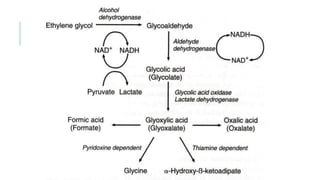
Ethylene glycol is metabolized by alcohol dehydrogenase to
glycoaldehyde, which is then metabolized to glycolic, glyoxylic, and
oxalic acids. These acids, along with excess lactic acid, are
responsible for the anion gap metabolic acidosis. Oxalate readily
precipitates with calcium to form insoluble calcium oxalate crystals.
Tissue injury is caused by widespread deposition of oxalate crystals
and the toxic effects of glycolic and glyoxylic acids.
SIGNS AND SYMPTOMS OF
POISONING
seizures
coma
cerebral edema (in some cases)
tachycardia
tachypnea, and
hypertension or hypotension
flank pain,
costovertebral angle tenderness, and
oliguric renal failure
DIAGNOSIS
Laboratory tests which include
complete blood count
serum electrolytes
alcohol toxicology panel with ethanol,
blood urea nitrogen
urinalysis
serum ethylene glycol level
calcium and magnesium levels
ANTIDOTE:ETHANOL AND
FOMEPIZOLE
Fomepizole
It is thought to act as an inhibitor of alcohol dehydrogenase and
therefore prevent the formation of acidic ethylene glycol metabolites.
It is adminstered in divided doses
-Loading dose, 15 mg / kg
-Maintance dose 10 mg / kg q4h
Administer fomepizole or ethanol to saturate the enzyme alcohol
dehydrogenase and prevent metabolism of ethylene glycol to its toxic
metabolites
Ethanol (ethyl alcohol) acts as a competitive substrate for the enzyme alcohol dehydrogenase, preventing the metabolic
formation of toxic metabolites from methanol or ethylene glycol
BARBITURATES:MECHANISM
OF ACTION
All barbiturates cause generalized depression of neuronal activity in
the brain. Interaction with a barbiturate receptor leads to enhanced
gammaaminobutyric acid (GABA)-mediated chloride currents and
results in synaptic inhibition. Hypotension that occurs with large
doses is caused by depression of central sympathetic tone as well as
by direct depression of cardiac contractility.
BARBITURATES:
Non-selective CNS depressants.
Derivatives of barbituric acid (2,4,6- trioxo
hexa hydro pyrimidine).
Popular sedative & hypnotics up to 1960’s.
Can produce effects ranging from sedation &
reduction of anxiety to unconsciousness &
death from respiratory & cardio vascular
failure.
USES:
Sedative & hypnotic.
Pre operative sedation.
Treatment of seizure disorders.
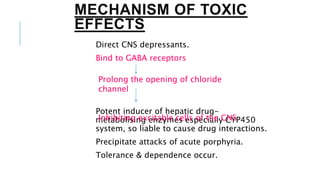
MECHANISM OF TOXIC
EFFECTS
Direct CNS depressants.
Bind to GABA receptors
Potent inducer of hepatic drug-
metabolising enzymes especially CYP450
system, so liable to cause drug interactions.
Precipitate attacks of acute porphyria.
Tolerance & dependence occur.
Prolong the opening of chloride
channel
Inhibiting excitable cells of the CNS
ACUTE BARBITURATE
POISONING
Leading cause of poisoning due to
their ready availability.
Most of the cases are suicidal but
some are due to error or ungraded
exploration in children.
Short acting barbiturates are more
dangerous than long acting.
Shock & anorexia occur quickly.
Coma is more severe with short acting
barbiturates.
SYMPTOMS:
Stupor or coma, areflexia.
Peripheral circulatory collapse.
Weak & rapid pulse.
Cold clammy skin.
Slow or rapid & shallow breathing.
Pupils constricted & reacting to light
initially but subsequently develops
paralytic dilatation.
Atelectasis.
Pulmonary edema.
Bronchopneumonia
Acute renal shut down.
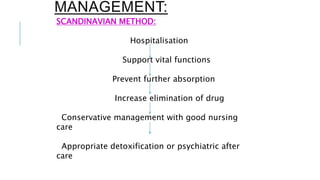
MANAGEMENT:
SCANDINAVIAN METHOD:
Hospitalisation
Support vital functions
Prevent further absorption
Increase elimination of drug
Conservative management with good nursing
care
Appropriate detoxification or psychiatric after
care
HOSPITALIZATION:
Admitted to the hospital.
SUPPORT VITAL FUNCTIONS:
Consciousness.
Airway , breathing , circulation.
Blood pressure.
PREVENT FURTHER ABSORPTION:
Emesis.
Gastric lavage.
Activated charcoal & catharsis.
INCREASE ELIMINATION OF DRUG:
Forced diuresis.
Alkalinization of urine.
Prophylactic antibiotic.
Peritoneal dialysis.
Hemodialysis.
Hemoperfusion.
OTHER MEASURES:
Psychiatric after care.
DIAGONOSIS
include electrolytes
Glucose
BUN
creatinine,
arterial blood gases
or pulse oximetry, and chest x-ray.
ANTIDOTE
There is no specific antidote.
SUPPORTIVE THERAPY
Administer activated charcoal, if available
Administer activated charcoal. Consider gastric lavage for massive ingestion
Enhanced elimination
1. Alkalinization of the urine (see p 55) increases the urinary elimination of
Phenobarbital but not other barbiturates. Its value in acute overdose is
unproved, and it may potentially contribute to fluid overload and pulmonary
edema.
2. Repeat-dose activated charcoal has been shown to decrease the half-life
of Phenobarbital, but it has not been shown to actually shorten the duration
of coma.
3. Hemoperfusion or hemodialysis may be necessary for severely intoxicated
patients not responding to supportive care (i.e., with intractable
hypotension).
Methyl Alcohol (Methanol) Poisoning
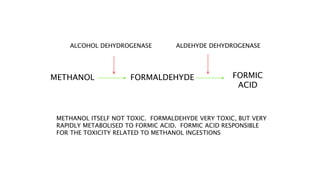
MECHANISM OF ACTION
METHANOL FORMALDEHYDE FORMIC
ACID
ALDEHYDE DEHYDROGENASEALCOHOL DEHYDROGENASE
METHANOL ITSELF NOT TOXIC. FORMALDEHYDE VERY TOXIC, BUT VERY
RAPIDLY METABOLISED TO FORMIC ACID. FORMIC ACID RESPONSIBLE
FOR THE TOXICITY RELATED TO METHANOL INGESTIONS
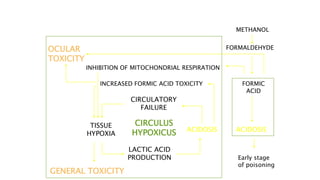
MECHANISM OF ACTION
METHANOL
FORMALDEHYDE
FORMIC
ACID
ACIDOSIS
Early stage
of poisoning
ACIDOSIS
TISSUE
HYPOXIA
LACTIC ACID
PRODUCTION
CIRCULATORY
FAILURE
GENERAL TOXICITY
INCREASED FORMIC ACID TOXICITY
OCULAR
TOXICITY
INHIBITION OF MITOCHONDRIAL RESPIRATION
CIRCULUS
HYPOXICUS
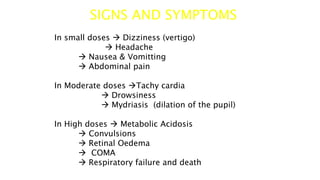
SIGNS AND SYMPTOMS
In small doses  Dizziness (vertigo)
 Headache
 Nausea & Vomitting
 Abdominal pain
In Moderate doses Tachy cardia
 Drowsiness
 Mydriasis (dilation of the pupil)
In High doses  Metabolic Acidosis
 Convulsions
 Retinal Oedema
 COMA
 Respiratory failure and death
SIGNS AND SYMPTOMS
CNS – CONVULSIONS, PROGRESSING TO COMA
RETINAL - BLURRED VISION, PHOTOPHOBIA, VISUAL
ACUITY LOSS, DILATED NON-REACTIVE PUPILS,
OPTIC NERVE BECOMES OEDEMATOUS
GIT - NAUSEA, VOMITING
CARDIAC - TACHYCARDIA, HYPERTENSION PROGRESSING
TO HYPOTENSION AND CARDIOGENIC SHOCK
RESPIRATORY - TACHYPNOEA
INVESTIGATION
BLOOD METHANOL LEVEL (by titration method)
ABG
Fundoscopy ( to examine retinal
TREATMENT
(i) ABC
(ii) CORRECTION OF METABOLIC ACIDOSIS
BICARBONATE (AGGRESSIVE TREATMENT)
(iii) Ethanol ( competitive binding to ADH)
(iv) Haemodialysis
(v) Folinic acid (elemination of formic acid)
(vi) Fomepizole
BENZODIAZEPINE POISONING
MODE OF
ACTION:
Benzodiazepines
Stimulating GABA b receptors
Opening up the chloride ion
channel in the receptor complex
↑se conductance of chloride ion
across the nerve cell membrane
Lowers the potential difference
btwn the interior & exterior of the
cell
Blocking the ability of the cell to
conduct nerve impulses
BENZODIAZEPINES
Anxiolytic & hypnotic agents.
Wide therapeutic index.
Safest of all sedative drugs.
USES:
Management of
Anxiety disorders
Seizure disorders
Insomnia
Movement disorders (adjunctive therapy)
Mania (adjunctive therapy)
MECHANISM OF
TOXICITY:Toxic symptoms-sedative action on the CNS.
Large doses-neuromuscular blockade .
Intravenous injection-peripheral vasodilation -fall
in BP, shock.
↓se alveolar ventilation (↓se PO2 , ↑se PCO2 ).
Induce CO2 narcosis in persons with COPD.
Respiratory depressant effect with sedative drugs-
concomitantly taken.
Death occurred in persons who concurrently
injected ethanol / CNS depressant.
IV dosing-hypotension & respiratory depression-
death.
ACUTE POISONING:
SIGNS AND SYMPTOMS:
MILD: Drowsiness , Ataxia , Weakness
MODERATE TO SEVERE :Vertigo , slurred
speech, nystagmus, partial ptosis, lethargy ,
hypotension, respiratory depression, coma
(stage 1 & 2 ).
COMA 1 (Stage 1): Responsive to painful
stimuli but not to verbal or tactile stimuli, no
disturbance in respiration or BP.
COMA 2 (Stage 2):Unconscious, not
responsive to painful stimuli, no disturbance
in respiration or BP.
MANAGEMENT:
LIFE SUPPORTIVE PROCEDURES & SYMPTOMATIC /
SPECIFIC TREATMENT:
Airway , breathing & circulation.
Intravenous fluid administration.
Endotracheal intubation.
Assisted ventilation.
Supplemental oxygen.
DECONTAMINATION:
Stomach wash within 6-12 hrs.
Activated charcoal.
Emesis is contraindicated.
IV FLUIDS:
CORRECTION OF HYPOTENSION WITH DOPAMINE
OR LEVARTERENOL:
ANTIDOTE TREATMENT: FLUMAZENIL
Flumazenil –reversing the coma induced by
benzodiazepines.
Mode of action – competitive antagonism.
Complete reversal of benzodiazepine effect with a
total slow iv dose of 1mg.
Administered in a series of smaller doses beginning
with 0.2 mg & progressively increasing by 0.1- 0.2
mg every minute until a cumulative total dose of
3.5 mg is reached.
Resedation occurs within ½ hr – 2 hrs.
Activation of opioid receptors results in inhibition of synaptic neurotransmission in
the central nervous system (CNS) and peripheral nervous system (PNS). Opioids
bind to and enhance neurotransmission at three major classes of opioid receptors.
It is also recognized that several poorly defined classes of opioid receptors exist
with relatively minor effects.
The physiological effects of opioids are mediated principally through mu and
kappa receptors in the CNS and periphery. Mu receptor effects include analgesia,
euphoria, respiratory depression, and miosis. Kappa receptor effects include
analgesia, miosis, respiratory depression, and sedation.
Two other opiate receptors that mediate the effects of certain opiates include
sigma and delta sites. Sigma receptors mediate dysphoria, hallucinations, and
psychosis; delta receptor agonism results in euphoria, analgesia, and seizures. The
opiate antagonists (eg, naloxone, nalmefene, naltrexone) antagonize the effects at
Mechanism of action:
Opioid poisoning
Signs and symptoms
• Opioids because of their effect on the part of the brain
that regulates breathing can when one overdoses on them
lead to the person not breathing anymore (respiratory
depression) and therefore death.
• Opiate overdose symptoms and signs can be referred to
as the "Opioid Overdose Triad": decreased level of
consciousness, pinpoint pupils and respiratory depression.
• Other symptoms include seizures and muscle spasms.
• Sometimes a person experiencing an opiate overdose can
lead to such a decreased level of consciousness that he or
she won't even wake up to their name being called or
being shaken by another person.
Treatment
• Death can be prevented in opioid overdoses if patients receive basic life support
and the administration of Naloxone soon after opioid overdose is suspected.
• Naloxone is effective at reversing the cause, rather than just the symptoms, of
an opioid overdose.
• A longer-acting variant is naltrexone. Naltrexone is primarily meant to treat
opioid and alcohol dependence.
• Programs to provide drug users and their caregivers with naloxone are
recommended.
• Airway control and adequate oxygenation remain the primary intervention if not
already established by EMS. Endotracheal intubation is indicated in patients who
cannot protect their airway.
REFERENCES:
TEXT BOOK OF FORENSIC MEDICINE AND TOXICOLOGY BY V.V PILLAY , 14TH
EDITION, PAGE NO:470-471.
PRINCIPLES OF CLINICAL TOXICOLOGY BY THOMAS . A . GOSSEL , 2ND EDITION,
PAGE NO:285-288.
PHARMACOLOGY BY H.P. RANG AND M.M. DALE , 5TH EDITION,PAGE NO:522.
ESSENTIALS OF MEDICAL PHARMACOLOGY BY K.D. TRIPATHI, 6TH EDITION, PAGE
NO:389.
WWW. GOOGLE.COM.

Cli path phy(coma-in-exogenous-intoxication)

  • 1.
    COMA IN EXOGENOUS INTOXICATION Madeby:-Rathod Vijay kumar Group no:26 4th year 1st semester
  • 2.
    a prolonged stateof deep unconsciousness, caused especially by severe injury or illness. What is coma???
  • 3.
     Ethylene glycol Barbiturates  Methy alcohol  Benzdiazepine  opioids Main subtances causing COMA
  • 4.
    ETHYLENE GLYCOL:MECHANISM OF POISONING. Ethyleneglycol is metabolized by alcohol dehydrogenase to glycoaldehyde, which is then metabolized to glycolic, glyoxylic, and oxalic acids. These acids, along with excess lactic acid, are responsible for the anion gap metabolic acidosis. Oxalate readily precipitates with calcium to form insoluble calcium oxalate crystals. Tissue injury is caused by widespread deposition of oxalate crystals and the toxic effects of glycolic and glyoxylic acids.
  • 6.
    SIGNS AND SYMPTOMSOF POISONING seizures coma cerebral edema (in some cases) tachycardia tachypnea, and hypertension or hypotension flank pain, costovertebral angle tenderness, and oliguric renal failure
  • 7.
    DIAGNOSIS Laboratory tests whichinclude complete blood count serum electrolytes alcohol toxicology panel with ethanol, blood urea nitrogen urinalysis serum ethylene glycol level calcium and magnesium levels
  • 8.
    ANTIDOTE:ETHANOL AND FOMEPIZOLE Fomepizole It isthought to act as an inhibitor of alcohol dehydrogenase and therefore prevent the formation of acidic ethylene glycol metabolites. It is adminstered in divided doses -Loading dose, 15 mg / kg -Maintance dose 10 mg / kg q4h
  • 9.
    Administer fomepizole orethanol to saturate the enzyme alcohol dehydrogenase and prevent metabolism of ethylene glycol to its toxic metabolites Ethanol (ethyl alcohol) acts as a competitive substrate for the enzyme alcohol dehydrogenase, preventing the metabolic formation of toxic metabolites from methanol or ethylene glycol
  • 10.
    BARBITURATES:MECHANISM OF ACTION All barbituratescause generalized depression of neuronal activity in the brain. Interaction with a barbiturate receptor leads to enhanced gammaaminobutyric acid (GABA)-mediated chloride currents and results in synaptic inhibition. Hypotension that occurs with large doses is caused by depression of central sympathetic tone as well as by direct depression of cardiac contractility.
  • 11.
    BARBITURATES: Non-selective CNS depressants. Derivativesof barbituric acid (2,4,6- trioxo hexa hydro pyrimidine). Popular sedative & hypnotics up to 1960’s. Can produce effects ranging from sedation & reduction of anxiety to unconsciousness & death from respiratory & cardio vascular failure. USES: Sedative & hypnotic. Pre operative sedation. Treatment of seizure disorders.
  • 12.
    MECHANISM OF TOXIC EFFECTS DirectCNS depressants. Bind to GABA receptors Potent inducer of hepatic drug- metabolising enzymes especially CYP450 system, so liable to cause drug interactions. Precipitate attacks of acute porphyria. Tolerance & dependence occur. Prolong the opening of chloride channel Inhibiting excitable cells of the CNS
  • 13.
    ACUTE BARBITURATE POISONING Leading causeof poisoning due to their ready availability. Most of the cases are suicidal but some are due to error or ungraded exploration in children. Short acting barbiturates are more dangerous than long acting. Shock & anorexia occur quickly. Coma is more severe with short acting barbiturates.
  • 14.
    SYMPTOMS: Stupor or coma,areflexia. Peripheral circulatory collapse. Weak & rapid pulse. Cold clammy skin. Slow or rapid & shallow breathing. Pupils constricted & reacting to light initially but subsequently develops paralytic dilatation. Atelectasis. Pulmonary edema. Bronchopneumonia Acute renal shut down.
  • 15.
    MANAGEMENT: SCANDINAVIAN METHOD: Hospitalisation Support vitalfunctions Prevent further absorption Increase elimination of drug Conservative management with good nursing care Appropriate detoxification or psychiatric after care
  • 16.
    HOSPITALIZATION: Admitted to thehospital. SUPPORT VITAL FUNCTIONS: Consciousness. Airway , breathing , circulation. Blood pressure. PREVENT FURTHER ABSORPTION: Emesis. Gastric lavage. Activated charcoal & catharsis.
  • 17.
    INCREASE ELIMINATION OFDRUG: Forced diuresis. Alkalinization of urine. Prophylactic antibiotic. Peritoneal dialysis. Hemodialysis. Hemoperfusion. OTHER MEASURES: Psychiatric after care.
  • 18.
  • 19.
    ANTIDOTE There is nospecific antidote.
  • 20.
    SUPPORTIVE THERAPY Administer activatedcharcoal, if available Administer activated charcoal. Consider gastric lavage for massive ingestion Enhanced elimination 1. Alkalinization of the urine (see p 55) increases the urinary elimination of Phenobarbital but not other barbiturates. Its value in acute overdose is unproved, and it may potentially contribute to fluid overload and pulmonary edema. 2. Repeat-dose activated charcoal has been shown to decrease the half-life of Phenobarbital, but it has not been shown to actually shorten the duration of coma. 3. Hemoperfusion or hemodialysis may be necessary for severely intoxicated patients not responding to supportive care (i.e., with intractable hypotension).
  • 21.
  • 22.
    MECHANISM OF ACTION METHANOLFORMALDEHYDE FORMIC ACID ALDEHYDE DEHYDROGENASEALCOHOL DEHYDROGENASE METHANOL ITSELF NOT TOXIC. FORMALDEHYDE VERY TOXIC, BUT VERY RAPIDLY METABOLISED TO FORMIC ACID. FORMIC ACID RESPONSIBLE FOR THE TOXICITY RELATED TO METHANOL INGESTIONS
  • 23.
    MECHANISM OF ACTION METHANOL FORMALDEHYDE FORMIC ACID ACIDOSIS Earlystage of poisoning ACIDOSIS TISSUE HYPOXIA LACTIC ACID PRODUCTION CIRCULATORY FAILURE GENERAL TOXICITY INCREASED FORMIC ACID TOXICITY OCULAR TOXICITY INHIBITION OF MITOCHONDRIAL RESPIRATION CIRCULUS HYPOXICUS
  • 24.
    SIGNS AND SYMPTOMS Insmall doses  Dizziness (vertigo)  Headache  Nausea & Vomitting  Abdominal pain In Moderate doses Tachy cardia  Drowsiness  Mydriasis (dilation of the pupil) In High doses  Metabolic Acidosis  Convulsions  Retinal Oedema  COMA  Respiratory failure and death
  • 25.
    SIGNS AND SYMPTOMS CNS– CONVULSIONS, PROGRESSING TO COMA RETINAL - BLURRED VISION, PHOTOPHOBIA, VISUAL ACUITY LOSS, DILATED NON-REACTIVE PUPILS, OPTIC NERVE BECOMES OEDEMATOUS GIT - NAUSEA, VOMITING CARDIAC - TACHYCARDIA, HYPERTENSION PROGRESSING TO HYPOTENSION AND CARDIOGENIC SHOCK RESPIRATORY - TACHYPNOEA
  • 26.
    INVESTIGATION BLOOD METHANOL LEVEL(by titration method) ABG Fundoscopy ( to examine retinal
  • 27.
    TREATMENT (i) ABC (ii) CORRECTIONOF METABOLIC ACIDOSIS BICARBONATE (AGGRESSIVE TREATMENT) (iii) Ethanol ( competitive binding to ADH) (iv) Haemodialysis (v) Folinic acid (elemination of formic acid) (vi) Fomepizole
  • 28.
  • 29.
    MODE OF ACTION: Benzodiazepines Stimulating GABAb receptors Opening up the chloride ion channel in the receptor complex ↑se conductance of chloride ion across the nerve cell membrane Lowers the potential difference btwn the interior & exterior of the cell Blocking the ability of the cell to conduct nerve impulses
  • 30.
    BENZODIAZEPINES Anxiolytic & hypnoticagents. Wide therapeutic index. Safest of all sedative drugs. USES: Management of Anxiety disorders Seizure disorders Insomnia Movement disorders (adjunctive therapy) Mania (adjunctive therapy)
  • 31.
    MECHANISM OF TOXICITY:Toxic symptoms-sedativeaction on the CNS. Large doses-neuromuscular blockade . Intravenous injection-peripheral vasodilation -fall in BP, shock. ↓se alveolar ventilation (↓se PO2 , ↑se PCO2 ). Induce CO2 narcosis in persons with COPD. Respiratory depressant effect with sedative drugs- concomitantly taken. Death occurred in persons who concurrently injected ethanol / CNS depressant. IV dosing-hypotension & respiratory depression- death.
  • 32.
    ACUTE POISONING: SIGNS ANDSYMPTOMS: MILD: Drowsiness , Ataxia , Weakness MODERATE TO SEVERE :Vertigo , slurred speech, nystagmus, partial ptosis, lethargy , hypotension, respiratory depression, coma (stage 1 & 2 ). COMA 1 (Stage 1): Responsive to painful stimuli but not to verbal or tactile stimuli, no disturbance in respiration or BP. COMA 2 (Stage 2):Unconscious, not responsive to painful stimuli, no disturbance in respiration or BP.
  • 33.
    MANAGEMENT: LIFE SUPPORTIVE PROCEDURES& SYMPTOMATIC / SPECIFIC TREATMENT: Airway , breathing & circulation. Intravenous fluid administration. Endotracheal intubation. Assisted ventilation. Supplemental oxygen. DECONTAMINATION: Stomach wash within 6-12 hrs. Activated charcoal. Emesis is contraindicated.
  • 34.
    IV FLUIDS: CORRECTION OFHYPOTENSION WITH DOPAMINE OR LEVARTERENOL: ANTIDOTE TREATMENT: FLUMAZENIL Flumazenil –reversing the coma induced by benzodiazepines. Mode of action – competitive antagonism. Complete reversal of benzodiazepine effect with a total slow iv dose of 1mg. Administered in a series of smaller doses beginning with 0.2 mg & progressively increasing by 0.1- 0.2 mg every minute until a cumulative total dose of 3.5 mg is reached. Resedation occurs within ½ hr – 2 hrs.
  • 35.
    Activation of opioidreceptors results in inhibition of synaptic neurotransmission in the central nervous system (CNS) and peripheral nervous system (PNS). Opioids bind to and enhance neurotransmission at three major classes of opioid receptors. It is also recognized that several poorly defined classes of opioid receptors exist with relatively minor effects. The physiological effects of opioids are mediated principally through mu and kappa receptors in the CNS and periphery. Mu receptor effects include analgesia, euphoria, respiratory depression, and miosis. Kappa receptor effects include analgesia, miosis, respiratory depression, and sedation. Two other opiate receptors that mediate the effects of certain opiates include sigma and delta sites. Sigma receptors mediate dysphoria, hallucinations, and psychosis; delta receptor agonism results in euphoria, analgesia, and seizures. The opiate antagonists (eg, naloxone, nalmefene, naltrexone) antagonize the effects at Mechanism of action: Opioid poisoning
  • 36.
    Signs and symptoms •Opioids because of their effect on the part of the brain that regulates breathing can when one overdoses on them lead to the person not breathing anymore (respiratory depression) and therefore death. • Opiate overdose symptoms and signs can be referred to as the "Opioid Overdose Triad": decreased level of consciousness, pinpoint pupils and respiratory depression. • Other symptoms include seizures and muscle spasms. • Sometimes a person experiencing an opiate overdose can lead to such a decreased level of consciousness that he or she won't even wake up to their name being called or being shaken by another person.
  • 37.
    Treatment • Death canbe prevented in opioid overdoses if patients receive basic life support and the administration of Naloxone soon after opioid overdose is suspected. • Naloxone is effective at reversing the cause, rather than just the symptoms, of an opioid overdose. • A longer-acting variant is naltrexone. Naltrexone is primarily meant to treat opioid and alcohol dependence. • Programs to provide drug users and their caregivers with naloxone are recommended. • Airway control and adequate oxygenation remain the primary intervention if not already established by EMS. Endotracheal intubation is indicated in patients who cannot protect their airway.
  • 38.
    REFERENCES: TEXT BOOK OFFORENSIC MEDICINE AND TOXICOLOGY BY V.V PILLAY , 14TH EDITION, PAGE NO:470-471. PRINCIPLES OF CLINICAL TOXICOLOGY BY THOMAS . A . GOSSEL , 2ND EDITION, PAGE NO:285-288. PHARMACOLOGY BY H.P. RANG AND M.M. DALE , 5TH EDITION,PAGE NO:522. ESSENTIALS OF MEDICAL PHARMACOLOGY BY K.D. TRIPATHI, 6TH EDITION, PAGE NO:389. WWW. GOOGLE.COM.